
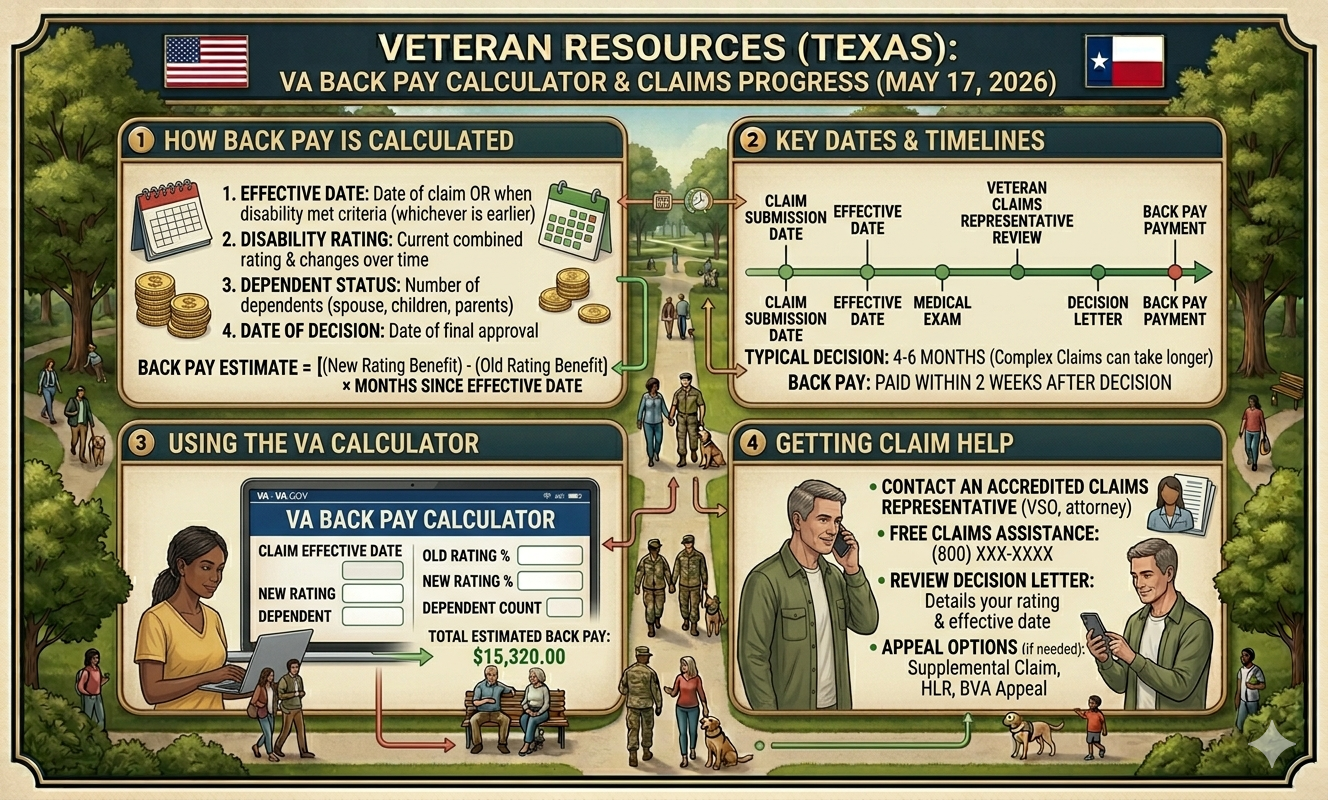
Understanding VA Back Pay
VA back pay refers to the compensation that a veteran is entitled to receive from the Department of Veterans Affairs (VA) retroactively for service-connected disabilities. The primary purpose of VA back pay is to provide financial rectification for the period between the date a claim is filed and the effective date of the rating decision. This compensation is significant as it ensures that veterans receive the financial support they are due for their sacrifices and service to the nation.
The calculation of VA back pay hinges on several factors, including the effective date of a veteran’s claim, their disability rating, and the length of time that has elapsed since the claim was filed. The effective date is crucial as it usually corresponds to the date the VA receives the claim or, in some cases, the date the veteran became eligible for benefits. Understanding how this effective date influences the back pay amount is essential for veterans and their families, as it dictates the total compensation owed.

Furthermore, veterans should be aware that the calculation of VA back pay is not a straightforward process. Various complexities can arise, including the potential for appeals, adjustments in disability ratings, or changes in eligibility status. These scenarios can affect the total amount of back pay a veteran may receive over time. Additionally, some veterans might qualify for special circumstances, such as Total Disability Individual Unemployability (TDIU), which can further complicate their claims.

In essence, comprehending the intricacies surrounding VA back pay is vital for veterans as it empowers them to effectively advocate for their rights and ensure that they receive the benefits they rightly deserve. By being knowledgeable about their claims and the back pay calculation process, veterans can make informed decisions and pursue appropriate avenues to secure their entitlements.
VA Back Pay Calculator: How Much Does the VA Owe You Right Now? (2026 Update)
The direct answer: Your VA back pay is the lump sum the VA owes you for the months between your effective date (usually the day you filed or submitted an Intent to File) and the date they finally approve your claim . With the 2.8% COLA increase effective December 1, 2025, 2026 rates are higher than previous years .
Real example: If you filed a claim in January 2025 and got approved in May 2026 for a 70% rating with a spouse and one child, you could be looking at roughly $20,000+ in back pay—not a bonus, but money the VA legally owes you for every day you waited .
Stop guessing. Here is exactly how to calculate what the VA owes you right now.
What Veterans Need to Know Right Now
Veterans May Qualify for Extra Benefits
Check available financial assistance, healthcare programs and other opportunities that may apply to you.
Check EligibilityDo not accept the first number the VA gives you without checking it. The VA miscalculates effective dates constantly—a mistake that costs veterans thousands .
The 2026 update: All compensation rates increased by 2.8% starting December 1, 2025 . If your back pay period crosses that date, the VA must use different rates for different months. Older calculators that don’t account for this will give you the wrong number.
Your mission right now: Find your Intent to File date (VA Form 21-0966). That single date is worth more than any other piece of paper in your claim folder .
The VA Back Pay Formula in Plain English
The VA uses a simple formula with a complicated execution:
(Monthly Rate for Your Rating + Dependents) x (Number of Months Between Effective Date and Approval Date) = Back Pay
But here is where veterans get confused: monthly rates change every December 1 due to COLA (Cost-of-Living Adjustments). The VA must apply the rate that was active during each specific month .
Example: A claim with an effective date of March 2024 and approval in May 2026 crosses two COLA changes (Dec 2024 and Dec 2025). The VA calculates three separate periods with three different monthly rates.
The “Effective Date”: Where Your Back Pay Starts (Or Dies)
Rule: Your effective date is generally the later of two dates—the date the VA received your claim, or the date your disability entitlement began .
But here are the big exceptions that push your date BACKWARD (meaning more money):
Exception #1: Filing Within 1 Year of Discharge
If you file within one year of leaving active duty, your effective date can be as early as the day after your separation—not the date you filed . This is free money for recent vets.
Example: Discharged June 1, 2024. File claim May 15, 2025 (within one year). Your effective date is June 2, 2024—almost a full year earlier than your filing date.
Exception #2: Intent to File (VA Form 21-0966)
Submit an Intent to File, and you get a one-year placeholder . You can spend 12 months gathering evidence while your effective date clock is already running.
Example: Intent to File submitted January 15, 2025. You file the actual claim December 10, 2025. Your effective date is still January 15, 2025—11 months of back pay you didn’t lose while preparing your case.
Exception #3: Presumptive Conditions
Certain conditions (Agent Orange, burn pits, Gulf War Syndrome) have special effective date rules that can go back to when the law changed, not when you filed .
2026 VA Disability Rates (The Numbers You Need)
Effective December 1, 2025 (2.8% COLA increase) :
| Rating | Single Veteran (No Dependents) | Veteran + Spouse (No Kids) |
|---|---|---|
| 10% | $180.42 | $180.42 |
| 20% | $356.66 | $356.66 |
| 30% | $552.47 | $617.47 |
| 40% | $795.84 | $860.84 |
| 50% | $1,132.90 | $1,197.90 |
| 60% | $1,435.02 | $1,500.02 |
| 70% | $1,808.45 | $1,909.45 |
| 80% | $2,102.15 | $2,203.15 |
| 90% | $2,362.30 | $2,463.30 |
| 100% | $3,938.58 | $4,079.58 |
Dependent additions (for ratings 30%+):
- Each child under 18: Add $76.00
- Each child over 18 in school: Add $247.00
- Spouse receiving Aid and Attendance: Add $141.00
Note: These rates only apply to December 2025 forward. For older months, you need historical rate tables .
How to Calculate Your Back Pay (Step-by-Step)
Step 1: Find your effective date.
Look at your VA decision letter (the “Rating Decision”). Find the line that says “Effective date of entitlement.” That is your starting line .
Step 2: Find your approval date.
This is the date on your decision letter, usually within a few weeks of when the VA approved your claim.
Step 3: Count the months between them.
Count every full month and partial month (the VA pays partial months in full).
Step 4: Determine your monthly rate for each calendar year.
If your back pay spans multiple years, you need the correct rate for each year. The VA updates rates every December 1.
Step 5: Do the math.
Monthly rate × number of months = total back pay (before any offsets).
Step 6: Subtract any payments already received (for increases only).
If the VA already paid you at a lower rate, subtract what you already got. You only get the difference .
Real-Life Back Pay Examples
Example 1: First-time claim (no prior payments)
- Effective date: March 1, 2025
- Approval date: May 17, 2026
- Rating: 70% with spouse (1 child)
- Monthly rate (2025): $1,909.45
- Monthly rate (2026): $1,909.45 (same rate for now—2026 rates just updated)
Months: March 2025 through April 2026 = 14 months
14 × $1,909.45 = $26,732.30 back pay
Example 2: Rating increase (from 30% to 70%)
- Effective date of increase: June 1, 2024
- Approval date: May 17, 2026
- Old rate (30% with spouse): $617.47
- New rate (70% with spouse): $1,909.45
- Difference owed per month: $1,291.98
Months: June 2024 through April 2026 = 23 months
23 × $1,291.98 = $29,715.54 back pay
Example 3: COLA adjustment across years (2024-2026)
- Effective date: September 1, 2023
- Rating: 100% single veteran
Calculation breakdown:
- Sep 2023 – Nov 2023: $3,737.85 × 3 months = $11,213.55
- Dec 2023 – Nov 2024: $3,737.85 × 12 months = $44,854.20 (rate updated Dec 2023)
- Dec 2024 – Nov 2025: $3,831.30 × 12 months = $45,975.60 (rate updated Dec 2024)
- Dec 2025 – Apr 2026: $3,938.58 × 5 months = $19,692.90 (rate updated Dec 2025)
Total back pay: $121,736.25
Where to Find a Free VA Back Pay Calculator
Option 1: VA Disability Calc & Track App (iOS)
This app launched a dedicated Back Pay Estimator in February 2026. Enter your Intent to File date, decision date, rating, and dependents—it handles the COLA math across multiple years .
Option 2: VetsForever Online Calculator
Free web-based calculator that uses official VA rate tables from 2000 through 2026. It breaks down your back pay by rate period so you can see exactly how the VA calculated each segment .
Option 3: Berry Law Back Pay Calculator
Simple online tool focused on effective date and dependent calculations .
Warning: These are estimates, not guarantees. The VA may have different effective date interpretations or staged ratings that affect your final amount .
When Will You Actually Get Paid?
Timeline: Most veterans receive back pay within 15 to 60 days of the VA’s decision .
How it arrives: Direct deposit to the bank account the VA has on file. Back pay is usually a separate deposit from your regular monthly payment .
If it is a large amount (over $25,000): The VA may issue the payment in installments or require additional approval, which can add weeks .
What if you do not see it after 60 days? Call the VA at 800-827-1000. Have your decision letter ready. Ask specifically: “Has my retroactive payment been released, and what is the Treasury payment date?”
Common Mistakes That Cost Veterans Thousands
Mistake #1: Not filing an Intent to File first.
Every month you spend gathering evidence without an ITF is a month of lost back pay. File VA Form 21-0966 today if you haven’t already .
Mistake #2: Accepting the VA’s effective date without question.
The VA often defaults to the date of the decision rather than the date you applied. This is a common error. If you see a date mismatch, appeal it .
Mistake #3: Forgetting to add dependents.
Dependents only affect payments at 30% or higher. But if you qualified for that rate and never added your spouse or kids, you are leaving money on the table—and back pay for dependents can be backdated to the qualifying event (marriage, birth) if reported within one year .
Mistake #4: Not checking for staged ratings.
If your rating changed during the claim process (e.g., 30% for 6 months, then 70% after that), the VA must pay different rates for different periods. Many veterans miss this and accept the lower number .
Mistake #5: Cashing the check without verifying the math.
The VA makes mistakes. A lot of them. Compare their calculation against your own or a calculator. If it is off, file a notice of disagreement immediately .
What This Means Financially for Your Family
A $20,000+ lump sum changes things. Here is what real veterans are doing with back pay right now:
- Clearing high-interest debt (credit cards, personal loans) before the interest eats them alive
- Catching up on mortgages after months of reduced income while waiting on the VA
- Paying for medical procedures the VA would not cover
- Starting a 529 college fund for kids using tax-free disability money
- Buying a reliable vehicle to get to VA appointments
Warning: Back pay is tax-free (same as your regular disability compensation) . Do not let anyone tell you otherwise. And do not let financial advisors talk you into risky investments with it just because it showed up as a lump sum.
The smart move: Put it in a high-yield savings account for 30 days. Let the excitement settle. Then make a plan.
The Political Context: Why Back Pay Exists
Back pay exists because the VA is slow. Really slow.
The average disability claim takes 150+ days to process as of 2026 . Appeals can take years. Congress created the back pay system so veterans are not penalized for government delays .
The 2026 twist: The VA’s new digital system was supposed to speed things up. It has not. Claim backlogs remain high. But the Intent to File system is working—veterans who use it are protecting their effective dates even when the VA takes 18 months to answer .
Proposed changes: Lawmakers have floated making the Intent to File valid for two years instead of one. Nothing has passed yet, but watch for it in late 2026 .
FAQ: Veterans’ Most Searched Questions
Q: How far back can VA back pay go?
A: There is no strict “maximum,” but your effective date determines it. If you filed a claim in 2015 and have been appealing continuously since then, back pay could go back to 2015 . If you just filed, it goes back to your filing date.
Q: Does the VA pay interest on back pay?
A: No. The VA does not pay interest on retroactive benefits. This is why filing quickly matters—every month you wait is a month of zero interest on money the VA owes you .
Q: What if I was underrated (e.g., got 30% but deserve 70%)?
A: If you appeal and win a higher rating, you are entitled to the difference in pay back to your effective date. This is the most common reason veterans receive five- and six-figure back pay checks .
Q: Can the VA take my back pay for debts?
A: Yes. If you owe money to the VA (overpayments) or other federal agencies (student loans, back taxes), they can withhold part or all of your back pay .
Q: Do I get back pay for dependent additions?
A: Yes, if you report the dependent within one year of the qualifying event (marriage, birth, adoption). The additional amount can be backdated to the event date .
Q: What is a “staged rating” and how does it affect back pay?
A: A staged rating is when your disability rating changes during the claim or appeal process. The VA must pay you the correct rate for each specific time period—not just the final rate. For example, if you had 30% for 6 months and 70% for 12 months, you get both rates applied to their respective periods .
Q: Can a lawyer help me get more back pay?
A: Yes, especially if the VA made an effective date error or staged rating mistake. Veterans disability lawyers work on contingency—they only get paid if you win, and their fee is capped at 20% of past-due benefits .
Final Takeaway
Back pay is not a gift. It is wages the VA withheld because they took too long.
Do the math yourself. Use a free calculator. Check the VA’s work against the numbers in this article. And if something looks wrong, appeal it—because the VA will not fix it for you.
Your three moves today:
- Find your Intent to File date or claim filing date
- Run your numbers through a 2026 back pay calculator
- If the VA already decided your claim, check their math against your calculation
You earned this money. The waiting is over. Now go get what they owe you.
Effective Dates and Your Claim
The effective date of a claim is a critical factor that can significantly influence the amount of back pay owed to a veteran. This date pertains to when a veteran submits their claim for benefits or the intent to file for these benefits. Understanding the effective date is essential, as it determines the starting point for any financial compensation the veteran might receive.
Generally, the effective date is established as the date the VA receives the claim or the date the veteran demonstrates intent to file. A primary aspect of this is the stipulation that veterans should file a claim as soon as they become aware of their entitlement to benefits. In many cases, timely submission can lead to a greater amount of back pay, covering the period from the effective date until the present.
For example, if a veteran files a claim on March 1, 2025, but the claim is granted based on disabilities that the veteran suffered from beginning on January 1, 2025, the VA back pay will be calculated from the January date, resulting in six months of benefits owed to the veteran. Conversely, if the veteran had waited to file the claim until after the effective date had passed, they might only receive compensation from the date the claim was filed. Thus, understanding the significance of the effective date is paramount.
Moreover, veterans must be aware that there are specific exceptions where the effective date can be assigned earlier than the date of claim submission. These situations arise under certain conditions, such as when evidence is obtained within a year before filing that supports the claim. Such nuances can affect calculations of back pay and should be discussed thoroughly with a VA representative to maximize potential benefits.
2.8% COLA Rate Increase for 2026
The Cost of Living Adjustment (COLA) is an essential mechanism designed to ensure that the benefits received by veterans keep pace with inflation. For the year 2026, the COLA is set to rise by 2.8%, a change that takes effect from December 1, 2025. This increase is critical as it directly affects the monthly payments received by veterans, along with their eligibility for various other VA benefits.
This adjustment is based on various economic indicators, specifically the Consumer Price Index for Urban Wage Earners and Clerical Workers (CPI-W), which reflects the cost of living. A rise in the COLA means that veterans will see an increase in their disability compensation, pensions, and other VA benefits, which is especially vital as inflation can erode purchasing power. By applying the 2.8% increase to existing benefit rates, the VA aims to alleviate some financial pressures faced by veterans in their daily lives.
Understanding the implications of the COLA increase is important for veterans and their families. The adjustment ensures that financial assistance remains relevant to current living costs, thereby helping veterans maintain their standard of living. For many recipients, receiving a COLA increase can significantly impact their ability to cover basic expenses, such as housing, healthcare, and groceries. Furthermore, this increment serves as a recognition of the sacrifices made by veterans and assists in their transition to civilian life.
The significance of the 2.8% COLA adjustment cannot be understated, as it represents an ongoing commitment by the government to support those who have served in the military. Veterans should prepare to integrate this adjustment into their financial planning for the upcoming year, ensuring they are aware of how these changes may enhance their overall benefits.
Calculating Your VA Back Pay
Determining the amount of VA back pay owed requires an understanding of several critical components. The first step involves identifying your disability rating, which is assigned by the U.S. Department of Veterans Affairs based on the severity of your service-related condition. This rating is expressed as a percentage, typically ranging from 0% to 100%. The higher the rating, the greater the monthly compensation. It’s crucial to reference the current VA compensation rates, which are updated annually and can be found on the official VA website.
Once your disability rating is established, the next step is to identify the effective date of your claim. This date marks when your entitlement to benefits began and is typically the earliest date that the VA determined you were disabled. If you filed your claim within one year of your discharge from service, the effective date may be the day after your discharge.
Next, you must calculate the total monthly compensation associated with your rating for each month from the effective date until the current date. This calculation may involve adjustments for any dependents you may have, as having dependents can increase the amount of your monthly benefit. The VA provides additional compensation rates, which vary depending on your family situation.
To illustrate, consider a veteran with a 70% disability rating whose effective date is January 1, 2020. If the current date is January 1, 2026, and assuming the monthly rate for a 70% disability rating is $1,400, the calculation would be as follows: $1,400 multiplied by 72 months results in $100,800. If the veteran has two dependents, the monthly compensation might increase to $1,500, leading to a total of $108,000 over the same period. Therefore, when calculating your VA back pay, it is essential to accurately utilize your rating and any associated factors, ensuring a precise claim for the compensation you are owed.
Real-Life Example of Back Pay Calculation
To illustrate how the back pay calculation works for veterans, let us consider a hypothetical case of a veteran named John Smith. John served in the military for five years and recently filed a claim for disability benefits due to a service-connected condition. Upon review, the Department of Veterans Affairs (VA) assigned him a rating of 50 percent effective from the date of his filing, which was January 15, 2023.
To calculate John’s back pay, we first determine the monthly compensation rate according to the VA’s benefits schedule. For a 50 percent disability rating in January 2023, the VA compensation is approximately $1,200 per month. Since John filed his claim on January 15, the VA considers him due compensation back to this filing date, establishing a starting point for calculating accrued benefits.
Next, we need to assess how many months of benefits he is owed. As of the current date, let’s assume it is September 30, 2026. Thus, the time frame between John’s effective date and the current date spans 33 months. To determine the total back pay, we multiply the monthly compensation rate by the number of months owed: $1,200 per month multiplied by 33 months totals $39,600.
It is also crucial to recognize that any additional compensation, such as for dependents, could further increase this back pay total. If John has one dependent, for instance, the monthly rate might rise to about $1,400. Therefore, the back pay considering the dependent would be $1,400 per month multiplied by 33 months, resulting in a total of $46,200.
This case illustrates how a veteran’s effective date, monthly compensation, and dependency status directly affect the back pay calculation. Understanding these elements can help veterans like John Smith anticipate the benefits they are owed and navigate the claims process more effectively.
Common Mistakes in Back Pay Calculation
Calculating VA back pay can be a complex process, and veterans often encounter several common mistakes that can lead to inaccuracies in their calculations. One frequent pitfall is the misunderstanding of effective dates. Many veterans presume that their back pay starts from the date of their application for benefits, rather than the effective date determined by the VA, which is often based on when the disability was identified or when the veteran’s claim was established. Familiarizing oneself with the effective date of the claim is crucial for accurate back pay calculations.
Another common mistake is the assumption that all benefits are retroactively paid from the effective date without considering transitional benefits or other compensable factors. Veterans should thoroughly review their entitlement letters to ensure they understand the specific types of benefits that may apply and their respective entitlements. This step will help avoid errors that stem from a lack of knowledge or misunderstanding of the benefits structure.
Additionally, veterans may overlook the importance of gathering proper documentation and evidence for their back pay calculations. Incomplete or missing records can lead to a significant underestimation of owed benefits. It is essential to keep meticulous records of medical appointments, diagnosis, and treatments related to the claim, as these will substantiate the claim and potentially increase the amount owed.
To mitigate these pitfalls, veterans are encouraged to consult with a claims agent or legal advisor experienced in VA matters. These professionals can provide valuable guidance and assist in accurately determining back pay amounts. Regularly reviewing one’s claim status and remaining informed about updates in VA regulations is equally important. By avoiding these common mistakes and ensuring thorough attention to detail, veterans can better navigate the back pay calculation process and secure the compensation they rightfully deserve.
Eligible Benefits Beyond Back Pay
When exploring the benefits available to veterans, it is essential to recognize that back pay is just one component of a comprehensive benefits package that the Department of Veterans Affairs (VA) offers. Beyond back pay, veterans may be eligible for several crucial financial and support services aimed at improving their quality of life and easing the transition to civilian life.
One significant benefit is the monthly compensation provided to veterans with service-connected disabilities. This compensation ensures that veterans receive financial support in recognition of the impact that their service-related conditions may have on their daily lives. The amount awarded is determined by the severity of the disability and can vary significantly, providing essential resources for veterans and their families.
Additionally, healthcare services represent a critical benefit available to veterans. The VA health care system offers a broad range of medical services, including preventive care, specialty treatment, and mental health services. Access to quality healthcare is vital for maintaining the wellness of veterans, many of whom may face health challenges related to their service. The VA prioritizes providing comprehensive health plans, ensuring that eligible veterans receive timely and effective care.
Education benefits also play a crucial role in supporting veterans’ post-service ambitions. Programs such as the Post-9/11 GI Bill enable eligible veterans to pursue higher education, vocational training, or even on-the-job training. These educational resources help veterans transition to the civilian workforce by enhancing their skills and knowledge.
Furthermore, veterans may access additional resources, such as housing assistance, vocational rehabilitation, and employment services, aimed at bridging the gap between military and civilian life. Organizations, both governmental and non-profit, offer valuable guidance and financial support, enriching the overall package of benefits available to veterans.
Resources for Veterans
Veterans navigating the complex landscape of VA claims and back pay calculations have access to various resources designed to provide support and assistance. These resources are essential for understanding entitlements and ensuring that veterans receive the benefits they deserve. One prominent organization is the Veterans Benefits Administration (VBA), which operates under the Department of Veterans Affairs. The VBA’s official website features comprehensive information about benefits, including guidance on filing claims and understanding compensation rates. It is a valuable starting point for anyone seeking assistance.
Another beneficial resource is the National Veterans Legal Services Program (NVLSP), which offers free legal aid and representation to veterans and their families. NVLSP provides detailed information about veterans’ rights and holds regular workshops aimed at educating veterans about the claims process. Additionally, local chapters of Veterans Service Organizations (VSOs), such as the American Legion and Disabled American Veterans (DAV), can provide personalized assistance when applying for benefits and navigating back pay calculations.
For immediate help, veterans can call the VA’s National Call Center at 1-800-827-1000, where trained specialists are available to answer questions regarding claims, compensation, and entitlements. Furthermore, the Veterans Crisis Line at 1-800-273-8255 offers support and resources for veterans facing emotional distress, which is often correlated with navigating their entitlement issues.
Additionally, online forums and communities, such as those found on Reddit or Facebook groups dedicated to veterans, can provide peer support and shared experiences that can be helpful for veterans feeling overwhelmed by the process. By utilizing these resources, veterans can feel more empowered and informed in their pursuit of back pay and entitlements.
Conclusion and Next Steps
In summary, understanding the complexities surrounding VA back pay is crucial for veterans and their families. The VA back pay calculator serves as a valuable tool to help individuals estimate the benefits owed to them, based on their specific situations. Throughout this blog post, we have discussed the criteria for determining eligibility for back pay, the factors influencing the amount received, and the significance of accurate record-keeping in the claims process.
It is essential to remember that the calculations derived from the VA back pay calculator are merely estimates. Each veteran’s case can be unique, influenced by numerous variables including service-connected disabilities, the date of application, and the rating assigned by the VA. Therefore, staying informed and proactive in navigating VA benefits is paramount.
If you believe you are entitled to back pay, it is advisable to take the next steps promptly. Gather all necessary documentation, review your claim status, and, if needed, consult with a VA representative or a qualified claims agent. These professionals can provide personalized assistance to ensure that you are receiving the full benefits you are entitled to.
Furthermore, keeping abreast of recent developments related to VA benefits can empower you as a claimant. Changes in legislation or updates from the VA may impact your entitlements. Engaging with veteran advocacy groups or exploring reputable resources online can provide additional insights and support.
Ultimately, taking an active role in your VA benefits journey can lead to a more favorable financial outcome. By utilizing the VA back pay calculator and seeking professional guidance where necessary, you can effectively navigate this complex process and secure the benefits you deserve.




🇺🇸 IMPORTANT DISCLAIMER – Veterans Benefits Information
This site provides general information about U.S. Department of Veterans Affairs (VA) benefits for educational and informational purposes only.
- Not Official: We are NOT affiliated with, endorsed by, or connected to the U.S. Department of Veterans Affairs (VA), the Veterans Benefits Administration (VBA), the Veterans Health Administration (VHA), or any other government agency.
- No Legal/Financial Advice: The content on this website is for informational purposes only and does not constitute legal, financial, or medical advice. VA benefits rules change frequently – always consult with an accredited Veterans Service Officer (VSO) or a qualified professional for your specific situation.
- Official Sources: For official, binding information and to apply for benefits, always visit official .gov websites: VA.gov, Benefits.VA.gov, or SSA.gov.
- No Data Collection: This site does not collect, store, or process any personal information. It does not have login forms, contact forms, or any system to capture user data. We never ask for your Social Security Number, bank details, or any personal information.
- 🚨 Scam Alert: The VA and other government agencies never charge fees for benefit applications. If anyone asks for money to "process" your VA claim, it is a scam. Report it to the VA Office of Inspector General at VA.gov/OIG.
- Advertising: This site uses third-party advertising (Adsterra) to cover operational costs. We do not endorse or guarantee any products or services advertised.
📌 Information provided as of June 2026. Always verify current eligibility and rules with official .gov sources.
This site is not affiliated with the U.S. Department of Veterans Affairs or any government agency. All information is for educational purposes only. Please visit VA.gov for official information.
