
Introduction to VA Disability Pay Rates
The importance of VA disability pay rates cannot be overstated, as these rates directly impact the financial well-being of veterans who have served their country. These payments are designed to provide essential support to veterans who have incurred disabilities as a result of their military service. Understanding these rates is crucial for veterans and their families, particularly in light of the annual adjustments that are made to them.
Your 2026 VA Disability Pay – The Direct Answer
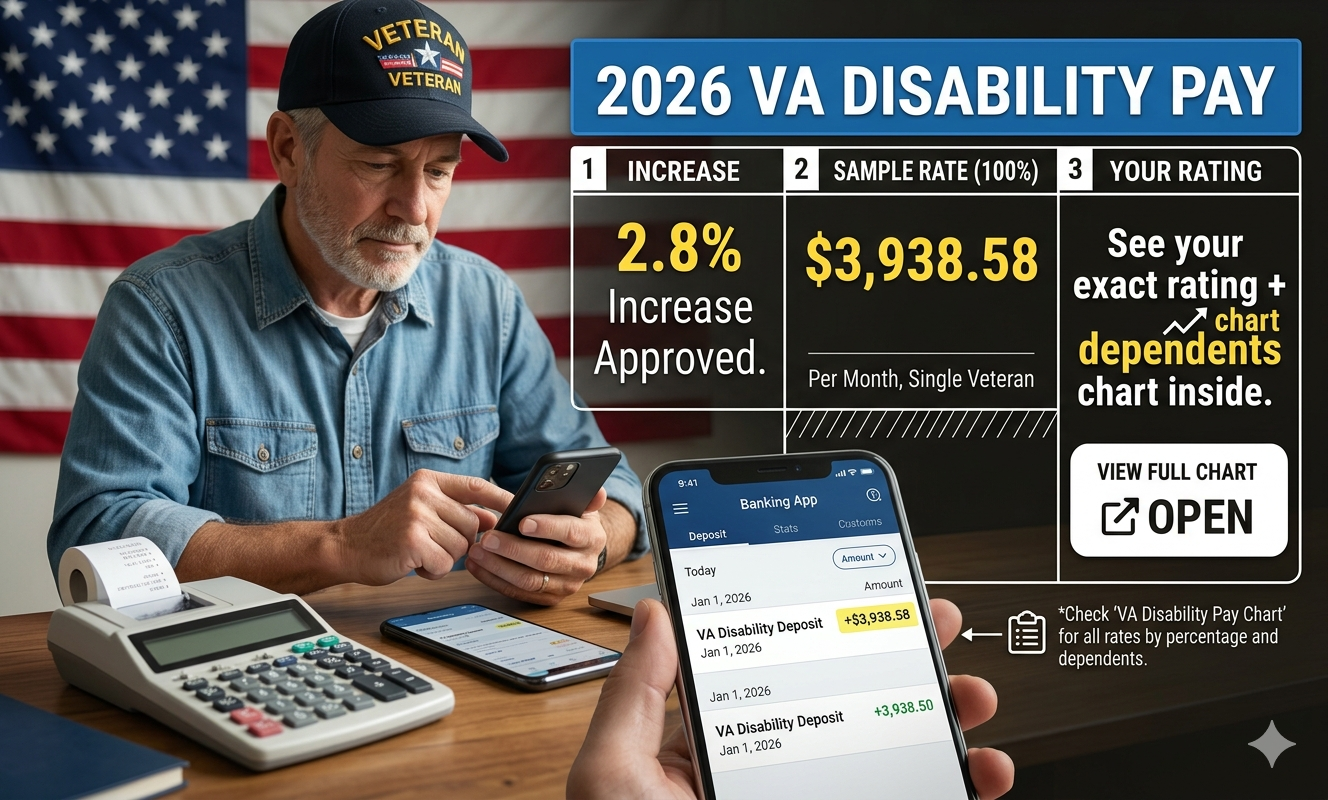
The 2026 VA disability pay rates increased by 2.8% , effective December 1, 2025. If you have a 100% disability rating with no dependents, your new monthly payment is $3,938.58 – up $107.28 from 2025 .

The first check reflecting this increase was paid on December 31, 2025 (for January 2026 benefits) . If you’re already receiving VA disability compensation, the increase was automatic – you don’t need to do anything.

Quick lookup by rating (veteran alone):
| Disability Rating | 2026 Monthly Rate | Increase from 2025 |
|---|---|---|
| 10% | $180.42 | +$4.91 |
| 20% | $356.66 | +$9.71 |
| 30% | $552.47 | +$15.05 |
| 40% | $795.84 | +$21.68 |
| 50% | $1,132.90 | +$30.86 |
| 60% | $1,435.02 | +$39.09 |
| 70% | $1,808.45 | +$49.26 |
| 80% | $2,102.15 | +$57.26 |
| 90% | $2,362.30 | +$64.34 |
| 100% | $3,938.58 | +$107.28 |
What Veterans Need to Know Right Now
Here’s the bottom line: the 2.8% COLA is smaller than the 8.7% jump in 2023, but it’s locked in . This increase applies to all VA disability compensation, including:
- Basic disability pay
- Special Monthly Compensation (SMC)
- Dependency and Indemnity Compensation (DIC)
- Total Disability Individual Unemployability (TDIU)
Important dates you need to know:
- The rate increase is retroactive to December 1, 2025
- Your December 2025 payment (paid Jan 1, 2026) had the new rates
- Future payments follow the 2026 schedule below
Real talk: If your January 2026 deposit looked higher than usual, that’s why. If it didn’t, check your rating and bank account. Some veterans saw the increase split across two deposits depending on their bank’s processing.
Complete 2026 VA Disability Pay Chart
Veterans May Qualify for Extra Benefits
Check available financial assistance, healthcare programs and other opportunities that may apply to you.
Check EligibilityThe tables below show your exact monthly tax-free payment based on your combined disability rating and family situation.
Veterans Without Children (30% – 100%)
| Dependent Status | 30% | 40% | 50% | 60% | 70% | 80% | 90% | 100% |
|---|---|---|---|---|---|---|---|---|
| Veteran Alone | $552.47 | $795.84 | $1,132.90 | $1,435.02 | $1,808.45 | $2,102.15 | $2,362.30 | $3,938.58 |
| Veteran + Spouse | $617.47 | $882.84 | $1,241.90 | $1,566.02 | $1,961.45 | $2,277.15 | $2,559.30 | $4,158.17 |
| Veteran + Spouse + 1 Parent | $669.47 | $952.84 | $1,329.90 | $1,671.02 | $2,084.45 | $2,417.15 | $2,717.30 | $4,334.41 |
| Veteran + Spouse + 2 Parents | $721.47 | $1,022.84 | $1,417.90 | $1,776.02 | $2,207.45 | $2,557.15 | $2,875.30 | $4,510.65 |
| Veteran + 1 Parent | $604.47 | $865.84 | $1,220.90 | $1,540.02 | $1,931.45 | $2,242.15 | $2,520.30 | $4,114.82 |
| Veteran + 2 Parents | $656.47 | $935.84 | $1,308.90 | $1,644.73 | $2,054.45 | $2,382.15 | $2,678.30 | $4,291.06 |
Aid & Attendance for Spouse (add to your rate): 30%: +$61 | 40%: +$81 | 50%: +$101 | 60%: +$121 | 70%: +$141 | 80%: +$161 | 90%: +$181 | 100%: +$201.41
Veterans With Children (30% – 100%)
| Dependent Status | 30% | 40% | 50% | 60% | 70% | 80% | 90% | 100% |
|---|---|---|---|---|---|---|---|---|
| Veteran + Child | $596.47 | $853.84 | $1,205.90 | $1,523.02 | $1,910.45 | $2,219.15 | $2,494.30 | $4,085.43 |
| Veteran + Spouse + Child | $666.47 | $947.84 | $1,322.90 | $1,663.02 | $2,074.45 | $2,406.15 | $2,704.30 | $4,318.99 |
| Vet + Spouse + Child + 1 Parent | $718.47 | $1,017.84 | $1,410.90 | $1,768.02 | $2,197.45 | $2,546.15 | $2,862.30 | $4,495.23 |
| Vet + Spouse + Child + 2 Parents | $770.47 | $1,087.84 | $1,498.90 | $1,873.02 | $2,320.45 | $2,686.15 | $3,020.30 | $4,671.47 |
| Vet + Child + 1 Parent | $648.47 | $923.84 | $1,293.90 | $1,628.02 | $2,033.45 | $2,359.15 | $2,652.30 | $4,261.67 |
| Vet + Child + 2 Parents | $700.47 | $993.84 | $1,381.90 | $1,733.02 | $2,156.45 | $2,499.15 | $2,810.30 | $4,437.91 |
Additional child amounts (add for EACH extra child beyond the first):
| Rating | Each Child Under 18 | Each Schoolchild Over 18 |
|---|---|---|
| 30% | $32.00 | $105.00 |
| 40% | $43.00 | $140.00 |
| 50% | $54.00 | $176.00 |
| 60% | $65.00 | $211.00 |
| 70% | $76.00 | $246.00 |
| 80% | $87.00 | $281.00 |
| 90% | $98.00 | $317.00 |
| 100% | $109.11 | $352.45 |
10% – 20% Rating (No Dependent Pay)
| Rating | Monthly Rate |
|---|---|
| 10% | $180.42 |
| 20% | $356.66 |
Note: Veterans with 10-20% ratings do not receive extra compensation for dependents .
Special Monthly Compensation (SMC) Rates 2026
If you have severe disabilities like loss of use of limbs, blindness, or require regular aid and attendance, you likely qualify for SMC instead of basic rates.
SMC-K (basic addition): $139.87 per month added to your base rate .
Higher SMC rates (veteran alone, no children):
| SMC Level | 2026 Monthly Rate | What It Means |
|---|---|---|
| L | $4,900.83 | Loss of use of one extremity or needing regular aid |
| M | $5,408.55 | Loss of use of two extremities |
| N | $6,152.64 | Loss of use of two extremities with additional conditions |
| O/P | $6,877.12 | Loss of use of three or four extremities |
| R.1 | $9,826.88 | Regular need for hospital care or daily nursing |
| R.2/T | $11,271.67 | Higher level of care needs |
| S (housebound) | $4,408.53 | Unable to leave home due to SC disabilities |
Real-life example: An SMC-R veteran with spouse and two parents gets $10,398.95 per month – that’s tax-free, on top of any other benefits .
2026 VA Disability Payment Schedule
The VA pays in arrears – your January service gets paid in February. Here are the 2026 deposit dates :
| Month of Service | Payment Date |
|---|---|
| January 2026 | January 30, 2026 |
| February 2026 | February 27, 2026 |
| March 2026 | April 1, 2026 |
| April 2026 | May 1, 2026 |
| May 2026 | June 1, 2026 |
| June 2026 | July 1, 2026 |
| July 2026 | July 31, 2026 |
| August 2026 | September 1, 2026 |
| September 2026 | October 1, 2026 |
| October 2026 | October 30, 2026 |
| November 2026 | December 1, 2026 |
| December 2026 | December 31, 2026 |
Pro tip: If your payment date falls on a weekend or federal holiday, the VA pays on the last business day before. Banks process at different speeds – some veterans see deposits up to 5 days early depending on their bank.
Who Qualifies for These Rates
You qualify for VA disability pay if you have a service-connected disability rating from 0% to 100% (combined). The rating comes from a VA claim decision.
Quick eligibility check:
- Served active duty, active duty for training, or National Guard (under specific circumstances)
- Received a discharge other than dishonorable
- Have a current diagnosed disability linked to your service
No rating yet? You can’t get these payments. File a claim today at VA.gov. Average processing time is 120-150 days right now. Back pay starts from the date you file.
Warning: Some “veteran service organizations” charge $5,000+ to file claims you can file yourself for free. Use a VA-accredited representative – they cannot charge for initial claims .
How Your Payment Is Calculated
VA disability ratings are combined, not added using VA math. This confuses almost every veteran.
Example: 50% + 30% does NOT equal 80%. VA math starts at 100% able. A 50% rating leaves you 50% able. Take 30% of that 50% (which is 15%) and add it to the original 50% – you get 65%, rounded to 70% .
Real numbers: A veteran with a 50% rating ($1,132.90) plus a 30% rating separately doesn’t get $1,132.90 + $552.47. They get the 70% rate ($1,808.45) if combined correctly.
Bottom line: Use the VA’s combined ratings table or ask a VSO to calculate before assuming your rate.
Common Mistakes Veterans Make
Mistake #1 – Not adding dependents to your claim
You can add your spouse, children, and dependent parents at any time. Each dependent increases your monthly pay significantly (see tables above). Do it online at VA.gov under “Dependents” – takes 5 minutes.
Mistake #2 – Assuming the VA automatically knows you have kids
They don’t. You must tell them. One veteran missed out on 4 years of dependent pay because he assumed his daughter was in the system. That’s over $8,000 lost.
Mistake #3 – Cashing the check without reviewing
The VA makes errors. Compare your deposit to these tables. If the numbers don’t match, call 1-800-827-1000 immediately.
Mistake #4 – Forgetting to report income changes for pension
If you receive VA pension (needs-based, different from disability compensation), you must report income changes or face overpayment penalties.
Scam alert: No one from the VA will ever call asking for your bank account “to verify the COLA increase.” Hang up. Report to VA police at 1-855-842-4570.
What This Means Financially for Veterans
A 2.8% increase on $3,938.58 adds $1,287.36 per year for a 100% disabled veteran alone .
For a 100% veteran with a spouse and two children: $4,318.99 per month = $51,827.88 per year tax-free .
Compare to average jobs: That’s equivalent to roughly $68,000 in pre-tax civilian wages (depending on your tax bracket).
For lower ratings: A 50% veteran alone gets $1,132.90 monthly = $13,594.80 annually tax-free. That’s not a fortune, but combined with VA health care and other benefits, it keeps many families afloat.
Warning about offsets: If you also receive military retirement pay, you may be subject to CRDP or CRSC rules. Talk to a benefits counselor before assuming both checks arrive untouched.
Political Context Behind the 2026 COLA
The 2.8% COLA is tied to Social Security’s increase, which is calculated from the Consumer Price Index for Urban Wage Earners (CPI-W). Congress didn’t vote on this – it’s automatic by law .
Why 2.8% and not higher? Inflation cooled in 2025 compared to 2022-2024. That’s good for the economy but means a smaller raise for veterans.
What’s coming in 2027: Experts project a 2.2-2.5% COLA for 2027 based on current economic indicators. Nothing is official until October 2026.
Proposed legislation to watch: The “Major Richard Star Act” would allow combat-injured veterans with less than 20 years of service to receive full military retirement AND VA disability. If passed, it could add thousands to affected veterans. No update as of March 2026.
FAQ (What Veterans Actually Ask Google)
Q: Is the 2026 VA disability increase already in my checks?
A: Yes. The increase was effective December 1, 2025, and first appeared in the check you received on or around January 1, 2026 .
Q: Will I get a separate COLA notice in the mail?
A: No. The VA does not mail individual COLA notices. Check your bank statement or VA.gov payment history. The increase is automatic.
Q: Do 10% disabled veterans get dependent pay?
A: No. Only veterans with a 30% or higher rating receive extra compensation for dependents .
Q: What if my January 2026 payment was the same as December 2025?
A: Contact the VA at 1-800-827-1000. This could be a processing error or your bank not updating. Do not ignore it.
Q: How do I add my new spouse or newborn to increase my payment?
A: Go to VA.gov → “Manage Dependents” → “Add Dependent.” You’ll need marriage certificate or birth certificate. The increase is retroactive to the date of marriage or birth if reported within one year.
Q: Can I get VA disability AND Social Security disability?
A: Yes. They are separate programs with different rules. VA disability is tax-free; Social Security is taxable. Neither cancels the other.
Q: What’s the maximum VA disability payment for 2026?
A: For basic disability: $3,938.58 (100% alone). For SMC-R2 with dependents: Over $11,000 per month .
Final Takeaway – One Minute Action Plan
If you’re already rated: Log into VA.gov. Check your payment history. Verify the amounts match the tables above. Update your dependents if anything changed (marriage, birth, child turned 18).
If you’re not rated: File today. Every month you wait is money left on the table. Use a VA-accredited representative – it’s free. Bring your DD214 and medical records.
If your payment is wrong: Call 1-800-827-1000. Have your Social Security number and rating decision letter ready. Ask for a “payment audit.”
For everyone: The 2.8% increase is locked in. Don’t let anyone charge you to “appeal for more COLA” – that’s not how it works. The only way to increase your monthly check is to increase your disability rating or add dependents.
One last thing: If someone calls, emails, or texts promising to “boost your 2026 VA disability rate” for a fee, it’s a scam. The VA does not outsource rate adjustments. Hang up.
Each year, the U.S. Department of Veterans Affairs (VA) reviews and adjusts these rates based on various economic indicators, including the cost of living. The recently announced 2026 VA disability pay chart includes a noteworthy 2.8% cost-of-living adjustment (COLA) which will be effective starting December 1, 2025. This adjustment plays a significant role in ensuring that disability payments keep pace with inflation, enabling veterans to maintain their purchasing power in an ever-changing economy. Veterans and their families rely on these adjustments to help cover essential living expenses, medical care, and other necessary services.
This year’s increase reflects a continued commitment from the government to support those who have bravely served. It is imperative for veterans to stay informed about their benefits, including how these adjustments may impact their monthly payments. As the landscape of VA disability compensation evolves, it is essential for veterans to understand their eligibility, benefits, and the implications of any changes to the pay rates that directly affect them.
In the upcoming sections, we will delve deeper into the specifics of the new pay rates, the categories of disability compensation, and other factors that contribute to overall veteran support.
Understanding Cost-of-Living Adjustments (COLA)
Cost-of-Living Adjustments, commonly referred to as COLA, are changes made to benefit payments that reflect alterations in the cost of living. This adjustment is particularly significant for veterans who rely on disability benefits for their livelihood. The primary purpose of COLA is to ensure that these benefits maintain their purchasing power amid inflation and rising living costs. Without such adjustments, the real value of benefits could diminish over time, adversely affecting the quality of life for veterans and their families.
For veterans receiving VA disability payments, COLA increases are closely monitored, as they directly correlate with the Consumer Price Index (CPI). The CPI tracks the average change in prices paid by consumers for various goods and services. When the CPI rises, indicating an increase in living costs, the VA makes adjustments to disability payments to compensate for this change. Thus, a COLA increase signifies a much-needed enhancement of financial support for those who have served the nation.
The historical context of COLA increases reveals a pattern of adjustments made annually, usually aligned with inflation rates. The recent increase of 2.8% for the year 2026 is particularly noteworthy as it demonstrates a proactive approach by the government to address the escalating cost of living, which has affected many families, including veterans. This specific percentage reflects economic conditions and demonstrates the commitment to ensuring that veterans do not suffer financially due to inflation. Hence, understanding COLA and its implications is crucial for veterans as they navigate their financial planning and well-being.
2026 VA Disability Pay Rate Changes by Disability Rating
The Department of Veterans Affairs (VA) annually adjusts disability compensation rates to reflect changes in the cost of living and inflation rates. For 2026, the VA has instituted a 2.8% increase in the disability pay rates, a change that impacts veterans with various disability ratings ranging from 0% to 100%. Below is a detailed overview of the new rates aligned with the respective disability ratings, juxtaposed against the previous year’s figures.
For a veteran rated at 0%, the monthly compensation has moved from $0 to $0, as there is no payment for those without a disability rating. However, for veterans rated at 10%, the compensation has transitioned from $164.58 to $169.16 monthly. Similarly, those rated at 20% will see an increase from $327.16 to $336.54. It can be observed that as the disability rating scales up, the compensation increases significantly, recognizing the higher needs of veterans with more severe disabilities.
At the mid-range, for veterans rated at 50%, the rate has risen from $1,073.00 to $1,102.68. This increment illustrates the VA’s ongoing effort to support veterans through adequate financial compensation reflective of their service-connected disabilities. Furthermore, for those rated at 70%, the pay has increased from $1,455.00 to $1,493.40.
At the highest rating of 100%, veterans will receive a monthly compensation of $3,665.38, up from $3,561.13. The compensation structure underscores the importance of supporting veterans, ensuring that those who have sacrificed their health and well-being for the country receive adequate support. These adjustments not only reflect a commitment to the veterans’ welfare but also align with the overall economic conditions affecting their quality of life.
Impact on Dependents and Additional Benefits
The recent adjustments in the VA disability pay chart reflect a notable increase of 2.8% effective immediately, which has significant implications for veterans with dependents. With these new rates, veterans can expect an enhancement in their compensation packages, particularly in light of their family commitments and responsibilities. This increase aims to better support veterans raising children or managing households with spouses who may also rely on the veteran’s compensation for financial stability.
For veterans with children, the additional payment amounts can be crucial. The 2026 rates indicate increased compensation for veterans who have dependent children, with financial support scales tailored to the number of children. This adjustment recognizes the rising costs associated with child-rearing, including education, healthcare, and basic living expenses. Consequently, the enhanced compensation may alleviate some of the financial burdens that families face, contributing positively to the overall welfare of dependents.
Furthermore, veterans who are married or in domestic partnerships will also see increased benefits under the new payment structure. The revisions provide an additional compensation layer for spouses, acknowledging their role in supporting the veteran’s recovery and rehabilitation. These increases are particularly beneficial for families coping with the challenges of a veteran’s disability, potentially leading to more comprehensive support networks.
In addition to the direct financial benefits, the new compensation rates may also expand eligibility for certain VA programs aimed at supporting dependents. These programs could include educational benefits for veteran’s children, health care support, or assistance with housing. Thus, the 2026 VA disability pay rates not only boost direct payments but also enhance the viability of resources available to veterans and their families.
Eligibility for VA Disability Compensation
Veterans seeking disability compensation from the Department of Veterans Affairs (VA) must meet specific eligibility criteria. To qualify for benefits, a veteran must be honorably discharged and have a service-related disability. This could include physical injuries, psychological conditions, or chronic ailments that stem from military service. The VA recognizes a wide range of disabilities, including both mental health conditions, such as post-traumatic stress disorder (PTSD), and physical disorders, such as amputations or conditions resulting from exposure to hazardous substances.
The initial step for veterans applying for disability compensation is to establish the connection between their military service and the disabilities claimed. This involves gathering medical evidence that demonstrates the extent and nature of the disability. Veterans can file their claims through the VA’s official website or by utilizing assistance from accredited representatives, who can simplify the claims process and ensure all necessary documentation is submitted correctly.
For those seeking an increase in their benefits due to worsening conditions or the development of new disabilities, submitting a claim for reevaluation is necessary. This can often be done through the same channels as initial applications. It is vital for veterans to provide updated medical records, which detail any changes in their health status and how these changes affect their daily life.
Additionally, certain veterans may be eligible for expedited claim processing. For instance, veterans with a 100% disability rating may be able to expedite their claims for additional benefits or special monthly compensation. Understanding these eligibility aspects and the application process can greatly enhance one’s ability to secure the benefits they rightfully deserve.
How to Access Your VA Disability Compensation
Veterans are entitled to access their VA disability compensation through several convenient methods. Understanding these processes is crucial for ensuring timely payments and efficient management of benefits. The primary methods of receiving these payments include direct deposit and mailing options.
Direct deposit is the preferred method for most veterans as it allows for secure and immediate access to funds. To initiate direct deposit, veterans must provide their bank account information to the Department of Veterans Affairs (VA). This way, the payments are automatically transferred to the account on the scheduled payment dates. It is advisable to verify that the VA has the correct banking details to avoid any interruptions in benefit payments.
For veterans who prefer or require receiving their compensation via mail, checks are issued and sent to the address on file with the VA. However, this method can lead to delays that may be inconvenient, especially if the check is lost or delayed in the postal system. Therefore, it is crucial to keep contact information updated, including mailing addresses, to ensure that payments are received without undue delay.
Moreover, veterans should regularly monitor their VA account through the official website or Veterans Affairs offices. This enables them to track payment statuses, review any potential changes to their benefits, or update their information as needed. Staying proactive about personal information ensures that communications from the VA are received promptly.
In conclusion, veterans seeking to access their VA disability compensation have multiple options at their disposal. Whether opting for direct deposit for convenience or maintaining a mailing option for traditional purposes, keeping all information current is essential to facilitate uninterrupted benefit payments.
FAQs on VA Disability Pay Rates
Understanding VA disability pay rates is crucial for veterans and their families to effectively navigate the benefits system. One of the most commonly asked questions pertains to the payment amounts. VA disability compensation is calculated based on the veteran’s disability rating, assessed on a scale of 0% to 100%. Each percentage corresponds to an established monthly payment amount, which is updated annually. The new rates effective from the 2026 VA disability pay chart reflect a 2.8% increase, ensuring that benefits keep pace with inflation and living costs.
Another frequent inquiry concerns the process of appealing decisions related to disability ratings or compensation amounts. Veterans have the right to appeal unfavorable decisions made by the VA. The appeals process can be intricate, involving various steps such as submitting a Notice of Disagreement and, if necessary, seeking a hearing before a judge. It is critical for veterans to understand that they must adhere to specific timelines when filing appeals, as failure to do so may jeopardize their chances of receiving due compensation.
Additionally, many veterans are confused about how adjustments to pay rates are determined. The VA adjusts these rates based on several factors, including changes in the cost of living and federal regulations. Each year, adjustments are announced and are designed to ensure veterans do not lose purchasing power due to inflation. The anticipated increases are a vital part of the financial planning for many veterans and their dependents.
In conclusion, veterans must stay informed about VA disability pay rates, the appeals process, and how adjustments are calculated to maximize their benefits. Understanding these elements can provide greater financial security and assurance in managing their VA benefits effectively.
Comparative Analysis: 2025 vs. 2026 VA Disability Pay Rates
The Department of Veterans Affairs (VA) provides disability compensation to veterans suffering from service-related disabilities. Each year, the rates of this compensation can change. The latest adjustments reflect a significant increase in VA disability pay rates for the year 2026 as compared to 2025. For the current year, the overall increase is set at 2.8%, a decision made in recognition of the evolving economic conditions and to support our veterans.
In 2025, veterans received compensation based on the previous year’s rates, which did not account for recent inflation or economic pressures. The 2026 adjustments address this by incorporating a cost-of-living adjustment (COLA), thereby improving the purchasing power of veterans. The increase is notable, especially when compared to the COLA rate of 3.0% that was introduced last year. While one might argue that the increase is modest, it is essential to consider the long-term impact it has on the livelihoods of veterans and their families.
For examples, under the new 2026 VA disability pay chart, a veteran rated at 100% disability will see their monthly compensation increase from $3,621.95 to approximately $3,719.90. Other disability ratings will also experience similar proportional increases, allowing veterans to allocate resources more effectively to their day-to-day needs.
The implications of these adjustments extend beyond mere monetary gain; they signify a commitment to acknowledging the sacrifices made by veterans. By increasing compensation rates, the VA demonstrates it values the contributions of service members and aims to provide them with adequate support. In light of these changes, veterans are encouraged to review their eligibility and take advantage of the increased rates that come with the new pay chart.
Conclusion and Looking Forward
In conclusion, understanding the 2026 VA Disability Pay Chart and the recent 2.8% rate adjustment is crucial for veterans and their families. This increase in rates represents a positive step toward addressing the financial needs of those who have served the nation. The updated chart illustrates the various compensation levels aligned with the severity of disabilities, ensuring that veterans receive the support they deserve.
Moreover, it is essential for veterans to remain informed about potential changes to VA benefits in the future. The VA continually reviews and adjusts compensation rates and policies to meet the evolving needs of veterans. Staying updated with these adaptations will allow veterans to make informed decisions and maximize their benefits effectively.
Veterans are encouraged to explore available resources, such as official VA websites and veteran service organizations, which provide valuable information and assistance related to disability compensation and other benefits. Engaging with these tools can help veterans better navigate the complexities of the VA system and ultimately ensure they are receiving all entitled support.
As we look forward, continual education about VA benefits will empower veterans to advocate for themselves and their loved ones. It is important to follow future announcements and updates from the Department of Veterans Affairs, as these can significantly impact the lives of veterans and their families.
Thus, staying informed about disability pay rates and having access to the right resources will greatly enhance the well-being of veterans, ensuring that they can live dignified and fulfilling lives as a recognition of their service.




🇺🇸 IMPORTANT DISCLAIMER – Veterans Benefits Information
This site provides general information about U.S. Department of Veterans Affairs (VA) benefits for educational and informational purposes only.
- Not Official: We are NOT affiliated with, endorsed by, or connected to the U.S. Department of Veterans Affairs (VA), the Veterans Benefits Administration (VBA), the Veterans Health Administration (VHA), or any other government agency.
- No Legal/Financial Advice: The content on this website is for informational purposes only and does not constitute legal, financial, or medical advice. VA benefits rules change frequently – always consult with an accredited Veterans Service Officer (VSO) or a qualified professional for your specific situation.
- Official Sources: For official, binding information and to apply for benefits, always visit official .gov websites: VA.gov, Benefits.VA.gov, or SSA.gov.
- No Data Collection: This site does not collect, store, or process any personal information. It does not have login forms, contact forms, or any system to capture user data. We never ask for your Social Security Number, bank details, or any personal information.
- 🚨 Scam Alert: The VA and other government agencies never charge fees for benefit applications. If anyone asks for money to "process" your VA claim, it is a scam. Report it to the VA Office of Inspector General at VA.gov/OIG.
- Advertising: This site uses third-party advertising (Adsterra) to cover operational costs. We do not endorse or guarantee any products or services advertised.
📌 Information provided as of June 2026. Always verify current eligibility and rules with official .gov sources.
This site is not affiliated with the U.S. Department of Veterans Affairs or any government agency. All information is for educational purposes only. Please visit VA.gov for official information.
