
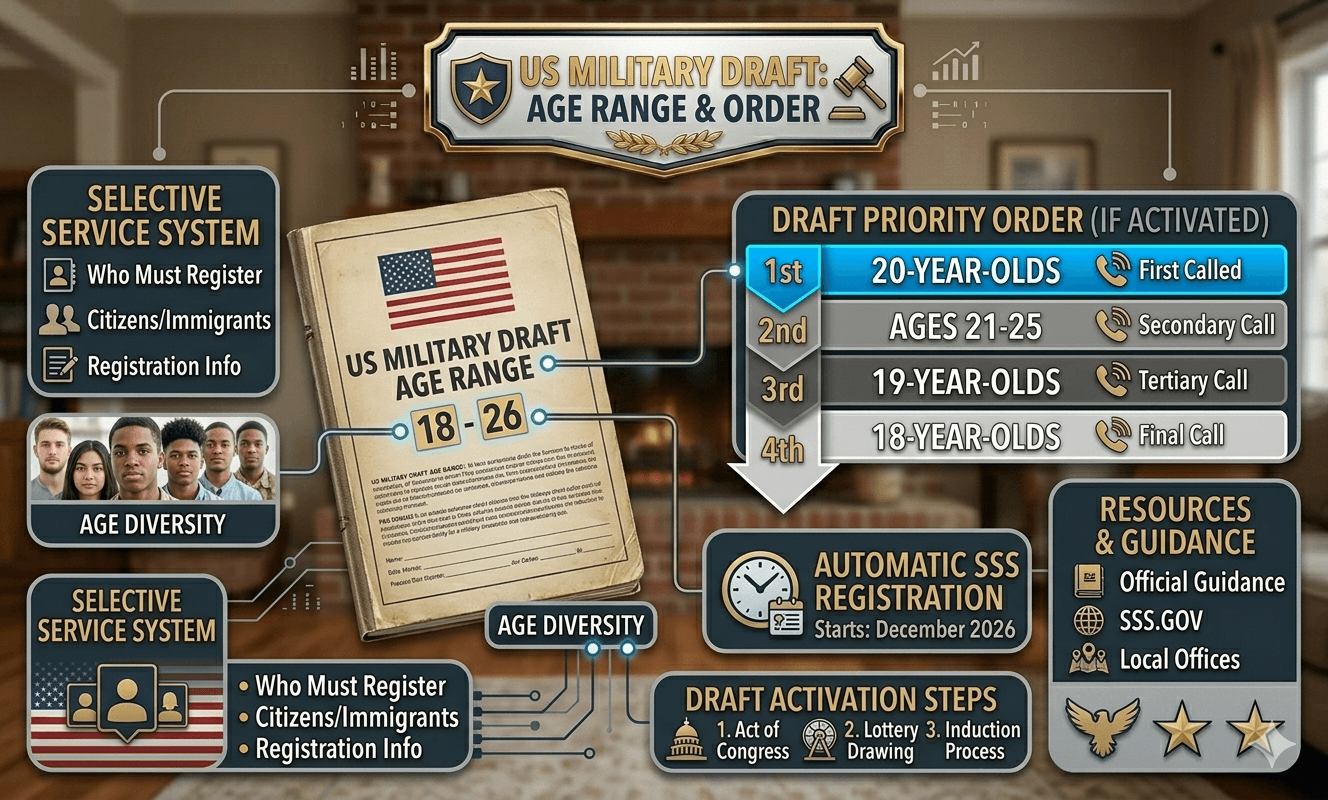
Introduction to the Military Draft Age
The military draft age in the United States, currently set between 18 and 26 years, serves as a critical threshold for individuals eligible for conscription in times of national conflict. The Selective Service System governs the registration process, requiring all male citizens as well as immigrant males residing in the U.S. to register by the age of 26. This system is designed to facilitate the quick mobilization of military personnel should the need arise, ensuring that the nation remains prepared for unforeseen circumstances.
Yes, the military draft age in the United States is 18 to 26 years old. If you are a male between those ages, you are required to register with the Selective Service System. But here is what most people get wrong: turning 18 does NOT mean you would be drafted first. In fact, 20-year-olds are the primary targets in a draft lottery—18- and 19-year-olds are called LAST .

Here is the critical update for 2026: The federal government is implementing automatic Selective Service registration starting December 18, 2026 . This means eligible men will no longer need to register themselves—the government will do it automatically using existing federal data sources. But no, this does NOT mean a draft has been activated. The United States has not had an active draft since 1973, and there is no military draft in 2026 .

This guide explains exactly how the draft age works, who gets called first, the new automatic registration rule, and what it means for you and your family.
What Americans Need to Know Right Now
There is a lot of confusion and anxiety spreading online about a potential military draft in 2026. Social media rumors, combined with ongoing military conflicts and recent policy changes, have created a wave of misinformation.
Here is the truth:
| Question | Answer |
|---|---|
| Is there an active military draft right now? | NO. The U.S. has an all-volunteer military. The last draft ended in 1973 . |
| Will automatic registration start a draft? | NO. Automatic registration just puts you in the database. It does not activate conscription . |
| Who has to register? | Almost all male U.S. citizens and male immigrants aged 18-25 . |
| What is the draft age range? | 18 to 26 years old (you are liable once you turn 18 and remain liable until your 26th birthday) . |
| What changed with the Army in 2026? | The Army raised its volunteer enlistment age limit from 35 to 42 . |
Real-life example: A 19-year-old college student worried about being drafted can rest easier knowing that 20-year-olds are the priority in a draft lottery. The order of induction specifically places 20-year-olds first, then 21, 22, 23, 24, 25, 19, and finally 18-year-olds .
Latest Updates Today (May 2026)
Veterans May Qualify for Extra Benefits
Check available financial assistance, healthcare programs and other opportunities that may apply to you.
Check EligibilityHere is everything that has changed or is about to change regarding military draft policy.
Automatic Selective Service Registration (Effective December 18, 2026)
This is the biggest news. A new rule passed by Congress as part of the 2025 National Defense Authorization Act will automate the registration process for the Selective Service System .
What is changing:
| Before December 2026 | After December 2026 |
|---|---|
| Men had to register themselves within 30 days of turning 18 | The government will automatically register eligible men |
| Late registration was allowed until age 26 | Automatic registration eliminates the need for self-registration |
| Failure to register carried penalties (loss of student aid, federal jobs) | Same penalties apply—but now you cannot “forget” to register |
Why this matters: The change transfers responsibility from individual men to the Selective Service System through integration with federal data sources . In 2024, only 81% of eligible men registered voluntarily . Automatic registration aims to close that gap.
Important: This does NOT activate a draft. It simply ensures the database is complete should a draft ever be needed .
Army Enlistment Age Increased (Effective April 20, 2026)
The U.S. Army raised its maximum enlistment age from 35 to 42 . This is for voluntary enlistment—not the draft.
New enlistment age limits by branch (2026):
| Branch | Minimum Age | Maximum Age |
|---|---|---|
| Army | 17 (with parental consent) | 42 |
| Navy | 17 | 41 |
| Air Force / Space Force | 17 | 42 |
| Marine Corps | 17 | 28 |
| Coast Guard | 17 | 41 |
Why this matters for the draft conversation: Some people confuse enlistment age changes with draft age changes. They are completely separate. The draft age remains 18-26. The enlistment age is for volunteers only.
Ongoing War in Iran and Draft Concerns
The U.S. is currently involved in military operations in Iran, which has led to increased public concern about a potential draft . However, defense officials have not indicated any plans to reinstate conscription. The all-volunteer force remains the standard.
The Military Draft Age Range: Exact Rules
Here is the precise legal framework for draft eligibility in the United States.
Age of Liability (When You Can Be Drafted)
According to federal law (50 USC 3803), every person required to register who is between the ages of 18 years and 6 months and 26 years is liable for training and service in the Armed Forces .
Important distinctions:
| Age Milestone | Status |
|---|---|
| 17 years, 3 months | Can submit early registration information (held until age 18) |
| 18th birthday | You become eligible to register; 30-day window begins |
| 18 years, 6 months | You are fully liable for draft if activated |
| 26th birthday | You are no longer required to register and cannot be drafted |
What this means in plain English: Once you turn 18, you are in the system (or will be automatically). Once you turn 26, you are out for good. There is no draft for anyone over 26 under current law.
Who Must Register for Selective Service
Almost all male residents of the United States must register, including :
| Category | Must Register? |
|---|---|
| U.S.-born citizens | ✅ YES |
| Naturalized citizens | ✅ YES |
| Permanent residents (green card holders) | ✅ YES |
| Refugees and asylum seekers | ✅ YES |
| Undocumented immigrants | ✅ YES |
| Dual citizens living abroad | ✅ YES |
| Men with expired visas (30+ days) | ✅ YES |
Exemptions (who does NOT need to register):
| Category | Exempt? |
|---|---|
| Women | ❌ NO (not required—see below) |
| Active duty military personnel | ✅ YES |
| Non-active Guard/Reserve members | ❌ NO (must register) |
| Hospitalized or incarcerated men | Must register within 30 days of release |
| Non-institutionalized disabled men capable of leaving home | Must register |
Women and the Draft
Current law: Women are NOT required to register for the Selective Service. The system does not accept voluntary registrations from women .
Could this change? There have been legislative proposals to require women to register, including debates during National Defense Authorization Act negotiations. As of May 2026, no such change has passed into law.
Who Gets Drafted First? The Order of Induction
This is the most misunderstood part of the draft system. If a draft were activated tomorrow, here is exactly who would be called and in what order.
Draft Lottery Order (by Age)
The Selective Service would conduct a National Draft Lottery using a random drawing of birthdays and numbers . The order of induction by age would be :
| Priority | Age Group |
|---|---|
| 1st | 20-year-olds (those whose 20th birthday falls during the lottery year) |
| 2nd | 21-year-olds |
| 3rd | 22-year-olds |
| 4th | 23-year-olds |
| 5th | 24-year-olds |
| 6th | 25-year-olds |
| 7th | 19-year-olds |
| 8th (LAST) | 18-year-olds |
Why this matters: An 18-year-old high school senior or college freshman is literally the LAST priority. The system is designed to draft people who have had time to mature and establish themselves before taking younger men who are still in education or early development.
Induction Process Steps
If a draft were activated :
- Lottery drawing determines random order based on birthdates
- Selected men receive induction orders by mail
- First reporting for medical and administrative screening
- Physical and mental fitness evaluation
- Induction into military service (if found fit)
Deferments and Exemptions in a Draft
If a draft were activated, certain men could request deferments or exemptions:
| Status | Potential Deferment |
|---|---|
| College students | Possible deferment until end of semester/academic year |
| High school students | Deferment until graduation or age 20 |
| Conscientious objectors | Exemption from combat roles (Alternative Service Program available) |
| Medical/disability reasons | Classification based on fitness |
| Sole surviving son | Historically exempt, but check current rules |
| Religious ministry | Possible exemption |
Penalties for Failing to Register
Even though there is no active draft, registration is still mandatory. Failure to register carries serious consequences.
Legal penalties (not currently enforced but on the books):
| Penalty | Maximum |
|---|---|
| Fine | $250,000 |
| Imprisonment | 5 years |
Practical penalties (actively enforced):
| Consequence | Impact |
|---|---|
| Federal student financial aid | Ineligible (FAFSA requires registration) |
| Federal jobs | Ineligible for employment |
| Citizenship for immigrants | Delayed or denied |
| State benefits | Many states require registration for driver’s licenses, state jobs |
What this means: Even if you never get drafted, you need to register to access federal student loans, many government jobs, and other benefits.
Historical Context: How Draft Ages Have Changed
The current draft age range of 18-26 is the result of decades of changes. Here is the history :
| Era | Age Range |
|---|---|
| Civil War (1863) | 20-35 |
| World War I (1917) | Initially 21-30, later expanded to 17-35 |
| World War II (1940) | 21-36 initially, expanded to 18-64 in 1941 |
| Post-WWII (1948) | 18-26 |
| Korean War era (1951) | 18.5-26 (24 months service) |
| Vietnam War era | 18-26 (with extensive deferment system) |
| 1973-present | Draft ended; registration only for ages 18-26 |
The Selective Service System was suspended in 1975, then reinstated in 1980 by President Jimmy Carter after the Soviet invasion of Afghanistan . Since then, registration has been required but no draft has been activated.
Common Misconceptions About the Military Draft
Let us clear up the confusion.
Misconception #1: “The draft is coming back in 2026.”
Reality: There is no active draft in 2026. Congress has not authorized conscription. Automatic registration is just an administrative change to the existing registration system, not a draft activation .
Misconception #2: “18-year-olds get drafted first.”
Reality: False. 20-year-olds are the first priority. 18-year-olds are the last priority in the draft order .
Misconception #3: “Women can be drafted now.”
Reality: False. Current law does not require women to register for Selective Service, and women cannot be drafted .
Misconception #4: “Automatic registration means I am being drafted.”
Reality: No. Automatic registration just puts you in the database. It is like automatically getting a driver’s license number—it does not mean you are being forced to drive .
Misconception #5: “If I turn 26, I can still be drafted.”
Reality: No. Once you turn 26, you are no longer required to register and you are not eligible to be drafted under current law .
Misconception #6: “Immigrants without legal status do not have to register.”
Reality: False. Undocumented immigrants are still required to register. Failure to do so can negatively affect future immigration applications .
What This Means for Different Age Groups
Here is how the draft age rules apply to you based on your current age.
If You Are 17 Years Old
- You cannot register yet, but you can submit early information (starting at 17 years, 3 months)
- You are not liable for the draft
- If a draft happened, you would be the absolute last priority
If You Are 18-25 Years Old
- You are required to register (or will be automatically registered starting Dec 2026)
- You are liable for the draft if one is activated
- If a draft happened, your age determines your priority (20-year-olds first, then up to 25, then down to 19, then 18)
If You Are 26 Years or Older
- You are no longer required to register
- You cannot be drafted under current law
- You have no further obligations to Selective Service
Parents of Teenage/Young Adult Sons
- Ensure your son understands registration requirements
- Know that automatic registration takes effect December 2026—but do not rely on it
- If your son applies for federal student aid, he needs to be registered
- If he turns 18 before December 2026, he should register manually to be safe
How to Check Your Registration Status
If you are unsure whether you are registered with Selective Service, you can check.
Online: Visit the Selective Service System website and use the “Verify Registration” tool. You will need your last name, Social Security number, and date of birth.
By phone: Call the Selective Service System at 888-655-1825.
What to do if you are not registered: If you are between 18 and 25 and not registered, register immediately online. Late registrations are accepted until your 26th birthday .
FAQ (What Americans Ask Google About Military Draft Age)
What is the military draft age in the United States?
The draft age range is 18 to 26 years old. Men become liable for the draft at 18 years and 6 months and remain liable until their 26th birthday .
Is there a military draft in 2026?
No. The United States has an all-volunteer military. The last draft ended in 1973 .
Can 18-year-olds be drafted?
Yes, technically they are within the draft age range. However, in a draft lottery, 18-year-olds are the LAST priority. 20-year-olds are called first .
What is the maximum age for military draft?
26 years old. Once you turn 26, you cannot be drafted under current law .
Do women have to register for the draft?
No. Current law does not require women to register for Selective Service. Women cannot be drafted .
What is automatic Selective Service registration?
Starting December 18, 2026, the government will automatically register eligible men aged 18-25 using existing federal data sources. This does NOT activate a draft .
Who is exempt from draft registration?
Active duty military personnel are exempt. Women are exempt. Men who are hospitalized or incarcerated must register after release. Disabled men capable of leaving home must register .
What happens if I do not register for Selective Service?
You become ineligible for federal student financial aid, federal jobs, and other government benefits. Failure to register is technically a felony with potential fines up to $250,000 .
Can undocumented immigrants be drafted?
Yes. Under current law, male residents aged 18-25 are required to register regardless of immigration status, including undocumented immigrants. Registration does not affect immigration status positively or negatively, but failure to register can negatively impact future applications .
Is the Army raising the draft age to 42?
No. The Army raised the VOLUNTEER enlistment age to 42. The draft age remains 18-26. These are two completely separate things .
Who gets drafted first in a lottery?
20-year-olds are the first priority, followed by 21, 22, 23, 24, 25, then 19, and finally 18-year-olds .
Final Takeaway (Actionable Summary)
The military draft age in the United States is 18 to 26 years old. Every male citizen and male resident within that age range is required to register with the Selective Service System. Starting December 18, 2026, that registration will happen automatically for most eligible men .
Here is what you need to do right now:
If you are a male aged 18-25:
- Verify your registration status today using the Selective Service website
- If you are not registered and you are under 26, register immediately
- Update your address with Selective Service if you move (required within 10 days)
- Do not panic about draft rumors—there is no active draft in 2026
If you are a parent of a male aged 17-25:
- Ensure your son understands registration requirements before he applies for college financial aid
- Know that automatic registration starts December 2026, but do not rely on it for anyone turning 18 before then
- Explain that registration does not mean immediate military service—it is just a database
If you are over 26:
You have no further obligations to Selective Service. You cannot be drafted. You are done.
If you are concerned about a potential draft:
Understand that reinstating the draft would require an act of Congress and a presidential signature. No such action has been taken or seriously proposed in 2026. The all-volunteer force has been the standard for over 50 years .
The most important thing to remember: Registration is NOT the same as being drafted. Registering is like getting a Social Security number—it is an administrative requirement. Being drafted would only happen if Congress and the President authorize conscription, which has not happened since 1973.
Stay informed. Ignore social media panic. Check official sources like the Selective Service System website for accurate information.
Registration with the Selective Service System is straightforward, requiring individuals to provide basic personal information, such as name, address, and date of birth. It is important to note that failure to register may result in significant legal consequences, including ineligibility for federal student financial aid, government jobs, and certain state benefits. Public awareness of these requirements tends to vary, often influenced by deep-seated misconceptions about the implications of the draft.
Many individuals misunderstand the draft process, believing it automatically results in conscription when, in reality, the U.S. maintains an all-volunteer military force. A draft would only be enacted in a situation where the government determines that volunteer recruitment cannot meet national security needs. Furthermore, it is crucial to emphasize that the draft process primarily targets younger individuals due to various factors, such as physical aptitude and the likelihood of incorporating them into military training.
In summary, understanding the military draft age and the associated registration requirements not only highlights the responsibilities of young citizens but also clarifies the broader context of national defense policies in the United States. This section aims to shed light on the intricacies involved in the draft system while dispelling common myths associated with it.
Who Gets Drafted First?
The military draft lottery is primarily designed to ensure a fair and organized selection process for those called to serve. In the context of the draft process, it is often assumed that younger individuals are prioritized for service; however, recent guidelines indicate that men aged 20 are, in fact, called before their 18- and 19-year-old counterparts. This approach stems from various factors, including physical maturity and educational factors, which influence the decision-making process related to enlistment.
One of the significant influences on who gets drafted first lies in the overall assessment of readiness and capability. By the age of 20, individuals generally exhibit greater physical maturity and life experience, which may make them more suitable for military training. Furthermore, 20-year-olds are often seen as being less likely to still be in high school, which may allow them to commit fully to military service without other obligations interrupting their training or deployment.
Moreover, the age organization of the draft lottery acts to equalize the eligibility scores among men. This means that although the youngest individuals, typically those aged 18 and 19, are indeed eligible, the lottery system permits a structured approach to selecting older, marginally more mature candidates first. Those born in the same year after a specified date are grouped together, thereby establishing a sequence of individuals based on their birth dates. The resulting numerical order enables officials to call up volunteers by the lottery number drawn, with specific age cohorts prioritized accordingly.
This selective process not only aims to ensure the efficiency of military enlistment but also reflects an understanding of the developmental differences that can exist between these age groups. Thus, while there may be a general perception regarding youthful eligibility for the draft, the rationale behind the prioritization of 20-year-olds demonstrates a strategic selection methodology.
The Automatic Registration Rule: An Overview
In December 2026, a significant change is set to occur concerning the military draft process: the implementation of the automatic registration rule. This new policy, introduced by the federal government, aims to streamline the draft registration process by utilizing existing data to enroll eligible individuals without requiring any proactive steps from them. Primarily targeted towards men of draft age, this automatic system significantly alters the traditional registration landscape.
The automatic registration rule will leverage information from various government agencies, such as the Department of Motor Vehicles and Social Security Administration, to create a comprehensive database of eligible men. This modernization of the registration process is anticipated to increase registration rates among young individuals, many of whom may not fully understand the importance of registering with the Selective Service System.
By removing barriers associated with manual registration, the automatic system seeks to ensure that the pool of eligible candidates is adequately populated. This is particularly crucial in times of national emergency when military mobilization may become necessary. The government’s reliance on existing data minimizes administrative burdens and enhances the efficiency of the draft registration system, making it more responsive to the needs of the military.
Furthermore, the significance of the automatic registration rule extends beyond mere numbers. It symbolizes a shift towards a more inclusive and accessible approach to military service obligations. By automating the process, the government acknowledges the complexities of contemporary life, where young men often balancing education, jobs, and personal commitments may overlook or forget to register. As such, the new rule not only addresses administrative efficiency but also reflects an understanding of the responsibilities that young citizens carry in today’s society.
Exemptions from the Draft
In the context of the military draft, certain individuals may be exempt from service based on specified criteria. Understanding these exemptions is crucial for those who want clarity regarding their potential draft status in 2026. Several categories are considered when determining exemption eligibility, including health issues, educational deferments, and other circumstances that merit special consideration.
Health-related exemptions are among the most common. Individuals who suffer from significant medical conditions, disabilities, or mental health issues may be deemed unfit for military service. These health assessments are typically conducted by qualified medical professionals, who ensure that only those who are physically and mentally capable are drafted, thus safeguarding the well-being of all individuals involved.
Education deferments also play a vital role when it comes to exemptions. Students actively pursuing higher education, such as university degrees, may have their draft eligibility postponed until they complete their studies. This policy is designed to encourage educational attainment and skill development, which are valuable for both the individual and the country. Moreover, certain vocational programs may qualify for similar deferments, acknowledging the importance of trade skills in national development.
In addition to health and educational criteria, there are other specific exemptions that may apply. For instance, individuals who are caregivers for dependents, such as children or elderly parents, might be excused from service to ensure family responsibilities are met. Likewise, members of religious organizations may seek exemption for reasons of conscience, asserting that their beliefs prevent them from participating in military activities.
In essence, while the military draft processes are stringent, various avenues for exemption exist to accommodate diverse personal circumstances. Understanding these categories can provide peace of mind for individuals concerned about their draft status in the upcoming years.
Understanding the Draft Lottery System
The draft lottery system serves as a mechanism for selecting individuals for military service during times of need. This process, implemented in various forms throughout U.S. history, involves a random drawing that allocates numbers to eligible individuals. These numbers ultimately determine the order in which potential draftees are called to serve. In the context of the military draft age in 2026, understanding this system is essential for prospective draftees.
Typically, the lottery begins by assigning dates of birth to specific numbers. For example, individuals born on January 1, for all years within the specified range, might be assigned a number, continuing through December 31. When the lottery is conducted, a random drawing is executed, pulling numbers from a container. This lottery determines the sequence in which individuals are called; the lower the number drawn, the earlier one is likely to be drafted.
The selection process operates under the premise of randomization, which is designed to promote fairness in who gets drafted. All males within the designated age range must register for the draft, regardless of their background or circumstances. Once the lottery is conducted, those with the drawn numbers will receive instructions regarding their induction into military service.
This system demystifies the selection process by demonstrating that no individual is chosen based on merit, wealth, or social status, but rather through chance. Individuals aware of their assigned number can prepare for potential mobilization while also understanding that their risk of being drafted correlates directly to the number drawn. Thus, comprehending the draft lottery system proves vital for anyone anticipating the possibility of conscription.
Impact of the Automatic Registration on Families
The introduction of automatic registration for the military draft in 2026 has substantial implications for families with eligible individuals. This new system can evoke a unique blend of emotional and logistical considerations, fundamentally affecting family dynamics. One of the primary aspects involves the heightened level of anxiety families may experience as they contemplate the possibility of a loved one being drafted. The uncertainty surrounding military conscription can be particularly distressing, especially for families that harbor concerns about safety and the potential repercussions of deployment.
Moreover, families should actively engage in preparatory discussions regarding the draft. Open communication can help alleviate some fears and facilitate a shared understanding of the situation. It is crucial for families to establish personal protocols or plans that address what actions they would take if a family member receives a draft notice. This preparation might include discussions about financial implications, discussions of health care, or arrangements for childcare for those with dependents.
Logistically, families may find themselves needing to gather essential documents related to their eligible members. This includes medical records, education documents, and any relevant identification that may be required during the enlistment process. Understanding these requirements is vital for efficiently navigating the bureaucratic landscape associated with the military draft.
In addition, the potential for a draft can alter relationships within the family unit. The differing views on military service, patriotism, and duty can lead to significant discussions, possibly inciting disagreements or fostering an environment of cooperation. It is essential for families to be aware of how the automatic registration affects not only the eligible individuals but also the family as a collective unit. By preparing both emotionally and logistically, families can better support each other in navigating the uncertainties of a potential draft scenario.
The Current State of the U.S. Military Draft
The U.S. military draft, a system historically used to recruit citizens into the armed forces during times of conflict, has not been actively utilized since 1973, when the draft was officially abolished in favor of an all-volunteer force. This transition reshaped the military landscape, leading to a system that relies on voluntary enlistment rather than mandatory service. As of today, the military population comprises individuals who choose to serve, which has both advantages and challenges.
Public sentiment regarding the military draft has evolved significantly over the decades. While many Americans understand the necessity of a strong military, opinions differ regarding the implications of a draft system. Some express concerns about potential inequities that may arise, particularly regarding who would be called to serve in the event of reinstatement. Historically, the draft has disproportionately affected various demographic groups, leading to discussions about fairness and societal obligations during national emergencies.
In the current geopolitical climate, with rising tensions in various parts of the world, discussions about the military’s readiness and recruitment strategies have gained prominence. The role of the military is not only about defense but also includes humanitarian missions and peacekeeping efforts. Understanding military policies, including the draft, is crucial for citizens. Staying informed enables individuals to grasp the implications of a draft reinstatement, should it occur, and helps shape public discourse around military service, recruitment, and national service obligations.
Being informed about the current policies surrounding the military draft can contribute to a comprehensive discussion on defense strategies and civic duties in the face of international challenges. It’s imperative that citizens engage with these topics to better understand the implications of military readiness in the 21st century.
Implications of the Military Draft for Young Men Today
The implementation of the military draft age and the automatic registration process has significant implications for young men between the ages of 18 and 26. As the landscape of national defense evolves, understanding the draft system becomes essential for this demographic. Being drafted into military service is not just a theoretical scenario; it affects young men’s educational, career, and personal choices. Thus, the urgency to comprehend how these systems operate is paramount.
For many young individuals, concerns about the military draft often stem from misconceptions or a lack of information. A draft may evoke fears of being uprooted from civilian life, or deter individuals from pursuing certain career paths. Therefore, it is crucial for young men to be equipped with knowledge about their rights and responsibilities should the draft system be enacted. This includes understanding the registration process, potential exemptions, and the legal implications of draft-related decisions. The Selective Service System maintains a comprehensive overview of these areas, and individuals should actively refer to these resources.
Another important aspect is awareness of the potential consequences of noncompliance. Ignoring draft registration can lead to legal ramifications, reducing access to federal benefits such as student loans or job training programs. Consequently, young men are encouraged to take proactive measures to stay informed and maintain compliance to safeguard their futures.
Engaging with community resources or legal advisors can provide clarity and guidance on navigating challenges related to the military draft. Ultimately, fostering a well-informed perspective on the draft process can empower young men to make confident decisions, regardless of the circumstances they may face in the event of a draft.
Conclusion: Staying Informed and Prepared
The landscape of military service is subject to change, particularly regarding draft policies and age eligibility. Understanding the factors influencing the military draft age in 2026 is crucial for individuals and families alike. Throughout this blog, we have explored key considerations, including the criteria for selection and how shifts in national security and demographics may affect who is drafted first. Given this dynamic environment, it is essential for potential candidates and their supporters to remain informed about draft regulations and requirements.
As we have noted, the military draft serves a vital role in maintaining national defense. Therefore, comprehending the implications of policy changes is imperative. Staying updated with legislative developments can help individuals understand their civic duties. It also aids in preparing for potential conscription in an informed manner. Engaging in discussions about military service and the draft can provide a sense of community and solidarity, ensuring that citizens are collectively aware of their roles in supporting national security.
In light of the evolving nature of military service, it is advisable to participate actively in public forums and discussions regarding conscription policies. Gathering insights on the changing age requirements for the military draft and who may be prioritized can empower individuals to make informed decisions about their futures. Ultimately, being proactive about understanding and engaging with these policies will equip everyone to face the realities of military service should the draft be enacted again.


🇺🇸 IMPORTANT DISCLAIMER – Veterans Benefits Information
This site provides general information about U.S. Department of Veterans Affairs (VA) benefits for educational and informational purposes only.
- Not Official: We are NOT affiliated with, endorsed by, or connected to the U.S. Department of Veterans Affairs (VA), the Veterans Benefits Administration (VBA), the Veterans Health Administration (VHA), or any other government agency.
- No Legal/Financial Advice: The content on this website is for informational purposes only and does not constitute legal, financial, or medical advice. VA benefits rules change frequently – always consult with an accredited Veterans Service Officer (VSO) or a qualified professional for your specific situation.
- Official Sources: For official, binding information and to apply for benefits, always visit official .gov websites: VA.gov, Benefits.VA.gov, or SSA.gov.
- No Data Collection: This site does not collect, store, or process any personal information. It does not have login forms, contact forms, or any system to capture user data. We never ask for your Social Security Number, bank details, or any personal information.
- 🚨 Scam Alert: The VA and other government agencies never charge fees for benefit applications. If anyone asks for money to "process" your VA claim, it is a scam. Report it to the VA Office of Inspector General at VA.gov/OIG.
- Advertising: This site uses third-party advertising (Adsterra) to cover operational costs. We do not endorse or guarantee any products or services advertised.
📌 Information provided as of June 2026. Always verify current eligibility and rules with official .gov sources.
This site is not affiliated with the U.S. Department of Veterans Affairs or any government agency. All information is for educational purposes only. Please visit VA.gov for official information.
