
Introduction to UK Military 4×4 Planning
As military operations evolve in complexity and scale, the role of 4×4 vehicles within the UK military becomes increasingly significant. These versatile vehicles are essential for supporting infantry units and are fundamental in enhancing mobility, tactical flexibility, and logistical efficiency on the battlefield. Specifically, 4×4 vehicles serve multiple purposes, including transportation of personnel, equipment logistics, and rapid response capabilities in diverse terrains.
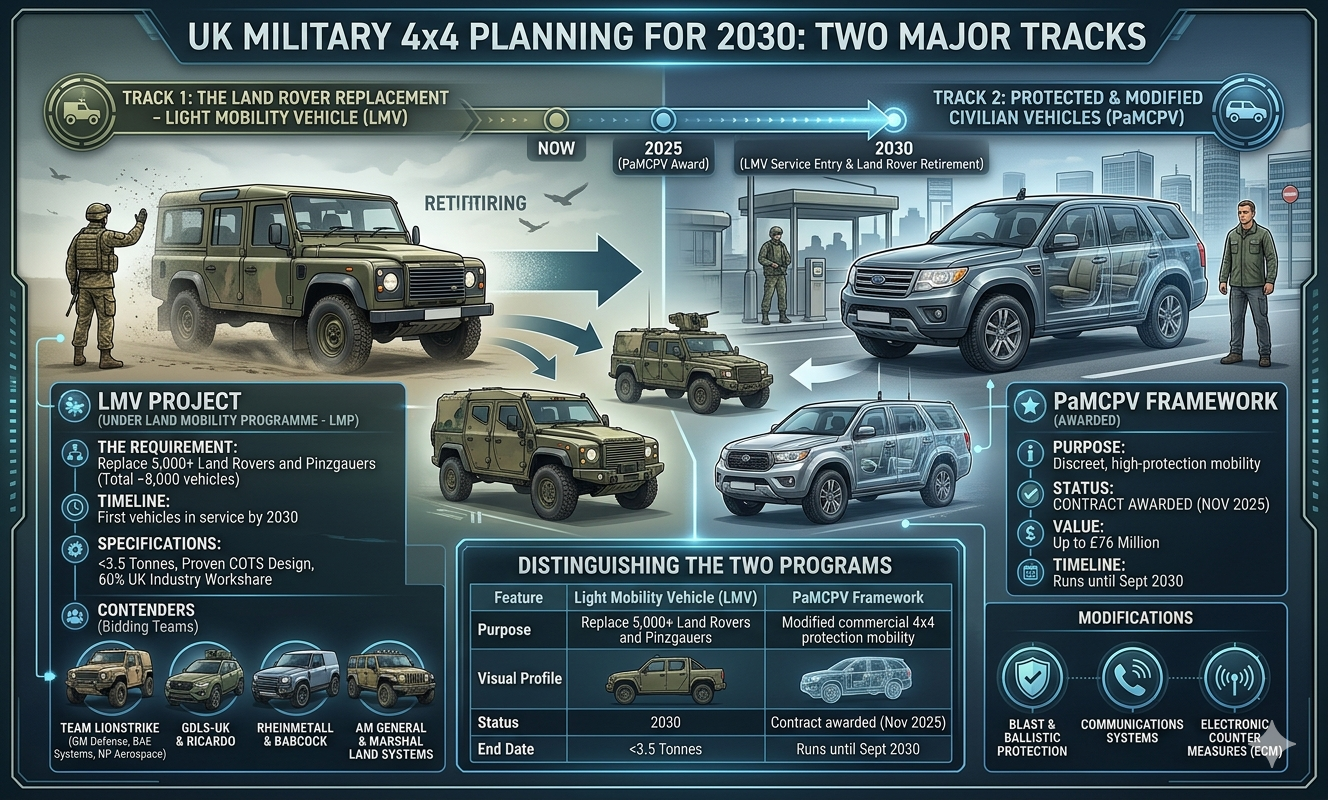
The UK military’s 4×4 planning for 2030 centers on two major tracks: the planned retirement of the iconic Land Rover and the awarding of a major contract for protected civilian-style vehicles.

Here are the key developments regarding UK military 4×4 tenders leading up to 2030.
🚙 The Land Rover Replacement: Light Mobility Vehicle (LMV)

After over 75 years of service, the British Army is officially retiring its remaining Land Rover fleet, with the final out-of-service date set for 2030. The replacement is being managed under the Light Mobility Vehicle (LMV) project, part of the broader Land Mobility Programme (LMP).
Key details of the LMV program:
- The Requirement: The LMV aims to replace not only the 5,000+ Land Rovers but also the Pinzgauer fleet, totaling nearly 8,000 vehicles.
- Timeline: The first new vehicles are expected to be in soldiers’ hands by 2030.
- Contenders: Several international teams have submitted bids, including:
- Team Lionstrike (GM Defense, BAE Systems, NP Aerospace) – proposing the Infantry Squad Vehicle (ISV).
- General Dynamics Land Systems-UK (with Ricardo).
- Rheinmetall and Babcock.
- AM General & Marshal Land Systems.
- Specifications: The LMV is defined as a platform weighing less than 3.5 tonnes. The MOD prefers a proven, commercial off-the-shelf (COTS) design to speed up delivery and requires that at least 60% of the work be carried out by UK industry.
🛡️ The “Stealth” Tender: Protected & Modified Civilian Vehicles (PaMCPV)
While the LMV focuses on tactical military vehicles, a separate framework exists for vehicles that need to blend in. The PaMCPV framework runs until September 2030 and covers vehicles modified for protection while maintaining a civilian appearance.
- Winning Bidders: A contract award notice published in November 2025 confirmed that suppliers have been chosen for this framework, which is worth up to £76 million.
- Vehicle Types: This includes 4x4s, cars, vans, and minibuses sourced from commercial markets.
- Modifications: These COTS vehicles are modified to include blast and ballistic protection, communication systems, and Electronic Counter Measures (ECM) for use in higher-risk areas where a military profile is unsuitable.
🤔 How to distinguish the two programs?
The table below summarizes the difference to help you understand which tender applies to which need:
| Feature | Light Mobility Vehicle (LMV) | PaMCPV Framework |
|---|---|---|
| Purpose | Replace military “workhorses” (Land Rover) | Provide discreet, armoured mobility |
| Visual Profile | Overt military | Civilian / Low profile |
| Status | Contenders bidding (Decision pending) | Awarded (Active framework) |
| End Date | Service entry by 2030 | Framework ends Sept 2030 |
Veterans May Qualify for Extra Benefits
Check available financial assistance, healthcare programs and other opportunities that may apply to you.
Check EligibilityTo summarize, the “UK military 4×4 tender 2030” effectively covers two different needs: one is the highly publicized competition to replace the old Land Rover with a new tactical truck, and the other is an active, awarded contract for specialized armoured cars that look like standard SUVs.
Are you interested in the specific technical requirements of the LMV bidders, or the companies that won the PaMCPV contract?
In the lead-up to 2030, the UK military is undergoing strategic planning to modernize its fleet of 4×4 vehicles. This planning is motivated by the need to adapt to contemporary threats, incorporate advanced technologies, and improve operational capabilities. As global conflicts and peacekeeping missions become more dynamic, the UK military recognizes that its wheeled vehicles must have the capability to handle a range of combat situations while ensuring safety and effectiveness for operators.
The anticipated changes in the UK military 4×4 vehicle sector will include enhancements in design, engineering, and onboard technology. Emphasis will be placed not only on improving the vehicles’ off-road performance but also on integrating innovative features such as better communication systems, real-time data exchange, and autonomous functionality. The integration of these technologies aims to provide personnel with superior situational awareness and operational readiness.
Ultimately, the evolution of 4×4 vehicles is not just about acquiring new models; it involves a comprehensive approach to maintain the UK armed forces’ edge in future military operations. As we look forward, it is crucial to understand the broader implications of these vehicle advancements and their anticipated impact on the effectiveness of military forces in the years to come.
The Land Rover has long been synonymous with the UK military, symbolizing reliability and ruggedness on and off the battlefield. Since its initial introduction in 1948, the Land Rover has evolved significantly, adapting to the changing needs of military operations around the world. It has been used in a multitude of roles, from troop transport to reconnaissance missions, proving itself invaluable during conflicts and peacekeeping operations alike.
The versatility of the Land Rover is one of its most commendable features. Its ability to navigate treacherous terrains, alongside its customizable options, allows it to fulfill various duties, such as logistics and support, in diverse environments. The vehicle’s four-wheel-drive capability ensures it can traverse through challenging landscapes while maintaining the safety and comfort of its crew. Moreover, models like the Defender have been modified for specific military tasks, further enhancing their functionality.
Historically, the Land Rover has been integral to military logistics and operations. Its deployment in critical missions, whether during the Gulf War, the Balkans, or contemporary peacekeeping efforts, demonstrates its role in enabling military success. The vehicle has not only served under the British flag but has also seen use by armed forces globally, further imprinting its legacy on military history.
However, as the British Army looks towards modernization and enhanced capabilities, the decision to retire the iconic Land Rover Defender marks a significant transition. The move is not merely a question of replacing an aging fleet, but rather a strategic decision to invest in next-generation vehicles that offer improved technology, armor, and transport capabilities. While the Land Rover will always hold a special place in the hearts of those who served with it, its retirement signals a new chapter for the UK military as they prepare for the future of warfare.
Reasons for Retirement of the Land Rover
The decision to retire the Land Rover from military service stems from several significant factors that reflect the ever-evolving landscape of modern warfare. Primarily, one of the key influences on this decision is the shift in operational requirements that the UK military faces today. As military strategies evolve to address new threats, the capabilities required from ground vehicles also change. This necessitates a fleet of vehicles that can meet contemporary demands, which increasingly involves combat scenarios characterized by urban warfare, improvised explosive devices (IEDs), and increased mobility across diverse terrains.
Furthermore, advancements in vehicle technology heavily impact the retirement of older models like the Land Rover. Modern military vehicles are equipped with superior technology that enhances their operational effectiveness. Innovations such as improved armor materials, advanced communication systems, and state-of-the-art navigation tools are indispensable in providing soldiers with the necessary edge on the battlefield. The Land Rover, while historically significant, lacks many of these modern advancements, making it less effective in today’s complex combat environments.
Moreover, there is a pressing need for the UK military to transition to more modern combat vehicles. New models are being designed specifically to address current and future operational challenges. These vehicles not only offer better protection and power but also allow for greater adaptability to various mission profiles. By phasing out the Land Rover, the UK military can invest in next-generation vehicles that will ensure they remain competitive and capable on the global stage. In light of these factors, it becomes increasingly clear why the retirement of the Land Rover has become an inevitable step forward in military modernization efforts.
Emergence of Protected Civilian-Style Vehicles
The evolution of military logistics and operational strategies has led to a notable shift towards the implementation of protected civilian-style vehicles (PCSVs) in military contexts. These vehicles are essentially civilian vehicles that have been enhanced with armor and other protective features to increase safety for personnel in conflict zones or unstable environments. Unlike traditional military vehicles, which often emphasize heavy armor and robust engineering, PCSVs provide a more versatile and adaptable solution, merging civilian utility with military-grade protection.
One of the primary advantages of using protected civilian-style vehicles is their inherent ability to blend into civilian populations. This attribute significantly enhances operational security and reduces the likelihood of being targeted by adversaries. The less militaristic appearance of PCSVs can facilitate safer access to urban areas and minimize the risk of escalation during missions where discretion is paramount.
Moreover, these vehicles typically offer better mobility, comfort, and fuel efficiency than their traditional counterparts, aligning with a wider range of operational needs. Their design often incorporates advanced technologies, including communication systems and situational awareness tools, which are crucial for modern military operations. By integrating features that are common in contemporary civilian vehicles, such as improved handling and passenger accommodations, military personnel can operate effectively in diverse environments while maintaining necessary protections.
In essence, the shift towards protected civilian-style vehicles reflects a broader trend in military planning that prioritizes operational flexibility, enhanced survivability, and cost-effectiveness. As the UK military continues to adapt to complex and evolving threats, the incorporation of PCSVs into its fleet could prove instrumental in achieving strategic objectives while ensuring the safety of military personnel.
Key Specifications and Features for Future Vehicles
The evolving landscape of military operations necessitates that the UK armed forces adapt and enhance their vehicle capabilities, particularly in 4×4 vehicles. The key specifications sought for future military 4×4 vehicles focus on several pivotal aspects that are instrumental in meeting operational demands.
First and foremost, armor requirements are a primary concern. Future vehicles must offer advanced ballistic protection to safeguard personnel against the increasingly sophisticated threats encountered in combat scenarios. This includes the integration of lightweight composite armor that can provide optimal protection while minimizing the overall weight of the vehicle, thereby enhancing its mobility.
Technological advancements represent another critical specification. Future 4×4 vehicles should incorporate cutting-edge technology, including artificial intelligence for navigation and threat detection, advanced communication systems for real-time information exchange, and electronic warfare capabilities. This technological infusion will not only bolster the effectiveness of military operations but also ensure seamless integration within multi-domain operational frameworks.
The payload capacity of future military 4×4 vehicles is also a significant factor. A higher payload capacity will enable these vehicles to transport essential equipment, supplies, and personnel effectively. This flexibility is necessary for different missions ranging from logistical support to reconnaissance and combat operations.
Furthermore, adaptability for various missions is vital. Future 4×4 military vehicles must be designed to accommodate a range of operational configurations, including command and control, medical evacuation, and direct-fire support roles. Modularity in design will allow for rapid reconfiguration, enhancing the versatility required to respond to diverse operational scenarios.
In summary, the specifications and features that the UK military seeks in future 4×4 vehicles revolve around advanced protection, technology, capacity, and adaptability, all of which are critical to maintaining operational readiness and effectiveness in the years leading up to 2030.
Major Contracts and Tenders in the Pipeline
The future landscape of UK military 4×4 vehicles is being shaped by a series of major contracts and tenders that are currently in the pipeline. The Ministry of Defence (MoD) is actively seeking to modernize its fleet, considering a range of advanced technologies, improved operational capabilities, and enhanced protection for personnel. As the MoD outlines its requirements, manufacturers and suppliers are gearing up to respond to upcoming opportunities.
Recent announcements from the MoD indicate that significant tenders related to tactical and operational vehicles will soon be made available. The planned acquisition aims to replace aging fleets, thereby ensuring that the UK Armed Forces maintain the effectiveness of their ground mobility. These contracts will primarily focus on delivering versatile, lightweight, and durable 4×4 vehicles that are capable of operating in various terrains and combat environments.
Moreover, collaboration with industry partners is becoming increasingly important. The MoD encourages innovation by engaging with both established firms and emerging companies within the defense sector. This engagement not only facilitates the integration of cutting-edge technologies but also fosters economic growth within the UK, as local companies are brought into the supply chain. As competition intensifies, it is crucial for manufacturers to deliver cost-effective solutions while meeting stringent performance criteria.
In addition to meeting immediate operational demands, these contracts will have long-term implications for the defense sector. The successful delivery of 4×4 vehicles could set a precedent for future procurement strategies and enhance partnerships between the MoD and the private sector. Ultimately, the upcoming years will be pivotal in defining the capabilities and readiness of the UK military’s ground forces through these strategic contracts and tenders.
Potential Manufacturers and Competitors
The landscape of manufacturers and competitors for the supply of 4×4 vehicles to the UK military is evolving rapidly as defense technology advances. Several key players have emerged as frontrunners in this field, each offering distinct capabilities to meet the evolving requirements of military operations.
One of the leading candidates is Land Rover, a renowned name in the automotive industry, with a rich history of producing vehicles for military use. Their models, particularly the Defender series, are known for their robust design, off-road capabilities, and adaptability, making them suitable for a range of operational scenarios. Their longstanding relationship with the UK military positions them well for future contracts.
Another significant player is General Dynamics, which provides the Foxhound vehicle. This light protected patrol vehicle has been specifically designed to offer superior mobility and protection in various terrains, reflecting the growing emphasis on survivability in modern combat contexts. General Dynamics’ reputation for innovation in defense solutions further enhances their competitiveness in the bidding process.
Oshkosh Defense also warrants attention, particularly due to their expertise in tactical wheeled vehicles. The company brings advanced engineering and robust supply chains to the table, showcasing their capacity to deliver high-performance military equipment. Their focus on sustainable materials and energy-efficient technologies aligns with the UK military’s goal of reducing carbon footprints without compromising operational capabilities.
Moreover, newer entrants like BAE Systems, which is actively developing a range of 4×4 vehicles with cutting-edge technology, pose as potential challengers. Their commitment to integrating autonomous systems and advanced materials positions them as credible competitors. The combination of established firms and newcomers creates a diverse competitive landscape, making the selection process for the UK military’s 4×4 vehicle contracts particularly dynamic.
Challenges Facing the UK Military in 4×4 Planning
The formulation of an effective strategy for the UK military’s 4×4 vehicle program encompasses numerous challenges that need to be addressed. One prominent hurdle is budget constraints. As public spending on defense is often subject to political scrutiny and economic fluctuations, securing adequate funding for the acquisition and maintenance of new 4×4 vehicles could prove to be a significant issue. Limitations in financial resources can hinder the procurement process and restrict the military’s ability to invest in innovative technologies.
Another challenge lies within the dynamic geopolitical landscape. With increasing tensions among global superpowers and evolving security threats, the military must remain agile in its capabilities. Changes in international relations may lead to an urgent need for rapid mobilization of assets, including 4×4 vehicles. Consequently, it is essential to balance the long-term modernization goals with short-term operational requirements, often placing added strain on available resources.
Furthermore, the advancement of technology presents both opportunities and challenges. With rapid developments in vehicle design, automation, and artificial intelligence, the UK military must ensure that its 4×4 vehicle fleet remains relevant and effective. However, incorporating new technologies often requires extensive research and development, testing, and validation processes. These endeavors can be time-consuming and costly, complicating the implementation of modernized vehicle systems.
In addition, there could be challenges related to the integration of new 4×4 vehicles with existing military infrastructure and interoperability with allied forces. Ensuring compatibility with other military assets and platforms is vital for operational success.
Conclusion: The Future Landscape of UK Military Vehicles
The UK military’s 4×4 vehicle landscape is set to undergo significant transformation by 2030, driven by evolving operational needs, technological advancements, and a staunch commitment to modernizing defense. As the nature of conflict continues to evolve, adaptability in military capabilities becomes paramount. Effectively integrating advanced technologies into 4×4 vehicles is essential for maintaining tactical superiority.
Future UK military 4×4 vehicles will likely embrace cutting-edge innovations such as enhanced connectivity, advanced armor protection, and improved mobility features, ensuring that they are well-equipped for diverse scenarios. The emphasis will also be placed on sustainability and efficiency, reflecting a broader trend across military operations to reduce environmental impact while optimizing performance.
Moreover, collaboration with industry partners will play a pivotal role in shaping the next generation of military vehicles. Engaging with innovative companies to harness emerging technologies will ensure that the UK maintains its competitive edge on the global stage. Continuous training and development of personnel to operate these next-gen vehicles will also be critical in leveraging their full potential.
As we look towards 2030, it is clear that the UK military must remain proactive in its approach to vehicle development and integration. This foresight will not only enhance operational readiness but also ensure that the armed forces are capable of addressing future challenges. Ultimately, investing in the future landscape of military 4×4 vehicles is not merely about adopting new technologies; it is about redefining the standard of military capability to safeguard national interests effectively.


🇺🇸 IMPORTANT DISCLAIMER – Veterans Benefits Information
This site provides general information about U.S. Department of Veterans Affairs (VA) benefits for educational and informational purposes only.
- Not Official: We are NOT affiliated with, endorsed by, or connected to the U.S. Department of Veterans Affairs (VA), the Veterans Benefits Administration (VBA), the Veterans Health Administration (VHA), or any other government agency.
- No Legal/Financial Advice: The content on this website is for informational purposes only and does not constitute legal, financial, or medical advice. VA benefits rules change frequently – always consult with an accredited Veterans Service Officer (VSO) or a qualified professional for your specific situation.
- Official Sources: For official, binding information and to apply for benefits, always visit official .gov websites: VA.gov, Benefits.VA.gov, or SSA.gov.
- No Data Collection: This site does not collect, store, or process any personal information. It does not have login forms, contact forms, or any system to capture user data. We never ask for your Social Security Number, bank details, or any personal information.
- 🚨 Scam Alert: The VA and other government agencies never charge fees for benefit applications. If anyone asks for money to "process" your VA claim, it is a scam. Report it to the VA Office of Inspector General at VA.gov/OIG.
- Advertising: This site uses third-party advertising (Adsterra) to cover operational costs. We do not endorse or guarantee any products or services advertised.
📌 Information provided as of June 2026. Always verify current eligibility and rules with official .gov sources.
This site is not affiliated with the U.S. Department of Veterans Affairs or any government agency. All information is for educational purposes only. Please visit VA.gov for official information.
