
Introduction to VA Rating for Sleep Apnea
The Veterans Affairs (VA) rating system plays a crucial role in determining the benefits provided to veterans dealing with various health conditions, including sleep apnea. Understanding the VA rating for sleep apnea is essential for veterans seeking benefits, as this rating directly influences financial compensation and access to healthcare services. Sleep apnea is a common condition among veterans, frequently arising from factors related to military service, such as stress, exposure to toxins, and sleep deprivation during combat or training.
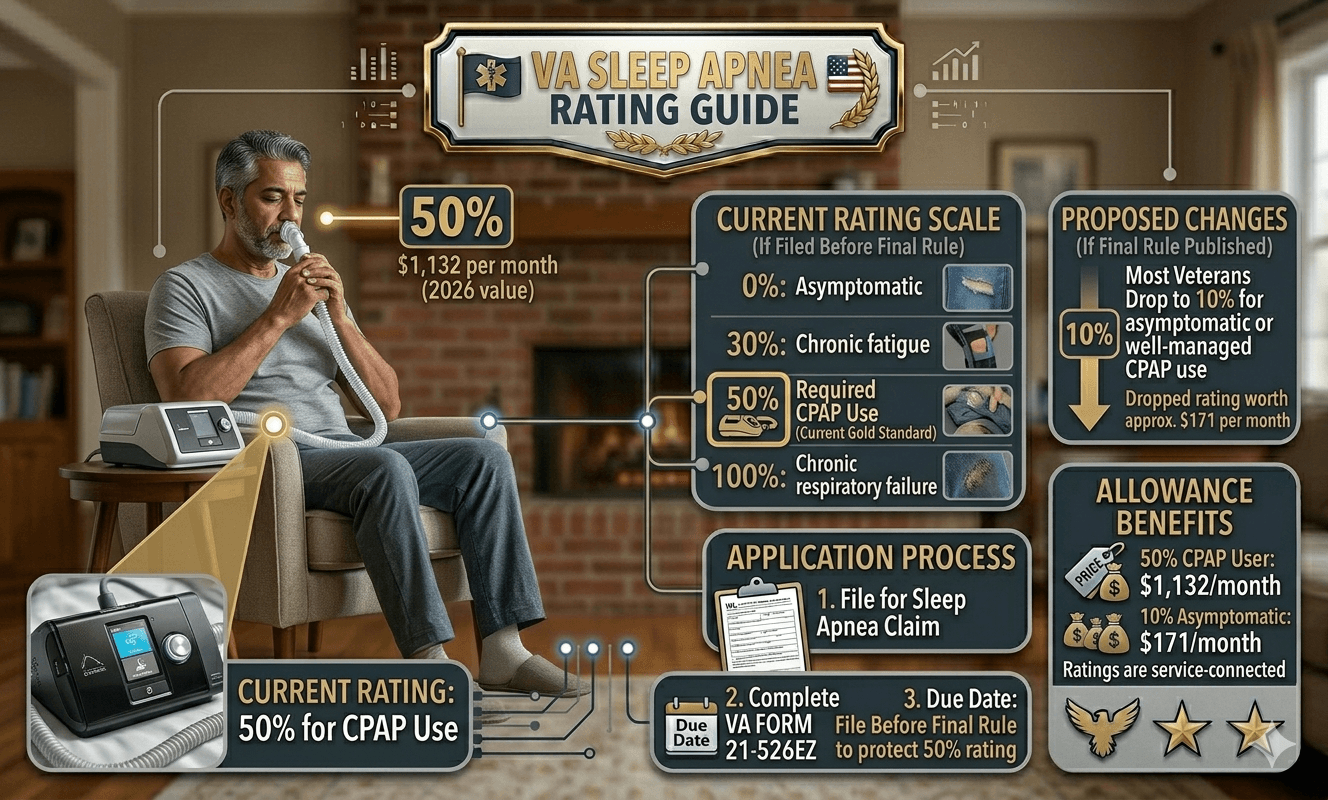
Yes, the VA rating for sleep apnea is currently 50% if you require a CPAP machine. That translates to $1,132.90 per month for a single veteran in 2026 . Lower ratings include 30% for persistent daytime sleepiness without a CPAP, 0% for asymptomatic cases, and 100% for the most severe cases involving tracheostomy or respiratory failure .

But here is the critical update every veteran needs to know right now: The VA has proposed major changes that would drop most CPAP users from 50% to just 10% . The proposed rule is not final yet—meaning the current 50% standard is still in effect. However, veterans who file before the final rule is published will be evaluated under the current, more favorable rating criteria . This guide covers current ratings, the pending changes, and exactly what you need to do to protect your benefits.
What Veterans Need to Know Right Now

Sleep apnea is one of the most common service-connected disabilities among veterans. But it is also one of the most confusing when it comes to VA ratings—and one of the most threatened by pending regulatory changes.
Real-life application: An Army veteran diagnosed with obstructive sleep apnea receives a CPAP machine from the VA. Under current rules, that veteran qualifies for a 50% disability rating—approximately $1,132 per month tax-free . Under the proposed rules, the same veteran would receive only 10% if the CPAP provides incomplete relief, or possibly 0% if symptoms are fully controlled . That is a difference of over $1,000 per month.
Here is the catch for 2026: The VA has been considering these changes since 2022. A final rule could be published at any time. Once published, the new rules will apply to all new claims . Veterans who already have a rating are protected by a grandfathering provision, but veterans who have not yet filed need to act.
Current VA Sleep Apnea Rating Schedule (Still in Effect)
The VA rates sleep apnea under 38 CFR § 4.97, Diagnostic Code 6847 . Here is the current rating scale:
| Rating | Criteria | What It Means |
|---|---|---|
| 0% | Asymptomatic but documented | You have a diagnosis but no current symptoms requiring treatment |
| 30% | Persistent daytime hypersomnolence | You experience significant daytime sleepiness but do not use a CPAP or similar device |
| 50% | Requires use of a breathing assistance device | You have been prescribed and use a CPAP, BiPAP, or similar device |
| 100% | Chronic respiratory failure with CO2 retention, cor pulmonale, or tracheostomy | The most severe cases involving organ damage or surgical airway intervention |
What the 50% Rating Means Financially (2026)
| Dependency Status | Monthly Payment (50% Rating) |
|---|---|
| Veteran alone | $1,132.90 |
| Veteran + spouse | Approximately $1,200+ |
| Veteran + spouse + child | Approximately $1,300+ |
Veterans May Qualify for Extra Benefits
Check available financial assistance, healthcare programs and other opportunities that may apply to you.
Check EligibilityThese amounts are tax-free and increase annually with cost-of-living adjustments .
What the Board of Veterans’ Appeals Says
Recent Board decisions confirm the current rating standard:
“A 50 percent rating is warranted when sleep apnea requires use of a breathing assistance device such as a continuous airway pressure (CPAP) machine. A 100 percent disability rating is warranted for sleep apnea which results in chronic respiratory failure with carbon dioxide retention or cor pulmonale; or requires tracheostomy.”
In practical terms, this means a veteran with a CPAP prescription gets 50%—period. There is no requirement to show that the CPAP is “effective” or that symptoms persist despite treatment .
Proposed VA Sleep Apnea Rating Changes: What You Must Know
The VA published a Notice of Proposed Rulemaking in February 2022 and a supplemental notice in September 2024. The proposed changes would fundamentally alter how sleep apnea is rated .
Proposed Rating Scale
| Rating | Proposed Criteria |
|---|---|
| 100% | Ineffective treatment or inability to use treatment WITH end-organ damage (heart, brain, kidney) |
| 50% | Ineffective treatment or inability to use treatment WITHOUT end-organ damage |
| 10% | Incomplete relief with treatment (including CPAP that provides partial relief) |
| 0% | Asymptomatic, fully controlled with or without treatment |
The 30% rating would be eliminated entirely under this proposal .
Why the VA Wants to Change the Rules
The VA argues that the current system overstates disability by focusing on the treatment prescribed rather than the residual impairment . In other words, if your CPAP works well and you function normally during the day, the VA believes a 50% rating is too high.
“VA states the existing criteria evaluate sleep apnea based on the intensity of treatment rather than residual disability, and advances in therapy now allow many veterans to function with minimal impairment despite requiring ongoing treatment.”
Who Is Protected — And Who Is Not
Currently rated veterans: Your existing rating is grandfathered. The VA cannot automatically reduce your rating when the new rule takes effect. Any reduction would require due process and evidence of sustained improvement .
Veterans who have not yet filed: This is where urgency matters most. Veterans who file their claim before the final rule is published will be evaluated under the current 50% CPAP standard. Once the new rule takes effect, that pathway closes .
Warning: If you already have a rating but file for an increase, you open your rating for re-evaluation under any applicable criteria—including the new rules if they have taken effect .
How to Qualify for VA Sleep Apnea Benefits
To receive VA disability for sleep apnea, you must establish a service connection . There are three pathways:
1. Direct Service Connection
Your sleep apnea began during active duty. Evidence includes:
- In-service medical records showing symptoms or diagnosis
- Sleep study conducted while on active duty
- Buddy statements documenting symptoms during service
2. Secondary Service Connection (Most Common for Veterans)
This is the most powerful pathway for many veterans. Sleep apnea can be secondary to another service-connected condition :
| Primary Condition | How It Links to Sleep Apnea |
|---|---|
| PTSD | PTSD disrupts sleep architecture; psychiatric medications cause weight gain and muscle relaxation that worsen apnea |
| Chronic rhinitis/sinusitis | Nasal blockage forces mouth breathing at night, triggering or worsening apnea |
| Asthma | Narrowed airways reduce oxygen flow; the two conditions often coexist |
| Weight gain | If weight gain is due to limited mobility from a service-connected disability, the resulting sleep apnea can be secondary |
| Toxic exposure (burn pits) | Respiratory damage from airborne irritants can lead to sleep apnea years after service |
Important: Sleep apnea is not a presumptive condition under the PACT Act. You must prove the connection .
3. Aggravation
A pre-existing condition worsened beyond its natural progression during service.
Evidence You Will Need
| Evidence Type | Description |
|---|---|
| Current diagnosis | Sleep study (polysomnography) confirming sleep apnea |
| Nexus opinion | A medical opinion linking your sleep apnea to service or another service-connected condition |
| CPAP prescription | Documentation from your VA provider prescribing a breathing assistance device |
| Compliance records | CPAP usage data showing you actually use the device |
How to File a VA Sleep Apnea Claim (Step-by-Step)
Step 1: Get a sleep study
The VA requires an official diagnosis. This usually means an in-lab polysomnography or a home sleep apnea test (HSAT) . Ask your VA primary care provider for a referral.
Step 2: Gather your evidence
- Sleep study results
- CPAP prescription (if applicable)
- Medical records showing in-service symptoms or connections to service-connected conditions
- Nexus letter from your doctor
Step 3: Determine your service connection pathway
- Direct: Did symptoms begin in service?
- Secondary: Do you have a service-connected condition that caused or worsened sleep apnea?
- Toxic exposure: Were you exposed to burn pits or airborne hazards?
Step 4: File your claim
- Online through VA.gov
- In person at a VA regional office
- With assistance from a VSO (DAV, VFW, American Legion)
Step 5: Do not wait if you are eligible now
Given the proposed changes, veterans who qualify should file as soon as possible .
Common Mistakes Veterans Make With Sleep Apnea Claims
Mistake #1: Assuming a CPAP automatically means 50%
Reality: Under current rules, yes—if you have a service connection. But many veterans fail to establish the service connection first. You need both: a CPAP prescription AND a link to service .
Mistake #2: Not filing secondary claims
Sleep apnea often develops after service due to other service-connected conditions . A veteran with service-connected PTSD may develop sleep apnea years later. That is still compensable—but you have to file it as a secondary claim.
Mistake #3: Waiting for the “right time”
With proposed changes looming, waiting is risky. Veterans who file before the final rule will be evaluated under the current 50% standard . Those who file after could see their rating cut to 10%.
Mistake #4: Not using CPAP consistently
If you are prescribed a CPAP but do not use it, the VA may question whether you truly “require” it. Use your device and keep compliance records.
Mistake #5: Filing for an increase without a strategy
If you already have a sleep apnea rating but want a higher rating (e.g., from 50% to 100%), be aware that opening your claim for review could expose it to new rating criteria .
What This Means Financially (Real Dollar Impact)
The difference between the current 50% rating and the proposed 10% rating is stark.
Monthly Comparison (2026 rates)
| Rating | Monthly Payment (Veteran Alone) | Annual Payment |
|---|---|---|
| 100% | Approximately $3,700+ | $44,000+ |
| 50% (current) | $1,132.90 | $13,594.80 |
| 30% (current) | Approximately $600+ | $7,200+ |
| 10% (proposed for CPAP users) | Approximately $180 | $2,160 |
| 0% | $0 | $0 |
The difference: Under the proposed rules, a veteran with a CPAP-controlled sleep apnea would lose approximately $950 per month — nearly $11,500 per year .
Combined Ratings Matter
Many veterans have multiple service-connected conditions. VA uses “VA math” to combine ratings, not simple addition .
Example: A veteran with 70% PTSD and 50% sleep apnea does not get 120%. Instead, VA calculates:
- 70% disability leaves 30% “efficiency”
- 50% of that 30% = 15%
- 70% + 15% = 85%, rounded to 90%
Under the proposed rules, if that same veteran’s sleep apnea dropped to 10%, the combined rating would drop to approximately 73% (rounded to 70%)—a significant reduction in monthly compensation.
Sleep Apnea and Other Respiratory Conditions: Special Rules
If you have both sleep apnea and another respiratory condition like asthma or COPD, the VA typically combines them under a single rating for the predominant disability .
The rule: 38 CFR § 4.96(a) prohibits combining ratings for multiple respiratory conditions. Instead, the VA assigns a single rating under the diagnostic code that reflects the predominant disability .
What this means: If you have both asthma and sleep apnea, you cannot simply add the ratings. The VA will evaluate both and assign the higher rating based on which condition is more disabling.
Example from a recent Board decision: A veteran with sleep apnea (requiring CPAP) and asthma (FEV-1 of 79% predicted) received a single 50% rating for the predominant disability—sleep apnea .
The Role of Toxic Exposure in Sleep Apnea Claims
The PACT Act expanded presumptive conditions for toxic exposure, but sleep apnea is NOT a presumptive condition .
However, you can still link sleep apnea to toxic exposure through direct evidence:
- Exposure to burn pits, airborne hazards, or other toxins during service
- Development of respiratory symptoms during or after service
- Medical nexus opinion connecting exposure to sleep apnea
This is a more challenging pathway but is viable with strong medical evidence .
FAQ (What Veterans Ask Google About Sleep Apnea VA Ratings)
What is the VA rating for sleep apnea with CPAP?
Currently, 50% if you have a service connection and require a CPAP machine .
Is sleep apnea a 100% VA disability?
Only in the most severe cases involving chronic respiratory failure, carbon dioxide retention, cor pulmonale, or tracheostomy .
Can I get VA disability for sleep apnea secondary to PTSD?
Yes. Many veterans receive secondary service connection for sleep apnea caused or aggravated by service-connected PTSD .
Is sleep apnea a presumptive condition under the PACT Act?
No. Sleep apnea is not a presumptive condition. You must prove service connection .
What is the proposed VA rating change for sleep apnea in 2026?
The VA proposes dropping most CPAP users from 50% to 10%, eliminating the 30% rating, and focusing on residual impairment rather than treatment prescribed .
If I already have a 50% sleep apnea rating, can the VA reduce it?
Existing ratings are grandfathered. The VA cannot automatically reduce your rating when new rules take effect .
How do I prove service connection for sleep apnea?
Through direct service connection (in-service onset), secondary service connection (caused by another service-connected condition), or aggravation .
How much does VA pay for 50% sleep apnea in 2026?
Approximately $1,132.90 per month for a single veteran .
What is the difference between 30% and 50% sleep apnea VA rating?
30% requires persistent daytime hypersomnolence without CPAP; 50% requires use of a breathing assistance device like CPAP .
Can I get TDIU for sleep apnea?
Possibly, if your sleep apnea—alone or combined with other conditions—prevents you from maintaining substantially gainful employment .
Final Takeaway (Actionable Summary)
The VA rating for sleep apnea currently stands at 50% for veterans who require a CPAP machine—worth over $1,132 per month tax-free . But major changes are proposed that would slash that rating to just 10% for most CPAP users .
Here is your action plan for 2026:
If you have sleep apnea and have NOT filed a claim:
- Get a sleep study and CPAP prescription from your VA provider
- Determine your service connection pathway (direct, secondary, or toxic exposure)
- Gather your evidence (sleep study, nexus letter, service records)
- File your claim NOW—before the final rule is published
- Once approved, your rating is grandfathered
If you have a service-connected condition that could cause sleep apnea:
- PTSD, chronic rhinitis, asthma, or weight gain from a service-connected disability are common pathways
- Request a nexus opinion linking your condition to sleep apnea
- File a secondary claim as soon as possible
If you already have a sleep apnea rating:
- Your current rating is protected
- Do NOT file for an increase without consulting an accredited representative—this could open your rating to re-evaluation
- Continue using your CPAP and maintain compliance records
If you are waiting for the “right time”:
The right time is now. The proposed rule could be published at any time. Once published, veterans filing new claims will be evaluated under the less favorable criteria .
The window to secure a 50% rating for CPAP-dependent sleep apnea is still open—but it may not stay open for long. Do not wait.
VA ratings for sleep apnea are determined based on the severity of the condition, which is evaluated through both medical examinations and the specific symptoms experienced by the veteran. The current VA rating system categorizes sleep apnea into various levels of severity, with ratings that can range from 0% to 100%. A higher percentage reflects a more severe impact of the condition on daily functioning and quality of life. Generally, an evaluation of 50% or higher indicates severe sleep apnea that requires continuous positive airway pressure (CPAP) therapy to manage symptoms effectively.
The criteria for evaluating sleep apnea encompass several factors, including the frequency and duration of apneic episodes, the need for oxygen supplementation during sleep, and any related health complications. Veterans must provide comprehensive medical evidence, such as sleep study results and physician statements, to support their claims. The outcome of this evaluation significantly affects the financial compensation awarded to veterans, influencing both monthly benefits and other additional services offered by the VA.
As the VA continues to reassess its rating criteria, ongoing discussions around the proposed changes to the current 50% rule are anticipated to be significant for veterans with sleep apnea. Understanding these elements of the VA rating system is vital for veterans navigating the benefits landscape, ensuring they are well-informed of their rights and entitlements.
Current VA Ratings for Sleep Apnea
In the context of the Veterans Affairs (VA) healthcare system, sleep apnea is classified under several rating categories based on the severity of its impact on a veteran’s daily functioning. The ratings for sleep apnea directly influence the compensation and benefits available to affected veterans. Currently, VA ratings for sleep apnea are primarily categorized into different percentages, each reflecting the severity of the condition and the accompanying symptoms.
The most commonly understood rating is the 50% evaluation, which applies to veterans who require a Continuous Positive Airway Pressure (CPAP) machine to manage their sleep apnea. This rating acknowledges the significant impact of the condition on sleep quality and daily life, as the use of CPAP indicates a moderate to severe form of the disorder that necessitates medical intervention.
Another critical rating is the 30% evaluation, designated for veterans experiencing persistent daytime sleepiness due to sleep apnea, even if they do not require CPAP treatment. This rating recognizes that the effects of sleep apnea extend beyond the bedroom and can significantly impair daily activities and quality of life.
Additionally, there exists a 0% rating for veterans who may be diagnosed with sleep apnea but remain asymptomatic. This rating indicates that the disorder does not currently affect the veteran’s functioning, hence does not warrant compensation. Conversely, the highest rating of 100% is reserved for individuals whose sleep apnea leads to more severe health complications or significant impairment in social or occupational capacities. Veterans seeking this rating must provide substantial medical evidence demonstrating the profound effect of their condition.
Financial Compensation Overview
The Department of Veterans Affairs (VA) provides financial compensation to veterans suffering from sleep apnea based on their disability ratings. The current rating system plays a crucial role in determining monthly compensation levels, which directly influence the quality of life for those affected. In 2026, veterans diagnosed with sleep apnea and rated at 50% can expect a monthly compensation of $1,132.90, a figure that underscores the significance of achieving this rating.
Compensation rates vary significantly based on the severity of the condition as reflected in the veteran’s disability rating. For instance, veterans rated at 0% receive no monthly compensation, while those with a 10% rating can expect modest payments of $165.92. As the rating increases, so do the monthly compensation amounts. Veterans rated at 30% will receive $508.24 per month, which significantly enhances their financial stability compared to lower-rated peers.
The 50% rating serves as a pivotal threshold for many veterans, as it not only brings higher compensation but also improves access to additional benefits. This rating allows for supplementary options, such as increased healthcare access and potential eligibility for other support programs, which can greatly aid in managing the challenges posed by sleep apnea.
It is essential for veterans to understand these compensation tiers, especially when navigating their benefits and addressing the impact of sleep apnea on daily life. There are potential revisions to the current rating system on the horizon, which may affect these compensation levels. Therefore, keeping informed about these changes and their implications will be vital for all veterans dealing with sleep apnea.
Proposed Changes to Sleep Apnea Ratings
The Department of Veterans Affairs (VA) has initiated a review of the current rating system for sleep apnea, which significantly affects many veterans who rely on Continuous Positive Airway Pressure (CPAP) therapy. One of the most notable proposed adjustments is the potential reduction of the rating for many CPAP users from the current 50% to a substantially lower 10%. This proposal has generated considerable discussion within veteran communities as it may influence the benefits received by those diagnosed with sleep apnea.
The reasoning behind this proposed change stems primarily from evolving medical guidelines and treatment standards for sleep apnea. Historically, a 50% rating had been justified based on the severity of the condition and the necessity for CPAP therapy. However, as treatment methods improve and the understanding of sleep apnea broadens, the VA is considering whether lower ratings might be more suitable for certain veterans whose conditions are managed effectively with CPAP.
This adjustment underscores the ongoing effort by the VA to align its ratings with current medical evidence and to ensure that the ratings accurately reflect the severity and functional impact of sleep apnea on veterans’ lives. If implemented, these proposed changes could affect a significant number of veterans, potentially reducing their monthly compensation and altering their overall access to benefits related to sleep apnea treatments.
For many veterans who have adapted to living with sleep apnea and have managed their symptoms effectively with CPAP, a reduction in their rating may invoke feelings of apprehension regarding future health evaluations and benefits. Understanding the implications of these proposed changes is crucial for veterans and advocates as they navigate this evolving landscape of healthcare and compensation.
The Importance of Timing: When to File a Claim
For veterans suffering from sleep apnea, understanding the importance of timing when filing a claim is crucial. Currently, the Department of Veterans Affairs (VA) utilizes a 50% rule for evaluating sleep apnea claims. This means that veterans can receive compensation based on the severity of their condition as assessed through the existing criteria. However, proposed changes to these rules may soon alter the claims process, making it imperative for veterans to file their claims under the current regulations before any adjustments take effect.
Filing a claim sooner rather than later will ensure that veterans benefit from the existing criteria, which are more favorable under the current 50% standard. Under this regulation, veterans can receive compensation if they are diagnosed with obstructive sleep apnea that requires a continuous positive airway pressure (CPAP) device or if they have other significant symptoms that warrant the assessment. As veterans navigate this process, they must recognize that those who wait may face restrictions or challenges imposed by the new standards, which might be less beneficial than the existing guidelines.
Additionally, the timeframe for processing claims can vary significantly, so veterans who file early can avoid potential delays associated with the impending rule changes. Veterans are urged to gather all necessary documentation to support their claim, including medical records, diagnosis letters, and any other relevant material that can strengthen their case. Moreover, contacting a veteran’s service organization for assistance might provide further guidance on navigating the claims process effectively.
To summarize, filing a claim for sleep apnea under the current regulations is critical for veterans seeking compensation. The advantages of acting promptly cannot be overstated, as the landscape of veteran benefits remains subject to change. By understanding the urgency of the situation, veterans can take proactive steps to secure the benefits they rightfully deserve.
How to File a Secondary Claim
Filing a secondary claim for sleep apnea can be an important step for veterans seeking disability compensation. A secondary claim is filed when a veteran believes that a service-connected condition has caused or aggravated another health condition—in this case, sleep apnea. Understanding the process to file this type of claim is crucial for ensuring proper compensation and support.
To qualify for a secondary claim, veterans must demonstrate a direct connection between their primary service-related disability and their diagnosed sleep apnea. For example, if a veteran has a service-connected condition such as PTSD, which has led to insomnia or anxiety, they may file a secondary claim arguing that these issues contributed to the onset of sleep apnea.
When preparing to file a secondary claim, it is essential to gather the necessary documentation. This includes medical records that confirm the diagnosis of sleep apnea, evidence that links the sleep disorder to the primary service-connected condition, and any treatment records that highlight the severity and impact of both conditions. Veterans should also obtain statements from their healthcare providers that outline how their primary condition has affected their sleep health.
Once all documentation is compiled, veterans can file their claim through the VA’s online portal or by submitting a paper application. During this process, it is crucial to complete all sections thoroughly and accurately to avoid delays. Additionally, veterans should keep copies of all submitted documents for their records. Seeking assistance from a representative, such as a Veterans Service Organization (VSO), can help ensure that claims are filed correctly and efficiently.
In conclusion, filing a secondary claim for sleep apnea involves understanding the connection between service-related disabilities and gathering extensive documentation to support the claim. By following these steps, veterans can enhance their chances of receiving the compensation they deserve.
To qualify for a VA rating for sleep apnea, veterans must demonstrate specific conditions related to their symptoms and medical histories that verify the presence and severity of their condition. The Department of Veterans Affairs categorizes sleep apnea into different degrees of severity, which can influence the rating assigned. Typically, ratings are assigned based on factors such as the frequency of episodes, the need for continuous positive airway pressure (CPAP) therapy, and the impact of the disorder on daily functioning.
For a 50% VA rating, veterans must show that their sleep apnea requires a CPAP machine for treatment and has a noticeable impact on their quality of life. Additionally, symptoms like chronic fatigue, excessive daytime sleepiness, or other physical and mental health issues may also be taken into account during the assessment process. Furthermore, higher ratings could be awarded if the veteran experiences more severe complications or additional health conditions related to sleep apnea.
Now, gathering evidence becomes a critical step for veterans seeking ratings. Veterans can bolster their claims by compiling various forms of documentation. This may include medical records detailing sleep studies, doctor’s notes that corroborate the diagnosis, and any related treatment records. Personal statements describing the impact of the condition on day-to-day activities can be beneficial, as can statements from family members or friends who witness the symptoms and their effects firsthand.
Finally, it’s essential to understand that each case is evaluated individually. Veterans are encouraged to seek guidance through official VA resources or consultation with medical professionals to navigate the complexities of the VA rating process for sleep apnea. Properly documenting the qualifying conditions not only aids in securing an appropriate rating but also ensures veterans receive the care and support they rightfully deserve.
Resources for Veterans Seeking Help
Veterans experiencing sleep apnea can find a range of resources to help them navigate the complexities of their condition and pursue compensation through the VA. Understanding the available options is critical. One primary resource is the U.S. Department of Veterans Affairs (VA) itself, which offers a comprehensive array of services designed to assist veterans with health care, benefits, and claims filing. Veterans can reach out to their local VA medical center or regional office for personalized assistance. You can find your nearest VA facility by visiting the official VA website.
In addition to VA offices, various online platforms provide invaluable information for veterans. Websites such as the National Veterans Foundation (NVF) and the Disabled American Veterans (DAV) offer guidance on how to file claims related to sleep apnea. These organizations specialize in supporting veterans and can help you understand the process involved in securing the correct rating for your condition.
Advocacy groups are also significant resources for those seeking help with sleep apnea claims. Organizations like the American Legion and Veterans of Foreign Wars (VFW) have dedicated representatives who are knowledgeable about VA procedures and can assist to ensure you receive the support and resources necessary. They often host workshops and meetings that provide veterans the opportunity to learn about their rights and available assistance.
Finally, support networks, including online forums and social media groups, allow veterans to connect with others dealing with similar challenges. These platforms can serve as safe spaces to exchange information, share personal experiences, and seek advice on navigating the VA system. Utilizing these resources effectively can significantly ease the claims process and improve outcomes for veterans struggling with sleep apnea.
Conclusion and Final Thoughts
As we approach 2026, the VA rating system for sleep apnea remains a focal point for many veterans seeking necessary benefits. The current system, which utilizes a 50% rating for moderate symptoms, provides essential support for those living with this condition. However, proposed changes could significantly alter the landscape of benefits available to veterans suffering from sleep apnea. Understanding these potential changes is crucial for veterans who wish to maximize their benefits before any new regulations take effect.
It is imperative for veterans to act swiftly in securing their entitlements under the existing regulations. The current criteria allow veterans to receive timely and adequate support, and delays in filing claims or collecting necessary documentation could result in missed opportunities. Veterans should ensure they are familiar with the application processes and eligibility requirements, as these can influence the outcome of their claims.
Additionally, staying informed about changes in the VA rating system is essential for all veterans. The landscape of veteran benefits is subject to adjustment, and understanding such developments can empower veterans to advocate for themselves more effectively. Seeking assistance from veteran service organizations or legal professionals specializing in VA claims can provide further guidance and support, ensuring that veterans are adequately prepared to navigate these complexities.
In conclusion, the current 50% rule is an essential aspect of the VA rating system for sleep apnea. Veterans must remain proactive in securing their benefits and staying updated on any potential changes. Continuous support and information dissemination are vital to helping veterans achieve the best outcomes regarding their health and well-being.




🇺🇸 IMPORTANT DISCLAIMER – Veterans Benefits Information
This site provides general information about U.S. Department of Veterans Affairs (VA) benefits for educational and informational purposes only.
- Not Official: We are NOT affiliated with, endorsed by, or connected to the U.S. Department of Veterans Affairs (VA), the Veterans Benefits Administration (VBA), the Veterans Health Administration (VHA), or any other government agency.
- No Legal/Financial Advice: The content on this website is for informational purposes only and does not constitute legal, financial, or medical advice. VA benefits rules change frequently – always consult with an accredited Veterans Service Officer (VSO) or a qualified professional for your specific situation.
- Official Sources: For official, binding information and to apply for benefits, always visit official .gov websites: VA.gov, Benefits.VA.gov, or SSA.gov.
- No Data Collection: This site does not collect, store, or process any personal information. It does not have login forms, contact forms, or any system to capture user data. We never ask for your Social Security Number, bank details, or any personal information.
- 🚨 Scam Alert: The VA and other government agencies never charge fees for benefit applications. If anyone asks for money to "process" your VA claim, it is a scam. Report it to the VA Office of Inspector General at VA.gov/OIG.
- Advertising: This site uses third-party advertising (Adsterra) to cover operational costs. We do not endorse or guarantee any products or services advertised.
📌 Information provided as of June 2026. Always verify current eligibility and rules with official .gov sources.
This site is not affiliated with the U.S. Department of Veterans Affairs or any government agency. All information is for educational purposes only. Please visit VA.gov for official information.
