
Introduction to Chapter 35 VA Benefits
Chapter 35 VA Benefits, also known as the Dependents’ Educational Assistance (DEA) program, is a vital initiative established to support eligible dependents and survivors of veterans whose disabilities are permanently and totally service-related. This program emphasizes education, providing a pathway for family members to pursue higher education and improve their career prospects. It aims to empower those who have lost a main contributor to household income due to the effects of a veteran’s service-related disabilities.
The primary purpose of Chapter 35 VA Benefits is to facilitate access to education for dependents of those veterans who are unable to continue their service due to severe conditions. The program not only alleviates the financial burden of educational costs but also serves as a tribute to the sacrifices made by these veterans. Enrollment in this program offers several benefits, including tuition assistance, a monthly stipend, and funding for additional educational resources such as books and supplies.

This assistance is significant as it reflects the commitment to ensure that the families of disabled or deceased veterans can still achieve their educational and career goals. Chapter 35 serves to provide a sense of stability and hope during challenging times, enabling eligible dependents to gain skills necessary for future employment opportunities. Over the years, countless families have benefited from affordable education through this program, allowing them to lead productive lives in honor of their loved ones’ sacrifices.

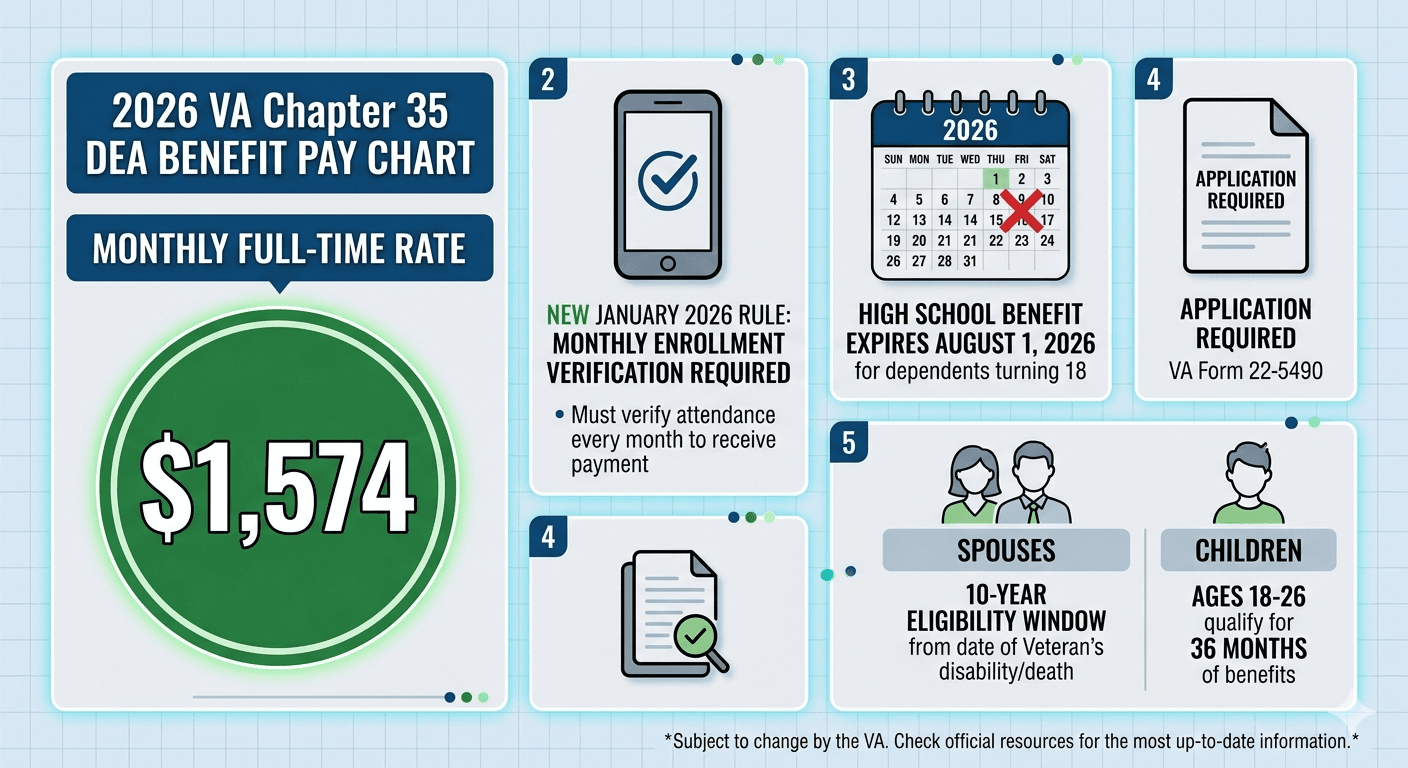
As of May 24, 2026, Chapter 35 VA benefits (also called DEA) pay eligible spouses and children of disabled veterans $1,574 per month for full-time college or trade school.
But there are THREE urgent changes families need to know TODAY. First, the VA now requires monthly enrollment verification for all Chapter 35 students—miss a month, miss a payment. Second, the special high school benefit for dependent children turns 18 sunsets on August 1, 2026—you have about 10 weeks left to claim it. Third, the VA is processing a record number of Chapter 35 claims, with a 30- to 90-day wait for your Certificate of Eligibility.
Bottom line: If your spouse or child plans to use Chapter 35 for the fall 2026 semester, you should apply today. The high school benefit is ending forever in August. And monthly verification is mandatory starting now—no exceptions.
What Veterans and Families Need to Know Right Now
Chapter 35 is not automatic. You must apply. And the rules changed dramatically in 2026.
Veterans May Qualify for Extra Benefits
Check available financial assistance, healthcare programs and other opportunities that may apply to you.
Check EligibilityThe Survivors’ and Dependents’ Educational Assistance Program (DEA) gives 36 months of education payments to the families of veterans who are 100% permanently and totally disabled (P&T) or who died from a service-connected condition.
The monthly payment lands in the STUDENT’S bank account—not the veteran’s, not the school’s. For the 2026 benefit year (October 1, 2025 through September 30, 2026), the full-time rate is $1,574 per month.
Real-life example: A spouse attending Ohio State University full-time for nine months receives about $14,166 over the school year. That money can pay tuition, rent, books, or childcare. But the family must pay the school directly—Chapter 35 does NOT send money to the university like the Post-9/11 GI Bill does.
The biggest mistake families make: Assuming the VA notifies them when they qualify. The VA does not. You must check the veteran’s award letter for “100% P&T” and then file VA Form 22-5490 yourself.
Latest Updates Today (May 24, 2026)
1. Monthly Enrollment Verification is NOW Mandatory
Starting January 2026, every Chapter 35 student must verify their enrollment each month to get paid. You can verify by:
- Text message (opt-in through your VA profile)
- Email link
- Online at VA.gov (Verify Your School Enrollment)
- Phone: 888-442-4551
- Ask VA system
If you do NOT verify, the VA withholds your payment. No warning. No grace period. Once you verify, payment processes in 5-7 calendar days.
Why this matters: A student who forgets to verify in September won’t see October’s payment until they verify—sometimes weeks late. Set a monthly calendar reminder. Do not rely on the school to do this for you.
2. High School Benefit Ends August 1, 2026—URGENT
This is the most time-sensitive news. Dependent children who turn 18 during their senior year of high school can receive Chapter 35 benefits while still in high school. But Congress is sunsetting this provision on August 1, 2026.
After August 1, high school students can no longer claim Chapter 35. If your child qualifies, you need to:
- Apply NOW using VA Form 22-5490
- Submit it by MAIL (online applications may not process fast enough for the high school benefit, according to recent beneficiary reports)
- Request back pay for up to 5 months of the current school year
That back pay could total approximately $7,800—real money for college visits, a car, or housing deposits.
Crucial detail: The first 5 months after the child turns 18 do NOT count against their 36 total months of benefits. So a student can collect high school payments AND still have a full 36 months for college.
3. VA Processing Times Are Running 30-90 Days
The VA is currently swamped with Chapter 35 applications. Expect 30 to 90 days from submission to receiving your Certificate of Eligibility (COE).
Action step: Submit your application NOW for fall 2026 semester. If you wait until August, your student may not have a COE when classes start.
4. 2026 COLA Increase Already Applied
The January 2026 Cost-of-Living Adjustment (COLA) increased all VA education benefits by 2.8%. The current $1,574 rate reflects that increase and is locked in through September 30, 2026.
Who Qualifies for Chapter 35 Benefits
Eligibility is narrower than many families think. Here is exactly who qualifies.
For Spouses
A spouse qualifies if:
- The veteran has a 100% permanent and total (P&T) service-connected disability rating, OR
- The veteran died from a service-connected condition, OR
- The veteran is a former POW, MIA, or was captured in the line of duty
The spouse has a 10-year window to use the benefit from the date the VA granted the P&T rating. If the veteran died on active duty, the spouse gets 20 years.
Critical distinction: A temporary 100% rating does NOT qualify. The VA award letter must explicitly say “permanent and total” or “P&T.”
For Children (Dependent Sons and Daughters)
A child qualifies if:
- The veteran meets the same disability/death criteria above
- The child is between ages 18 and 26 (with exceptions—see below)
- For eligibility dates BEFORE August 1, 2023: Must be at least 18
- For eligibility dates ON or AFTER August 1, 2023: Can use at any age
The high school exception (ending August 1, 2026): A child who turns 18 during senior year can receive benefits while still in high school. After August 1, this ends. Apply now.
Who Does NOT Qualify
- Children of veterans rated less than 100% P&T (including 100% temporary)
- Spouses after the 10-year window expires
- Children over age 26 (with no disability extension)
- Dependents of veterans with dishonorable discharges
How to Apply: Step-by-Step Guide
Follow these exact steps. Do not skip any.
Step 1: Confirm P&T Status
Find the veteran’s VA award letter. Look for the phrase “permanent and total” or “P&T.” If it’s not there, the family does not qualify for Chapter 35 yet.
Step 2: Complete VA Form 22-5490
Go to VA.gov and search for “Dependents’ Application for VA Education Benefits.” Complete the online application. It takes about 30 minutes.
Information you will need:
- Veteran’s full name, SSN, and VA file number
- Veteran’s branch and dates of service
- The disability rating letter (upload a scan)
- Dependent applicant’s name, DOB, and SSN
- The school’s name and program of study
For the high school benefit (ending August 1): Some beneficiaries report that mailing the paper form is faster for this specific use case. Print the form, fill it out, and mail it to the VA Regional Processing Office.
Step 3: Notify the School’s VA Certifying Official
Call the Veterans Services office at the student’s school. Tell them the application is submitted. Ask them to prepare the enrollment certification so it is ready to go the moment your Certificate of Eligibility arrives.
Step 4: Wait for the COE
The VA mails your Certificate of Eligibility within 30-90 days. The school CANNOT certify enrollment without it.
Step 5: Complete the Enrollment Datasheet
Once the school receives your COE, they will ask you to complete an Enrollment Datasheet. Do this immediately before each semester.
Step 6: Verify Enrollment EVERY MONTH
Starting the month your benefits begin, verify your enrollment through VA.gov, text, email, or phone. Do this during the last week of every month. Payments arrive 5-7 days after verification.
What Chapter 35 Pays: Complete 2026 Rate Chart
Full-time rates for the 2026 benefit year (October 1, 2025 – September 30, 2026)
| Type of Training | Full-Time Monthly Rate |
|---|---|
| College/University (full-time) | $1,574 |
| Trade/Vocational School (full-time) | $1,574 |
| Special Restorative Training | $1,574 |
Part-time college rates:
| Enrollment Level | Monthly Rate |
|---|---|
| 3/4 time | $1,244 |
| 1/2 time | $912 |
| Less than 1/2 time | $912 (or actual tuition, whichever is less) |
| 1/4 time or less | $393.50 (or actual tuition, whichever is less) |
On-the-Job Training & Apprenticeships:
| Months of Training | Monthly Rate |
|---|---|
| Months 1-6 | $999 |
| Months 7-12 | $751 |
| Months 13-18 | $493 |
| Month 19+ | $251 |
Other benefits:
- Licensing/certification tests: Up to $2,000 reimbursement
- Correspondence training (spouses only): 55% of cost per lesson
Common Mistakes Families Make (Avoid These)
Mistake #1: Thinking the School Gets Paid Directly
Chapter 35 pays the STUDENT, not the school. The family must pay tuition out of pocket using the monthly stipend. For families expecting the VA to send a check to the bursar’s office, this creates major problems.
Fix: Set up a dedicated bank account for Chapter 35 payments. Automatically transfer money to cover tuition when it arrives.
Mistake #2: Missing Monthly Verification
As of January 2026, every single month requires verification. If you verify on October 1 for September attendance, you are fine. If you forget until October 15, your September payment is delayed.
Fix: Add a recurring calendar alert for the 28th of every month: “Verify VA enrollment.”
Mistake #3: Assuming Chapter 35 and Post-9/11 GI Bill Can Both Be Used Fully
A dependent who qualifies for both Chapter 35 AND the Fry Scholarship (Post-9/11 for surviving children) cannot use 36 months of each. The VA caps total combined education benefits at 81 months across all programs.
Fix: Run the numbers before choosing. For most families, Fry Scholarship (full tuition + BAH + book stipend) beats Chapter 35 (stipend only). But Fry is not available to children of living disabled vets—only survivors.
Mistake #4: Waiting Until Senior Year of High School to Apply for College Benefits
The VA takes 30-90 days to process applications. If you wait until July to apply for September college start, your student may not have benefits until October or November.
Fix: Apply the moment the veteran receives the 100% P&T rating—even if the child is only 15. The eligibility is established, and the application can sit ready.
Mistake #5: Overlooking the High School Deadline
The high school benefit ends August 1, 2026. Families who wait until fall 2026 to apply will have lost the opportunity entirely.
Fix: If your child turns 18 during their senior year between now and August 1, 2026, file this week. Use mail for fastest processing.
What Chapter 35 Means Financially for Your Family
Let’s talk real numbers for Ohio families and beyond.
A full-time college student using Chapter 35 receives $1,574 per month for 9 months: $14,166 per school year.
Compare that to average costs:
- Average in-state public university tuition (Ohio): ~$12,000/year
- Remaining for rent/books after tuition: ~$2,166
That is tight but possible. However, a student at a private university ($35,000+/year) will need additional loans, scholarships, or family support.
Compare Chapter 35 vs. Post-9/11 Transfer (for families who still can transfer):
| Feature | Chapter 35 (DEA) | Post-9/11 Transfer |
|---|---|---|
| Monthly payment to student | $1,574 (full-time) | BAH ($1,500-$2,800+) + $1,000/year books |
| Tuition paid to school | No | Yes (full in-state public) |
| 36-month total (9-month year) | ~$14,166 | ~$18,000+ PLUS tuition |
| Veteran retains benefits? | Yes (family’s own) | No (veteran transfers away) |
The financial reality: For a living 100% P&T veteran who never transferred their GI Bill, Chapter 35 is the only option. For surviving families, Fry Scholarship (Post-9/11) is usually better.
The high school benefit windfall: A child who turns 18 in January 2026 and graduates in June 2026 can claim up to 5 months of back pay at $1,574/month = $7,870 tax-free for high school attendance. This does NOT reduce college benefits.
Political & Government Context Behind the 2026 Changes
Why is monthly verification happening now?
Statutorily required. The VA was supposed to implement monthly verification years ago. A 2024 audit revealed over $100 million in improper education benefit payments due to uncorrected enrollment changes. January 2026 was the hard deadline.
The VA admits this is a “major change” for Chapter 35 beneficiaries and has launched a “comprehensive communication strategy.” But many families report never receiving notices.
Why is the high school benefit ending August 1, 2026?
Congress quietly sunset this provision in the same appropriations bill that funded the VA for 2026. The official reason: cost savings. The unofficial reality: the provision was always intended as temporary when expanded in 2023, and no one pushed for renewal.
What is not being said publicly: The VA’s education budget for Chapter 35 increased by $267 million in 2026 and will increase another $220 million in 2027. The sunset of high school benefits is projected to save approximately $180 million over five years.
The Rudisill-Perkins impact: Recent court decisions have expanded education benefits for some veterans, but these do not directly affect Chapter 35 dependents. However, the VA is currently automating eligibility reviews, which has caused some processing delays.
FAQ: Chapter 35 VA Benefits 2026
Q: How do I verify my Chapter 35 enrollment each month?
A: Go to VA.gov and search “Verify Your School Enrollment.” Or opt into text verification through your VA profile. You can also call 888-442-4551. Do this every month during the last week of the month.
Q: What is the Chapter 35 monthly payment for 2026?
A: Full-time college or trade school: $1,574 per month. Part-time rates: $1,244 (3/4 time), $912 (1/2 time), $393.50 (1/4 time). Apprenticeship rates start at $999/month and decrease over time.
Q: Can my child use Chapter 35 for high school?
A: Only if they turn 18 during their senior year AND you apply before August 1, 2026. After August 1, this benefit ends permanently. The first 5 months do not count against their 36 college months.
Q: How long does a spouse have to use Chapter 35 benefits?
A: 10 years from the date the veteran received the 100% P&T rating. If the veteran died on active duty, the spouse gets 20 years.
Q: What is the age limit for children using Chapter 35?
A: Generally, children must use benefits between ages 18 and 26. However, if the child became eligible on or after August 1, 2023, they can use benefits at any age (but still must complete by age 26 unless disability exception applies).
Q: Does Chapter 35 pay for online college?
A: Yes. Online/distance education counts toward enrollment status. The monthly payment is the same as in-person for full-time enrollment.
Q: Can a child use Chapter 35 and the veteran still claim them as a dependent for VA disability?
A: No. Once a child turns 18, they generally drop off the veteran’s disability award. Chapter 35 payments usually exceed what the veteran would receive for the child as a dependent.
Q: What is the 81-month rule?
A: The VA caps combined education benefits at 81 months total across all programs. If a dependent uses 36 months of Chapter 35 and later qualifies for another VA education program, they cannot exceed 81 total months.
Q: How do I apply for Chapter 35?
A: Complete VA Form 22-5490 online at VA.gov. You will need the veteran’s disability rating letter showing 100% P&T. Processing takes 30-90 days.
Q: What is the difference between Chapter 35 and Fry Scholarship?
A: Fry Scholarship (Post-9/11 GI Bill for surviving children) pays full tuition directly to the school PLUS monthly BAH housing PLUS book stipend. Chapter 35 pays a flat monthly stipend to the student. For surviving families, Fry is almost always better.
Final Takeaway: Your Action Plan for Today
If you are a 100% P&T veteran with a spouse or child who might attend school:
Apply for Chapter 35 today. Do not wait. The 30- to 90-day processing time means every day counts for fall 2026 enrollment.
If your child turns 18 during their senior year AND graduates before or in June 2026:
File VA Form 22-5490 by MAIL this week. The high school benefit ends August 1, 2026. You could receive up to $7,870 in back pay that does NOT reduce college benefits. This is a one-time opportunity expiring in 10 weeks.
If your child is already using Chapter 35 for college:
Set up monthly verification reminders. The VA will not pay you if you forget to verify. Use text verification for the easiest experience. Call 888-442-4551 if you miss a month.
If you are a surviving spouse with children:
Compare Chapter 35 vs. Fry Scholarship before choosing. Once you elect one, you generally cannot switch. For most surviving families, Fry Scholarship provides more total value (full tuition + BAH + books).
Most important: Chapter 35 is not automatic. The VA does not track down eligible families. You must apply. And with the high school benefit sunsetting in August 2026, waiting is not an option.
Eligibility for Chapter 35 Benefits
Chapter 35 benefits, officially classified under the Dependents’ Educational Assistance (DEA) program, are designed to support eligible dependents and survivors of veterans who are permanently and totally disabled due to a service-related condition or who died while on active duty. This section outlines the specific conditions and requirements that determine eligibility for these benefits.
Firstly, the primary beneficiaries of the Chapter 35 education benefits are the spouses and children of qualifying veterans. To qualify as an eligible spouse, one must be the legally married partner of a veteran who has been rated permanently and totally disabled due to a service-connected impairment, or who has died as a result of such a disability. Age restrictions apply; spouses can typically access benefits until they reach the age of 26, although this may vary according to specific circumstances.
Children, on the other hand, must also meet certain age requirements to be considered eligible for Chapter 35 benefits. Generally, a child is eligible from the age of 18 until they turn 26. Furthermore, children must be pursuing a program of education to qualify for these benefits, and the institution must be recognized by the Department of Veterans Affairs. In cases where a veteran has passed away, children may still retain eligibility, provided their parent’s death was a result of a service-related cause.
Documentation is an essential part of the eligibility verification process. Applicants must submit certain required paperwork upon application, including forms outlining the veteran’s service details, proof of the relationship to the veteran, and evidence of the veteran’s disability status. It is crucial for dependents and survivors to provide comprehensive documentation to substantiate their claims effectively.
2026 Pay Rates Under Chapter 35
The Chapter 35 benefits program, designed to provide educational assistance to dependents of veterans who are permanently and totally disabled due to a service-related condition or who have died as a result of military service, continues to play a significant role in supporting education for many individuals in 2026. The pay rates under Chapter 35 for the year 2026 are expected to reflect adjustments that consider inflation and the rising cost of education, ensuring that recipients receive adequate assistance.
For the year 2026, the monthly benefit rates for Chapter 35 are anticipated to align with cost adjustments similar to previous years. Specifically, these rates are determined by the U.S. Department of Veterans Affairs (VA) through a combination of factors that may include the cost-of-living adjustments (COLA) and other legislative changes. Typically, the VA announces these rates early in the fiscal year, providing clarity to potential beneficiaries on the financial support they can expect.
As it stands, eligible dependents may receive a standardized amount, which is aimed at covering tuition and fees associated with various educational programs, including college, vocational training, and apprenticeships. It is essential for beneficiaries to stay informed of these adjustments, as they can significantly impact educational planning and budgeting. Moreover, the implementation of these rates serves the broader purpose of ensuring that education remains accessible and affordable for eligible dependents of veterans. Consequently, individuals and families should continue to explore the potential benefits of Chapter 35 and plan accordingly for their educational future.
Types of Educational Programs Covered
Chapter 35 benefits provide a comprehensive range of educational programs designed to support eligible dependents of veterans who are permanently and totally disabled due to a service-related condition or who died in service. These benefits encompass various types of educational opportunities to help beneficiaries obtain necessary skills and qualifications.
One category includes traditional college and university programs, where eligible students can attend degree-granting institutions. This option allows for pursuit of associate, bachelor, and advanced degree programs, ensuring that students receive a robust educational experience. Furthermore, vocational and technical training programs are also covered, which offer essential skills in various trades and crafts, preparing individuals for the workforce with targeted expertise.
Additionally, Chapter 35 benefits include on-the-job training and apprenticeship programs. These programs provide hands-on experience, allowing beneficiaries to earn while they learn. Such practical training is crucial in fields where experience is valued as much as formal education.
Flight training is another valuable educational avenue included under Chapter 35 benefits. This option is particularly beneficial for those aiming to pursue careers as commercial pilots, providing them with the training necessary to meet Federal Aviation Administration (FAA) requirements.
Each type of program under Chapter 35 comes with specific duration limits for eligibility. Generally, beneficiaries can receive assistance for up to 45 months of education, but this may vary based on the educational path chosen. Ultimately, understanding these various educational options is vital for maximizing the advantages of Chapter 35 benefits in support of both personal and professional growth.
Application Process for Chapter 35 Benefits
The process of applying for Chapter 35 VA benefits, which provide educational assistance to the dependents of veterans, involves several essential steps. This structured approach is designed to simplify the application experience and increase the likelihood of approval. First and foremost, individuals seeking benefits should confirm their eligibility. This is crucial as Chapter 35 benefits are specifically available to certain groups including children and spouses of service members who are permanently and totally disabled due to a service-related condition or who died in the line of duty.
Once eligibility has been established, applicants need to gather the necessary documentation. The primary form required to apply for Chapter 35 benefits is the VA Form 22-5490, Application for Survivors’ and Dependents’ Educational Assistance. It’s important to complete this form accurately to avoid delays in the application process. Applicants should also have documentation that supports their eligibility such as the veteran’s service record, marriage certificate, or birth certificate if applying as a dependent child.
Submission of the application can be done through various methods, including online via the VA’s website, by mail, or in person at a regional VA office. The online submission is often the preferred method due to its speed and convenience. Regardless of the method chosen, it is advisable to retain copies of all submitted documents for personal records. Additionally, applicants should be vigilant about potential common pitfalls in the process, such as incomplete forms or inadequate documentation, which can lead to processing delays or denials.
Overall, staying organized and informed throughout the application process can significantly improve the chances of securing Chapter 35 VA benefits. After submitting the application, applicants can track the status through the VA’s online portal, which provides insights into the processing timeline and any additional information that may be needed.
Renewal and Continued Eligibility
To maintain access to Chapter 35 VA benefits, recipients must demonstrate compliance with the requirements for renewal and continued eligibility. Chapter 35 benefits, also known as Dependents’ Educational Assistance (DEA), are allocated to eligible dependents and survivors of veterans who are permanently and totally disabled due to a service-related condition. This section outlines the necessary actions that beneficiaries must undertake to renew their benefits and ensure they remain eligible.
The renewal process generally requires recipients to provide updated information regarding their educational enrollment and progress. Beneficiaries must be enrolled in an approved educational program that is consistent with the goals of their career development and must maintain satisfactory academic progress at their chosen institution. Institutions typically define satisfactory academic progress as maintaining a certain GPA or completing a specific percentage of attempted courses. Failure to meet these standards may jeopardize continued eligibility for benefits.
In addition to academic progress, beneficiaries are expected to fulfill any reporting obligations the Department of Veterans Affairs (VA) may stipulate. This could include submitting periodic updates regarding personal information, educational status, or changes in circumstances that may affect eligibility. Moreover, it is advisable for beneficiaries to keep abreast of any changes in VA policy or procedures regarding Chapter 35 benefits, as these may affect renewal requirements. Regularly consulting the VA’s official resources or contacting an educational institution’s veterans affairs office can provide additional guidance.
Overall, the renewal and continued eligibility for Chapter 35 benefits hinge on maintaining educational compliance and adhering to reporting requirements. By fulfilling these obligations, beneficiaries can ensure uninterrupted access to valuable educational assistance.
Impact of Chapter 35 Benefits on Financial Aid
Chapter 35 VA Benefits, also known as Dependents’ Educational Assistance (DEA), provide critical educational support to eligible dependents of veterans who are permanently and totally disabled due to service-related conditions or who have died as a result of such conditions. While these benefits play a significant role in financing education, their presence can influence the prospects for additional financial aid or scholarships available to the recipients.
When assessing eligibility for federal or state financial aid, including grants and scholarships, the availability of Chapter 35 benefits may affect a student’s total financial needs. Educational institutions typically consider all forms of financial aid and resources when determining a student’s eligibility for additional funding. This means that if a student is receiving Chapter 35 benefits, it may be treated as one of the resources available for educational expenses.
It is important for students to understand how these benefits impact their overall financial aid profile. For instance, schools may adjust the expected family contribution based on the amount awarded in Chapter 35 benefits, potentially leading to a reduction in other need-based aid. Additionally, certain scholarships may have specific stipulations regarding the amount of assistance a student can receive, meaning the presence of Chapter 35 benefits could disqualify recipients from other funding sources.
Students should be proactive in discussing their individual circumstances with financial aid advisers at their respective institutions. Such conversations can provide clarity regarding how Chapter 35 benefits may influence eligibility for various forms of financial assistance. Understanding these implications will help ensure that the overall funding situation is optimized, allowing recipients to maximize their educational opportunities without jeopardizing their financial aid prospects.
Frequently Asked Questions about Chapter 35 Benefits
Chapter 35 benefits, also known as Dependents Educational Assistance (DEA), provide educational assistance to eligible dependents, including spouses and children of veterans who are permanently and totally disabled due to a service-related condition. This section addresses common questions that potential and current beneficiaries may have regarding these benefits.
One of the most common queries relates to the calculation of benefits. The amount a beneficiary can receive under Chapter 35 can vary based on several factors, including the length of enrollment, the type of course taken, and whether the institution is approved by the Department of Veterans Affairs (VA). In 2026, the rates may vary as adjustments are made periodically. Typically, beneficiaries are notified of the current rate when they apply for benefits, and it is advisable to check the VA’s official website for the most up-to-date figures.
Another area of concern is the timeline for processing applications. Potential beneficiaries often ask how long they should expect to wait before receiving a decision on their application for Chapter 35 benefits. The processing times can vary significantly based on the volume of applications being handled at any given moment, but applicants can usually expect a response within a few weeks to a few months. It’s beneficial to ensure that all required documentation is submitted at the time of application to avoid unnecessary delays.
In cases where a claim has been denied, many beneficiaries wonder how to resolve disputes. The VA provides a clear process for appeal; beneficiaries can submit a Notice of Disagreement (NOD) following a denial decision. It is important to gather and present necessary evidence during this appeals process, as this documentation can significantly affect the outcome. Guidance from a veterans service organization or legal professional may also be advantageous in navigating these complex issues.
Conclusion: The Importance of Chapter 35 Benefits
Chapter 35 VA benefits play a crucial role in providing educational support to eligible dependents and survivors of service members who have been permanently and totally disabled or who have died as a result of a service-related condition. These benefits not only facilitate access to quality education and vocational training opportunities but also foster personal development and enhance overall well-being. The financial assistance provided under this program can ease the burden of tuition fees, books, and other educational expenses, allowing beneficiaries to focus on their studies and career aspirations without the overwhelming stress of financial constraints.
For many, the Chapter 35 benefits serve as an essential lifeline, empowering them to pursue their educational goals and achieve a higher standard of living. Whether attending a college, university, vocational school, or other accredited training programs, eligible individuals can leverage these benefits to cultivate vital skills and knowledge necessary for successful career paths. This can lead to improved job prospects, increased earning potential, and ultimately, a more stable future.
It is important for dependents and survivors who qualify to be well-informed about their eligibility for Chapter 35 benefits and the application process. By taking advantage of these services, they can significantly impact their lives positively. Engaging in educational opportunities financed by Chapter 35 benefits can also serve as a meaningful tribute to the sacrifices made by service members. In conclusion, these benefits hold great significance in supporting the aspirations of those eligible, making it essential for them to explore the possibilities available through this helpful program.

🇺🇸 IMPORTANT DISCLAIMER – Veterans Benefits Information
This site provides general information about U.S. Department of Veterans Affairs (VA) benefits for educational and informational purposes only.
- Not Official: We are NOT affiliated with, endorsed by, or connected to the U.S. Department of Veterans Affairs (VA), the Veterans Benefits Administration (VBA), the Veterans Health Administration (VHA), or any other government agency.
- No Legal/Financial Advice: The content on this website is for informational purposes only and does not constitute legal, financial, or medical advice. VA benefits rules change frequently – always consult with an accredited Veterans Service Officer (VSO) or a qualified professional for your specific situation.
- Official Sources: For official, binding information and to apply for benefits, always visit official .gov websites: VA.gov, Benefits.VA.gov, or SSA.gov.
- No Data Collection: This site does not collect, store, or process any personal information. It does not have login forms, contact forms, or any system to capture user data. We never ask for your Social Security Number, bank details, or any personal information.
- 🚨 Scam Alert: The VA and other government agencies never charge fees for benefit applications. If anyone asks for money to "process" your VA claim, it is a scam. Report it to the VA Office of Inspector General at VA.gov/OIG.
- Advertising: This site uses third-party advertising (Adsterra) to cover operational costs. We do not endorse or guarantee any products or services advertised.
📌 Information provided as of June 2026. Always verify current eligibility and rules with official .gov sources.
This site is not affiliated with the U.S. Department of Veterans Affairs or any government agency. All information is for educational purposes only. Please visit VA.gov for official information.
