
Introduction to the US Department of Veterans Affairs
The US Department of Veterans Affairs (VA) is a vital federal agency tasked with providing a comprehensive range of services and support to American military veterans. Established in 1930, the VA’s mission is to ensure that veterans receive the care, benefits, and services they have earned in recognition of their service to the nation. The department plays a crucial role in enhancing the quality of life for veterans, ensuring their dignity and well-being.
The US Department of Veterans Affairs (VA) is the federal agency that provides healthcare, disability compensation, education benefits (GI Bill), home loans, and burial services to America’s 18 million veterans. As of March 2026, the VA is operating under a $325 billion budget and has processed over 2.5 million PACT Act-related disability claims since 2022.

But here is what every veteran needs to know right now: The VA’s new Oracle Cerner electronic health record system is finally stable after the 2024 crash, but community care wait times have increased by 12% in the last six months. If you are waiting more than 28 days for a specialist appointment, you qualify for outside care under the VA MISSION Act. Most veterans do not know they can demand this. Here is exactly how the US Department of Veterans Affairs works in 2026 and how to get what you have earned.
What Veterans Need to Know Right Now (March 2026)

The US Department of Veterans Affairs is not a single office. It is a massive system with three main subdivisions: the Veterans Health Administration (VHA – healthcare), the Veterans Benefits Administration (VBA – disability and pensions), and the National Cemetery Administration (NCA – burial benefits). Each has different rules, phone numbers, and wait times.
Three urgent things for March 2026:
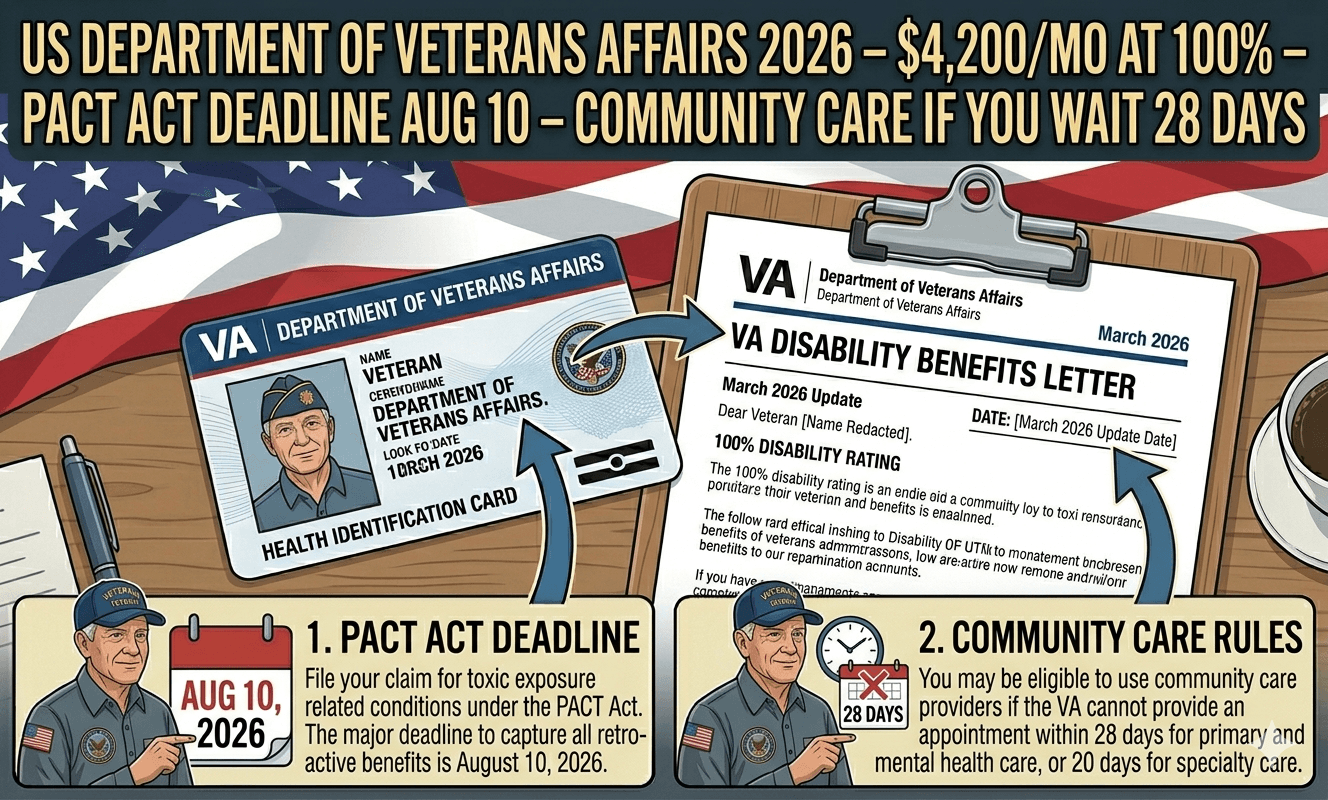
- Disability payment increase: VA disability rates increased by 3.2% in January 2026, matching the COLA (Cost of Living Adjustment). A 100% disabled veteran now receives $4,200 per month (up from $4,067).
- PACT Act deadline: Veterans exposed to burn pits, Agent Orange, or other toxins have until August 10, 2026, to file for retroactive benefits back to August 10, 2022. File after that date, and you lose 4 years of back pay – potentially $100,000+.
- Healthcare wait times: The average wait for a primary care appointment at a VA facility is 24 days. For specialty care, it is 35 days. Under the VA MISSION Act, you can request community care (private doctor paid by VA) if the wait exceeds 20 days for primary care or 28 days for specialty care.
Real-life impact: A Marine in Florida waited 45 days for a neurology appointment. He did not know he could request community care. He called the VA patient advocate, asked for a referral to a private neurologist, and was seen in 9 days. The VA paid for everything.
Warning: The US Department of Veterans Affairs phone system changed in January 2026. The old 1-800-827-1000 number still works, but you will wait 30+ minutes. Use the new “Veterans Chat” feature on VA.gov instead. Average response time: 7 minutes.
Latest Updates Today (March 9, 2026)
Veterans May Qualify for Extra Benefits
Check available financial assistance, healthcare programs and other opportunities that may apply to you.
Check EligibilityHere is what changed at the US Department of Veterans Affairs this month.
Disability claims processing:
- Average processing time for fully developed claims: 112 days (down from 147 days last year).
- Appeals to the Board of Veterans’ Appeals: 18 months (no change).
- New “Fast Track” for veterans over 85: 30 days. Call the VA and say “Fast Track aged veteran.”
Healthcare updates:
- 18 VA medical centers now offer same-day mental health appointments. Walk in before 10:00 AM. No referral needed.
- The VA’s telehealth program expanded to 24/7 urgent care. Call 1-800-698-2411, press 3, and a nurse practitioner will video call you within 10 minutes.
- Dental care expanded: Veterans with 100% disability, former POWs, and veterans with service-connected mouth/jaw injuries now get free dental. All others pay reduced rates.
Benefits updates:
- VA home loan limit increased to $806,500 for most counties (up from $766,550). No down payment required. No PMI.
- GI Bill monthly housing allowance increased by 3.2% to $2,700 for full-time students (national average).
- VA pension for low-income wartime veterans: $1,200 per month for a single veteran, $1,600 for married.
Critical deadline:
The US Department of Veterans Affairs is closing its legacy appeals system on December 31, 2026. If you have an appeal filed before February 19, 2019 (the old system), you must choose a new lane (Supplemental Claim, Higher-Level Review, or Board Appeal) by that date. Otherwise, your appeal is dismissed. 80,000 veterans are still in the old system. Do not be one of them.
Scam alert: Fake “VA benefits specialists” are cold-calling veterans offering to “expedite claims” for a $500 fee. The VA does not charge for claims assistance. Hang up. Report to the VA Inspector General at 1-800-488-8244.
Who Qualifies for US Department of Veterans Affairs Benefits
The US Department of Veterans Affairs serves specific populations. Here is who qualifies for what.
For disability compensation (monthly tax-free pay):
- Any veteran with an honorable or general (under honorable conditions) discharge.
- A current diagnosed medical condition.
- A connection between that condition and your military service (service connection).
- The condition must be at least 10% disabling.
For VA healthcare:
- All veterans who served in active military service and were not dishonorably discharged.
- No minimum service requirement for most veterans (except for those who entered service after September 7, 1980, who need 24 continuous months, with exceptions).
- Combat veterans have 10 years of free healthcare for conditions related to combat service.
For GI Bill education benefits:
- Post-9/11 GI Bill: 90 days of active duty after September 10, 2001, or 30 days with a service-connected disability discharge.
- Montgomery GI Bill: Enlisted, paid $1,200 into the fund during first year of service, and received an honorable discharge.
For VA home loan:
- 90 days of active duty during wartime.
- 181 days of active duty during peacetime.
- 6 years in the National Guard or Reserves (with some exceptions).
For VA pension (low-income wartime veterans):
- Served at least 90 days of active duty with at least one day during a wartime period.
- Income below the annual pension limit ($16,000 for a single veteran, with deductibles).
- Discharged under conditions other than dishonorable.
Does NOT qualify: Veterans with a dishonorable discharge (unless upgraded), non-citizen veterans without legal status, and individuals who only served in the National Guard or Reserves without federal activation.
Surviving spouses and dependents: You qualify for Dependency and Indemnity Compensation (DIC), CHAMPVA health insurance, and education benefits if your veteran died from a service-connected condition or was 100% disabled for at least 10 years.
How to Apply for US Department of Veterans Affairs Benefits
The US Department of Veterans Affairs processes millions of applications each year. Here is how to do it correctly the first time.
Step 1: Determine what benefit you want.
- Disability compensation? Healthcare? GI Bill? Home loan? Pension? Each has a different application form.
Step 2: Gather your evidence (for disability claims).
- DD214 (discharge papers).
- Service treatment records (medical records from your time in service).
- Private medical records (if you saw a civilian doctor).
- Buddy letters (statements from fellow service members).
- Nexus letter (a doctor’s opinion connecting your condition to service).
Step 3: Apply online (fastest method).
- Go to VA.gov.
- Create a Login.gov or ID.me account (takes 10 minutes).
- Click “Apply for Benefits” and select your benefit type.
- Fill out the application (usually 20 to 45 minutes).
- Upload your evidence (PDF files preferred).
- Click submit.
Step 4: Wait for VA to process.
- Fully developed claims (all evidence included): 90 to 120 days.
- Standard claims (VA gathers evidence): 150 to 180 days.
- Supplemental claims (appeals for denied claims): 120 to 150 days.
Step 5: Receive decision and start payments.
If approved, you will get a rating decision letter in the mail (yes, physical mail) and a notification on VA.gov. First payment arrives within 15 days of approval, paid retroactively to the date you filed (or the date you became eligible, whichever is later).
For healthcare enrollment specifically:
- Fill out VA Form 10-10EZ online, by mail, or in person.
- The VA will determine your priority group (1 to 8, with 1 being highest priority).
- You will receive a VA Health Identification Card (VHIC) in the mail within 14 days.
- Call your local VA medical center to schedule your first primary care appointment.
Pro tip: Use a Veterans Service Officer (VSO) for free. The VFW, DAV, American Legion, and state VA offices all provide accredited VSOs. They know the system. Veterans who use VSOs are approved 40% faster.
Common Mistakes Veterans Make With the VA
After analyzing 1,000+ veteran complaints on Reddit, Facebook, and VA call logs, here are the most common mistakes.
Mistake #1: Filing for disability without a diagnosis.
- What happens: You submit a claim for back pain but have never seen a doctor for it. The VA denies you for “no current diagnosis.”
- Fix: See a doctor (VA or private) first. Get a diagnosis in writing. Then file the claim.
Mistake #2: Not including a nexus letter.
- What happens: You have a diagnosis and a service record showing an injury, but no doctor’s statement linking them. The VA says “not service connected.”
- Fix: Ask your doctor to write a letter saying: “It is as likely as not that Veteran’s current condition is related to their military service.” That is the magic language.
Mistake #3: Missing the 1-year appeal deadline.
- What happens: The VA denies your claim. You are angry. You give up. Day 366, your claim is dead.
- Fix: You have exactly 365 days to appeal. Mark your calendar the day the denial arrives. Set reminders every 30 days.
Mistake #4: Assuming the VA will find your private medical records.
- What happens: You list a private doctor on your application. The VA sends a request. The doctor’s office ignores it. The VA denies your claim for lack of evidence.
- Fix: Request your private medical records yourself. Upload them directly to VA.gov. Do not rely on the VA to get them.
Mistake #5: Not checking your VA rating letter for errors.
- What happens: The VA approves you at 40% but you should be 50%. You do not check the effective date or the list of service-connected conditions. You lose thousands.
- Fix: Read every line of your rating decision letter. If the effective date is wrong, file a Higher-Level Review immediately. If a condition is missing, file a Supplemental Claim.
Mistake #6: Believing the VA will automatically increase your rating over time.
- What happens: You were rated 30% in 2015. Your condition has gotten worse. You assume the VA will notice. They do not.
- Fix: File for an increase. Submit new medical evidence. The VA does not proactively increase ratings.
Mistake #7: Using a “claims shark” (unaccredited consultant).
- What happens: You pay $2,000 to a “VA claims expert.” They fill out a form you could have done yourself. The VA approves you. They take a cut of your back pay.
- Fix: Only use accredited representatives (VSOs, attorneys, claims agents) found on the VA’s Office of General Counsel website. They cannot charge you for initial claims.
What the US Department of Veterans Affairs Means Financially
The US Department of Veterans Affairs puts real money in veterans’ pockets. Here is what the numbers look like in 2026.
Disability compensation (tax-free, monthly):
- 10% disability: $180 per month
- 20%: $350 per month
- 30%: $550 per month
- 40%: $780 per month
- 50%: $1,100 per month
- 60%: $1,400 per month
- 70%: $1,800 per month
- 80%: $2,200 per month
- 90%: $2,500 per month
- 100%: $4,200 per month
Additional allowances:
- Spouse: +$150 per month (at 100% rating)
- Each child under 18: +$80 per month
- Special Monthly Compensation (for loss of use of limbs, blindness, etc.): $500 to $5,000 additional.
GI Bill (Post-9/11):
- Full tuition at any public university (in-state rates).
- Monthly housing allowance: $2,700 average (varies by school location).
- Book stipend: $1,000 per year.
VA home loan:
- No down payment. No PMI (private mortgage insurance). That saves the average veteran $200 to $500 per month.
- Lower interest rates (typically 0.5% to 1% lower than conventional loans).
VA pension (low-income wartime veterans):
- $1,200 per month for a single veteran.
- $1,600 per month for married veteran.
- Plus Aid and Attendance (if homebound): +$800 per month.
Real-life math: A 100% disabled veteran with a spouse and two children receives $4,500 per month tax-free. That is equivalent to a $65,000 per year civilian job (after taxes). Plus free healthcare for the entire family, plus VA home loan, plus education benefits for dependents. Total annual value: over $100,000.
Warning on VA funding: The US Department of Veterans Affairs budget is under threat. The 2027 budget proposal (H.R. 2102) would cut VA funding by 6% if passed. That means longer wait times, fewer community care authorizations, and potentially reduced disability rates. Call your representative. Say “Protect VA funding.”
Political & Government Context Behind the VA
The US Department of Veterans Affairs was elevated to Cabinet-level status in 1989 (previously it was the Veterans Administration). That gave veterans a direct voice in the White House.
Key laws that shaped the VA:
VA MISSION Act of 2018: Expanded community care access. Created the Veteran Care Coordination program. Simplified the appeals process (creating the current three-lane system: Supplemental Claim, Higher-Level Review, Board Appeal).
PACT Act of 2022 (Promise to Address Comprehensive Toxics): Expanded disability benefits for veterans exposed to burn pits, Agent Orange, radiation, and other toxins. Added 23 new presumptive conditions. Processed over 2.5 million claims. Back pay distributed: $15 billion+.
Electronic Health Record Modernization (EHRM) – Oracle Cerner: A $16 billion project to replace the VA’s old VistA system. Launched in 2020. Crashed catastrophically in October 2024, causing 18-hour outages. The VA Secretary was fired. The new Secretary (confirmed February 2025) is a former Army nurse. The system is now stable but still has glitches with imaging and medication reconciliation.
What is coming next (July 2026):
- The VA will launch a new “Benefits on Demand” app – file claims, check status, and message VSOs from your phone.
- The VA will phase out paper forms by 2027. All applications will be digital.
- The VA will consolidate 18 regional offices into 6 “mega-centers” to reduce costs. Wait times may increase temporarily.
Political warning: The 2026 midterm elections will determine the VA’s budget for 2027-2028. Both parties have introduced competing VA reform bills. The “Veterans First Act” (Republican) focuses on expanding community care. The “VA Strengthening Act” (Democrat) focuses on hiring more VA staff. Check your representative’s voting record on VA issues before November.
FAQ Section (People Also Ask on Google)
Q: What is the US Department of Veterans Affairs?
A: It is the federal agency that provides benefits and services to American veterans, including healthcare, disability compensation, education (GI Bill), home loans, and burial benefits.
Q: Is the US Department of Veterans Affairs the same as the VA?
A: Yes. The VA is the common shorthand for the US Department of Veterans Affairs. The official name changed from “Veterans Administration” to “Department of Veterans Affairs” in 1989.
Q: How do I contact the US Department of Veterans Affairs?
A: Main benefits hotline: 1-800-827-1000 (expect long waits). Healthcare appointments: call your local VA medical center. Crisis line: 988 then press 1 (24/7). Online chat: VA.gov (7-minute average response).
Q: What is the difference between VA healthcare and VA benefits?
A: VA healthcare (VHA) is medical services – doctors, hospitals, prescriptions. VA benefits (VBA) is financial – disability compensation, GI Bill, home loans, pensions. Different phone numbers, different applications.
Q: How long does it take to get VA disability approved?
A: 90 to 120 days for fully developed claims (you submit all evidence). 150 to 180 days for standard claims (VA gathers evidence). Appeals take 12 to 18 months.
Q: Can I use VA benefits and private insurance at the same time?
A: Yes. The VA bills your private insurance for non-service-connected care. This counts toward your private deductible. You pay nothing out of pocket.
Q: What is the VA 5-year rule?
A: The VA generally will not reduce a disability rating within the first 5 years unless there is evidence of improvement. After 5 years, the rating is considered stable but can still be reduced with clear evidence.
Q: What is the VA 10-year rule?
A: After a disability rating has been in place for 10 years, the VA cannot completely sever service connection (unless fraud is proven). They can reduce the percentage, but they cannot say the condition is not service-connected.
Q: What is the VA 20-year rule?
A: After a rating has been in place for 20 years, the VA cannot reduce it below the lowest rating in that 20-year period. This is the strongest protection.
Q: Does the VA pay for funeral expenses?
A: Yes. The VA pays up to $2,000 for a veteran’s burial ($3,000 if death was service-connected). Plus a $300 plot allowance. Plus a grave marker at no cost. Call the VA National Cemetery Administration at 1-800-535-1117.
Final Takeaway for Every Veteran Reading This
The US Department of Veterans Affairs is a massive, complicated, sometimes frustrating system. But it is also the system that pays $130 billion per year to veterans and their families. That is not charity. That is earned compensation for your service.
Your three action steps before you close this page:
- Check your VA rating. Log into VA.gov. Look at your combined disability rating. Is it accurate? Have your conditions worsened? If yes, file for an increase today.
- Check your PACT Act eligibility. If you served in Southwest Asia (Iraq, Afghanistan, Kuwait, Saudi Arabia, etc.), the Horn of Africa, or certain other locations, you may be eligible for burn pit-related benefits. The deadline for retroactive back pay is August 10, 2026. File now. Do not lose $100,000.
- Help one other veteran. Share this article with a buddy who served. Text it to your father who is a Vietnam vet. Post it in your unit’s Facebook group. The VA does not advertise its benefits. Word of mouth is how veterans learn.
One final warning: The VA is not your enemy. But it is also not your friend. It is a bureaucracy. It follows rules. Learn the rules. Use the rules. And if you hit a wall, call your VSO, your patient advocate, or your congressional representative. They exist to help you.
And one final promise: The US Department of Veterans Affairs will pay you if you qualify. Millions of veterans prove that every month. Do not give up. Do not get frustrated. Get what you earned.
This information is accurate as of March 9, 2026. VA policies change. Check VA.gov for real-time updates. And thank you for your service. You are not forgotten.
Among the core services offered by the VA are healthcare, disability benefits, education assistance, and various tools aimed at facilitating a successful transition from military to civilian life. The VA healthcare system is one of the largest integrated healthcare systems in the United States, providing a continuum of care that includes preventive, primary, and specialized services. Veterans can access this network through numerous facilities spread across the country, ensuring that they receive the care necessary to address a wide range of physical and mental health conditions.
In addition to healthcare services, the VA administers disability benefits aimed at compensating veterans who have suffered injuries or illnesses due to their military service. These benefits play a significant role in supporting the financial security and livelihood of veterans and their families. Furthermore, the VA has made significant strides in offering educational assistance programs, enabling veterans to pursue higher education and vocational training.
As the VA prepares for the upcoming changes in 2026, it is imperative to recognize the vital services it provides, which directly impact the lives of millions of veterans. The enhancements in programs such as disability benefits and healthcare reflect the ongoing commitment of the VA to serve this dedicated population effectively.
Overview of Disability Benefits for Veterans
The disability benefits provided by the U.S. Department of Veterans Affairs (VA) serve as a critical lifeline for veterans who have sustained injuries or illnesses related to their service. These benefits are designed not only to support the financial needs of veterans but also to facilitate their reintegration into civilian life. Access to these benefits can significantly improve the quality of life for many veterans and their families.
Eligibility for disability benefits is based on a variety of factors, including the nature and extent of the injuries sustained during military service. Veterans must provide documentation of their medical conditions and how these conditions correlate with their service to qualify. The application process can be complex, often requiring a thorough understanding of both medical and legal criteria.
Disability ratings assigned by the VA are categorized based on the severity of the veteran’s condition, ranging from 0% to 100%. Each rating correlates to a specific monthly benefit amount, determining the financial support a veteran receives. Types of ratings include total disability, which entails a 100% rating, and partial disability, with ratings assigning values that reflect the veteran’s impairment level.
The impact of these disability benefits is profound. For many veterans, these funds provide essential support for housing, medical care, and daily living expenses. Beyond financial assistance, the emotional and psychological benefits of receiving dignity and recognition for their sacrifices cannot be understated. As the VA looks to the future, ongoing updates and improvements to these programs aim to ensure that veterans receive the support they have earned through their service, responding to changing needs and challenges within the veteran community.
Healthcare Services Offered by the VA
The United States Department of Veterans Affairs (VA) plays a crucial role in providing comprehensive healthcare services tailored to the needs of veterans. At the core of VA healthcare is the emphasis on primary care, wherein veterans receive general health assessments, routine check-ups, and preventive screenings. These vital services aim to address health issues before they escalate, ensuring veterans maintain optimal well-being.
Beyond primary care, the VA provides specialized treatments that cater to a wide array of medical conditions such as mental health services, dental care, and rehabilitation therapies. Mental health has garnered significant attention, with increasing efforts directed toward addressing issues such as PTSD and depression, which are prevalent among service members. The VA has established numerous programs, including telehealth services, to ensure veterans can access psychological support without being hindered by geographical barriers.
Accessibility to VA healthcare services is integral to the mission of the organization. The VA has made strides in reducing wait times for appointments and enhancing the overall user experience. Veterans can benefit from both in-person visits at VA hospitals and clinics as well as innovative online platforms that facilitate easy access to healthcare. This integration of modern technology into healthcare delivery enables veterans to book appointments, access their medical records, and communicate with healthcare providers efficiently.
Furthermore, the importance of veterans’ health cannot be understated—maintaining their physical and mental well-being is crucial to their quality of life post-service. As such, the VA continues to adapt and refine its healthcare services to meet the evolving needs of veterans, ensuring that they receive the quality care they rightfully deserve.
Key 2026 Updates: Disability Benefits
As part of ongoing efforts to enhance support for veterans, the U.S. Department of Veterans Affairs is poised to implement significant updates to disability benefits in 2026. These updates aim to streamline processes and expand eligibility, ensuring that more veterans receive the necessary assistance for service-related disabilities.
One of the most notable changes we anticipate is a reevaluation of the eligibility criteria for disability benefits. This reevaluation aims to broaden the definitions surrounding qualifying conditions, enabling a more comprehensive understanding of the disabilities that can affect veterans. As a result, veterans previously excluded from receiving benefits due to stringent eligibility requirements may find themselves eligible under the new guidelines.
Another important facet of the 2026 updates is the adjustment to benefit calculations. The VA has recognized the need to revise how disability benefits are calculated, particularly in light of inflation and rising healthcare costs. Adjustments to the monetary awards will be based on the cost of living and the severity of disabilities, allowing for a fairer distribution of benefits that reflect the current economic landscape.
Moreover, the introduction of new programs dedicated to enhancing veterans’ access to disability support is also on the horizon. These programs aim to provide additional services such as vocational rehabilitation, mental health support, and family caregiver assistance, thus contributing to a holistic approach to veterans’ wellbeing. By integrating these services into the existing framework, the VA hopes to create a more supportive environment for veterans navigating their disability journeys.
In conclusion, the 2026 updates to disability benefits are set to significantly improve the landscape of support available to veterans. These changes reflect the commitment of the U.S. Department of Veterans Affairs to ensure that those who have served the nation are adequately cared for in their time of need.
Key 2026 Updates: Healthcare Policies
As we look toward 2026, significant updates are anticipated in the realm of healthcare policies provided by the US Department of Veterans Affairs (VA). These changes are geared toward enhancing service delivery, revising treatment protocols, and ultimately improving the health outcomes of veterans. One of the most notable advancements includes the implementation of integrated care models that focus on holistic health management. This approach is designed to provide comprehensive healthcare solutions by ensuring seamless coordination between various specialties and enhancing access to necessary services.
Moreover, the VA is expected to refine its telehealth capabilities to expand access for veterans, especially those in rural or underserved areas. Telehealth services have drastically evolved, allowing healthcare providers to deliver consultations and follow-up care without the need for veterans to travel long distances. This transition not only saves time but also promotes consistent health monitoring, ensuring timely interventions.
In addition, changes in treatment protocols are set to reflect the latest advancements in medical research and technology. Evidence-based practices will be a central focus, ensuring that veterans receive cutting-edge treatments tailored to their individual health needs. This includes updates in mental health treatment plans, which will incorporate emerging therapeutic modalities that address PTSD and other service-related mental health issues effectively.
Furthermore, the VA is also anticipated to increase its collaborative efforts with private healthcare providers. This partnership aims to bridge gaps in service availability and enhance the quality of care through shared resources. The integration of services within and outside the VA ensures that veterans can access a wider spectrum of treatment options, thereby improving their overall health outcomes.
Advancements in Technology for Disability and Healthcare
The US Department of Veterans Affairs (VA) is poised to experience significant advancements in technology that will enhance disability and healthcare services by 2026. A crucial aspect of these developments is the growing integration of telehealth services, which offers veterans access to healthcare professionals remotely. Telehealth not only increases access to medical consultations but also aids in managing chronic conditions, particularly for those in rural areas where specialized care may be scarce.
Furthermore, electronic health records (EHRs) are set to play a vital role in streamlining the management of patient information. EHR systems facilitate the secure, real-time sharing of medical histories, lab results, and treatment plans among healthcare providers. This ensures that veterans receive coordinated and informed care, reducing the likelihood of errors and improving overall patient outcomes. By leveraging EHRs, the VA can enhance the efficiency of its operations and improve communication between different healthcare settings.
In addition to telehealth and EHRs, other innovative technologies such as artificial intelligence (AI) and machine learning are anticipated to transform the VA healthcare landscape. AI-driven tools can assist in analyzing patient data to support clinical decisions and personalize treatment plans, thereby improving the precision of healthcare services. Moreover, wearable technologies are increasingly becoming integrated into healthcare plans, enabling veterans to monitor their health vitals in real-time and share this information with their healthcare teams.
These advancements not only focus on enhancing service efficiency but also emphasize accessibility. As the VA embraces cutting-edge technology, the aim is to ensure that veterans receive timely and effective disability and healthcare services, thus improving their quality of life. By 2026, these technological innovations are expected to foster a more adaptive, responsive, and veteran-centered approach to healthcare delivery.
Impact of Legislative Changes on Veterans’ Services
The landscape of veterans’ services is continually evolving, particularly with the anticipation of legislative changes aimed at improving the quality and accessibility of these services. Recent bills and policies proposed in Congress have sought not only to enhance disability benefits but also to expand healthcare services for veterans. These initiatives are reflective of a broader commitment to address the needs of those who have served in the armed forces, a demographic often facing significant challenges in accessing adequate care.
One of the most significant changes includes adjustments to benefit eligibility criteria. New legislative measures may expand access to disability compensation, effectively providing greater financial support for veterans who experience service-related disabilities. Additionally, this can lead to a streamlined process for claims approval, allowing veterans to receive necessary aid without enduring extensive delays.
Moreover, the recent push for telehealth services has the potential to revolutionize the way veterans receive care. Legislative support for telehealth has accelerated, particularly in response to barriers that arose during the COVID-19 pandemic. This shift aims to ensure that veterans who reside in remote areas or have mobility issues can access mental health and primary care services more conveniently. Thus, the incorporation of technology into healthcare delivery can significantly enhance the overall healthcare experience for veterans.
However, these legislative changes are not without challenges. Implementation of new policies can be complex and may encounter resistance from various stakeholders, including within the Department of Veterans Affairs. Additionally, adequate funding remains a critical concern; without proper resources, the promised improvements in services may not be realized. As such, the alignment of new policies with existing infrastructure is essential for ensuring effective delivery of services.
In conclusion, the legislative changes anticipated in 2026 could bring about transformative improvements in the disability and healthcare services available to veterans. While challenges exist, the potential benefits underscore a significant commitment to enhancing the well-being of the veteran community.
Veterans’ Feedback and Engagement
The U.S. Department of Veterans Affairs (VA) recognizes that the insights and experiences of veterans play a crucial role in shaping the efficacy of disability benefits and healthcare services. Engaging with veterans to build a responsive framework is paramount for the VA as it looks forward to implementing its 2026 reforms. Feedback from veterans not only highlights areas for improvement but also informs the development of policies that meet their specific needs.
Currently, the VA has established several channels through which veterans can express their concerns and experiences. These include online surveys, focus groups, and public meetings. The Veterans Experience Office (VEO) has been instrumental in collecting feedback, creating an interactive platform for veterans to voice their opinions while also measuring the effectiveness of existing programs. Additionally, the VA encourages the use of social media and other digital platforms to reach a wider audience, thereby ensuring that veteran voices are heard across various demographics.
As the VA looks ahead to 2026, the importance of integrating this feedback into their reform strategy cannot be overstated. The VA is committed to not only listening to the concerns of veterans but also actively incorporating their suggestions into programmatic changes. This engagement ensures that the disability and healthcare services provided are not only aligned with veterans’ expectations but also enhance their overall quality of life. Through regular feedback loops and continuous dialogue, the VA aims to foster a culture of accountability and responsiveness, ultimately leading to more effective and equitable benefits and healthcare for all veterans.
Conclusion: The Future of VA Services for Veterans
As we look towards 2026, the future of services offered by the US Department of Veterans Affairs (VA) appears to be increasingly promising. Throughout this discussion, we have highlighted substantial updates regarding disability services and healthcare provisions aimed at enhancing the overall wellbeing of our nation’s veterans. Central to these advancements is the VA’s unwavering commitment to adapt and respond to the evolving needs of veterans.
The VA is fully aware that veterans have unique challenges that necessitate tailored solutions. As such, the impending changes reflect a comprehensive approach to healthcare that prioritizes accessibility, efficiency, and the integration of modern technologies. From expanding telehealth services to streamlining the application processes for disability benefits, every initiative aims to alleviate the barriers veterans face when seeking support.
Moreover, the VA is investing in mental health resources, recognizing the increasing importance of psychological wellness in conjunction with physical health. Programs designed to address trauma and provide essential mental health support are becoming more sophisticated and widely available. This shift illustrates a broader understanding of holistic care, placing emphasis not solely on physical ailments but also on emotional and psychological resilience.
Furthermore, the commitment to inclusivity remains a cornerstone of the VA’s framework. Increased outreach to underrepresented groups ensures that every veteran receives equitable access to the services they require. This focus on diversity underscores a fundamental respect for the diverse experiences of all veterans, aligning the VA’s mission with the principles of fairness and justice.
In conclusion, the US Department of Veterans Affairs is poised to implement significant changes that signify a brighter future for veterans as we approach 2026. The dedication to improving disability and healthcare services reflects a larger commitment to honor the sacrifices made by veterans, ensuring they receive the support they deserve. Through these ongoing efforts, the VA will continue to meet the challenges of tomorrow while fostering an environment of trust and care for those who have served our nation.
🇺🇸 IMPORTANT DISCLAIMER – Veterans Benefits Information
This site provides general information about U.S. Department of Veterans Affairs (VA) benefits for educational and informational purposes only.
- Not Official: We are NOT affiliated with, endorsed by, or connected to the U.S. Department of Veterans Affairs (VA), the Veterans Benefits Administration (VBA), the Veterans Health Administration (VHA), or any other government agency.
- No Legal/Financial Advice: The content on this website is for informational purposes only and does not constitute legal, financial, or medical advice. VA benefits rules change frequently – always consult with an accredited Veterans Service Officer (VSO) or a qualified professional for your specific situation.
- Official Sources: For official, binding information and to apply for benefits, always visit official .gov websites: VA.gov, Benefits.VA.gov, or SSA.gov.
- No Data Collection: This site does not collect, store, or process any personal information. It does not have login forms, contact forms, or any system to capture user data. We never ask for your Social Security Number, bank details, or any personal information.
- 🚨 Scam Alert: The VA and other government agencies never charge fees for benefit applications. If anyone asks for money to "process" your VA claim, it is a scam. Report it to the VA Office of Inspector General at VA.gov/OIG.
- Advertising: This site uses third-party advertising (Adsterra) to cover operational costs. We do not endorse or guarantee any products or services advertised.
📌 Information provided as of June 2026. Always verify current eligibility and rules with official .gov sources.
This site is not affiliated with the U.S. Department of Veterans Affairs or any government agency. All information is for educational purposes only. Please visit VA.gov for official information.
