
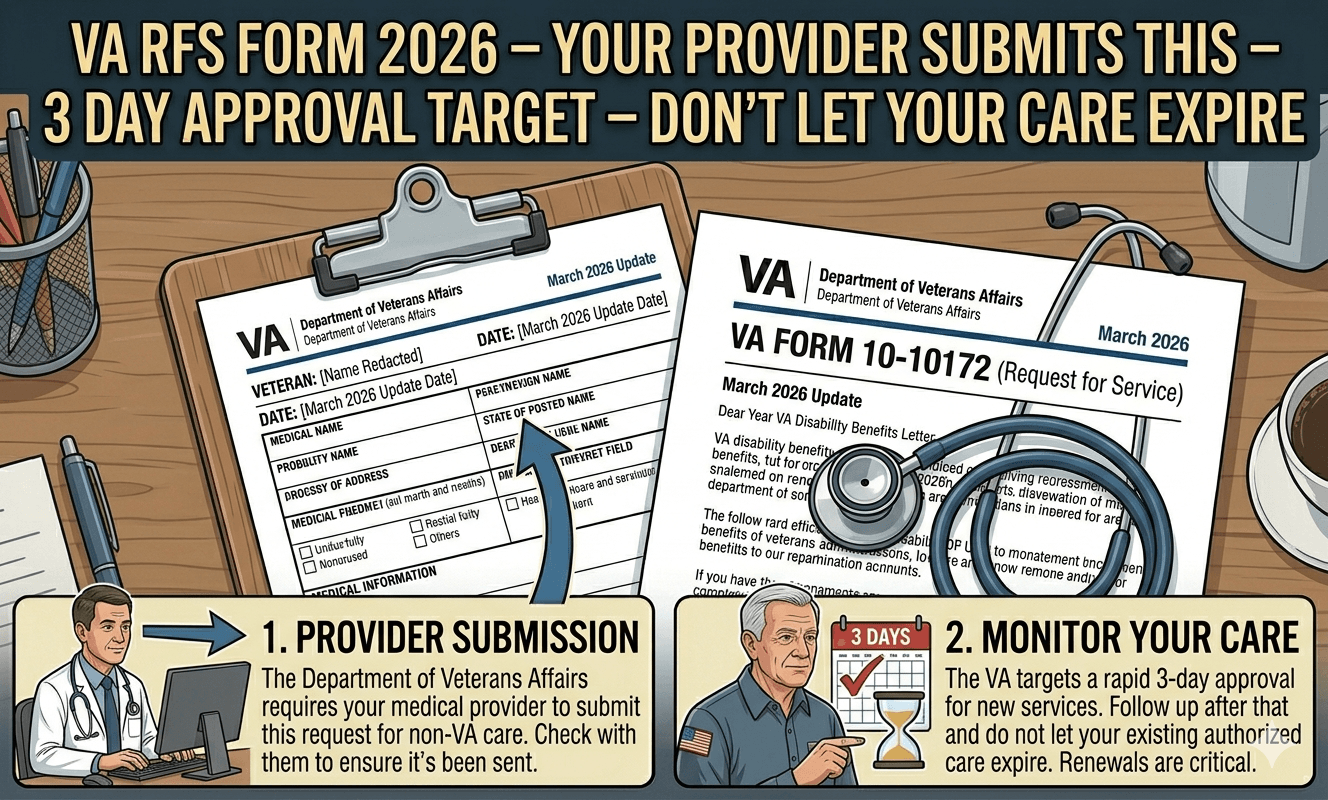
Introduction to VA RFS Form 10-10172
The VA RFS Form 10-10172, also known as the ‘Request for Service’, plays a crucial role in enhancing healthcare access for veterans who require additional community care. This form is specifically designed for instances where the Veterans Affairs (VA) system is unable to provide adequate treatment options. The need for this form is underscored by the necessity for veterans to receive timely and appropriate medical care, particularly when the existing VA facilities may not be able to cater to their specific health needs.
The VA RFS form (officially VA Form 10-10172, “Request for Service”) is the document your community doctor submits to the VA when you need more treatments than your current referral allows. If you are seeing a non-VA provider through the Community Care Network and your 12 authorized sessions are running out, this form is the only way to get more.

But here is the critical thing most veterans get wrong: You do not fill out this form yourself. Your community provider does. If you call the VA asking about “my RFS form,” they will redirect you back to your doctor’s office. The real problem? Many providers do not know how to submit it correctly. The VA rejects nearly 30% of RFS forms on first submission due to missing signatures or weak clinical justifications. Here is exactly how to make sure yours gets approved.
What Veterans Need to Know Right Now (March 2026)

If you are a veteran receiving care from a community provider (a doctor or therapist outside the VA system), the VA RFS form is the key to continuing that care. Here is what changed recently.
Three things you must understand immediately:
- The RFS form is not for you to fill out. It is a provider-to-VA document. Your job is to ask your provider to submit it.
- The form was shortened from three pages to two pages in late 2025, making it easier for providers to complete .
- Dental RFS forms now require specific tooth numbers and CDT codes as of August 2025. Before that, dental requests were exempt .
Real-life impact: A veteran in Texas receiving massage therapy for chronic back pain had 12 authorized sessions. After session 10, his provider submitted an RFS form for 6 more sessions. The VA approved it in 3 business days. Without that form, he would have paid $150 per session out of pocket.
The hard truth: The VA does not automatically renew referrals. When your authorized visits run out, care stops unless your provider submits an RFS. Do not assume the VA will remind you. They will not.
Latest Updates Today (March 2026)
Veterans May Qualify for Extra Benefits
Check available financial assistance, healthcare programs and other opportunities that may apply to you.
Check EligibilityAs of this month, the VA RFS form process has several important updates. Here is what you need to know.
New electronic submission system: Community providers can now submit RFS forms online through the HealthShare Referral Manager (HSRM) portal . This is faster than fax. The VA targets a 3-business-day response time for most RFS requests, though complex cases can take up to 14 days .
Dental RFS changes: As of August 2025, VA response letters for dental RFS now list specific Current Dental Terminology (CDT) codes and tooth numbers . This means your dentist must be precise. “Tooth pain” is not enough. They need to specify which tooth and what procedure code.
Signature requirement remains strict: The VA will reject any RFS form without a signature (wet or electronic) . If your provider faxes an unsigned form, it goes to the bottom of the pile. They must resubmit. That adds weeks to your wait.
Exemptions still apply: Dental and IVF/ART (in vitro fertilization) services are exempt from using Form 10-10172 . Your provider should use alternative VA processes for those services.
Processing time warning: The VA says 3 business days is the target. But in reality, many RFS forms take 10 to 14 days. If your current authorization expires in a week, you have a gap. Submit the RFS at least 3 weeks before your visits run out.
Who Qualifies for RFS Submission
The VA RFS form is not for every veteran. It applies only in specific situations. Here is who qualifies.
You need an RFS if:
- You are already in the VA Community Care Network (seeing a non-VA provider).
- Your current authorized number of visits is about to run out (for example, you had 12 physical therapy sessions approved and you have completed 10).
- Your current authorization is expiring within 2 weeks .
- You need a new specialty service that was not in your original referral.
- You need a procedure or equipment not included in the original Standardized Episode of Care (SEOC) .
You do NOT need an RFS if:
- You have never seen a community provider through the VA. You need an initial referral first.
- You are a new veteran applying for VA healthcare. That is a different process (Form 10-10EZ).
- You are seeking dental or IVF services. Those are exempt from the RFS form .
What about massage therapy? Yes, massage therapy providers use the RFS form. The Zeel provider network (which handles many VA massage referrals) prompts providers to submit an RFS at the 10th session of a 12-session referral .
Real-life example: A veteran with lower back pain receives chiropractic care through the VA’s Community Care program. His referral authorized 12 visits over 6 months. At month 5, after 10 visits, his chiropractor determines he needs 6 more visits. The chiropractor submits an RFS form to the local VA medical center. The VA approves 4 additional visits. That is a win.
How the RFS Process Works (Step by Step)
The VA RFS form process involves three parties: you (the veteran), your community provider, and the VA. Here is how it works from start to finish.
Step 1: You Request More Care
At your next appointment, tell your provider: “My authorized visits are running out. Can you request more from the VA?”
What to say specifically: “Please submit a Request for Service form (VA Form 10-10172) to my local VA medical center. I need more visits for the same condition.”
Why this matters: Many providers do not know about the RFS form. They assume the VA will automatically approve more visits. That is wrong. You must ask.
Step 2: Your Provider Completes the Form
Your provider fills out VA Form 10-10172. Here is what they need to include :
- Requesting provider name and NPI number (their national provider identifier).
- Veteran information: Your full name, last 4 digits of SSN, date of birth, and current authorization number (found on your VA referral letter).
- What is being requested: Either additional visits to an existing referral OR completely new services.
- Medical necessity justification: This is the most important part. The provider must explain why you need more care, using measurable outcomes .
For massage or physical therapy: The provider should include pain scale improvements (e.g., “Patient’s back pain improved from 8/10 to 4/10”), functional improvements (e.g., “Patient can now walk 10 blocks pain-free”), and specific goals still in progress .
For durable medical equipment (DME): The provider must specify the equipment type, medical necessity, and expected duration of use .
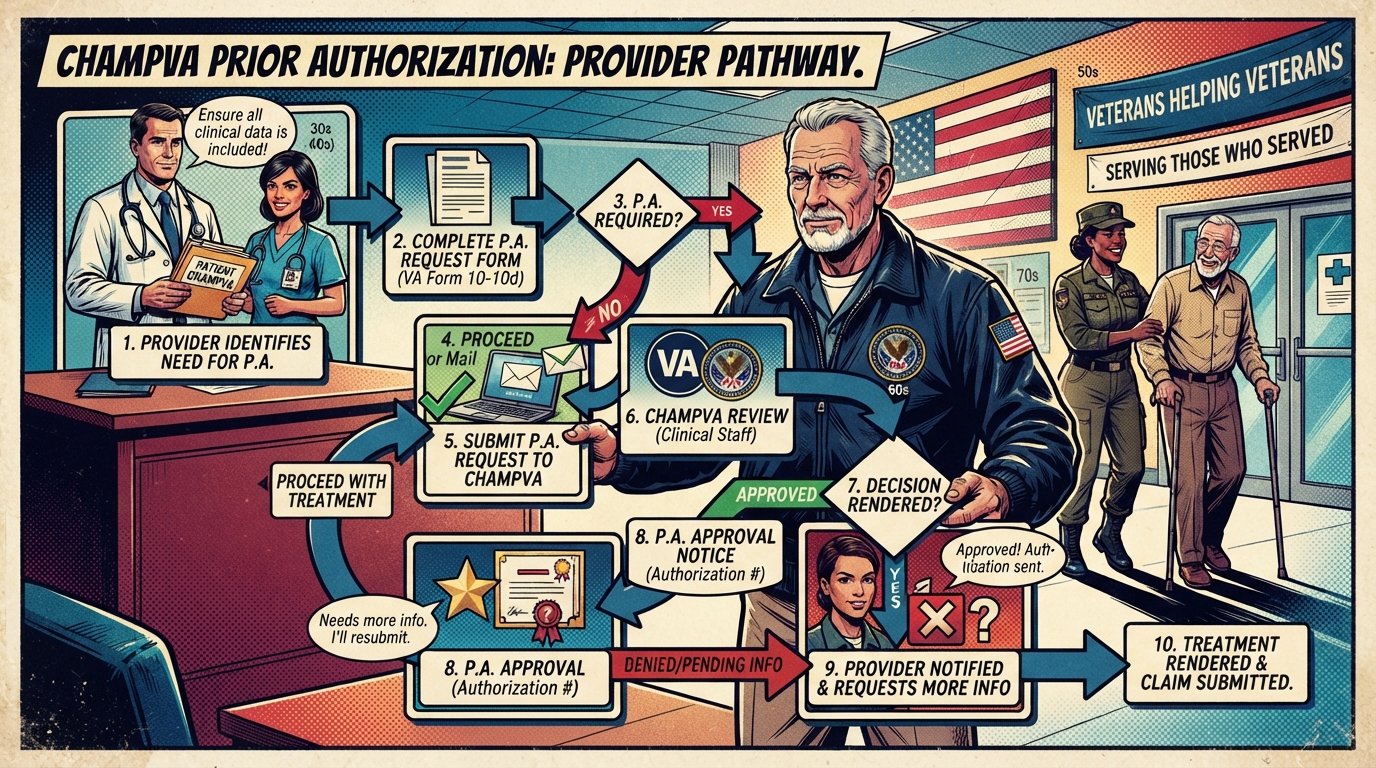
Step 3: Provider Submits the RFS
The provider submits the completed and signed form to your local VA medical center’s Community Care office. Submission methods include :
- HealthShare Referral Manager (HSRM) – online portal (fastest, preferred).
- Electronic fax – faster than paper mail.
- Traditional fax – slower, but still accepted.
- Secure messaging – through VA-approved platforms.
- Paper mail – slowest; avoid if possible.
Signature requirement: The form must be signed by the provider (wet ink or electronic). Unsigned forms are rejected immediately .
Step 4: VA Reviews the Request
The VA Community Care office reviews the RFS. They check:
- Is the veteran eligible for community care?
- Is the requested service clinically necessary?
- Is the provider qualified and in-network?
Timeline: The VA targets 3 business days for most RFS forms. Complex cases can take up to 14 business days .
Possible outcomes:
- Full approval: You get the requested number of visits.
- Partial approval: You get fewer visits than requested.
- Denial: You get nothing. The VA will explain why in writing.
Step 5: You Receive a New Referral or Denial
If approved, the VA issues a new authorization. Your provider receives it through HSRM or by mail. You can continue your care.
If denied, your provider can appeal or submit a new RFS with additional documentation.
Do not provide care without approval: The VA will not pay for services provided before an RFS is approved . If your provider treats you while waiting for approval, you could be billed.
Common Mistakes Veterans Make With RFS Forms
After reviewing hundreds of veteran experiences, here are the most common mistakes and how to avoid them.
Mistake #1: Thinking you fill out the RFS form yourself.
- What happens: You download VA Form 10-10172, fill it out, and fax it to the VA. Nothing happens. The VA ignores it because only providers can submit RFS requests.
- Fix: Give the form to your provider. Ask them to complete and submit it. You are the patient, not the submitter.
Mistake #2: Waiting until your last authorized visit to request more.
- What happens: Your 12th physical therapy session is today. Your provider submits an RFS tomorrow. The VA takes 10 days to approve it. You miss 2 weeks of treatment.
- Fix: Ask your provider to submit the RFS at session 8 or 9. The VA allows RFS submission up to 2 weeks before a referral expires .
Mistake #3: Your provider submits a weak clinical justification.
- What happens: The provider writes “Patient needs more visits.” That is it. The VA denies the RFS for lack of medical necessity.
- Fix: Ask your provider to include specific, measurable improvements: pain scale numbers, range of motion measurements, reduced medication use, improved sleep or function .
Mistake #4: Forgetting to check if the RFS was actually submitted.
- What happens: Your provider says “I’ll send it.” But they forget. You wait 3 weeks. No approval. You call the VA. They have no record.
- Fix: Ask your provider for a confirmation number or proof of submission. If using HSRM, they get a tracking number. Get it.
Mistake #5: Assuming a denial is final.
- What happens: The VA denies your RFS. You give up. You stop treatment.
- Fix: Ask for the denial reason in writing. Then ask your provider to submit a new RFS with stronger documentation. Many denials are due to missing information, not lack of medical need.
What the RFS Form Means Financially for You
The VA RFS form directly affects your wallet. Here is why.
Without an approved RFS: Your community care stops. You either go without treatment or pay out of pocket. Typical costs: $150 per physical therapy session, $200 per specialist visit, $500+ for durable medical equipment.
With an approved RFS: The VA pays for everything. Your cost is $0 (or a small copay depending on your VA priority group).
Real-life math: A veteran needing 12 additional physical therapy sessions at $150 each would pay $1,800 out of pocket without an RFS. With an approved RFS, that cost drops to $0.
Lost back pay warning: If your provider submits an RFS and the VA takes 14 days to approve it, you lose 2 weeks of treatment. That is not just inconvenience. That is delayed recovery, more pain, and potentially worse long-term outcomes.
What about travel reimbursement? If you travel more than 40 miles one way to your community provider, the VA may reimburse mileage. But you need an approved referral (including RFS extensions) first. Keep your receipts.
Scam alert: No one should charge you to submit an RFS form. If a provider asks for a “processing fee,” report them to the VA Office of Inspector General. The VA prohibits providers from billing veterans for RFS-related administrative costs.
Political & Government Context Behind the RFS Process
The VA RFS form exists because of the VA MISSION Act of 2018. That law expanded veterans’ access to community care when VA facilities are too far away, too slow, or cannot provide the needed service.
Before the MISSION Act: Veterans had limited community care options. The RFS process was informal. Approvals took months. Denials were common.
After the MISSION Act: The VA created the Community Care Network (CCN) and standardized the RFS process. The goal was 3-day approvals.
The reality in 2026: The system works better than before, but it is not perfect. The VA’s electronic health record modernization (Oracle Cerner) caused major delays in 2024 and 2025. Those delays are mostly resolved, but some VA medical centers still struggle with backlogs.
What is coming next (July 2026): The VA plans to fully integrate RFS submission into the HSRM portal, eliminating fax and mail options entirely. Providers who still use paper will be forced to go digital. This will speed up approvals for most veterans but may cause problems for small provider offices without digital infrastructure.
Proposed legislation (H.R. 4501, “RFS Reform Act”): This bill would require the VA to approve or deny all RFS forms within 5 business days, with automatic approval if the VA misses the deadline. The bill is in committee as of March 2026. If passed, it would dramatically speed up community care access.
Call your representative: Tell them you support H.R. 4501. Veterans should not wait weeks for care while the VA processes paperwork.
FAQ Section (People Also Ask on Google)
Q: What does RFS stand for in VA terms?
A: RFS stands for “Request for Service.” It is the formal process by which community providers ask the VA to authorize additional care for a veteran.
Q: Can a veteran fill out VA Form 10-10172?
A: No. The form is designed for community care providers. You can fill out your personal information section, but the provider must complete the clinical sections and sign it. The VA will not process an RFS submitted by a veteran.
Q: How long does an RFS take to get approved?
A: The VA targets 3 business days for most RFS requests. Complex cases can take up to 14 business days . Submit at least 2 to 3 weeks before your current authorization expires.
Q: What if my provider refuses to submit an RFS?
A: Ask why. If they say it is too much paperwork, remind them that the VA will not pay for unauthorized care. If they still refuse, contact your VA patient advocate. You may need to switch to a different community provider.
Q: Can I submit an RFS for a new condition?
A: Yes, but it is better to get a new initial referral. For new conditions, your VA primary care provider should issue a new community care referral. The RFS process is intended for extensions of existing care, not entirely new diagnoses.
Q: What is the difference between an RFS and a referral?
A: A referral is the initial authorization to see a community provider. An RFS is a request to extend or modify an existing referral. Think of the referral as the first chapter and the RFS as a sequel.
Q: Does the RFS form work for dental care?
A: Dental services are exempt from the standard RFS form . Your dentist should use the VA’s dental referral process instead. However, as of August 2025, VA response letters for dental RFS now include specific tooth numbers and CDT codes .
Q: What happens if the VA denies my RFS?
A: You receive a denial letter explaining why. Common reasons: lack of medical necessity, incomplete documentation, or expired eligibility. You can appeal or ask your provider to submit a new RFS with stronger justification.
Q: Can I get an RFS for massage therapy?
A: Yes. The Zeel provider network manages many VA massage referrals and has a specific RFS process for massage therapists . The therapist must document measurable functional improvements.
Q: Does the RFS form work for durable medical equipment (DME)?
A: Yes. The redesigned two-page RFS form dedicates one page to medical services and one page to DME . Your provider must specify the equipment type, medical necessity, and expected duration of use.
Final Takeaway for Every Veteran Reading This
The VA RFS form (VA Form 10-10172) is your ticket to continuing community care when your initial referral runs out. You do not fill it out yourself. Your provider does. But you are the one who asks for it, follows up on it, and ensures it gets submitted correctly.
Your three action steps before your next appointment:
- Check your current authorization letter. How many visits are left? When does it expire? If you have 3 or fewer visits remaining or the expiration date is within 3 weeks, ask your provider about an RFS today.
- At your next appointment, say these exact words: “My authorized visits are running out. Can you please submit a Request for Service (VA Form 10-10172) to my local VA for more visits? I need you to include specific pain scores and functional improvements so the VA approves it.”
- Follow up. Ask your provider for a confirmation number or proof of submission. Call your VA community care office 5 business days later to confirm receipt. Do not assume it is being handled.
One final warning: The VA will not retroactively approve care. If you receive treatment before an RFS is approved, the VA will not pay for it. You will be billed. Wait for the approval letter before scheduling additional visits.
And one final piece of hope: The RFS system works when used correctly. Thousands of veterans get additional community care visits every month through this process. Be persistent. Be informed. Be your own advocate.
This information is accurate as of March 9, 2026. VA policies change. Check with your local VA medical center for facility-specific RFS procedures. And thank you for your service.
One of the primary functions of the VA RFS Form 10-10172 is to facilitate a streamlined process for veterans seeking referrals for services outside of the VA healthcare system. This is particularly important as veterans may encounter situations where the available services do not meet their needs, whether due to geographic limitations, lengthy wait times, or specialized treatments that are not available at VA facilities. By submitting this request, veterans can gain access to a broader range of healthcare providers and specialists in their communities.
Moreover, the VA RFS Form 10-10172 serves as a formal mechanism through which veterans can express their healthcare needs. It establishes the basis for increased community care visits, ensuring that veterans receive the necessary attention and medical support to improve their well-being. The use of this form is not just a procedural step but rather a vital part of the commitment to providing veterans with comprehensive healthcare solutions.
In essence, the VA RFS Form 10-10172 is instrumental in promoting veterans’ health equity by connecting them with essential healthcare services outside the traditional VA system. As the landscape of veterans’ healthcare continues to evolve, understanding the function and importance of this form becomes imperative for both veterans and healthcare providers alike.
Who Needs the VA RFS Form?
The VA RFS Form 2026 serves a crucial role for veterans seeking increased community care visits. Generally, veterans will need to pursue this form under specific circumstances that indicate a limitation in their current authorized care provided by the Department of Veterans Affairs. Understanding these conditions is essential for those using non-VA providers who may find themselves reaching their limits on available visits.
One primary scenario where the VA RFS Form becomes necessary is when veterans are receiving care from non-VA healthcare professionals. While the VA has implemented many avenues to access community care, there are times when the additional care required surpasses the initial authorization. In such cases, the timely submission of this form helps veterans articulate their needs effectively and request further community care visits.
Another significant instance involves veterans who have already exhausted their allotted visits. The VA outlines a defined number of community care visits that a veteran can take advantage of in a given time frame. If the veteran encounters a need for more frequent treatments due to ongoing health issues or complications, it may prompt them to fill out and submit the VA RFS Form 2026.
Veterans must remain informed about their healthcare stipulations, particularly regarding the limits of their services. In cases where their medical needs extend beyond the standard care, utilizing the VA RFS Form is a necessary step to advocate for themselves and ensure they receive the care they deserve. By understanding when to act and what forms to fill, veterans can navigate their healthcare options more effectively, adapting to their ongoing needs in the most timely manner.
Understanding the VA RFS Form Process
The VA RFS Form 2026 is designed to facilitate the process by which veterans can receive increased community care visits. This form is essential in bridging the gap between veterans requiring additional support and the resources provided by the Department of Veterans Affairs (VA). Crucially, the responsibility for completing and submitting the form falls upon the community care provider rather than the veteran themselves. This procedural structure is implemented to ensure a streamlined process that prioritizes the well-being of the veteran.
The process begins when a veteran has received treatment through community care and requires additional visits to manage their health needs. The provider must assess the necessity for increased visits based on the veteran’s condition, treatment plan, and overall health objectives. Once this assessment is completed, the provider initiates the completion of the VA RFS Form 2026.
The form plays a pivotal role as it acts as an official request directed to the VA, indicating the need for further community care visits. The provider submits it to the appropriate VA office electronically or via postal service, depending on the established protocols. The submission process is typically accompanied by necessary documentation that supports the request, such as medical records and treatment details. The VA reviews these submissions and subsequently determines the approval of the request.
This structured approach not only ensures that veterans have continued access to necessary care but also fosters communication between the provider and the VA. By bridging this coordination, the VA RFS Form 2026 assists in maintaining a high standard of care for veterans, ensuring they receive the support they need to manage their health effectively.
Mistakes to Avoid When Submitting the VA RFS Form
When filing the VA RFS Form 2026, careful attention must be paid to the details to prevent its rejection. One common mistake occurs when signatures are missing. This can be particularly problematic as the absence of a required signature will halt the processing of the request for increased community care visits. Ensure that all necessary parties, including the veteran and the healthcare provider, have signed the form before submission.
Another frequent pitfall is the lack of adequate clinical justification. The VA requires thorough documentation to support the request for increased visits. This means that providers must articulate the specific reasons why additional community care visits are necessary. Failing to provide a clear and comprehensive rationale can lead to a denial of the request. Therefore, practitioners should make it a priority to include relevant patient history, current health status, and the anticipated benefits of the increased visits.
Moreover, submitting incomplete forms, either through missing information or failure to include supporting documents, can also jeopardize the request. Each section of the form should be filled out completely, and attachments such as previous treatment records or referral letters should accompany the submission whenever relevant. It is advisable to double-check the form for completeness before sending it to the VA.
Finally, providers should be cautious about the timing of their submissions. Delays can occur if the form is submitted close to deadlines or during high-traffic periods at the VA. To circumvent this issue, submitting the request as early as possible is encouraged, ensuring there is ample time to address any questions or requests for additional information from the VA.
Clinical Justification: What is Required?
Clinical justification plays a pivotal role in the approval process for the VA RFS Form 2026, as it outlines the need for increased community care visits for veterans. This aspect is essential for ensuring that the veterans receive appropriate and necessary care tailored to their specific medical needs. The concept of clinical justification refers to a comprehensive and well-supported rationale that convincingly articulates why additional treatment visits are required.
For a successful request, careful documentation is imperative. The community provider must present substantial evidence that details the veteran’s current health conditions, treatment history, and overall prognosis. Essential components of this documentation include a thorough clinical evaluation, relevant medical records, and a clear treatment plan. These elements not only validate the necessity for increased visits but also demonstrate the ongoing support the veteran requires.
Additionally, it is important for the community provider to include information about any previous treatments and their outcomes. This will help establish a clear narrative indicating why current care models may not suffice. By providing this essential background, the request strengthens its position, making it easier for decision-makers to understand the necessity of the request.
Furthermore, the inclusion of specific clinical guidelines or protocols that align with the veteran’s diagnosis can be advantageous. This not only reinforces the clinical justification but also showcases the provider’s adherence to best practices in patient care. Ultimately, successful approval of the VA RFS Form 2026 hinges on presenting comprehensive clinical justifications that are backed by credible documents, ensuring veterans receive the enhanced community care they deserve.
New 2026 Rules Regarding Community Care
In 2026, the Department of Veterans Affairs (VA) introduced significant changes affecting community care visits for veterans, primarily through updates to the VA RFS Form 2026. These changes aim to improve access to necessary medical care and reflect the evolving needs of veterans across the United States.
One of the most notable shifts is the adjustment of eligibility criteria for community care. Previously, veterans needed to meet specific requirements to qualify for visits outside traditional VA facilities. The new regulations broaden these criteria, allowing more veterans, particularly those living in rural or underserved areas, to access community care services. This expansion is crucial, as it acknowledges the geographical barriers many veterans face in receiving timely medical attention.
Additionally, the approval process for accessing community care has been streamlined. Under the new rules, veterans can expect a more efficient and transparent system, reducing the time it takes to obtain the necessary approvals for community care visits. This improvement is designed to minimize delays and enhance the overall patient experience by allowing quicker access to healthcare providers.
Moreover, the VA emphasizes the importance of communication between veterans and their healthcare providers. The updated regulations encourage more robust dialogues regarding health needs, ensuring that veterans receive care tailored to their individual circumstances. Providers are now better equipped to assist veterans in navigating the intricacies of the updated VA RFS Form 2026, making the process clearer and more manageable.
These changes reflect the VA’s commitment to supporting our veterans and adapting to their needs. Health practitioners and veterans should stay informed about these new regulations to maximize the benefits of community care services.
The Role of Community Providers in the Process
Community providers play a crucial role in the VA RFS Form 2026 process, directly impacting veterans’ access to necessary community care visits. As part of the collaboration between the Veterans Affairs (VA) system and community healthcare providers, it is essential for these providers to be fully informed and actively engaged in the completion and submission of the Request for Increased Community Care Visits form.
One of the primary responsibilities of community providers is to ensure that the VA RFS Form 2026 is filled out accurately and comprehensively. This requires a thorough understanding of the form’s requirements, including the need for clear justification of the requested increased visits. Community providers should be well-versed in the specific criteria established by the VA, which includes documenting the veteran’s medical conditions, treatment history, and the rationale for needing more frequent care. By accurately completing these forms, providers can significantly enhance the probability of approval, which ultimately benefits the veteran.
Moreover, timely submission of the form is equally crucial. Community providers must adhere to the deadlines set by the VA to prevent delays in veterans receiving the care they need. To streamline this process, healthcare providers can establish protocols for collecting the necessary information and submitting the required forms. Regular training sessions in regards to the VA’s procedures and updates on the RFS process can aid community providers in staying informed and effective in their roles.
In addition to these responsibilities, community providers should also engage in open communication with veterans regarding their needs and concerns. By fostering a collaborative environment, providers can help veterans navigate the complexities of the VA system, ensuring that they receive timely and appropriate care.
VA Support Resources for Veterans
Veterans navigating the complexities of the VA RFS Form 2026 can benefit from numerous support resources designed to assist them through the process. Understanding the request for increased community care visits necessitates knowledge of the available tools and organizations that can provide guidance. The Department of Veterans Affairs (VA) itself offers several helplines and resources that can clarify the process and address any queries.
One primary resource is the VA’s Health Benefits helpline, which veterans can contact for assistance related to benefits and community care. The helpline is staffed by knowledgeable representatives who can provide detailed information about eligibility, application procedures, and the nuances of the VA RFS Form 2026. Additionally, veterans can utilize the 1-800-MyVA411 (1-800-698-2411) hotline to receive assistance tailored to their specific needs.
In addition to official helplines, numerous community organizations exist to support veterans. Groups such as the American Legion, Veterans of Foreign Wars (VFW), and Disabled American Veterans (DAV) have dedicated volunteers and staff who understand the intricacies of VA forms and can assist veterans in filling out the necessary paperwork. These organizations often hold workshops and informational sessions to educate veterans about the community care process and how to effectively complete the VA RFS Form 2026.
Online resources are also available, including the VA’s official website, which contains comprehensive guides, FAQs, and downloadable resources that veterans can refer to at their convenience. Forums and social media groups have also emerged as valuable platforms where veterans can share their experiences and knowledge regarding community care visits, thus providing peer-to-peer support and insights.
Conclusion and Call to Action
Throughout this discussion on the VA RFS Form 2026, we have outlined the critical aspects of the Request for Increased Community Care Visits for Veterans. Understanding this process is essential for veterans seeking to enhance their access to community care services, particularly when their health needs surpass the capabilities of traditional VA facilities. We have explored the criteria for submitting the form, the necessary documentation required, and the significance of maintaining effective communication with healthcare providers.
It is clear that being proactive in addressing healthcare needs through the VA RFS Form can lead to improved treatment options and general well-being for veterans. By effectively navigating the community care system, veterans have an opportunity to ensure they receive timely and appropriate medical attention. Communication with community providers plays a vital role in this process, making it imperative for veterans to voice their specific needs and concerns.
As a call to action, we urge veterans to take the necessary steps to educate themselves about the VA RFS Form 2026 and engage actively with their community care providers. This process not only empowers veterans to advocate for their health but also facilitates a collaborative approach in managing their care. Those eligible should not hesitate to complete and submit their requests for increased visits, thereby maximizing their access to essential healthcare services. Staying informed, being persistent, and establishing open dialogues with healthcare professionals will pave the way for enhanced support and care tailored to individual needs.


🇺🇸 IMPORTANT DISCLAIMER – Veterans Benefits Information
This site provides general information about U.S. Department of Veterans Affairs (VA) benefits for educational and informational purposes only.
- Not Official: We are NOT affiliated with, endorsed by, or connected to the U.S. Department of Veterans Affairs (VA), the Veterans Benefits Administration (VBA), the Veterans Health Administration (VHA), or any other government agency.
- No Legal/Financial Advice: The content on this website is for informational purposes only and does not constitute legal, financial, or medical advice. VA benefits rules change frequently – always consult with an accredited Veterans Service Officer (VSO) or a qualified professional for your specific situation.
- Official Sources: For official, binding information and to apply for benefits, always visit official .gov websites: VA.gov, Benefits.VA.gov, or SSA.gov.
- No Data Collection: This site does not collect, store, or process any personal information. It does not have login forms, contact forms, or any system to capture user data. We never ask for your Social Security Number, bank details, or any personal information.
- 🚨 Scam Alert: The VA and other government agencies never charge fees for benefit applications. If anyone asks for money to "process" your VA claim, it is a scam. Report it to the VA Office of Inspector General at VA.gov/OIG.
- Advertising: This site uses third-party advertising (Adsterra) to cover operational costs. We do not endorse or guarantee any products or services advertised.
📌 Information provided as of June 2026. Always verify current eligibility and rules with official .gov sources.
This site is not affiliated with the U.S. Department of Veterans Affairs or any government agency. All information is for educational purposes only. Please visit VA.gov for official information.
