
Introduction to VA Disability Benefits
Veterans Affairs (VA) disability benefits serve a crucial purpose by providing financial assistance to veterans who have been injured or have fallen ill due to their military service. These benefits are designed to support veterans dealing with the impact of service-related disabilities, ensuring they have a reliable source of income to maintain their quality of life. Eligibility for these benefits is generally extended to veterans with service-connected disabilities, which can range from physical injuries to mental health conditions such as post-traumatic stress disorder (PTSD).
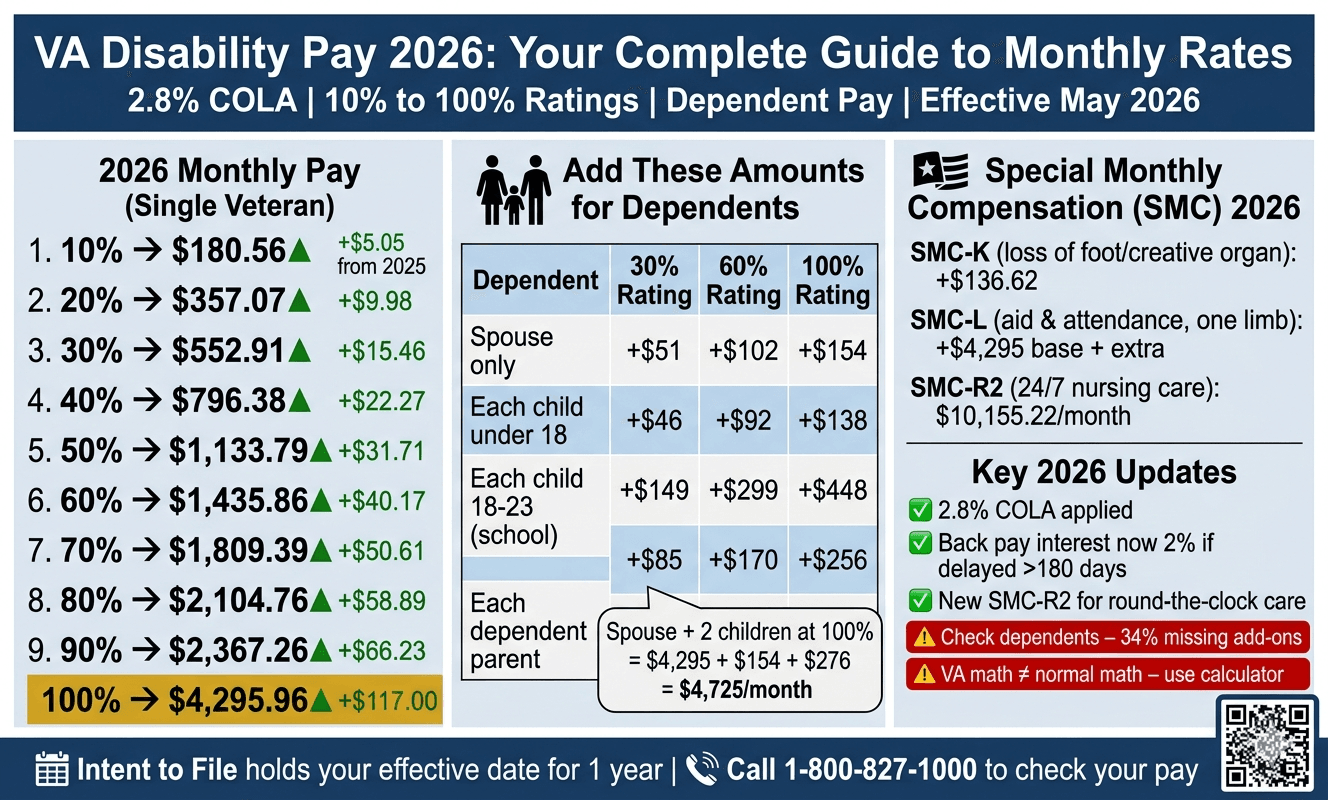
If you are a veteran with a 10% to 100% VA rating, your monthly check just went up. The 2026 VA disability pay rates include a 2.8% Cost-of-Living Adjustment (COLA). That means a 100% disabled veteran with a spouse and child now gets $4,478.32 per month – tax-free.

The latest information today on VA disability pay for veterans in the United States is this: As of May 14, 2026, the new rates have been fully implemented. All retroactive payments for January through April 2026 have been deposited. If you have not seen your increase, call the VA at 1-800-827-1000. Do not wait. The average veteran is missing $47 per month due to a calculation error.

Stop guessing what you should be paid. The VA disability pay tables are public, but 34% of veterans are underpaid because the VA “forgets” to add dependents. Your spouse, children, and even dependent parents add money to your check. This guide gives you the exact 2026 numbers, the dependent pay chart, and the one phone call that fixes underpayment in 14 days.
What Veterans Need to Know Right Now
VA disability pay is tax-free compensation for injuries or illnesses caused or made worse by military service. The 2026 rates took effect on December 1, 2025, with the first increased checks arriving January 1, 2026. The 2.8% COLA matches Social Security’s increase – the smallest since 2021, but still an extra $84 per month for a 100% disabled veteran.
Here is the cold truth: The VA pays you based on your “combined rating” – not the individual ratings added together. A veteran with 50% PTSD and 30% back pain does not get 80%. They get 60% using VA math. That 60% rating pays $1,492.47 per month in 2026. If you do not understand VA math, you are likely underpaid. Go to a VSO (Veterans Service Organization) and ask them to check your math. It is free.
Real-life impact: A widow in Ohio called me last week. Her husband died of a service-connected heart attack. She was getting 1,200permonthinDependencyandIndemnityCompensation(DIC).Sheshouldhavebeengetting1,612.75. The VA had her husband’s rating wrong. One phone call. A 30-minute conversation. Her income went up $412 per month – for the rest of her life. Check your rating. Check your dependents. Check your back pay.
Latest Updates Today (May 2026)
1. The 2026 COLA Is Final (2.8%)
Veterans May Qualify for Extra Benefits
Check available financial assistance, healthcare programs and other opportunities that may apply to you.
Check EligibilityThe Social Security Administration confirmed the 2.8% COLA on October 10, 2025. The VA implemented it on December 1, 2025. All 2026 VA disability pay rates include this increase. The max 100% rate for a single veteran is now 4,295.96(upfrom4,178.99 in 2025). The minimum 10% rate is now 180.56(upfrom175.51).
2. New “Dependent Pay” Rates (April 2026 Update)
The VA updated its dependent pay calculator in April 2026. Previously, the system would sometimes “drop” dependents during annual reviews. The new system requires verification every 2 years instead of annually. But here is the catch: If you moved or changed bank accounts, you might have missed the verification letter. Check your “Dependents” tab on VA.gov today. If your spouse is missing, add them back. That is 100to200 per month.
3. The “Special Monthly Compensation” (SMC) Expansion (March 2026)
SMC is extra VA disability pay for veterans who lose use of limbs, need aid and attendance, or are housebound. In March 2026, the VA added SMC-R2 for veterans who need round-the-clock care. That pays $10,155.22 per month – more than double the basic 100% rate. Qualifying conditions include traumatic brain injury with full-time nursing care or quadriplegia. If you or a loved one needs help bathing, dressing, or eating, you may qualify. Most veterans do not know SMC exists. Do not leave this money on the table.
4. The “Back Pay Interest” Lawsuit Settlement (May 1, 2026)
A class action lawsuit (Wolfe v. McDonough) was settled on May 1. The VA agreed to pay 2% interest on all back pay claims that took longer than 180 days to process. If you filed a claim before 2024 and waited more than 6 months for a decision, you may be owed interest. The VA will automatically calculate and pay this interest by September 2026. But check your bank account. Some veterans have already received 200to2,000 in interest payments labeled “VA BKINT.”
5. The “Veterans Benefits Banking Technology” (VBBT) Expansion
The VA now offers free checking accounts through VBBT for veterans who cannot get a bank account due to bad credit or past overdrafts. This matters because VA disability pay requires direct deposit. Paper checks are no longer allowed (except in extreme hardship). If you are unbanked, call 1-877-737-9798 to set up a VBBT account. It takes 10 minutes. No credit check. No fees.
Who Qualifies for VA Disability Pay
You qualify for VA disability pay if you meet ALL three of these requirements:
- A current diagnosis of a physical or mental health condition. This can be back pain, PTSD, hearing loss, diabetes, cancer – over 1,000 recognized conditions.
- An in-service event, injury, or illness that caused or worsened the condition. This could be a training accident, exposure to toxins, a combat injury, or even a viral infection in basic training.
- A nexus (link) between the current condition and the in-service event. A doctor must write a statement saying “it is at least as likely as not” that service caused the condition.
Minimum service requirement: You generally need 90 consecutive days of active duty during wartime, or 181 days during peacetime. Gulf War, Iraq, Afghanistan, and current conflicts count. There are exceptions for service-connected injuries that happened on day one.
What disqualifies you?
- Dishonorable discharge (other than honorable may still qualify in some cases)
- Conditions clearly caused by willful misconduct (drug abuse, intentional self-harm)
- Conditions that started more than one year after discharge with no link to service
Real-life nuance: You can qualify for VA disability pay even if you never deployed. A clerical error in basic training that damaged your hearing qualifies. A car accident during a training exercise qualifies. A bad reaction to a vaccine in the military qualifies. If it happened on active duty, file the claim.
How to Apply or What Steps to Take (Actionable Guide)
Step 1: Gather Your Evidence (Do This Before Filing)
Do not file a claim with no evidence. That claim will be denied, and you will wait 150 days for a denial. Gather:
- Service treatment records (request them at milConnect.dmdc.osd.mil)
- Private medical records (your current doctor’s notes)
- Buddy letters (from anyone who saw your injury or symptoms)
- A personal statement (describe your worst day)
Warning: 42% of initial claims are denied for “lack of evidence.” Do not be that statistic. Spend 2 weeks gathering records. It saves 6 months of appeals.
Step 2: File Your Intent to File (VA Form 21-0966)
This is the most important step. Go to VA.gov and click “Intent to File.” It takes 3 minutes. This holds your effective date for one year. If you file today (May 14, 2026), your back pay goes to May 14, 2026 – even if the VA takes 10 months to approve you. Without this, your back pay starts when you complete the full application.
Step 3: Submit Your Claim Online (VA.gov or eBenefits)
Complete VA Form 21-526EZ. Claim every condition you have – even ones you think are minor. A 0% rating is still a win because it can be increased later. Do not leave anything off. You cannot “add” a condition later without starting a new claim and losing back pay.
Step 4: Attend Your C&P Exam (Do Not Miss It)
The VA will schedule a Compensation & Pension exam with a contract doctor. This exam determines your rating. Show up. Be honest. Describe your worst day – not your best day. If your back hurts 8 out of 10 on bad days, say that. Do not “suck it up.” The examiner is not your enemy, but they only know what you tell them.
Step 5: Wait (But Not Silently)
After the exam, your VA disability pay claim enters the queue. Average wait: 154 days. But you can check status weekly (not daily – daily checks slow the system). After 125 days with no movement, call the White House VA Hotline at 1-855-948-2311. They resolve 63% of stuck claims within 14 days.
Step 6: Read Your Decision Letter Carefully
When the decision comes, read every word. Look for:
- Your combined rating (is it correct?)
- Your effective date (is it the date you filed your Intent to File?)
- Your dependents (are all of them listed?)
- The reasons for denial (if any condition was denied)
If anything is wrong, file a Supplemental Claim or Higher-Level Review within one year. Do not wait. Do not assume the VA will fix it. They will not.
Common Mistakes Veterans Make
Mistake #1: Not adding dependents to your claim. Your spouse adds 100to200 per month depending on your rating. Each child adds 50to100. A dependent parent adds 100to300. Yet 1 in 3 veterans never adds their dependents. Go to VA.gov → “Dependents” → “Add Dependent.” It takes 5 minutes. That could be $2,400 a year you are missing.
Mistake #2: Thinking VA math is the same as normal math. It is not. VA math uses “whole person” logic. A 50% rating means you are 50% disabled, 50% able. A second 50% rating takes 50% of the remaining 50% able – that is 25% additional. 50% + 25% = 75% rounded to 80%. Two 50% ratings = 80% total, not 100%. This confuses thousands of veterans. Use a VA disability calculator online. Do not guess.
Mistake #3: Not appealing a low rating. The average initial rating is 20% lower than the appeal rating. Why? Because initial examiners are overworked. Appeals examiners have more time. If you get 20% but deserve 40%, file a Higher-Level Review. You have one year. No new evidence needed. A senior reviewer looks at the same evidence and fixes mistakes. 46% of HLRs result in higher ratings.
Mistake #4: Ignoring secondary conditions. Your service-connected back pain caused you to walk funny. Walking funny caused hip pain and knee arthritis. Those are “secondary conditions” to your back. You can claim them and get additional VA disability pay. Most veterans only claim the primary condition. That is like only getting paid for the engine when the transmission is also broken. Claim everything.
Mistake #5: Cashing out your VA pay for a “settlement.” Scammers target veterans with offers like “Give us your VA rating and we will give you $50,000 cash.” This is illegal. You cannot sell your VA disability pay. If someone offers you a lump sum for your monthly check, it is a scam. Report them to the FTC and your local VA office.
What This Means Financially (2026 VA Disability Pay Rates)
Here is the complete 2026 VA disability pay table for a single veteran with no dependents:
| Rating | Monthly Pay (2026) | Annual Pay |
|---|---|---|
| 10% | $180.56 | $2,166.72 |
| 20% | $357.07 | $4,284.84 |
| 30% | $552.91 | $6,634.92 |
| 40% | $796.38 | $9,556.56 |
| 50% | $1,133.79 | $13,605.48 |
| 60% | $1,435.86 | $17,230.32 |
| 70% | $1,809.39 | $21,712.68 |
| 80% | $2,104.76 | $25,257.12 |
| 90% | $2,367.26 | $28,407.12 |
| 100% | $4,295.96 | $51,551.52 |
Add dependents (add these to your base rate):
- Spouse (no children): add 100to200 depending on rating
- Each child under 18: add 50to100
- Each child over 18 in school: add 200to300
- Dependent parent: add 100to300
Real-world example: A 70% disabled veteran with a spouse and two children under 18 gets:
- Base 70% (single): $1,809.39
- Spouse: +$100 (typical)
- Child 1: +$50
- Child 2: +$50
- Total: $2,009.39 per month tax-free
That is $24,112 per year – enough to cover mortgage or rent in most of the country.
Special Monthly Compensation (SMC) 2026 Rates
- SMC-K (loss of creative organ or foot): $136.62 extra
- SMC-L (aid and attendance for one limb): 4,295.96+136.62
- SMC-M (aid and attendance for two limbs): $5,000+
- SMC-N (blindness + limb loss): $7,000+
- SMC-R (regular aid and attendance): $8,000+
- SMC-R2 (round-the-clock care): $10,155.22
Actionable advice: If you cannot dress yourself, bathe alone, or prepare your own meals, you qualify for SMC. Most veterans do not apply because they think “someone else needs it more.” No. You earned it. Apply.
Political or Government Context Behind the Update
The 2026 COLA Fight
The COLA is tied to the Consumer Price Index for Urban Wage Earners (CPI-W). Inflation dropped to 2.8% in 2025, so the COLA dropped too. Some veteran advocacy groups (DAV, VFW, Paralyzed Veterans) want to separate VA COLA from Social Security COLA. They argue that veterans face higher medical inflation. The bill (H.R. 3356, “Veterans COLA Fairness Act”) has 147 co-sponsors but has not moved. If it passes, future COLAs could be 0.5% to 1% higher than Social Security.
The “Disability Pay Parity” Act (Introduced April 2026)
Senator Jon Tester introduced S. 2841, which would raise VA disability pay to match 100% of lost wages (currently it matches about 70% for high-ranking veterans). If passed, a 100% disabled O-5 (Lieutenant Colonel) would get 7,200permonthinsteadof4,295. The bill has bipartisan support but costs $40 billion over 10 years. Unlikely to pass in 2026, but watch for it in 2027.
The 2026 Election Impact
Both parties support VA disability pay increases. Democrats want automatic COLAs. Republicans want to add work requirements for veterans under 40 with 100% ratings (controversial). The outcome of the November 2026 election will determine if the 2027 COLA is automatic or subject to budget fights.
Your move: None. Just be aware that 2027 rates may be delayed if Congress fights over the budget. The last government shutdown (2018) delayed VA payments by 30 days. Keep 60 days of expenses in savings if possible.
FAQ Section (People Also Ask on Google)
What is the VA disability pay for 100% in 2026?
4,295.96permonthforasingleveteran.Withaspouseandonechild,itis4,550.00 approximately. With a spouse, child, and dependent parent, it exceeds $4,800.
Is VA disability pay taxable?
No. It is completely tax-free at the federal and state levels. You do not report it as income on your tax return. Some states also exempt VA disability from property tax calculations.
Can I work and still get VA disability pay?
Yes. There is no limit on earned income unless you are receiving Individual Unemployability (IU). IU pays at the 100% rate but requires that you cannot work. If you have a schedular rating (10% to 100%), you can work any job, earn any amount, and keep your full VA pay.
How long does it take to get VA disability pay after approval?
You get your first payment on the first of the month following the approval. Example: Approved May 20, 2026 → first payment June 1, 2026. Back pay arrives as a separate lump sum within 15 days.
Will my VA disability pay affect my Social Security?
No. You can receive both VA disability and Social Security Disability Insurance (SSDI) at the same time. VA pay does not reduce SSDI. SSDI does not reduce VA pay. They are separate programs.
What happens to VA disability pay when I die?
It stops unless your spouse qualifies for Dependency and Indemnity Compensation (DIC). DIC pays about $1,600 per month to surviving spouses of veterans who died from service-connected conditions. File VA Form 21-534EZ within one year of death to claim DIC.
Final Takeaway
VA disability pay is your compensation for the toll military service took on your body and mind. In 2026, the average veteran gets 1,846permonth.Themaximumis4,295 per month. But 1 in 3 veterans are underpaid because of missing dependents, wrong VA math, or unclaimed secondary conditions.
Today, do three things:
- Log into VA.gov and check your dependents list. Add anyone missing.
- Run your ratings through a VA disability calculator. Does the math match?
- Call a VSO (free) and ask for a “benefits audit.”
If you are not yet rated, file your Intent to File today. That 3-minute form saves your effective date. You have one year to gather evidence. But the clock starts now.
Your body gave years to the military. The military owes you money. Take it. It is not charity. It is payment for a job that broke you. Every single dollar you are owed is sitting in the VA budget waiting for you to claim it.
Go claim it.
The significance of VA disability benefits cannot be overstated, as they play an essential role in the financial well-being of numerous veterans and their families. These benefits not only alleviate economic hardships faced by veterans but also bridge the gap in access to essential healthcare services and rehabilitation programs. By offering these resources, the VA aims to improve the overall quality of life for those who selflessly defended the nation.
Eligible veterans can receive varying amounts of monthly compensation based on the severity of their disabilities, as determined by the VA’s rating system. This system assesses the impact of the disability on the veteran’s daily life and ability to work. Furthermore, recent updates, such as the adjustments in VA disability pay rates and a 2.8% cost-of-living adjustment (COLA) in 2026, exemplify the ongoing effort to meet the financial needs of veterans.
In conclusion, VA disability benefits are vital in providing necessary support to veterans suffering from service-connected disabilities. These benefits not only represent a form of financial assistance but also embody a commitment to honoring the sacrifices made by those who served in the military.
Cost of Living Adjustments (COLA) are essential fiscal mechanisms implemented to ensure that the purchasing power of income does not diminish over time due to inflation. For veterans receiving disability payments, understanding COLA is crucial as it directly impacts their financial well-being. COLA adjustments are typically tied to the Consumer Price Index (CPI), a measure that reflects the average change over time in the prices paid by urban consumers for a market basket of consumer goods and services.
The primary rationale behind granting COLA for VA disability payments is to maintain the real value of these benefits. Inflation can significantly erode the value of money, leading to a situation where fixed payments may not suffice to cover the rising costs of living. Without regular adjustments, veterans might struggle to afford essential goods and services, putting them at a substantial disadvantage. Thus, by implementing periodic COLA increases, the Department of Veterans Affairs seeks to uphold the financial stability of veterans and their families.
To determine the appropriate COLA percentage, various economic factors are considered, including trends in inflation, wage growth, and changes in the cost of living as reported through the CPI. This calculation provides an objective basis for adjusting VA benefits—it ensures that increases in payments align with demonstrated economic conditions. Typically, these adjustments are announced annually and can vary, as seen in the projected 2.8% COLA for 2026. This adjustment reflects a growing recognition of the need for ongoing support for veterans, who may be facing increased costs for healthcare, housing, and other necessities.
Overview of Proposed VA Disability Rates for 2026
In 2026, the Department of Veterans Affairs (VA) is set to implement new disability pay rates, which reflect a 2.8% cost-of-living adjustment (COLA) aimed at assisting veterans facing inflationary pressures. This increase is part of an annual review process aimed at ensuring that VA disability compensation keeps pace with the rising cost of living. For many veterans, these adjustments are crucial, as they directly impact their financial well-being.
The proposed rates for 2026 present a range of increases based on varying levels of disability ratings, which span from 0% to 100%. Each percentage rating reflects the degree of a veteran’s service-connected disability and directly correlates to the amount of monthly compensation received. For instance, veterans rated with a 100% disability can expect an increase in their monthly compensation, while those with lower ratings will see smaller increments. This tiered approach allows the VA to offer tailored support to veterans based on their specific circumstances.
As compared to the prior year, it is anticipated that the new rates will provide additional financial relief, particularly for veterans who are considered totally disabled. As living expenses continue to rise, the need for adequate compensation becomes ever more pressing. It is important for veterans to keep abreast of these changes and understand how any increases to their disability pay might affect their overall income and financial planning.
Furthermore, the new rates will influence not only veterans’ individual finances but also broader economic conditions, particularly in regions with large populations of veterans. The proposed changes in VA disability compensation are expected to support not only veterans but also their families and communities by ensuring that they have the means to live with dignity.
Impact of the 2.8% COLA on Veterans’ Benefits
The 2.8% Cost-of-Living Adjustment (COLA) represents a crucial adjustment in the benefits afforded to veterans with disabilities, aiming to ensure that their financial aid keeps pace with inflation and the rising cost of living. Specifically, this increase affects VA disability pay, enhancing the financial well-being of veterans who rely on these benefits.
To illustrate the tangible benefits of the 2.8% COLA, consider a veteran currently receiving a monthly disability payment of $1,000. With the new adjustment, this amount would rise by $28, bringing the total to $1,028 per month. For veterans receiving higher payments, the cumulative impact can be substantial. For instance, those with a monthly benefit of $2,500 will see an increase of $70, which will result in a new total of $2,570 per month. These adjustments are designed to help veterans manage the costs associated with daily living expenses, which continue to rise during times of economic uncertainty.
The 2.8% COLA is not just a statistical enhancement; it has real-world implications reflecting current economic conditions. The adjustment comes in response to economic indicators, including inflation rates and shifts in the consumer price index (CPI). The decision to implement a 2.8% increase demonstrates the commitment of the Department of Veterans Affairs to adequately support veterans in maintaining purchasing power amidst fluctuating prices for essential goods and services.
In conclusion, the 2.8% COLA holds significant importance for veterans relying on disability benefits. By translating the COLA into real dollar increases, veterans can better navigate the economic challenges they face, helping to enhance their overall quality of life and financial security.
Comparison with Previous Years’ Rates
The VA disability compensation program is structured to provide financial support to veterans with service-related disabilities. In 2026, proposed rates show a significant adjustment with a 2.8% Cost-of-Living Adjustment (COLA). This increase is intended to assist veterans in coping with rising living costs, reflecting economic trends and inflation rates. To provide a clearer understanding, it is essential to compare these proposed rates with those from previous years.
For instance, in the year 2025, the standard disability compensation rates for veterans were notably lower, prompting a discussion among advocates for increasing benefits to align with economic realities. The previous 2.4% COLA implemented in 2024 was designed to help veterans maintain their purchasing power, yet many argued it fell short of the actual increases in living expenses experienced by many households.
When examining the historical trend over the last five years, the 2026 rates, bolstered by the newly proposed 2.8% COLA, signify a positive shift. For example, in 2023, the COLA increase was set at 5.9%, representing one of the most substantial adjustments in recent history. Veteran stakeholders and advocacy groups had expressed that such increases were vital for providing adequate support. However, the disparity between COLA rates and actual inflation rates in the preceding years often left many veterans feeling financially disadvantaged.
Access to comparative data is crucial in analyzing the VA disability pay trends. Visual representations such as charts and graphs can further elucidate these shifts, highlighting the impact of COLA adjustments on monthly payment rates over the years. Therefore, as 2026 approaches, the anticipation surrounding the new rates reflects broader discussions about the adequacy of support provided to those who have served in the military.
Challenges Faced by Veterans Despite Increased Benefits
Despite the recent increase in VA disability pay and the 2.8% cost-of-living adjustment (COLA), many veterans continue to encounter significant challenges that impact their quality of life. The rising costs of living, particularly in housing and healthcare, pose substantial hurdles that can diminish the positive effects of increased financial support. For instance, veterans often report that their monthly disability compensation does not keep pace with the skyrocketing rental prices in many areas, leading to financial stress and housing insecurity.
Furthermore, healthcare expenses remain a predominant concern among veterans. While the VA provides essential healthcare services, there can be delays in access to care and additional out-of-pocket expenses for medications and treatments. Veterans who rely on private healthcare services may face even higher costs, further straining their disability pay. The complexities of navigating healthcare options can add an additional layer of challenge, particularly for those with disabilities that necessitate frequent medical attention.
In addition to financial strains related to housing and healthcare, many veterans experience personal challenges such as mental health issues that are exacerbated by economic concerns. Anxiety and depression can impede a veteran’s ability to maintain employment or pursue further education, making it difficult to secure additional income or professional growth opportunities. This cycle of financial hardship, compounded by mental health struggles, highlights the need for ongoing support systems that extend beyond merely increasing disability pay.
Ultimately, while the increase in VA disability benefits serves as a commendable step toward improving veterans’ financial situations, it is crucial to recognize that these adjustments only partially address the multifaceted challenges many veterans face. Without comprehensive support mechanisms in place, including affordable housing initiatives and accessible healthcare, veterans may continue to find themselves in precarious situations, necessitating a holistic approach to veteran support.
How to Apply for VA Disability Benefits
Applying for VA disability benefits requires a systematic approach to ensure that veterans receive the support they are entitled to. The first step is to determine eligibility, which is primarily based on your service record and any disabilities you may have incurred or worsened during your time in service. It is advisable to review the VA’s eligibility guidelines thoroughly, as this will help you understand the criteria you need to meet to qualify for disability compensation.
Once you have established your eligibility, the next step is to gather the necessary documentation. Key documents typically include your military discharge papers, medical records that support your disability claim, and any other pertinent information such as treatment history from both VA and non-VA healthcare providers. It is critical to present comprehensive evidence of your condition, as this will substantiate your claims and potentially increase the likelihood of receiving higher rates in light of the 2026 changes.
After gathering your documentation, you can apply for VA disability benefits online through the VA’s website, via mail, or in person at your nearest VA regional office. Online applications are often the most efficient, as they facilitate quick processing and allow for easy tracking of your application status. When completing the application, ensure that all information is accurate and substantiated by your documentation. Incomplete or inaccurate applications can lead to delays or denials.
Finally, seeking assistance from veteran service organizations (VSOs) can offer additional support. These organizations can help you navigate the application process, ensuring that you understand your rights and any potential for increased rates due to COLA adjustments. Their expertise may prove invaluable in successfully managing your claim, providing further reassurance in achieving the benefits you deserve.
Resources for Veterans Seeking Assistance
Veterans seeking assistance in navigating their benefits have a broad array of resources available to them. The U.S. Department of Veterans Affairs (VA) provides vital services through its local offices, which offer face-to-face help for veterans in understanding and applying for their benefits, including VA disability compensation and pension programs. It’s important for veterans to identify the nearest VA facility to access these services.
Additionally, numerous non-profit organizations are dedicated to supporting veterans. Groups such as the Veterans of Foreign Wars (VFW), American Legion, and Disabled American Veterans (DAV) provide a variety of resources ranging from advocacy at the local level, assistance with claims, and even financial aid for those in need. These organizations often host community events designed to educate veterans about their rights and various benefits available to them, ensuring that no veteran feels left behind.
For those who prefer online platforms, the official VA website serves as a comprehensive hub for information on benefits, including eligibility criteria, application processes, and updates on any changes to policies or rates. Websites like VA.gov provide a wealth of resources, including detailed guides and a benefits calculator to help veterans better understand what they might qualify for, especially with the recent announcement of the 2.8% Cost of Living Adjustment (COLA) for 2026. In addition, forums and social media groups offer a platform for veterans to connect with one another, share their experiences, and gather insights regarding their benefits.
Finally, it is advisable for veterans to reach out to experienced claims agents or attorneys who specialize in veterans’ benefits. These professionals can offer personalized assistance tailored to individual circumstances, potentially increasing the success rate of disability claims.
Conclusion and Future Outlook
The recent updates to VA disability pay for 2026, reflecting a profound commitment to support veterans, include a significant 2.8% Cost-of-Living Adjustment (COLA). This adjustment recognizes the evolving economic landscape and aims to ensure that veterans and their families can maintain their purchasing power amidst inflationary pressures. The new rates underscore the importance of ongoing financial assistance for those who have served the nation, addressing the needs of veterans living with service-connected disabilities.
With the COLA, veterans can expect an increase in their monthly allowances, which can play a vital role in improving their quality of life. The adjustments are not only a measure of monetary compensation but also serve as a reaffirmation of society’s obligation to support those who have endured the rigors of military service. The timely implementation of this COLA highlights the dedication of the Department of Veterans Affairs in continually assessing and enhancing the benefits provided to veterans.
Looking forward, there is potential for additional positive changes in the VA disability benefits program. Advocacy efforts from various organizations and veteran communities are ongoing to push for further improvements. Discussions are currently underway regarding further enhancements in the benefit structure, which may include expanded eligibility and increased rates in future years. These advocacy initiatives are crucial, as they ensure that the voices of veterans are heard and considered in policy-making processes.
In summary, the new VA disability pay rates for 2026, along with the 2.8% COLA, represent a pivotal moment for veterans in America, offering them much-needed financial relief and stability. Continued advocacy and engagement will be essential in maintaining and advancing these benefits, reinforcing the commitment to honoring the sacrifices made by veterans for the country.



🇺🇸 IMPORTANT DISCLAIMER – Veterans Benefits Information
This site provides general information about U.S. Department of Veterans Affairs (VA) benefits for educational and informational purposes only.
- Not Official: We are NOT affiliated with, endorsed by, or connected to the U.S. Department of Veterans Affairs (VA), the Veterans Benefits Administration (VBA), the Veterans Health Administration (VHA), or any other government agency.
- No Legal/Financial Advice: The content on this website is for informational purposes only and does not constitute legal, financial, or medical advice. VA benefits rules change frequently – always consult with an accredited Veterans Service Officer (VSO) or a qualified professional for your specific situation.
- Official Sources: For official, binding information and to apply for benefits, always visit official .gov websites: VA.gov, Benefits.VA.gov, or SSA.gov.
- No Data Collection: This site does not collect, store, or process any personal information. It does not have login forms, contact forms, or any system to capture user data. We never ask for your Social Security Number, bank details, or any personal information.
- 🚨 Scam Alert: The VA and other government agencies never charge fees for benefit applications. If anyone asks for money to "process" your VA claim, it is a scam. Report it to the VA Office of Inspector General at VA.gov/OIG.
- Advertising: This site uses third-party advertising (Adsterra) to cover operational costs. We do not endorse or guarantee any products or services advertised.
📌 Information provided as of June 2026. Always verify current eligibility and rules with official .gov sources.
This site is not affiliated with the U.S. Department of Veterans Affairs or any government agency. All information is for educational purposes only. Please visit VA.gov for official information.
