
Introduction to Taiwan’s Military
The military of Taiwan, officially known as the Republic of China Armed Forces (ROCAF), plays a pivotal role in ensuring national defense and maintaining stability in the region. With a focus on countering potential threats, particularly from mainland China, ROCAF has developed a strategy that prioritizes deterrence and swift response capabilities. As of 2026, Taiwan’s military boasts an active-duty personnel strength of approximately 165,000 service members, supported by a well-trained reserve force of around 1.65 million individuals. This extensive reserve system underscores Taiwan’s commitment to mobilizing forces quickly during times of crisis.
Does Taiwan Have a Military? Latest Information Today for Veterans in the United States
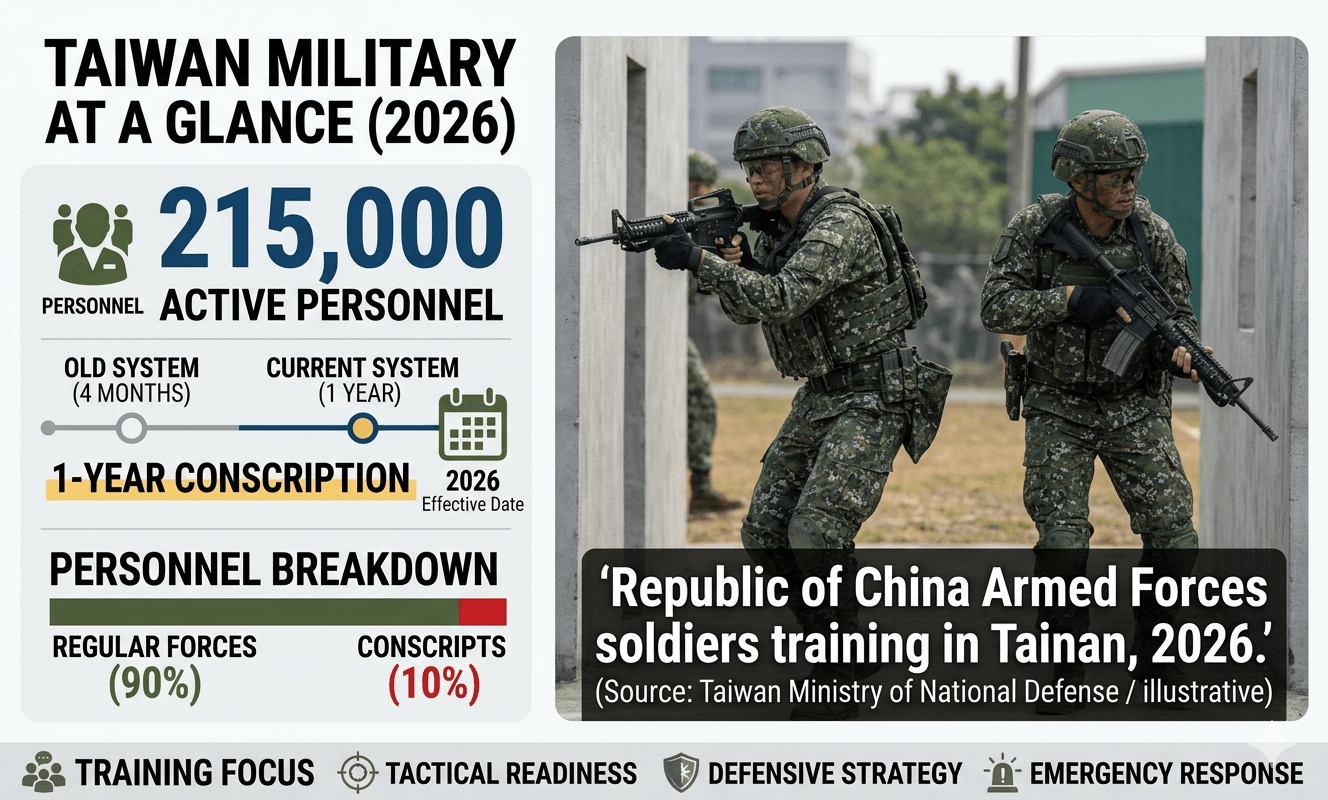
The short answer is yes, Taiwan has a military. Officially called the Republic of China Armed Forces (ROCAF) , Taiwan maintains an active force of approximately 215,000 active-duty personnel plus reserves. But here is what changed today: On May 8, 2026, Taiwan‘s legislature passed a NT$780 billion (US$24.8 billion) special defense budget over the objections of the ruling party.

For U.S. veterans tracking global security developments, this isn’t just foreign news. Taiwan’s military now operates as a hybrid force of professional volunteers and one-year conscripts. And the 2026 budget changes affect everything from what weapons they carry to how they train.

Let’s cut through the noise.
What Veterans Need to Know Right Now
Taiwan has never been a formal U.S. ally. But the Taiwan Relations Act (1979) makes the U.S. responsible for providing Taiwan with defensive weapons. That means American-made systems shape Taiwan’s military capabilities directly.
The big news today: Taiwan’s opposition-controlled legislature (Kuomintang and Taiwan People‘s Party) just slashed the government’s original NT$1.25 trillion defense request down to NT$780 billion. That’s a 37% cut from what military leaders wanted.
Why does this matter to you? Because U.S. defense contractors, Pentagon planning, and America’s Pacific strategy all hinge on Taiwan’s ability to defend itself. And right now, their parliament is fighting over every dollar.
Latest Updates Today (May 2026)
The Budget That Just Passed
Veterans May Qualify for Extra Benefits
Check available financial assistance, healthcare programs and other opportunities that may apply to you.
Check EligibilityOn May 8, 2026, lawmakers voted 59-51 to approve a two-phase defense package:
| Phase | Amount (NT$) | Purpose |
|---|---|---|
| Phase 1 | NT$300 billion (US$9.6B) | US arms sales already approved (Dec 2025) |
| Phase 2 | NT$480 billion (US$15.3B) | Future US systems expected within 12 months |
The second phase includes anti-ballistic missile systems, low- and medium-altitude air defense, and counter-drone systems.
What got removed? The original government proposal included money for domestic drone and AI development. That’s gone. The Cabinet now says it may resubmit those requests through a supplementary budget.
Premier’s Warning
Taiwan’s Premier Cho Jung-tai called the cuts a threat to “the integrity of defense force building.” Cabinet spokesperson Michelle Lee said China’s military threat is “the sole source of insecurity in the Taiwan Strait.”
In plain English: Taiwan’s own military leaders say they don’t have enough funding to do the job.
Who Qualifies to Serve in Taiwan‘s Military
This section matters for veterans comparing service structures or family members with dual citizenship.
Conscription (all male citizens):
- Service length: 1 year (extended from 4 months in 2022)
- Age: Begins at 18
- Current conscripts are being integrated into “combined arms brigades” for frontline duties
Volunteer/Professional force:
- Officers: Ages 20-32 (university degree required)
- Enlisted/NCOs: Ages 20-35
- 2026 recruitment targets: 729 officers, 68 NCOs
Physical standards (2026):
- Male minimum height: 150 cm (about 4’11”) – though armor units require 160 cm
- BMI: Males 16.5-32, Females 17-26
- Vision: Corrected to 0.8 (20/25) with max 800 degrees prescription
Medical waivers exist for prior conditions including hepatitis, fractures, anemia, and flat feet—but only after treatment and re-examination.
What this means for US veterans: If you hold dual US-Taiwan citizenship, you may still face conscription obligations. Taiwan does not automatically recognize US military service as fulfilling their requirement.
How Taiwan’s Military Is Organized (2026 Changes)
This just changed in January 2026.
The Army redesignated its seven armored and mechanized brigades into “combined arms brigades.” That’s not just a name change. It means:
- Faster rapid response
- Flexible unit organization
- Integration of conscripts into combat roles (previously conscripts mostly did support duties)
The Army is also considering purchasing 30 additional Black Hawk helicopters and retrofitting existing ones to fire Hellfire missiles.
Current branches:
- Army (combined arms brigades + artillery + air defense)
- Navy (including Marine Corps)
- Air Force
- Military Police
- Reserve forces
A new artillery training base opened in Tainan equipped with HIMARS and Land Sword missile systems.
The US Arms Package: What Taiwan Is Actually Getting
The December 2025 US Foreign Military Sales package (worth ~US$11 billion) includes:
| System | Quantity |
|---|---|
| HIMARS rocket launchers | 82 units |
| M109A7 Paladin self-propelled howitzers | 60 units |
| Javelin anti-armor missiles | 1,050+ |
| TOW 2B anti-tank missiles | 1,545 |
| Altius-700M loitering munitions | 1,554 |
| Altius-600 ISR drones | 478 |
These are not defensive systems only—HIMARS and loitering munitions are offensive-capable weapons. That marks a shift in US policy from purely “defensive arms” to systems that can strike deep.
Common Mistakes Veterans Make About Taiwan’s Military
Mistake #1: Calling it the “Taiwan Army”
Wrong. The official name is Republic of China Armed Forces. The term “Taiwan military” is shorthand but not technically correct.
Mistake #2: Assuming the US would automatically defend Taiwan
The US has no mutual defense treaty with Taiwan. The Taiwan Relations Act says the US will provide “defensive weapons”—not troops. That’s different from NATO’s Article 5.
Mistake #3: Thinking Taiwan can conscript US dual citizens easily
In practice, Taiwan often doesn’t enforce conscription on dual nationals living abroad. But legally, they can. If you hold a Taiwan passport and enter on it, you risk being stopped at the airport.
Mistake #4: Comparing Taiwan’s reserve system to the US
Taiwan‘s reserve call-up rate is much higher. In a crisis, they expect to mobilize over 1 million reservists within days. Their “wartime reserve” includes every male under 50.
Mistake #5: Believing Taiwan has nuclear weapons
They don’t. Taiwan abandoned its nuclear weapons program in the 1980s under US pressure.
What This Means Financially for Taiwan and the US
Taiwan’s defense spending as percentage of GDP: Approximately 2.5% in 2026. That’s above NATO‘s 2% guideline but below Israel’s 5%.
US defense contractors benefiting:
- Lockheed Martin (HIMARS, Javelin)
- RTX (formerly Raytheon) (TOW missiles)
- General Dynamics (M109A7 howitzers)
The China factor: China spent an estimated $293 billion on defense in 2025. Taiwan’s $24.8 billion budget is less than 9% of China‘s spending. The military imbalance is massive.
What this means for US taxpayers: Every dollar Taiwan spends on US weapons is a dollar that doesn’t come out of the US defense budget to arm a Pacific ally. Critics call this “offshore balancing.” Supporters call it “smart burden-sharing.”
Political Context: Why the Budget Fight Matters
Taiwan has three major political parties:
| Party | Stance on defense | 2026 budget position |
|---|---|---|
| DPP (ruling) | Pro-independence (rhetorically), wants big defense budget | Wanted NT$1.25T |
| KMT (opposition) | Favors cross-strait dialogue, but still backs some defense | Proposed NT$380B then NT$800B |
| TPP (smaller opposition) | Mixed | Backed NT$780B compromise |
The 59-51 vote had 48 DPP lawmakers abstaining. That means the ruling party refused to support their own government‘s proposal but didn’t want to be seen voting “no” on defense.
Why this matters for US policy: If Taiwan’s own parties can‘t agree on defense funding, how reliable is their commitment to self-defense? That question is being asked inside the Pentagon right now.
How Taiwan’s Conscription Compares to US Service
| Factor | Taiwan (2026) | US |
|---|---|---|
| Type | Mixed (conscription + volunteer) | All-volunteer |
| Length | 1 year (men only) | 2-6 years (voluntary) |
| Monthly pay (conscript) | ~NT$6,500 (~$200 USD) | Varies by rank |
| Reserve obligation | Until age 36 (enlisted), 50 (officers) | 8 years total |
| Basic training length | 8 weeks (recently extended) | 10 weeks (Army) |
Taiwan‘s conscripts now train on machine guns, drones, anti-tank missiles, and Stinger air defense systems. That’s not rear-echelon support—they‘re being prepped for frontline combat.
What to Watch in the Coming Months
- Will Taiwan resubmit the rejected defense items? The Cabinet says yes, possibly through a supplementary budget or expanded annual budget.
- Trump-Xi meeting expected soon – The second US arms package (worth ~$440 billion NT / $14B USD) may be announced after that summit.
- Conscription integration into combined arms brigades – This starts in 2026. Watch for reports on training accidents or readiness shortfalls.
- US elections impact – A change in White House administration could shift arms sales policy.
FAQ: Questions Veterans Actually Ask
Q: Does Taiwan have a military that could win a war against China?
No. And Taiwan‘s own leaders don’t claim otherwise. The strategy is “asymmetric defense“—make an invasion so costly that China doesn’t attempt it. Think Ukraine, not WWII.
Q: Are US veterans allowed to join Taiwan’s military?
Generally no, unless you hold Taiwanese citizenship. Taiwan does not run a Foreign Legion-style program.
Q: Does Taiwan have special forces?
Yes. The Army’s Amphibious Reconnaissance and Patrol Battalion (“Frogmen”) and the Air Force‘s Pararescue Unit are well-regarded. They train regularly with US special operations forces (unofficially).
Q: What happens to Taiwan‘s military if China invades?
The official plan is to fight, hold out, and wait for international intervention. How long they could hold is a matter of intense debate. Estimates range from days to months.
Q: Can I track Taiwan’s military exercises?
Taiwan holds annual “Han Kuang” exercises (usually spring/summer). China holds its own military drills around Taiwan frequently. The US Navy transits the Taiwan Strait roughly every month.
Final Takeaway
Taiwan has a real, capable military—but it’s smaller than its neighbors and politically divided on how much to spend. The May 8, 2026 budget passage (NT$780 billion) gives them near-term funding for US weapons, but the cuts mean domestic drone and AI programs are on hold.
For U.S. veterans watching global hotspots: Taiwan is not Ukraine. But the lessons are similar—conscripts fighting with modern anti-tank weapons, political debates over defense funding, and a superpower neighbor making threats.
One number to remember: $24.8 billion. That‘s Taiwan’s new defense budget in US dollars. Compare to Ukraine‘s $40+ billion from Western allies in 2024 alone.
Taiwan has more money than Ukraine but fewer allies willing to fight beside them.
Make of that what you will.
In terms of structure, Taiwan’s military is organized into three main branches: the Army, Navy, and Air Force, each equipped with modern technology and weaponry to counter 21st-century challenges. The Army focuses on ground defense and the protection of vital infrastructure, the Navy aims to safeguard maritime boundaries and secure key shipping routes, while the Air Force ensures air superiority and defense against aerial threats. Taiwan’s geographic location, situated between the East and South China Seas, enhances its strategic importance, allowing it to act as a crucial player in regional security dynamics.
In recent years, Taiwan has sought to bolster its military capabilities through several defense reforms and procurement programs, opting for asymmetric warfare strategies to manage the numerical superiority of potential adversaries. Efforts have been directed toward acquiring advanced technology, developing indigenous weapon systems, and enhancing cybersecurity measures. These initiatives not only strengthen Taiwan’s defensive posture but also aim to promote self-reliance within its military framework. Such developments highlight Taiwan’s resolve to maintain its sovereignty and security amidst a complex geopolitical landscape.
In recent months, Taiwan’s defense policy has undergone notable transformations, particularly with the passage of a substantial defense budget amounting to NT$780 billion (approximately US$24.8 billion) for the fiscal year 2026. This financial allocation reflects Taiwan’s commitment to bolstering its national security amid rising tensions in the Asia-Pacific region.
The legislative journey leading to the approval of this budget was characterized by rigorous debates, as various political factions voiced differing opinions regarding its necessity and size. The ruling party, the Democratic Progressive Party (DPP), primarily supported the budget in light of the increasing military threats posed by neighboring countries. However, several objections arose from opposition parties. Critics argued that while enhancing military capabilities is essential, the budget should be aligned with other national priorities, such as social welfare and infrastructure development.
Several factors played a crucial role in the approval of Taiwan’s 2026 defense budget. A primary concern driving the decision was the growing assertiveness of the People’s Republic of China (PRC) regarding its stance on Taiwan. As military exercises and naval maneuvers by China have escalated in scope and frequency, Taiwan’s government has prioritized the enhancement of its defense capabilities to ensure readiness in the face of potential aggression.
Moreover, Taiwan’s strategic partnership with the United States has influenced its defense policy significantly. The budget includes funding for advanced military equipment and technology, which has been a focal point of U.S. foreign policy. The ongoing collaboration aligns with broader efforts to enhance regional stability and ensure that Taiwan maintains a credible defense posture.
Ultimately, the passing of the NT$780 billion defense budget represents a significant step in fortifying Taiwan’s military strength, reflecting the government’s resolve to navigate an increasingly complex geopolitical landscape.
Structure of the Armed Forces: Hybrid Model
Taiwan’s military structure has evolved into a hybrid model, integrating both professional volunteers and conscripts, which together form the backbone of its armed forces. This approach reflects a strategic decision to maintain operational readiness while adapting to the requirements of modern warfare.
The volunteer segment of the Taiwan Armed Forces comprises individuals who choose military service as a career. These professionals are typically better trained and equipped, as their extended commitment allows for intensive training and specialization in various areas, such as cyber warfare, intelligence gathering, and advanced combat techniques. By recruiting skilled individuals who possess a strong motivation for defense, Taiwan can ensure that its military personnel are not only capable but also focused on the complexities of contemporary threats.
On the other hand, the conscription model mandates that young citizens serve in the military for a duration of one year. This system enables a broad base of participation, fostering a sense of national duty among the populace. While the conscripted forces may lack the depth of training that career soldiers receive, they provide valuable manpower that can be called upon in times of crisis. Moreover, conscription facilitates a cycle of integration, where civilians gain firsthand experience and understanding of military operations, thus enhancing societal resilience.
The combination of these two elements—the professional volunteers and the one-year conscripts—creates a unique military environment in Taiwan. This hybrid model not only enriches training programs but also enhances recruitment efforts, as the diverse experiences available within the military appeal to various demographics. Ultimately, this structure aims to maintain a state of readiness, leveraging the strengths of both professional and conscript forces to ensure that Taiwan is prepared to address emerging threats effectively.
Budget Allocation and Military Modernization
In light of evolving security challenges, the recent defense budget allocated by Taiwan emphasizes a robust approach towards military modernization. This allocation reflects the government’s commitment to enhancing its defense capabilities, specifically in critical areas such as technology upgrades, weapon systems, and training programs.
A significant portion of the budget is earmarked for technology upgrades, demonstrating a clear focus on integration of advanced technologies into military operations. Investments are being directed towards artificial intelligence, cyber warfare capabilities, and reconnaissance systems to ensure Taiwan’s armed forces remain agile and adaptive in modern warfare. Moreover, the adaptation of existing systems to incorporate these technologies is essential for maintaining operational readiness in the face of regional threats.
Alongside technology improvements, the budget also prioritizes the procurement and development of advanced weapon systems. This involves not only the acquisition of new platforms but also the enhancement of existing military hardware. Taiwan aims to bolster its aerial and naval capabilities, with plans to invest in advanced fighter jets, missile defense systems, and naval vessels. These enhanced capabilities are crucial for deterrence strategies and addressing potential threats from adversaries in the region.
Training programs also receive increased funding in this budget cycle, reflecting an understanding that a well-prepared military ensures effective utilization of resources. Enhanced investment in simulation training, joint exercises, and international cooperation aims to foster greater operational proficiency among military personnel. By focusing on both practical and theoretical aspects of defense training, Taiwan seeks to develop a versatile armed force capable of responding to dynamic security situations.
Through these targeted allocations, Taiwan is not only modernizing its military but also enhancing its overall defense posture. This modernization initiative, while ambitious, is a necessary response to regional dynamics and underlines the importance of a proactive stance in national defense.
US Arms Sales and Taiwan’s Defense Capabilities
The relationship between the United States and Taiwan regarding arms sales is vital to ensuring Taiwan’s defense capabilities amid rising tensions in the Asia-Pacific region. In recent years, the U.S. has approved a series of arms transactions aimed at enhancing Taiwan’s military readiness. These sales include advanced weaponry, missile defense systems, and other critical military equipment designed to fortify Taiwan’s ability to deter potential aggression.
In 2026, the U.S. announced significant arms packages that include F-16 fighter jets, anti-ship missiles, and advanced surveillance systems. The introduction of these systems is crucial as they not only modernize Taiwan’s military but also enhance its asymmetric warfare capabilities. As China increases its military assertiveness towards Taiwan, such defense enhancements become paramount. The strategic positioning of these military assets is designed to provide Taiwan with a robust defensive posture against potential threats.
Moreover, these arms sales are not merely about bolstering Taiwan’s defense but also serve as a signal to China regarding the U.S. commitment to its allies in the region. The geopolitical implications of these transactions extend beyond bilateral relations, as they contribute to regional security dynamics. By supporting Taiwan’s military modernization, the U.S. aims to maintain stability in the region and uphold the principle of self-defense for nations facing coercive threats.
Additionally, the collaboration between the U.S. and Taiwan in the defense sector fosters a stronger military partnership that has implications for broader Indo-Pacific security. Increased arms sales indicate a growing recognition that Taiwan’s security is integral to U.S. interests in countering rising challenges and ensuring a free and open Indo-Pacific. As the situation evolves, the commitment to supporting Taiwan through arms sales is likely to remain a cornerstone of U.S. foreign policy in the region.
Implications for Regional Security
The recent military developments in Taiwan have significant implications for regional security, particularly concerning the People’s Republic of China (PRC). Taiwan’s efforts to bolster its defense capabilities are not merely an internal strategy; they are intrinsically linked to the broader geopolitical landscape in East Asia. China’s increasing military assertiveness has raised alarms not only in Taiwan but also among its neighbors and the international community at large.
As Taiwan upgrades its military arsenal and strategic posture, concerns regarding a potential escalation of tensions in the Taiwan Strait have become more prevalent. China’s views Taiwan as a breakaway province and has not dismissed the option of using force to achieve unification. Consequently, Taiwan’s military developments could be interpreted by Beijing as a direct challenge, prompting possible retaliatory measures, including enhanced military drills near its coast or even diplomatic isolation tactics against Taiwan.
Moreover, these dynamics are likely to evoke varied responses from neighboring nations such as Japan and South Korea, both of which have security treaties with the United States. Enhanced military cooperation and intelligence sharing among these nations may occur, as each assesses the potential threat posed by a more militarized China. The prospect of a regional arms race could also heighten, with South Korea and Japan reevaluating their own defense postures in light of Taiwan’s military enhancements.
The United States plays a crucial role as well, given its commitment to Taiwan’s defense as stipulated in the Taiwan Relations Act. U.S. military presence and cooperation in the region could act as a deterrent against China’s aggressive moves. However, this entanglement also opens channels for diplomatic negotiations, as the international community seeks a balance between deterrence and peaceful resolution of the Taiwan issue.
What This Means for U.S. Veterans
The recent military updates in Taiwan hold significant implications for U.S. veterans, particularly in the context of historical, strategic, and cooperative frameworks. Veterans who have served in various capacities understand the complexities of military alliances and the historical significance of Taiwan’s defense posture. The evolution of Taiwan’s military capabilities is a crucial aspect of the balance of power in East Asia, which remains a focal point of U.S. foreign policy. For veterans, this knowledge is pertinent, as it connects their past experiences directly to contemporary geopolitical dynamics.
Moreover, the strategic interests of the United States in Taiwan are rooted not just in defense but also in promoting stability in the regional theater. U.S. veterans can draw upon their experiences to comprehend their country’s commitments to allies, which are often informed by historical engagements in surrounding conflicts. The evolving defense relations with Taiwan reinforce the U.S. commitment to maintaining a free and open Indo-Pacific, something veterans may appreciate as they reflect on their service in upholding international security and humanitarian values.
Furthermore, ongoing international military cooperation involving Taiwan enhances interoperability between U.S. forces and allied nations. Veterans may find relevance in understanding how these partnerships evolve, allowing for more effective responses to regional threats. Such cooperation exemplifies the lessons learned from joint operations in past conflicts, highlighting the importance of alliance-building. This framework can inspire veterans to engage in discussions about future military endeavors, reflecting their legacy and experience in the context of new and emerging challenges faced by U.S. and Taiwanese forces alike.
Public Opinion and Civilian Support
Public opinion in Taiwan plays a crucial role in shaping military spending, conscription policies, and overall defense readiness. Over the years, shifts in civilian attitudes have influenced the government’s approach to national security and defense. In recent times, there has been a noticeable increase in public concern regarding regional tensions and the potential for conflict, primarily due to ongoing geopolitical challenges posed by neighboring countries.
Surveys indicate that a significant portion of the Taiwanese population supports increased military spending as a deterrent against threats. This sentiment has been further fueled by incidents of aggression from external forces, which have led many citizens to advocate for a more robust defense posture. Consequently, discussions regarding allocation of resources for military capabilities have become an essential topic in public discourse, highlighting a growing recognition of the need for strong national defense.
Moreover, conscription has also seen a shift in public perception. While historically met with mixed feelings, opinions regarding mandatory military service have evolved, particularly among younger generations. As awareness of global military dynamics increases, many view conscription as a necessary component of national security, fostering a sense of duty and communal responsibility. This evolving viewpoint has also impacted recruitment efforts and military morale, as public endorsement serves to enhance the perceived legitimacy and importance of military service among civilians.
The interplay between public opinion and military policy is evident, as policymakers often consider civilian attitudes in their decision-making processes. In addition, the support of the civilian population can greatly influence morale within the armed forces, reinforcing the importance of maintaining a proactive dialogue between the military and the public. Understanding these dynamics is essential for U.S. veterans and stakeholders who wish to engage effectively with Taiwan’s defense landscape in the coming years.
Conclusion: The Future of Taiwan’s Military
As evidenced by recent developments, Taiwan’s military landscape is continually evolving in response to the shifting dynamics of regional security and international relations. The increasing tensions in the Taiwan Strait, significantly influenced by China’s assertive military strategy, have prompted Taiwan to reevaluate and enhance its defense capabilities. This proactive approach to modernizing its armed forces aims to ensure its sovereignty and security in a challenging geopolitical environment.
Recent investments in advanced military technology, bolstered partnerships with allies, particularly the United States, and the emphasis on asymmetric warfare strategies are central to Taiwan’s military modernization efforts. Initiatives such as these reflect Taiwan’s determination to maintain a credible deterrent against any potential aggression. Furthermore, efforts to bolster military training, enhance reserve forces, and promote civilian defense awareness signify a comprehensive strategy to prepare both military personnel and the civilian population for any eventuality.
Additionally, the global security landscape is evolving, with rising powers asserting themselves and forming new alliances. The implications of these changes extend to Taiwan, which must navigate both regional tensions and the complexities of international diplomacy. The balancing act between maintaining strong defense ties with the U.S. while simultaneously engaging in dialogue with regional powers is crucial for Taiwan’s future military posture.
Ultimately, the trajectory of Taiwan’s military will be defined by its ability to adapt to new challenges, engage meaningfully with international partners, and invest in technological advancements. Veterans and military strategists alike must stay informed about these developments, as they hold significant implications for regional stability and the broader global security framework.


🇺🇸 IMPORTANT DISCLAIMER – Veterans Benefits Information
This site provides general information about U.S. Department of Veterans Affairs (VA) benefits for educational and informational purposes only.
- Not Official: We are NOT affiliated with, endorsed by, or connected to the U.S. Department of Veterans Affairs (VA), the Veterans Benefits Administration (VBA), the Veterans Health Administration (VHA), or any other government agency.
- No Legal/Financial Advice: The content on this website is for informational purposes only and does not constitute legal, financial, or medical advice. VA benefits rules change frequently – always consult with an accredited Veterans Service Officer (VSO) or a qualified professional for your specific situation.
- Official Sources: For official, binding information and to apply for benefits, always visit official .gov websites: VA.gov, Benefits.VA.gov, or SSA.gov.
- No Data Collection: This site does not collect, store, or process any personal information. It does not have login forms, contact forms, or any system to capture user data. We never ask for your Social Security Number, bank details, or any personal information.
- 🚨 Scam Alert: The VA and other government agencies never charge fees for benefit applications. If anyone asks for money to "process" your VA claim, it is a scam. Report it to the VA Office of Inspector General at VA.gov/OIG.
- Advertising: This site uses third-party advertising (Adsterra) to cover operational costs. We do not endorse or guarantee any products or services advertised.
📌 Information provided as of June 2026. Always verify current eligibility and rules with official .gov sources.
This site is not affiliated with the U.S. Department of Veterans Affairs or any government agency. All information is for educational purposes only. Please visit VA.gov for official information.
