
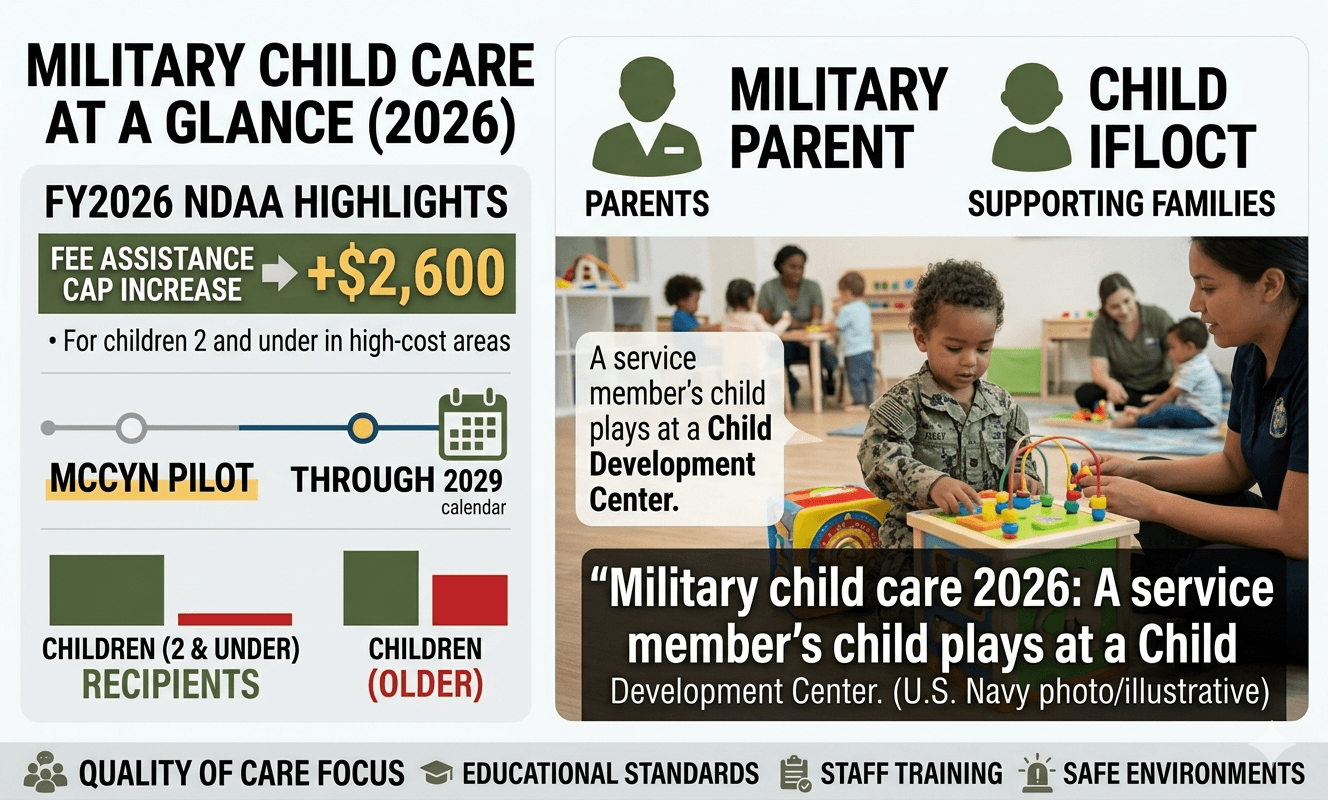
Introduction to Military Child Care in 2026
As we near 2026, the landscape of military child care is evolving to better support the unique needs of military families. The significance of child care cannot be overstated since it plays a crucial role in enabling service members to fulfill their duties while ensuring their children are cared for in a nurturing environment. For military families, the challenges of frequent relocations and deployments can add layers of complexity to securing reliable child care. These families often encounter difficulties accessing quality child care services as they transition from one duty station to another, which can add stress during already challenging times.
Military Child Care 2026: $2,600 Monthly Subsidies, 900+ New Navy Slots & NDAA Changes Veterans’ Families Need Today
The short answer: Yes, military child care costs are dropping and access is expanding in 2026. The FY2026 National Defense Authorization Act (NDAA) just authorized a five-year pilot increasing monthly fee assistance caps by 30%—from $2,000 to $2,600 per child for kids 2 and under in high-cost areas . The Navy is also opening 900+ new child care spaces by 2028 .

If you’re an active duty parent, dual-military couple, or single service member with kids, this changes your family budget right now. No more paying $1,500+ out-of-pocket while sitting on a CDC waitlist for 18 months.

Let’s get straight to what matters.
What Military Families Need to Know Right Now
The biggest news: The FY26 NDAA includes Section 589D—a five-year pilot program extending the Military Child Care in Your Neighborhood (MCCYN) Fee Assistance Program through December 31, 2029 .
That means if your base CDC has a waitlist (and most do), you can now get government subsidies for off-base civilian care—including licensed home daycares, nannies, and babysitters.
Second big news: The Navy just announced 900+ new child care slots opening at key fleet concentration areas through 2028, including new CDC construction at Naval Base Point Loma, Naval Base Kitsap, and Joint Expeditionary Base Little Creek-Fort Story .
Veterans May Qualify for Extra Benefits
Check available financial assistance, healthcare programs and other opportunities that may apply to you.
Check EligibilityBut here’s the catch: Funding is not guaranteed forever. The program “is not an entitlement program and is subject to the availability of funds” . Translation: apply now before waitlists refill.
Latest Updates Today (May 2026)
NDAA 2026: The $2,600 Monthly Cap
The old rate cap for FY2026 was $2,000 per child per month. The new five-year pilot increases that cap by 30% for children two years old or younger in high-cost areas .
| Child Age | Old Monthly Cap | New Cap (High-Cost Areas) |
|---|---|---|
| 0-2 years | $2,000 | $2,600 |
| 3+ years | $2,000 | $2,000 (pending expansion) |
Who qualifies for the higher cap: Families living in areas with high child care service costs. The Department of Defense determines this based on local market rates.
Navy Expansion: 900+ New Slots by 2028
The Navy’s Child and Youth Programs (CYP) are adding:
- Four major construction projects ongoing at Naval Base Point Loma, Naval Base Kitsap (two projects), and Joint Expeditionary Base Little Creek-Fort Story
- 154 additional slots already created at Naval Base Kitsap through converted chapel and community center spaces
- 1,000 new MCCYN fee-assistance spaces in FY26 alone
Real talk: 900 slots sounds big, but Navy families have been on waitlists for years. Apply immediately if you’re at these bases.
New ELM Curriculum Fully Implemented by End of FY26
The Early Learning Matters (ELM) curriculum is rolling out to all Navy CDCs worldwide. It’s a play-based, brain-science-backed program designed to ease the stress of PCS moves and prepare kids for school .
For parents: This means your child won’t fall behind academically when you PCS every 2-3 years. The curriculum is standardized across all Navy CDCs.
Who Qualifies for Military Child Care Programs
Eligibility depends on which program you’re applying for. Here’s the breakdown.
Child Development Centers (On-Base)
Priority goes to :
- Active duty service members (highest priority)
- Dual-military couples
- Single parents
- DoD civilian employees
- Reserve/Guard members on active duty orders
MCCYN Fee Assistance (Off-Base)
You qualify if :
- You are active duty (including eligible Reserve component families)
- Your base CDC or FCC has no available space (you must check first)
- You have children ages birth to 12 years
- You are a single military parent, dual-military couple, or your spouse is working or attending school full- or part-time
The deployment provision: MCC also provides child care fee assistance specifically when the military parent is deployed, regardless of spouse’s work status .
Army Respite Care (No-Cost Hourly Care)
This is for families in crisis or high-stress situations. You qualify if :
- Deployed Contingency Operation (you have deployment orders)
- Wounded Warrior (assigned to WTU or WTB)
- Rotational Forces
- Deployed Non-Contingency Operation
What you get: Up to 16 hours of no-cost hourly child care per child per month .
What it covers: Appointments, errands, a break, nights, weekends, and overnight care. Yes, overnight.
Coast Guard Families
The Coast Guard has separate authority under 14 USC 2922. Fees are based on total family income, and there’s a 15% discount for the second and any subsequent child enrolled .
How to Apply: Step-by-Step (Do This Today)
Step 1: Create a MilitaryChildCare.com Account
This is the central hub for all DoD child care programs. Go to MilitaryChildCare.com and create a household profile .
Why this matters: You can’t request fee assistance without an account. Do it now.
Step 2: Check On-Base Availability First
Army Fee Assistance Program guidelines state: “If there is space available for a Sponsor’s child/children at an Army CDC/FCC/SAC, then such space must be used” .
Don’t skip this step. You must verify no on-base slots exist before applying for off-base subsidies.
Step 3: Apply for MCCYN Fee Assistance Through CCAoA
The program is administered by Child Care Aware of America (CCAoA) . Contact them:
- Phone: 800-424-2246 or 703-341-4100
- Email: msp@usa.childcareaware.org
- Website: ChildCareAware.org
Step 4: For Respite Care – Submit Documents
You’ll need :
- Deployment orders (if applicable)
- Army Respite Child Care Parent Application
- Child(ren)’s birth certificate or self-certification form
- If single parent: Power of Attorney + POA contact info
Note: The spouse/second parent does NOT have to be working, going to school, or looking for work to qualify for Respite Care .
Step 5: Follow Up Every 30 Days
Waitlists are long. The system is overloaded. Call every 30 days to check your status. Be polite but persistent.
Common Mistakes Military Parents Make
Mistake #1: Assuming On-Base Care Is Your Only Option
Wrong. MCCYN exists specifically for families at duty stations with limited CDC availability. Over 1,000 new fee-assistance spaces just opened in FY26 .
Mistake #2: Not Applying Because You Think You Won’t Qualify
Eligibility is broader than most families realize. Single parents, dual-military couples, and families where the spouse works or attends school all qualify .
Even if your spouse stays home: You still qualify for Respite Care during deployment or if you’re a wounded warrior.
Mistake #3: Forgetting to Renew Annually
Fee assistance is not automatic. You must reapply each year. Missing the deadline means losing your subsidy.
Mistake #4: Paying Full Price for Off-Base Care Without Checking Reimbursement
Some families pay $1,800/month out of pocket for civilian care when they could be paying the on-base rate (often $600-900) through fee assistance. Don’t do this. Apply first.
Mistake #5: Ignoring Respite Care Benefits
16 hours of free child care per month is worth $300-500 in savings. Use it. You’ve earned it.
Mistake #6: Assuming the Waitlist Will Move Quickly
It won’t. The average wait time for a CDC slot at major installations is 12-18 months. Apply as soon as you have orders to a new duty station—even before you PCS.
Mistake #7: Not Using the ELM Curriculum Advantage
If you have a choice between CDCs, prioritize those using the ELM curriculum. It’s designed specifically for military kids who move frequently . Continuity matters.
What This Means Financially for Your Family
Let’s do real math.
Without fee assistance: Average civilian infant care costs $1,200–$2,000 per month depending on location. For a family with two kids under 5, that’s $28,800–$48,000 per year.
With MCCYN fee assistance: You pay the on-base CDC rate (typically $600–$900 per month per child). The government pays the difference—up to $2,600 per child in high-cost areas .
Example: You live in San Diego (high-cost area). Civilian care costs $2,200/month for your 1-year-old. On-base CDC rate is $800/month. MCCYN covers the $1,400 difference.
Annual savings: $16,800 per child.
Respite care savings: 16 free hours per month at $15/hour = $240/month saved. $2,880/year.
Total potential annual savings for a dual-military family with two young kids: Over $36,000.
That’s not pocket change. That’s a fully funded college savings plan.
Political & Government Context Behind the 2026 Changes
Why Is This Happening Now?
The military is facing a retention crisis. Child care costs are consistently cited as a top-three factor affecting service members’ decisions to stay in or get out .
The numbers don’t lie: Over 70% of military families report child care challenges affect their retention decisions. The Pentagon is finally listening.
NDAA 2026: Bipartisan Support
The FY26 NDAA passed with strong bipartisan backing. The MCCYN pilot extension was Section 589D—not a headline provision, but a quiet win for military families .
Navy’s “Readiness Strategy”
The Navy’s expansion is explicitly framed as a “readiness strategy” . Translation: They can’t keep ships manned if parents can’t afford child care.
Vice Adm. Scott Gray put it bluntly: “Access to high-quality, reliable childcare reflects our commitment to our people and increases fleet readiness” .
What’s Still Missing
- No universal pre-K for military families (yet)
- No backup care mandate (if your provider cancels, you’re on your own)
- No subsidy for before/after school care for kids over 12
Advocacy groups are pushing for these in the FY27 NDAA.
FAQ: Questions Military Parents Actually Ask
Q: Can I use a nanny or babysitter with MCCYN fee assistance?
Yes. The 2026 NDAA expanded qualified providers to include nannies, babysitters, and licensed in-home centers as long as they meet MCCYN standards .
Q: What if my spouse is unemployed? Do we still qualify?
For standard MCCYN, the spouse must be working or attending school. But for Respite Care (deployment or wounded warrior), the spouse’s employment status doesn’t matter .
Q: How long is the waitlist for on-base CDC?
12-18 months at major installations. Apply immediately after receiving PCS orders—even before you move.
Q: Does the Coast Guard offer the same benefits?
Similar, but separate authority under 14 USC 2922. Fees are based on total family income, and second children get a 15% discount . Contact your local Coast Guard work-life office.
Q: I’m in the Reserves. Do I qualify?
Yes, if you’re on active duty orders. For inactive duty, eligibility varies. Check with your unit’s family support center.
Q: Can I use fee assistance for overnight care?
Yes, for Respite Care. Standard MCCYN is for daytime care, but Respite Care specifically covers nights and weekends .
Q: What happens if I PCS to a new base?
You must reapply. Your fee assistance does not automatically transfer. Start the process 60 days before your move.
Q: Is there a scam risk?
Yes. Scammers impersonate CCAoA officials asking for “processing fees.” The real program never charges application fees. Report suspicious calls to your base legal office.
Final Takeaway
Military child care in 2026 is better than it was in 2025—but it’s still not perfect.
The wins: $2,600 monthly caps for toddlers in high-cost areas. 900+ new Navy slots. A five-year pilot that locks in MCCYN funding through 2029. Free respite care for deployed and wounded warrior families.
The reality: Waitlists are still long. Funding is not guaranteed forever. And you have to advocate for yourself.
One number to remember: 30%. That’s the cap increase for infants and toddlers in high-cost areas. If you live in San Diego, Seattle, Norfolk, or Honolulu, that’s your number.
One action to take today: Go to MilitaryChildCare.com and create your account. It takes 10 minutes. It could save you $16,800 this year.
Your family’s readiness starts here.
The U.S. military recognizes these challenges and is taking active measures to enhance the child care options available to its personnel. One of the most notable initiatives includes the implementation of a $2,600 monthly subsidy program aimed at alleviating financial burdens associated with child care expenses. This subsidy not only aims to support families financially but also fosters the growth and development of children by ensuring they have access to quality care and educational opportunities.
Additionally, a planned increase of 900 new slots in Navy child care facilities underscores the military’s commitment to expanding access to child care services. These added slots are essential for accommodating the growing number of service members and their children, allowing families to access necessary resources and care. The holistic approach to improving military child care in 2026 holds the potential to greatly enhance the quality of life for military families, providing them with the foundational support they require as they navigate the complexities of military life.
Overview of the New $2,600 Monthly Subsidies
The proposed implementation of a $2,600 monthly subsidy for military child care represents a significant advancement in support for military families. This financial assistance aims to alleviate the often substantial financial strains associated with obtaining quality child care services, which can be particularly burdensome for those serving in the armed forces. Military families frequently face unique challenges that impact their reliance on dependable child care, including frequent relocations and extended deployments. This subsidy could prove invaluable in providing the necessary resources for parents to secure reliable and affordable child care options.
Eligibility for the subsidy is expected to encompass active-duty service members across various branches of the military, ensuring a wide-reaching impact on families with differing financial circumstances. While the specific application process and criteria have yet to be finalized, it is anticipated that the guidelines will focus on streamlining access for those who require assistance the most. By simplifying the application procedure, the Department of Defense aims to ensure that the benefits reach eligible families effectively.
The roll-out of these subsidies comes in response to increasing calls from military advocacy groups that highlight the financial hardships experienced by military families in securing quality child care. The new subsidy is designed not only to provide economic relief but also to promote the well-being of children and, by extension, support the overall mission readiness of military units. Families who would have otherwise struggled to meet child care costs will now have a structured financial backing, opening doors to better child care solutions and positively influencing both child development and family dynamics.
In summary, the introduction of the $2,600 monthly subsidy signifies a proactive approach to addressing the challenges faced by military families in securing child care. As the rollout unfolds, further details regarding eligibility and the application process will be critical in ensuring that the intended beneficiaries can take full advantage of this program.
Expansion of Child Care Slots: 900 New Navy Slots
The recent announcement of 900 new child care slots within the Navy signifies a considerable advancement in the efforts to address the growing demand for child care services among military families. As the military community continues to expand, the challenge of securing reliable and accessible child care options becomes increasingly pressing. The introduction of these additional slots is poised to provide vital support to Navy families, ensuring they receive affordable and quality child care solutions.
This initiative is particularly relevant in light of the challenges many military families face, including frequent relocations, deployments, and the unique demands of military life. By increasing the availability of child care slots, the Navy aims to alleviate some of the burdens associated with child care shortages. Families will now have improved access to needed services, allowing parents to balance their military commitments with the essential task of raising children.
The impact of this expansion is expected to be multifaceted. Beyond simply increasing the number of available slots, the initiative aims to enhance the overall quality of child care provided. With an emphasis on meeting the needs of young children and supporting their development, the Navy’s commitment is also evident in the training and resources allocated to child care providers within these newly established slots.
Furthermore, the introduction of these 900 slots is not merely a response to immediate needs; it also reflects a proactive approach to future demands. As more Navy families join the service, the infrastructure must adapt correspondingly. This strategic growth in child care capacity will not only provide immediate relief but also establish a sustainable model for the years to come.
The Importance of Affordable Child Care for Military Families
Affordable and accessible child care is an essential service for military families, impacting their overall well-being and stability. Given the unique challenges faced by these families—such as frequent relocations, deployments, and unpredictable schedules—the availability of reliable child care can significantly ease stressors that are often inherent in military life. The relationship between child care access and family stability is clear; when military personnel have secure child care options, they can focus more effectively on their duties without the distraction of family-related concerns.
Furthermore, child care support directly correlates with the performance of service members. Knowing that their children are well-cared for allows service members to concentrate fully on their missions. When child care solutions are not optimal, service members may experience increased anxiety and distraction, leading to decreased operational effectiveness. By providing a structured environment for children, affordable child care not only supports the family unit but also contributes positively to military readiness.
Additionally, affordable child care aids in promoting equitable opportunities for children in military families. Quality care enables developmental growth and educational readiness, which are crucial for children’s futures. As such, when military families have access to ample child care resources, they can attain a better work-life balance, which is vital for the overall morale and mental health of these families. Investing in military child care is, therefore, an investment in the future of the military itself, ensuring that service members can adequately fulfill their responsibilities while nurturing their families.
Challenges Currently Facing Military Child Care Services
Military child care services have been a crucial support system for service members and their families. However, these services are currently facing several significant challenges that affect their accessibility and quality. Among the most pressing issues are high costs, long waiting lists, and overall capacity constraints.
High costs of child care continue to be a barrier for many military families. While government subsidies help alleviate some financial pressure, the expense of quality care remains daunting. Families often find that market rates for child care services far exceed what they can comfortably afford, especially in high-cost living areas near military bases. This situation can lead to families opting for less desirable care options, compromising the quality of care their children receive.
Moreover, long waiting lists for available spots in military-operated child care facilities have become a common occurrence. Many installations experience an overwhelming demand for child care services due to the increasing number of active duty personnel. As a result, families may find themselves in a prolonged waiting period before obtaining a spot, leaving parents in a stressful situation as they balance work commitments with child care needs.
Capacity issues further exacerbate the problem. Many child care facilities are operating at or near maximum capacity, unable to accommodate the growing number of families seeking assistance. New initiatives, including the recently announced $2,600 monthly subsidies and additional slots, aim to address these critical gaps. Nonetheless, systematic capacity improvements and a comprehensive strategy are essential to ensure that military families have access to the child care services they require.
Plan for Future Child Care Needs in the Military
As military families continue to grow, the demand for quality child care services increases correspondingly. Recognizing this trend, the military has initiated strategic plans to ensure that child care needs are met both in the short-term and over the coming years. Forecasts indicate a rise in the number of military families, necessitating an expansion of available resources. This includes leveraging subsidies, enhancing infrastructure, and increasing the number of available child care slots.
The implementation of $2,600 monthly subsidies is a notable component of this strategy, as it aims to alleviate the financial burden faced by military families. These subsidies will allow families to afford high-quality child care options, ultimately leading to better developmental outcomes for children and providing parents with greater peace of mind while they serve. Furthermore, the anticipated addition of 900 new Navy child care slots stands to significantly enhance capacity. This expansion illustrates a commitment to fostering a supportive environment for military personnel and their families.
In assessing the future child care landscape, the military is not only focused on immediate solutions but also on sustainable growth. Plans are being made to adapt to unpredictable changes, such as shifts in deployment cycles, changes in family sizes, and the evolving needs of service members. Continuous engagement with military families through surveys and feedback mechanisms will ensure that the strategies in place remain relevant and effective.
Overall, cultivating a robust child care system is crucial for maintaining readiness and ensuring the well-being of service members and their families. A proactive approach that anticipates future demands will help the military fulfill its commitment to supporting those who serve the nation.
Comparison with Civilian Child Care Programs
The landscape of child care services presents a complex interplay between military and civilian programs, each designed with specific goals and challenges. Military child care programs, such as those within the Department of Defense, offer a suite of options tailored to meet the unique needs of military families. These programs often provide subsidies, making them financially accessible compared to many civilian counterparts. With the recent announcement of $2,600 monthly subsidies and 900 new Navy slots in 2026, military child care is poised to further alleviate the financial burden on service members and their families.
In contrast, civilian child care programs vary widely in terms of quality and affordability. Many civilian providers do not have access to the substantial funding available to military programs, which can result in higher costs for parents. This discrepancy can make it difficult for civilian families to find adequate care without incurring significant financial strain. Additionally, civilian child care options often face challenges such as insufficient staffing and licensing requirements, leading to variability in care quality.
However, civilian child care programs have the advantage of catering to a broader population. This diversity can promote a variety of educational philosophies and caregiving approaches, allowing parents to select options that best align with their values. Furthermore, the competitive nature of the civilian market can drive innovations in child care, offering unique solutions and programs that may not yet be present in military settings.
Ultimately, while military child care programs are specifically designed to support the distinctive lifestyle of military families, they also present challenges, particularly in availability, which can lead to long waitlists. Civilian programs, though more varied, grapple with issues of affordability and quality. Both sectors have unique benefits and challenges, which should be carefully considered by parents when selecting appropriate care for their children.
Feedback from Military Families
The military child care programs have frequently been at the forefront of discussions among families affected by the unique lifestyle of military service. The proposed changes, such as the introduction of $2,600 monthly subsidies and the addition of 900 new Navy slots, have prompted a variety of reactions from military families. Many parents express a significant sense of relief at the prospect of increased financial support, indicating that the current costs of child care can be burdensome. Families have reported that the existing programs often fall short, especially in terms of accessibility and affordability. With the new subsidies, parents anticipate a more manageable budget and increased peace of mind, which is crucial for maintaining their overall well-being.
Testimonials from these families further illustrate the impact of child care services on their daily lives. One military spouse articulated that “the support made available through these programs is indispensable for military families. It helps us balance our professional obligations while ensuring our children are cared for in a nurturing environment.” The sentiment is echoed by others who believe the proposed enhancements could significantly alleviate stressors associated with childcare challenges.
Additionally, there is a sense of hope amongst families regarding the introduction of the new Navy slots. Many view this as an opportunity to improve the availability of quality care. A parent shared, “With more slots available, we can finally have a fighting chance to find child care that doesn’t involve long waiting lists or excessive out-of-pocket expenses.” This feedback supports the notion that the proposed changes could play a vital role in transforming military child care, creating a more supportive and sustainable system for service families.
Conclusion and the Way Forward
In reviewing the current landscape of military child care, it becomes evident that significant strides have been made in addressing the needs of military families. The introduction of monthly subsidies amounting to $2,600, alongside the addition of 900 new Navy slots, represents a substantial commitment to enhancing child care accessibility. These initiatives aim not only to alleviate the financial burdens faced by military families but also to foster a supportive environment for their children during transitions inherent to military life.
As we look toward the future of military child care, the importance of these initiatives cannot be overstated. The availability of quality child care services plays a crucial role in enabling military parents to focus on their duties, ensuring that their service does not come at the cost of their family’s well-being. Continued investment in child care options, along with ongoing support systems, is essential to facilitate smoother adjustments for military families and to improve their overall quality of life.
Future efforts should aim to address the evolving needs of military families, considering factors such as geographic mobility, diverse family structures, and varying developmental needs of children. Providing comprehensive resources, enhancing the quality of available services, and ensuring equitable access for all service members are vital components of a thriving military community.
In conclusion, the commitment to improving military child care is an essential element of supporting our service members and their families. By recognizing the significance of these initiatives and continuing to advocate for expansive resources, we can create an environment where military families thrive, enhancing not just their immediate situations but also the broader military community they are part of.


🇺🇸 IMPORTANT DISCLAIMER – Veterans Benefits Information
This site provides general information about U.S. Department of Veterans Affairs (VA) benefits for educational and informational purposes only.
- Not Official: We are NOT affiliated with, endorsed by, or connected to the U.S. Department of Veterans Affairs (VA), the Veterans Benefits Administration (VBA), the Veterans Health Administration (VHA), or any other government agency.
- No Legal/Financial Advice: The content on this website is for informational purposes only and does not constitute legal, financial, or medical advice. VA benefits rules change frequently – always consult with an accredited Veterans Service Officer (VSO) or a qualified professional for your specific situation.
- Official Sources: For official, binding information and to apply for benefits, always visit official .gov websites: VA.gov, Benefits.VA.gov, or SSA.gov.
- No Data Collection: This site does not collect, store, or process any personal information. It does not have login forms, contact forms, or any system to capture user data. We never ask for your Social Security Number, bank details, or any personal information.
- 🚨 Scam Alert: The VA and other government agencies never charge fees for benefit applications. If anyone asks for money to "process" your VA claim, it is a scam. Report it to the VA Office of Inspector General at VA.gov/OIG.
- Advertising: This site uses third-party advertising (Adsterra) to cover operational costs. We do not endorse or guarantee any products or services advertised.
📌 Information provided as of June 2026. Always verify current eligibility and rules with official .gov sources.
This site is not affiliated with the U.S. Department of Veterans Affairs or any government agency. All information is for educational purposes only. Please visit VA.gov for official information.
