
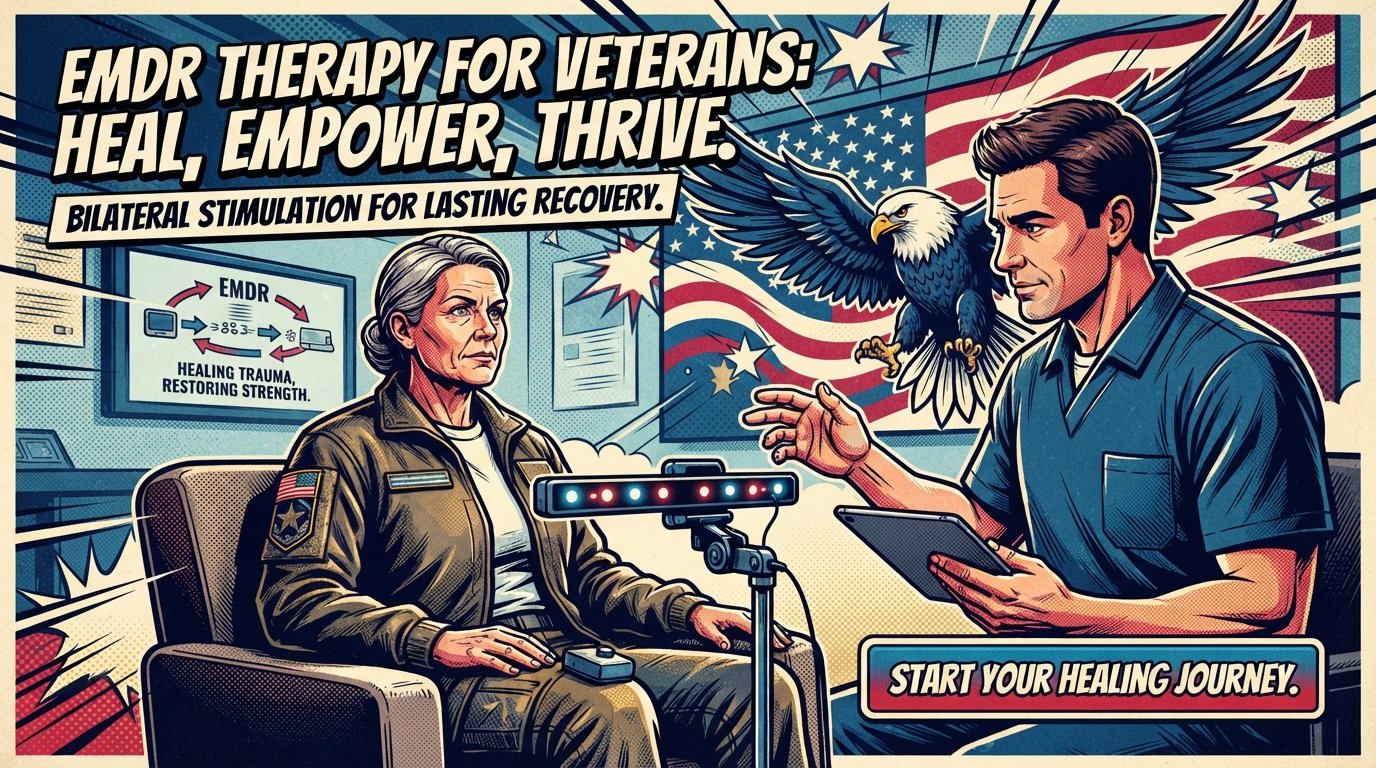
EMDR Therapy: Complete 2026 Guide for Veterans
EMDR (Eye Movement Desensitization and Reprocessing) is an evidence-based psychotherapy that helps veterans process traumatic memories using bilateral stimulation. The VA recommends EMDR with a “Strong For” rating and covers it at no cost for enrolled veterans. Treatment typically requires 6–12 sessions. Up to 77% of combat veterans no longer meet PTSD criteria after completing EMDR.
Quick Facts
| Item | Details |
|---|---|
| Benefit | Evidence-based trauma therapy covered by VA at no cost |
| Eligibility | Veterans enrolled in VA healthcare; all veterans with PTSD or trauma-related conditions |
| Application | Speak with VA primary care or mental health provider for referral |
| Processing Time | Treatment typically 2–4 months; intensive programs available |
| Official Agency | U.S. Department of Veterans Affairs (VA), Veterans Health Administration |
| Required Forms | None for VA care; DD-214 for VA healthcare enrollment (VA Form 10-10EZ) |
| Updated For | 2026 (VA/DoD Clinical Practice Guideline 2023; MISSION Act community care) |
What Is EMDR Therapy?
EMDR stands for Eye Movement Desensitization and Reprocessing. It is a trauma-focused psychotherapy that helps people process and make sense of traumatic memories while paying attention to a back-and-forth movement or sound. The VA defines EMDR as a treatment where you recall traumatic memories while engaging in bilateral stimulation — typically guided eye movements, tapping, or tones.

EMDR is based on the adaptive information processing model. This model holds that PTSD results from past disturbing experiences that were not adequately processed and therefore still cause distress when the person is reminded of them. These unprocessed memories contain the thoughts, feelings, and physical sensations that occurred during the traumatic event. EMDR focuses on changing how the memory is stored in the brain through bilateral stimuli. By briefly recalling the event and then engaging in bilateral stimulation, the intensity of the emotions related to the trauma is reduced.

For veterans, this matters because combat trauma, military sexual trauma (MST), and moral injury do not fade with time. Without targeted intervention, they drive hypervigilance, avoidance, sleep disruption, and often self-medication with alcohol or other substances. EMDR directly targets the neurological source of those responses rather than addressing symptoms in isolation.
What you should do next: If you are enrolled in VA healthcare, ask your primary care provider or mental health provider for a referral to EMDR therapy. If you are not enrolled, apply at VA.gov or call 1-877-222-8387.
How EMDR Works: The Eight Phases
EMDR follows eight defined phases. The sequencing is intentional — rushing into trauma reprocessing without proper preparation is one of the ways EMDR can go wrong. This is why working with a trained clinician in a structured setting matters enormously.
Phase 1: History-Taking and Treatment Planning
The therapist reviews your history, identifies traumatic memories that need processing, and develops a treatment plan. This phase also assesses your readiness for trauma processing and identifies any stabilizing skills you need first.
Phase 2: Preparation
Veterans May Qualify for Extra Benefits
Check available financial assistance, healthcare programs and other opportunities that may apply to you.
Check EligibilityThe therapist teaches you coping skills and relaxation techniques to manage emotional distress. You learn to create a “safe place” in your mind and practice calming strategies. This phase ensures you are stable enough to handle trauma processing without becoming overwhelmed.
Phase 3: Assessment
You identify a specific target memory and the negative beliefs, emotions, and physical sensations associated with it. You also identify a positive belief you want to install. The therapist measures your baseline distress level using the Subjective Units of Disturbance (SUD) scale.
Phase 4: Desensitization
This is the core reprocessing phase. You briefly recall the target memory while simultaneously engaging in bilateral stimulation. Between sets of stimulation, you report whatever comes to mind — images, thoughts, emotions, or physical sensations. The therapist continues until your distress level drops significantly.
Phase 5: Installation
You strengthen the positive belief identified in Phase 3. The therapist uses bilateral stimulation to reinforce the positive cognition until it feels completely true.
Phase 6: Body Scan
You scan your body for any remaining tension or discomfort related to the memory. Any residual physical sensations are processed using bilateral stimulation.
Phase 7: Closure
The therapist ensures you are stable and calm at the end of each session. You may use relaxation techniques from Phase 2. The therapist explains what to expect between sessions.
Phase 8: Reevaluation
At the start of the next session, the therapist reviews your progress and identifies any remaining targets or new issues that have emerged.
The standard EMDR protocol typically requires 10–12 weekly 60- or 90-minute sessions for PTSD. Single-incident trauma can resolve in 6–12 sessions. Intensive programs condense treatment into a shorter timeframe.
How Effective Is EMDR for Veterans?
EMDR is one of the most effective treatments available for PTSD in veterans. Research published in peer-reviewed journals and endorsed by the American Psychological Association and the World Health Organization consistently shows EMDR to be one of the most effective treatments for PTSD.
Key research findings
2025 VA retrospective study: This large-scale study suggests that EMDR is an effective treatment for PTSD in veterans, showing a large effect size for PTSD symptoms and a medium effect size for depression symptoms.
Community mental health network study (2025): Clients who attended at least four sessions showed substantial symptom reductions for EMDR (ΔM = 16.6, d = 0.86), comparable to CPT (ΔM = 19.3, d = 0.98) and PE (ΔM = 17.4).
Telehealth vs. in-person study: Findings suggest that EMDR is an effective PTSD treatment for veterans, and in-person and telehealth modalities largely yielded similar outcomes, highlighting both modalities as effective.
Intensive EMDR program (2026): A six-day intensive EMDR program with twice-daily sessions produced significant PTSD symptom reductions at three-month follow-up in veterans with clinical and subclinical presentations. Response rates were 63.9% on the CAPS-5 and 77.4% on the PCL-5.
EMDR vs. CPT and PE
All three treatments — EMDR, Cognitive Processing Therapy (CPT), and Prolonged Exposure (PE) — are recommended as first-line treatments for PTSD. The 2023 VA/DoD Clinical Practice Guideline recommends individual, manualized trauma-focused psychotherapies for PTSD with a “Strong For” rating for CPT, EMDR, and PE.
| Therapy | Typical Sessions | Per-Session Cost | Total Cost Range | Best For |
|---|---|---|---|---|
| CPT | 12 | $125–$275 | $1,500–$3,300 | All PTSD types, especially guilt/shame-related trauma |
| PE | 8–15 | $125–$275 | $1,000–$4,125 | Avoidance-dominant PTSD, single-incident trauma |
| EMDR | 6–12 | $150–$300 | $900–$3,600 | Single-incident trauma, phobic responses |
Source: TherapyExplained, 2026 pricing analysis.
Treatment completion rates
One meta-regression found that the odds of completing treatment were twice as high for EMDR (OR = 2.44) compared to CPT, while PE demonstrated modest reductions in completion odds compared to CPT (OR = 0.73). This suggests that veterans may be more likely to complete EMDR treatment than some other trauma-focused therapies.
How long do results last?
Improvements in PTSD were maintained at 6 months post-treatment in a real-world evaluation of EMDR for military veterans. The durability of results makes EMDR a strong investment in long-term recovery.
VA Coverage for EMDR Therapy
The VA recognizes EMDR as an evidence-based treatment for PTSD and covers it at no additional cost for enrolled veterans. Treatment is available through VA medical centers, community-based outpatient clinics, and Vet Centers.
Where EMDR is available in VA
PTSD Clinical Teams (PCT): PCTs prioritize evidence-based psychotherapies including EMDR, CPT, PE, and Written Exposure Therapy (WET). PCT services are intensive and typically time-limited, with most veterans engaging in services for 2–4 months.
General Mental Health Clinics: EMDR may be available through general mental health services depending on provider training and clinic resources.
Vet Centers: All Vet Center services are free, and many offer EMDR as part of their counseling services. Services include individual, group, marriage and family counseling, MST counseling, and EMDR, CPT, and CBT.
Community Care: Under the VA MISSION Act, veterans can access EMDR through community providers if VA cannot provide the treatment within 20 days or if the veteran’s commute exceeds 30 minutes.
How to get EMDR through VA
Step 1: Enroll in VA healthcare if you are not already enrolled. Apply online at VA.gov or call 1-877-222-8387.
Step 2: Speak with your VA primary care provider or mental health provider. Tell them you are interested in EMDR therapy for PTSD or trauma-related symptoms.
Step 3: Request a referral to the PTSD Clinical Team (PCT) or a mental health provider trained in EMDR.
Step 4: If VA cannot schedule you within 20 days or your commute exceeds 30 minutes, ask about community care under the MISSION Act.
Step 5: Complete your treatment. Most veterans engage in EMDR for 2–4 months.
What you should do next: If you are not enrolled in VA healthcare, enroll now. If you are enrolled and want EMDR, ask for a referral at your next appointment.
EMDR for Specific Veteran Populations
EMDR has been adapted and studied for specific types of trauma that commonly affect veterans. These adaptations address the unique needs of different veteran populations.
Combat-related PTSD
Combat-related PTSD is characterized by severe and chronic symptomatology and is often accompanied by comorbid mental and physical health problems. A 2026 literature review summarizing current evidence on the effectiveness of EMDR in reducing intrusive PTSD symptoms in combat veterans found that EMDR is effective for this population.
Military Sexual Trauma (MST)
EMDR is used to treat MST-related PTSD. Vet Centers provide MST counseling and EMDR as part of their free services. The therapy can help survivors process trauma without the burden of extensive verbal disclosure, which can be particularly important for MST survivors.
Moral Injury
Moral injury — the psychological, social, and spiritual impact of actions that violate deeply held moral beliefs — is common among veterans. EMDR therapy helps treat moral injury specific to the military community on multiple levels. EMDR-certified therapists have developed frameworks that integrate EMDR with elements of Compassion-Focused Therapy (CFT) and Acceptance and Commitment Therapy (ACT) for moral injury treatment.
Blind-to-Therapist Protocol
The Blind-to-Therapist (B2T) protocol is an EMDR adaptation that reduces the burden of disclosure while preserving therapeutic efficacy. This protocol is particularly relevant for justice-involved veterans and those who struggle with shame, mistrust, or operational secrecy. Reprocessing sessions typically range from 4 to 8, targeting imagery, beliefs, and bodily sensations held privately by the client.
How to Find an EMDR Therapist
Finding a qualified EMDR therapist is essential. EMDR-trained therapists are not widely available in VA or DoD settings, in large part because EMDR is a proprietary treatment managed by outside organizations with their own certification processes.
Options for finding an EMDR therapist
Through VA: Ask your VA mental health provider for a referral to a PCT or a provider trained in EMDR. Not all VA facilities have EMDR-trained providers. If your facility does not, ask about community care under the MISSION Act.
Through EMDRIA: The EMDR International Association maintains a “Find an EMDR Therapist” directory listing more than 16,000 EMDR therapists. You can search by location, telehealth availability, and veteran/military specialization.
Through Vet Centers: Vet Centers provide free counseling services including EMDR. Services are confidential and do not require a VA disability claim or enrollment in VA healthcare.
Through community care: If you qualify under the MISSION Act, you can see a community EMDR therapist with VA authorization. The provider must be in the VA Community Care Network (CCN).
What to ask a potential EMDR therapist
Are you EMDRIA-certified or EMDR-trained?
How many veterans have you treated with EMDR?
Do you have experience with combat trauma, MST, or moral injury?
What is your approach to stabilization before trauma processing?
How many sessions do you typically recommend?
EMDR Costs and Insurance
EMDR therapy costs vary depending on the provider, location, and whether you use VA benefits or private insurance.
Cost breakdown
| Payment Method | Cost to Veteran |
|---|---|
| VA healthcare (enrolled) | $0 |
| Vet Center | $0 |
| VA community care (MISSION Act) | $0 with authorization |
| Private insurance | Copay varies ($0–$75 typical) |
| Out-of-pocket | $150–$300 per session |
Source: TherapyExplained, 2026; EMDRTherapist.info, 2026.
A veteran using VA benefits may pay nothing for EMDR. Someone using private insurance may only pay a small copay. EMDR intensives (half-day, full-day, or multi-day formats) range from $1,500 to $4,500 depending on the program.
What you should do next: If you are a veteran, your first step should be VA healthcare enrollment. If you have private insurance, check your mental health coverage and ask about EMDR-specific coverage. If you have no coverage, ask providers about sliding-scale fees or reduced-fee sessions for veterans.
EMDR vs. Other PTSD Treatments
EMDR is one of three first-line trauma-focused psychotherapies recommended by the VA/DoD Clinical Practice Guideline. Each has different characteristics that may make one a better fit depending on your preferences and needs.
Comparison table
| Feature | EMDR | CPT | PE |
|---|---|---|---|
| Focus | Processing traumatic memories using bilateral stimulation | Changing upsetting thoughts and feelings about trauma | Gradually approaching trauma-related memories and situations |
| Typical sessions | 6–12 | 12 | 8–15 |
| Verbal disclosure | Limited — you do not have to describe the trauma in detail | Requires detailed discussion of trauma | Requires detailed discussion of trauma |
| Homework | Minimal | Worksheets and practice assignments | Between-session exposures |
| Best for | Single-incident trauma, phobic responses | Guilt/shame-related trauma | Avoidance-dominant PTSD |
| Completion odds | Highest (OR = 2.44 vs. CPT) | Reference | Lower (OR = 0.73 vs. CPT) |
Source: 2023 VA/DoD PTSD CPG; Pacing in PTSD therapy meta-regression, 2026.
Which treatment is right for you?
There is no single treatment that is right for everyone. The VA recommends working with your health care provider to decide together which is best for you based on benefits, risks, side effects, and other preferences. The PTSD Decision Aid, created by the National Center for PTSD, is a recommended tool to help veterans explore evidence-based treatment options.
What you should do next: Ask your VA provider about the PTSD Decision Aid. Discuss your treatment goals, your comfort with verbal disclosure, and your preferences for session frequency.
Common Mistakes Veterans Make With EMDR
1. Assuming EMDR is not available at VA.
EMDR is a VA-recommended treatment and is available at many VA facilities, Vet Centers, and through community care. Ask specifically for it — do not assume it is not offered.
2. Skipping the preparation phases.
EMDR is not just eye movements. The preparation and stabilization phases are essential for safety and effectiveness. Rushing into trauma processing without proper preparation is one of the ways EMDR can go wrong.
3. Not asking about community care.
If your local VA does not have an EMDR-trained provider or cannot see you within 20 days, you may qualify for community care under the MISSION Act. Veterans often do not know this option exists.
4. Giving up after a few sessions.
EMDR typically requires 6–12 sessions for single-incident trauma. Some veterans may need more sessions for complex trauma. Do not judge the treatment based on the first few sessions.
5. Not telling your therapist if something is not working.
EMDR is adaptable. If the bilateral stimulation is uncomfortable or the pace feels wrong, tell your therapist. They can adjust the approach.
6. Ignoring co-occurring conditions.
Many veterans with PTSD also have depression, anxiety, or substance use disorders. EMDR can be integrated into a broader treatment plan that addresses all conditions.
7. Not verifying your therapist’s training.
EMDR is a specialized therapy. Not all therapists who list EMDR on their profile have completed full EMDRIA-approved training. Ask about their certification and experience.
8. Waiting until crisis to seek treatment.
EMDR is most effective when started before symptoms become overwhelming. If you are struggling with trauma symptoms, reach out now.
Common Questions
What is EMDR therapy?
EMDR (Eye Movement Desensitization and Reprocessing) is a trauma-focused psychotherapy that helps people process traumatic memories using bilateral stimulation. It is based on the idea that PTSD results from unprocessed memories that get stuck in the brain. EMDR helps integrate those memories into the brain’s normal narrative system, reducing their emotional intensity.
How does EMDR work for veterans?
EMDR helps veterans process combat trauma, military sexual trauma, and moral injury by targeting the neurological source of trauma responses. You briefly recall a traumatic memory while engaging in bilateral stimulation — eye movements, tapping, or tones. This reduces the emotional intensity of the memory without erasing it.
Is EMDR effective for veterans with PTSD?
Yes. The 2023 VA/DoD Clinical Practice Guideline recommends EMDR with a “Strong For” rating. Research shows up to 77% of combat veterans no longer meet PTSD diagnostic criteria after completing EMDR. A 2025 VA retrospective study found large effect sizes for PTSD symptoms and medium effect sizes for depression symptoms.
Does the VA cover EMDR therapy?
Yes. The VA recognizes EMDR as an evidence-based treatment for PTSD and covers it at no additional cost for enrolled veterans. It is available at VA medical centers, Vet Centers, and through community care under the MISSION Act if VA cannot provide the treatment within 20 days or if your commute exceeds 30 minutes.
How do I get EMDR therapy through the VA?
Enroll in VA healthcare, then speak with your primary care or mental health provider about a referral to EMDR. Ask specifically for the PTSD Clinical Team (PCT) or a provider trained in EMDR. If VA cannot see you within 20 days, ask about community care.
How many EMDR sessions do veterans need?
EMDR typically requires 6–12 sessions for single-incident trauma. The standard protocol usually involves 10–12 weekly 60- or 90-minute sessions. Complex trauma may require more sessions. Intensive programs can condense treatment into a shorter timeframe.
Can EMDR be done via telehealth?
Yes. Research shows that EMDR delivered via telehealth and in person yielded largely similar outcomes for veterans. Telehealth makes EMDR accessible for veterans in rural areas or those who cannot commute to a VA facility.
What is the difference between EMDR and CPT?
EMDR focuses on processing traumatic memories using bilateral stimulation, while CPT focuses on changing upsetting thoughts and feelings about trauma. EMDR requires limited verbal disclosure — you do not have to describe the trauma in detail. CPT requires detailed discussion of trauma. Both are first-line treatments recommended by VA.
What is the difference between EMDR and PE?
EMDR uses bilateral stimulation to process trauma, while PE involves gradually approaching trauma-related memories and situations you have been avoiding. EMDR requires less verbal disclosure and typically fewer sessions. PE is often recommended for avoidance-dominant PTSD.
Can EMDR help with moral injury?
Yes. EMDR therapy helps treat moral injury specific to the military community. EMDR-certified therapists have developed frameworks that integrate EMDR with Compassion-Focused Therapy and Acceptance and Commitment Therapy for moral injury treatment. The Blind-to-Therapist protocol is particularly useful for veterans who struggle with shame or operational secrecy.
How do I find an EMDR therapist?
Ask your VA provider for a referral. You can also use the EMDR International Association’s “Find an EMDR Therapist” directory, which lists more than 16,000 EMDR therapists. Vet Centers provide free EMDR services. If you qualify for community care under the MISSION Act, you can see a community EMDR therapist with VA authorization.
Does EMDR work for military sexual trauma?
Yes. EMDR is used to treat MST-related PTSD. Vet Centers provide MST counseling and EMDR as part of their free services. The therapy can help survivors process trauma without the burden of extensive verbal disclosure, which can be particularly important for MST survivors.
Key Takeaways
EMDR is an evidence-based trauma therapy that helps veterans process PTSD, MST, and moral injury.
The VA recommends EMDR with a “Strong For” rating and covers it at no cost for enrolled veterans.
Treatment typically requires 6–12 sessions; intensive programs are available.
Up to 77% of combat veterans no longer meet PTSD diagnostic criteria after completing EMDR.
EMDR can be delivered via telehealth with outcomes similar to in-person treatment.
Veterans can access EMDR through VA medical centers, Vet Centers, and community care under the MISSION Act.
EMDR is effective for combat trauma, MST, moral injury, and other trauma types.
The therapy follows eight phases, beginning with history-taking and stabilization before trauma processing.
Veterans can find EMDR therapists through VA, EMDRIA’s directory, or Vet Centers.
If VA cannot provide EMDR within 20 days or your commute exceeds 30 minutes, you may qualify for community care.
Official Resources
VA PTSD Treatment Information: https://www.ptsd.va.gov/understand_tx/emdr.asp
VA PTSD Decision Aid: https://www.ptsd.va.gov/apps/decisionaid/
VA PTSD Clinical Teams: https://www.va.gov/health-care/health-needs-conditions/mental-health/ptsd/
EMDR International Association (EMDRIA): https://www.emdria.org/
EMDRIA Find a Therapist Directory: https://www.emdria.org/find-an-emdr-therapist/
VA Vet Centers: https://www.va.gov/find-locations/?facilityType=vet_center
VA MISSION Act Community Care: https://www.va.gov/communitycare/
VA/DoD Clinical Practice Guideline for PTSD: https://www.healthquality.va.gov/guidelines/MH/ptsd/
VA Mental Health Services: https://www.mentalhealth.va.gov/
Veterans Crisis Line: Dial 988, then press 1




🇺🇸 IMPORTANT DISCLAIMER – Veterans Benefits Information
This site provides general information about U.S. Department of Veterans Affairs (VA) benefits for educational and informational purposes only.
- Not Official: We are NOT affiliated with, endorsed by, or connected to the U.S. Department of Veterans Affairs (VA), the Veterans Benefits Administration (VBA), the Veterans Health Administration (VHA), or any other government agency.
- No Legal/Financial Advice: The content on this website is for informational purposes only and does not constitute legal, financial, or medical advice. VA benefits rules change frequently – always consult with an accredited Veterans Service Officer (VSO) or a qualified professional for your specific situation.
- Official Sources: For official, binding information and to apply for benefits, always visit official .gov websites: VA.gov, Benefits.VA.gov, or SSA.gov.
- No Data Collection: This site does not collect, store, or process any personal information. It does not have login forms, contact forms, or any system to capture user data. We never ask for your Social Security Number, bank details, or any personal information.
- 🚨 Scam Alert: The VA and other government agencies never charge fees for benefit applications. If anyone asks for money to "process" your VA claim, it is a scam. Report it to the VA Office of Inspector General at VA.gov/OIG.
- Advertising: This site uses third-party advertising (Adsterra) to cover operational costs. We do not endorse or guarantee any products or services advertised.
📌 Information provided as of June 2026. Always verify current eligibility and rules with official .gov sources.
This site is not affiliated with the U.S. Department of Veterans Affairs or any government agency. All information is for educational purposes only. Please visit VA.gov for official information.
