
Complex PTSD Symptoms: A Veteran’s Guide to Recognition, Diagnosis, and VA Care
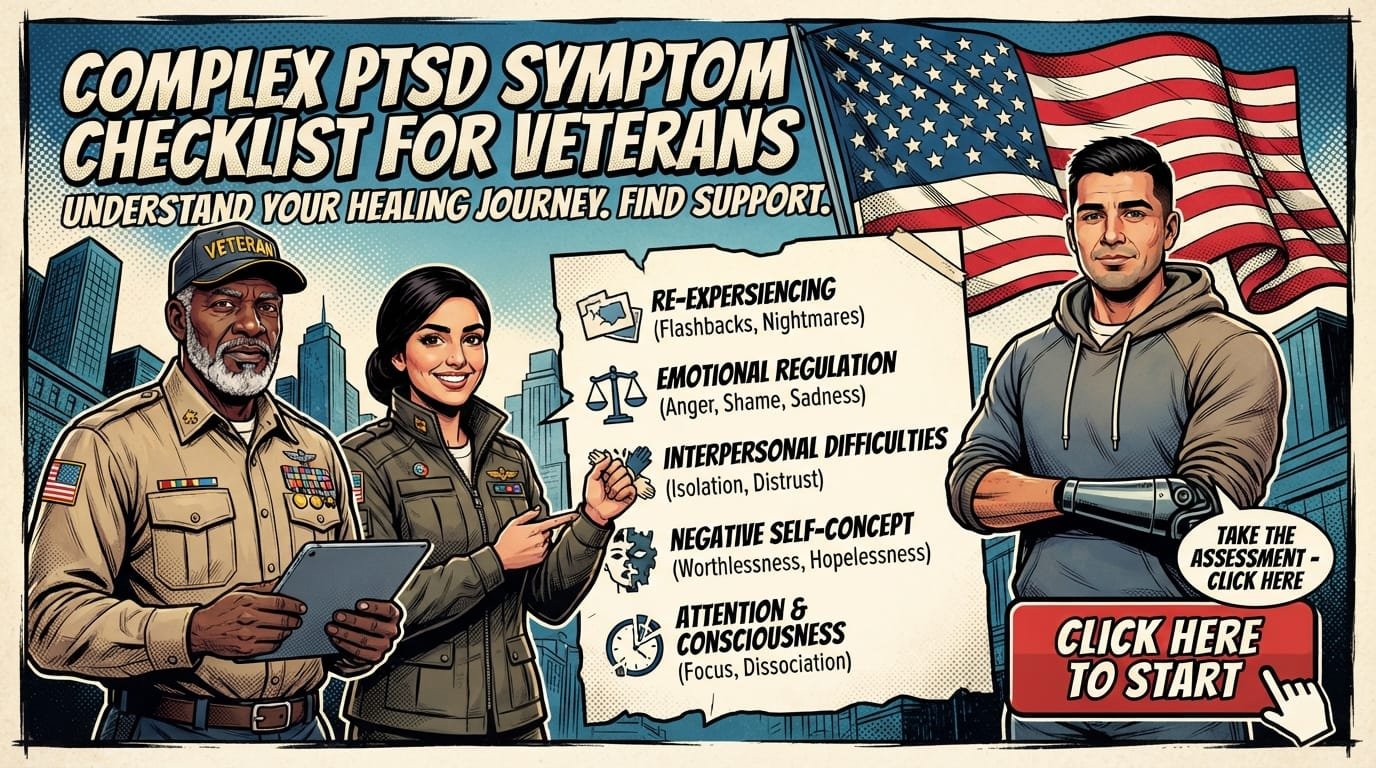
Complex PTSD (C-PTSD) symptoms include the three core PTSD clusters — re-experiencing, avoidance, and sense of threat — plus three additional disturbances in self-organization: difficulty regulating emotions, persistent negative self-concept (worthlessness, shame), and interpersonal difficulties. C-PTSD is recognized in the ICD-11 but not the DSM-5. VA treats C-PTSD under its PTSD diagnosis.
Quick Facts
| Item | Details |
|---|---|
| Condition | Complex Post-Traumatic Stress Disorder (C-PTSD / CPTSD) |
| Who Qualifies for VA Care | Veterans with service-connected trauma; combat, MST, or other military-related trauma |
| Diagnostic Manual | Recognized in ICD-11 (WHO); not a separate diagnosis in DSM-5 |
| VA Disability | Rated under PTSD using the General Rating Formula for Mental Disorders (38 CFR § 4.130) |
| Official Agency | U.S. Department of Veterans Affairs (VA); National Center for PTSD |
| Required Assessment | Clinician-Administered PTSD Scale (CAPS-5); International Trauma Questionnaire (ITQ) |
| Updated For | 2026 |
What Is Complex PTSD?
Complex PTSD is a mental health condition that develops after prolonged, repeated, or inescapable trauma — typically involving harm from another person. It was first formalized as a diagnosis in the World Health Organization’s International Classification of Diseases, 11th Revision (ICD-11).

C-PTSD goes beyond standard PTSD. The ICD-11 defines it as meeting all three core PTSD criteria plus three additional “disturbances in self-organization” (DSO) symptom clusters. This means a person with C-PTSD experiences the classic PTSD symptoms and also struggles with emotion regulation, self-concept, and relationships.

The American Psychiatric Association’s DSM-5 does not recognize C-PTSD as a separate diagnosis. In the DSM-5, many C-PTSD symptoms are captured under the broader PTSD diagnosis or the dissociative subtype. The VA’s National Center for PTSD notes that while the DSM does not have a separate C-PTSD diagnosis, the PTSD diagnosis in DSM-5 includes a broad range of symptoms that come from repeated personal trauma.
Why it matters for veterans: Military service frequently involves prolonged exposure to threat, loss of control, moral injury, and repeated traumatic events. These conditions align with the trauma profile that produces C-PTSD. Understanding the distinction helps veterans get the right treatment and accurate disability ratings.
What veterans should do next: If you recognize yourself in the symptoms below, contact your VA mental health provider or call the Veterans Crisis Line at 988 (Press 1). Ask specifically for a C-PTSD-informed assessment using the International Trauma Questionnaire (ITQ).
The Six Core Symptom Clusters of Complex PTSD
C-PTSD is defined by six symptom clusters: the three core PTSD clusters plus three DSO clusters. You must have at least one symptom from each of the six categories to meet ICD-11 criteria.
The Three Core PTSD Clusters
Veterans May Qualify for Extra Benefits
Check available financial assistance, healthcare programs and other opportunities that may apply to you.
Check Eligibility1. Re-experiencing the Trauma
Re-experiencing means the traumatic event intrudes into your present life. Symptoms include:
Flashbacks — feeling or acting as if the trauma is happening again
Nightmares related to the trauma
Vivid intrusive memories or images
Physical reactions (racing heart, sweating) when reminded of the trauma
2. Avoidance
Avoidance means you try to escape anything that reminds you of the trauma. Symptoms include:
Avoiding thoughts, feelings, or memories of the trauma
Avoiding people, places, conversations, or activities that trigger reminders
Emotional numbing — shutting down feelings to avoid pain
Withdrawing from social situations
3. Persistent Sense of Current Threat
A persistent sense of threat means your body and mind stay on high alert even when you are safe. Symptoms include:
Hypervigilance — constantly scanning for danger
Exaggerated startle response — jumping at sudden noises or movements
Difficulty sleeping
Irritability or angry outbursts
Difficulty concentrating
The Three DSO Clusters (Additional C-PTSD Symptoms)
4. Affect Dysregulation (Difficulty Regulating Emotions)
Affect dysregulation means you have trouble managing your emotional responses. Symptoms include:
Persistent sadness or depression
Suicidal thoughts or self-harm urges
Explosive anger or rage
Feeling emotionally numb or shut down
Difficulty calming down once upset
A 2026 network analysis of C-PTSD symptoms in military veterans found that “feelings of worthlessness” showed the highest strength centrality, along with “external avoidance” — meaning these symptoms may drive other symptoms in the network.
5. Persistent Negative Self-Concept
Negative self-concept means you consistently view yourself as diminished, defeated, or worthless. Symptoms include:
Feeling like a failure
Persistent shame or guilt
Feelings of worthlessness
Believing you are permanently damaged
Feeling completely different from other people
6. Interpersonal Difficulties
Interpersonal difficulties means you struggle to connect with and maintain relationships. Symptoms include:
Difficulty feeling close to others
Feeling distant or cut off from people
Trouble trusting others
Repeated conflicts in relationships
Avoiding intimacy
The same network analysis found that the connection between emotional detachment and difficulty feeling close to others was strong — suggesting that emotional numbing directly fuels relationship problems in C-PTSD.
C-PTSD Symptom Checklist
Use this checklist to track symptoms you experience. This is not a diagnostic tool, but it can help you prepare for a conversation with a mental health provider.
| Symptom Cluster | Specific Symptoms | Check If Present |
|---|---|---|
| Re-experiencing | Flashbacks, nightmares, intrusive memories | ☐ |
| Avoidance | Avoiding reminders, emotional numbing, social withdrawal | ☐ |
| Sense of Threat | Hypervigilance, startle response, sleep problems | ☐ |
| Affect Dysregulation | Rage, numbness, suicidal thoughts, depression | ☐ |
| Negative Self-Concept | Worthlessness, shame, feeling permanently damaged | ☐ |
| Interpersonal Difficulties | Distrust, isolation, difficulty feeling close | ☐ |
If you checked symptoms in all six categories, you may meet criteria for C-PTSD. Bring this list to your VA mental health provider.
How Complex PTSD Differs from PTSD
C-PTSD and PTSD share the same three core symptom clusters. The difference is that C-PTSD includes the three additional DSO clusters — affect dysregulation, negative self-concept, and interpersonal difficulties.
| Feature | PTSD | Complex PTSD |
|---|---|---|
| Trauma type | Often single event (accident, disaster, assault) | Prolonged, repeated, inescapable trauma (war captivity, childhood abuse, domestic violence, MST) |
| Core symptoms | Re-experiencing, avoidance, sense of threat | Same three core symptoms |
| Additional symptoms | — | Affect dysregulation, negative self-concept, interpersonal difficulties |
| ICD-11 diagnosis | Yes | Yes |
| DSM-5 diagnosis | Yes | Not a separate diagnosis; partially captured under PTSD |
| Functional impairment | Varies | Typically greater; C-PTSD shows higher psychiatric severity and lower quality of life |
Research on treatment-seeking military veterans consistently shows that C-PTSD is associated with greater symptom severity and functional impairment than PTSD alone. One study of Danish treatment-seeking veterans found that 31.4% met probable ICD-11 criteria for C-PTSD, compared to 13.0% for PTSD. Another study of UK treatment-seeking veterans found 54.3% met criteria for C-PTSD, compared to 13.8% for PTSD.
What veterans should do next: If you have PTSD symptoms plus significant difficulties with emotions, self-worth, or relationships, ask your provider to assess for C-PTSD using the International Trauma Questionnaire (ITQ). The ITQ is a 12-item self-report measure that assesses both PTSD and C-PTSD symptoms.
C-PTSD and Military Service: Why Veterans Are at Risk
Veterans face elevated risk for C-PTSD because military service often involves the types of prolonged, repeated trauma that produce the condition. These include:
Combat exposure — repeated deployments, exposure to death and violence, threat of injury
Military sexual trauma (MST) — sexual assault or harassment during service
Prisoner of war (POW) captivity — prolonged captivity under hostile control
Moral injury — perpetrating, witnessing, or failing to prevent acts that violate deep moral beliefs
Childhood adversity — pre-service trauma that increases vulnerability to later trauma
A 24-year longitudinal study of ex-POWs found that the C-PTSD class reported significantly higher levels of functional impairment, dissociative tendencies, worsened physical health, and lower cognitive assessment scores compared to the PTSD-only class.
Prevalence of C-PTSD in military samples ranges from 5% to over 80%, depending on the population and assessment method. Among treatment-seeking veterans, C-PTSD is often more common than PTSD alone.
What veterans should do next: If you experienced prolonged or repeated trauma during service — especially captivity, MST, or multiple deployments — inform your VA provider. The VA’s National Center for PTSD provides specialized assessment and treatment for complex trauma.
How VA Evaluates Complex PTSD for Disability Benefits
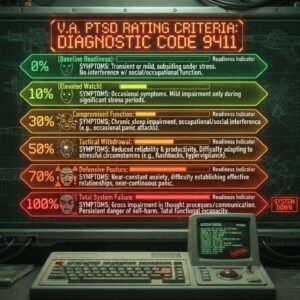
VA does not have a separate disability rating for C-PTSD. VA rates C-PTSD under the PTSD diagnostic code (38 CFR § 4.130) using the General Rating Formula for Mental Disorders. The rating is based on occupational and social impairment.
| VA Rating | Criteria |
|---|---|
| 0% | Diagnosis of PTSD but symptoms are not severe enough to interfere with occupational or social functioning |
| 10% | Occupational and social impairment with occasional decrease in work efficiency; symptoms controlled by continuous medication |
| 30% | Occupational and social impairment with occasional decrease in work efficiency and intermittent periods of inability to perform occupational tasks |
| 50% | Occupational and social impairment with reduced reliability and productivity due to symptoms such as flattened affect, circumstantial speech, panic attacks, difficulty understanding complex commands |
| 70% | Occupational and social impairment with deficiencies in most areas — work, school, family relations, judgment, thinking, mood |
| 100% | Total occupational and social impairment due to symptoms such as persistent delusions, hallucinations, grossly inappropriate behavior, disorientation to time and place, memory loss |
What veterans should do next: If you are filing a VA disability claim for C-PTSD, document how your symptoms affect your ability to work and maintain relationships. Keep a symptom journal. Request a VA Form 21-526EZ (Application for Disability Compensation) and submit supporting evidence, including buddy statements and treatment records.
Treatment Options for Complex PTSD at VA
VA offers evidence-based treatments for PTSD that also address C-PTSD symptoms. The three first-line trauma-focused therapies recommended by VA/DoD clinical practice guidelines are:
Cognitive Processing Therapy (CPT)
CPT is a 12-session manualized therapy developed by Patricia Resick. It focuses on identifying and changing unhelpful thoughts and beliefs related to trauma. Meta-analytic findings show CPT produces large reductions in PTSD symptoms across a range of outcomes, including complicated presentations.
Prolonged Exposure (PE)
PE is a therapy that helps you gradually confront trauma-related memories and situations you have been avoiding. It typically involves 8–15 sessions. Research has found PE effective for PTSD and is being compared directly to modular CBT for C-PTSD in ongoing VA trials.
Eye Movement Desensitization and Reprocessing (EMDR)
EMDR uses guided eye movements while you recall traumatic memories. It is recommended by VA/DoD guidelines as a trauma-focused treatment for PTSD. Veterans and war-affected populations have shown significant reductions in trauma effects from both EMDR and trauma-focused CBT.
Patient-Centered Modular CBT (PACE)
PACE is a newer treatment specifically designed for C-PTSD. It consists of five modules addressing affect dysregulation, disturbed relationships, negative self-concept, PTSD symptoms, and insomnia/nightmares. A randomized controlled trial comparing PACE to Prolonged Exposure is currently underway with 60 veterans with C-PTSD.
Medications
The three recommended medications for PTSD are paroxetine, sertraline, and venlafaxine. These may help with some C-PTSD symptoms, particularly depression and anxiety, but they do not address all C-PTSD symptom clusters.
What veterans should do next: Call your VA medical center’s mental health department and ask about trauma-focused therapy. If you are not enrolled in VA healthcare, apply online at va.gov or call 1-877-222-8387. Veterans with other-than-honorable discharges may still qualify for mental health care.
Common Mistakes Veterans Make with C-PTSD
1. Assuming it’s “just PTSD.” C-PTSD involves additional symptoms that standard PTSD treatment may not fully address. If you have PTSD symptoms plus significant emotion regulation, self-concept, or relationship problems, ask for a C-PTSD-informed assessment.
2. Not reporting all symptoms. Veterans often minimize or omit symptoms they find shameful — especially worthlessness, dissociation, and relationship problems. These are core C-PTSD symptoms and need to be reported for accurate diagnosis and rating.
3. Self-medicating with alcohol or drugs. Substance use is common among veterans with C-PTSD as a way to numb overwhelming feelings. This can worsen symptoms and interfere with treatment. VA offers integrated treatment for PTSD and substance use.
4. Avoiding treatment because of stigma. Many veterans believe seeking mental health care will harm their career or reputation. VA mental health records are confidential, and treatment does not automatically affect your security clearance or VA benefits.
5. Not filing a VA claim. Many veterans with C-PTSD are eligible for VA disability compensation but never file. A VA rating can provide monthly tax-free compensation, healthcare priority, and access to additional benefits.
6. Missing the effective date. The effective date of your VA claim determines when back pay begins. File as soon as you have a diagnosis and nexus, even if you are still gathering evidence.
Appeals Process for C-PTSD Claims
If your VA disability claim for C-PTSD is denied or rated lower than expected, you have appeal options. VA offers three decision review lanes:
| Appeal Lane | Best For | Timeframe |
|---|---|---|
| Supplemental Claim | New and relevant evidence not previously considered | Average 125 days |
| Higher-Level Review | No new evidence; arguing VA made an error in the original decision | Average 125 days |
| Board Appeal | Want a Veterans Law Judge to review your case | 1–2 years (longer with hearing) |
What veterans should do next: If you disagree with a VA decision, file your appeal within one year to preserve your original effective date. You can file online at va.gov or by mail using VA Form 10182 (Notice of Disagreement) or VA Form 20-0995 (Supplemental Claim).
Resources for Veterans with Complex PTSD
VA Resources
Veterans Crisis Line: Dial 988, then Press 1. Available 24/7.
VA National Center for PTSD: ptsd.va.gov — Comprehensive information on PTSD and C-PTSD, including assessment tools and treatment options.
VA Mental Health: va.gov/health-care/health-needs-conditions/mental-health
VA Caregiver Support: caregiver.va.gov
Women Veterans Health Care: va.gov/womenvet
Non-VA Resources
NAMI (National Alliance on Mental Illness): nami.org — Information and support for C-PTSD.
Give an Hour: giveanhour.org — Free mental health services for veterans and military families.
Cohen Veterans Network: cohenveteransnetwork.org — Free mental health care for post-9/11 veterans.
Headstrong: headstrong.org — No-cost, barrier-free mental health care for post-9/11 veterans.
Common Questions
What are the main symptoms of complex PTSD?
C-PTSD symptoms include the three core PTSD clusters — re-experiencing, avoidance, and persistent sense of threat — plus three additional clusters: difficulty regulating emotions, persistent negative self-concept (worthlessness, shame), and interpersonal difficulties. You need symptoms from all six clusters for a C-PTSD diagnosis.
How is C-PTSD different from PTSD?
C-PTSD includes all the core PTSD symptoms plus disturbances in self-organization. The trauma that causes C-PTSD is typically prolonged, repeated, and inescapable. People with C-PTSD generally have more severe symptoms and greater functional impairment than those with PTSD alone.
Is complex PTSD recognized by the VA?
VA does not have a separate C-PTSD diagnosis in its disability rating system. VA rates C-PTSD symptoms under the PTSD diagnostic code using the General Rating Formula for Mental Disorders. The VA’s National Center for PTSD provides information and treatment for C-PTSD.
Can I get VA disability for complex PTSD?
Yes. VA evaluates C-PTSD symptoms under the PTSD rating criteria. Ratings range from 0% to 100% based on occupational and social impairment. Many veterans with C-PTSD receive ratings of 50%, 70%, or 100%.
What trauma causes complex PTSD?
C-PTSD is associated with prolonged, repeated, inescapable trauma. In military contexts, this includes combat exposure over multiple deployments, prisoner of war captivity, military sexual trauma, and childhood abuse that occurred before service. Any chronic interpersonal trauma can cause C-PTSD.
What treatment does VA offer for complex PTSD?
VA offers trauma-focused therapies including Cognitive Processing Therapy (CPT), Prolonged Exposure (PE), and EMDR. A newer treatment called PACE (Patient-Centered Modular CBT) is specifically designed for C-PTSD and is currently being studied in VA trials.
Does C-PTSD qualify for Social Security disability?
Yes. C-PTSD can qualify for Social Security Disability Insurance (SSDI) or Supplemental Security Income (SSI) if symptoms prevent you from working. SSA evaluates mental health conditions using its own criteria, which differ from VA’s rating system.
What is the International Trauma Questionnaire (ITQ)?
The ITQ is a 12-item self-report questionnaire that assesses ICD-11 PTSD and C-PTSD. Six items measure PTSD symptoms and six measure the three DSO clusters. It is the most-studied assessment tool for C-PTSD.
Can complex PTSD cause physical symptoms?
Yes. C-PTSD often includes physical symptoms such as headaches, dizziness, chest pains, stomach aches, chronic pain, and fatigue. Chronic stress from C-PTSD can also worsen existing health conditions and increase risk for cardiovascular problems.
How do I file a VA claim for complex PTSD?
File VA Form 21-526EZ (Application for Disability Compensation). Submit your diagnosis, treatment records, a personal statement describing how symptoms affect your work and social functioning, and buddy statements from people who have observed your symptoms.
What is the difference between C-PTSD and borderline personality disorder?
Both involve emotion dysregulation and relationship difficulties. C-PTSD develops from trauma and includes core PTSD symptoms. BPD typically involves a pervasive pattern of unstable relationships and identity disturbance that may or may not be trauma-related. Some people have both conditions.
Are there clinical trials for complex PTSD at VA?
Yes. VA is currently conducting trials comparing PACE (Patient-Centered Modular CBT) to Prolonged Exposure for C-PTSD. You can find VA clinical trials at clinicaltrials.gov or by asking your VA provider.
Key Takeaways
Complex PTSD includes the three core PTSD clusters plus three additional clusters: affect dysregulation, negative self-concept, and interpersonal difficulties.
C-PTSD is recognized in ICD-11 but not DSM-5; VA rates it under the PTSD diagnostic code.
Veterans are at elevated risk due to prolonged, repeated trauma exposure including combat, MST, and captivity.
VA treatment options include CPT, PE, EMDR, and the newer PACE protocol for C-PTSD.
VA disability ratings for C-PTSD range from 0% to 100% based on occupational and social impairment.
The International Trauma Questionnaire (ITQ) is the primary assessment tool for C-PTSD.
You can appeal a VA rating decision through Supplemental Claim, Higher-Level Review, or Board Appeal.
The Veterans Crisis Line is available 24/7 at 988 (Press 1).
Physical symptoms like headaches, chronic pain, and fatigue are common in C-PTSD.
Treatment works — trauma-focused therapies show large effect sizes for symptom reduction.
Official Resources
VA National Center for PTSD: ptsd.va.gov
VA.gov Mental Health: va.gov/health-care/health-needs-conditions/mental-health
Veterans Crisis Line: 988 (Press 1) | veteranscrisisline.net
VA Disability Compensation: va.gov/disability
VA Form 21-526EZ: va.gov/find-forms/about-form-21-526ez
VA Caregiver Support: caregiver.va.gov
USA.gov Benefits Finder: usa.gov/benefits


🇺🇸 IMPORTANT DISCLAIMER – Veterans Benefits Information
This site provides general information about U.S. Department of Veterans Affairs (VA) benefits for educational and informational purposes only.
- Not Official: We are NOT affiliated with, endorsed by, or connected to the U.S. Department of Veterans Affairs (VA), the Veterans Benefits Administration (VBA), the Veterans Health Administration (VHA), or any other government agency.
- No Legal/Financial Advice: The content on this website is for informational purposes only and does not constitute legal, financial, or medical advice. VA benefits rules change frequently – always consult with an accredited Veterans Service Officer (VSO) or a qualified professional for your specific situation.
- Official Sources: For official, binding information and to apply for benefits, always visit official .gov websites: VA.gov, Benefits.VA.gov, or SSA.gov.
- No Data Collection: This site does not collect, store, or process any personal information. It does not have login forms, contact forms, or any system to capture user data. We never ask for your Social Security Number, bank details, or any personal information.
- 🚨 Scam Alert: The VA and other government agencies never charge fees for benefit applications. If anyone asks for money to "process" your VA claim, it is a scam. Report it to the VA Office of Inspector General at VA.gov/OIG.
- Advertising: This site uses third-party advertising (Adsterra) to cover operational costs. We do not endorse or guarantee any products or services advertised.
📌 Information provided as of June 2026. Always verify current eligibility and rules with official .gov sources.
This site is not affiliated with the U.S. Department of Veterans Affairs or any government agency. All information is for educational purposes only. Please visit VA.gov for official information.
