
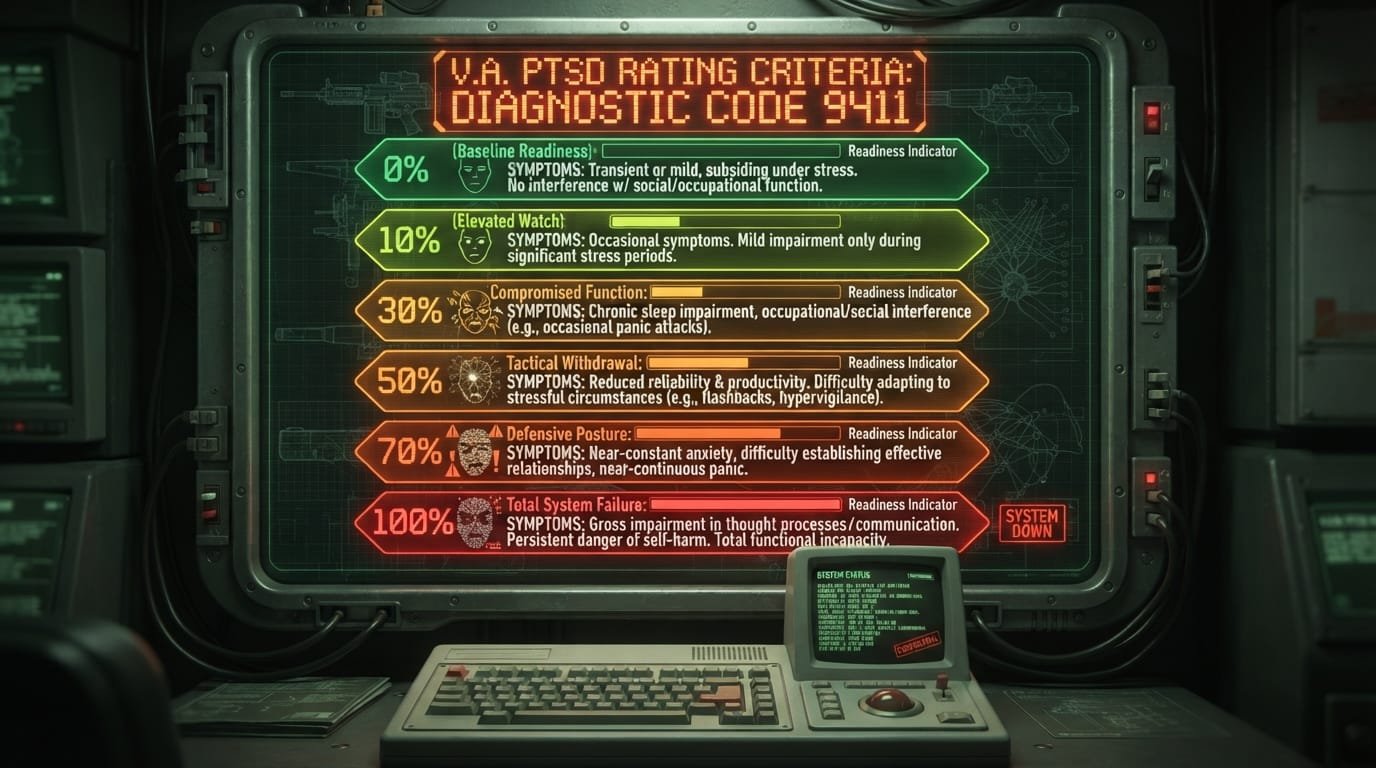
VA PTSD Rating Criteria: Complete 2026 Guide to Diagnostic Code 9411
VA rates PTSD under 38 CFR § 4.130, Diagnostic Code 9411, using the General Rating Formula for Mental Disorders. Ratings are assigned at 0%, 10%, 30%, 50%, 70%, or 100% based on how much PTSD impairs your occupational and social functioning. The 100% rating requires total occupational and social impairment.
Quick Facts What Are the VA PTSD Rating Criteria?
| Item | Details |
|---|---|
| Benefit | VA disability compensation for service-connected PTSD |
| Rating Code | Diagnostic Code 9411, 38 CFR § 4.130 |
| Eligibility | Veterans with a PTSD diagnosis linked to military service |
| Application | VA Form 21-526EZ (initial claim) or 21-526EZ (increase) |
| Processing Time | 100-200+ days depending on complexity and appeals |
| Official Agency | U.S. Department of Veterans Affairs |
| Required Forms | VA Form 21-526EZ; VA Form 21-0781 (stressor statement); DBQ 21-0960P-4 or 21-0960P-3 |
| Updated For | 2026 |
How Does VA Rate PTSD?
VA assigns PTSD ratings by comparing your symptoms to the General Rating Formula for Mental Disorders in 38 CFR § 4.130. The rating reflects how much your PTSD impairs your ability to work, maintain relationships, and handle daily activities.

The rating schedule uses the phrase “such as” throughout the criteria. This means the symptoms listed are examples, not a complete checklist. VA must consider all symptoms that affect your occupational and social impairment, including those in the DSM-5 diagnostic criteria for PTSD.
The Role of Occupational and Social Impairment

The central question in every PTSD rating decision is this: How much does PTSD interfere with your ability to function at work and in social relationships? VA examines:
Your work history since discharge
Performance evaluations, disciplinary actions, and job losses
Relationship problems, divorce, and isolation
Social withdrawal and avoidance behaviors
Evidence from C&P exams, treatment records, and lay statements
A Veteran who held a job but was demoted, received poor evaluations, or had conflicts with coworkers may still qualify for a higher rating. The schedule measures impairment, not employment status alone.
PTSD Rating Levels: 0% to 100% Explained
0% Rating – Service Connected but Not Compensable
A 0% rating means VA recognizes PTSD as service connected, but the condition causes no significant occupational or social impairment. A 0% rating is not compensable but grants eligibility for VA health care and other benefits.
Criteria: A diagnosed mental disorder that is either asymptomatic or has symptoms so mild they do not interfere with occupational or social functioning.
Veterans May Qualify for Extra Benefits
Check available financial assistance, healthcare programs and other opportunities that may apply to you.
Check EligibilityThe 0% rating is the lowest possible for PTSD. Under proposed 2026 changes, the 0% rating would be eliminated, and every service-connected mental health condition would begin at 10%.
10% Rating – Mild Impairment
A 10% rating is assigned when PTSD symptoms are mild and generally controlled by medication or treatment.
Criteria: Occupational and social impairment due to mild or transient symptoms that decrease work efficiency and ability to perform occupational tasks only during periods of significant stress, or symptoms controlled by continuous medication.
Compensation (2026 rates): Approximately $175.51 per month for a single Veteran with no dependents.
30% Rating – Occasional Decrease in Work Efficiency
A 30% rating applies when PTSD causes occasional decrease in work efficiency and intermittent periods of inability to perform occupational tasks, even though you are generally functioning satisfactorily.
Criteria: Occupational and social impairment with occasional decrease in work efficiency and intermittent periods of inability to perform occupational tasks (although generally functioning satisfactorily, with routine behavior, self-care, and conversation normal), due to symptoms such as:
Depressed mood
Anxiety
Suspiciousness
Panic attacks (weekly or less often)
Chronic sleep impairment
Mild memory loss (forgetting names, directions, recent events)
Compensation (2026 rates): Approximately $534.59 per month for a single Veteran.
50% Rating – Reduced Reliability and Productivity
A 50% rating is the most common PTSD rating assigned by VA. It applies when PTSD causes reduced reliability and productivity in occupational and social settings.
Criteria: Occupational and social impairment with reduced reliability and productivity due to symptoms such as:
Flattened affect
Circumstantial, circumlocutory, or stereotyped speech
Panic attacks more than once a week
Difficulty understanding complex commands
Impairment of short- and long-term memory (e.g., retention of only highly learned material, forgetting to complete tasks)
Impaired judgment
Impaired abstract thinking
Disturbances of motivation and mood
Difficulty in establishing and maintaining effective work and social relationships
Compensation (2026 rates): Approximately $1,041.82 per month for a single Veteran.
70% Rating – Deficiencies in Most Areas
A 70% rating applies when PTSD causes deficiencies in most areas, including work, school, family relations, judgment, thinking, or mood.
Criteria: Occupational and social impairment, with deficiencies in most areas, such as work, school, family relations, judgment, thinking, or mood, due to symptoms such as:
Suicidal ideation
Obsessional rituals that interfere with routine activities
Speech intermittently illogical, obscure, or irrelevant
Near-continuous panic or depression affecting the ability to function independently, appropriately, and effectively
Impaired impulse control (such as unprovoked irritability with periods of violence)
Spatial disorientation
Neglect of personal appearance and hygiene
Difficulty in adapting to stressful circumstances (including work or a work-like setting)
Inability to establish and maintain effective relationships
Compensation (2026 rates): Approximately $1,716.28 per month for a single Veteran.
100% Rating – Total Occupational and Social Impairment
A 100% rating is the highest scheduler rating for PTSD. It applies when PTSD causes total occupational and social impairment.
Criteria: Total occupational and social impairment, due to symptoms such as:
Gross impairment in thought processes or communication
Persistent delusions or hallucinations
Grossly inappropriate behavior
Persistent danger of hurting self or others
Intermittent inability to perform activities of daily living (including maintenance of minimal personal hygiene)
Disorientation to time or place
Memory loss for names of close relatives, own occupation, or own name
Compensation (2026 rates): Approximately $3,737.85 per month for a single Veteran.
A 100% PTSD rating may also qualify a Veteran for additional benefits, including:
Dependents’ Educational Assistance (Chapter 35)
VA dental care
Commissary and exchange privileges
Possible eligibility for Special Monthly Compensation (SMC) if housebound or requiring aid and attendance
PTSD Rating Comparison Table
| Rating | Occupational & Social Impairment | Key Symptoms | Monthly Compensation (2026 estimate) |
|---|---|---|---|
| 0% | None | Asymptomatic or mild symptoms | $0 |
| 10% | Mild or transient | Symptoms controlled by medication; impairment during stress | ~$175.51 |
| 30% | Occasional decrease | Depressed mood, anxiety, panic attacks weekly or less, sleep impairment | ~$534.59 |
| 50% | Reduced reliability and productivity | Flattened affect, panic attacks more than weekly, memory impairment, impaired judgment | ~$1,041.82 |
| 70% | Deficiencies in most areas | Suicidal ideation, obsessional rituals, near-continuous panic, impaired impulse control | ~$1,716.28 |
| 100% | Total | Gross impairment in thought, persistent delusions, danger to self or others, disorientation | ~$3,737.85 |
What Evidence Does VA Need for a PTSD Rating?
VA needs three things to grant service connection for PTSD: a current diagnosis, an in-service stressor, and a nexus linking the two. For a rating increase, VA examines medical evidence showing the severity of your current symptoms.
For Initial Service Connection
| Requirement | What VA Needs |
|---|---|
| Current diagnosis | A PTSD diagnosis from a VA or private mental health provider using DSM-5 criteria |
| In-service stressor | Evidence of a traumatic event during military service |
| Nexus | Medical opinion linking the stressor to your current PTSD |
Stressor Verification
For combat Veterans, VA generally accepts the Veteran’s statement of the stressor if it is consistent with the circumstances of their service. VA may verify stressors through:
Military records (unit records, after-action reports)
VA Form 21-0781 (Statement in Support of Claim for Service Connection for PTSD)
VA Form 21-0781a (for personal assault or military sexual trauma)
For Rating Increases
To increase your PTSD rating, you must show that your symptoms have worsened and now meet the criteria for a higher rating. Submit:
Updated treatment records showing symptom severity
A new DBQ completed by your provider
Lay statements from family, friends, or coworkers describing how PTSD affects you
Employment records showing performance issues, disciplinary actions, or termination
Disability Benefits Questionnaire (DBQ)
The PTSD DBQ is the primary medical evidence form for PTSD claims. Two versions exist:
VA Form 21-0960P-4: Initial PTSD DBQ (for new claims establishing service connection)
VA Form 21-0960P-3: Review PTSD DBQ (for rating increases and reevaluations)
Your provider completes the DBQ, documenting your symptoms and their impact on occupational and social functioning. VA accepts DBQs from VA providers and private providers.
PTSD Rating and the C&P Exam
What Happens at a PTSD C&P Exam
A Compensation and Pension (C&P) exam for PTSD is a forensic evaluation, not a treatment session. A VA examiner or contracted provider will:
Review your claims file and medical history
Ask about your military service and traumatic experiences
Assess your current PTSD symptoms using DSM-5 criteria
Evaluate your occupational and social functioning
Complete the appropriate PTSD DBQ
How to Prepare
Bring a written statement describing your worst days, not your best days
Be honest about symptoms you might normally downplay
Bring lay statements from people who see your daily struggles
Review the rating criteria so you understand what the examiner is looking for
Do not exaggerate, but do not minimize either
Common C&P Exam Mistakes
Minimizing symptoms: Many Veterans present themselves well during a 30-minute exam. Describe your worst days, not your best.
Not mentioning relationship problems: Social impairment includes marital conflict, isolation, and difficulty maintaining friendships.
Forgetting to mention medication side effects: Sedation, weight gain, and emotional numbness are relevant to your rating.
Not preparing: The examiner will not know your full story unless you tell it.
PTSD Secondary Conditions and VA Ratings
PTSD can cause or worsen other conditions. VA can rate these secondary conditions separately and combine them with your PTSD rating.
Common Secondary Conditions to PTSD
| Secondary Condition | Why It Happens | Typical VA Rating |
|---|---|---|
| Obstructive Sleep Apnea | PTSD disrupts sleep; psychiatric medications cause weight gain | 0% to 100% (based on severity) |
| Depression | Often co-occurs with PTSD; can be rated separately or combined | 0% to 100% |
| Anxiety Disorder | Generalized anxiety frequently accompanies PTSD | 0% to 100% |
| Hypertension | Chronic stress and PTSD-related hyperarousal raise blood pressure | 10% to 60% |
| IBS (Irritable Bowel Syndrome) | Stress and autonomic dysfunction affect digestion | 10% to 30% |
| Migraines | PTSD-related tension and hyperarousal trigger headaches | 0% to 50% |
| Erectile Dysfunction | Medication side effects and psychological factors | Special Monthly Compensation (SMC-K) |
| Substance Use Disorder | Self-medication of PTSD symptoms | 0% to 100% |
| TBI-Related Symptoms | PTSD and TBI frequently co-occur in combat Veterans | Rated under separate TBI criteria |
How to Claim Secondary Conditions
File VA Form 21-526EZ and list the secondary condition. Provide a nexus letter from your doctor stating that your service-connected PTSD caused or aggravated the secondary condition. The standard is “at least as likely as not” (50% or greater probability).
VA Math: Combined Ratings
VA does not simply add ratings together. It uses a combined rating formula. For example:
PTSD at 70% and sleep apnea at 50% does not equal 120%
Using VA math: 70% + 50% = 85% combined rating, which rounds to 90%
Adding IBS at 30%: 90% + 30% = 93%, which rounds to 90%
This is why pursuing secondary conditions can meaningfully increase your total compensation even if each individual rating seems modest.
Proposed 2026 Changes to VA PTSD Rating Criteria
VA has proposed major changes to how mental health conditions, including PTSD, are rated. These changes are not yet final as of 2026.
What Would Change
The proposed system would replace the current “occupational and social impairment” language with a five-domain functional assessment:
| Domain | What It Measures |
|---|---|
| Cognition | Memory, concentration, decision-making, problem-solving |
| Relationships | Interactions with others at home, work, and in social settings |
| Task Completion | Ability to start and finish tasks at work and in daily life |
| Navigating Environments | Comfort leaving home, using transportation, handling new situations |
| Self-Care | Personal hygiene, medication compliance, attending appointments |
Proposed Rating Tiers
| Proposed Rating | Criteria |
|---|---|
| 10% | Mild impairment in one or more domains |
| 30% | Mild impairment in two or more domains |
| 50% | Moderate impairment in one domain |
| 70% | Severe impairment in one domain, or moderate in two or more |
| 100% | Total impairment in one or more domains |
Key Changes
0% rating eliminated: Every diagnosed condition would start at 10%.
Higher ratings possible while employed: A Veteran with severe symptoms could qualify for 70% or 100% even if still working.
More objective criteria: The new system uses measurable functional levels instead of subjective judgments about “occupational and social impairment.”
What Veterans Should Do Now
If your PTSD has worsened, file for an increase under the current criteria
If you have a 0% rating and symptoms persist, consider filing for an increase
Keep detailed records of how PTSD affects each of the five proposed domains
These changes are proposed, not final—current ratings remain in effect
Status: As of 2026, these changes remain proposed. No final rule has been published. Veterans already rated are protected under grandfathering provisions.
How to Apply for a PTSD Rating or Increase
Step-by-Step: Initial PTSD Claim
Gather your evidence: DD-214, medical records, stressor statements, buddy statements
Complete VA Form 21-526EZ: Application for Disability Compensation
Submit VA Form 21-0781: Statement in Support of Claim for PTSD (stressor details)
Attend your C&P exam: VA will schedule a PTSD examination
Wait for the decision: Processing times vary widely
Step-by-Step: PTSD Rating Increase
Get an updated diagnosis and DBQ: Ask your provider to complete VA Form 21-0960P-3
Write a statement: Describe how your symptoms have worsened since your last rating
Collect lay statements: Ask family or friends to describe changes they’ve observed
File VA Form 21-526EZ: Check “increase” and list PTSD
Attend any required exams: VA may request a new C&P exam
Review the decision: If denied, consider an appeal
Online Application
Apply online at VA.gov. You can file VA Form 21-526EZ electronically. Upload supporting documents directly to your claim.
Processing Times
| Claim Type | Typical Processing Time |
|---|---|
| Initial PTSD claim | 100-200 days |
| Rating increase | 100-150 days |
| Appeal (Supplemental Claim) | 125-200 days |
| Appeal (Board) | 1-3 years |
Processing times vary by VA regional office and claim complexity.
Payment Dates
VA disability compensation is paid on the first business day of each month. If the first falls on a weekend or holiday, payment arrives the preceding business day.
Common Mistakes That Hurt PTSD Claims
Presenting your best self at the C&P exam: The examiner evaluates your worst days, not your best. Be honest about your struggles.
Not filing for secondary conditions: Sleep apnea, IBS, migraines, and hypertension secondary to PTSD can significantly increase your combined rating.
Assuming a 50% rating is “good enough”: If your symptoms meet 70% or 100% criteria, file for an increase.
Missing the appeal deadline: You have one year from the decision letter to file a Notice of Disagreement.
Not submitting lay statements: Buddy statements from family and friends are powerful evidence of social impairment.
Downplaying suicidal ideation: Suicidal ideation is a 70% criterion. Many Veterans avoid discussing it due to stigma.
Not documenting medication side effects: Sedation, weight gain, and emotional numbness affect your functioning and should be documented.
Filing without a current diagnosis: You need a DSM-5 PTSD diagnosis from a qualified provider.
Not appealing a 0% rating: A 0% rating is service connected but not compensable. If symptoms persist, appeal or file for an increase.
Waiting too long to file: Back pay is limited to the date you filed (or up to one year before, if you file within one year of an informal claim).
Appeals Process for PTSD Rating Decisions
If VA denies your PTSD claim or assigns a lower rating than you believe you deserve, you have three appeal options under the Appeals Modernization Act.
Three Review Options
Supplemental Claim (VA Form 20-0995): Submit new and relevant evidence. This is the fastest and most straightforward option.
Higher-Level Review (VA Form 20-0996): Request a senior reviewer to examine your case based on the existing evidence. No new evidence allowed.
Board Appeal (VA Form 10182): Appeal directly to the Board of Veterans’ Appeals. You can choose:
Direct review (no new evidence)
Evidence submission (submit new evidence)
Hearing (testify before a Veterans Law Judge)
Deadlines
One year from the date of a VA decision letter to file a Notice of Disagreement
60 days for Board of Veterans’ Appeals decisions
One year from a Supplemental Claim denial to file another Supplemental Claim
Getting Help with Your Appeal
Accredited Veterans Service Organizations (VSOs) provide free representation. Options include:
Disabled American Veterans (DAV)
Veterans of Foreign Wars (VFW)
American Legion
Wounded Warrior Project
State and county Veterans service officers
Common Questions
What is the VA rating for PTSD?
VA rates PTSD under 38 CFR § 4.130, Diagnostic Code 9411, at 0%, 10%, 30%, 50%, 70%, or 100%. The rating depends on how much PTSD impairs your occupational and social functioning. The 100% rating requires total occupational and social impairment.
What is the most common PTSD rating?
The 50% rating is the most commonly assigned PTSD rating. It applies when PTSD causes occupational and social impairment with reduced reliability and productivity. This includes symptoms like panic attacks more than once a week, memory impairment, and impaired judgment.
Can I get 100% VA disability for PTSD?
Yes. A 100% rating requires total occupational and social impairment. Symptoms include gross impairment in thought processes, persistent delusions or hallucinations, persistent danger of hurting yourself or others, and disorientation to time or place.
What are the criteria for a 70% PTSD rating?
A 70% rating requires occupational and social impairment with deficiencies in most areas, such as work, school, family relations, judgment, thinking, or mood. Symptoms include suicidal ideation, obsessional rituals, near-continuous panic or depression, and impaired impulse control.
What symptoms qualify for a 50% PTSD rating?
A 50% rating requires reduced reliability and productivity. Symptoms include flattened affect, panic attacks more than once a week, impaired short- and long-term memory, impaired judgment, and difficulty establishing and maintaining effective work and social relationships.
How do I increase my PTSD rating?
File VA Form 21-526EZ for an increase. Submit an updated DBQ, treatment records showing worsened symptoms, and lay statements describing how PTSD affects your daily life. If your symptoms now meet higher criteria, VA should increase your rating.
What is the PTSD DBQ?
The PTSD Disability Benefits Questionnaire documents your diagnosis and symptoms. VA Form 21-0960P-4 is the Initial PTSD DBQ. VA Form 21-0960P-3 is the Review PTSD DBQ for increases. Both must be completed by a qualified provider.
Can I get PTSD and TBI rated separately?
Yes. PTSD and TBI are rated under different diagnostic codes. PTSD falls under DC 9411 (mental disorders), and TBI is rated under DC 8045. VA must avoid rating the same symptoms under both conditions.
What secondary conditions can I claim with PTSD?
Common secondary conditions include sleep apnea, depression, anxiety, hypertension, IBS, migraines, and erectile dysfunction. You need a medical nexus linking the secondary condition to your service-connected PTSD.
What are the proposed 2026 PTSD rating changes?
VA has proposed replacing the current occupational and social impairment language with a five-domain functional assessment: cognition, relationships, task completion, navigating environments, and self-care. The 0% rating would be eliminated. These changes are not yet final.
What is the effective date for a PTSD rating increase?
The effective date is generally the date VA received your claim for increase. If you file within one year of an informal claim or intent to file, you may receive back pay to an earlier date.
Can I work and still receive 100% PTSD?
Under current criteria, a 100% rating requires total occupational impairment. However, under proposed changes, a Veteran could qualify for 100% based on severe symptoms in one functional domain even if still employed. This change is not yet in effect.
What is the PACT Act and does it help PTSD claims?
The PACT Act expands VA health care and benefits for toxic-exposed Veterans. It does not directly change PTSD rating criteria, but it makes it easier to establish service connection for certain conditions, which can support a PTSD claim when stressors are linked to toxic exposure.
How long does a PTSD claim take?
Initial PTSD claims typically take 100-200 days. Rating increases take 100-150 days. Appeals can take longer: Supplemental Claims 125-200 days; Board appeals 1-3 years.
Can I appeal a PTSD rating decision?
Yes. You can file a Supplemental Claim with new evidence, request a Higher-Level Review, or appeal to the Board of Veterans’ Appeals. You generally have one year from the decision letter to appeal.
Key Takeaways
VA rates PTSD under 38 CFR § 4.130, Diagnostic Code 9411, using the General Rating Formula for Mental Disorders.
Ratings are 0%, 10%, 30%, 50%, 70%, or 100%, based on occupational and social impairment.
The 50% rating is the most common, requiring reduced reliability and productivity.
The 70% rating requires deficiencies in most areas, including work, school, and relationships.
The 100% rating requires total occupational and social impairment.
Secondary conditions like sleep apnea, IBS, and hypertension can be rated separately and combined with PTSD.
VA has proposed major changes to mental health ratings, including eliminating the 0% rating and using a five-domain functional assessment. These changes are not yet final.
You can appeal a PTSD rating decision through Supplemental Claim, Higher-Level Review, or Board Appeal.
Lay statements from family and friends are powerful evidence for PTSD rating increases.
The PACT Act does not change PTSD rating criteria but may help establish service connection for related conditions.
Official Resources
VA PTSD Rating Schedule (38 CFR § 4.130): ecfr.gov
VA PTSD Information: ptsd.va.gov
VA Disability Compensation: va.gov/disability
VA Form 21-526EZ: va.gov/forms/21-526EZ
VA Form 21-0781: va.gov/forms/21-0781
VA Form 21-0960P-4 (Initial PTSD DBQ): va.gov/vaforms
VA Form 21-0960P-3 (Review PTSD DBQ): va.gov/vaforms
VA Appeals: va.gov/decision-reviews
Board of Veterans’ Appeals: va.gov/board-of-veterans-appeals
PACT Act Information: va.gov/pact





🇺🇸 IMPORTANT DISCLAIMER – Veterans Benefits Information
This site provides general information about U.S. Department of Veterans Affairs (VA) benefits for educational and informational purposes only.
- Not Official: We are NOT affiliated with, endorsed by, or connected to the U.S. Department of Veterans Affairs (VA), the Veterans Benefits Administration (VBA), the Veterans Health Administration (VHA), or any other government agency.
- No Legal/Financial Advice: The content on this website is for informational purposes only and does not constitute legal, financial, or medical advice. VA benefits rules change frequently – always consult with an accredited Veterans Service Officer (VSO) or a qualified professional for your specific situation.
- Official Sources: For official, binding information and to apply for benefits, always visit official .gov websites: VA.gov, Benefits.VA.gov, or SSA.gov.
- No Data Collection: This site does not collect, store, or process any personal information. It does not have login forms, contact forms, or any system to capture user data. We never ask for your Social Security Number, bank details, or any personal information.
- 🚨 Scam Alert: The VA and other government agencies never charge fees for benefit applications. If anyone asks for money to "process" your VA claim, it is a scam. Report it to the VA Office of Inspector General at VA.gov/OIG.
- Advertising: This site uses third-party advertising (Adsterra) to cover operational costs. We do not endorse or guarantee any products or services advertised.
📌 Information provided as of June 2026. Always verify current eligibility and rules with official .gov sources.
This site is not affiliated with the U.S. Department of Veterans Affairs or any government agency. All information is for educational purposes only. Please visit VA.gov for official information.
