
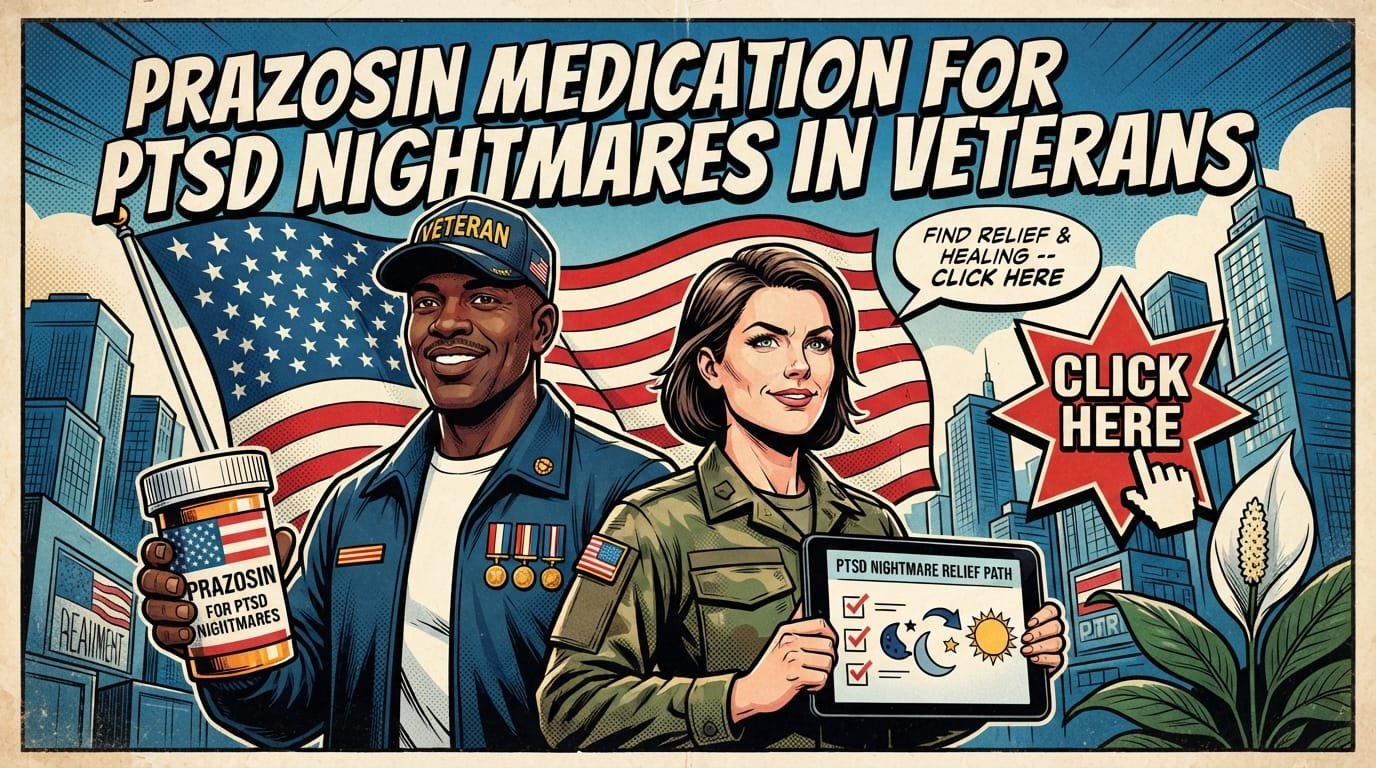
Prazosin for PTSD: A Veteran’s Guide to Evidence, Dosing, and VA Care
Prazosin is an alpha-1 adrenergic antagonist used off-label to treat PTSD-related nightmares and sleep disturbance. The 2023 VA/DoD Clinical Practice Guideline suggests prazosin specifically for PTSD nightmares but recommends against it for global PTSD symptoms. Typical starting dose is 1 mg at bedtime, titrated gradually. Veterans may require higher doses than civilians.
Quick Facts
| Item | Details |
|---|---|
| Medication | Prazosin (generic; brand name Minipress) |
| Drug Class | Alpha-1 adrenergic antagonist (alpha blocker) |
| FDA-Approved Use | Hypertension (high blood pressure) |
| PTSD Use | Off-label for PTSD-related nightmares and sleep disturbance |
| Who Qualifies | Veterans enrolled in VA healthcare with PTSD-related sleep symptoms |
| How to Get It | VA mental health or primary care provider prescription |
| Starting Dose | 1 mg at bedtime |
| VA Target Dose | 6–10 mg/day (may be higher in veterans) |
| Official Agency | U.S. Department of Veterans Affairs (VA); National Center for PTSD |
| Updated For | 2026 |
What Is Prazosin?
Prazosin is a generic prescription medication in the alpha-1 adrenergic antagonist class. It was originally approved by the FDA to treat high blood pressure. In PTSD care, it is used off-label to reduce trauma-related nightmares and sleep disruption.

Prazosin works by blocking alpha-1 receptors in the brain that respond to norepinephrine — the neurotransmitter often called “adrenaline.” In PTSD, the brain’s noradrenergic system becomes overactive, especially during sleep. This overactivity triggers the nightmares, disturbed awakenings, and hyperarousal that disrupt sleep. By blocking these receptors, prazosin reduces the brain’s exaggerated stress response during the night.

Why it matters for veterans: Sleep problems affect more than 90% of people with PTSD. Trauma-related nightmares are among the most distressing symptoms because they prevent restorative sleep, worsen daytime symptoms, and increase suicide risk. Prazosin is one of the few medications with evidence specifically for this symptom.
What veterans should do next: If you experience frequent PTSD-related nightmares or disturbed sleep, ask your VA provider about prazosin. It is not a sedative — it improves sleep quality by reducing nocturnal hyperarousal rather than knocking you out.
What the Evidence Shows
The evidence on prazosin is mixed but meaningful. Early studies showed strong benefits; a large VA trial did not.
Early Positive Studies
Prazosin first drew attention in the 1990s and early 2000s when researchers at the VA Northwest MIRECC discovered it was highly effective at reducing and often eliminating PTSD trauma nightmares, sleep disruption, and daytime hyperarousal in combat veterans. Small placebo-controlled trials, including a 20-week crossover study of Vietnam combat veterans, demonstrated significant reductions in trauma nightmares and improved sleep quality.
Veterans May Qualify for Extra Benefits
Check available financial assistance, healthcare programs and other opportunities that may apply to you.
Check EligibilityA 15-week randomized controlled trial in active-duty soldiers showed prazosin significantly superior to placebo on all primary outcome measures.
The PACT Trial (2018): A Major Reversal
The largest and most rigorous study of prazosin for PTSD was the VA-funded PACT trial (Prazosin and Combat Trauma), published in the New England Journal of Medicine in 2018. This six-month randomized controlled trial of 304 veterans found that prazosin was not superior to placebo for PTSD symptoms, nightmares, overall PTSD symptoms, or clinical global impression of change.
This result contradicted nearly all smaller studies. One explanation is that the PACT trial had a larger placebo response than earlier trials, potentially because it involved more frequent clinical contact and monitoring.
What the Meta-Analyses Show
A 2025 systematic review and meta-analysis of 10 randomized controlled trials with 648 patients found that prazosin significantly improved insomnia (effect size −0.654) and nightmares (effect size −0.641), but did not significantly improve overall PTSD symptoms.
A separate network meta-analysis of 99 RCTs with 10,481 participants found that prazosin was the best pharmacological treatment for PTSD-related sleep issues, increasing subjective total sleep time by nearly 80 minutes on average compared to placebo.
Bottom line: The evidence is strongest for nightmares and insomnia. The evidence is weak for prazosin as a standalone treatment for global PTSD symptoms.
VA Recommendations for Prazosin
The 2023 VA/DoD Clinical Practice Guideline takes a nuanced position on prazosin. VA suggests prazosin for the treatment of PTSD-associated nightmares, but recommends against prazosin as monotherapy or augmentation therapy for global PTSD symptoms.
| Recommendation | Strength | Applies To |
|---|---|---|
| Suggests for | Weak for | PTSD-associated nightmares |
| Suggests against | Against | Global PTSD symptoms (monotherapy or augmentation) |
The VA/DoD guideline recommends trauma-focused psychotherapy as the treatment of choice for PTSD, with medication as an adjunct. Prazosin is specifically recommended for nightmares — a specific symptom — not as a broad PTSD treatment.
The American Academy of Sleep Medicine (AASM) recommends prazosin as the first-line agent for PTSD-related nightmares and sleep disturbance with Level A evidence. A 2024–2025 psychopharmacology algorithm update from Harvard South Shore Program researchers concludes that “prazosin remains the first-line treatment for PTSD-related sleep impairment, including nightmares and disturbed awakenings”.
What veterans should do next: If you are already taking prazosin and it helps, the VA guideline does not recommend stopping it. The decision to continue or discontinue should be individualized between you and your provider.
How Prazosin Is Dosed for PTSD
Prazosin dosing follows a gradual titration schedule. Starting low and increasing slowly reduces the risk of side effects, especially low blood pressure.
Standard Titration Protocol
| Step | Dose | Timing |
|---|---|---|
| Start | 1 mg | At bedtime |
| After 2–3 days | 2 mg | At bedtime |
| Then increase | By 1 mg every 2–7 days | Based on benefit and side effects |
| Target (VA guideline) | 6–10 mg/day | May require higher doses in veterans |
| Average effective dose | ~3 mg (range 1–13 mg) | Civilian populations |
Military vs. Civilian Dosing
Research consistently shows that veterans and active-duty service members may require higher doses than civilians. Mean final doses in trials have been:
| Population | Nighttime Dose | Morning Dose (if needed) |
|---|---|---|
| Men (military) | 16 mg | 5 mg |
| Women (military) | 7 mg | 2 mg |
| Men (civilian) | 2–6 mg | — |
| Women (civilian) | 2–6 mg | — |
Maximum doses studied in clinical trials reached 20 mg at bedtime for men and 10 mg at bedtime for women.
What veterans should do next: Most clinicians do not titrate high enough for veterans. If you are not seeing improvement at 6–10 mg, discuss a higher dose with your provider before abandoning the medication.
Side Effects of Prazosin
Prazosin is generally well tolerated, but side effects can occur. The most common side effect is dizziness, which often improves after the first few doses.
Common Side Effects
| Side Effect | Frequency |
|---|---|
| Dizziness | 10% |
| Headache | 8% |
| Drowsiness | 8% |
| Lack of energy | 7% |
| Weakness | 7% |
| Palpitations | 5% |
| Nausea | 5% |
Source: NHS Highland Prazosin for PTSD-related nightmares guidelines.
First-Dose Hypotension
Prazosin can cause a drop in blood pressure, especially after the first dose. This is called first-dose hypotension. It can lead to fainting (syncope), reported by about 1% of patients at doses of 2 mg and higher.
How to reduce risk:
Take the first dose at bedtime
Stand up slowly from sitting or lying positions
Avoid driving or operating machinery until you know how the medication affects you
Tell your provider about all other blood pressure medications you take
Orthostatic Hypotension
Orthostatic hypotension means your blood pressure drops when you stand up, causing lightheadedness. This is the major dose-limiting side effect. Your provider should monitor your blood pressure, especially during titration.
What veterans should do next: If you experience dizziness or fainting, contact your provider before taking another dose. Dose adjustments or slower titration may resolve the issue.
How to Get Prazosin Through VA
Prazosin is available through VA healthcare at no cost to eligible veterans. You do not need a service-connected disability rating to receive it.
Step-by-Step Process
Enroll in VA healthcare. If you are not already enrolled, apply online at va.gov or call 1-877-222-8387.
Schedule a mental health appointment. Contact your VA medical center’s mental health department or your primary care provider.
Discuss your sleep symptoms. Describe your nightmares, disturbed awakenings, and any daytime symptoms. Prazosin is prescribed specifically for nightmares and sleep disturbance.
Receive a prescription. If your provider determines prazosin is appropriate, they will prescribe it through the VA pharmacy.
Follow up regularly. Prazosin requires dose titration and monitoring. Expect follow-up visits to adjust the dose and check blood pressure.
What If You Are Not Enrolled in VA Healthcare?
Veterans with other-than-honorable discharges may still qualify for mental health care through VA. Contact your local VA medical center or call 1-877-222-8387 to check eligibility.
What veterans should do next: Bring a symptom diary to your appointment. Document nightmare frequency, sleep quality, and how sleep problems affect your daytime functioning. This information helps your provider determine the right starting dose and titration speed.
Prazosin vs. Other PTSD Sleep Medications
Prazosin is not the only option for PTSD-related sleep problems. Here is how it compares to alternatives.
| Medication | Best For | Evidence Level | Key Drawbacks |
|---|---|---|---|
| Prazosin | Nightmares, disturbed awakenings, sleep terrors | Level A (AASM); VA suggests for nightmares | Dizziness, hypotension, requires titration |
| Hydroxyzine | Sleep onset | Modest evidence for TST | Sedation, anticholinergic effects |
| Trazodone | Sleep maintenance | Promising but not significant vs. placebo in NMA | Sedation, priapism (rare) |
| SSRIs (sertraline, paroxetine) | Global PTSD symptoms | FDA-approved for PTSD | Can worsen sleep problems |
| Benzodiazepines | — | Not recommended | Tolerance, dependence, worsen nightmares, memory impairment |
A network meta-analysis found that prazosin was the best pharmacological treatment for PTSD-related sleep issues, particularly nightmares. SSRIs and benzodiazepines lacked strong evidence for sleep efficacy, and benzodiazepines carry the risk of worsening PTSD symptoms.
What veterans should do next: If prazosin does not work for you, ask your provider about hydroxyzine or trazodone. Avoid benzodiazepines for PTSD-related sleep problems — they are specifically not recommended.
Common Mistakes Veterans Make with Prazosin
1. Giving up too early. Prazosin requires gradual titration. Some veterans stop after a few days because they do not see immediate results. A proper trial takes weeks and may require dose increases.
2. Not going high enough. The VA target dose is 6–10 mg/day, but veterans often need higher doses. If you are not improving at a low dose, discuss increasing it before stopping.
3. Taking the first dose during the day. The first dose should be taken at bedtime to reduce the risk of fainting from low blood pressure.
4. Not reporting dizziness. Dizziness is common but manageable with dose adjustments. Do not suffer in silence — tell your provider.
5. Expecting prazosin to treat all PTSD symptoms. Prazosin is for nightmares and sleep disturbance. It is not a standalone treatment for global PTSD. Trauma-focused psychotherapy remains the first-line treatment.
6. Stopping abruptly. If you and your provider decide to discontinue prazosin, taper slowly. Abrupt discontinuation can cause symptom worsening or rebound.
7. Not combining with therapy. Prazosin works best as an adjunct to trauma-focused psychotherapy, not as a replacement.
Common Questions
Is prazosin FDA-approved for PTSD?
No. Prazosin is FDA-approved for hypertension (high blood pressure). Its use for PTSD-related nightmares is off-label, meaning it is prescribed based on clinical evidence rather than FDA approval for that specific condition.
Does prazosin actually work for PTSD nightmares?
The evidence is mixed. Early studies showed strong benefits, but a large 2018 VA trial found no difference from placebo. A 2025 meta-analysis found prazosin significantly improved insomnia and nightmares but not overall PTSD symptoms. Many clinicians still consider it first-line for PTSD nightmares.
What dose of prazosin is used for PTSD?
The typical starting dose is 1 mg at bedtime. The dose is increased gradually, usually by 1 mg every 2–7 days. The VA target dose is 6–10 mg/day, but veterans often require higher doses. Mean final doses in trials were 16 mg at night for men and 7 mg at night for women.
How long does prazosin take to work for nightmares?
Some patients notice improvement within the first week or two. A full trial takes several weeks of gradual titration to reach an effective dose. If you do not respond after an adequate trial at an adequate dose, your provider may try a different medication.
What are the most common side effects of prazosin?
The most common side effects are dizziness (10%), headache (8%), drowsiness (8%), lack of energy (7%), weakness (7%), palpitations (5%), and nausea (5%). Dizziness usually improves after the first few doses.
Can I drink alcohol while taking prazosin?
Alcohol can worsen the blood pressure-lowering effects of prazosin and increase the risk of dizziness and fainting. Discuss alcohol use with your provider. Many veterans with PTSD also struggle with alcohol use, and prazosin may be useful for individuals with comorbid alcohol use disorder.
Does prazosin help with daytime PTSD symptoms?
Prazosin is primarily used for nighttime symptoms. Some clinicians add a morning dose for daytime hyperarousal, irritability, and hypervigilance. A 2024 study found prazosin also improved depression in PTSD patients.
Is prazosin safe for long-term use?
Prazosin has been used for hypertension for decades. Long-term use for PTSD is generally considered safe, but the optimal duration of treatment is not established. Periodic reviews with your provider are recommended.
What if prazosin doesn’t work for me?
If prazosin does not work after an adequate trial, your provider may try hydroxyzine or trazodone. Benzodiazepines should be avoided. Trauma-focused psychotherapy remains essential regardless of medication response.
Can women take prazosin for PTSD?
Yes. Women typically require lower doses than men. Mean final doses in trials were 7 mg at night for women compared to 16 mg at night for men. Women may also be more sensitive to side effects.
Does prazosin interact with other medications?
Prazosin can add to the blood pressure-lowering effects of other antihypertensives, including beta blockers, calcium channel blockers, and phosphodiesterase type 5 inhibitors (like Viagra). Tell your provider about all medications you take.
Can I get prazosin without VA healthcare?
Yes, if you have a civilian provider who prescribes it. However, VA healthcare provides prazosin at no cost to eligible veterans. If you are not enrolled in VA healthcare, you can still ask your civilian provider about prazosin.
Is prazosin a controlled substance?
No. Prazosin is not a controlled substance and has no abuse potential. It does not cause dependence or withdrawal in the way that benzodiazepines or opioids can.
Key Takeaways
Prazosin is an alpha-1 blocker used off-label for PTSD-related nightmares and sleep disturbance.
The 2023 VA/DoD guideline suggests prazosin for PTSD nightmares but recommends against it for global PTSD symptoms.
The 2018 PACT trial found no difference between prazosin and placebo, but a 2025 meta-analysis found significant benefits for insomnia and nightmares.
Typical starting dose is 1 mg at bedtime, titrated gradually to 6–10 mg/day or higher.
Veterans may require higher doses than civilians — mean final doses were 16 mg at night for men and 7 mg at night for women in military trials.
Common side effects include dizziness (10%), headache (8%), and drowsiness (8%); first-dose hypotension is a risk.
Prazosin is available at no cost through VA healthcare for eligible veterans.
Prazosin is not a standalone treatment for PTSD — trauma-focused psychotherapy remains first-line.
Benzodiazepines should be avoided for PTSD-related sleep problems.
A 2024 study found prazosin also improved depression in PTSD patients.
Official Resources
VA National Center for PTSD: ptsd.va.gov
VA/DoD Clinical Practice Guideline for PTSD: healthquality.va.gov/guidelines/MH/ptsd
VA Mental Health: va.gov/health-care/health-needs-conditions/mental-health
VA.gov Enrollment: va.gov/health-care/apply
Veterans Crisis Line: 988 (Press 1) | veteranscrisisline.net
USDA (for context on federal programs): usda.gov
USA.gov Benefits Finder: usa.gov/benefits

🇺🇸 IMPORTANT DISCLAIMER – Veterans Benefits Information
This site provides general information about U.S. Department of Veterans Affairs (VA) benefits for educational and informational purposes only.
- Not Official: We are NOT affiliated with, endorsed by, or connected to the U.S. Department of Veterans Affairs (VA), the Veterans Benefits Administration (VBA), the Veterans Health Administration (VHA), or any other government agency.
- No Legal/Financial Advice: The content on this website is for informational purposes only and does not constitute legal, financial, or medical advice. VA benefits rules change frequently – always consult with an accredited Veterans Service Officer (VSO) or a qualified professional for your specific situation.
- Official Sources: For official, binding information and to apply for benefits, always visit official .gov websites: VA.gov, Benefits.VA.gov, or SSA.gov.
- No Data Collection: This site does not collect, store, or process any personal information. It does not have login forms, contact forms, or any system to capture user data. We never ask for your Social Security Number, bank details, or any personal information.
- 🚨 Scam Alert: The VA and other government agencies never charge fees for benefit applications. If anyone asks for money to "process" your VA claim, it is a scam. Report it to the VA Office of Inspector General at VA.gov/OIG.
- Advertising: This site uses third-party advertising (Adsterra) to cover operational costs. We do not endorse or guarantee any products or services advertised.
📌 Information provided as of June 2026. Always verify current eligibility and rules with official .gov sources.
This site is not affiliated with the U.S. Department of Veterans Affairs or any government agency. All information is for educational purposes only. Please visit VA.gov for official information.
