
IBS VA Disability Rating: Complete 2026 Guide to Diagnostic Code 7319
VA rates irritable bowel syndrome (IBS) under Diagnostic Code 7319 at 10%, 20%, or 30% based on symptom frequency. A 10% rating requires abdominal pain related to defecation at least once in three months; 30% requires weekly pain. There is no 0% rating since May 19, 2024, so service-connected IBS is always compensable.
Quick Facts
| Item | Details |
|---|---|
| Benefit | Tax-free monthly VA disability compensation for service-connected IBS |
| Eligibility | Veterans with a current IBS diagnosis linked to military service or qualifying Gulf War service |
| Application | VA Form 21-526EZ (Application for Disability Compensation and Related Compensation Benefits) |
| Processing Time | Varies by claim type; appeals average 125–730 days |
| Official Agency | U.S. Department of Veterans Affairs (VA), Veterans Benefits Administration |
| Required Forms | VA Form 21-526EZ; DBQ 21-0960G-3 (Intestinal Conditions) completed by examiner |
| Updated For | 2026 (Revised DC 7319 effective May 19, 2024; 2.8% COLA effective December 1, 2025) |
What Is the VA Disability Rating for IBS?
The VA disability rating for IBS is a percentage assigned by the Department of Veterans Affairs that reflects how severely your irritable bowel syndrome impairs your ability to work and function in daily life. VA rates IBS under Diagnostic Code 7319 in 38 CFR Part 4, the VA Schedule for Rating Disabilities.

Under the current rating criteria, service-connected IBS can receive a 10%, 20%, or 30% disability rating. The maximum schedular rating for IBS is 30%. These ratings are based primarily on how frequently you experience abdominal pain related to defecation, along with the presence of other qualifying gastrointestinal symptoms.

The rating matters because it determines your monthly VA disability compensation. At a 30% rating, a single veteran receives $552.47 per month in 2026. IBS can also combine with other service-connected conditions to produce a higher overall combined rating, which increases your monthly payment further.
What you should do next: If your IBS is connected to your military service, file a claim using VA Form 21-526EZ. If you already have a rating under the old criteria, request a reevaluation under the new standards.
How VA Rates IBS Under Diagnostic Code 7319
VA rates IBS using specific frequency-based criteria that were completely rewritten effective May 19, 2024. The previous rating system used vague descriptive terms — “mild,” “moderate,” and “severe” — and allowed for a 0% rating. The new system uses measurable frequency thresholds and eliminated the 0% rating entirely.
The key takeaway: any service-connected IBS diagnosis is now always compensable. There is no longer a scenario where a veteran has service-connected IBS but receives 0% compensation. This is one of the most significant improvements in the digestive system rating schedule in decades.
The 10% Rating Criteria
Veterans May Qualify for Extra Benefits
Check available financial assistance, healthcare programs and other opportunities that may apply to you.
Check EligibilityA 10% VA disability rating for IBS applies when you experience:
Abdominal pain related to defecation at least once during the previous three months, AND
At least two of the following additional symptoms:
Changes in how frequently you have bowel movements
Changes in stool form
Straining or urgency
Mucorrhea (mucus discharge)
Abdominal bloating
Subjective abdominal distension
Even relatively infrequent symptoms can qualify for a compensable rating under this standard.
The 20% Rating Criteria
A 20% rating applies when you experience:
Abdominal pain related to defecation for at least three days per month during the previous three months, AND
At least two of the additional symptoms listed above
The 20% rating is relatively new. It was added in the May 2024 rewrite to fill the gap between the old 10% and 30% ratings. Veterans whose symptoms fell between “moderate” and “severe” under the old system can now receive a more accurate 20% evaluation.
The 30% Rating Criteria
The 30% rating is the maximum schedular rating for IBS under Diagnostic Code 7319. It applies when you experience:
Abdominal pain related to defecation at least one day per week during the previous three months, AND
At least two of the additional symptoms listed above
Because frequency is the determining variable, what you document about how often your symptoms occur matters more than how vividly you describe any single episode. A detailed symptom log can be the difference between a 10% and a 30% rating.
Rating comparison table
| Rating | Abdominal Pain Frequency | Additional Symptoms Required | 2026 Monthly Pay (Veteran Alone) |
|---|---|---|---|
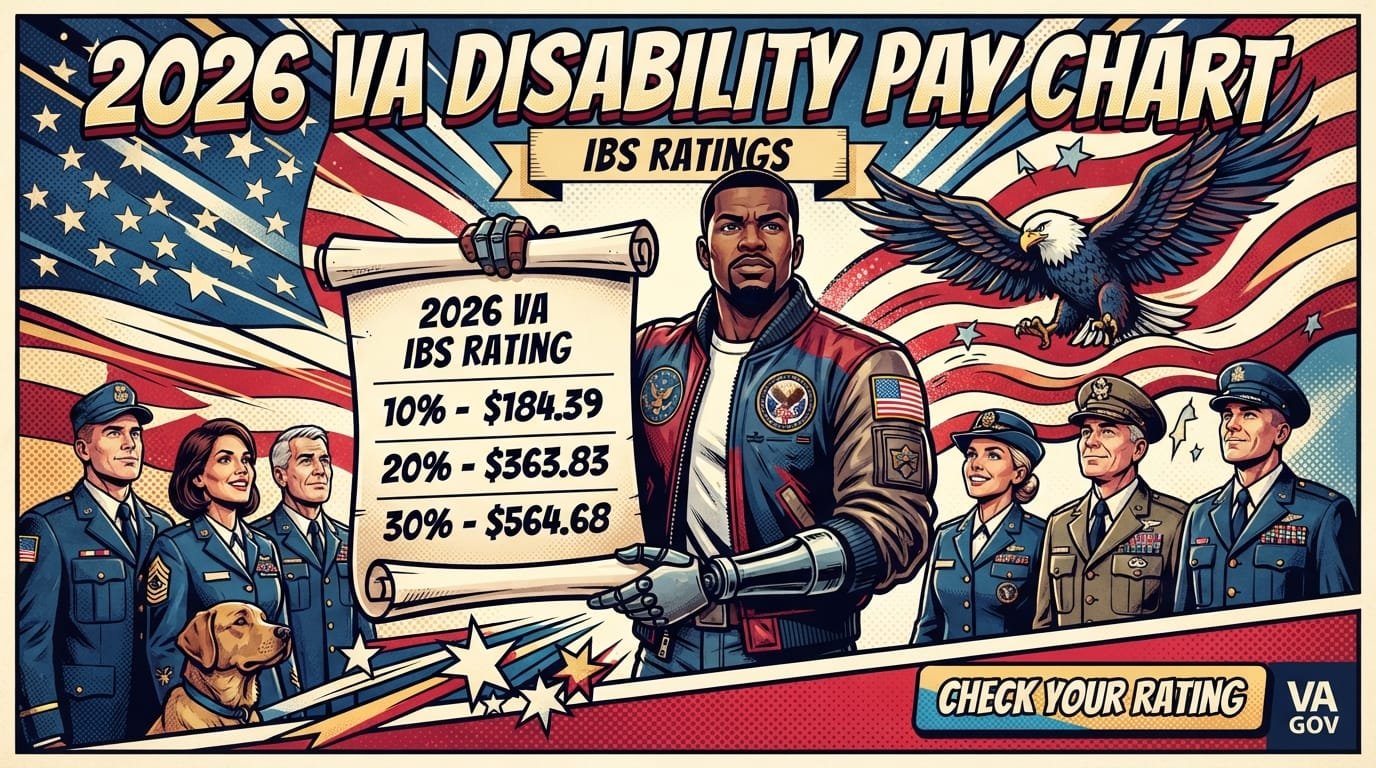
| 10% | At least once in past 3 months | 2 or more | $180.42 |
| 20% | At least 3 days per month | 2 or more | $356.66 |
| 30% | At least 1 day per week | 2 or more | $552.47 |
Source: 38 CFR § 4.114, DC 7319; 91 FR 7386.
The May 2024 Rule Change: What Changed and Why It Matters
The VA amended the digestive system rating schedule effective May 19, 2024, updating criteria for 55 medical conditions. For IBS specifically, three major changes took effect.
Before May 2024
| Rating | Criteria |
|---|---|
| 0% | Mild irritable colon syndrome with disturbances of bowel function and occasional episodes of abdominal distress |
| 10% | Moderate irritable colon syndrome with frequent episodes of bowel disturbance with abdominal distress |
| 30% | Severe irritable colon syndrome with diarrhea, or alternating diarrhea and constipation, with more or less constant abdominal distress |
After May 2024
| Rating | Criteria |
|---|---|
| 10% | Abdominal pain related to defecation at least once in the previous three months, plus two or more additional symptoms |
| 20% | Abdominal pain related to defecation at least three days per month, plus two or more additional symptoms |
| 30% | Abdominal pain related to defecation at least one day per week, plus two or more additional symptoms |
What this means for you
No more 0% ratings. If your IBS is service-connected, you receive at least 10%. This eliminates the frustrating scenario where a veteran proves service connection but receives no compensation.
More precise criteria. The frequency-based standards are easier to document and apply consistently. Vague terms like “frequent” and “constant” have been replaced with measurable thresholds.
New 20% level. Veterans whose symptoms fall between the old 10% and 30% now have an intermediate rating that more accurately reflects their impairment.
Pending claims considered under both. Claims that were pending on May 19, 2024, are considered under both the old and new rating criteria, and whichever is more favorable to the veteran is applied. Current ratings are not reduced solely because of the update — a reduction only occurs if there is actual improvement in the disability.
Gulf War Presumptive Service Connection for IBS
If you served in the Southwest Asia theater of operations during the Persian Gulf War, you may qualify for presumptive service connection for IBS under 38 CFR § 3.317. This is the most valuable route to service connection for IBS because it eliminates the need for a nexus opinion linking your condition to your service.
What the presumptive framework covers
Under 38 CFR § 3.317, VA pays compensation to Persian Gulf veterans who exhibit objective indications of a qualifying chronic disability. Qualifying chronic disabilities include functional gastrointestinal disorders (excluding structural gastrointestinal diseases). IBS is specifically listed as an example of a functional gastrointestinal disorder.
The regulation defines functional gastrointestinal disorders as conditions characterized by chronic or recurrent symptoms that are unexplained by structural, endoscopic, laboratory, or other objective signs of injury or disease. The listed examples include irritable bowel syndrome, functional dyspepsia, functional vomiting, functional constipation, functional bloating, functional abdominal pain syndrome, and functional dysphagia.
What you need to prove
For presumptive service connection, you need:
Qualifying service in the Southwest Asia theater of operations during the covered period
A qualifying chronic disability — a functional gastrointestinal disorder such as IBS
Manifestation to a compensable degree — which is now easier since IBS has no 0% rating
You do not need a medical nexus opinion. You do not need your service treatment records to mention bowel symptoms. The presumption fills that gap.
The December 31, 2026 deadline
Under 38 CFR § 3.317, the qualifying chronic disability must have become manifest either during active service in the Southwest Asia theater of operations or to a degree of 10% or more not later than December 31, 2026. If you have qualifying Gulf War service and IBS that has reached at least 10% severity, file now. Do not wait until after the deadline.
IBS as a Secondary Condition to PTSD or Other Disabilities
You can also establish service connection for IBS on a secondary basis if your IBS was caused or aggravated by an already service-connected condition. The most common secondary connection for IBS is to PTSD or other mental health conditions.
IBS secondary to PTSD
VA has granted service connection for IBS as secondary to PTSD in multiple Board of Veterans’ Appeals decisions. The medical theory is that PTSD and other mental health conditions alter the gut-brain axis, the bidirectional communication system between the central nervous system and the enteric nervous system. Chronic stress and anxiety can trigger or worsen gastrointestinal symptoms.
To win a secondary service connection claim, you need:
An already service-connected condition (such as PTSD)
A current diagnosis of IBS
A medical nexus opinion from a qualified physician stating that your service-connected condition caused or aggravated your IBS
The nexus opinion is essential for secondary claims. Unlike the Gulf War presumptive route, you must prove the link between your existing disability and your IBS.
IBS secondary to other conditions
IBS can also be secondary to other service-connected conditions, including:
Persistent depressive disorder — VA has remanded claims for IBS secondary to depression for further development
Anxiety disorders — Veterans with service-connected anxiety may qualify for IBS benefits if the conditions are medically linked
Gastrointestinal conditions — If you have a service-connected GI condition that has worsened or caused IBS-like symptoms
Secondary conditions that can stem from IBS
Just as IBS can be secondary to another condition, other conditions can be secondary to IBS. These include:
Depression and anxiety resulting from the social and occupational limitations of IBS
Sleep disturbances caused by nighttime symptoms
Social isolation from fear of symptom flare-ups in public
Each secondary condition is separately ratable and can increase your combined disability rating.
2026 VA Disability Compensation for IBS
The 2026 VA disability rates took effect December 1, 2025, following a 2.8% cost-of-living adjustment (COLA). These amounts are tax-free at the federal level and in all states.
IBS ratings and monthly compensation
| Rating | Monthly Payment (Veteran Alone) | Monthly Payment (With Spouse) | Annual Payment (Veteran Alone) |
|---|---|---|---|
| 10% | $180.42 | N/A | $2,165.04 |
| 20% | $356.66 | N/A | $4,279.92 |
| 30% | $552.47 | $617.47 | $6,629.64 |
Source: 91 FR 7386; VA.gov, effective December 1, 2025.
Dependent pay begins at the 30% rating. If you are rated 30% for IBS and have a spouse, you receive $617.47 per month instead of $552.47. Veterans with children receive additional amounts for each dependent child under 18 or in school.
Combining IBS with other conditions
IBS is rarely rated alone. Most veterans with service-connected IBS have other conditions, and VA uses a combined rating formula to determine their overall disability percentage. For example:
| Condition | Rating |
|---|---|
| IBS | 30% |
| PTSD | 50% |
| Knee condition | 20% |
| Combined Rating | 70% |
| 2026 Monthly Payment (Veteran Alone) | $1,808.45 |
The combined rating formula does not simply add percentages. It accounts for how each condition affects your overall functioning. But adding IBS to your combined rating can push you into a higher overall percentage and a higher monthly payment.
How to File a VA Disability Claim for IBS
Filing for IBS disability compensation uses VA Form 21-526EZ, the Application for Disability Compensation and Related Compensation Benefits. You can file online, by mail, or through an accredited representative.
Step-by-step process
Step 1: Confirm your service connection route.
Determine whether you qualify for Gulf War presumptive service connection, direct service connection, or secondary service connection. The route you choose determines the evidence you need.
Step 2: Gather medical evidence.
Collect current treatment records, test results, and a diagnosis of IBS. The diagnosis should meet the Rome IV criteria, which the VA incorporated into Diagnostic Code 7319. You also need documentation of symptom frequency — a symptom log is extremely valuable.
Step 3: Get a nexus opinion if needed.
For direct or secondary service connection, you need a medical nexus opinion linking your IBS to your military service or to an existing service-connected condition. For Gulf War presumptive claims, a nexus is not required.
Step 4: Complete VA Form 21-526EZ.
File online at VA.gov for the fastest processing. You can upload supporting documents directly.
Step 5: Attend your C&P exam.
VA will schedule a Compensation & Pension exam. The examiner completes DBQ 21-0960G-3 (Intestinal Conditions, Other Than Surgical or Infectious), which asks about the frequency and severity of your diarrhea, constipation, abdominal distress, and symptom exacerbations.
Step 6: Receive your decision.
VA issues a rating decision with your disability percentage and effective date.
Ways to file
| Method | Details |
|---|---|
| Online | VA.gov (recommended for fastest processing) |
| VA Evidence Intake Center, Janesville, WI | |
| In person | Any VA regional office |
| With a representative | VSO, accredited attorney, or claims agent |
Required Documents and Evidence for IBS Claims
The evidence you need depends on your service connection route. VA gives more weight to medical evidence that documents the frequency and functional impact of your symptoms.
Evidence for direct service connection
Current IBS diagnosis — From a gastroenterologist or primary care physician
Medical treatment records — Showing ongoing treatment, medications, and symptom history
Symptom log — Documenting how often you experience abdominal pain, urgency, diarrhea, constipation, and other symptoms
Nexus opinion — A physician’s statement linking your IBS to your military service
Lay statements — From family or friends describing how IBS affects your daily life
Evidence for Gulf War presumptive service connection
Proof of qualifying service — DD-214 or other records showing service in the Southwest Asia theater
Current IBS diagnosis — Meeting the Rome IV criteria
Symptom frequency documentation — To establish at least 10% severity
No nexus required
Evidence for secondary service connection
Proof of the primary service-connected condition — VA rating decision or award letter
Current IBS diagnosis
Nexus opinion — A physician’s statement linking the primary condition to the IBS
The DBQ for IBS
Your C&P examiner completes DBQ 21-0960G-3. The examiner documents:
Frequency and severity of diarrhea, constipation, or alternating episodes
Abdominal distress (occasional, frequent, or constant)
Number and frequency of symptom exacerbations over the past 12 months
Whether findings support mild, moderate, or severe irritable colon (DC 7319)
Weight loss or other objective signs
You can have your own doctor complete the same DBQ and submit it as evidence. This is often more favorable than relying solely on a VA examiner’s assessment.
Common Mistakes That Cost Veterans the IBS Rating They Deserve
1. Not documenting symptom frequency.
The new rating criteria are frequency-based. If you do not document how often your symptoms occur, VA cannot accurately rate you. Keep a daily symptom log.
2. Assuming IBS cannot be service-connected.
IBS is one of the most commonly granted VA disabilities, especially for Gulf War veterans. The Gulf War presumptive route eliminates the need for a nexus opinion.
3. Missing the December 31, 2026 Gulf War deadline.
If you have qualifying Southwest Asia service, file now. The presumptive window for IBS manifesting to 10% or more closes on December 31, 2026.
4. Filing without current medical evidence.
An old diagnosis from years ago is not enough. You need current medical records showing your ongoing symptoms and how they affect your functioning.
5. Describing your best day instead of your typical day.
The C&P examiner needs to understand how often you experience symptoms, not just how severe your worst episode was. Be specific about frequency.
6. Ignoring secondary conditions.
If your IBS has caused depression, anxiety, or sleep disturbances, those are separately ratable conditions that can increase your combined rating.
7. Not filing for an increase if you were rated under the old criteria.
The May 2024 changes added the 20% rating and eliminated the 0% rating. If you were rated 0% before May 2024, you may now qualify for 10% or higher.
8. Not knowing the 30% rating requires weekly symptoms.
To receive the maximum 30% rating, you need abdominal pain related to defecation at least once per week for the past three months, plus two or more additional symptoms.
Appeals Process for IBS Claim Denials
If VA denies your IBS claim or assigns a rating lower than you believe is correct, you have three decision review options under the Appeals Modernization Act (AMA). You have one year from the decision date to file most appeals and preserve your effective date.
| Appeal Lane | Form | When to Use It | New Evidence? | Average Processing |
|---|---|---|---|---|
| Supplemental Claim | VA Form 20-0995 | You have new and relevant evidence | Yes, required | 125 days |
| Higher-Level Review | VA Form 20-0996 | VA made an error on the existing record | No | 125 days |
| Board Appeal | VA Form 10182 | You want a Veterans Law Judge to decide | Depends on docket | 365–730 days |
You cannot file the same appeal option twice in a row on the same issue. You can move between lanes after a decision. The Supplemental Claim lane is often the fastest when you can obtain additional medical evidence, such as a more detailed symptom log or a stronger nexus opinion.
TDIU and IBS
If your IBS prevents you from maintaining substantially gainful employment, you may qualify for Total Disability Based on Individual Unemployability (TDIU). TDIU pays at the 100% rate — $3,938.58 per month for a single veteran in 2026 — even if your schedular rating is lower.
TDIU eligibility thresholds
One disability rated at least 60%, OR
Multiple disabilities combining to at least 70%, with at least one disability rated 40% or higher
A 30% IBS rating alone does not meet these thresholds. However, if you have other service-connected conditions that combine to 70% or more, and your IBS contributes to your inability to work, you may qualify for TDIU.
Extraschedular TDIU for IBS
VA can grant TDIU on an extraschedular basis under 38 CFR 4.16(b) if your service-connected disabilities prevent substantially gainful employment even though the schedular criteria are not met. This requires a strong medical and vocational record showing that your IBS and other conditions prevent full-time work.
Common Questions
What is the VA disability rating for IBS?
VA rates IBS under Diagnostic Code 7319 at 10%, 20%, or 30% based on symptom frequency. The 10% rating requires abdominal pain related to defecation at least once in three months. The 30% rating requires weekly pain. There is no 0% rating since May 19, 2024.
How much does IBS VA disability pay in 2026?
A 10% rating pays $180.42 per month for a single veteran. A 20% rating pays $356.66. A 30% rating pays $552.47. These amounts are tax-free and reflect a 2.8% COLA effective December 1, 2025.
What changed with the new IBS rating criteria?
Effective May 19, 2024, VA eliminated the 0% rating, added a 20% rating, and replaced vague severity terms with specific frequency thresholds. Service-connected IBS is now always compensable at 10% or higher.
Can I get service connection for IBS from the Gulf War?
Yes. Under 38 CFR § 3.317, Gulf War veterans who served in the Southwest Asia theater can receive presumptive service connection for functional gastrointestinal disorders including IBS. No nexus opinion is required. The presumptive window closes December 31, 2026.
What is a functional gastrointestinal disorder?
A functional gastrointestinal disorder is a condition characterized by chronic or recurrent symptoms that cannot be explained by structural, endoscopic, or laboratory findings. IBS is the most common example. VA recognizes these disorders as qualifying chronic disabilities for Gulf War presumptive service connection.
Can IBS be secondary to PTSD?
Yes. VA has granted service connection for IBS as secondary to PTSD in multiple Board of Veterans’ Appeals decisions. The medical theory is that PTSD alters the gut-brain axis, triggering or worsening IBS symptoms. A nexus opinion from a physician is required.
What evidence do I need for an IBS claim?
You need a current IBS diagnosis, medical treatment records, a symptom log documenting frequency, and a nexus opinion (unless you qualify for Gulf War presumptive service connection). The C&P examiner completes DBQ 21-0960G-3.
How do I prepare for an IBS C&P exam?
Keep a daily symptom log documenting abdominal pain, urgency, diarrhea, constipation, and other symptoms. Bring the log to the exam. Describe your typical day, not your best day. Be specific about how often symptoms occur.
What is the maximum VA rating for IBS?
The maximum schedular rating for IBS is 30% under Diagnostic Code 7319. Veterans whose IBS causes total occupational impairment may be able to pursue TDIU, which pays at the 100% rate.
Can I get a higher rating than 30% for IBS?
The schedular maximum is 30%. To receive compensation above 30%, you would need to qualify for TDIU based on your combined disabilities, or have additional conditions that increase your combined rating.
How long does an IBS VA claim take?
Processing times vary. Supplemental Claims and Higher-Level Reviews have a 125-day processing goal. Board Appeals take 365 to 730 days. Initial claims depend on the regional office and the complexity of the evidence.
What symptoms does VA look for in an IBS claim?
VA looks for abdominal pain related to defecation, changes in stool frequency or form, straining or urgency, mucorrhea, abdominal bloating, and subjective abdominal distension. The frequency of these symptoms determines your rating.
Did the May 2024 changes affect existing IBS ratings?
No. Current ratings are not reduced solely because of the update. A reduction only occurs if there is actual improvement in the disability. Pending claims on May 19, 2024, were considered under both the old and new criteria, whichever was more favorable.
What if my IBS claim was denied before May 2024?
You may have a basis for a new claim or appeal. The new criteria eliminated the 0% rating and added the 20% rating. If you were previously denied or rated 0%, file a supplemental claim with updated evidence.
Key Takeaways
VA rates IBS under Diagnostic Code 7319 at 10%, 20%, or 30% based on symptom frequency.
The May 2024 rule change eliminated the 0% rating — service-connected IBS is always compensable.
The 10% rating requires abdominal pain related to defecation at least once in three months.
The 30% rating requires weekly pain plus two or more additional symptoms.
Gulf War veterans can receive presumptive service connection for IBS under 38 CFR § 3.317 without a nexus opinion.
The Gulf War presumptive window closes December 31, 2026 — file now if you qualify.
IBS can be service-connected as a secondary condition to PTSD, depression, or anxiety.
The 2026 rates pay $180.42 at 10%, $356.66 at 20%, and $552.47 at 30% for a single veteran.
Document symptom frequency — it is the determining factor for your rating.
Three appeal lanes exist: Supplemental Claim, Higher-Level Review, and Board Appeal.
Official Resources
VA Disability Compensation Rates: https://www.va.gov/disability/compensation-rates/
VA Form 21-526EZ: https://www.va.gov/find-forms/about-form-21-526ez/
38 CFR § 4.114 – Digestive System: https://www.ecfr.gov/current/title-38/chapter-I/part-4/subpart-B/subject-group-ECFR5e7b2a0b7a7d7f7/section-4.114
38 CFR § 3.317 – Persian Gulf Veterans: https://www.ecfr.gov/current/title-38/chapter-I/part-3/subpart-A/subject-group-ECFR39056aee4e9ff13/section-3.317
VA Decision Review Options: https://www.va.gov/resources/choosing-a-decision-review-option/
VA News – Digestive System Rating Update: https://news.va.gov/129622/va-updates-disability-rating-schedule-for-digestive-system/
VA.gov – IBS Disability Benefits: https://www.va.gov/disability/eligibility/
Federal Register – VASRD Digestive Update: https://public-inspection.federalregister.gov/2024-05138.pdf
VA C&P Exam Information: https://www.va.gov/disability/va-claim-exam/
38 CFR Part 4 – VASRD: https://www.ecfr.gov/current/title-38/part-4





🇺🇸 IMPORTANT DISCLAIMER – Veterans Benefits Information
This site provides general information about U.S. Department of Veterans Affairs (VA) benefits for educational and informational purposes only.
- Not Official: We are NOT affiliated with, endorsed by, or connected to the U.S. Department of Veterans Affairs (VA), the Veterans Benefits Administration (VBA), the Veterans Health Administration (VHA), or any other government agency.
- No Legal/Financial Advice: The content on this website is for informational purposes only and does not constitute legal, financial, or medical advice. VA benefits rules change frequently – always consult with an accredited Veterans Service Officer (VSO) or a qualified professional for your specific situation.
- Official Sources: For official, binding information and to apply for benefits, always visit official .gov websites: VA.gov, Benefits.VA.gov, or SSA.gov.
- No Data Collection: This site does not collect, store, or process any personal information. It does not have login forms, contact forms, or any system to capture user data. We never ask for your Social Security Number, bank details, or any personal information.
- 🚨 Scam Alert: The VA and other government agencies never charge fees for benefit applications. If anyone asks for money to "process" your VA claim, it is a scam. Report it to the VA Office of Inspector General at VA.gov/OIG.
- Advertising: This site uses third-party advertising (Adsterra) to cover operational costs. We do not endorse or guarantee any products or services advertised.
📌 Information provided as of June 2026. Always verify current eligibility and rules with official .gov sources.
This site is not affiliated with the U.S. Department of Veterans Affairs or any government agency. All information is for educational purposes only. Please visit VA.gov for official information.
