
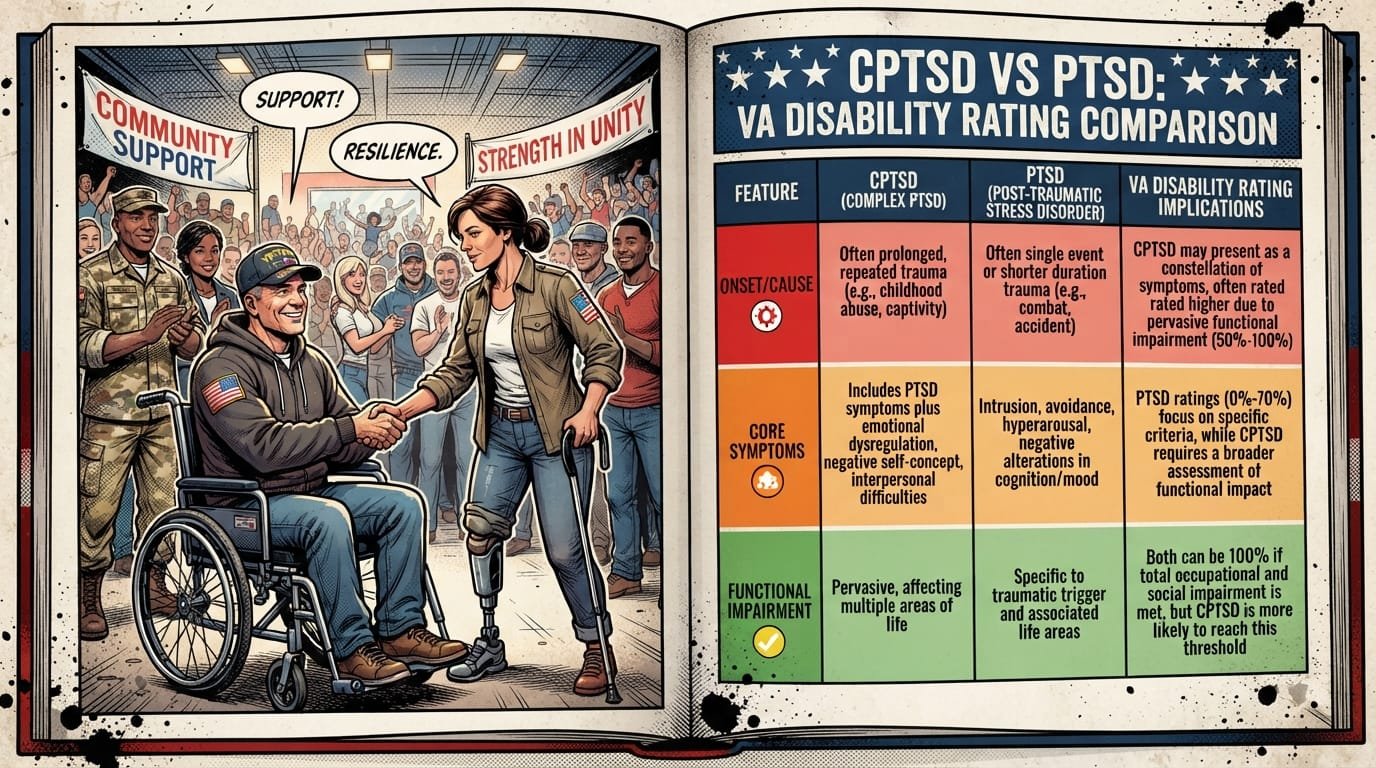
Complex PTSD (CPTSD): Symptoms and VA Benefits
Complex PTSD (CPTSD) is not a separate diagnosis in the DSM-5-TR, which the VA uses for mental health ratings. The VA evaluates CPTSD symptoms under the existing PTSD rating criteria in 38 CFR § 4.130, Diagnostic Code 9411. Veterans with CPTSD symptoms receive ratings from 0% to 100% based on occupational and social impairment.
Quick Facts
| Item | Details |
|---|---|
| Benefit | VA disability compensation for service-connected mental health condition |
| Eligibility | Veterans with a PTSD diagnosis linked to military service, including CPTSD symptoms |
| Application | VA Form 21-526EZ; VA Form 21-0781 for stressor statement |
| Processing Time | Average 3–4 months for a fully developed claim |
| Official Agency | U.S. Department of Veterans Affairs (VA) |
| Required Forms | VA Form 21-526EZ; VA Form 21-0781; PTSD DBQ (completed by examiner) |
| Updated For | 2026 compensation rates and proposed rating changes |
What Is Complex PTSD (CPTSD)?
Complex PTSD is a mental health condition that develops after prolonged, repeated exposure to traumatic events. It includes all the core symptoms of PTSD—re-experiencing, avoidance, and hyperarousal—plus additional difficulties in emotion regulation, self-concept, and relationships. The World Health Organization introduced CPTSD as a formal diagnosis in the ICD-11 in 2018.

CPTSD is distinct from standard PTSD in both cause and symptom profile. Standard PTSD typically develops after a single traumatic event, such as a combat explosion or a car accident. CPTSD develops after chronic trauma—repeated combat deployments, prolonged captivity, childhood abuse, or ongoing military sexual trauma. The distinction matters because CPTSD symptoms are often more severe and more resistant to standard treatment.

The VA’s National Center for PTSD acknowledges CPTSD as a clinically relevant concept. The VA has stated that research supports the distinction between ICD-11 PTSD and CPTSD, and that CPTSD is often a more comorbid and debilitating condition than PTSD alone.
CPTSD vs. PTSD: Key Differences
The main difference between PTSD and CPTSD is the type of trauma and the additional symptoms involved. CPTSD includes “disturbances in self-organization” (DSO) that go beyond standard PTSD symptoms.
| Feature | PTSD | CPTSD |
|---|---|---|
| Trauma type | Single or short-term event | Prolonged, repeated trauma |
| Core symptoms | Re-experiencing, avoidance, hyperarousal | Same as PTSD plus DSO |
| Emotion regulation | May be affected | Significant difficulty regulating emotions |
| Self-concept | Generally stable | Persistent negative self-concept, shame, worthlessness |
| Relationships | May be affected | Persistent difficulty maintaining relationships |
| Diagnostic manual | DSM-5-TR and ICD-11 | ICD-11 only (not in DSM-5-TR) |
| VA diagnostic code | 9411 (PTSD) | 9411 (PTSD) |
The ICD-11 requires that a person meet criteria for PTSD first. CPTSD is diagnosed when PTSD criteria are met plus significant difficulties in affect regulation, self-concept, and relationships. A person cannot be diagnosed with both PTSD and CPTSD under ICD-11—it is one or the other.
The DSM-5-TR, which the VA uses for diagnostic purposes, does not include CPTSD as a separate diagnosis. The VA evaluates mental health conditions under 38 CFR § 4.130, and CPTSD symptoms are typically captured under the PTSD diagnostic code 9411.
Symptoms of Complex PTSD
Veterans May Qualify for Extra Benefits
Check available financial assistance, healthcare programs and other opportunities that may apply to you.
Check EligibilityCPTSD symptoms fall into two categories: core PTSD symptoms and additional disturbances in self-organization. Veterans with CPTSD typically experience symptoms from both categories.
Core PTSD Symptoms
Re-experiencing: Flashbacks, nightmares, and intrusive memories of the traumatic event
Avoidance: Avoiding people, places, and situations that remind you of the trauma
Hyperarousal: Hypervigilance, exaggerated startle response, irritability, and sleep disturbance
Disturbances in Self-Organization (DSO)
Emotion dysregulation: Difficulty calming down when upset, explosive anger, emotional numbness
Negative self-concept: Persistent feelings of shame, guilt, worthlessness, or being permanently damaged
Relationship difficulties: Difficulty feeling close to others, distrust, avoiding relationships, or repeated patterns of revictimization
The International Trauma Questionnaire (ITQ) is the most-studied assessment tool for CPTSD. It includes six items that assess the three DSO constructs: emotion dysregulation, negative self-concept, and relationship disturbances.
Does the VA Recognize CPTSD?
The VA does not recognize CPTSD as a separate diagnosis for rating purposes. The VA uses the DSM-5-TR, which does not include CPTSD. However, the VA evaluates CPTSD symptoms under the PTSD rating criteria in 38 CFR § 4.130, Diagnostic Code 9411.
In practice, this means a veteran with CPTSD symptoms can receive a PTSD rating. The VA will look at the full range of symptoms—including the DSO symptoms—when determining the level of occupational and social impairment. The 2026 rating changes have included explicit training for VA raters on Complex PTSD, including symptoms that go beyond standard PTSD such as difficulty regulating emotions.
For veterans, the key point is this: you do not need a formal CPTSD diagnosis to receive a rating for your symptoms. If your mental health provider documents symptoms consistent with CPTSD—emotion dysregulation, negative self-concept, relationship difficulties—the VA should consider those symptoms when assigning your rating under the PTSD criteria.
How the VA Rates CPTSD Symptoms
The VA rates CPTSD symptoms using the same General Rating Formula for Mental Disorders that applies to PTSD. The rating is based on the degree of occupational and social impairment your symptoms cause.
| Rating | Key Criteria | Monthly Compensation (Veteran Alone, 2026) |
|---|---|---|
| 0% | Diagnosis exists, but symptoms do not interfere with functioning | $0 |
| 10% | Mild or transient symptoms that decrease work efficiency during significant stress | $180.42 |
| 30% | Occasional decrease in work efficiency; intermittent inability to perform occupational tasks | $552.47 |
| 50% | Reduced reliability and productivity; difficulty maintaining effective work and social relationships | $1,132.90 |
| 70% | Deficiencies in most areas (work, family, judgment, thinking, mood) | $1,759.19 |
| 100% | Total occupational and social impairment | $3,291.06 |
The symptoms associated with each rating level correspond to the CPTSD symptom clusters. For example:
A 30% rating may apply if you have depressed mood, anxiety, chronic sleep impairment, and mild memory loss.
A 50% rating may apply if you have flattened affect, panic attacks more than once a week, impaired judgment, and difficulty maintaining relationships.
A 70% rating may apply if you have suicidal ideation, near-continuous depression, impaired impulse control, and difficulty adapting to stressful circumstances.
A 100% rating may apply if you have gross impairment in thought processes, persistent delusions or hallucinations, or persistent danger of hurting yourself or others.
Who Qualifies for VA Benefits with CPTSD?
To qualify for VA disability benefits with CPTSD symptoms, you must meet the same three requirements as any PTSD claim:
Current diagnosis. You need a current diagnosis of PTSD from a qualified medical professional. The diagnosis may note CPTSD features or symptoms, but the formal diagnosis in your VA records will be PTSD under DSM-5-TR criteria.
In-service stressor. You must have experienced a traumatic event during military service. For CPTSD, the stressor is often prolonged or repeated—multiple deployments, extended combat exposure, military sexual trauma, or prolonged captivity. The VA must be able to verify the stressor, or you must provide credible evidence.
Nexus. A medical professional must provide an opinion linking your current PTSD symptoms to your military service. The nexus letter should state that your condition is “at least as likely as not” caused by your service.
Veterans with CPTSD often have additional service-connection considerations. If your CPTSD developed from prolonged exposure to trauma during service, the stressor is typically easier to verify than a single-event PTSD claim. If your CPTSD stems from military sexual trauma (MST), the VA applies relaxed evidentiary standards.
Required Documents and VA Forms
Filing a claim for CPTSD symptoms requires the same documentation as a PTSD claim.
| Document/Form | Purpose |
|---|---|
| VA Form 21-526EZ | Application for Disability Compensation |
| VA Form 21-0781 | Statement in Support of Claim for PTSD (stressor statement) |
| Medical records | Current diagnosis, treatment notes, medication list |
| Nexus letter | Medical opinion linking PTSD to military service |
| Lay statements | Buddy statements from fellow service members, family, or friends |
| DD-214 | Proof of military service |
| PTSD DBQ | Completed by VA examiner or private provider (for review claims) |
VA Form 21-0781 is particularly important for CPTSD claims. You use this form to describe the traumatic events that caused your condition. For CPTSD, you should describe the pattern of prolonged or repeated trauma, not just a single event. Include dates, locations, and specific circumstances.
How to File a CPTSD-Related VA Claim
Filing a claim for CPTSD symptoms follows the same process as any PTSD claim.
Step 1: Gather Evidence
Collect your current medical records showing your PTSD diagnosis and treatment. Include treatment notes that document CPTSD symptoms—emotion dysregulation, negative self-concept, and relationship difficulties. Also gather your service treatment records and any records documenting the traumatic events.
Step 2: Obtain a Nexus Letter
Ask your treating mental health provider to write a nexus letter connecting your PTSD to your military service. The letter should specifically address how the prolonged or repeated trauma of your service caused your current symptoms.
Step 3: Complete VA Forms
File VA Form 21-526EZ. Include VA Form 21-0781 to describe your stressor. Submit lay statements from family, friends, or fellow service members who have observed your symptoms.
Step 4: Submit Your Claim
File online through VA.gov, by mail to the VA Claims Intake Center, or in person at a VA regional office. The online application is the fastest method.
Step 5: Attend Your C&P Exam
The VA will schedule a C&P exam. The examiner will complete a PTSD DBQ documenting your symptoms and their severity. Describe your worst days and be specific about CPTSD symptoms that go beyond standard PTSD—emotional numbness, shame, difficulty trusting others.
The CPTSD C&P Exam: What to Expect
The C&P exam for CPTSD symptoms is the same as a PTSD C&P exam. The examiner will review your file, ask about your symptoms, and complete a DBQ. The exam typically lasts two to four hours.
The examiner will ask about your traumatic experiences, your current symptoms, and how those symptoms affect your work and relationships. For CPTSD, it is important to describe:
How often you have difficulty regulating your emotions
Whether you experience persistent shame or guilt
How your symptoms affect your ability to trust and connect with others
Whether you avoid relationships or have a pattern of revictimization
How your symptoms affect your daily functioning and self-care
The examiner will document these symptoms in the DBQ. The VA will use the DBQ findings to assign your rating.
Secondary Conditions Related to CPTSD
Veterans with CPTSD often develop secondary conditions that can increase their combined disability rating. The VA allows you to claim conditions that are caused or aggravated by your service-connected PTSD.
| Secondary Condition | Typical Rating | Connection to CPTSD |
|---|---|---|
| Depression | 30–70% | Often co-occurs with CPTSD |
| Anxiety disorders | 10–30% | Common co-occurrence |
| Sleep apnea | 30–50% | PTSD disrupts sleep; medications cause weight gain |
| Hypertension | 10–20% | Chronic stress elevates blood pressure |
| GERD | 10–30% | Stress and medications worsen reflux |
| Substance use disorder | 10–50% | Self-medication for trauma symptoms |
To claim a secondary condition, file VA Form 21-526EZ and list the condition as secondary to your service-connected PTSD. You will need a medical opinion stating that your PTSD caused or aggravated the secondary condition.
TDIU for CPTSD
If your CPTSD symptoms prevent you from maintaining substantially gainful employment but your rating is less than 100%, you may qualify for Total Disability Based on Individual Unemployability (TDIU). TDIU pays you at the 100% rate.
To qualify for TDIU based on PTSD alone, you generally need a single disability rated at least 60%. If you have multiple service-connected conditions, you need a combined rating of at least 70%, with at least one condition rated 40% or higher.
CPTSD symptoms that support a TDIU claim include severe emotion dysregulation, inability to maintain relationships, and persistent negative self-concept that interferes with work performance.
Common Mistakes in CPTSD Claims
Understanding why claims fail helps you avoid the same errors.
| Mistake | Consequence | How to Avoid |
|---|---|---|
| Only describing standard PTSD symptoms | VA misses CPTSD symptoms | Describe emotion dysregulation, shame, and relationship difficulties |
| Downplaying symptoms at the C&P exam | Lower rating assigned | Describe your worst days honestly |
| No nexus letter | VA cannot link symptoms to service | Obtain a medical opinion from your provider |
| Vague stressor statement | VA cannot verify the event | Provide specific details about prolonged or repeated trauma |
| Missing the C&P exam | Claim denied | Attend or reschedule with good cause |
| Not claiming secondary conditions | Lower combined rating | File secondary claims for related conditions |
The Proposed 2026 Mental Health Rating Changes
The VA has proposed significant changes to how it rates PTSD and other mental health conditions. As of March 2026, these changes remain proposed. No final rule has been published, and current ratings remain in effect for veterans already rated. Veterans already rated are protected under grandfathering provisions.
The proposed system would replace the occupational-and-social-impairment framework with a Five Functional Domains model:
Cognition: Memory, concentration, decision-making, problem-solving
Interpersonal interactions and relationships: Social functioning at home, work, and community
Task completion and life activities: Work duties, education, daily responsibilities
Navigating environments: Comfort leaving home, using transportation, unfamiliar settings
Self-care: Hygiene, nutrition, basic daily routines
Each domain would be rated on a severity scale from 0 to 4. Ratings would be determined by the combination of severity levels across domains. The 0% rating would be eliminated, meaning any service-connected mental health condition would receive at least 10%.
The proposed changes would require new DBQs designed to capture the five domains. The VA has stated it is developing new DBQs for mental health conditions and introducing special training for healthcare professionals. If finalized, these changes would affect how CPTSD symptoms are documented and rated.
The VA has also issued an interim final rule that changes how medication effects are considered in rating decisions. This rule directs examiners to rate disabilities as they present, including the impact of medication, and to disregard unmedicated baseline severity. Veterans service organizations, including the VFW, have raised concerns that this change may penalize veterans who rely on medication to function.
Appeals Process for CPTSD Claims
If the VA denies your claim or assigns a rating lower than you believe is warranted, you have three decision review options:
Supplemental Claim. File this if you have new and relevant evidence the VA did not consider. You can file at any time, but filing within one year of the decision preserves your effective date.
Higher-Level Review. Request a senior reviewer to examine your case for errors. You cannot submit new evidence with this option.
Board Appeal. Appeal to the Board of Veterans’ Appeals. You can choose a direct review, evidence submission, or a hearing with a Veterans Law Judge.
You have one year from the date on your decision letter to request a Higher-Level Review or Board Appeal. Supplemental Claims can be filed at any time.
State Benefits for Veterans with CPTSD Ratings
State benefits for disabled veterans vary widely. A 100% PTSD rating—whether based on standard PTSD or CPTSD symptoms—qualifies you for state programs in many states.
| State | Key Benefit for 100% PTSD Rating |
|---|---|
| Texas | Full property tax exemption on primary residence |
| Florida | Full property tax exemption; no state income tax |
| California | Assessed-value exclusion up to $271,009 (2026 low-income) |
| Arizona | Full property tax exemption for 100% rating |
| Alabama | Full property tax exemption on primary residence plus 160 acres |
| Colorado | 50% exemption on first $200,000; TDIU also qualifies |
Most states offer full property tax exemptions for veterans rated 100% permanent and total. Veterans rated 50% or higher often qualify for partial exemptions. VA disability compensation is not taxed by any state or the federal government.
Common Questions
What is complex PTSD?
Complex PTSD (CPTSD) is a mental health condition that develops after prolonged, repeated exposure to traumatic events. It includes all the core symptoms of PTSD—re-experiencing, avoidance, and hyperarousal—plus additional difficulties in emotion regulation, self-concept, and relationships. It is recognized in the ICD-11 but not the DSM-5-TR.
Does the VA recognize complex PTSD?
The VA does not recognize CPTSD as a separate diagnosis for rating purposes because it uses the DSM-5-TR, which does not include CPTSD. However, the VA evaluates CPTSD symptoms under the PTSD rating criteria in 38 CFR § 4.130, Diagnostic Code 9411. The VA has trained raters on CPTSD symptoms.
Can I get VA disability for complex PTSD?
Yes, if your CPTSD symptoms are linked to your military service. You need a current diagnosis, an in-service stressor, and a nexus letter. The VA will rate your symptoms using the PTSD rating criteria, which include the additional CPTSD symptoms like emotion dysregulation and relationship difficulties.
What is the difference between PTSD and complex PTSD?
PTSD typically develops after a single traumatic event. CPTSD develops after prolonged, repeated trauma. CPTSD includes additional symptoms called disturbances in self-organization: difficulty regulating emotions, persistent negative self-concept, and relationship difficulties. CPTSD is in ICD-11 but not DSM-5-TR.
How does the VA rate complex PTSD symptoms?
The VA rates CPTSD symptoms using the General Rating Formula for Mental Disorders in 38 CFR § 4.130. Ratings range from 0% to 100% based on occupational and social impairment. The additional CPTSD symptoms—emotion dysregulation, shame, and relationship problems—are considered when determining your rating level.
Can I file a VA claim for CPTSD if I don’t have a formal diagnosis?
You need a current diagnosis of PTSD from a qualified medical professional. The diagnosis may note CPTSD features, but the formal diagnosis in your VA records will be PTSD under DSM-5-TR criteria. Your provider can document CPTSD symptoms without using the formal CPTSD label.
What symptoms should I describe at my C&P exam for CPTSD?
Describe your worst days. Be specific about emotion dysregulation (explosive anger, emotional numbness), negative self-concept (shame, guilt, worthlessness), and relationship difficulties (distrust, avoidance, revictimization). Also describe how these symptoms affect your work, family, and daily functioning.
Does the PACT Act cover complex PTSD?
The PACT Act does not create a presumptive service connection for PTSD or CPTSD. However, it expands VA health care eligibility for toxic-exposed veterans, including mental health services. If you served in a PACT Act location, you may be eligible for expanded VA health care enrollment.
Can I get TDIU for complex PTSD?
Yes, if your CPTSD symptoms prevent you from maintaining substantially gainful employment. TDIU pays at the 100% rate. You generally need a single disability rated at least 60% or a combined rating of 70% with one condition at 40% or higher.
What is the proposed Five Functional Domains model?
The VA has proposed replacing the occupational-and-social-impairment framework with a Five Functional Domains model. The five domains are cognition, interpersonal interactions and relationships, task completion and life activities, navigating environments, and self-care. As of March 2026, these changes remain proposed.
Key Takeaways
Complex PTSD (CPTSD) is recognized in ICD-11 but not in the DSM-5-TR, which the VA uses for ratings.
The VA evaluates CPTSD symptoms under the PTSD rating criteria in 38 CFR § 4.130, Diagnostic Code 9411.
CPTSD includes all core PTSD symptoms plus disturbances in self-organization: emotion dysregulation, negative self-concept, and relationship difficulties.
CPTSD typically develops after prolonged, repeated trauma such as multiple deployments, prolonged captivity, or military sexual trauma.
To receive VA benefits, you need a current PTSD diagnosis, an in-service stressor, and a nexus letter linking your symptoms to service.
The VA rates CPTSD symptoms from 0% to 100% based on occupational and social impairment.
The VA has trained raters on CPTSD symptoms, which can support higher ratings when documented properly.
Secondary conditions like depression, anxiety, and sleep apnea can increase your combined rating.
TDIU pays at the 100% rate if CPTSD prevents substantially gainful employment.
The VA has proposed a Five Functional Domains model for mental health ratings. As of March 2026, these changes remain proposed.
Official Resources
VA Disability Compensation: https://www.va.gov/disability/
VA Form 21-526EZ: https://www.va.gov/forms/21-526ez/
VA Form 21-0781: https://www.va.gov/forms/21-0781/
38 CFR § 4.130 Rating Schedule: https://www.ecfr.gov/current/title-38/section-4.130
VA National Center for PTSD: https://www.ptsd.va.gov/
VA C&P Exam Information: https://www.va.gov/disability/va-claim-exam/
VA Decision Reviews and Appeals: https://www.va.gov/resources/decision-reviews-faqs/
VA Mental Health Services: https://www.va.gov/health-care/health-needs-conditions/mental-health/






🇺🇸 IMPORTANT DISCLAIMER – Veterans Benefits Information
This site provides general information about U.S. Department of Veterans Affairs (VA) benefits for educational and informational purposes only.
- Not Official: We are NOT affiliated with, endorsed by, or connected to the U.S. Department of Veterans Affairs (VA), the Veterans Benefits Administration (VBA), the Veterans Health Administration (VHA), or any other government agency.
- No Legal/Financial Advice: The content on this website is for informational purposes only and does not constitute legal, financial, or medical advice. VA benefits rules change frequently – always consult with an accredited Veterans Service Officer (VSO) or a qualified professional for your specific situation.
- Official Sources: For official, binding information and to apply for benefits, always visit official .gov websites: VA.gov, Benefits.VA.gov, or SSA.gov.
- No Data Collection: This site does not collect, store, or process any personal information. It does not have login forms, contact forms, or any system to capture user data. We never ask for your Social Security Number, bank details, or any personal information.
- 🚨 Scam Alert: The VA and other government agencies never charge fees for benefit applications. If anyone asks for money to "process" your VA claim, it is a scam. Report it to the VA Office of Inspector General at VA.gov/OIG.
- Advertising: This site uses third-party advertising (Adsterra) to cover operational costs. We do not endorse or guarantee any products or services advertised.
📌 Information provided as of June 2026. Always verify current eligibility and rules with official .gov sources.
This site is not affiliated with the U.S. Department of Veterans Affairs or any government agency. All information is for educational purposes only. Please visit VA.gov for official information.
