
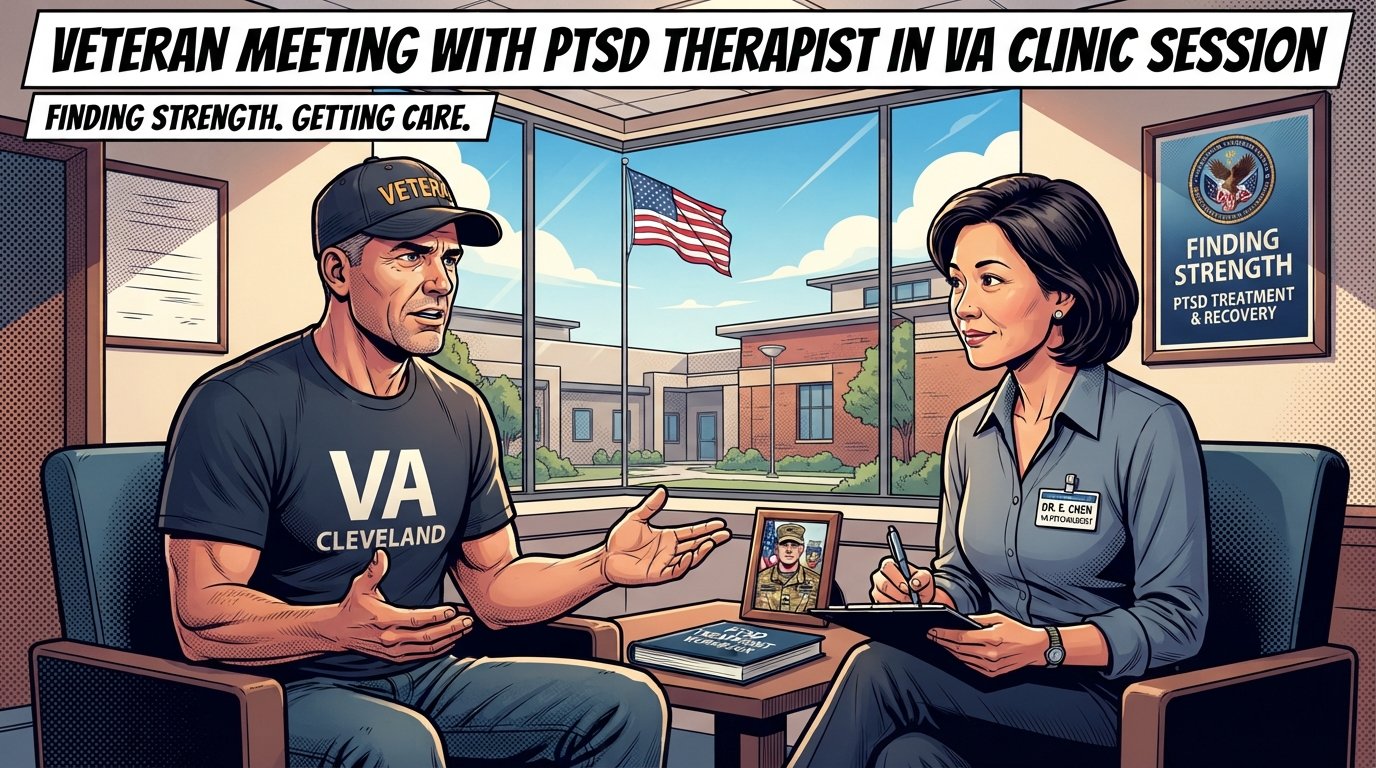
PTSD Therapy Near Me: Complete 2026 Guide for Veterans
PTSD therapy for veterans is available through VA medical centers, community-based outpatient clinics, Vet Centers, and VA Community Care Network providers. Evidence-based treatments include Cognitive Processing Therapy (CPT), Prolonged Exposure (PE), EMDR, and Written Exposure Therapy (WET). All enrolled veterans can access care. Call 988 (then press 1) for 24/7 crisis support.
Quick Facts
| Item | Details |
|---|---|
| Benefit | Evidence-based PTSD therapy at no cost to eligible veterans |
| Eligibility | Veterans with other-than-dishonorable discharge; combat veterans; MST survivors; National Guard/Reserve with federal deployment |
| Application | Contact VA medical center, CBOC, or Vet Center; self-referral allowed for mental health care |
| Processing Time | Initial assessment typically within days to 2 weeks; Community Care referral if VA cannot see you within 20 days |
| Official Agency | U.S. Department of Veterans Affairs (VA); Vet Centers through Readjustment Counseling Service |
| Required Forms | DD-214 for enrollment; no forms required for crisis services |
| Updated For | October 2026 |
What Is PTSD and Who Does It Affect?
Post-traumatic stress disorder (PTSD) is a mental health condition that develops after experiencing or witnessing a life-threatening or traumatic event. It affects veterans at higher rates than the general population, particularly those who served in combat zones.

PTSD can result from military experiences including combat exposure, IED explosions, military sexual trauma (MST), and witnessing comrades injured or killed. It can also develop from non-combat trauma that occurred before, during, or after military service.

What PTSD looks like:
Nightmares, flashbacks, or intrusive memories
Severe anxiety in public or crowded places
Avoiding people, places, or situations that trigger memories
Difficulty sleeping or concentrating
Feeling emotionally numb, guilty, or constantly on edge
Difficulty in jobs or relationships
PTSD is treatable. Many veterans see significant symptom reduction within 2–4 months of starting evidence-based treatment.
What veterans should do next: If symptoms have lasted longer than a few months, take a confidential self-screen at vetselfcheck.org or contact your nearest VA facility to schedule an assessment.
How to Find PTSD Therapy Near You
You can find PTSD therapy near you through four main pathways: VA medical centers, community-based outpatient clinics (CBOCs), Vet Centers, and VA Community Care Network providers. Each pathway offers different levels of care and access.
Pathway 1: VA Medical Centers
Veterans May Qualify for Extra Benefits
Check available financial assistance, healthcare programs and other opportunities that may apply to you.
Check EligibilityVA medical centers provide the full continuum of PTSD care, including outpatient therapy, intensive outpatient programs (IOP), and residential treatment. Most VA medical centers have a PTSD Clinical Team (PCT) that provides specialized, evidence-based treatment.
How to connect: Contact your VA primary care provider for a mental health referral, or self-refer to mental health care directly. You do not need a provider’s permission to start mental health care at VA.
Pathway 2: Community-Based Outpatient Clinics (CBOCs)
CBOCs are VA-operated clinics located in communities away from major medical centers. They provide outpatient mental health services, including PTSD therapy, closer to where veterans live. If your local CBOC cannot provide the specific PTSD treatment you need, you may qualify for a Community Care referral.
Pathway 3: Vet Centers
Vet Centers are community-based counseling centers operated through VA’s Readjustment Counseling Service. They provide confidential counseling, assessment, and referral services to any veteran who served in a war zone. Vet Centers serve veterans from conflicts including Somalia, Iraq, and Afghanistan, as well as Vietnam, Gulf War, and peacetime eras.
Key advantages of Vet Centers:
No fees or charges for services
Services are confidential — no information is shared with any person or agency (including VA) without your consent
Most staff are veterans themselves
Family members are also eligible for services for military-related issues
To find a Vet Center: Call 1-800-905-4675 (Eastern) or 1-866-496-8838 (Pacific). The Vet Center program also has a 24/7 hotline answered by combat veterans: 1-877-927-8387 (WAR-VETS).
Pathway 4: VA Community Care Network (CCN)
Under the VA MISSION Act, veterans who cannot receive timely care from VA can be referred to community providers in the VA Community Care Network. This includes private therapists and treatment programs that accept VA authorization.
You may qualify for Community Care if:
VA cannot provide the needed service within 20 days
Your commute to the nearest VA facility exceeds 30 minutes
VA does not offer the specific treatment you need at your local facility
How to request Community Care: Ask your VA primary care provider or mental health provider for a referral. The referral is processed through the HealthShare Referral Manager system.
| Care Pathway | Best For | Cost | Appointment Speed |
|---|---|---|---|
| VA Medical Center | Full continuum of care including residential | $0 | Varies; usually 1–2 weeks |
| CBOC | Outpatient therapy close to home | $0 | Varies by location |
| Vet Center | Confidential counseling; no VA enrollment required | $0 | Often within days |
| Community Care (CCN) | When VA wait exceeds 20 days or drive exceeds 30 min | $0 with authorization | Within days after authorization |
Evidence-Based PTSD Therapies for Veterans
The VA and Department of Defense recommend four core trauma-focused psychotherapies for PTSD. These treatments have the strongest research support and are available at most VA facilities.
Cognitive Processing Therapy (CPT)
CPT teaches veterans to change upsetting thoughts and feelings related to trauma. You learn to identify and challenge unhelpful beliefs — such as “It was my fault” or “I can’t trust anyone” — that developed after the traumatic event.
Format: Weekly sessions of 50–60 minutes, typically 12 weeks. Written assignments are part of the treatment.
Best for: Veterans struggling with guilt, shame, or negative beliefs about themselves or the world.
Prolonged Exposure (PE)
PE helps veterans gradually face and get used to trauma-related memories and situations they have been avoiding. By approaching these memories in a safe, controlled way, the brain learns that the trauma is in the past and no longer dangerous.
Format: 90-minute sessions each week for 9–12 weeks, with weekly homework assignments.
Best for: Veterans who avoid crowded places, activities, or situations that trigger trauma memories.
Eye Movement Desensitization and Reprocessing (EMDR)
EMDR helps veterans process and make sense of trauma while paying attention to a back-and-forth movement or sound — such as a therapist’s finger moving side to side, a light, or a tone. EMDR adapts to the brain’s natural healing process.
Format: Sessions vary; typically 8–12 sessions.
Best for: Veterans with multiple traumas. EMDR is often preferred when there are several traumatic events to process.
Written Exposure Therapy (WET)
WET is a shorter treatment that uses writing exercises led by a therapist to reduce PTSD symptoms. It requires fewer sessions and less homework than CPT or PE.
Format: 5–7 sessions.
Best for: Veterans who want a quicker option with fewer between-session assignments.
Comparison of Core PTSD Therapies
| Therapy | Duration | Session Length | Key Technique | Best For |
|---|---|---|---|---|
| CPT | 12 weeks | 50–60 min | Changing unhelpful thoughts | Guilt, shame, negative beliefs |
| PE | 9–12 weeks | 90 min | Gradual exposure to trauma memories | Avoidance behaviors |
| EMDR | 8–12 sessions | Varies | Bilateral stimulation during processing | Multiple traumas |
| WET | 5–7 sessions | Varies | Structured writing exercises | Quicker treatment option |
How to choose: The National Center for PTSD offers a PTSD Decision Aid tool at ptsd.va.gov/apps/decisionaid/ to help veterans explore which evidence-based treatment fits their needs and preferences.
VA Residential PTSD Treatment Programs
For veterans with severe PTSD or those who have not responded to standard outpatient treatment, VA operates residential rehabilitation treatment programs (RRTPs). These programs provide 24/7 care in a structured environment.
What Residential Treatment Offers
VA residential PTSD programs provide comprehensive treatment and rehabilitation services, including:
Individual and group therapy
Evidence-based PTSD treatments (CPT, PE, EMDR)
Medication management
Substance use treatment (for co-occurring conditions)
Coping skills training
Whole Health approaches (yoga, acupuncture, recreation therapy)
Family involvement when appropriate
Program Details
| Feature | Details |
|---|---|
| Number of programs | 250+ programs at approximately 120 sites |
| Total beds | 6,500+ across VA |
| Typical duration | 6–7 weeks |
| Admission | Priority admissions within 48 hours; non-priority within 20 days |
| Care settings | VA facilities or community-based programs |
Source: VA FY 2026 budget documents.
Who Residential Treatment Is For
Residential PTSD programs are designed for veterans who:
Experience PTSD symptoms that disrupt daily life
Have not improved with outpatient treatment
Need a structured, supportive environment for recovery
May have co-occurring conditions like depression or substance use
Examples of VA residential PTSD programs:
Stress Disorder Treatment Unit (SDTU): A therapeutic community for veterans with combat-related PTSD
Ascend PTSD Program: A 6-week residential program with 20 beds
Trauma Recovery Program (TRP): An outpatient PTSD program following intake evaluation
What to do next: Ask your VA mental health provider about residential treatment options. If VA cannot provide residential treatment within the access standards, you may qualify for Community Care.
PTSD Therapy for Active Duty and TRICARE Beneficiaries
Active duty service members and TRICARE beneficiaries have access to PTSD therapy through military treatment facilities (MTFs), TRICARE network providers, and specialized programs.
TRICARE Mental Health Coverage
TRICARE covers medically and psychologically necessary mental health and substance use care, including both inpatient and outpatient treatment. As of 2026, many services like office-based outpatient therapy do not require pre-authorization for TRICARE Select users.
Coverage includes:
Individual therapy for PTSD
Group therapy
Psychiatric evaluations
Intensive Outpatient Programs (IOP)
Partial Hospitalization Programs (PHP)
Residential treatment
Costs for TRICARE Beneficiaries
| Beneficiary Category | Outpatient Therapy Copay | Inpatient Care |
|---|---|---|
| Active Duty | $0 | $0 |
| Active Duty Family (Prime) | $0 | $0 |
| Retirees (Prime) | $12–$16 | Varies |
| Retirees (Select) | $33–$39 | Varies |
Note: The Brandon Act (2026) improved the process for service members to seek mental health evaluations without fear of retaliation.
Stress Disorder Treatment Unit for Active Duty
The Stress Disorder Treatment Unit (SDTU) is a therapeutic community for active duty service members experiencing symptoms of combat-related PTSD. Active duty members with PTSD symptoms are admitted directly to the SDTU unless other medical or psychiatric problems require prior attention.
How to Start PTSD Therapy: Step-by-Step
Starting PTSD therapy is simpler than many veterans expect. You do not need to wait for a referral or a crisis to begin.
Step 1: Determine Your Eligibility
Most veterans qualify for VA health care. Factors include:
Completed active military service in the Army, Navy, Air Force, Marines, or Coast Guard
Discharged under other than dishonorable conditions
National Guard or Reservist who completed a federal deployment to a combat zone
Important: Health care eligibility is not just for those who served in combat. VA health care is not just for service-connected injuries or conditions.
Step 2: Contact Your Nearest VA Facility
Call your local VA medical center or CBOC and ask to schedule a mental health assessment. You can self-refer to mental health care — you do not need your primary care provider’s permission.
Step 3: Complete an Initial Assessment
The first appointment is a consultative interview that helps the treatment team understand your trauma-related difficulties. At some facilities, this interview lasts about 2 hours. Appointments are encouraged but not always required.
Step 4: Get Matched with a Treatment Plan
After the assessment, you’ll be referred to the appropriate level of care. This may include a PTSD Clinical Team, general mental health clinic, or a specialized program.
Step 5: Begin Treatment
Most veterans referred to PTSD specialty care engage in treatment for 2–4 months. Many complete their treatment and discharge from mental health services. Others may need additional services to address co-occurring conditions.
If You Are Not Enrolled in VA Health Care
If you have not yet enrolled in VA health care, complete VA Form 10-10EZ online at VA.gov or call 1-877-222-8387. Bring your DD-214 if available. Even without a DD-214, VA enrollment staff can assist you.
Common Mistakes Veterans Make When Seeking PTSD Therapy
Waiting for a crisis to seek help. PTSD therapy is most effective when started early. You do not need to be in crisis to get care.
Thinking therapy means you are weak. About 90% of veterans on one VA psychologist’s team now choose virtual sessions, and demand for care continues to grow. Asking for help is a sign of strength.
Not knowing self-referral is allowed. You do not need your primary care provider’s permission to start mental health care at VA.
Assuming you are not eligible because you did not serve in combat. VA health care eligibility is not limited to combat veterans. PTSD can develop from any trauma.
Ignoring co-occurring conditions. PTSD often occurs alongside depression, anxiety, or substance use. Addressing all conditions together improves outcomes.
Not asking about Community Care. If VA cannot see you within 20 days or your commute exceeds 30 minutes, you have the right to request a referral to a community provider.
Overlooking Vet Centers. Vet Centers provide confidential counseling with no fees, and most staff are veterans themselves. No VA enrollment is required.
Stopping treatment too early. Most evidence-based PTSD treatments require 5–12 sessions. Many veterans see significant improvement by session 6, but completing the full course produces better long-term results.
Not bringing your DD-214. For enrollment, your DD-214 speeds up the process. If you cannot locate it, VA Enrollment can still assist you.
Forgetting about virtual care. About 90% of veterans on one VA team now choose virtual sessions. Telehealth removes barriers like transportation and work conflicts.
Common Questions
1. How do I find PTSD therapy near me as a veteran?
Contact your nearest VA medical center, community-based outpatient clinic (CBOC), or Vet Center. You can self-refer to mental health care without a primary care referral. If VA cannot see you within 20 days or your commute exceeds 30 minutes, you may qualify for Community Care through the MISSION Act.
2. What PTSD therapies are available for veterans?
VA offers four core evidence-based therapies: Cognitive Processing Therapy (CPT), Prolonged Exposure (PE), Eye Movement Desensitization and Reprocessing (EMDR), and Written Exposure Therapy (WET). Additional options include CBT-I for insomnia, ACT, DBT, and Whole Health approaches like yoga and acupuncture.
3. Do I need to be enrolled in VA health care to get PTSD therapy?
For VA medical centers and CBOCs, yes — you must be enrolled in VA health care. However, Vet Centers provide confidential counseling to any veteran who served in a war zone, regardless of VA enrollment status. Crisis services are available to all veterans.
4. How long does PTSD therapy take?
CPT typically takes 12 weeks. PE takes 9–12 weeks. EMDR takes 8–12 sessions. WET takes 5–7 sessions. Most veterans referred to PTSD specialty care engage in treatment for 2–4 months and many discharge from mental health services after completing treatment.
5. What is the Veterans Crisis Line?
The Veterans Crisis Line provides 24/7 confidential support for veterans in crisis. Dial 988 then press 1, chat online at VeteransCrisisLine.net/Chat, or text 838255. You do not need to be enrolled in VA benefits or health care to connect.
6. What is a Vet Center?
Vet Centers are community-based counseling centers operated through VA’s Readjustment Counseling Service. They provide confidential counseling, assessment, and referral to any veteran who served in a war zone. Services are free, and most staff are veterans themselves.
7. Can I get PTSD therapy through Community Care?
Yes, under the MISSION Act. You may qualify if VA cannot provide the needed service within 20 days or if your commute to the nearest VA facility exceeds 30 minutes. Ask your VA provider for a referral to a community provider.
8. Does TRICARE cover PTSD therapy for active duty and families?
Yes. TRICARE covers medically and psychologically necessary mental health care, including individual therapy, group therapy, IOP, PHP, and residential treatment. As of 2026, many outpatient therapy services do not require pre-authorization for TRICARE Select users.
9. What is residential PTSD treatment?
Residential treatment provides 24/7 care in a structured environment for veterans with severe PTSD or those who have not improved with outpatient therapy. VA operates 250+ residential programs with 6,500+ beds. Typical duration is 6–7 weeks.
10. What is the PTSD Decision Aid?
The PTSD Decision Aid is a tool created by the National Center for PTSD to help veterans explore which evidence-based treatment option fits their needs and preferences. It is available at ptsd.va.gov/apps/decisionaid/.
11. Can women veterans get PTSD therapy?
Yes. VA offers full-service health care to women veterans, including PTSD therapy. Residential programs serve veterans of all genders, and VA has made efforts to ensure inclusivity in care settings.
12. What should I do if I am in a crisis right now?
Call 988 and press 1, text 838255, or chat online at VeteransCrisisLine.net/Chat. You can also go to any community emergency room — VA covers emergency care under the COMPACT Act for veterans in suicidal crisis.
Key Takeaways
VA offers four core evidence-based PTSD therapies: CPT, PE, EMDR, and WET. All are available at most VA facilities at no cost to eligible veterans.
Four ways to find therapy: VA medical centers, CBOCs, Vet Centers, and Community Care Network providers.
Self-referral is allowed. You do not need your primary care provider’s permission to start mental health care at VA.
Vet Centers provide confidential counseling to any veteran who served in a war zone, with no fees and no VA enrollment required.
Community Care is available under the MISSION Act if VA cannot see you within 20 days or your commute exceeds 30 minutes.
Residential treatment is available for severe PTSD through 250+ VA programs with 6,500+ beds nationwide. Typical duration is 6–7 weeks.
TRICARE covers PTSD therapy for active duty, retirees, and families. Active duty and Prime family members typically pay $0.
Virtual care is widely available. About 90% of veterans on one VA PTSD team choose telehealth sessions.
The Veterans Crisis Line is available 24/7. Dial 988 then press 1, text 838255, or chat online.
PTSD is treatable. Most veterans referred to PTSD specialty care engage in treatment for 2–4 months, and many discharge from services after completing treatment.
Official Resources
VA PTSD Treatment: VA.gov/health-care/health-needs-conditions/mental-health/ptsd
National Center for PTSD: ptsd.va.gov
PTSD Decision Aid Tool: ptsd.va.gov/apps/decisionaid
VA Mental Health Services: VA.gov/health-care/health-needs-conditions/mental-health
Find a Vet Center: VA.gov/find-locations
VA Community Care: VA.gov/communitycare
TRICARE Mental Health: tricare.mil/mentalhealth
Veterans Crisis Line: Dial 988, then press 1 | Text 838255 | VeteransCrisisLine.net
VA Health Care Enrollment (10-10EZ): VA.gov/health-care/apply
SAMHSA Veterans Resources: samhsa.gov/find-support/how-to-cope/veterans




🇺🇸 IMPORTANT DISCLAIMER – Veterans Benefits Information
This site provides general information about U.S. Department of Veterans Affairs (VA) benefits for educational and informational purposes only.
- Not Official: We are NOT affiliated with, endorsed by, or connected to the U.S. Department of Veterans Affairs (VA), the Veterans Benefits Administration (VBA), the Veterans Health Administration (VHA), or any other government agency.
- No Legal/Financial Advice: The content on this website is for informational purposes only and does not constitute legal, financial, or medical advice. VA benefits rules change frequently – always consult with an accredited Veterans Service Officer (VSO) or a qualified professional for your specific situation.
- Official Sources: For official, binding information and to apply for benefits, always visit official .gov websites: VA.gov, Benefits.VA.gov, or SSA.gov.
- No Data Collection: This site does not collect, store, or process any personal information. It does not have login forms, contact forms, or any system to capture user data. We never ask for your Social Security Number, bank details, or any personal information.
- 🚨 Scam Alert: The VA and other government agencies never charge fees for benefit applications. If anyone asks for money to "process" your VA claim, it is a scam. Report it to the VA Office of Inspector General at VA.gov/OIG.
- Advertising: This site uses third-party advertising (Adsterra) to cover operational costs. We do not endorse or guarantee any products or services advertised.
📌 Information provided as of June 2026. Always verify current eligibility and rules with official .gov sources.
This site is not affiliated with the U.S. Department of Veterans Affairs or any government agency. All information is for educational purposes only. Please visit VA.gov for official information.
