
Veterans Home Loans in Texas: The Complete 2026 Guide
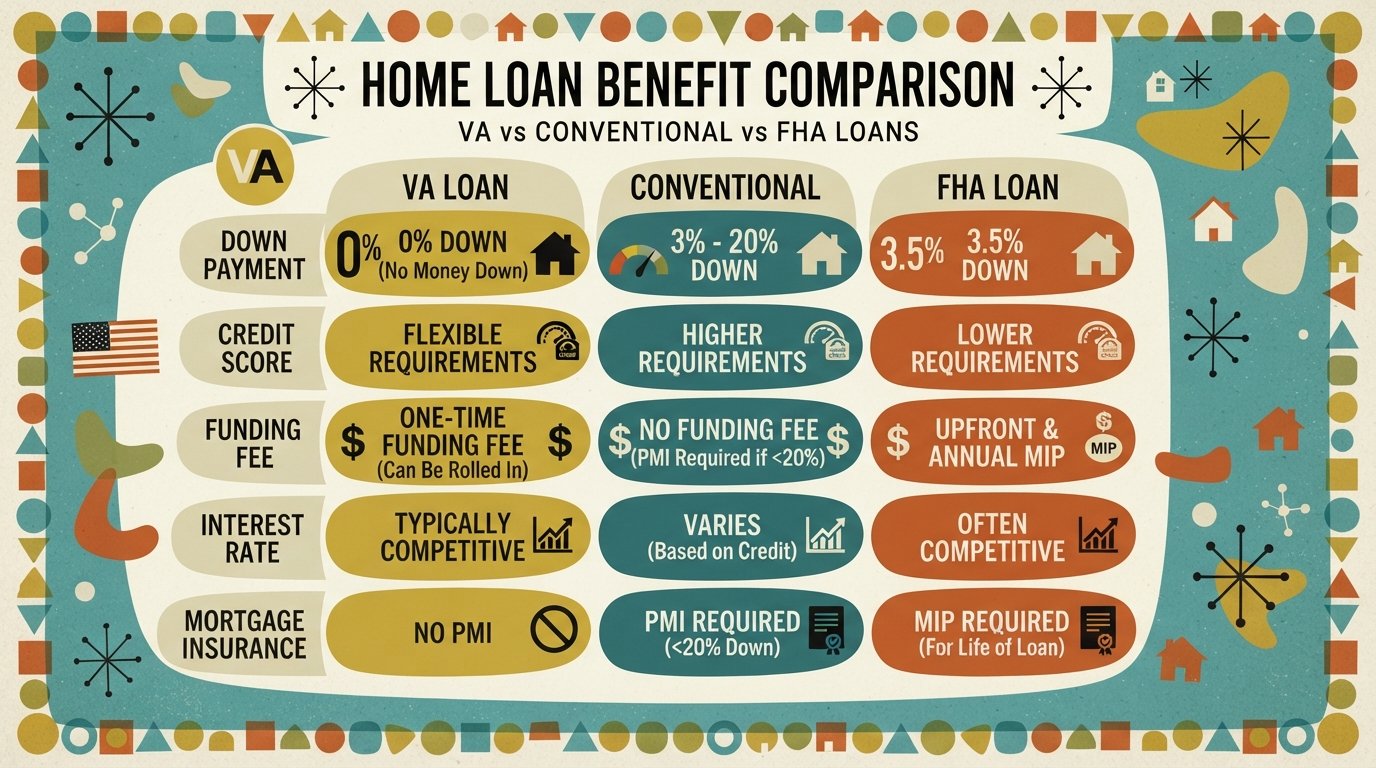
VA home loans in Texas let eligible veterans, active-duty members, and surviving spouses buy a primary residence with $0 down payment and no monthly private mortgage insurance. Veterans with full entitlement have no VA-imposed loan limit. Texas also offers a state rate subsidy through the Veterans Land Board that can reduce your interest rate by 0.25%–0.50%.
Quick Facts
| Item | Details |
|---|---|
| Benefit | $0 down payment, no PMI, competitive interest rates, no VA loan limit for full entitlement |
| Eligibility | Veterans, active duty, National Guard, Reservists, surviving spouses with qualifying service |
| Application | Obtain COE (VA Form 26-1880 or lender electronic pull); apply with VA-approved lender |
| Processing Time | 30–45 days from contract to closing |
| Official Agency | U.S. Department of Veterans Affairs (VA); Texas Veterans Land Board (VLB) |
| Required Forms | COE, DD-214, VA Form 26-1880 (if not electronically pulled) |
| Updated For | 2026 |
What Is a VA Home Loan?
A VA home loan is a mortgage made by a private lender and partially guaranteed by the U.S. Department of Veterans Affairs. The VA guaranty protects the lender against part of the loss if the borrower defaults, which allows lenders to offer better terms than conventional loans. The benefit is available to eligible veterans, active-duty service members, National Guard and Reserve members, and certain surviving spouses. In Texas, VA loans can be combined with the Texas Veterans Land Board rate subsidy program for even lower rates.

Why it matters: VA loans consistently offer the lowest total monthly payment of any mortgage product. With $0 down, no PMI, and rates typically 0.25%–0.50% below conventional rates, VA loans save Texas veterans thousands of dollars over the life of the loan. On a $425,000 Dallas home, skipping PMI alone saves about $195 per month—more than $23,000 over 10 years.

What veterans should do next: Obtain your Certificate of Eligibility (COE) through your lender or the VA, then get pre-approved with a VA-experienced lender.
VA Loan Limits in Texas for 2026
Veterans with full entitlement have no VA-imposed loan limit. The 2026 conforming reference limit for partial-entitlement borrowers is $832,750 in all Texas counties for a one-unit property. Texas has no high-cost counties above the standard limit.
Loan Limits by Property Type (2026)
| Property Type | Conforming Reference Limit |
|---|---|
| 1-unit | $832,750 |
| 2-unit | $1,066,250 |
| 3-unit | $1,288,800 |
| 4-unit | $1,601,750 |
Full entitlement: If you have never used a VA loan, or you sold and paid off a prior VA loan, you have full entitlement. No VA-imposed limit applies. A lender will evaluate your credit, income, and the property appraisal to determine how much you can borrow.
Partial entitlement: If you have an active VA loan or had a foreclosure on a prior VA loan, you have partial entitlement. In that case, the county conforming limit determines how much you can borrow with $0 down. To borrow above that limit, you need a down payment equal to 25% of the overage.
Veterans May Qualify for Extra Benefits
Check available financial assistance, healthcare programs and other opportunities that may apply to you.
Check EligibilityWhat veterans should do next: Confirm your entitlement status with your lender early. Most lenders can pull your COE electronically during pre-approval.
Who Qualifies for a VA Home Loan in Texas?
You qualify for a VA home loan in Texas if you meet specific service history requirements and have an honorable discharge. The VA loan program is available to veterans, active-duty service members, National Guard and Reserve members, and certain surviving spouses.
Eligible Groups
Active-duty service members: 90 continuous days during wartime or 181 days during peacetime.
Veterans: Same service requirements as active duty, with an honorable discharge.
National Guard and Reservists: 6 years of service in the Selected Reserve or National Guard, or 90 days of active-duty service under Title 10.
Surviving spouses: May qualify if the veteran died in service or from a service-connected disability, with specific remarriage rules.
Certain public uniformed service members: Public Health Service (PHS) and NOAA Commissioned Corps.
Key Eligibility Rules
You must have a valid Certificate of Eligibility (COE).
The property must be your primary residence; you must intend to occupy it within 60 days of closing.
You must meet the lender’s credit, income, and residual income requirements.
The property must meet VA Minimum Property Requirements (MPRs).
What veterans should do next: If you are unsure about your eligibility, contact the VA at 1-800-827-1000 or use the VA’s online COE application.
National Guard and Reserve Eligibility in Texas
National Guard and Reserve members qualify for the same VA loan benefits as active-duty veterans after meeting a minimum service threshold. You generally qualify after 90 days of active-duty service under Title 10, or after 6 creditable years in the Selected Reserve or National Guard.
Qualifying Service Paths
| Service Category | Requirement |
|---|---|
| Active duty | 90 continuous days (wartime) or 181 days (peacetime) |
| National Guard/Reserve | 6 years in Selected Reserve/Guard, OR 90 days Title 10 active duty |
| Surviving spouse | Qualifies under federal VA rules |
Important distinction: “Active duty for training” does not count toward VA loan eligibility for Guard and Reserve members. Only active-duty service under Title 10 or qualifying Selected Reserve service counts.
What veterans should do next: Request your DD-214 or, for Guard/Reserve, your NGB Form 22 or equivalent service records. Use these to apply for your COE through your lender or the VA.
Surviving Spouse VA Loan Eligibility in Texas
An eligible surviving spouse can use the VA home loan benefit to buy or refinance a primary residence in Texas. Eligibility is based on federal VA rules rather than Texas residency alone.
Qualifying Paths for Surviving Spouses
Veteran died while in service: The surviving spouse must meet applicable marital-status rules.
Veteran died from a service-connected disability: Often connected to a Dependency and Indemnity Compensation (DIC) award.
Certain veterans who were totally disabled before death: Depends on specific statutory survivor-benefit criteria.
Spouse of a service member MIA or POW: A closely related eligibility category.
Remarriage Rules
A surviving spouse who remarried may still qualify for VA loan benefits if they remarried on or after age 57 and on or after December 16, 2003. For surviving spouses receiving DIC, remarriage after age 57 also preserves eligibility.
Funding fee exemption: A surviving spouse of a veteran who died on active service or later from service-connected causes is exempt from paying the VA funding fee.
What surviving spouses should do next: Apply for your COE through the VA using VA Form 26-1880, or ask your lender to pull it electronically. You will need the veteran’s DD-214, marriage certificate, and death certificate or DIC documentation.
Texas Veterans Land Board (VLB) Rate Subsidy
The Texas Veterans Land Board (VLB) offers a rate subsidy program that reduces the interest rate on a standard VA-guaranteed loan by approximately 0.25%–0.50%. This is not a separate loan type; it is a rate reduction applied to a VA loan through VLB-participating lenders.
How the Texas Vet Rate Subsidy Works
| Feature | Details |
|---|---|
| Rate reduction | 0.25%–0.50% below standard VA market rate |
| 30-year savings | $35,000–$50,000 on a typical Texas purchase |
| Eligibility | Texas resident, remaining VA entitlement, no prior Texas Vet loan use |
| Additional discount | Veterans with 30%+ service-connected disability may qualify for extra rate discount |
| How to access | Work with a VLB-participating lender |
| Not all lenders participate | Confirm your lender offers the Texas Vet rate |
Important: The VLB home improvement loan program is on a temporary moratorium effective April 30, 2026. The home loan rate subsidy program remains active.
What veterans should do next: Ask your VA lender if they participate in the Texas Veterans Land Board program. If not, contact the VLB directly for a list of participating lenders.
VA Funding Fee: Rates and Exemptions
The VA funding fee is a one-time payment on VA-guaranteed loans used to buy, build, improve, or refinance a home. The fee ranges from 0.5% to 3.3% depending on the loan type, down payment amount, and whether you are a first-time or subsequent user.
VA Funding Fee Rates for 2026
| Loan Use | Down Payment | Funding Fee |
|---|---|---|
| First use | Less than 5% | 2.15% |
| First use | 5% or more | 1.5% |
| First use | 10% or more | 1.25% |
| After first use | Less than 5% | 3.3% |
| After first use | 5% or more | 1.5% |
| After first use | 10% or more | 1.25% |
| IRRRL (refinance) | N/A | 0.5% |
| Cash-out refinance | N/A | 2.15% (first use) / 3.3% (after first use) |
Who Is Exempt from the VA Funding Fee
You are exempt from the VA funding fee if any of the following apply:
You are receiving VA compensation for a service-connected disability (any rating, including 10%)
You are eligible for VA compensation but receiving retirement or active-duty pay instead
You are receiving certain Dependency and Indemnity Compensation (DIC)
You are a service member with a proposed or memorandum rating before closing for a pre-discharge claim
You are currently serving on active duty and received a Purple Heart on or before the loan closing date
You are a surviving spouse of a veteran who died on active service or later from service-connected causes
Tax deduction: The VA funding fee is now tax-deductible.
What veterans should do next: If you have a service-connected disability rating of 10% or higher, confirm your exemption with your lender before closing. You will need to provide your VA disability benefits letter.
How to Apply for a VA Home Loan in Texas
Applying for a VA home loan in Texas involves several steps. The process begins with your Certificate of Eligibility and ends with closing on your new home.
Step 1: Obtain Your Certificate of Eligibility (COE)
The COE proves to your lender that you qualify for the VA loan benefit. Most lenders can pull your COE electronically during pre-approval, which is usually faster than applying through the VA directly.
To apply for your COE:
Online: Use the VA’s COE application portal
By mail: Submit VA Form 26-1880 with your DD-214
Through your lender: Most VA-approved lenders can obtain your COE electronically
Step 2: Get Pre-Approved with a VA-Approved Lender
Work with a lender experienced in VA loans. Not all lenders offer the same rates or fees. Shopping around can save thousands over the life of the loan.
Documents you will need:
COE
DD-214 or service records
Recent pay stubs or income documentation
Bank statements
Tax returns
Photo ID
Step 3: Find a VA-Eligible Home in Texas
The property must meet VA Minimum Property Requirements (MPRs) for safety, soundness, and sanitation. In Texas, common MPR issues include foundation conditions (due to clay soils), roof condition, and peeling paint on older homes.
Step 4: Submit Your Purchase Offer
Your real estate agent will submit an offer on your behalf. VA loans are not inherently harder to close than conventional loans. Timeline issues are usually documentation, appraisal scheduling, or repair negotiation problems—not “VA problems.”
Step 5: Complete the VA Appraisal and Underwriting
The VA appraisal is ordered by your lender and typically takes 7–14 days. Underwriting takes 5–10 days after the appraisal is received.
Step 6: Close on Your Home
Once you have clear to close, you will sign the final paperwork. The funding fee (if applicable) can be paid out-of-pocket or rolled into the loan.
Typical Texas VA Loan Timeline
| Stage | Timeframe |
|---|---|
| Pre-approval | 1–3 days |
| House hunting | 1 week to several months |
| Under contract & loan setup | 2–5 days |
| VA appraisal | 7–14 days |
| Underwriting | 5–10 days |
| Clear to close & final closing | 3–7 days |
What veterans should do next: Start with your COE and pre-approval. Get your documents organized early to avoid delays.
Texas-Specific Benefits for Veteran Homebuyers
Texas offers several benefits that can be stacked with a VA loan to reduce your total cost of homeownership.
Texas Property Tax Exemption for Disabled Veterans
Veterans with a 100% VA disability rating or Individual Unemployability (TDIU) receive a full homestead exemption from property taxes in Texas. This means zero property taxes on your primary residence, regardless of home value. Veterans with ratings of 10%–99% receive partial exemptions ranging from $5,000 to $12,000.
Why it matters: The combination of a VA loan (no PMI, $0 down) and the 100% property tax exemption creates an extremely low monthly housing cost for disabled veterans in Texas.
Texas Veterans Land Board Programs
The VLB offers several programs beyond the rate subsidy, including land loans (5% minimum down), home improvement loans (currently on moratorium), and home loans through participating lenders.
HAVEN Grant Program
The Federal Home Loan Bank of Dallas offers Housing Assistance for Veterans (HAVEN) grants for home modifications, new construction, or down payment assistance. FHLB Dallas allocated $1 million for HAVEN grants in 2026.
Texas Veterans Commission Fund for Veterans’ Assistance
The TVC Fund for Veterans’ Assistance provides grants for mortgage payments and payments in arrears, not to exceed a 6-month period or $6,000 per beneficiary household per grant period.
Common Mistakes to Avoid
1. Not shopping around for lenders. Accepting the first loan offer can cost you thousands. Fee differences of $10,000–$20,000 are common between VA lenders. Shop at least three lenders.
2. Assuming your disability exemption is automatic. Lenders will not automatically waive the funding fee. You must provide documentation of your VA disability rating. Confirm the exemption before closing.
3. Misunderstanding occupancy rules. You must certify in good faith that you intend to occupy the home as your primary residence within 60 days of closing. Misrepresenting your intent is occupancy fraud and can trigger loan acceleration and legal exposure.
4. Not understanding residual income requirements. Most surprise VA denials trace to residual income, not credit score. Childcare costs, car payments, and family size move the number more than veterans expect.
5. Ignoring Texas-specific appraisal issues. Texas clay soils and weather lead to common VA appraisal conditions. Foundation and roof issues are frequent VA flag points.
6. Assuming VA loans are harder to close. VA loans can close on a normal timeline when the file is solid and the lender is experienced. The issue is presentation and preparation, not the loan type.
7. Not exploring the Texas Vet rate subsidy. Not all VA lenders participate in the VLB program. If your lender does not offer it, you could be leaving money on the table.
8. Draining savings for upfront costs. VA loans require $0 down, but you still need cash reserves for closing costs, moving expenses, and emergencies.
9. Not getting your COE early. COE delays or eligibility assumptions can slow your loan process. Most lenders can pull it electronically, but allow time if your records are not in VA systems.
10. Assuming you cannot rent out a room or part of the home. VA occupancy rules allow some flexibility, but you must occupy the property as your primary residence. Rental income from a portion of the home may be considered.
Latest Rule Changes for 2026
VA Home Loan Program Reform Act (2025)
The VA Home Loan Program Reform Act was signed into law in July 2025 to provide a safety net for veteran borrowers. The program was still non-operational as of May 2026.
VA Funding Fee Now Tax-Deductible
As of February 2026, the VA funding fee is tax-deductible. This reduces the effective cost of the funding fee for borrowers who pay it.
Increased Conforming Loan Limits
The 2026 conforming loan limit for all Texas counties increased to $832,750, up from $806,500 in 2025—a 3.3% increase.
Proposed Increase to Refinance Fees
Legislation proposed in 2026 would increase VA home loan refinancing fees by $4 billion, nearly tripling fees from 0.5% to 1.42%. For a South Texas veteran refinancing a $250,000 mortgage, the fee would rise from about $1,250 to $3,550. This proposal has not been enacted.
VLB Home Improvement Loan Moratorium
The VLB Home Improvement Loan program is on a temporary moratorium effective April 30, 2026. The VLB home loan and land loan programs remain active.
What veterans should do next: Monitor the VA’s website for updates on program changes. If you are considering a refinance, act before any fee increases take effect.
Common Questions
1. Do VA loans in Texas require a down payment?
No. Veterans with full entitlement can purchase a home with $0 down payment. The VA does not require a down payment. However, if you buy above the conforming limit and have partial entitlement, you may need a down payment on the overage.
2. What is the VA loan limit in Texas for 2026?
Veterans with full entitlement have no VA-imposed loan limit. The 2026 conforming reference limit for partial-entitlement borrowers is $832,750 for a one-unit property in all Texas counties. Texas has no high-cost counties above that limit.
3. Who qualifies for a VA loan in Texas?
Veterans, active-duty service members, National Guard and Reserve members (after 6 years or 90 days of Title 10 active duty), and certain surviving spouses. You must have an honorable discharge and meet the VA’s service history requirements.
4. What is the VA funding fee in 2026?
The VA funding fee is 2.15% for first-use purchases with less than 5% down, and 3.3% for subsequent uses. The fee is reduced with larger down payments (1.5% at 5% down, 1.25% at 10% down) and is waived entirely for veterans with a service-connected disability rating of 10% or higher.
5. How do I get a Certificate of Eligibility (COE)?
Most lenders can pull your COE electronically during pre-approval. You can also apply through the VA’s online portal, by mail using VA Form 26-1880, or through your lender. You will need your DD-214 or service records.
6. Does Texas have a special VA loan program?
Yes. The Texas Veterans Land Board (VLB) offers a rate subsidy that reduces the interest rate on a VA loan by 0.25%–0.50%. This is a state benefit applied on top of the federal VA guarantee. You must work with a VLB-participating lender.
7. Can surviving spouses get a VA loan in Texas?
Yes. An eligible surviving spouse can use the VA home loan benefit if the veteran died in service or from a service-connected disability. Remarriage rules apply: a surviving spouse who remarried on or after age 57 and on or after December 16, 2003, may still qualify.
8. Do VA loans require PMI in Texas?
No. VA loans never require private mortgage insurance (PMI) or mortgage insurance premium (MIP). This saves borrowers hundreds of dollars per month compared to FHA loans.
9. What is the Texas Vet rate subsidy?
The Texas Vet rate subsidy is a state program through the Veterans Land Board that reduces the interest rate on a VA loan by approximately 0.25%–0.50%. Over 30 years, this can save $35,000–$50,000. Veterans with a 30%+ service-connected disability may qualify for an additional rate discount.
10. How long does it take to close a VA loan in Texas?
A typical VA loan closes in 30–45 days from contract to closing. The VA appraisal takes 7–14 days, and underwriting takes 5–10 days after the appraisal. Pre-approval takes 1–3 days.
11. Can I use a VA loan to buy a duplex or multi-unit property in Texas?
Yes. VA loans can be used to purchase properties with up to four units, provided you occupy one unit as your primary residence. The loan limits for multi-unit properties are higher: $1,066,250 for 2 units, $1,288,800 for 3 units, and $1,601,750 for 4 units.
12. What are VA Minimum Property Requirements (MPRs) in Texas?
VA MPRs ensure the property is safe, sound, and sanitary. In Texas, common MPR issues include foundation conditions (clay soils), roof condition, and peeling paint on older homes. The VA appraisal will identify any required repairs.
13. Can I rent out my VA-financed home in Texas?
You must occupy the home as your primary residence within 60 days of closing. After you have established occupancy, VA rules allow some flexibility, but you must maintain the home as your primary residence. Renting out a room or portion of the home may be allowed.
14. What happens if I have a VA loan and want to buy another home in Texas?
If you still have your first VA loan, you may have partial entitlement. You can use your remaining entitlement to buy another home, but you may need a down payment if the purchase exceeds your remaining entitlement. Alternatively, you can pay off the first VA loan to restore full entitlement.
15. Is the VA funding fee tax-deductible?
Yes. As of February 2026, the VA funding fee is tax-deductible. Consult your tax advisor for specific guidance on your situation.
Key Takeaways
VA loans in Texas offer $0 down payment and no monthly PMI for eligible veterans, active-duty members, and surviving spouses.
Full entitlement means no VA-imposed loan limit. The 2026 conforming reference limit for partial entitlement is $832,750 in all Texas counties.
The Texas Veterans Land Board (VLB) offers a rate subsidy of 0.25%–0.50% below standard VA rates, saving $35,000–$50,000 over 30 years.
The VA funding fee is 2.15% for first use (less than 5% down) and 3.3% for subsequent uses. Veterans with a 10%+ disability rating are exempt.
National Guard and Reserve members qualify after 6 years of service or 90 days of Title 10 active duty.
Surviving spouses may qualify if the veteran died in service or from a service-connected disability, with specific remarriage rules.
VA loans never require PMI or MIP, saving hundreds per month compared to FHA loans.
Common mistakes include not shopping for lenders, misunderstanding occupancy rules, and missing the funding fee exemption.
**The 2026 conforming loan limit increased to $832,750** for all Texas counties, up from $806,500 in 2025.
The VA funding fee is now tax-deductible, reducing the effective cost for borrowers who pay it.
Official Resources
U.S. Department of Veterans Affairs – VA Home Loans: www.va.gov/housing-assistance/home-loans/
VA Certificate of Eligibility: www.va.gov/housing-assistance/home-loans/how-to-request-coe/
VA Funding Fee and Closing Costs: www.va.gov/housing-assistance/home-loans/funding-fee-and-closing-costs/
VA Minimum Property Requirements: www.va.gov/housing-assistance/home-loans/loan-approval/
Texas Veterans Land Board: www.glo.texas.gov/vlb
Texas Veterans Commission: www.tvc.texas.gov
Texas Veterans Portal: www.texas.gov/veterans
Federal Home Loan Bank of Dallas HAVEN Grants: www.fhlb.com
U.S. Department of Veterans Affairs: www.va.gov


🇺🇸 IMPORTANT DISCLAIMER – Veterans Benefits Information
This site provides general information about U.S. Department of Veterans Affairs (VA) benefits for educational and informational purposes only.
- Not Official: We are NOT affiliated with, endorsed by, or connected to the U.S. Department of Veterans Affairs (VA), the Veterans Benefits Administration (VBA), the Veterans Health Administration (VHA), or any other government agency.
- No Legal/Financial Advice: The content on this website is for informational purposes only and does not constitute legal, financial, or medical advice. VA benefits rules change frequently – always consult with an accredited Veterans Service Officer (VSO) or a qualified professional for your specific situation.
- Official Sources: For official, binding information and to apply for benefits, always visit official .gov websites: VA.gov, Benefits.VA.gov, or SSA.gov.
- No Data Collection: This site does not collect, store, or process any personal information. It does not have login forms, contact forms, or any system to capture user data. We never ask for your Social Security Number, bank details, or any personal information.
- 🚨 Scam Alert: The VA and other government agencies never charge fees for benefit applications. If anyone asks for money to "process" your VA claim, it is a scam. Report it to the VA Office of Inspector General at VA.gov/OIG.
- Advertising: This site uses third-party advertising (Adsterra) to cover operational costs. We do not endorse or guarantee any products or services advertised.
📌 Information provided as of June 2026. Always verify current eligibility and rules with official .gov sources.
This site is not affiliated with the U.S. Department of Veterans Affairs or any government agency. All information is for educational purposes only. Please visit VA.gov for official information.
