
VA Disability Appeal Process: Step-by-Step Guide
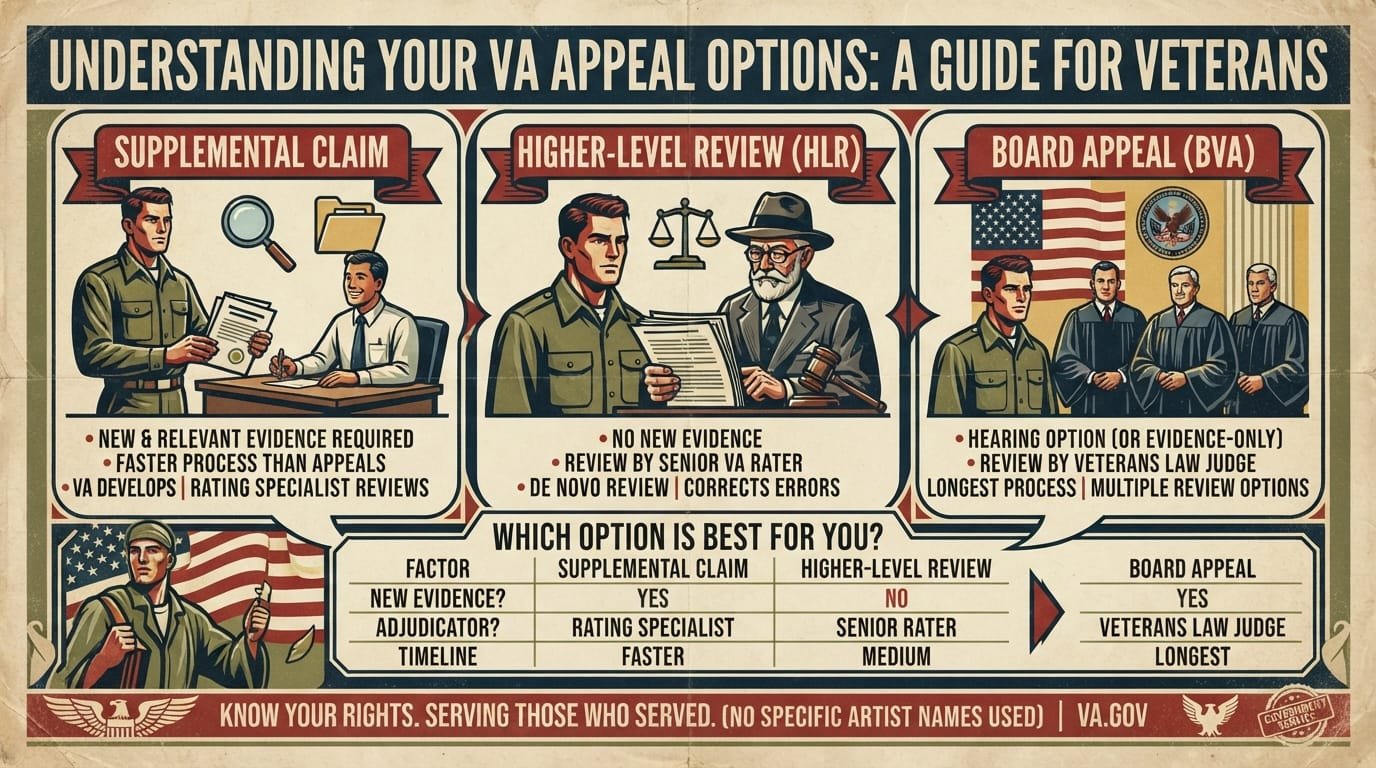
If VA denies your disability claim, you have three appeal options: a Supplemental Claim (new evidence), a Higher-Level Review (no new evidence), or a Board Appeal (Veterans Law Judge). For most benefits, you have one year from the decision date to file. Use VA Form 20-0995, 20-0996, or 10182.
Quick Facts
| Item | Details |
|---|---|
| What It Is | A formal request to review a VA disability decision you disagree with |
| Who Qualifies | Veterans, survivors, and dependents who received a VA decision dated on or after Feb. 19, 2019 |
| Application | Online at VA.gov, by mail, or in person |
| Processing Time | Supplemental Claim: 2–5 months; Higher-Level Review: 3–4 months; Board Appeal: 1–2+ years |
| Official Agency | U.S. Department of Veterans Affairs (VA); Board of Veterans’ Appeals (BVA) |
| Required Forms | VA Form 20-0995 (Supplemental Claim); 20-0996 (Higher-Level Review); 10182 (Board Appeal) |
| Deadline | 1 year from decision date (most benefits); Supplemental Claims can be filed anytime |
| Updated For | 2026 |
What Is the VA Disability Appeal Process?
The VA disability appeal process is the formal system for challenging a VA decision you disagree with. If VA denied your disability claim, assigned a lower rating than you expected, or got the effective date wrong, you have the right to request a review.

The appeals system changed significantly under the Appeals Modernization Act (AMA) of 2017, which took full effect on February 19, 2019. The legacy appeals process no longer exists for decisions dated on or after that date. Instead, veterans now choose from three distinct decision review options: a Supplemental Claim, a Higher-Level Review, or a Board Appeal.

Each option has different rules, timelines, and evidence requirements. Choosing the right one for your situation is the single most important decision you will make in the appeals process.
The Three Appeal Options: Side-by-Side Comparison
VA offers exactly three decision review options. Each one serves a different purpose. You cannot use all three at once for the same issue, but you can move between them after receiving a decision.
| Feature | Supplemental Claim | Higher-Level Review | Board Appeal |
|---|---|---|---|
| Form | VA Form 20-0995 | VA Form 20-0996 | VA Form 10182 |
| New Evidence | Yes—required unless based on change in law | No | Depends on docket type |
| Who Reviews | A new reviewer at the VA regional office | A senior reviewer at the VA regional office | A Veterans Law Judge at the Board |
| Informal Conference | No | Yes (optional, one-time) | No (but hearing available) |
| Deadline | Anytime (file within 1 year to preserve effective date) | 1 year from decision date | 1 year from decision date |
| Average Processing Time | 4–5 months (VA goal: 125 days) | 4–5 months (VA goal: 125 days) | 1 year (Direct Review); 1–2+ years (Evidence/Hearing) |
| Best For | You have new medical evidence or a change in law applies | You believe VA made an error but have no new evidence | You want a judge to review your case or need a hearing |
Decision Tree: Which Appeal Option Should You Choose?
Ask yourself these questions in order:
Do you have new and relevant evidence (new medical records, a new nexus letter, a new diagnosis)?
Yes → File a Supplemental Claim (VA Form 20-0995).
No → Go to question 2.
Is your claim affected by a change in law (such as the PACT Act)?
Yes → File a Supplemental Claim even without new medical evidence.
No → Go to question 3.
Do you believe VA made a clear error (misread evidence, applied the wrong law, overlooked a medical opinion)?
Yes → Request a Higher-Level Review (VA Form 20-0996).
No → Go to question 4.
Do you want a Veterans Law Judge to review your case, or do you want a hearing?
Yes → File a Board Appeal (VA Form 10182).
Option 1: Supplemental Claim (VA Form 20-0995)
A Supplemental Claim is used when you have new and relevant evidence that VA did not consider in its original decision. This is the only appeal option that allows you to add new evidence at the regional office level. A reviewer will decide whether the new evidence changes the decision.
What Counts as “New and Relevant” Evidence
Veterans May Qualify for Extra Benefits
Check available financial assistance, healthcare programs and other opportunities that may apply to you.
Check EligibilityNew evidence means information not previously submitted to VA. Relevant evidence means information that tends to prove or disprove the issue on appeal.
Examples include:
New medical records or treatment notes
A new medical nexus letter connecting your condition to service
A new diagnosis
Lay statements from fellow service members or family
A DBQ (Disability Benefits Questionnaire) from a private provider
Special Rule: PACT Act and Other Changes in Law
If you are filing a Supplemental Claim based on a change in law—such as the PACT Act—you do not need to submit new medical evidence. You only need medical evidence that documents the diagnosis and severity of your claimed condition. You do not need to prove that your service caused the condition; you only need to meet the service requirements for the presumption.
How to File a Supplemental Claim
Complete VA Form 20-0995.
Submit or identify the new and relevant evidence.
File online at VA.gov, by mail, or in person.
You can file a Supplemental Claim at any time, but VA recommends filing within one year of your decision letter to preserve your effective date.
Processing Time
VA’s goal is to complete Supplemental Claims within an average of 125 days (4–5 months). Actual times range from 2–5 months depending on the complexity of the claim and the evidence submitted.
Option 2: Higher-Level Review (VA Form 20-0996)
A Higher-Level Review is used when you believe VA made an error but you do not have new evidence to submit. A more senior reviewer at the same VA regional office will conduct a new review based solely on the evidence that was already in your file. They cannot consider any new evidence.
Key Features
Same evidence only: The reviewer looks at the same record the original decision-maker reviewed.
Error correction focus: This option is best when you believe VA misread evidence, overlooked a medical opinion, or misapplied the law.
No duty to assist: VA does not have a duty to gather new evidence during a Higher-Level Review.
Informal Conference
You can request an optional, one-time informal conference with the higher-level reviewer. This is a phone call where you or your accredited representative can point out specific errors in the case. To request an informal conference, select item 16A on VA Form 20-0996.
The informal conference can be valuable, but it may delay the review. You can have only one informal conference per Higher-Level Review.
How to File a Higher-Level Review
Complete VA Form 20-0996.
If desired, request an informal conference.
File online at VA.gov, by mail, or in person.
You must file within one year of the date on your decision letter.
Processing Time
VA’s goal is to complete Higher-Level Reviews within an average of 125 days (4–5 months). Actual times average 3–4 months.
Option 3: Board Appeal (VA Form 10182)
A Board Appeal sends your case to a Veterans Law Judge at the Board of Veterans’ Appeals (BVA) in Washington, D.C. This is the highest level of administrative review within VA. When you file a Board Appeal, you must choose one of three dockets (types of review).
The Three Board Appeal Dockets
| Docket Type | What It Means | New Evidence Allowed? | Hearing Available? | Typical Timeline |
|---|---|---|---|---|
| Direct Review | The judge reviews the same evidence already in your file | No | No | ~1 year (VA goal: 365 days) |
| Evidence Submission | The judge considers new evidence alongside the existing record | Yes (90-day window after filing) | No | 1–2+ years |
| Hearing | You present your case directly to a Veterans Law Judge | Yes | Yes | 2+ years |
How to Choose a Board Docket
Direct Review: Choose this if you believe the existing evidence already supports your claim and VA simply made a mistake. This is the fastest option.
Evidence Submission: Choose this if you have new evidence but do not want a hearing. You can submit evidence within 90 days of filing your appeal.
Hearing: Choose this if you want to speak directly to a Veterans Law Judge. You can choose from three hearing formats: virtual, videoconference, or in-person. A Board hearing is optional and may increase the time it takes for the Board to decide your appeal.
How to File a Board Appeal
Complete VA Form 10182.
In Part II, select ONE of the three docket options (Direct Review, Evidence Submission, or Hearing).
File online at VA.gov, by mail, or by fax.
You must file within one year of the date on your decision letter.
If you select the Evidence Submission or Hearing docket, you must submit new evidence within 90 days of filing your appeal.
Processing Time
VA’s goal for the Direct Review docket is an average of 365 days (1 year). Goals for Evidence Submission and Hearing dockets are longer. In practice, Board appeals on the Direct Review docket typically take about a year, while Evidence Submission and Hearing dockets can take 1–2 years or more.
What Happens After You File an Appeal?
After you file your appeal, VA will process your case according to the option you selected. Here is what to expect from each:
Supplemental Claim
VA receives your form and new evidence.
A reviewer at the regional office reviews the new evidence.
VA issues a new decision.
If denied, you can file another Supplemental Claim, request a Higher-Level Review, or appeal to the Board.
Higher-Level Review
VA assigns a senior reviewer to your case.
If you requested an informal conference, the reviewer calls you or your representative.
The reviewer examines the same evidence and issues a new decision.
If denied, you can file a Supplemental Claim (if you have new evidence) or appeal to the Board.
Board Appeal
VA dockets your appeal and assigns it a place in line based on the docket type.
For Evidence Submission: you submit evidence within 90 days.
For Hearing: the Board schedules your hearing.
A Veterans Law Judge reviews your case and issues a decision.
If denied, you can appeal to the U.S. Court of Appeals for Veterans Claims (CAVC) within 120 days of the Board’s decision.
After a Board Decision: Court Appeal
The CAVC is an independent court that reviews Board decisions for legal errors. You have 120 days from the date printed on the Board decision to file a Notice of Appeal with the CAVC. This is a jurisdictional deadline—missing it means the CAVC cannot hear your case under any circumstances.
You can appeal to the CAVC on your own (pro se) or with an accredited attorney.
Effective Dates and Back Pay: Why Timing Matters
Filing your appeal within one year of the decision letter preserves your original effective date. If VA grants your appeal after that one-year window closes, you may lose back pay that would have been owed from the original claim date.
How Effective Dates Work
Original claim: The effective date is generally the date VA received your claim or the date your disability arose, whichever is later.
Rating increase: The effective date is the earliest date the disability worsened, if the claim is received within one year of that date.
Appeal: Filing within one year of a denial preserves your original effective date. This can mean thousands of dollars in back pay if the appeal succeeds.
Example
If you filed your original claim in June 2024 and VA denied it in December 2024, filing an appeal by December 2025 preserves your June 2024 effective date. If the appeal succeeds in 2026, VA may owe back pay from June 2024 to the present.
Continuous Pursuit
You can move between appeal lanes without losing your effective date, as long as you file within one year of each denial. Each new denial restarts a new one-year window.
Common Mistakes Veterans Make in the Appeals Process
Many veterans lose appeals because of avoidable mistakes. Here are the most common ones:
Missing the one-year deadline. For Higher-Level Reviews and Board Appeals, you have exactly one year from the decision date. Missing it can mean losing your effective date.
Filing a Higher-Level Review with new evidence. The reviewer cannot consider new evidence. If you have new evidence, file a Supplemental Claim instead.
Choosing the wrong Board docket. If you have new evidence but select Direct Review, the judge cannot consider it.
Not submitting evidence within the 90-day window. For Evidence Submission and Hearing dockets, you must submit new evidence within 90 days of filing your appeal.
Failing to request an informal conference. If you believe VA made an error, an informal conference gives you a direct chance to point it out.
Giving up after one denial. The appeals system allows multiple rounds of review. You can move between lanes after each decision.
Not filing a Supplemental Claim after a PACT Act change. If your condition is now presumptive under the PACT Act, you may be able to file a Supplemental Claim without new medical evidence.
Missing the 120-day CAVC deadline. After a Board decision, you have exactly 120 days to appeal to court. This deadline is strictly enforced.
Not keeping copies of everything. Keep copies of all forms, evidence, and decision letters.
Not seeking help. Accredited attorneys, claims agents, and Veterans Service Organizations (VSOs) can help you navigate the appeals process at no cost or on a contingency basis.
How to Get Help with Your Appeal
You do not have to navigate the appeals process alone. Several free and low-cost resources are available:
| Resource | What They Do | Cost |
|---|---|---|
| Veterans Service Organizations (VSOs) | Accredited representatives help file claims and appeals | Free |
| VA Accredited Attorneys | Legal representation before VA and the CAVC | Contingency fee (typically 20% of back pay) |
| VA Accredited Claims Agents | Assist with claims and appeals | Varies |
| Board of Veterans’ Appeals | Reviews appeals; staff can answer procedural questions | Free |
To find an accredited representative, visit VA.gov and search for “accredited representative.”
Common Questions
1. How long do I have to appeal a VA decision?
For most VA benefits, you have one year from the date on your decision letter to request a Higher-Level Review or a Board Appeal. You can file a Supplemental Claim at any time, but VA recommends filing within one year to preserve your effective date.
2. What is the difference between a Supplemental Claim and a Higher-Level Review?
A Supplemental Claim allows you to submit new and relevant evidence. A Higher-Level Review does not allow new evidence; it is for cases where you believe VA made an error based on the existing record. Both are processed at the VA regional office level.
3. Can I submit new evidence with a Board Appeal?
It depends on the docket you choose. Direct Review does not allow new evidence. Evidence Submission allows new evidence within 90 days of filing. Hearing allows new evidence and a hearing with a Veterans Law Judge.
4. What happens if I miss the one-year appeal deadline?
If you miss the one-year deadline, you lose the ability to preserve your original effective date. You can still file a Supplemental Claim at any time, but the effective date will generally be the date VA receives the new claim, not the original claim date.
5. Can I switch appeal options after filing?
You generally must wait for a decision in your current lane before pursuing another option. After a denial, you can file in a different lane. Filing within one year of each denial preserves your effective date.
6. What is an informal conference?
An informal conference is an optional phone call with the higher-level reviewer assigned to your Higher-Level Review. It gives you or your representative a chance to point out specific errors in the case. You can have only one informal conference per Higher-Level Review.
7. How long does a Board Appeal take?
Direct Review docket appeals average about 1 year. Evidence Submission and Hearing docket appeals can take 1–2 years or more, depending on the complexity of the case and whether a hearing is requested.
8. What is the CAVC?
The U.S. Court of Appeals for Veterans Claims (CAVC) is an independent federal court that reviews Board of Veterans’ Appeals decisions for legal errors. You have 120 days from the date on the Board decision to file a Notice of Appeal with the CAVC.
9. Do I need a lawyer to appeal a VA decision?
No. You can file an appeal on your own. However, an accredited attorney, claims agent, or VSO representative can help you choose the right option and present your case. VSO representation is free.
10. What is the PACT Act and how does it affect appeals?
The PACT Act expands VA benefits for veterans exposed to burn pits, Agent Orange, and other toxic exposures. If your condition is now presumptive under the PACT Act, you can file a Supplemental Claim without new medical evidence—you only need proof of diagnosis and service requirements.
11. Can I appeal a decision on a claim I filed before February 19, 2019?
If your decision is dated before February 19, 2019, and you filed a Notice of Disagreement, you are in the legacy appeals system. You may be able to opt into the modernized review system if you have a Statement of the Case dated on or after February 19, 2019, and are within 60 days of that statement.
12. What happens if the Board denies my appeal?
You can appeal to the CAVC within 120 days of the Board decision. You can also file a motion for reconsideration or a motion to vacate with the Board. Filing a Supplemental Claim with new evidence is another option.
13. How do I check the status of my appeal?
Sign in to VA.gov and check your claim or appeal status online. You can also call the VA benefits hotline at 1-800-827-1000.
14. What is the difference between Direct Review and Evidence Submission at the Board?
Direct Review means the judge reviews only the evidence already in your file—no new evidence and no hearing. Evidence Submission means the judge considers new evidence you submit within 90 days of filing, but no hearing is held. Direct Review is faster.
15. Can I get back pay if my appeal is granted?
Yes. If your appeal succeeds, VA will pay back pay from your effective date to the present. Filing within one year of each denial preserves your original effective date, maximizing the back pay you may receive.
Key Takeaways
VA offers three appeal options: Supplemental Claim (VA Form 20-0995), Higher-Level Review (VA Form 20-0996), and Board Appeal (VA Form 10182).
You have one year from the decision date to file a Higher-Level Review or Board Appeal. Supplemental Claims can be filed anytime.
Supplemental Claims allow new evidence; Higher-Level Reviews do not.
Board Appeals have three dockets: Direct Review (fastest), Evidence Submission, and Hearing.
Filing within one year preserves your effective date, which can mean significant back pay if the appeal succeeds.
The PACT Act allows Supplemental Claims without new medical evidence for presumptive conditions.
After a Board decision, you have 120 days to appeal to the CAVC.
VSOs provide free representation for veterans navigating the appeals process.
Common mistakes include missing deadlines, choosing the wrong lane, and failing to submit evidence within the 90-day window.
VA’s processing goals are 125 days for Supplemental Claims and Higher-Level Reviews, and 365 days for Direct Review Board Appeals.
Official Resources
VA Decision Reviews and Appeals: va.gov/decision-reviews
VA Decision Reviews FAQs: va.gov/resources/decision-reviews-faqs
VA Form 20-0995 (Supplemental Claim): va.gov/find-forms/about-form-20-0995
VA Form 20-0996 (Higher-Level Review): va.gov/find-forms/about-form-20-0996
VA Form 10182 (Board Appeal): va.gov/find-forms/about-form-10182
Board of Veterans’ Appeals: bva.va.gov
U.S. Court of Appeals for Veterans Claims: uscourts.cavc.gov
VA Benefits hotline: 1-800-827-1000
Veterans Crisis Line: Dial 988, then press 1
USA.gov Veterans Benefits: usa.gov/veterans-benefits



🇺🇸 IMPORTANT DISCLAIMER – Veterans Benefits Information
This site provides general information about U.S. Department of Veterans Affairs (VA) benefits for educational and informational purposes only.
- Not Official: We are NOT affiliated with, endorsed by, or connected to the U.S. Department of Veterans Affairs (VA), the Veterans Benefits Administration (VBA), the Veterans Health Administration (VHA), or any other government agency.
- No Legal/Financial Advice: The content on this website is for informational purposes only and does not constitute legal, financial, or medical advice. VA benefits rules change frequently – always consult with an accredited Veterans Service Officer (VSO) or a qualified professional for your specific situation.
- Official Sources: For official, binding information and to apply for benefits, always visit official .gov websites: VA.gov, Benefits.VA.gov, or SSA.gov.
- No Data Collection: This site does not collect, store, or process any personal information. It does not have login forms, contact forms, or any system to capture user data. We never ask for your Social Security Number, bank details, or any personal information.
- 🚨 Scam Alert: The VA and other government agencies never charge fees for benefit applications. If anyone asks for money to "process" your VA claim, it is a scam. Report it to the VA Office of Inspector General at VA.gov/OIG.
- Advertising: This site uses third-party advertising (Adsterra) to cover operational costs. We do not endorse or guarantee any products or services advertised.
📌 Information provided as of June 2026. Always verify current eligibility and rules with official .gov sources.
This site is not affiliated with the U.S. Department of Veterans Affairs or any government agency. All information is for educational purposes only. Please visit VA.gov for official information.
