
Homestead Exemption for Disabled Veterans in Texas: The Complete 2026 Guide
Texas offers a 100% homestead exemption from property taxes for veterans with a 100% VA disability rating or Individual Unemployability. Veterans with ratings of 10%–99% receive partial exemptions ranging from $5,000 to $12,000 off their home’s assessed value. There are no income limits and no cap on home value for the full exemption.
Quick Facts
| Item | Details |
|---|---|
| Benefit | Full property tax exemption for 100% disabled veterans; partial exemption ($5,000–$12,000) for 10%–99% ratings |
| Eligibility | Texas resident veterans with VA service-connected disability rating; surviving spouses (unremarried) |
| Application | Form 50-114 filed with county appraisal district; online, mail, fax, or in person |
| Processing Time | Typically 30–90 days after filing with appraisal district |
| Official Agency | Texas Comptroller of Public Accounts; County Appraisal Districts |
| Required Forms | Form 50-114 (Residence Homestead Exemption Application); VA disability letter |
| Updated For | 2026 |
What Is the Texas Disabled Veteran Homestead Exemption?
The Texas disabled veteran homestead exemption is a property tax benefit that reduces the taxable value of a veteran’s primary residence based on their VA service-connected disability rating. It is authorized under Texas Tax Code Section 11.22 for partial exemptions and Section 11.131 for the 100% exemption. The exemption applies to school, county, city, and special district taxes. Veterans with a 100% disability rating or Individual Unemployability (TDIU) receive a complete exemption from property taxes on their homestead.

Why it matters: Texas has one of the most generous disabled veteran property tax benefits in the nation. A 100% disabled veteran pays zero property taxes on their home, regardless of the home’s value. For veterans with lower ratings, the exemption still provides meaningful annual savings. There are no income limits for either the full or partial exemption.

What veterans should do next: File Form 50-114 with your county appraisal district. Applications are due by April 30 of the tax year for which you are requesting the exemption. Veterans filing for the 100% disabled veteran exemption may file late, up to five years after the delinquency date.
Who Qualifies for the Texas Disabled Veteran Homestead Exemption?
You qualify if you are a Texas resident veteran who has been classified by the U.S. Department of Veterans Affairs (or the branch of the armed services in which you served) as having a service-connected disability. You must own and occupy the property as your principal residence on January 1 of the tax year in which you are applying. There are no income limits and no age requirements for the disabled veteran homestead exemption.
Eligible Groups
Veterans with a VA service-connected disability rating of 10% or higher
Veterans receiving 100% VA disability compensation
Veterans with Individual Unemployability (TDIU) rated at 100%
Unremarried surviving spouses of qualifying disabled veterans
Surviving spouses of service members killed or fatally injured in the line of duty
Key Eligibility Rules
Texas residency required: The veteran must be a Texas resident.
Property ownership: You must own the property on January 1 of the tax year you are applying for the exemption.
Principal residence: The property must be your primary homestead.
VA certification: The disability must be service-connected and rated by the VA or the branch of service.
Important distinction: The disabled veteran exemption is not the same as the disabled person exemption. The disabled person exemption (Tax Code Section 11.13) applies only to residence homestead property. The disabled veteran exemption can be applied to any one property the disabled veteran owns.
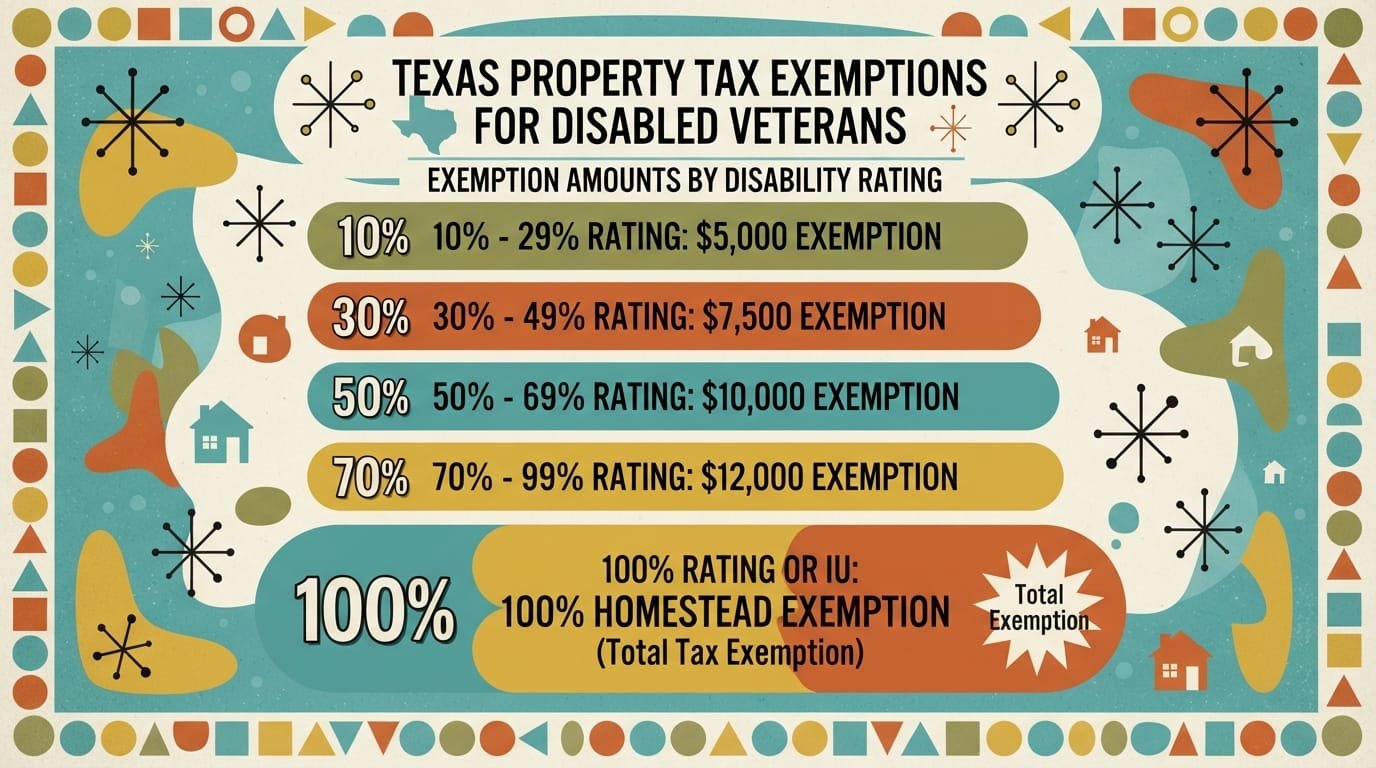
Exemption Amounts by Disability Rating
The exemption amount depends on your VA service-connected disability rating. The higher your rating, the larger the exemption.
| Disability Rating | Exemption Amount (Up To) |
|---|---|
| 10% to 29% | $5,000 from the property’s value |
| 30% to 49% | $7,500 from the property’s value |
| 50% to 69% | $10,000 from the property’s value |
| 70% to 100% | $12,000 from the property’s value |
| 100% or TDIU | Full exemption on total appraised value |
Veterans May Qualify for Extra Benefits
Check available financial assistance, healthcare programs and other opportunities that may apply to you.
Check Eligibility**Additional $12,000 exemption:** A disabled veteran may also qualify for an additional $12,000 exemption if the veteran is:
Age 65 or older with a disability rating of at least 10%
Totally blind in one or both eyes
Has lost the use of one or more limbs
What veterans should do next: Locate your current VA disability benefits letter showing your rating. You will need to submit this with Form 50-114. Contact the VA at 1-800-827-1000 if you need a current benefits letter.
The 100% Disabled Veteran Homestead Exemption
Veterans with a 100% VA disability rating or Individual Unemployability (TDIU) receive a complete exemption from property taxes on their residence homestead. This means you pay zero property taxes on your primary home, regardless of its value. The exemption applies to all taxing units, including school districts, counties, cities, and special districts.
What the 100% Exemption Covers
School district taxes
County taxes
City taxes
Special district taxes
All other property taxes on the homestead
No income limit: There is no income test for the 100% disabled veteran homestead exemption. Your income level does not affect eligibility.
No cap on home value: The exemption applies to the total appraised value of the homestead. Whether your home is worth $200,000 or $2,000,000, you pay zero property taxes.
TDIU counts as 100%: Veterans receiving Temporary Disability Individual Unemployability (TDIU) benefits at the 100% rate qualify for the full exemption.
What veterans should do next: Apply using Form 50-114 and submit a current VA letter confirming your 100% disability compensation or Individual Unemployability status. The letter must be dated within two years.
Surviving Spouse Exemption Rules
An unremarried surviving spouse of a veteran who qualified for the 100% disabled veteran homestead exemption at the time of death may continue to receive the full exemption. The surviving spouse must remain unmarried and continue to use the property as their primary residence.
Surviving Spouse Eligibility Requirements
The surviving spouse must not have remarried since the veteran’s death
The property was the surviving spouse’s residence homestead when the veteran died
The property remains the surviving spouse’s residence homestead
The deceased veteran qualified for or would have qualified for the 100% exemption at the time of death
Transferring the Exemption
A surviving spouse may transfer the 100% disabled veteran homestead exemption to a subsequent homestead if they do not remarry. This allows the surviving spouse to maintain the property tax benefit if they move to a new home.
Beginning with the 2026 tax year, a qualifying surviving spouse may receive a 100% exemption of the appraised value of their residence homestead if the veteran died from a VA-recognized presumptive condition. This applies even if the veteran did not have a 100% disability rating at the time of death.
What surviving spouses should do next: Submit Form 50-114 along with a copy of the marriage certificate, the veteran’s death certificate, and documentation showing the veteran’s disability rating. Contact your county appraisal district for specific requirements.
How to Apply for the Texas Disabled Veteran Homestead Exemption
Applying for the exemption involves completing Form 50-114 and submitting it to your county appraisal district. The form covers all homestead exemption types, including the disabled veteran exemption.
Step-by-Step Application Process
Step 1: Obtain Form 50-114
Download Form 50-114 from the Texas Comptroller’s website (comptroller.texas.gov) or your county appraisal district’s website. The form is titled “Application for Residence Homestead Exemption.”
Step 2: Complete the Application
Provide all required information, including:
Property owner name and address
Texas driver’s license or ID number
Date you began occupying the property
Disability rating information
Exemption type you are claiming
Step 3: Gather Required Documents
You will need:
Copy of your Texas driver’s license or Texas ID card showing the property address
Current VA disability benefits letter (dated within two years)
For surviving spouses: marriage certificate and death certificate
Ownership documents if the property is not listed in your name
Step 4: File with Your County Appraisal District
Submit the completed form and documents to the appraisal district office in the county where your property is located. Do not file with the Texas Comptroller’s office.
Filing options:
Online: Many county appraisal districts offer online filing through their websites
Mail: Send to your county appraisal district
Fax: Available at most appraisal districts
In person: Visit your county appraisal district office
Step 5: Receive Confirmation
The appraisal district will review your application and notify you of approval or denial. If approved, the exemption is applied to your property tax account.
Application Deadline
Standard deadline: April 30 of the tax year for which you are requesting the exemption.
Late filing for disabled veterans: Disabled veterans (not surviving spouses) may file a late application for a residence homestead exemption under Tax Code Sections 11.131 or 11.132 up to five years after the delinquency date.
Late filing for other homestead exemptions: You may file a late application for most homestead exemptions up to two years after the delinquency date.
What veterans should do next: File early. Do not wait until April 30. Contact your county appraisal district if you have questions about required documentation or filing procedures.
Required Documents Checklist
| Document | Purpose |
|---|---|
| Form 50-114 | Residence Homestead Exemption Application |
| Texas Driver’s License or ID | Proof of residency and property address match |
| VA Disability Benefits Letter | Proof of service-connected disability rating (dated within 2 years) |
| Marriage Certificate | Required for surviving spouse applications |
| Death Certificate | Required for surviving spouse applications |
| Recorded Deed | Required if property is not listed in applicant’s name |
| Trust Documents | Required if property is held in a trust |
Important: There is never a fee to apply for a homestead exemption or for any appraisal district services.
Texas Disabled Veteran Exemption vs. Other Property Tax Benefits
Texas offers multiple property tax benefits that may interact with the disabled veteran homestead exemption. Understanding how these programs work together can help you maximize your savings.
| Program | Eligible Veterans | Income Limits | Online Application |
|---|---|---|---|
| Disabled Veteran Exemption (11.22) | 10%–99% VA rating | None | Form 50-114 |
| 100% Disabled Veteran Exemption (11.131) | 100% or TDIU | None | Form 50-114 |
| General Homestead Exemption (11.13) | All homeowners | None | Form 50-114 |
| Over-65 Exemption | Age 65+ | None | Form 50-114 |
| Disabled Person Exemption | SSDI or physician certification | None | Form 50-114 |
| Tax Ceiling (Over-65/Disabled) | Age 65+ or disabled | None | Form 50-114 |
Key rule: A veteran who qualifies for more than one property exemption is only eligible for one exemption but may choose the greatest exemption they qualify for. However, the disabled veteran exemption can be combined with the general homestead exemption and the over-65 exemption in some cases.
What veterans should do next: Review all exemptions you may qualify for and apply for the ones that provide the greatest benefit. Contact your county appraisal district for guidance on combining exemptions.
Common Mistakes to Avoid
1. Missing the April 30 deadline. The standard deadline for filing a homestead exemption is April 30. While disabled veterans can file late (up to five years after the delinquency date), filing on time ensures your exemption is applied for the current tax year.
2. Filing with the wrong office. Form 50-114 must be filed with your county appraisal district, not the Texas Comptroller’s office. Filing with the wrong office delays processing.
3. Not updating your VA letter. The VA disability benefits letter must be dated within two years. An outdated letter may result in denial.
4. Assuming the exemption is automatic. You must apply for the exemption. It is not granted automatically, even if you have a 100% VA disability rating.
5. Not reapplying after moving. If you move to a new home, you must file a new application for the homestead exemption. The exemption does not automatically transfer to a new property (with limited exceptions for surviving spouses).
6. Not notifying the appraisal district of changes. You have a duty to notify the chief appraiser when your entitlement to any exemption ends. Failure to do so may result in penalties.
7. Assuming TDIU does not qualify. Veterans receiving Temporary Disability Individual Unemployability (TDIU) at the 100% rate qualify for the full exemption. Some veterans assume TDIU is different from a 100% rating, but for Texas property tax purposes, it counts.
**8. Forgetting about the additional $12,000 exemption.** Veterans who are 65 or older with a 10% disability rating, totally blind, or have lost limbs may qualify for an additional $12,000 exemption.
9. Not checking for local option exemptions. Some taxing units offer additional local option exemptions. Check with your county appraisal district to see if additional exemptions are available in your area.
10. Not keeping documentation. Keep copies of your application, VA letter, and approval notices for your records.
Latest Rule Changes for 2026
New Surviving Spouse Exemption (Tax Code 11.136)
Beginning with the 2026 tax year, a qualifying surviving spouse may receive a 100% exemption of the appraised value of their residence homestead if the veteran died from a VA-recognized presumptive condition. This applies even if the veteran did not have a 100% disability rating at the time of death. The surviving spouse must not have remarried.
Why it matters: This change expands eligibility for surviving spouses of veterans who died from conditions related to burn pit exposure, Agent Orange, and other toxic exposures recognized under the PACT Act.
Proposed Expansion to 60% Threshold
A proposed constitutional amendment (HJR 117) would allow the legislature to exempt all or part of the market value of the residence homestead of a disabled veteran with a disability rating of at least 60%. This proposal took effect January 1, 2026, and applies only to tax years beginning on or after that date. Veterans with ratings between 60% and 99% should monitor this change for potential additional relief.
Increased Exemption Amounts Proposed
Proposed legislation (SB 3060) would increase exemption amounts for veterans with ratings between 10% and 49%. Under the proposal, veterans with a 10%–29% rating would receive a $30,000 exemption (up from $5,000), and veterans with a 30%–49% rating would receive a $40,000 exemption (up from $7,500). This legislation is contingent on voter approval of a constitutional amendment.
What veterans should do next: Stay informed about legislative changes by monitoring the Texas Comptroller’s website and contacting your county appraisal district for updates. If you are a surviving spouse of a veteran who died from a presumptive condition, apply for the new exemption under Tax Code 11.136.
Common Questions
1. What is the Texas disabled veteran homestead exemption?
The Texas disabled veteran homestead exemption reduces the taxable value of a veteran’s primary residence based on their VA service-connected disability rating. Veterans with a 100% rating receive a full exemption and pay no property taxes. Veterans with ratings of 10%–99% receive partial exemptions of $5,000 to $12,000.
2. How do I qualify for the 100% disabled veteran homestead exemption?
You must have a 100% VA disability rating or Individual Unemployability (TDIU) from the VA. You must be a Texas resident, own the property on January 1 of the tax year, and use it as your primary residence. There are no income limits or age requirements.
3. What is the deadline to apply for the disabled veteran homestead exemption?
The standard deadline is April 30 of the tax year for which you are requesting the exemption. Disabled veterans (not surviving spouses) may file a late application up to five years after the delinquency date.
4. What form do I use to apply for the disabled veteran homestead exemption?
Use Form 50-114, Application for Residence Homestead Exemption. The form is available from the Texas Comptroller’s website or your county appraisal district. File it with your county appraisal district, not the Comptroller’s office.
5. What documents do I need to apply?
You need Form 50-114, a copy of your Texas driver’s license or ID showing the property address, and a current VA disability benefits letter dated within two years. Surviving spouses also need a marriage certificate and death certificate.
6. Is there an income limit for the Texas disabled veteran homestead exemption?
No. There is no income limit for either the partial exemption or the 100% exemption. Your income does not affect eligibility.
7. Can I get the exemption if I have a 70% disability rating?
Yes. Veterans with a 70%–99% disability rating receive a $12,000 exemption from their property’s assessed value. Additionally, veterans who are 65 or older with a 10% rating, totally blind, or have lost limbs may qualify for an additional $12,000 exemption.
8. Does TDIU qualify for the 100% disabled veteran homestead exemption?
Yes. Veterans receiving Temporary Disability Individual Unemployability (TDIU) at the 100% rate qualify for the full homestead exemption. TDIU counts as a 100% rating for Texas property tax purposes.
9. Can my surviving spouse keep the exemption after I die?
Yes, if your surviving spouse does not remarry and continues to use the property as their primary residence. The surviving spouse may also transfer the exemption to a subsequent homestead if they do not remarry. Beginning in 2026, surviving spouses of veterans who died from presumptive conditions may qualify for a 100% exemption.
10. Do I need to reapply for the exemption every year?
No. Once the exemption is granted, you do not need to reapply annually as long as you continue to qualify. However, the chief appraiser may require you to file a new application to confirm your current qualification.
11. What if I miss the April 30 deadline?
Disabled veterans may file a late application up to five years after the delinquency date. Other homestead exemptions may be filed up to two years after the delinquency date. File as soon as possible to avoid further delays.
12. Does the exemption apply to all property taxes?
Yes. The 100% disabled veteran homestead exemption applies to school, county, city, and special district taxes. The partial exemption reduces the taxable value for all taxing units.
13. Can I combine the disabled veteran exemption with other exemptions?
A veteran who qualifies for more than one property exemption is only eligible for one exemption but may choose the greatest exemption they qualify for. However, the disabled veteran exemption can be combined with the general homestead exemption in some cases.
**14. What is the additional $12,000 exemption for disabled veterans?**
Veterans who are age 65 or older with a disability rating of at least 10%, totally blind in one or both eyes, or have lost the use of one or more limbs may qualify for an additional $12,000 exemption.
15. What if my exemption application is denied?
If your application is denied, you have the right to protest the decision with your county appraisal district. Contact the appraisal district for information on the protest process and deadlines.
Key Takeaways
Texas offers a 100% homestead exemption for veterans with a 100% VA disability rating or TDIU. This means zero property taxes on your primary residence, regardless of home value.
Veterans with ratings of 10%–99% receive partial exemptions ranging from $5,000 to $12,000 off their home’s assessed value.
There are no income limits and no cap on home value for the disabled veteran homestead exemption.
Use Form 50-114 to apply. File with your county appraisal district by April 30.
Disabled veterans can file late up to five years after the delinquency date.
Surviving spouses may retain the exemption if they do not remarry and continue to use the property as their primary residence.
Beginning in 2026, surviving spouses of veterans who died from presumptive conditions may qualify for a 100% exemption under Tax Code 11.136.
TDIU counts as a 100% rating for the full homestead exemption.
An additional $12,000 exemption is available for veterans who are 65+, blind, or have lost limbs.
There is never a fee to apply for a homestead exemption or any appraisal district service.
Official Resources
Texas Comptroller of Public Accounts: www.comptroller.texas.gov
Texas Comptroller – Disabled Veteran and Surviving Spouse Exemptions FAQ: comptroller.texas.gov/taxes/property-tax/exemptions/disabledvet-faq.php
Texas Comptroller – 100% Disabled Veteran FAQ: comptroller.texas.gov/taxes/property-tax/exemptions/disabledvet-100-faq.php
Form 50-114 (Application for Residence Homestead Exemption): comptroller.texas.gov
VA Disability Compensation: www.va.gov/disability/
Texas Veterans Portal: www.texas.gov/veterans


🇺🇸 IMPORTANT DISCLAIMER – Veterans Benefits Information
This site provides general information about U.S. Department of Veterans Affairs (VA) benefits for educational and informational purposes only.
- Not Official: We are NOT affiliated with, endorsed by, or connected to the U.S. Department of Veterans Affairs (VA), the Veterans Benefits Administration (VBA), the Veterans Health Administration (VHA), or any other government agency.
- No Legal/Financial Advice: The content on this website is for informational purposes only and does not constitute legal, financial, or medical advice. VA benefits rules change frequently – always consult with an accredited Veterans Service Officer (VSO) or a qualified professional for your specific situation.
- Official Sources: For official, binding information and to apply for benefits, always visit official .gov websites: VA.gov, Benefits.VA.gov, or SSA.gov.
- No Data Collection: This site does not collect, store, or process any personal information. It does not have login forms, contact forms, or any system to capture user data. We never ask for your Social Security Number, bank details, or any personal information.
- 🚨 Scam Alert: The VA and other government agencies never charge fees for benefit applications. If anyone asks for money to "process" your VA claim, it is a scam. Report it to the VA Office of Inspector General at VA.gov/OIG.
- Advertising: This site uses third-party advertising (Adsterra) to cover operational costs. We do not endorse or guarantee any products or services advertised.
📌 Information provided as of June 2026. Always verify current eligibility and rules with official .gov sources.
This site is not affiliated with the U.S. Department of Veterans Affairs or any government agency. All information is for educational purposes only. Please visit VA.gov for official information.
