
Veterans Disability Lawyers: When You Need One and How to Choose
Hire a VA disability lawyer after a denial, a low rating, or a complex appeal. You do not need a lawyer for an initial claim—federal law bars attorneys from charging fees before VA decides. Accredited attorneys typically charge 20% of back pay, paid only if you win. VSOs are free.
Quick Facts
| Item | Details |
|---|---|
| What It Is | Legal representation for VA disability claims and appeals |
| Who Qualifies | Any veteran, survivor, or dependent with a VA claim or appeal |
| When to Hire | After a denial, low rating, delayed appeal, or complex case |
| Application | VA Form 21-22a (Appointment of Individual as Claimant’s Representative) |
| Processing Time | Varies by appeal lane; Board Appeals take 1–2+ years |
| Official Agency | VA Office of General Counsel (OGC) accredits attorneys |
| Required Forms | VA Form 21-22a; fee agreement filed with OGC |
| Fee Structure | Contingency fee, capped at 20% of back pay by VA regulation |
| Updated For | 2026 |
When Do You Need a VA Disability Lawyer?
Most veterans hire a VA-accredited attorney after VA has made a decision on their claim. The most common situations include a denied claim, a lower-than-expected disability rating, an appeal that seems stalled indefinitely, or a wrong effective date that reduces back pay. If you disagree with a VA decision and feel overwhelmed by the appeals process, a lawyer can help.

You do not need a lawyer to file an initial disability claim. Federal law prohibits attorneys from charging fees for helping with initial claims. The VA claims process was designed to allow veterans to file on their own, with low evidence requirements and a duty to assist.

That said, veterans law has become extremely complex. The VA bureaucracy creates many opportunities for inconsistency and mistakes. For appeals—especially Board of Veterans’ Appeals (BVA) and Court of Appeals for Veterans Claims (CAVC) cases—accredited attorneys bring legal training and specialized knowledge that can make a measurable difference.
Decision Tree: Do You Need a Lawyer?
Step 1: Have you received a VA decision?
No → File your initial claim with help from a free VSO. You cannot hire a fee-charging attorney yet.
Yes → Go to Step 2.
Step 2: Do you disagree with the decision?
No → You do not need a lawyer. Accept the decision and move forward.
Yes → Go to Step 3.
Step 3: Is your case straightforward?
A single condition, clear service records, and strong medical evidence → A VSO may be sufficient.
Multiple conditions, secondary conditions, toxic exposure, mental health, or a disputed rating → Consider hiring a lawyer.
Go to Step 4.
Veterans May Qualify for Extra Benefits
Check available financial assistance, healthcare programs and other opportunities that may apply to you.
Check EligibilityStep 4: What is at stake?
A small rating increase → A VSO may handle it.
Significant back pay, TDIU, SMC, or a CAVC appeal → A lawyer is likely worth the fee.
What Is a VA Disability Lawyer?
A VA disability lawyer is a licensed attorney accredited by the VA’s Office of General Counsel (OGC) to represent veterans in claims for VA benefits. Accreditation is required to practice before the VA. An accredited attorney must be a member in good standing of at least one state bar and must complete continuing legal education (CLE) requirements.
Attorneys are one of three types of accredited representatives recognized by VA. The other two are Veterans Service Organization (VSO) representatives and accredited claims agents. Each type has different qualifications, costs, and ideal use cases.
What an Accredited Attorney Can Do
Review your VA claims file and identify errors
Gather additional medical evidence and write legal arguments
Represent you in Supplemental Claims, Higher-Level Reviews, and Board Appeals
Request hearings before a Veterans Law Judge
Appeal a Board decision to the CAVC
Negotiate fee agreements subject to VA oversight
Attorney vs. VSO vs. Claims Agent: Side-by-Side Comparison
Choosing the right representative depends on your case, your budget, and what stage you are in. Here is how the three types compare.
| Feature | VSO Representative | Accredited Attorney | Accredited Claims Agent |
|---|---|---|---|
| Cost | Free | 20–33.3% of back pay (contingency) | 20–33.3% of back pay (contingency) |
| Accreditation | Recommended by a VA-recognized VSO | State bar member + OGC accreditation | Passes a VA-administered written exam |
| Best For | Initial claims, straightforward appeals | Complex appeals, CAVC, legal errors | Appeals, claims preparation |
| Legal Training | Not required | Yes (law degree required) | Not required |
| Access to VA File | Yes (VA Form 21-22) | Yes (VA Form 21-22a) | Yes (VA Form 21-22a) |
| Fee Cap | N/A (free) | 20% of back pay per VA regulation | 20% of back pay per VA regulation |
| Can Charge for Initial Claims? | No | No | No |
Pros and Cons of Each
VSO Representatives
Pros: Free, experienced with high-volume claims, access to your VA file, nationwide presence.
Cons: High caseloads, variable quality, less personalized attention, limited legal expertise.
Accredited Attorneys
Pros: Legal expertise, trained in VA law, can handle complex appeals, can appeal to CAVC.
Cons: Charge fees, generally available only after an initial decision.
Accredited Claims Agents
Pros: Specialized in VA claims, pass a written exam, can charge fees for appeals.
Cons: Not attorneys; cannot provide legal advice or represent you in court.
How to Verify a VA Disability Lawyer Is Accredited
You can verify whether an attorney is VA-accredited by searching the VA’s Office of General Counsel accreditation database. Never hire an unaccredited “claims consultant” or “coach.” These individuals operate outside VA oversight, charge fees, and may not be authorized to represent you before VA.
Step-by-Step Verification
Visit VA.gov and navigate to the accredited representative search tool.
Search by name, state, or organization.
Confirm the individual appears in the VA’s OGC accreditation list.
Check that their accreditation status is current.
Red Flags of an Unaccredited Representative
Cannot provide a VA accreditation number
Charges upfront fees for initial claims
Promises a specific rating or outcome
Pressures you to sign a fee agreement before reviewing your case
Is not listed in the OGC database
How Much Do VA Disability Lawyers Cost?
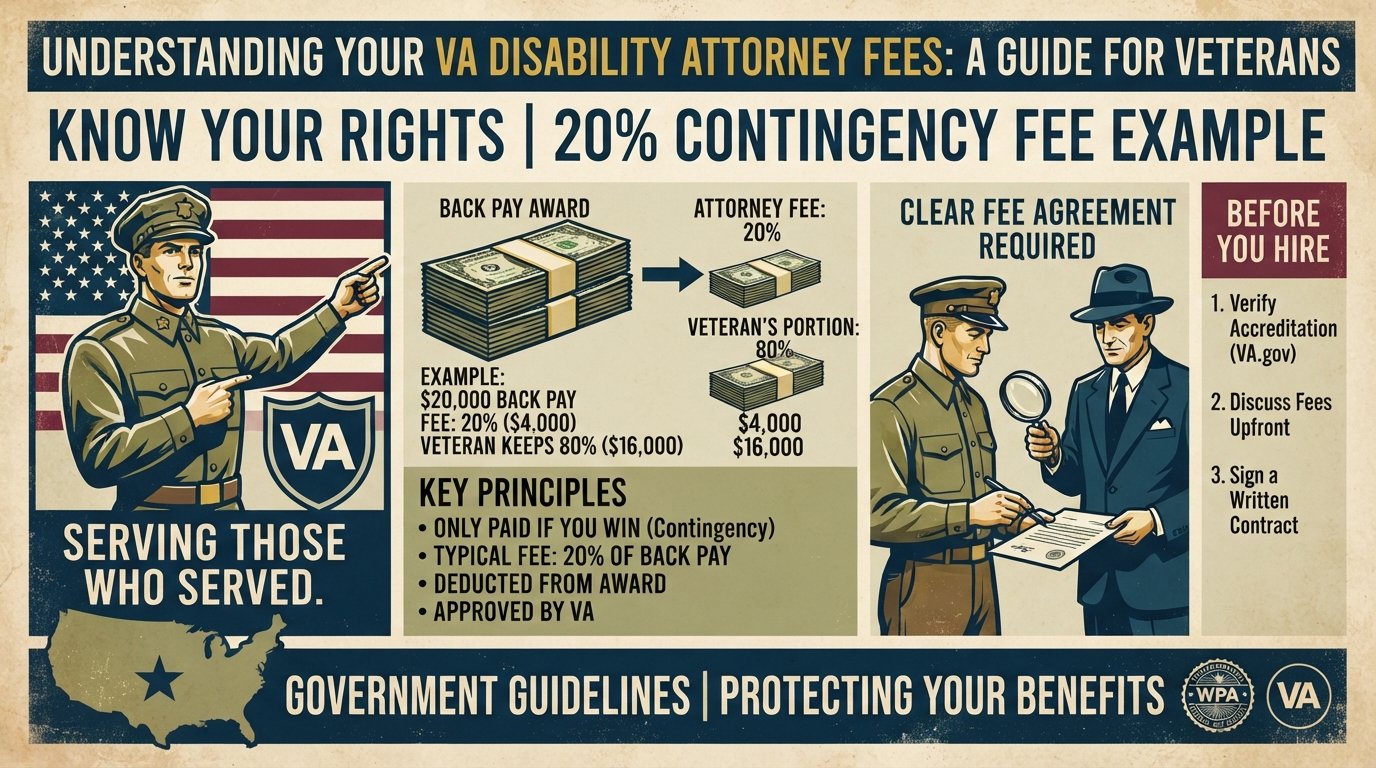
VA-accredited attorneys typically charge a contingency fee of 20% of your back pay. By law, VA may withhold a portion of a veteran’s back pay to pay accredited representatives directly. Fees are generally limited to 20% of past-due benefits. No upfront costs are required, and you pay nothing unless you win.
Fee Structure Breakdown
| Fee Type | Details |
|---|---|
| Contingency Fee | 20% of back pay (VA regulation cap) |
| Upfront Costs | None |
| Ongoing Monthly Benefits | Not subject to attorney fees |
| Fee Agreement | Must be signed and filed with VA’s OGC |
| Payment Source | Withheld from back pay by VA |
Example Calculation
If an attorney helps you win a 70% rating backdated 2 years, your retroactive pay might be approximately $43,400**. At a 20% contingency fee, the attorney would receive approximately **$8,680. Your ongoing monthly payments are unaffected.
VA Public Disclosure of Attorney Fees
Beginning in January 2026, the VA began publicly reporting the amount of money it pays to accredited attorneys and claims agents. In the 12 months ending December 2025, VA paid $394.7 million** to attorneys and agents. The monthly average over the same period was **$32 million. This transparency allows veterans to see where this money goes and make more informed decisions.
Accreditation Requirements for VA Attorneys
To practice before the VA, an attorney must be accredited by the VA’s Office of General Counsel. The initial accreditation process includes application to OGC, self-certification of bar admission information, and a determination of character and fitness.
Initial Accreditation
Must be a member in good standing of at least one state bar
OGC presumes character and fitness based on state bar membership unless credible information suggests otherwise
Must complete 3 hours of qualifying CLE during the first 12-month accreditation period
Maintaining Accreditation
Attorneys must complete an additional 3 hours of qualifying CLE every two years
Must file recertifications with OGC confirming good standing
Must report any changes to bar status
What to Look for in a VA Disability Lawyer
Look for an attorney who is VA-accredited, experienced in veterans law, and transparent about fees and strategy. Not all attorneys who handle veterans claims are equally qualified. Here is what to evaluate.
Key Qualifying Questions
Are you VA-accredited? — Verify independently through OGC.
What percentage of your practice is veterans law? — Specialists outperform generalists.
Have you represented veterans before the CAVC? — If your case may go to court, this matters.
What is your fee structure? — Confirm the 20% contingency and what happens if you discharge them.
Will you handle my case personally or pass it to a junior associate? — Know who will do the work.
What is your communication style? — You should receive regular updates.
Do you offer a free consultation? — Most veterans law firms do.
Qualities of a Strong VA Disability Lawyer
Specialization: Focuses exclusively or primarily on veterans benefits
Accreditation: Listed in the VA OGC database
Transparency: Clear about fees, timelines, and realistic outcomes
Communication: Responds to questions and keeps you informed
Track record: Has successfully handled cases similar to yours
Ethics: Does not promise specific ratings or guaranteed wins
Common Mistakes Veterans Make When Hiring a Lawyer
Many veterans waste money or lose appeals because they hire the wrong representative or wait too long. Here are the most common mistakes:
Hiring an unaccredited “claims consultant.” These individuals are not authorized to represent you before VA and charge fees without OGC oversight.
Waiting too long to hire a lawyer. The appeals process has strict deadlines. Missing the one-year window can cost you your effective date and back pay.
Choosing a lawyer based solely on price. The cheapest option may not be the best for a complex appeal.
Not asking about CAVC experience. If your case may go to court, your attorney needs federal court experience.
Signing a fee agreement without understanding it. Know what happens if you discharge your attorney or if they withdraw.
Not verifying accreditation. Always check the OGC database.
Hiring a lawyer for an initial claim. You cannot be charged for initial claim help, and a VSO can do it for free.
Assuming all lawyers handle VA appeals. Many general practice attorneys do not. Look for specialists.
Not discussing strategy upfront. Ask how they plan to approach your case.
Failing to keep copies of your own records. Always maintain your own files.
The VA Appeals Process: Where a Lawyer Adds Value
A lawyer adds the most value in the appeals process, especially at the Board of Veterans’ Appeals and the CAVC. Under the Appeals Modernization Act, there are three decision review options.
The Three Appeal Lanes
| Lane | Form | New Evidence? | Reviewed By | Best For |
|---|---|---|---|---|
| Supplemental Claim | VA Form 20-0995 | Yes | Regional office | New medical evidence |
| Higher-Level Review | VA Form 20-0996 | No | Senior reviewer | VA errors, no new evidence |
| Board Appeal | VA Form 10182 | Depends on docket | Veterans Law Judge | Legal arguments, hearings |
Board Appeal Dockets
| Docket | New Evidence? | Hearing? | Timeline |
|---|---|---|---|
| Direct Review | No | No | ~1 year |
| Evidence Submission | Yes (90-day window) | No | 1–2+ years |
| Hearing | Yes | Yes | 2+ years |
Where Lawyers Add the Most Value
Board Appeals (Hearing and Evidence Submission dockets): Complex legal arguments and evidence development.
CAVC appeals: Legal errors, federal court practice, and oral argument.
Effective date disputes: Maximizing back pay.
TDIU and SMC claims: Establishing eligibility for higher-level benefits.
Secondary service connection: Linking new conditions to service-connected disabilities.
PACT Act claims: Navigating toxic exposure presumptions and evidence requirements.
PACT Act and Toxic Exposure Claims: Why a Lawyer May Help
The PACT Act expanded VA benefits for veterans exposed to burn pits, Agent Orange, and other toxic substances. If your condition is now presumptive under the PACT Act, you can file a Supplemental Claim without new medical evidence—you only need proof of diagnosis and service requirements. A VA-accredited attorney familiar with PACT Act nuances can devise an effective strategy and help achieve a fair outcome.
What the PACT Act Covers
Over 20 new presumptive conditions for toxic exposure
Expanded health care eligibility for toxic-exposed veterans
Streamlined processing for presumptive claims
When to Hire a Lawyer for a PACT Act Claim
Your PACT Act claim was denied
You have a condition not on the presumptive list but linked to toxic exposure
You need to prove exposure or service connection
You are appealing a Board decision
Common Questions
1. When should I hire a VA disability lawyer?
Hire a lawyer after VA denies your claim, assigns a lower rating than expected, or delays your appeal. You cannot be charged for help with an initial claim, so most attorneys focus on appeals. A VSO can help with initial claims for free.
2. Do I need a lawyer for my VA disability claim?
You do not need a lawyer for an initial claim. For appeals, especially Board Appeals or CAVC cases, a lawyer can significantly improve your chances. Represented veterans had an allowed rate of 42.7% versus 29.7% for unrepresented veterans in some studies.
3. How much does a VA disability lawyer cost?
VA-accredited attorneys typically charge a 20% contingency fee on back pay. You pay nothing unless you win. Ongoing monthly benefits are not subject to attorney fees. Fee agreements must be filed with VA’s OGC.
4. What is the difference between a VSO and a VA disability lawyer?
A VSO representative is free and helps with initial claims and straightforward appeals. A VA-accredited attorney charges a contingency fee and handles complex appeals, Board hearings, and CAVC cases. Attorneys have legal training that VSOs may lack.
5. Can a lawyer help with an initial VA claim?
No. Federal law prohibits attorneys from charging fees for initial claims. You can file on your own or with a free VSO. Some attorneys may provide pro bono or legal aid assistance.
6. How do I verify a VA disability lawyer is accredited?
Search the VA Office of General Counsel accreditation database at VA.gov. Confirm the attorney’s name appears and their status is current. Never hire an unaccredited claims consultant.
7. What is a claims agent?
A claims agent is not a lawyer but is accredited by VA after passing a written exam. Claims agents can charge fees for appeals but cannot provide legal advice or represent you in court.
8. Can I switch lawyers during my appeal?
Yes. You can discharge your accredited representative at any time and appoint a new one. Tell your former representative immediately and file a new VA Form 21-22a. Review your fee agreement for discharge terms.
9. What happens if I lose my appeal?
If the Board denies your appeal, you have 120 days to appeal to the CAVC. You can also file a motion for reconsideration or file a Supplemental Claim with new evidence. A lawyer can help you decide the best path.
10. Are VA disability lawyer fees tax-deductible?
Attorney fees paid from VA back pay may have tax implications. Consult a tax professional. VA disability compensation itself is tax-free.
11. How long does a VA disability appeal take with a lawyer?
Timelines depend on the lane. Supplemental Claims and Higher-Level Reviews take 4–5 months. Board Appeals on the Direct Review docket take about 1 year. Evidence Submission and Hearing dockets take 1–2+ years. A lawyer can help you choose the fastest lane.
12. What is the CAVC?
The U.S. Court of Appeals for Veterans Claims (CAVC) is an independent federal court that reviews Board decisions for legal errors. You have 120 days from the Board decision to file a Notice of Appeal. An attorney experienced in CAVC practice is essential.
13. Can a lawyer help with a PACT Act claim?
Yes. A VA-accredited attorney familiar with PACT Act nuances can help you file a Supplemental Claim, gather evidence, and appeal a denial. For presumptive conditions, you may not need new medical evidence.
14. What should I ask a VA disability lawyer before hiring?
Ask: Are you VA-accredited? What percentage of your practice is veterans law? Have you handled CAVC appeals? What is your fee structure? Will you handle my case personally? Do you offer a free consultation?
15. Is it worth hiring a lawyer for a VA disability appeal?
For complex appeals, significant back pay, Board hearings, or CAVC cases, yes. Represented veterans have higher success rates in appeals. For simple rating increases, a VSO may be sufficient.
Key Takeaways
Hire a VA disability lawyer after a denial, low rating, or complex appeal. You do not need one for an initial claim.
VA-accredited attorneys charge a contingency fee capped at 20% of back pay. You pay nothing unless you win.
VSOs are free and handle initial claims and straightforward appeals.
Verify accreditation through the VA Office of General Counsel database. Never hire an unaccredited consultant.
Attorneys add the most value at the Board of Veterans’ Appeals and the CAVC.
The PACT Act allows Supplemental Claims without new medical evidence for presumptive conditions.
Filing within one year of a VA decision preserves your effective date and protects back pay.
VA publicly reports attorney fee payments—$394.7 million in the last 12 months.
Common mistakes include hiring unaccredited representatives, waiting too long, and not verifying credentials.
Ask the right questions before hiring: accreditation, experience, fees, and communication style.
Official Resources
VA Decision Reviews and Appeals: va.gov/decision-reviews
Find an Accredited Representative: va.gov/get-help-from-accredited-representative
VA Accredited Representative FAQs: va.gov/resources/va-accredited-representative-faqs
VA Office of General Counsel (Accreditation): va.gov/ogc
Board of Veterans’ Appeals: bva.va.gov
U.S. Court of Appeals for Veterans Claims: uscourts.cavc.gov
VA Attorney Fee Report: benefits.va.gov/REPORTS/attorney-fee-report
VA Benefits hotline: 1-800-827-1000
Veterans Crisis Line: Dial 988, then press 1



🇺🇸 IMPORTANT DISCLAIMER – Veterans Benefits Information
This site provides general information about U.S. Department of Veterans Affairs (VA) benefits for educational and informational purposes only.
- Not Official: We are NOT affiliated with, endorsed by, or connected to the U.S. Department of Veterans Affairs (VA), the Veterans Benefits Administration (VBA), the Veterans Health Administration (VHA), or any other government agency.
- No Legal/Financial Advice: The content on this website is for informational purposes only and does not constitute legal, financial, or medical advice. VA benefits rules change frequently – always consult with an accredited Veterans Service Officer (VSO) or a qualified professional for your specific situation.
- Official Sources: For official, binding information and to apply for benefits, always visit official .gov websites: VA.gov, Benefits.VA.gov, or SSA.gov.
- No Data Collection: This site does not collect, store, or process any personal information. It does not have login forms, contact forms, or any system to capture user data. We never ask for your Social Security Number, bank details, or any personal information.
- 🚨 Scam Alert: The VA and other government agencies never charge fees for benefit applications. If anyone asks for money to "process" your VA claim, it is a scam. Report it to the VA Office of Inspector General at VA.gov/OIG.
- Advertising: This site uses third-party advertising (Adsterra) to cover operational costs. We do not endorse or guarantee any products or services advertised.
📌 Information provided as of June 2026. Always verify current eligibility and rules with official .gov sources.
This site is not affiliated with the U.S. Department of Veterans Affairs or any government agency. All information is for educational purposes only. Please visit VA.gov for official information.
