
Rehab for Veterans Near Me in Texas: The Complete 2026 Guide
Veterans in Texas can access rehabilitation through VA medical centers, Vet Centers, and community care providers. Key programs include the San Antonio Polytrauma Rehabilitation Center, Comprehensive Integrated Inpatient Rehabilitation Programs at Dallas and San Antonio VA, Home Based Primary Care, substance use disorder residential treatment, and vocational rehabilitation through VA’s Chapter 31 program.
Quick Facts
| Item | Details |
|---|---|
| Benefit | Inpatient rehab, outpatient PT/OT/speech therapy, polytrauma/TBI care, spinal cord injury rehab, SUD residential treatment, vocational rehab, blind rehab |
| Eligibility | Veterans enrolled in VA health care; clinical need for rehabilitation services; service-connected or non-service-connected conditions |
| Application | VA Form 10-10EZ for enrollment; referral through VA primary care provider; VA Form 28-1900 for VR&E |
| Processing Time | Health care enrollment: 1–2 weeks; clinical assessment: 1–3 weeks; authorization: up to 5 business days |
| Official Agency | U.S. Department of Veterans Affairs (VA); Texas Veterans Commission (TVC) |
| Required Forms | VA Form 10-10EZ, VA Form 28-1900, DD-214 |
| Updated For | 2026 |
What Is Veteran Rehabilitation in Texas?
Veteran rehabilitation in Texas is a system of medical and vocational services designed to help veterans recover from injury, illness, or disability and restore maximum function and independence. The VA offers these services through its medical centers, outpatient clinics, Community Living Centers, Domiciliary residential programs, and community care network. Services range from acute inpatient rehabilitation for severe injuries to outpatient physical therapy and vocational counseling.

Why it matters: Texas is home to one of only five VA Polytrauma Rehabilitation Centers in the nation, located in San Antonio. The state also has Comprehensive Integrated Inpatient Rehabilitation Programs at Dallas and San Antonio VA medical centers, spinal cord injury centers in Dallas and San Antonio, and a Blind Rehabilitation Center in Waco. Texas veterans have access to some of the most specialized rehabilitation services available in the VA system.

What veterans should do next: If you are not already enrolled in VA health care, complete VA Form 10-10EZ. Then contact your VA primary care provider to request a rehabilitation assessment and referral.
VA Rehabilitation Facilities in Texas
Texas has multiple VA rehabilitation facilities offering specialized care. The following table lists the major centers and their rehabilitation specialties.
| Facility | Location | Rehabilitation Services |
|---|---|---|
| San Antonio Polytrauma Rehabilitation Center | San Antonio, TX | Polytrauma, TBI, severe multi-trauma rehabilitation |
| Dallas VA CIIRP/ASP | Dallas, TX | Comprehensive inpatient rehab, amputation specialty program |
| South Texas VA (Audie L. Murphy) | San Antonio, TX | CIIRP, spinal cord injury, SUD residential, domiciliary |
| Michael E. DeBakey VA Medical Center | Houston, TX | Physical medicine & rehab, prosthetics, domiciliary, SUD |
| Waco Blind Rehabilitation Center | Waco, TX | Blind and low vision rehabilitation |
| West Texas VA (Big Spring) | Big Spring, TX | Community Living Center rehab, domiciliary, PTSD/SUD |
| El Paso VA Health Care Center | El Paso, TX | Brain and spinal cord injury treatment services |
| Olin E. Teague Veterans’ Center | Temple, TX | Spinal cord injury, physical medicine & rehab |
What veterans should do next: Contact your nearest VA medical center to ask about rehabilitation services available in your area. If specialized care is not available locally, ask about VA Community Care options through TriWest Healthcare Alliance.
Polytrauma Rehabilitation Center in San Antonio
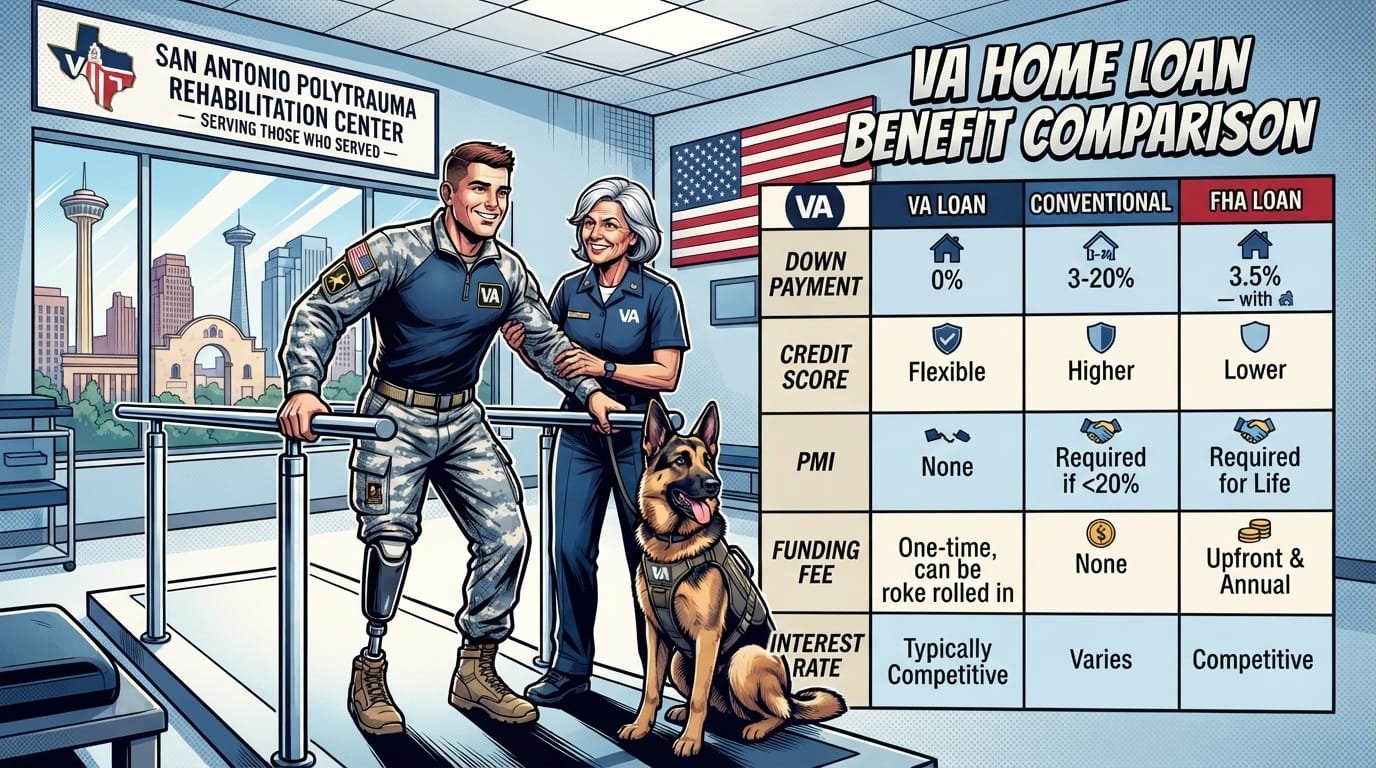
The San Antonio Polytrauma Rehabilitation Center (PRC) is one of only five flagship VA PRCs in the United States. It opened in 2011 as a $66 million state-of-the-art inpatient and outpatient rehabilitation center. The facility treats veterans and active-duty service members with multiple traumatic injuries, including traumatic brain injury, amputations, spinal cord injuries, and other severe trauma.
Veterans May Qualify for Extra Benefits
Check available financial assistance, healthcare programs and other opportunities that may apply to you.
Check EligibilityThe five PRCs in the United States:
Minneapolis, MN
Palo Alto, CA
Richmond, VA
Tampa, FL
San Antonio, TX
Eligibility: The PRC serves veterans and service members with polytrauma—severe injuries to more than one organ system, including brain injuries. Veterans must be enrolled in VA health care and referred by a VA provider.
Why it matters: The San Antonio PRC serves as a hub for acute medical and rehabilitation care, research, and education. Texas veterans with severe polytrauma injuries can receive world-class rehabilitation without leaving the state.
What veterans should do next: If you or a loved one has sustained polytrauma, contact the South Texas Veterans Health Care System at 1-888-686-6350 or ask your VA primary care provider for a referral to the San Antonio PRC. The VA’s Polytrauma System of Care includes 110 specialized rehabilitation sites across the country.
Comprehensive Integrated Inpatient Rehabilitation Program (CIIRP)
The Comprehensive Integrated Inpatient Rehabilitation Program (CIIRP) at the Dallas VA Medical Center provides intensive inpatient rehabilitation for veterans recovering from serious injury or illness. The program uses a team approach that includes the veteran, their family or caregiver, and a multidisciplinary team of doctors, therapists, nurses, prosthetists, and other professionals.
Admission criteria:
Must be medically stable
Must be able to participate in therapy 3 hours a day, 6 days a week
Must need at least two forms of therapy (physical, occupational, or speech therapy)
Must be alert and able to follow instructions consistently
Must be motivated and willing to participate in therapy
Should have potential to significantly improve function or achieve independence
Should have a safe and clear discharge plan
Services include: Physical therapy, occupational therapy, speech-language pathology, kinesiotherapy, recreational therapy, psychology, prosthetics, driver evaluation and training, and case management.
Why it matters: CIIRP provides the intensity of therapy needed for veterans with significant functional impairments who need to regain independence after stroke, orthopedic injury, amputation, or other serious conditions.
What veterans should do next: Ask your VA primary care provider for a referral to CIIRP at the Dallas VA Medical Center or the South Texas VA in San Antonio.
Amputation Specialty Program (ASP)
The Amputation Specialty Program (ASP) at the Dallas VA Medical Center is an inpatient rehabilitation program for veterans with limb loss. The program is CARF-accredited and provides intensive rehabilitation services addressing physical, psychological, and medical challenges. The ASP is located within the CIIRP unit in the Community Living Center at the Dallas VA North Texas Health Care System.
Eligibility criteria:
Must be medically stable
Must be able to participate in therapy 3 hours a day, 5 out of 6 days a week
Must need help with two or more therapies (PT, OT, or speech)
Must be alert and able to follow instructions
Must be motivated and willing to participate
Should be able to improve function or achieve independence
Should be able to be discharged outside of an institutional setting
Services provided: The rehabilitation team includes physiatrists, physical therapists, occupational therapists, prosthetists, psychologists, social workers, rehabilitation nurses, speech-language pathologists, kinesiotherapists, recreation therapists, and chaplains.
Why it matters: Veterans with amputations need specialized, intensive rehabilitation to maximize function and quality of life. The ASP provides access to on-site prosthetic labs and cutting-edge rehabilitation technology.
What veterans should do next: Contact the CIIRP/ASP coordinator at the Dallas VA Medical Center at 214-857-0350 or ask your VA primary care provider for a referral.
Spinal Cord Injury Rehabilitation in Texas
Texas has two VA spinal cord injury centers: one at the Dallas VA Medical Center and one at the Audie L. Murphy Memorial Veterans Hospital in San Antonio. Both centers provide specialized rehabilitation for veterans with spinal cord injuries and disorders.
Dallas VA Spinal Cord Injury Center: A 30-bed facility providing specialized care for veterans with spinal cord injuries. The VA is currently building a new Spinal Cord Injury & Disorders Long-Term Care Center at the Dallas campus, expected to open in 2027.
San Antonio Spinal Cord Injury Center: A 30-bed center at the Audie L. Murphy Memorial Veterans Hospital providing comprehensive spinal cord injury rehabilitation.
What veterans should do next: If you have a spinal cord injury, contact the VA Spinal Cord Injuries and Disorders System of Care at 1-800-877-0814. Your VA primary care provider can provide a referral to the nearest center.
Traumatic Brain Injury (TBI) Rehabilitation
VA offers comprehensive traumatic brain injury care in Texas, including evaluation, rehabilitation, therapies, and long-term support through the Polytrauma System of Care. TBI rehabilitation is available at the San Antonio Polytrauma Rehabilitation Center and at VA medical centers across the state.
TBI rehabilitation services include:
Comprehensive TBI evaluation
Cognitive rehabilitation
Physical, occupational, and speech therapy
Neuropsychological assessment
Mental health support for depression, anxiety, and PTSD
Family education and support
Community reintegration services
Why it matters: TBI is a signature injury of recent conflicts. Veterans with TBI may experience memory problems, difficulty concentrating, headaches, balance issues, and emotional changes. Early rehabilitation can significantly improve outcomes.
What veterans should do next: If you have experienced a TBI during service, contact your VA primary care provider for a comprehensive evaluation. The VA’s Polytrauma System of Care is designed to provide coordinated care across the full spectrum of TBI severity.
Substance Use Disorder Rehabilitation in Texas
VA offers substance use disorder (SUD) treatment at facilities across Texas, including residential rehabilitation, intensive outpatient programs, medication-assisted treatment, and detox services. The VA provides SUD treatment at major medical centers including Houston, Dallas, San Antonio, and Big Spring.
Houston VA Domiciliary: A newly constructed 48-bed residential facility that offers veterans with identified addiction or substance use disorders residential rehabilitation, recovery, and health maintenance. Each veteran receives an individualized treatment plan including group and individual therapy. To enroll, speak to your primary care physician.
Dallas VA Domiciliary Residential Rehabilitation Treatment Program (DRRTP): A residential treatment program for veterans with substance use disorders, mental health conditions, and homelessness, providing 24-hour treatment and rehabilitative services.
Big Spring VA Domiciliary (George H. O’Brien Jr. VA Medical Center): Helps veterans who struggle with PTSD, depression, anxiety, and substance use through residential rehabilitation.
San Antonio SARRTP: Substance Abuse Residential Rehabilitation Treatment Program at the Audie L. Murphy Memorial Veterans Hospital.
What veterans should do next: Contact your VA primary care provider to request a referral to a SUD treatment program. For immediate help, call the VA Substance Use Disorder Program at 1-888-385-4444.
Blind and Low Vision Rehabilitation
The Waco Blind Rehabilitation Center at the Doris Miller VA Medical Center provides intensive interdisciplinary rehabilitation to veterans with visual impairment. The program helps veterans overcome the effects of severe vision loss and blindness.
Services include:
Living skills assessment and training
Orientation and mobility training
Communication skills (Braille, keyboarding, adaptive technology)
Manual skills training
Low vision therapy
Computer access training
Why it matters: Vision loss can significantly impact a veteran’s independence. VA blind rehabilitation helps veterans learn new skills to maintain independence at home and in the community.
What veterans should do next: Contact your VA primary care provider for a referral to the Waco Blind Rehabilitation Center or the Visual Impairment Services Team (VIST) coordinator at your local VA medical center.
Vocational Rehabilitation and Employment (VR&E)
VA’s Veteran Readiness and Employment (VR&E) program—also known as Chapter 31—helps veterans with service-connected disabilities prepare for, find, and maintain suitable employment. The program provides job training, education, resume development, employment accommodations, and independent living services.
Eligibility:
You have a service-connected disability rating of at least 10% and a serious employment handicap, OR
You have a service-connected disability rating of 20% or more, OR
You are a service member who will receive a discharge other than dishonorable for a service-connected disability after completing a VA vocational rehabilitation program
Basic period of eligibility: 12 years from the date of separation from active military service or the date you were first notified of a new service-connected disability.
How to apply: Complete VA Form 28-1900, Application for Veteran Readiness and Employment. You can apply online at VA.gov, by mail, or in person at a VA regional office. If eligible, you will be invited to an orientation session and an initial evaluation with a Vocational Rehabilitation Counselor.
Texas VR&E support: The Texas Veterans Commission employs VR&E Liaisons to support veterans transitioning from VR&E training to employment.
Why it matters: VR&E helps veterans with service-connected disabilities overcome employment barriers and find meaningful careers. It is one of the most comprehensive vocational rehabilitation programs available to veterans.
What veterans should do next: Apply online at VA.gov or complete VA Form 28-1900. Contact the Texas Veterans Commission at 1-800-252-8387 for assistance with VR&E applications.
VA Community Care for Rehabilitation
VA Community Care allows eligible veterans to receive rehabilitation services from approved community providers when VA cannot provide timely or geographically accessible care. In Texas, TriWest Healthcare Alliance manages the Community Care Network.
Eligibility for Community Care:
VA cannot provide the service in a timely manner
You live more than 30 minutes from a VA facility for primary care, or more than 60 minutes for specialty care
The service is not available at a VA facility
The veteran meets other qualifying criteria under the MISSION Act
Community Care services include: Dialysis, rehabilitation, residential/home/hospice care, immunizations, long-term acute care, durable medical equipment, and complementary and integrative health services.
Why it matters: Many Texas veterans live far from VA medical centers. Community Care ensures veterans can receive rehabilitation services close to home through approved providers.
What veterans should do next: Ask your VA primary care provider if you qualify for Community Care. If approved, TriWest Healthcare Alliance will coordinate your referral to a community rehabilitation provider.
Home-Based Rehabilitation Programs
VA provides rehabilitation services in the home for veterans who need skilled care but have difficulty traveling to a VA facility or clinic.
Home Based Primary Care (HBPC): Provides comprehensive primary care and rehabilitation in the home to veterans with complex chronic conditions. An interdisciplinary team delivers care directly to the veteran’s home.
VA Home Health Care: Covers skilled nursing, physical therapy, occupational therapy, speech therapy, and home health aide services when ordered by a VA physician and provided by a VA-authorized home health agency.
Community Living Center (CLC): Provides short-term rehabilitation, skilled nursing, and restorative therapies for veterans recovering from surgery, illness, or injury. The CLC serves as a bridge between hospitalization and home.
Why it matters: Home-based rehabilitation helps veterans remain independent in their own homes and reduces the need for institutional care.
What veterans should do next: Ask your VA primary care provider for a referral to HBPC, home health care, or a Community Living Center rehabilitation program.
Rehabilitation Programs Comparison Table
| Program | Eligible Veterans | Income Limits | Online Application |
|---|---|---|---|
| Polytrauma/TBI Rehab | Enrolled veterans with polytrauma or TBI | None | Referral through VA provider |
| CIIRP/ASP | Enrolled veterans with serious injury or amputation | None | Referral through VA provider |
| Spinal Cord Injury Rehab | Enrolled veterans with SCI | None | Referral through VA provider |
| SUD Residential Treatment | Enrolled veterans with substance use disorder | None | Referral through VA provider |
| Blind Rehabilitation | Enrolled veterans with vision loss | None | Referral through VA provider |
| VR&E (Chapter 31) | Veterans with service-connected disability and employment handicap | None | VA Form 28-1900 |
| Community Care Rehab | Veterans meeting MISSION Act criteria | None | Referral through VA provider |
| Home-Based Rehab | Enrolled veterans with clinical need | None | Referral through VA provider |
How to Apply for Veteran Rehabilitation in Texas
Applying for veteran rehabilitation in Texas involves several steps. The process begins with VA health care enrollment and a clinical referral.
Step 1: Enroll in VA Health Care
If you are not already enrolled, complete VA Form 10-10EZ, Application for Health Benefits. You can apply online at VA.gov, by mail, or in person at your nearest VA medical center.
Required documents:
DD-214 or discharge papers
Social Security number
Financial information (for certain benefits)
Insurance information
Step 2: Contact Your VA Primary Care Provider
Once enrolled, schedule an appointment with your VA primary care provider. Explain that you need rehabilitation services. The provider will evaluate your clinical needs and determine what services you qualify for.
Step 3: Complete a Clinical Assessment
A VA social worker, nurse, or provider will conduct a clinical assessment. The assessment evaluates your functional abilities, medical conditions, living situation, and rehabilitation goals. The assessment determines what services you qualify for.
Step 4: Obtain a Referral
If you meet the clinical criteria, your VA provider will approve and refer you for rehabilitation services. For specialized programs like CIIRP or the Polytrauma Rehabilitation Center, the referral goes to the specific facility’s admissions team.
Step 5: Begin Services
Once approved, you will be scheduled for rehabilitation services at the appropriate facility. Services may be provided at a VA medical center, outpatient clinic, Community Living Center, or in your home.
Processing Times
VA health care enrollment: 1–2 weeks
Clinical assessment: 1–3 weeks after referral
Authorization: Up to 5 business days after the request is received
VR&E evaluation: 2–4 weeks after application
Common Mistakes to Avoid
1. Assuming you need a service-connected disability to get rehab. VA rehabilitation services are available to enrolled veterans regardless of whether their condition is service-connected. A clinical need is the primary requirement.
2. Not enrolling in VA health care first. Rehabilitation services require VA health care enrollment. If you are not enrolled, complete VA Form 10-10EZ before requesting rehab services.
3. Not exploring specialized programs. Texas has a Polytrauma Rehabilitation Center, CIIRP, Amputation Specialty Program, and blind rehabilitation center. Ask your VA provider about all available options.
4. Failing to complete the clinical assessment. The clinical assessment is required to determine eligibility and service levels. Failing to complete it delays rehabilitation services.
5. Not considering VR&E for employment-related goals. If you want to return to work, VR&E (Chapter 31) provides job training, education, and employment support that standard medical rehab does not cover.
6. Missing the VR&E 12-year eligibility window. You generally have 12 years from separation from active duty or notification of a new service-connected disability to use VR&E benefits. Don’t wait.
7. Not exploring Community Care options. If you live far from a VA facility or cannot get timely care, you may qualify for Community Care through TriWest. Ask your VA provider.
8. Ignoring mental health and SUD treatment. Rehabilitation often involves mental health challenges. VA offers integrated mental health and substance use disorder treatment alongside physical rehabilitation.
9. Not bringing documentation to your assessment. Bring your DD-214, medical records, and any relevant VA documentation to your rehabilitation assessment.
10. Assuming rehab is only for severe injuries. VA rehabilitation covers a wide range of needs, from post-surgical physical therapy to cognitive rehabilitation and vocational training. If you have a functional limitation, ask about rehab.
Latest Rule Changes Affecting Veteran Rehabilitation in Texas
Elizabeth Dole Home Care Act (2025)
The Senator Elizabeth Dole 21st Century Veterans Healthcare and Benefits Improvement Act, signed into law January 2, 2025, expands veterans’ access to home- and community-based services, including rehabilitation. The law increases coverage for non-institutional care from 65% to 100% of nursing home costs and strengthens support for family caregivers.
PACT Act (2022) and Rehabilitation
The PACT Act expanded VA health care eligibility for veterans exposed to burn pits, Agent Orange, and other toxic substances. Veterans who became eligible for VA health care under the PACT Act are also eligible for rehabilitation services if they meet clinical criteria. This includes cognitive rehabilitation for neurological conditions related to toxic exposure.
New Dallas Spinal Cord Injury Center
The VA is building a new Spinal Cord Injury & Disorders Long-Term Care Center at the Dallas VA campus, expected to open in 2027. The facility will include inpatient beds, therapy and recreation areas, and a rooftop garden to support recovery.
New VA Outpatient Clinics in Texas
VA is expanding outpatient services in Texas with new clinics in Rosenberg (Fort Bend County) and other locations. The Rosenberg clinic will provide primary care, mental health, radiology, prosthetics, and physical therapy.
House Bill 114 (2025)
Texas House Bill 114 transitions certain veterans’ mental health initiatives from the Health and Human Services Commission to the Texas Veterans Commission effective September 1, 2025. This includes the Texas Veterans + Family Alliance Grant Program, which funds mental health and substance use treatment services for veterans and their families.
Appeals Process
If your VA rehabilitation request is denied, you have the right to appeal. VA appeals are processed through the Veterans Benefits Administration for benefit-related decisions, or through the Veterans Health Administration for clinical decisions.
How to Appeal a Clinical Decision
Request a clinical review: Contact the VA medical center’s Patient Advocate to request a review of the clinical decision.
Request a second opinion: You can request a second opinion from another VA provider.
File a formal appeal: If the clinical review is denied, you can file a formal appeal through the VA’s appeals process.
Contact the Patient Advocate: The VA Patient Advocate can help you understand your rights and navigate the appeals process.
How to Appeal a VR&E Decision
File a Notice of Disagreement: Submit VA Form 21-0958 or a written statement within one year of the decision.
Request a Decision Review: Choose from Higher-Level Review, Supplemental Claim, or Board Appeal.
Contact a VSO: A VA-accredited Veterans Service Officer can provide free assistance with your appeal.
Why it matters: Many denials are due to missing documentation or insufficient evidence. Appeals give veterans a second chance to present their case.
What veterans should do next: Contact the VA Patient Advocate at your local medical center or a VA-accredited representative from the Texas Veterans Commission at 1-800-252-8387.
Common Questions
1. How do I find rehab services for veterans near me in Texas?
Contact your nearest VA medical center or clinic. You can find VA facilities in Texas at VA.gov. Major rehabilitation centers are located in San Antonio, Dallas, Houston, Waco, Big Spring, and El Paso. If you live far from a VA facility, ask about VA Community Care through TriWest Healthcare Alliance.
2. What is the San Antonio Polytrauma Rehabilitation Center?
The San Antonio PRC is one of only five VA Polytrauma Rehabilitation Centers in the nation. It opened in 2011 and provides intensive inpatient and outpatient rehabilitation for veterans and service members with multiple traumatic injuries, including TBI, amputations, and spinal cord injuries. It is located at the South Texas Veterans Health Care System.
3. Does VA cover inpatient rehabilitation in Texas?
Yes. VA offers inpatient rehabilitation at multiple Texas facilities, including the Comprehensive Integrated Inpatient Rehabilitation Program at Dallas and San Antonio VA medical centers. Eligibility requires that you be medically stable, need at least two forms of therapy, and be able to participate in 3 hours of therapy per day.
4. What is CIIRP and how do I qualify?
CIIRP stands for Comprehensive Integrated Inpatient Rehabilitation Program. It is an intensive inpatient program for veterans recovering from serious injury or illness. You must be medically stable, able to participate in therapy 3 hours a day, 6 days a week, need at least two forms of therapy (PT, OT, or speech), and be motivated to participate.
5. Does VA cover substance use disorder rehab in Texas?
Yes. VA offers SUD treatment at facilities across Texas, including residential rehabilitation at the Houston VA Domiciliary (48 beds), Dallas VA DRRTP, Big Spring VA Domiciliary, and San Antonio SARRTP. Treatment includes detox, counseling, group therapy, medication-assisted treatment, and aftercare planning.
6. What is VR&E and how do I apply?
VR&E (Veteran Readiness and Employment), also known as Chapter 31, helps veterans with service-connected disabilities prepare for and find employment. You must have a service-connected disability rating of at least 10% with a serious employment handicap, or 20% or more. Apply using VA Form 28-1900 at VA.gov.
7. Does VA cover spinal cord injury rehabilitation in Texas?
Yes. VA operates spinal cord injury centers at the Dallas VA Medical Center (30 beds) and the Audie L. Murphy Memorial Veterans Hospital in San Antonio (30 beds). A new Spinal Cord Injury & Disorders Long-Term Care Center is under construction at the Dallas campus, expected to open in 2027.
8. Does VA cover blind rehabilitation in Texas?
Yes. The Waco Blind Rehabilitation Center at the Doris Miller VA Medical Center provides intensive interdisciplinary rehabilitation to veterans with visual impairment. Services include living skills training, orientation and mobility, communication skills, and adaptive technology training. Ask your VA provider for a referral.
9. How do I get a referral for rehabilitation at the VA?
Contact your VA primary care provider and explain that you need rehabilitation services. The provider will evaluate your clinical needs and provide a referral. For specialized programs like CIIRP or the Polytrauma Rehabilitation Center, the referral goes to the specific facility’s admissions team.
10. Can I get rehab through VA Community Care in Texas?
Yes, if you meet MISSION Act criteria. This includes situations where VA cannot provide the service in a timely manner, you live more than 30 minutes from a VA facility for primary care or more than 60 minutes for specialty care, or the service is not available at a VA facility. TriWest Healthcare Alliance manages Community Care in Texas.
11. Does VA offer vocational rehabilitation in Texas?
Yes. VA’s VR&E program (Chapter 31) provides job training, education, resume development, and employment accommodations for veterans with service-connected disabilities. The Texas Veterans Commission employs VR&E Liaisons to support veterans transitioning from training to employment. Apply using VA Form 28-1900.
12. What is the Amputation Specialty Program?
The Amputation Specialty Program at the Dallas VA Medical Center is a CARF-accredited inpatient rehabilitation program for veterans with limb loss. It provides intensive rehabilitation addressing physical, psychological, and medical challenges. The program includes on-site prosthetic labs and access to advanced rehabilitation technology.
13. Does VA offer home-based rehabilitation in Texas?
Yes. VA Home Based Primary Care and VA Home Health Care provide rehabilitation services in the home for veterans with clinical needs. Services include physical therapy, occupational therapy, speech therapy, and skilled nursing. Ask your VA primary care provider for a referral.
14. What is a Community Living Center?
A Community Living Center (CLC) is a VA facility that provides short-term rehabilitation, skilled nursing, and restorative therapies for veterans recovering from surgery, illness, or injury. The CLC serves as a bridge between hospitalization and home. Texas CLCs are located at major VA medical centers across the state.
15. What should I do if my VA rehab claim is denied?
If your rehabilitation request is denied, contact the VA Patient Advocate at your local medical center to request a clinical review. For benefit-related decisions like VR&E, you can file a Notice of Disagreement within one year and choose from Higher-Level Review, Supplemental Claim, or Board Appeal. Contact the Texas Veterans Commission at 1-800-252-8387 for free assistance.
Key Takeaways
Texas is home to one of only five VA Polytrauma Rehabilitation Centers, located in San Antonio, providing world-class care for veterans with severe multi-trauma injuries.
VA offers multiple inpatient rehabilitation programs in Texas, including CIIRP at Dallas and San Antonio VA, the Amputation Specialty Program at Dallas VA, and spinal cord injury centers in Dallas and San Antonio.
Substance use disorder residential rehabilitation is available at the Houston VA Domiciliary (48 beds), Dallas VA, Big Spring VA, and San Antonio VA.
VR&E (Chapter 31) provides vocational rehabilitation for veterans with service-connected disabilities, with a 12-year eligibility window from separation or notification of a new disability.
VA Community Care through TriWest Healthcare Alliance allows veterans to receive rehabilitation from community providers when VA cannot provide timely or geographically accessible care.
Home-based rehabilitation programs include Home Based Primary Care, VA Home Health Care, and Community Living Centers for veterans who need care at home.
The Elizabeth Dole Home Care Act (2025) expanded coverage for non-institutional care from 65% to 100% of nursing home costs, making it easier for veterans to receive rehabilitation at home.
The PACT Act (2022) expanded VA health care eligibility, opening rehabilitation benefits to millions of veterans exposed to burn pits and Agent Orange.
The Waco Blind Rehabilitation Center provides intensive rehabilitation for veterans with vision loss, including living skills, orientation and mobility, and adaptive technology training.
VA is expanding rehabilitation infrastructure in Texas, including a new Spinal Cord Injury & Disorders Long-Term Care Center in Dallas expected to open in 2027.
Official Resources
VA Polytrauma/TBI System of Care: www.va.gov/health-care/health-needs-conditions/polytrauma/
VA Rehabilitation Services: www.va.gov/health-care/health-needs-conditions/
VA Veteran Readiness and Employment (VR&E): www.va.gov/careers-employment/vocational-rehabilitation/
VA Community Care: www.va.gov/communitycare/
VA Mental Health Services: www.mentalhealth.va.gov
Veterans Crisis Line: 988 (press 1)
South Texas Veterans Health Care System: www.va.gov/south-texas-health-care/
VA North Texas Health Care System (Dallas): www.va.gov/north-texas-health-care/
Michael E. DeBakey VA Medical Center (Houston): www.va.gov/houston-health-care/
Texas Veterans Commission: www.tvc.texas.gov
Texas Health and Human Services (TV+FA): www.hhs.texas.gov


🇺🇸 IMPORTANT DISCLAIMER – Veterans Benefits Information
This site provides general information about U.S. Department of Veterans Affairs (VA) benefits for educational and informational purposes only.
- Not Official: We are NOT affiliated with, endorsed by, or connected to the U.S. Department of Veterans Affairs (VA), the Veterans Benefits Administration (VBA), the Veterans Health Administration (VHA), or any other government agency.
- No Legal/Financial Advice: The content on this website is for informational purposes only and does not constitute legal, financial, or medical advice. VA benefits rules change frequently – always consult with an accredited Veterans Service Officer (VSO) or a qualified professional for your specific situation.
- Official Sources: For official, binding information and to apply for benefits, always visit official .gov websites: VA.gov, Benefits.VA.gov, or SSA.gov.
- No Data Collection: This site does not collect, store, or process any personal information. It does not have login forms, contact forms, or any system to capture user data. We never ask for your Social Security Number, bank details, or any personal information.
- 🚨 Scam Alert: The VA and other government agencies never charge fees for benefit applications. If anyone asks for money to "process" your VA claim, it is a scam. Report it to the VA Office of Inspector General at VA.gov/OIG.
- Advertising: This site uses third-party advertising (Adsterra) to cover operational costs. We do not endorse or guarantee any products or services advertised.
📌 Information provided as of June 2026. Always verify current eligibility and rules with official .gov sources.
This site is not affiliated with the U.S. Department of Veterans Affairs or any government agency. All information is for educational purposes only. Please visit VA.gov for official information.
