
State Veterans Affairs Office Near Me Claims Help
To find a State Veterans Affairs office near you for claims help, use the National Association of State Directors of Veterans Affairs (NASDVA) website, which provides a directory for all 50 states and U.S. territories . You can also search online for “[your state] Department of Veterans Affairs” to locate local offices and contact a Veterans Service Officer (VSO) for free, accredited assistance with your VA disability claim, appeal, or benefits question. Services are available at no cost to veterans and their families .
Quick Facts
| Item | Details |
|---|---|
| Service | Free claims assistance, benefits counseling, and advocacy |
| Eligibility | Veterans, active duty, National Guard, Reservists, military families, surviving spouses, and caregivers |
| Application | Contact your state or county Veterans Service Office directly |
| Processing Time | Varies by state and case complexity; state offices can help expedite by ensuring complete filings |
| Official Agency | State Department of Veterans Affairs + U.S. Department of Veterans Affairs |
| Required Documents | DD-214, VA rating letter, service records, medical records, photo ID |
| Updated For | 2026 |
What Is a State Veterans Affairs Office?
State Veterans Affairs offices are government agencies in every U.S. state and territory dedicated to serving veterans, service members, and their families . They are the second-largest provider of services to veterans, contributing more than $8 billion annually in benefits . These offices are members of the National Association of State Directors of Veterans Affairs (NASDVA), which represents all 50 states, Washington, D.C., and five U.S. territories .

What They Do
VA Disability Combined Rating Calculator
Add each disability rating from your decision letter.

Estimate only. The VA makes the official rating decision. Not legal or financial advice, and not affiliated with the Department of Veterans Affairs.
State Veterans Affairs offices improve the quality of life for veterans by spreading awareness about and providing access to federal, state, and local VA benefits . Their core mission is to assist veterans in securing any benefits or privileges under federal or state law .
They achieve this through:
Reviewing service records and determining benefit eligibility for veterans, spouses, and dependents
Assisting with the accurate completion of forms, including VA Form 21-526EZ and appeals forms
Transmitting completed claims to the proper state or federal officials
Assisting with initial claims and appeals, including scheduling Compensation and Pension (C&P) exams
Explaining VA disability rating criteria and facilitating correspondence between the VA and the veteran
Who Works There: Veterans Service Officers (VSOs)
The key person you will work with is a Veterans Service Officer (VSO) . A VSO is a professional accredited by the U.S. Department of Veterans Affairs to submit applications and claims for veterans . They specialize in federal and state VA benefits and apply that knowledge to the needs of every veteran, dependent, and survivor .
VSOs provide free services—they do not charge veterans for their help . They can represent you in:
Initial disability claims
Supplemental claims
Higher-level reviews
Appeals to the Board of Veterans Appeals
How to find a VSO: Search for your state’s Department of Veterans Affairs website or use the NASDVA directory. Many VSOs are also located at county veterans service offices, VA regional offices, and local veterans organizations like the American Legion, VFW, or DAV .
What Claims Help Can a State VA Office Provide?
Army Fitness Test (AFT) Score Calculator
Formerly the ACFT. Five events, 500 points. Enter your results.
Estimate for training only. Points are interpolated from the official Army tables (effective 1 June 2025) and can differ by a few points. Your score of record comes from your unit graders. Official score tables (PDF). Not affiliated with the U.S. Army.
State VA offices and their VSOs can assist with virtually every type of VA claim. They are experts in the claims process and can provide help with:
Initial Disability Claims
Filing your initial claim using VA Form 21-526EZ
Gathering and submitting medical evidence and service records to support your claim
Ensuring your claim is “well-grounded” to avoid unnecessary delays
PACT Act Claims
Identifying if you are eligible for benefits due to toxic exposure during service (e.g., Camp Lejeune water contamination or burn pit exposure)
Filing your claim and connecting you with the right VA resources
Appeals and Decision Reviews
Assisting with all three appeal lanes: Supplemental Claim, Higher-Level Review, and Board Appeal
Developing a legal strategy for your appeal
Submitting new and relevant evidence
In some states, connecting you with free legal counsel for appeals that have gone beyond the Board of Veterans Appeals (as seen in South Carolina’s partnership with NVLSP)
Other Benefits Assistance
VA pension claims
Education benefits (GI Bill)
Vocational rehabilitation and employment
Healthcare enrollment
State-specific benefits (property tax exemptions, education waivers, vehicle registration fees, etc.)
The “No Cost” Guarantee
All assistance from a state VSO is provided free of charge. If you are ever asked to pay for help with a VA claim from someone who is not a VA-accredited attorney, you should be cautious. State and county VSOs are a trustworthy, zero-cost resource.
How to Find a State Veterans Affairs Office Near You
There are several ways to locate the State Veterans Affairs office closest to you:
1. Use the NASDVA Directory
The National Association of State Directors of Veterans Affairs (NASDVA) website provides links and contact information for the lead veterans agency in every state .
2. Search Online
A simple Google search for “[Your State] Department of Veterans Affairs” or “[Your County] Veterans Service Office” will typically yield immediate results.
Examples from search results:
Louisiana: The Louisiana Department of Veterans Affairs (LDVA) has 84 staffed locations across the state, including veterans service offices, veterans homes, and cemeteries .
Washington: The Washington Department of Veterans Affairs (WDVA) has field offices across the state with trained claims counselors. You can contact them at 1-800-562-2308 or visit dva.wa.gov .
Arkansas: The Arkansas Department of Veterans Affairs (ADVA) provides free claims assistance. You can reach them at 501-370-3820 or visit vet.arkansas.gov .
New York: The New York State Department of Veterans’ Services operates field offices and County Veterans Service Agencies. You can call their hotline at 1-888-VETSNYS or use the NYS Veterans mobile app to find offices near you .
3. Visit a VA Regional Office
Many state VSOs are co-located at VA Regional Offices. For example, in Arkansas, VSO representatives from the DAV, VFW, and American Legion are available at the Little Rock Regional Office .
4. Check Local Veteran Service Organizations
If you cannot reach a state office, local VSOs from organizations like the VFW, DAV, or American Legion can also provide accredited claims assistance .
Required Documents for Claims Help
When you contact a State VA office for claims help, bring these documents to your appointment. Having them ready will make the process much faster .
DD-214 (Certificate of Release or Discharge from Active Duty)
VA Rating Letter (if you already have a rating)
Service Treatment Records (STRs) or other medical records
Photo ID
Proof of Residency
State VA Offices vs. VA Regional Offices: What’s the Difference?
| Aspect | State VA Office | VA Regional Office |
|---|---|---|
| Ownership | State government | Federal government (U.S. Department of Veterans Affairs) |
| Staff | State employees, often VA-accredited VSOs | Federal employees |
| Primary Role | Claims assistance, state benefits, advocacy | Process claims, issue decisions, pay benefits |
| Cost | Free | Free |
| Who to Contact | For help filing a claim or appeal | For questions about a claim in process |
State VA Offices are there to help you prepare and submit your claim. They act as your advocate.
VA Regional Offices (like the Winston-Salem Regional Office for North Carolina) are the ones who decide your claim . If you need to check on the status of a claim already filed, you might contact the VA Regional Office or check VA.gov.
What to Expect When You Visit a State VSO
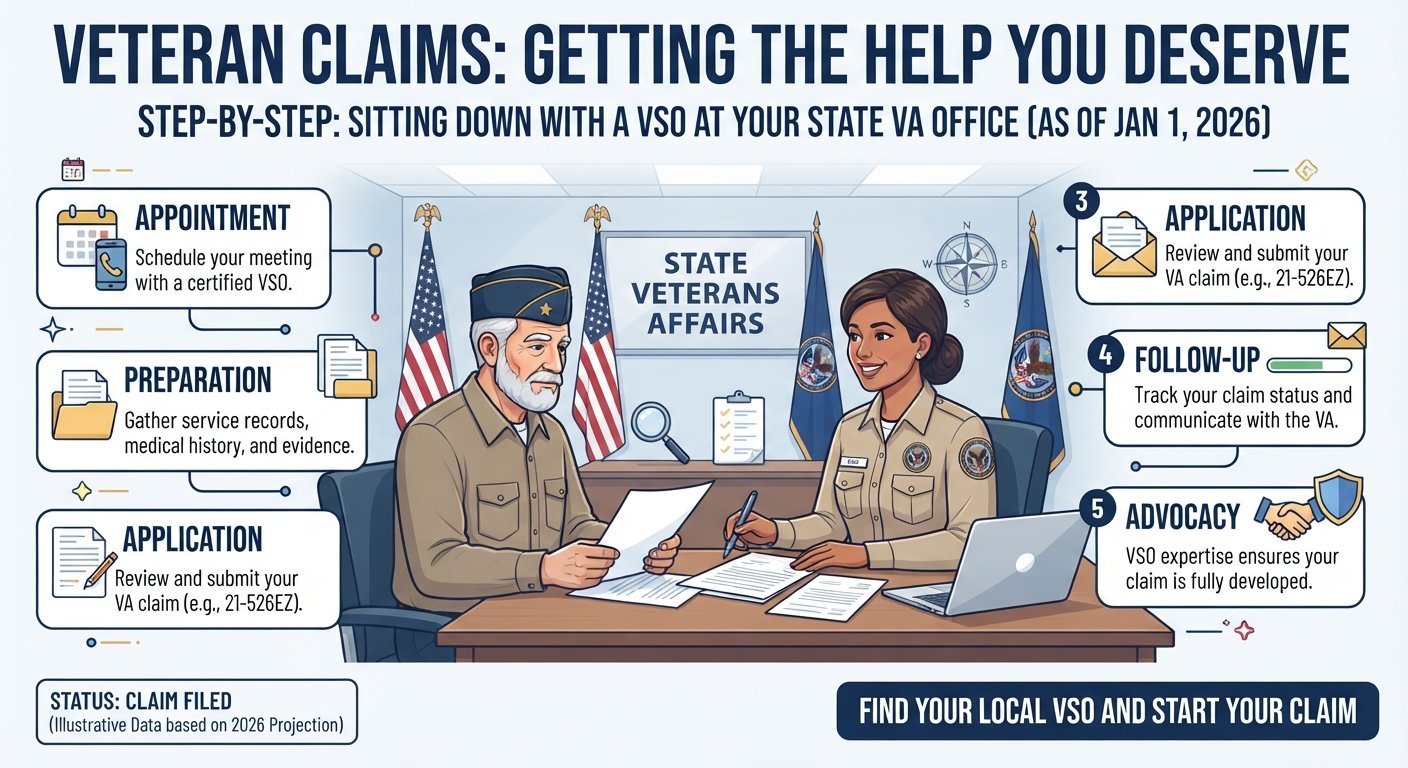
Initial Intake: You will sit down with a VSO who will review your service history and discuss any physical or mental health conditions you have.
Document Review: The VSO will request your service and medical records.
Claim Development: The VSO will help you determine what conditions to claim and gather “nexus” evidence (linking your condition to your service).
Filing: The VSO will help you complete the necessary forms (like VA Form 21-526EZ) and submit them through the proper channels.
Follow-up: The VSO will help you track your claim’s progress and handle any requests from the VA for additional information (like scheduling a C&P exam) .
Common Questions
1. How do I find a Veterans Service Officer (VSO) near me?
Start by visiting the NASDVA website to find your state’s Department of Veterans Affairs . You can also contact local Veterans Service Organizations (VSOs) like the VFW, DAV, or American Legion, which have accredited representatives who provide free claims assistance .
2. Does my state have a veterans affairs office?
Yes. Every U.S. state, Washington D.C., and several U.S. territories have a state agency dedicated to veterans’ affairs . These agencies belong to the National Association of State Directors of Veterans Affairs (NASDVA) .
3. What is a Veterans Service Officer (VSO) and how can they help?
A VSO is an accredited professional who assists veterans and their families with filing VA claims and appeals . They can help you gather evidence, complete forms, and represent you before the VA. Their services are always free .
4. How much does a Veterans Service Officer cost?
Nothing. VSOs from state or county veterans affairs offices and accredited veterans service organizations provide their services at no cost to the veteran or their family .
5. Can a VSO help me appeal a denied claim?
Yes, VSOs are specifically trained to assist with appeals. They can help you file a Supplemental Claim, request a Higher-Level Review, or appeal to the Board of Veterans Appeals . In some states, like South Carolina, they are trained in advanced advocacy techniques .
6. What is the difference between a State VA Office and a VA Regional Office?
The State VA Office helps you file your claim and advocates on your behalf. The VA Regional Office is the federal agency that makes the decision on your claim . They are separate entities with different roles.
7. How do I file a VA claim with the help of a VSO?
Contact your local state or county veterans service office to make an appointment. Bring your DD-214, medical records, and photo ID. The VSO will help you fill out VA Form 21-526EZ and submit your claim electronically .
8. What is the phone number for the New York State Veterans hotline?
The New York State Department of Veterans’ Services operates a toll-free hotline at 1-888-VETSNYS (1-800-838-7697) for information on benefits and appointments .
9. How many state VA offices are in Louisiana?
The Louisiana Department of Veterans Affairs (LDVA) has 84 staffed locations across the state, including service offices, veterans homes, and cemeteries . This network ensures veterans across Louisiana can access in-person support.
10. What are the duties of the State Veterans Affairs Board in Mississippi?
Under Mississippi law, the State Veterans Affairs Board is required to assist former and present members of the Armed Forces and their dependents in securing benefits . They also have a legal obligation to process powers of attorney for veterans claims within 30 days .
11. How do I find the Arkansas Department of Veterans Affairs?
You can contact the Arkansas Department of Veterans Affairs (ADVA) at 501-370-3820 or visit their website at vet.arkansas.gov . They have service officers located across the state to provide free claims assistance.
12. Does NASDVA provide help with VA claims?
The National Association of State Directors of Veterans Affairs (NASDVA) represents the lead state agencies that do provide this help. NASDVA itself is an association, but its member offices—the state departments of veterans affairs—are where veterans go for direct claims assistance .
Key Takeaways
Free, accredited help is available. State Veterans Affairs offices employ VA-accredited Veterans Service Officers (VSOs) who provide free assistance with disability claims, appeals, and other benefits .
Find your local office via NASDVA. Use the National Association of State Directors of Veterans Affairs directory or search “[Your State] Department of Veterans Affairs” to find an office near you .
VSOs are powerful advocates. They are experts in the claims process. They can gather evidence, prepare arguments, and even help with appeals that go to the Board of Veterans Appeals .
Bring your DD-214 and medical records. Having your discharge papers and medical evidence ready will significantly speed up the claims process when you meet with a VSO.
State benefits are also available. In addition to federal claims, state VA offices can help you access state-specific benefits like property tax exemptions, education waivers, and vehicle registration discounts.
Every state participates. All 50 states, Washington D.C., and five U.S. territories have a designated state veterans agency .
Training is ongoing. State offices are continuously improving their services. South Carolina, for example, recently partnered with the National Veterans Legal Services Program to provide advanced training to its claims representatives .
Walk-ins may be available. Many state and county offices, like the Little Rock Regional Office in Arkansas and the Louisiana Department of Veterans Affairs, accept walk-ins or have multiple locations for easy access .
Official Resources
NASDVA (National Association of State Directors of Veterans Affairs) – Directory of all state veterans agencies: https://www.nasdva.us
VA.gov – File claims and manage benefits online: https://www.va.gov
VA Regional Office Locator – https://www.va.gov/find-locations
VA Form 21-526EZ – Initial disability claim form: https://www.va.gov/disability/how-to-file-claim
Veterans Crisis Line – Call 988 (then press 1), text 838255, or chat at VeteransCrisisLine.net
🇺🇸 IMPORTANT DISCLAIMER – Veterans Benefits Information
This site provides general information about U.S. Department of Veterans Affairs (VA) benefits for educational and informational purposes only.
- Not Official: We are NOT affiliated with, endorsed by, or connected to the U.S. Department of Veterans Affairs (VA), the Veterans Benefits Administration (VBA), the Veterans Health Administration (VHA), or any other government agency.
- No Legal/Financial Advice: The content on this website is for informational purposes only and does not constitute legal, financial, or medical advice. VA benefits rules change frequently – always consult with an accredited Veterans Service Officer (VSO) or a qualified professional for your specific situation.
- Official Sources: For official, binding information and to apply for benefits, always visit official .gov websites: VA.gov, Benefits.VA.gov, or SSA.gov.
- No Data Collection: This site does not collect, store, or process any personal information. It does not have login forms, contact forms, or any system to capture user data. We never ask for your Social Security Number, bank details, or any personal information.
- 🚨 Scam Alert: The VA and other government agencies never charge fees for benefit applications. If anyone asks for money to "process" your VA claim, it is a scam. Report it to the VA Office of Inspector General at VA.gov/OIG.
- Advertising: This site uses third-party advertising (Adsterra) to cover operational costs. We do not endorse or guarantee any products or services advertised.
📌 Information provided as of June 2026. Always verify current eligibility and rules with official .gov sources.
This site is not affiliated with the U.S. Department of Veterans Affairs or any government agency. All information is for educational purposes only. Please visit VA.gov for official information.
