
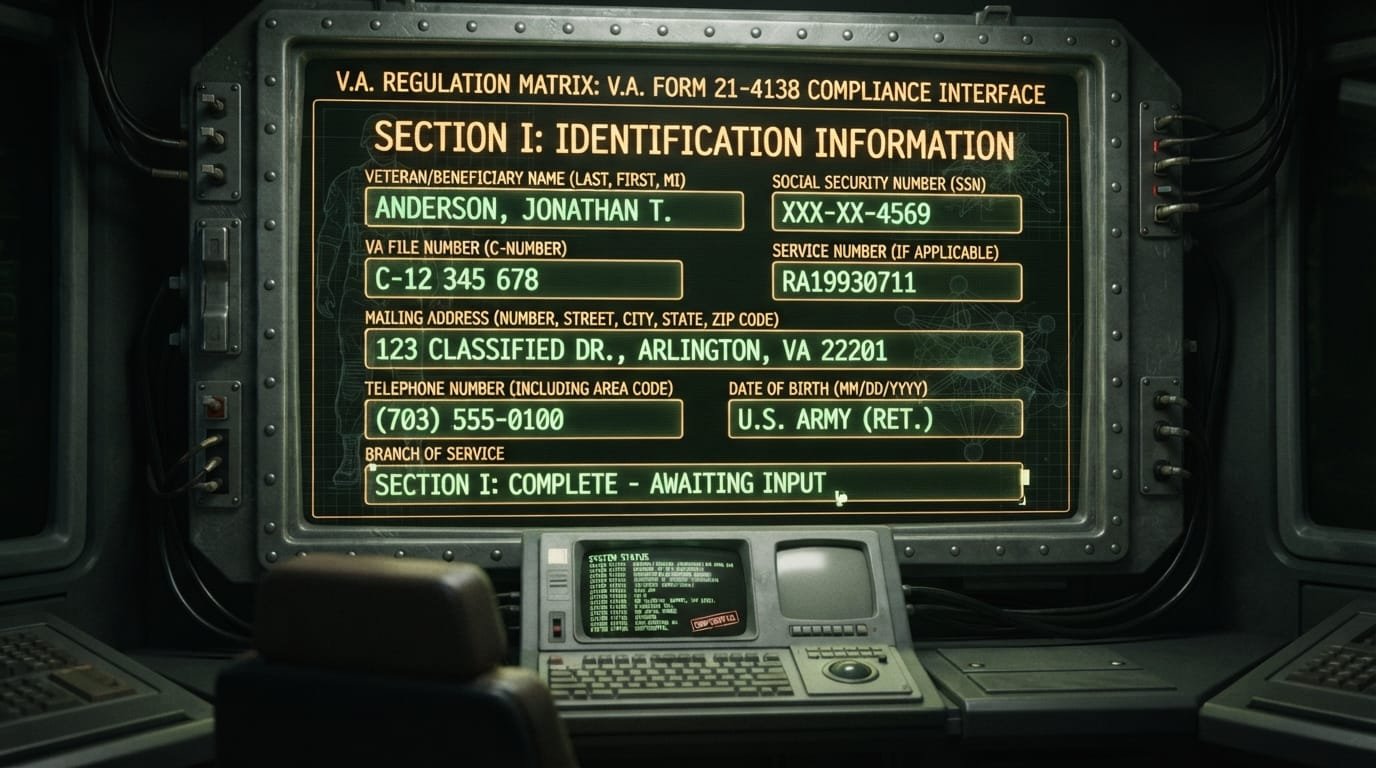
VA Form 21-4138: Complete Guide to Statement in Support of Claim
VA Form 21-4138, Statement in Support of Claim, is a general-purpose lay statement form that lets Veterans provide written testimony about facts related to their VA claim. It is used to share more information as instructed by another VA form or process, including details about family situations, finances, claimed disabilities, and other issues that do not fit on the original claim form.
Quick Facts What Is VA Form 21-4138?

| Item | Details |
|---|---|
| Benefit | Provides written lay evidence to support VA claims |
| Eligibility | Veterans, dependents, and survivors with a pending or future VA claim |
| Application | Download from VA.gov or submit online through the VA online tool |
| Processing Time | Evidence reviewed as part of the underlying claim (100-200+ days) |
| Official Agency | U.S. Department of Veterans Affairs |
| Required Forms | VA Form 21-4138 (primary); VA Form 21-526EZ (underlying claim) |
| Updated For | 2026 |
When Should You Use VA Form 21-4138?
Use VA Form 21-4138 when another VA form or process asks for additional information that doesn’t fit elsewhere. VA specifically lists several situations where this form is appropriate.
When to Use Form 21-4138
To share more details about your family situation or finances for pension, Dependency and Indemnity Compensation, or accrued benefits applications
To tell VA about reimbursement you received after submitting a medical expense report
To share more details about claimed disabilities or other issues that can’t fit on the original claim form
To provide a personal statement describing your in-service event, injury, or how your condition affects daily life
To submit a buddy statement from a fellow service member, family member, or friend who witnessed your condition or the events leading to it
When NOT to Use Form 21-4138
When VA specifically requests Form 21-10210 (Lay/Witness Statement)
For claims involving benefits outside the seven categories listed on the form
When you need to file an initial disability claim (use VA Form 21-526EZ instead)
The Seven Claim Types Covered

According to the form’s instructions, VA Form 21-4138 is designed for use with seven specific claim types:
Disability compensation
Health care
Pension
Housing assistance
Education benefits
Life insurance
Career and employment assistance
For claims outside these categories, VA Form 21-10210 is the preferred form.
VA Form 21-4138 vs. VA Form 21-10210: Key Differences
Both forms submit lay evidence, but they serve different purposes. Choosing the wrong one can slow down your claim.
| Feature | VA Form 21-4138 | VA Form 21-10210 |
|---|---|---|
| Official Name | Statement in Support of Claim | Lay/Witness Statement |
| Primary Use | Claimant’s own statement for specific claim types | Formal statement for any claim type |
| Who Can Use It | Veteran or claimant for their own claim | Veteran for their own claim OR someone else for another’s claim |
| Buddy Statements | Sometimes used, but not designed for it | Designed specifically for buddy statements |
| Claim Categories | Limited to seven claim types | Any claim with the Veterans Benefits Administration |
| Revision Date | July 2024 | Current version on VA.gov |
In 2021, VA formally introduced Form 21-10210 as the preferred form for lay statements. However, Form 21-4138 remains valid, accepted, and widely used by Veterans, VSOs, and accredited claims agents. If VA requests a specific form, use the one they name.
How to Fill Out VA Form 21-4138
Veterans May Qualify for Extra Benefits
Check available financial assistance, healthcare programs and other opportunities that may apply to you.
Check EligibilityVA Form 21-4138 has three main sections: identification information, the statement itself (Remarks), and a declaration of intent with your signature. The form is available as a fillable PDF on VA.gov and can also be submitted through VA’s online tool.
Section I: Identification Information
Provide your basic identifying details so VA can associate the statement with your claim file. Required information includes:
Full name
Social Security number
VA file number (if known)
Date of birth
Service number (if applicable)
Telephone number
Email address (optional)
Mailing address
Critical tip: Always include your VA file number or Social Security number. Without it, VA may not be able to match your statement to your claim.
Section II: Remarks (Your Statement)
This is the main part of the form where you explain your condition, event, or issue in your own words. If you need more space, indicate on the form that an addendum is attached.
Section III: Declaration of Intent
Sign and date the form. Your signature certifies that the statements are true and correct to the best of your knowledge and belief.
How to Write a Strong Statement in Support of Claim
A strong statement is specific, honest, and directly connected to your claimed condition. VA law gives significant weight to lay evidence—testimony from Veterans and witnesses based on personal observation—under 38 CFR § 3.303(a) and § 3.303(b).
The Two Jobs of a Personal Statement
Every effective statement does two things:
Tells the story: Describe the in-service event, injury, or exposure that started your condition.
Shows the impact: Explain how the condition affects your work, sleep, relationships, and daily life today.
A Five-Part Structure That Works
Use this structure to organize your statement:
Part 1: Identify the claim. Open by naming the specific condition this statement addresses. Example: “This statement supports my claim for service connection for PTSD.”
Part 2: Describe the in-service event. Include dates, locations, unit names, and what happened. Be as specific as possible. Example: “On March 15, 2004, while stationed at [location], I witnessed [specific event]. My unit was [unit name].”
Part 3: Describe symptoms from then until now. Explain what symptoms started and how they have progressed. Include treatment history, gaps in treatment, and why gaps occurred.
Part 4: Describe current impact on work and daily life. This is where many statements fall short. Use concrete examples:
“I can no longer attend my child’s school events because crowds trigger panic attacks.”
“I have been written up at work three times in the past year for missing deadlines because I cannot concentrate.”
“My spouse and I sleep in separate rooms because I wake up screaming.”
Part 5: Close with certification. Sign and date the statement.
What to Include
Specific dates, places, and events
Names of units, ships, or duty stations
Concrete examples of how symptoms affect daily functioning
The progression of symptoms over time
Why there may be gaps in treatment records
How the condition affects relationships, work, and self-care
What to Avoid
Vague or general statements (“I have trouble sleeping”)
Medical diagnoses you are not qualified to make
Exaggeration or fabrication
Emotional appeals without factual content
Copying and pasting from other sources
How to Write a Buddy Statement on VA Form 21-4138
A buddy statement is a written account from someone who witnessed your in-service event or has observed how your condition affects you. Fellow service members, spouses, family members, friends, and coworkers can all write buddy statements.
Who Can Write a Buddy Statement
Fellow service members who witnessed the in-service event
Spouses or partners who observe daily symptoms
Family members who have seen changes in behavior
Friends who can describe social withdrawal or isolation
Coworkers or supervisors who have observed performance issues
What a Strong Buddy Statement Includes
The writer’s relationship to you and how long they’ve known you
Specific observations with dates or timeframes
Concrete examples of symptoms or limitations they’ve witnessed
How your condition has changed over time
Their contact information (VA may follow up)
Buddy Statement Example
“I served with [Veteran’s name] in [unit] from [date] to [date]. On [date], I personally witnessed [specific event]. Since then, I have observed [specific symptoms]. For example, on [date], [specific incident]. I believe these symptoms are related to [the in-service event].”
Common Mistakes to Avoid
1. Not Including Your VA File Number or Social Security Number
Without identifying information, VA cannot match your statement to your claim file. Always include your VA file number or SSN.
2. Being Too Vague or General
Specific dates, events, and details strengthen the statement. “I have trouble sleeping” is weak. “I wake up every night at 3 a.m. and cannot fall back asleep for at least two hours” is strong.
3. Not Connecting the Statement to a Specific Claim
Every statement should name the specific condition it supports. Do not write a general statement about your health without linking it to a claimed disability.
4. Submitting the Statement Without Supporting Evidence
A statement is stronger when submitted alongside medical records, buddy statements, and other evidence. Do not rely on the statement alone.
5. Understating Symptoms Out of Pride
Many Veterans minimize their struggles. VA raters evaluate your worst days, not your best. Be honest about the full impact of your condition.
6. Using the Wrong Form
If VA requests Form 21-10210, use that form. If you are writing a buddy statement, Form 21-10210 is preferred. Using the wrong form can delay processing.
7. Not Signing and Dating the Form
An unsigned or undated form is not valid. Section III requires your signature and date to certify the statement.
How to Submit VA Form 21-4138
Online Submission
You can submit your statement online instead of filling out and sending the paper form. VA.gov provides an online tool for this purpose.
By Mail
Mail the completed form to the VA regional office handling your claim. Include any supporting documents.
Through Your VSO
Accredited Veterans Service Organizations (VSOs) can submit the form on your behalf. Options include the DAV, VFW, American Legion, and state/county Veterans service officers.
Direct Upload
If you are working with a VSO or accredited representative, they may use Direct Upload to submit your form electronically. This is often the fastest method.
Legal Basis: Why Your Statement Counts
Many Veterans believe their personal statement won’t matter because they don’t have a medical degree. That is incorrect. VA law gives significant weight to lay evidence under several legal frameworks.
38 CFR § 3.303(a) — Direct Service Connection
Service connection may be established by showing a present disability, in-service incurrence or aggravation of a disease or injury, and a nexus between the in-service event and the current disability. Your personal statement is direct evidence of the in-service incurrence element—you are the primary witness to what happened to you during service.
38 CFR § 3.303(b) — Chronicity and Continuity
For conditions that were chronic during service, VA may presume continuity after service. Your personal statement can establish that you experienced continuous symptoms from service to the present, bridging gaps in treatment records.
Jandreau v. Nicholson (Fed. Cir. 2007)
The Federal Circuit held that a Veteran’s lay testimony about an in-service injury is competent lay evidence, even on medical questions, when the Veteran is capable of personally observing the symptoms described. This means VA cannot dismiss your statement simply because you are not a doctor.
Common Questions
What is VA Form 21-4138?
VA Form 21-4138 is a Statement in Support of Claim. It is a general-purpose lay statement form used to provide written testimony about facts related to a VA claim. VA describes it as a form to share more information as instructed by another VA form or process.
Is VA Form 21-4138 still valid in 2026?
Yes. The form has a July 2024 revision date and remains accepted by VA. While Form 21-10210 is the preferred form for lay statements since 2021, Form 21-4138 is still valid and widely used.
What is the difference between 21-4138 and 21-10210?
Form 21-4138 is for your own statement supporting specific claim types. Form 21-10210 is for formal lay or witness statements, including buddy statements, and can be used for any claim type. Form 21-10210 is VA’s preferred form for lay evidence.
Who can use VA Form 21-4138?
Veterans, dependents, and survivors can use it to provide additional information for claims related to disability, health care, pension, housing, education, life insurance, or employment.
Can I use VA Form 21-4138 for a buddy statement?
You can, but Form 21-10210 is the preferred form. If you are writing a statement for someone else’s claim, use Form 21-10210.
How do I write a strong statement?
Be specific with dates, places, and concrete examples. Describe both the in-service event and how your condition affects your daily life today. Use the five-part structure: identify the claim, describe the event, describe symptoms, describe impact, and certify.
Do I need to include medical records with my statement?
It is not required, but it strengthens your claim. Submit your statement alongside medical records, buddy statements, and other supporting evidence.
Can I submit VA Form 21-4138 online?
Yes. VA.gov provides an online tool for submitting statements. You can also mail the paper form or submit through your VSO.
How long does VA take to review my statement?
Your statement is reviewed as part of the underlying claim. Initial claims typically take 100-200 days. Rating increases take 100-150 days.
What happens if I don’t include my VA file number?
VA may not be able to associate your statement with your claim file. Always include your VA file number or Social Security number.
Can my spouse write a statement?
Yes. Your spouse can write a buddy statement describing how your condition affects your relationship and daily life. Use Form 21-10210 for this purpose.
What if I need more space on the form?
You can attach an addendum. Indicate on Form 21-4138 that an addendum is attached. Many Veterans submit their statement as a separate typed document.
Is lay evidence really considered by VA?
Yes. Under 38 CFR § 3.303 and Jandreau v. Nicholson, VA must consider competent lay evidence about symptoms you can personally observe. Your statement is direct evidence of your in-service event and current symptoms.
What is the most common mistake Veterans make?
Being too vague. “I have back pain” is weak. “I have sharp pain in my lower back that shoots down my left leg, makes it impossible to sit for more than 20 minutes, and has caused me to miss work three times this month” is strong.
Can I submit multiple statements?
Yes. You can submit multiple statements as needed throughout the claims process. Each statement should address a specific condition or issue.
How do I know if my statement helped my claim?
You may receive a decision letter that references the evidence you submitted. If VA assigns a higher rating or grants service connection, your statement likely contributed.
What if I disagree with VA’s decision?
You have three appeal options: Supplemental Claim (VA Form 20-0995), Higher-Level Review (VA Form 20-0996), or Board Appeal (VA Form 10182). You generally have one year from the decision letter to appeal.
Can a VSO help me fill out the form?
Yes. Accredited VSOs provide free assistance with filling out forms and building claims. Options include the DAV, VFW, American Legion, and state/county Veterans service officers.
Do I need to use the official form?
No. VA accepts statements on a blank piece of paper. However, using the official form helps ensure proper tracking and processing. The key legal requirements are that the statement be signed, dated, and submitted as part of the official claim package.
How long should my statement be?
There is no word limit. A strong statement is typically one to three pages. Focus on quality over quantity—specific, factual details matter more than length.
Key Takeaways
VA Form 21-4138 is a Statement in Support of Claim used to provide written testimony about facts related to a VA claim.
The form is designed for seven claim types: disability compensation, health care, pension, housing assistance, education benefits, life insurance, and employment assistance.
Form 21-4138 remains valid despite VA introducing Form 21-10210 as the preferred form for lay statements in 2021.
A strong statement does two things: describes the in-service event and describes how the condition affects daily life now.
Use specific dates, places, and concrete examples. Vague statements are weak statements.
Always include your VA file number or Social Security number so VA can match your statement to your claim.
Under 38 CFR § 3.303 and Jandreau v. Nicholson, VA must give weight to competent lay evidence about observable symptoms.
For buddy statements, Form 21-10210 is preferred. Form 21-4138 is for your own statement.
Common mistakes include being too vague, not linking the statement to a specific claim, and understating symptoms.
You can submit Form 21-4138 online through VA.gov, by mail, or through your VSO.
Official Resources
VA Form 21-4138 (Statement in Support of Claim): va.gov/forms/21-4138
VA Form 21-10210 (Lay/Witness Statement): va.gov/forms/21-10210
VA Form 21-526EZ (Disability Compensation Application): va.gov/forms/21-526EZ
Evidence Needed for Your Disability Claim: va.gov/disability/how-to-file-claim/evidence-needed
VA Decision Reviews and Appeals: va.gov/decision-reviews
38 CFR § 3.303 (Service Connection): ecfr.gov
VA Forms Search: va.gov/find-forms




🇺🇸 IMPORTANT DISCLAIMER – Veterans Benefits Information
This site provides general information about U.S. Department of Veterans Affairs (VA) benefits for educational and informational purposes only.
- Not Official: We are NOT affiliated with, endorsed by, or connected to the U.S. Department of Veterans Affairs (VA), the Veterans Benefits Administration (VBA), the Veterans Health Administration (VHA), or any other government agency.
- No Legal/Financial Advice: The content on this website is for informational purposes only and does not constitute legal, financial, or medical advice. VA benefits rules change frequently – always consult with an accredited Veterans Service Officer (VSO) or a qualified professional for your specific situation.
- Official Sources: For official, binding information and to apply for benefits, always visit official .gov websites: VA.gov, Benefits.VA.gov, or SSA.gov.
- No Data Collection: This site does not collect, store, or process any personal information. It does not have login forms, contact forms, or any system to capture user data. We never ask for your Social Security Number, bank details, or any personal information.
- 🚨 Scam Alert: The VA and other government agencies never charge fees for benefit applications. If anyone asks for money to "process" your VA claim, it is a scam. Report it to the VA Office of Inspector General at VA.gov/OIG.
- Advertising: This site uses third-party advertising (Adsterra) to cover operational costs. We do not endorse or guarantee any products or services advertised.
📌 Information provided as of June 2026. Always verify current eligibility and rules with official .gov sources.
This site is not affiliated with the U.S. Department of Veterans Affairs or any government agency. All information is for educational purposes only. Please visit VA.gov for official information.
