
VA Hospice Benefits: Complete 2026 Guide to End-of-Life Care
VA hospice benefits provide comfort-focused care at no cost to enrolled Veterans with a terminal illness and a life expectancy of six months or less. Services include skilled nursing, pain management, respite care, and bereavement support for families. Hospice is part of the VHA Standard Medical Benefits Package and does not require service connection.
Quick Facts What Are VA Hospice Benefits?
| Item | Details |
|---|---|
| Benefit | No-cost hospice and palliative care for terminally ill Veterans |
| Eligibility | Enrolled in VA health care; terminal prognosis of 6 months or less; comfort-focused goals |
| Application | Contact VA primary care provider or social worker for referral |
| Processing Time | Referral review within 24 hours to 1 business week |
| Official Agency | Veterans Health Administration (VHA), U.S. Department of Veterans Affairs |
| Required Forms | VA Form 10-10EZ (if not enrolled); DD-214; advance directives |
| Updated For | 2026 |
What Is Hospice Care?
Hospice care is comfort-focused care for Veterans with a terminal condition and a life expectancy of six months or less who are no longer seeking curative treatment. It addresses physical, emotional, and spiritual needs through an interdisciplinary team of doctors, nurses, social workers, chaplains, and therapists.

Hospice is not the same as palliative care. Palliative care can be provided at any stage of illness—even alongside active treatment—and does not require a terminal prognosis. Hospice is a type of palliative care specifically for the final months of life.
Why It Matters

Hospice care improves quality of life for terminally ill Veterans and their families. It manages pain, controls symptoms, and provides emotional and spiritual support during a difficult time. For Veterans carrying service-related trauma, hospice teams trained in military culture can address issues that civilian providers may miss.
Who Qualifies for VA Hospice Benefits?
All enrolled Veterans qualify for hospice care if they meet the clinical need for the service, as determined by a VA physician. There are no copays for hospice care, whether provided by VA or an organization with a VA contract.
Eligibility Requirements
To qualify for VA hospice benefits, a Veteran must:
Be enrolled in VA health care
Have a diagnosis of a life-limiting or terminal illness with a life expectancy of six months or less if the disease runs its normal course
Agree to focus on comfort care rather than curative treatment
Have this prognosis certified by two physicians, including a VA physician
Does the Illness Need to Be Service-Connected?
No. Hospice benefits are available to all enrolled Veterans regardless of whether the terminal illness is service connected. This is a critical point—Veterans do not need a VA disability rating to receive hospice care.
Basic VA Health Care Enrollment
Veterans May Qualify for Extra Benefits
Check available financial assistance, healthcare programs and other opportunities that may apply to you.
Check EligibilityIf the Veteran is not already enrolled in VA health care, they must first apply using VA Form 10-10EZ. Eligibility for VA health care generally requires:
Service in the active military, naval, or air service
Separation under conditions other than dishonorable
Meeting minimum service requirements (generally 24 continuous months for post-1980 enlistees)
What Services Does VA Hospice Cover?
VA hospice covers comprehensive medical, emotional, and practical support for the Veteran and their family at no cost. Services are available 24/7, 365 days a year, in all settings where Veterans call home—including private residences, nursing homes, and VA inpatient units.
Medical Services
Regular nursing visits to monitor condition and provide care
Physician oversight and home visits when needed
24/7 on-call nursing support for emergencies
Crisis care when symptoms become difficult to manage at home
Short-term inpatient care for symptom management
Physical, occupational, and speech therapy
Emotional and Spiritual Support
Psychological counseling
Multi-denominational pastoral care
Social work support
Bereavement services for families for 13 months after the Veteran’s passing
Practical Support
Nutrition support
Pharmacy services for symptom management
Respite care to give family caregivers a break
Durable medical equipment (hospital beds, wheelchairs, oxygen)
Four Levels of Hospice Care
| Level of Care | What It Provides |
|---|---|
| Routine Home Care | Regular visits from hospice team at home |
| Continuous Home Care | Intensive care during a crisis at home |
| General Inpatient Care | Short-term hospital care for symptom management |
| Respite Care | Up to 5 days at a time to relieve family caregivers |
What Does VA Hospice Cost?
VA hospice care costs nothing for enrolled Veterans. There are no copays for hospice care, whether it is provided directly by VA or through a VA-contracted community hospice agency.
For Veterans using CHAMPVA (for spouses and dependents), hospice services are reimbursed at 100% of the allowable amount for all four levels of care.
Medications and Equipment
The hospice agency covers medications related to the terminal diagnosis. VA provides medications for conditions unrelated to the hospice diagnosis. The same split applies to durable medical equipment—the hospice agency covers equipment related to the terminal illness, and VA covers equipment for other conditions.
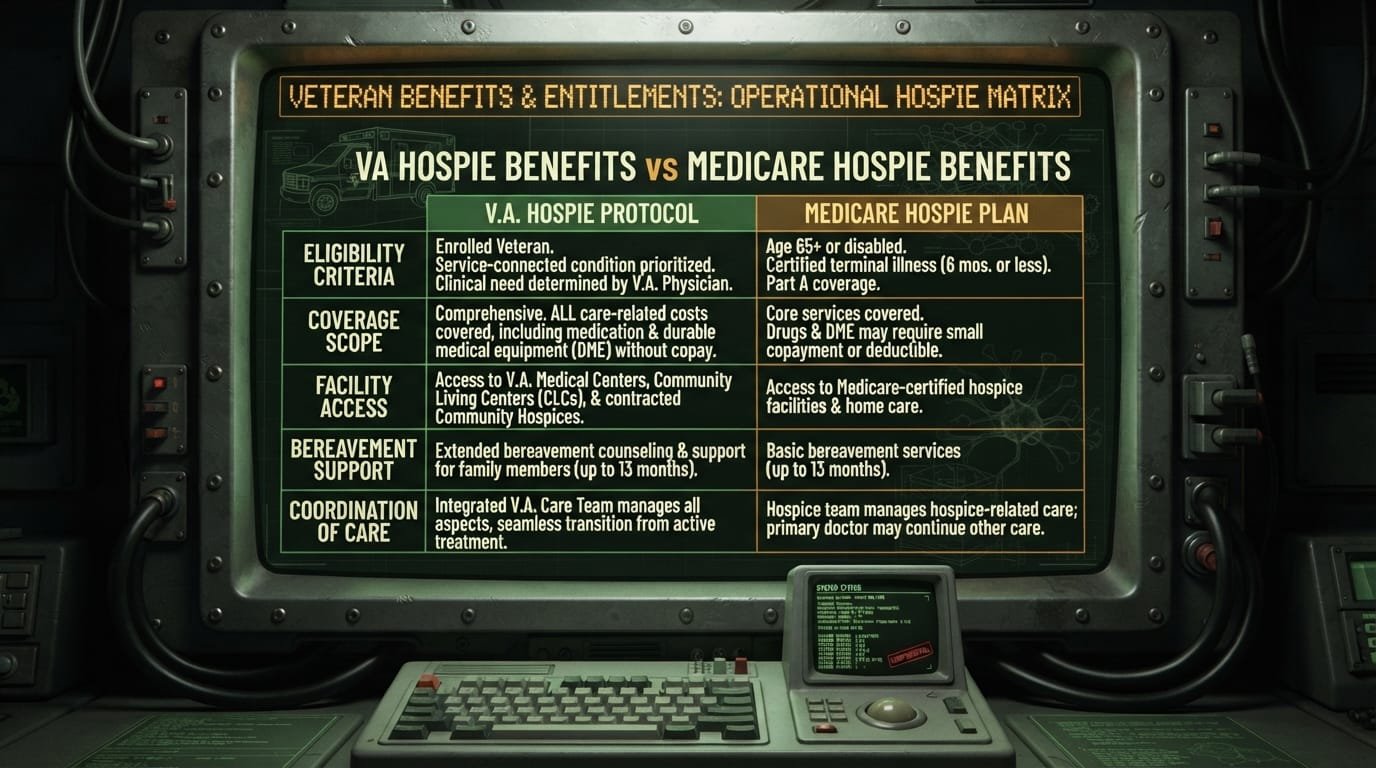
VA Hospice vs. Medicare Hospice: Key Differences
Veterans who are eligible for both VA benefits and Medicare can choose which hospice benefit to use. The two programs have important differences.
| Feature | VA Hospice | Medicare Hospice |
|---|---|---|
| Cost | No copays | May have copays for respite care and medications |
| Concurrent care | VA allows continued treatment for the terminal illness | Medicare requires waiver of curative treatment |
| Respite care limit | No annual limit specified | Limited to 5 days per respite period |
| Payer | VA | Medicare Part A |
| Eligibility | Enrolled in VA health care | Medicare Part A enrollee |
| Care settings | Home, VA facility, community nursing home | Home, hospice facility, nursing home |
Can Veterans Use Both VA and Medicare Hospice?
Yes, with limits. A Veteran who elects the Medicare hospice benefit waives the right to Medicare payment for services related to the terminal illness. However, the Veteran can still receive VA care and benefits for services not related to the hospice diagnosis.
This means:
Medicare pays for hospice services related to the terminal illness
VA continues to provide care for other conditions
VA may cover some hospice-related services that Medicare does not cover
VA’s approach to concurrent care is more flexible than Medicare’s. VA allows Veterans to receive hospice care AND ongoing treatment aimed at improving quality of life—including chemotherapy or radiation in some cases—as long as the care is palliative in intent.
How to Apply for VA Hospice Benefits
Applying for VA hospice benefits starts with a conversation with the Veteran’s VA care team. There is no separate application form for hospice—the process begins with a referral from a VA provider.
Step-by-Step Process
Talk to your VA primary care provider or social worker. Ask about hospice eligibility and request a referral.
VA physician certifies prognosis. A VA physician must confirm a life expectancy of six months or less if the illness runs its normal course.
Develop a care plan. The Veteran, family, and hospice team meet to create a plan addressing medical, social, spiritual, and psychological needs.
Choose a hospice setting. Hospice can be provided at home (private residence or nursing home), in a VA inpatient unit, or through a VA-contracted community hospice agency.
Begin services. Care typically begins within days of the referral and care plan development.
Required Documents
DD-214 or other military separation documents
VA Form 10-10EZ (if not already enrolled in VA health care)
Advance directives (living will, durable power of attorney for health care)
Social Security number
Health insurance information (Medicare, private insurance)
Referral Timeline
Referrals are reviewed within 24 hours when possible. If additional clinical information is needed, the process may take up to one business week.
How to Request a Referral
Ask your doctor, social worker, or another member of your VA care team to contact the patient transfer coordinator at your local VA medical center. For Veterans already enrolled in VA care, this is the fastest path to hospice services.
How to Pay for Care: Aid and Attendance and Other VA Benefits
VA Aid and Attendance is a pension benefit that provides additional monthly income to eligible wartime Veterans who need help with daily activities like bathing, dressing, and eating. It is not a hospice benefit, but it can continue alongside hospice enrollment to help cover personal care and assisted living costs.
2026 Aid and Attendance Rates
| Category | Monthly Rate |
|---|---|
| Single Veteran | $2,424 |
| Married Veteran (spouse needs care) | $1,903 |
| Married Veteran (with care needs) | $2,874 |
| Married Veterans (both need care) | $3,845 |
| Surviving Spouse | $1,558 |
Source: VA pension rates effective December 1, 2025.
Who Qualifies for Aid and Attendance
To qualify, a Veteran must:
Receive a VA pension
Need help with at least one activity of daily living (bathing, dressing, eating, toileting)
OR be bedridden
OR have severely limited vision
OR be in a nursing home due to disability
Important Note for Hospice Veterans
Since Aid and Attendance processing can take several months, Veterans on home hospice with a very short prognosis may not receive the benefit in time to use it. However, for Veterans with longer prognoses, the benefit can help them remain at home longer.
VA Disability Compensation Continues
VA disability compensation benefits are not reduced or affected by entering hospice care. If a Veteran receives VA disability compensation, those payments continue unchanged during hospice enrollment.
Expedited VA Claims for Terminally Ill Veterans
VA prioritizes disability claims from terminally ill Veterans. Claims may qualify for expedited review if the Veteran has a terminal diagnosis, a severe or rapidly progressing illness, or advanced age combined with serious health conditions.
How to Request Expedited Processing
Submit medical documentation confirming the diagnosis—such as a doctor’s note or treatment record—along with the claim. VA will move the case to the front of the processing queue.
What If the Veteran Passes Before the Claim Is Decided?
If a Veteran passes away while a VA disability claim is pending, their spouse can step in as a substitute claimant. If the claim is later approved, the spouse can retroactively receive any compensation the Veteran would have been entitled to before death.
Burial Benefits for Veterans in Hospice Care
VA provides burial allowances for eligible Veterans, including those who die while receiving VA-furnished hospice care at home. Under a temporary expansion effective through October 1, 2026, Veterans discharged from VA medical or nursing care to receive VA-provided hospice care at home—and who pass away between July 1, 2025, and October 1, 2026—are eligible for burial benefits even though they died outside a VA facility.
Gerald’s Law
Congress passed Gerald’s Law to fix a loophole that denied burial benefits to Veterans who died at home while receiving VA hospice care. The law was named after Gerald Elliott, a Navy Veteran who died at home in 2015 while under VA hospice care but was denied burial benefits because he was not at a VA facility. The benefit is currently set to expire in October 2026, but legislation has been introduced to extend it through 2030 or make it permanent.
Burial Benefits Available
Burial allowance (up to $2,000 for service-connected deaths; $300 for non-service-connected deaths plus plot allowance)
Headstone or marker
Burial flag
Burial in a VA national cemetery at no cost to the family
Caregiver Support During Hospice
The VA Caregiver Support Program provides resources, training, and financial support to family caregivers of Veterans, including those in hospice care.
Services Available
Respite care: Up to 30 days per calendar year of inpatient respite at a VA-contracted nursing home
Bereavement counseling: No-cost support for spouses, children, and family caregivers after the Veteran’s passing
Caregiver support line: Call 855-260-3274 to connect with a support coordinator
Training and education: Resources to help caregivers provide care
Monthly stipend: Available to qualifying post-9/11 caregivers through the VA Caregiver Support Program
Veterans Decision Aid
VA offers a Veteran Decision Aid for Care at Home or in the Community to help Veterans and families determine which home care services or long-term care services best meet current or future needs.
Survivor Benefits After the Veteran Passes
When a Veteran dies, surviving spouses and dependents may be eligible for several VA benefits.
Dependency and Indemnity Compensation (DIC)
DIC is monthly compensation paid to surviving spouses and dependents of Veterans whose death was connected to military service. For 2026, surviving spouses receive $1,699 per month.
Survivors Pension
The VA Survivors Pension provides monthly payments to low-income, unremarried surviving spouses and dependent children of deceased wartime Veterans.
Other Benefits
Burial and memorial benefits (as described above)
Bereavement counseling for family members
Education benefits (if the Veteran had a 100% permanent and total rating)
Health care through CHAMPVA for qualifying dependents
Common Mistakes to Avoid
Waiting too long to ask about hospice. Hospice is most beneficial when started early. If a VA physician estimates six months or less, don’t delay the referral.
Assuming hospice means giving up all treatment. VA allows concurrent care—hospice services can continue alongside certain treatments aimed at quality of life.
Thinking the illness must be service-connected. Hospice benefits are available regardless of service connection. All enrolled Veterans qualify if they meet the clinical need.
Not telling the family about bereavement support. VA provides bereavement services for 13 months after the Veteran’s passing. Families should ask about this.
Forgetting to apply for Aid and Attendance. If the Veteran needs help with daily activities, A&A can provide additional monthly income. Apply early since processing takes time.
Not asking about burial benefits. If the Veteran dies at home while receiving VA hospice care, family members should ask about burial allowances before making arrangements.
Missing the Medicare/VA coordination. If the Veteran has both Medicare and VA benefits, understand which payer covers which services. Electing Medicare hospice does not terminate VA eligibility.
Not designating a substitute claimant. If a disability claim is pending and the Veteran passes, the spouse should immediately file to substitute as claimant to preserve back pay rights.
Assuming all hospice agencies are the same. Choose a hospice agency that participates in the We Honor Veterans program or has specific training in military culture and trauma-informed care.
Not discussing advance care planning. Advance directives help ensure the Veteran’s wishes are honored and reduce stress on family members.
Appeals Process for VA Benefit Denials
If VA denies a benefit related to hospice care—such as Aid and Attendance, disability compensation, or burial benefits—Veterans and survivors have appeal options.
Three Review Options
Supplemental Claim (VA Form 20-0995): Submit new and relevant evidence for a new decision
Higher-Level Review (VA Form 20-0996): Request a senior reviewer to examine your case based on the existing evidence
Board Appeal (VA Form 10182): Appeal directly to the Board of Veterans’ Appeals
Deadlines
One year from the date of a VA decision letter to file a Notice of Disagreement
60 days for Board of Veterans’ Appeals decisions
Getting Help with Appeals
Accredited Veterans Service Organizations (VSOs) provide free representation. Options include the DAV, VFW, American Legion, Wounded Warrior Project, and state/county Veterans service officers.
Common Questions
What are VA hospice benefits?
VA hospice benefits provide comfort-focused care at no cost to enrolled Veterans with a terminal illness and a life expectancy of six months or less. Services include skilled nursing, pain management, respite care, and bereavement support.
Who qualifies for VA hospice care?
All enrolled Veterans qualify if they have a terminal diagnosis with a prognosis of six months or less and are focusing on comfort care rather than curative treatment. The illness does not need to be service connected.
Is VA hospice free?
Yes. There are no copays for hospice care, whether it is provided by VA directly or through a VA-contracted community hospice agency.
Does VA hospice cover home care?
Yes. Hospice care can be provided at home, in a VA inpatient unit, or through a VA-contracted community hospice agency. Most Veterans prefer to receive hospice care at home.
Can I receive VA hospice and Medicare hospice at the same time?
Veterans can receive VA hospice or Medicare hospice. If you elect Medicare hospice for your terminal illness, you waive Medicare payment for services related to that illness. However, you can still receive VA care for other conditions.
Does entering hospice affect my VA disability compensation?
No. VA disability compensation continues unchanged when a Veteran enters hospice care.
What is concurrent care at the VA?
Concurrent care allows Veterans to receive hospice services while continuing certain treatments aimed at improving quality of life. VA allows this—unlike Medicare, which requires waiving curative treatment.
How do I apply for VA hospice care?
Talk to your VA primary care provider or social worker. They will initiate a referral. A VA physician must certify a life expectancy of six months or less.
What is Aid and Attendance?
Aid and Attendance is a VA pension benefit for wartime Veterans who need help with daily activities like bathing and dressing. It provides additional monthly income and can continue alongside hospice enrollment.
Does VA provide bereavement support?
Yes. VA provides bereavement services for families for 13 months after the Veteran’s passing. This includes counseling and support groups at no cost.
What burial benefits are available for Veterans in hospice?
Veterans who die at home while receiving VA hospice care may be eligible for burial allowances, headstones, and burial in a VA national cemetery. The temporary expansion of this benefit is set to expire October 1, 2026.
Can a spouse continue a VA claim after the Veteran passes?
Yes. If a Veteran passes while a disability claim is pending, the spouse can file to substitute as claimant. If the claim is approved, the spouse can receive retroactive compensation.
What is the VA Caregiver Support Program?
The VA Caregiver Support Program provides resources, training, respite care, and financial support to family caregivers of Veterans. Call 855-260-3274 to connect with a support coordinator.
What is the difference between hospice and palliative care?
Palliative care can be provided at any stage of illness and alongside active treatment. Hospice is a type of palliative care for Veterans with a terminal prognosis of six months or less.
Can a Veteran on hospice still receive VA health care for other conditions?
Yes. VA continues to provide care for conditions unrelated to the terminal illness. The hospice agency covers care related to the terminal diagnosis.
Key Takeaways
VA hospice benefits provide no-cost comfort care to enrolled Veterans with a terminal illness and a prognosis of six months or less.
The terminal illness does not need to be service connected. All enrolled Veterans qualify if they meet the clinical need.
Hospice services include nursing care, pain management, respite care, bereavement support, and four levels of care.
There are no copays for hospice care, whether provided by VA or a VA-contracted community agency.
VA allows concurrent care—hospice plus quality-of-life treatments—while Medicare requires waiving curative treatment.
Aid and Attendance can continue alongside hospice to help cover personal care costs.
VA disability compensation continues unchanged during hospice enrollment.
Burial benefits are temporarily expanded for Veterans who die at home while receiving VA hospice care (through October 1, 2026).
Bereavement services are available to families for 13 months after the Veteran’s passing.
To start hospice, contact your VA primary care provider or social worker for a referral.
Official Resources
VA Hospice and Palliative Care: va.gov/geriatrics
VA Form 10-10EZ: va.gov/forms/10-10ez
VA Caregiver Support: caregiver.va.gov
VA Aid and Attendance: va.gov/pension/aid-attendance-housebound
VA Burial Benefits: va.gov/burials-memorials
VA Survivor Benefits: va.gov/family-member-benefits
VA Disability Compensation: va.gov/disability
We Honor Veterans: wehonorveterans.org
VA Decision Reviews and Appeals: va.gov/decision-reviews




🇺🇸 IMPORTANT DISCLAIMER – Veterans Benefits Information
This site provides general information about U.S. Department of Veterans Affairs (VA) benefits for educational and informational purposes only.
- Not Official: We are NOT affiliated with, endorsed by, or connected to the U.S. Department of Veterans Affairs (VA), the Veterans Benefits Administration (VBA), the Veterans Health Administration (VHA), or any other government agency.
- No Legal/Financial Advice: The content on this website is for informational purposes only and does not constitute legal, financial, or medical advice. VA benefits rules change frequently – always consult with an accredited Veterans Service Officer (VSO) or a qualified professional for your specific situation.
- Official Sources: For official, binding information and to apply for benefits, always visit official .gov websites: VA.gov, Benefits.VA.gov, or SSA.gov.
- No Data Collection: This site does not collect, store, or process any personal information. It does not have login forms, contact forms, or any system to capture user data. We never ask for your Social Security Number, bank details, or any personal information.
- 🚨 Scam Alert: The VA and other government agencies never charge fees for benefit applications. If anyone asks for money to "process" your VA claim, it is a scam. Report it to the VA Office of Inspector General at VA.gov/OIG.
- Advertising: This site uses third-party advertising (Adsterra) to cover operational costs. We do not endorse or guarantee any products or services advertised.
📌 Information provided as of June 2026. Always verify current eligibility and rules with official .gov sources.
This site is not affiliated with the U.S. Department of Veterans Affairs or any government agency. All information is for educational purposes only. Please visit VA.gov for official information.
