
VA Loan Guide: Eligibility, Requirements and How It Works
A VA loan is a mortgage backed by the U.S. Department of Veterans Affairs that offers no down payment, no private mortgage insurance, and competitive interest rates for eligible Veterans, active-duty service members, and surviving spouses. In 2026, the baseline loan limit is $832,750 for most U.S. counties. You must obtain a Certificate of Eligibility (COE) before applying. The VA guarantees up to 25% of the loan amount to your lender.
Quick Facts
| Item | Details |
|---|---|
| Benefit | VA-guaranteed home loan with no down payment and no PMI |
| Eligibility | Veterans, active-duty service members, National Guard, Reserves, and certain surviving spouses |
| Application | Obtain COE via VA.gov or lender, then apply with a VA-approved lender |
| Processing Time | COE typically issued within days to weeks; appraisal averages 7 business days |
| Official Agency | U.S. Department of Veterans Affairs (VA) |
| Required Forms | VA Form 26-1880 (COE request), DD-214, statement of service (if active duty) |
| Updated For | 2026 |
What Is a VA Loan and How Does It Work?
A VA loan is a mortgage loan guaranteed by the U.S. Department of Veterans Affairs, available to eligible Veterans, active-duty service members, National Guard and Reserve members, and certain surviving spouses. The VA does not lend money directly. Instead, it promises the lender that if you default, VA will cover part of the loss — up to 25% of the loan amount for a borrower with full entitlement, under 38 U.S.C. 3703.

That 25% guaranty replaces the down payment and mortgage insurance a conventional or FHA loan would require. Because the lender is protected either way, it can offer terms that are difficult to match elsewhere:
No down payment, as long as the appraised value supports the sales price.
No private mortgage insurance (PMI) and no monthly mortgage insurance premium.
Competitive interest rates that are often lower than conventional loans.
Fewer closing costs, with VA limits on what you can be charged.
No penalty for paying the loan off early.

The VA loan benefit is reusable and lasts a lifetime. You can use it more than once, though subsequent uses may carry a higher funding fee unless you have remaining entitlement or restore it by paying off the previous loan.
2026 VA Loan Limits
The 2026 baseline conforming loan limit for VA loans is $832,750 in most U.S. counties, up 3.3% from $806,500 in 2025. High-cost counties have a ceiling of $1,249,125, up from $1,209,750 in 2025. Two Hawaii counties — Maui and Kalawao — have limits up to $1,299,500, the actual national maximum for 2026.
Full Entitlement vs. Remaining Entitlement
Most first-time VA loan users have what is called full entitlement. This means the VA will guarantee up to 25% of whatever loan amount the lender approves, regardless of county limits.
If you have an existing VA loan you are still paying back, you have remaining entitlement. The VA limits its guarantee to 25% of the applicable FHFA county loan limit minus the entitlement you already used. You can still get a VA loan using remaining entitlement, but you may need to make a down payment to cover the gap.
| Entitlement Status | Who Has It | Loan Limit Impact |
|---|---|---|
| Full entitlement | First-time VA loan users; Veterans who paid off previous VA loans | No county loan limit — VA guarantees 25% of any loan amount |
| Remaining entitlement | Veterans with an active VA loan | Limited to 25% of county limit minus entitlement already used; down payment may be required |
Who Qualifies for a VA Loan?
Veterans May Qualify for Extra Benefits
Check available financial assistance, healthcare programs and other opportunities that may apply to you.
Check EligibilityYou qualify for a VA loan if you meet service requirements and have a discharge that is other than dishonorable. Eligibility is based on your length of active-duty service and the era in which you served. You do not need to be a first-time homebuyer, and there is no income cap for VA loan eligibility.
Service Requirements by Era
| Era You Served In | Minimum Active Duty |
|---|---|
| Gulf War era (August 2, 1990 to now) | 24 continuous months, or the full period you were called to active duty (at least 90 days) |
| September 8, 1980 to August 1, 1990 | 24 continuous months, or the full period called to active duty (at least 181 days) |
| Vietnam (August 5, 1964 to May 7, 1975) | 90 total days, or fewer if discharged for a service-connected disability |
| Korea (June 27, 1950 to January 31, 1955) | 90 total days, or fewer if discharged for a service-connected disability |
| World War II (September 16, 1940 to July 25, 1947) | 90 total days, or fewer if discharged for a service-connected disability |
Source: VA eligibility guidelines as of 2026.
National Guard and Reserve Eligibility
You may qualify if you have 6 years of service in the National Guard or Reserves, or if you served 90 days of Title 32 orders (with at least 30 consecutive days).
Surviving Spouse Eligibility
Surviving spouses may qualify for a VA loan if they are:
Un-remarried surviving spouses of Veterans who died in service (active, Reserve, or National Guard) or from a service-connected cause.
Surviving spouses who remarried after age 57 (on or after December 16, 2003).
Certain surviving spouses of Veterans who were totally disabled at the time of death.
Certain surviving spouses receiving or eligible for Dependency and Indemnity Compensation (DIC).
Surviving spouses receiving DIC are exempt from the VA funding fee.
Credit and Income Requirements
The VA sets no minimum credit score, but individual lenders do. Most VA lenders look for a score of at least 620, though some accept 580. The VA’s debt-to-income (DTI) guideline is 41% or less. If your DTI exceeds 41%, you can still qualify if your residual income — money left after housing and debt payments — exceeds VA’s table by at least 20%, or your lender justifies the loan in writing.
2026 Residual Income Benchmarks (Loans of $80,000 or More)
| Family Size | Northeast | Midwest | South | West |
|---|---|---|---|---|
| 1 | $450 | $441 | $441 | $491 |
| 2 | $755 | $738 | $738 | $823 |
| 3 | $909 | $889 | $889 | $990 |
| 4 | $1,025 | $1,003 | $1,003 | $1,117 |
Source: VA Lenders Handbook M26-7 Chapter 4.
How to Get a VA Loan: Step-by-Step
Getting a VA loan involves three main stages: obtaining your Certificate of Eligibility, applying with a lender, and closing on the home. The process can take 30 to 45 days from accepted offer to closing under normal circumstances.
Step 1: Obtain Your Certificate of Eligibility (COE)
The COE confirms to your lender that you qualify for the VA home loan benefit. You can request it three ways:
Online through VA.gov — the fastest option. Most Veterans receive their COE within minutes if their records are clean.
By mail using VA Form 26-1880, Request for a Certificate of Eligibility. Mail it to the address for your regional VA loan center.
Through your lender — many VA-approved lenders can request the COE directly through VA’s Web LGY system, often returning it electronically during your first conversation.
Documents you will need to request a COE:
Veterans: DD-214 or other discharge documents.
Active-duty service members: A statement of service signed by your commander, adjutant, or personnel officer.
National Guard members: DD-214 showing activation under 32 USC sections 316, 502, 503, 504, or 505; an annual point statement; or DD220 with orders.
Reserve members: DD-214 or other discharge documents.
Surviving spouses: The Veteran’s DD-214, death certificate, marriage certificate, and proof of DIC eligibility if applicable.
Step 2: Apply with a VA-Approved Lender
VA does not lend money directly. You apply with a bank, credit union, or mortgage company that participates in the VA loan program. The lender underwrites you using VA standards and its own requirements.
What lenders review:
Credit score (typically 580–620 minimum)
Debt-to-income ratio (41% preferred)
Residual income (compared against VA’s regional table)
Employment history (usually at least two years)
Proof of income and assets
Step 3: Complete the VA Appraisal
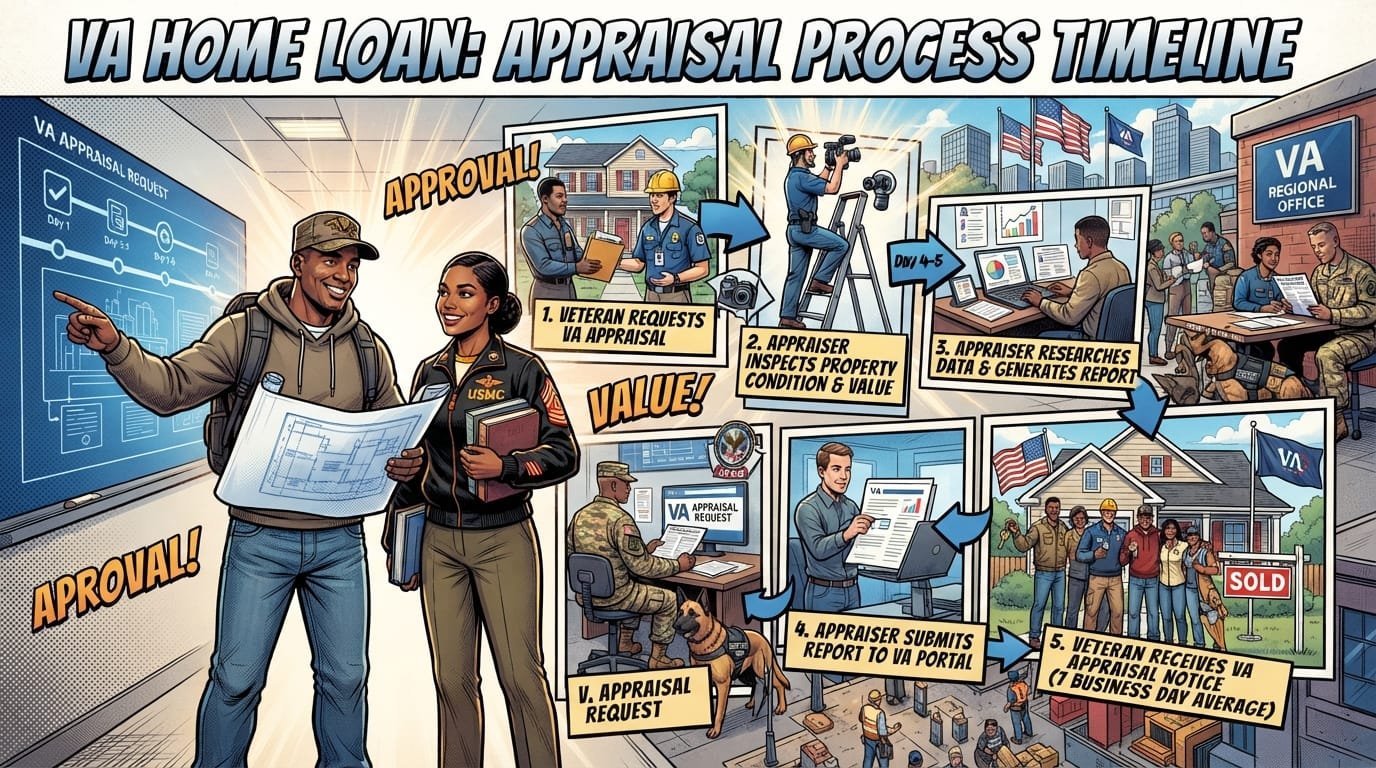
VA requires an appraisal to determine the home’s market value and confirm the property meets VA Minimum Property Requirements (MPRs). A VA-certified appraiser is assigned by the VA. As of 2026, the average VA appraisal takes approximately 7 business days to complete — equal to conventional and FHA appraisal timelines.
The appraisal fee is paid by the buyer and typically ranges from $400 to $1,200 depending on the property and location.
Eligible property types include:
Detached single-family homes and townhomes
Condominiums in VA-approved projects (requires pre-approval or waiver)
Multi-family properties up to four units (if you live in one unit)
Manufactured homes
Proposed or under-construction homes (closing upon completion)
Land-only loans are not permitted.
Step 4: Close on the Home
At closing, you will sign the final loan documents, pay any remaining closing costs, and receive the keys. You must move into the home within a reasonable period after closing — VA loans are for primary residences only.
VA Funding Fee: What You Pay and Who Is Exempt
The VA funding fee is a one-time payment made by borrowers on VA-guaranteed home loans. It helps offset the cost of the program to taxpayers and allows Veterans to benefit from features like no down payment and no monthly private mortgage insurance.
2026 VA Funding Fee Rates
| Loan Use | Down Payment | Funding Fee |
|---|---|---|
| First use | Less than 5% | 2.15% |
| First use | 5% or more | 1.5% |
| First use | 10% or more | 1.25% |
| After first use | Less than 5% | 3.3% |
| After first use | 5% or more | 1.5% |
| After first use | 10% or more | 1.25% |
| Cash-out refinance (first use) | — | 2.15% |
| Cash-out refinance (after first use) | — | 3.3% |
| IRRRL (streamline refinance) | — | 0.5% |
Source: VA funding fee rate charts, 2026.
Who Is Exempt from the Funding Fee?
You do not pay the VA funding fee if any of these apply to you:
You are receiving VA compensation for a service-connected disability.
You are eligible to receive VA compensation but are receiving retirement or active-duty pay instead.
You are receiving certain Dependency and Indemnity Compensation.
You are a service member with a proposed or memorandum rating before closing that confirms eligibility for compensation due to a pre-discharge claim.
You are currently serving on active duty and have received a Purple Heart on or before the loan closing date.
Since 2021, more than half of Veterans who obtained a VA-guaranteed home loan were exempt from the funding fee. Veterans with any level of VA disability compensation (10% or higher) are completely exempt, saving an estimated $4,300 to $10,000 on a typical purchase.
How to Pay the Funding Fee
You can pay the funding fee out-of-pocket at closing or roll it into the loan amount. Rolling it in increases your monthly payment and total interest costs, but it reduces the cash you need at closing. The funding fee is now tax-deductible for borrowers who itemize.
VA Loan Closing Costs
VA loans have lower closing costs than conventional loans because VA limits what lenders can charge. The lender origination fee is capped at 1% of the loan amount. VA also prohibits certain fees that conventional borrowers typically pay, including application fees, rate lock fees, and attorney fees in some cases.
Fees you may pay at closing:
VA appraisal fee ($400–$1,200)
Credit report fee
Title search and title insurance
Recording fees and transfer taxes
Prepaid items (property taxes, homeowners insurance)
VA funding fee (unless exempt)
On a purchase or construction loan, you can finance only the VA funding fee into the loan amount. All other fees must be paid at closing unless the seller agrees to cover them through concessions. Sellers can contribute up to 4% of the home’s fair market value toward your closing costs.
VA Loan Interest Rates in 2026
VA loan interest rates fluctuate daily based on market conditions, your credit score, loan term, and the lender you choose. As of 2026, the national average 30-year fixed VA loan rate has ranged from approximately 5.25% to 6.45% depending on the date and source.
Current rate benchmarks (2026):
| Loan Type | Rate Range |
|---|---|
| 30-year fixed VA purchase | 5.25%–6.45% |
| 15-year fixed VA purchase | 4.75%–5.02% |
| VA IRRRL (refinance) | 5.00%–5.99% |
| 30-year VA refinance APR | 6.43%–6.54% |
The VA does not set interest rates. Each lender sets its own rate based on your credit profile and market conditions. VA loans are often slightly lower than conventional mortgages, but this is not guaranteed. Shop with at least three lenders to compare rates and fees before choosing.
VA Loan Refinancing Options
VA offers two main refinancing options: the Interest Rate Reduction Refinancing Loan (IRRRL) and the VA Cash-Out Refinance.
IRRRL (VA Streamline Refinance)
The IRRRL refinances an existing VA loan to obtain a lower interest rate, lower monthly payment, or convert an adjustable-rate mortgage to a fixed-rate loan. Key features:
Funding fee: 0.5% — the lowest of any VA loan type.
No cash out — you cannot access home equity through an IRRRL.
Limited underwriting — most IRRRLs do not require full underwriting.
Closing costs can be financed into the loan amount.
Exempt Veterans pay no funding fee.
VA Cash-Out Refinance
The VA Cash-Out Refinance allows you to access up to 100% of your home equity in cash. You can use the funds for home improvements, debt consolidation, education, or emergency expenses. You can also use a cash-out refinance to refinance a non-VA loan (such as a conventional mortgage) into a VA-backed loan.
Funding fee: 2.15% (first use) or 3.3% (after first use).
Cash access: Up to your full home equity.
Closing costs may be paid from loan proceeds.
Exempt Veterans pay no funding fee.
VA Loan Assumption Rules
VA loans are assumable, meaning a buyer can take over the seller’s VA loan — same rate, same terms, same remaining balance — instead of getting a new mortgage. Any VA loan issued after March 1, 1988, is eligible for assumption.
How Assumption Works
The buyer and seller agree on how to handle any equity gap between the home’s value and the loan balance.
The buyer must meet the lender’s credit and income requirements and receive approval from the lender and VA.
The buyer pays a 0.5% funding fee on the assumed debt within 15 days of assuming the mortgage.
If approved, the seller is released from liability on the loan, and the buyer takes over payments.
Important: If you are a Veteran with an existing VA loan and you allow someone to assume it without VA approval, you remain liable for the loan if the assumer defaults. Always work through the lender and VA to complete the assumption properly.
Common Mistakes to Avoid
Assuming the VA sets your interest rate. It does not. VA does not lend money or set rates. Compare at least three lenders.
Missing the funding fee exemption. If you have any VA disability rating (10% or higher), you are exempt. Tell your lender before closing.
Not getting a COE before house hunting. Sellers may not take your offer seriously without proof of eligibility.
Using the loan for a rental property or second home. VA loans are for primary residences only.
Ignoring the residual income requirement. DTI alone does not determine approval. VA also checks residual income.
Letting someone assume your loan without VA approval. You remain liable if the assumer defaults.
Not budgeting for the funding fee. It can add thousands to your loan amount if rolled in.
Skipping the appraisal. A VA appraisal is required and protects you from overpaying.
Forgetting that VA loans have no prepayment penalty. Pay extra or pay off early without fees.
Not restoring entitlement after paying off a previous VA loan. You can restore entitlement to use the benefit again with full purchasing power.
Common Questions
How do I get a VA loan?
First, obtain your Certificate of Eligibility (COE) through VA.gov, by mail using VA Form 26-1880, or through your lender. Then apply with a VA-approved lender. Complete the VA appraisal, satisfy underwriting, and close on the home. The entire process typically takes 30–45 days.
What is the VA loan limit for 2026?
The baseline VA loan limit is $832,750 for most U.S. counties in 2026. High-cost counties have a ceiling of $1,249,125, with two Hawaii counties reaching $1,299,500. If you have full entitlement, there is no county loan limit on how much you can borrow with no down payment.
How much is the VA funding fee in 2026?
The VA funding fee is 2.15% for first-time use with less than 5% down, and 3.3% for subsequent use with less than 5% down. With 5% or more down, the fee drops to 1.5%. With 10% or more down, it drops to 1.25%. The IRRRL funding fee is 0.5%. Veterans with any VA disability rating are exempt.
Who is exempt from the VA funding fee?
Veterans receiving VA compensation for a service-connected disability, Veterans eligible for compensation but receiving retirement pay, surviving spouses receiving DIC, service members with a proposed rating, and active-duty members with a Purple Heart are all exempt from the VA funding fee.
Do VA loans require a down payment?
No. VA loans do not require a down payment as long as the sales price does not exceed the appraised value and you have full entitlement. If you have remaining entitlement or the loan exceeds county limits, a down payment may be required.
What credit score do I need for a VA loan?
The VA sets no minimum credit score. However, most lenders require a score of at least 620, and some accept 580. Your debt-to-income ratio and residual income are also key factors in approval.
Can I use a VA loan more than once?
Yes. The VA loan benefit is reusable and lasts a lifetime. After paying off a previous VA loan, you can restore your entitlement and use the benefit again with full purchasing power. Subsequent uses may carry a higher funding fee unless you are exempt.
Can I refinance a non-VA loan into a VA loan?
Yes. The VA Cash-Out Refinance allows you to refinance a conventional or FHA loan into a VA-backed loan. You can also access cash up to your full home equity. The funding fee for a cash-out refinance is 2.15% (first use) or 3.3% (after first use).
What is an IRRRL?
The Interest Rate Reduction Refinancing Loan (IRRRL) is a VA streamline refinance that lowers your interest rate or converts an adjustable-rate mortgage to a fixed-rate loan. The funding fee is only 0.5%, and most IRRRLs do not require full underwriting. You cannot take cash out with an IRRRL.
Are VA loans assumable?
Yes. VA loans issued after March 1, 1988, are assumable. The buyer must qualify with the lender and VA, and pay a 0.5% funding fee. If the assumption is approved, the seller is released from liability. If not approved, the seller remains liable.
Do VA loans have prepayment penalties?
No. VA loans have no prepayment penalties. You can pay extra toward your principal or pay off the loan early at any time without fees.
Can I use a VA loan to buy a condo?
Yes, but the condominium project must be VA-approved. You can check approval status through the VA’s condo approval database or ask your lender. Single-family homes, townhomes, and multi-family properties up to four units are also eligible.
Key Takeaways
A VA loan is a mortgage guaranteed by the VA, offering no down payment, no PMI, and competitive rates.
The 2026 baseline loan limit is $832,750; high-cost counties reach $1,249,125.
Eligibility requires qualifying active-duty service — typically 90 days wartime, 181 days peacetime, or 6 years in the Guard/Reserves.
You must obtain a Certificate of Eligibility (COE) before applying with a lender.
The VA funding fee is 2.15% for first use with less than 5% down, or 3.3% for subsequent use. Veterans with any disability rating are exempt.
VA loans are for primary residences only and cannot be used for investment properties.
The VA appraisal averages 7 business days in 2026.
IRRRL (streamline refinance) has a 0.5% funding fee and cannot access cash.
VA Cash-Out Refinance allows access to up to 100% of home equity.
VA loans have no prepayment penalties and are assumable with lender and VA approval.
Official Resources
VA.gov — VA Home Loans: https://www.va.gov/housing-assistance/home-loans/
VA.gov — Purchase Loan: https://www.va.gov/housing-assistance/home-loans/loan-types/purchase-loan/
VA.gov — How to Request a COE: https://www.va.gov/housing-assistance/home-loans/how-to-request-coe/
VA.gov — Funding Fee and Closing Costs: https://www.va.gov/housing-assistance/home-loans/funding-fee-and-closing-costs/
VA.gov — VA Form 26-1880: https://www.va.gov/forms/26-1880/
VA.gov — Surviving Spouse Home Loan: https://www.va.gov/family-and-caregiver-benefits/housing-assistance/surviving-spouse-home-loan/
VA.gov — Eligibility: https://www.va.gov/housing-assistance/home-loans/eligibility/
U.S. Department of Veterans Affairs: https://www.va.gov/





🇺🇸 IMPORTANT DISCLAIMER – Veterans Benefits Information
This site provides general information about U.S. Department of Veterans Affairs (VA) benefits for educational and informational purposes only.
- Not Official: We are NOT affiliated with, endorsed by, or connected to the U.S. Department of Veterans Affairs (VA), the Veterans Benefits Administration (VBA), the Veterans Health Administration (VHA), or any other government agency.
- No Legal/Financial Advice: The content on this website is for informational purposes only and does not constitute legal, financial, or medical advice. VA benefits rules change frequently – always consult with an accredited Veterans Service Officer (VSO) or a qualified professional for your specific situation.
- Official Sources: For official, binding information and to apply for benefits, always visit official .gov websites: VA.gov, Benefits.VA.gov, or SSA.gov.
- No Data Collection: This site does not collect, store, or process any personal information. It does not have login forms, contact forms, or any system to capture user data. We never ask for your Social Security Number, bank details, or any personal information.
- 🚨 Scam Alert: The VA and other government agencies never charge fees for benefit applications. If anyone asks for money to "process" your VA claim, it is a scam. Report it to the VA Office of Inspector General at VA.gov/OIG.
- Advertising: This site uses third-party advertising (Adsterra) to cover operational costs. We do not endorse or guarantee any products or services advertised.
📌 Information provided as of June 2026. Always verify current eligibility and rules with official .gov sources.
This site is not affiliated with the U.S. Department of Veterans Affairs or any government agency. All information is for educational purposes only. Please visit VA.gov for official information.
