
Veterans Clinic Near Me: How to Find a VA Clinic in Your State
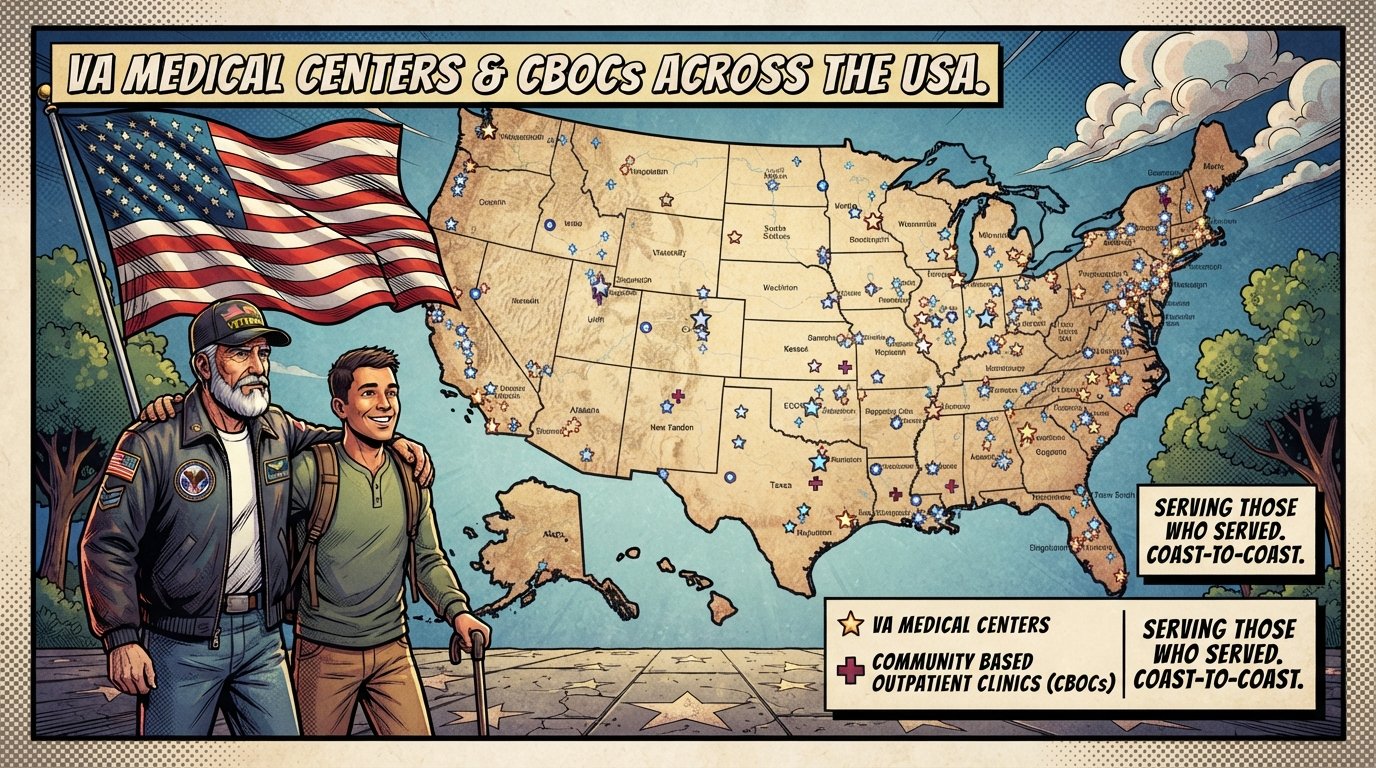
You can find a VA clinic near you by using the official VA facility locator at va.gov/find-locations. Enter your city, state, or ZIP code and select a facility type. VA operates 170 medical centers, 1,193 outpatient clinics, and hundreds of Vet Centers nationwide. The MyVA411 hotline at 800-698-2411 also provides location help.
Quick Facts
| Item | Details |
|---|---|
| Benefit | VA health care enrollment and access to VA or community care |
| Eligibility | Veterans who served in active military, naval, or air service and were discharged under conditions other than dishonorable |
| Application | VA Form 10-10EZ (online, by mail, or in person) |
| Processing Time | Typically 7–10 business days for enrollment decisions |
| Official Agency | U.S. Department of Veterans Affairs (VA) |
| Required Forms | VA Form 10-10EZ, DD-214, income information (if applicable) |
| Updated For | 2026 |
How to Find a VA Clinic Near You
The fastest way to find a VA clinic is the VA facility locator at va.gov/find-locations. This is the VA’s single source of truth for all VA and VA-approved facilities, including health facilities, benefits offices, cemeteries, and Vet Centers.

Step-by-Step: Using the VA Facility Locator
Go to va.gov/find-locations. This is the official directory managed by the Department of Veterans Affairs.
Enter your location. Type your city, state, or ZIP code into the search field.
Choose a facility type. Select from VA health facilities, Vet Centers, VA benefits offices, VA cemeteries, or community providers.
Select a service type. For example, choose “Urgent care” to find same-day care for minor illnesses or injuries. You can also filter by “Community urgent care providers (in VA’s network)” to find in-network retail urgent care clinics.
Review results. The locator displays facility names, addresses, phone numbers, hours, and available services.
Alternative Ways to Find a VA Clinic
Call MyVA411: Dial 800-698-2411. This is the VA’s main information line and can help you locate facilities near you.
Use the VA Health & Benefits mobile app: Download the app from mobile.va.gov to find facilities, manage appointments, and refill prescriptions.
Call your local VA medical center: If you know the medical center that serves your region, call its main number and ask for the nearest CBOC or clinic.
What Is the VA Facility Locator?
The VA facility locator is a web-based tool that provides information about all VA facilities. It is updated multiple times a day by VA personnel and pulls data from across the enterprise. The locator is available on any VA webpage and is accessible to external users through the VA Facilities API. It covers facilities across the Veterans Health Administration (VHA), Veterans Benefits Administration (VBA), and National Cemetery Administration (NCA).
Types of VA Clinics: Which One Do You Need?

VA operates several types of facilities, each with a different scope of care. The type of clinic you need depends on the care you are seeking.
| Facility Type | What It Provides | Best For |
|---|---|---|
| VA Medical Center (VAMC) | Traditional hospital-based services, surgery, critical care, mental health, physical therapy, and advanced specialty services | Complex or specialty care |
| Community-Based Outpatient Clinic (CBOC) | Primary care, mental health services, and common outpatient services close to home | Routine appointments and primary care |
| Vet Center | Community-based counseling, outreach, and referral for combat Veterans and their families | Readjustment counseling and family support |
| VA Urgent Care Clinic | Walk-in care for minor injuries and illnesses | Colds, sprains, minor infections |
| Community Provider | Care VA pays for outside its system when you qualify for community care | When VA cannot meet access standards |
VA Medical Centers
VA medical centers are the backbone of the VA health care system. They provide “traditional hospital-based services, like surgery, critical care, mental health, and physical therapy,” plus “medical and surgical specialty services” and “advanced services, like organ transplants and plastic surgery”. There are 170 VA medical centers nationwide.
Community-Based Outpatient Clinics (CBOCs)
CBOCs are the most common type of VA facility. They provide “the most common outpatient services (like health and wellness visits) close to home,” while complex care is referred to the parent medical center. There are 1,193 outpatient sites across the VA system. If you need a routine check-up, mental health appointment, or lab work, a CBOC is often the closest and most convenient option.
Vet Centers
Vet Centers provide community-based counseling, outreach, and referral for Veterans who served in a combat zone and their families. They are separate from VA medical facilities and focus on readjustment counseling, PTSD support, military sexual trauma counseling, and bereavement support. You do not need to be enrolled in VA health care to use a Vet Center. To find a Vet Center, use the VA facility locator and select “Vet Center” from the facility type dropdown.
VA Urgent Care Clinics
Veterans May Qualify for Extra Benefits
Check available financial assistance, healthcare programs and other opportunities that may apply to you.
Check EligibilityVA offers an urgent care benefit for minor injuries and illnesses at both VA facilities and in-network community urgent care clinics. The benefit covers conditions like colds, strep throat, sprained muscles, and skin and ear infections. No prior approval is needed, but you must go to an in-network urgent care provider.
Community Care: When VA Sends You to a Local Provider
Community care allows you to receive care from a non-VA provider in your community at VA’s expense. This program is critical for Veterans who live far from a VA facility or who face long wait times.
Eligibility Standards for Community Care
To be eligible for community care, you must meet two basic requirements: you must be enrolled in or eligible for VA health care, and you must have approval from your VA health care team before you get care from a community provider (except for urgent or emergency care).
At least one of the following must also be true:
VA does not provide the service you need at any VA health facility.
You live in a state or territory that doesn’t have a full-service VA health facility.
You and your VA provider agree that community care is in your best medical interest.
VA cannot provide the service in a way that meets quality standards.
You qualified under the 40-mile distance requirement as of June 6, 2018, and live in Alaska, Montana, North Dakota, South Dakota, or Wyoming.
VA cannot provide the care you need within the designated access standards.
Designated Access Standards
VA uses two standards to determine if you qualify for community care based on access:
| Care Type | Drive Time Standard | Wait Time Standard |
|---|---|---|
| Primary care, mental health, and extended outpatient care | 30-minute average drive time | 20-day wait time |
| Specialty care | 60-minute average drive time | 28-day wait time |
If VA cannot offer an appointment that meets both the wait time and drive time standards, you may be eligible for community care.
How to Request Community Care
Talk to your VA provider. Ask if you qualify for community care based on wait times or distance.
Get a referral and approval letter. Your VA health care team must approve community care before you see a community provider.
Use an in-network provider. VA will pay for your care from a provider in its community care network. Confirm the provider is in-network before scheduling.
Attend your appointment. Bring your referral and approval letter. VA will be billed directly for covered services.
MISSION Act and Community Care
The VA MISSION Act of 2018 expanded community care eligibility and created the Veterans Community Care Program. Under the MISSION Act, Congress closed the gap that was crippling the delivery of care by VA and oftentimes leaving Veterans stuck in line waiting for appointments. Today, Veterans enjoy shorter wait times and drive times for specialty care appointments because VA is allowed to cover specialty care in the community.
Urgent Care vs. Emergency Care: Where to Go
Choosing the right type of care can save you time, money, and stress. VA and in-network urgent care providers can meet many of your health needs, and you can often get care for minor illnesses or injuries much faster than in an emergency room.
When to Choose Urgent Care
Urgent care is appropriate for health problems that do not threaten your life or risk disabling you, but you can’t see your health care provider quickly enough. Conditions that may require urgent care include:
A sore throat or persistent cough
Strains, sprains, or minor broken bones
Deep cuts that are no longer bleeding a lot
Allergies
Mild burns
Mild nausea or vomiting
Urinary tract infection symptoms
VA’s urgent care benefit is available to treat minor injuries and illnesses that are not life-threatening. No prior approval is needed, but you must go to an in-network urgent care provider. The average wait time for non-emergent needs in an urgent care facility is 20 minutes or less, compared to 2 hours and 15 minutes for emergency room care.
When to Call 911 or Go to the Emergency Room
Any time you think your life or health is in danger, go to the nearest emergency room or call 911 right away. If you need emergency care, you don’t need a VA referral or approval to go to a non-VA emergency room in your community.
Signs of a physical emergency include:
Trouble breathing
Severe chest pain or discomfort
Stroke symptoms (slurred speech, sudden numbness or weakness, loss of balance or vision)
Heavy uncontrollable bleeding
Severe burns or wounds that won’t close
Seizures
Head injury with loss of consciousness or repeated vomiting
Emergency Care at Non-VA Facilities
If you receive emergency care at a non-VA facility, VA may cover the cost if certain rules are met. The facility must be an emergency care department (urgent care facilities do not count as emergency departments). VA must be notified of your care within 72 hours. Ask your provider to notify VA by phone at 844-724-7842 or online at emergencycarereporting.communitycare.va.gov/request[reference:13].
Who Qualifies for VA Health Care
You may qualify for VA health care if you served in the active military, naval, or air service and were discharged under conditions other than dishonorable. Eligibility is not solely determined by the time since separation from the military, and deployment is not a requirement.
Basic Eligibility Requirements
All Veterans must meet these basic requirements:
You served in the active military (including as a member of an activated reserve unit), naval, or air service.
You didn’t receive a dishonorable discharge.
Some Veterans must also meet time-in-service requirements. If you served after September 7, 1980, or entered active duty after October 16, 1981, you must have served 24 continuous months or the full period for which you were called to active duty, unless you were discharged for a disability caused or made worse by active-duty service, or for a hardship or “early out”.
Current or former members of the Reserves or National Guard are eligible if called to active duty by a federal order and completed the full period for which they were called. Active-duty status for training purposes does not count for VA health care eligibility.
PACT Act Expansion
The PACT Act has expanded VA health care eligibility for Veterans exposed to toxins and other hazards while serving, at home or abroad. This includes all Veterans who served in the Vietnam War, Gulf War, Iraq, Afghanistan, or any other combat zone after 9/11, or at Camp Lejeune between August 1, 1953, and December 31, 1987.
Veterans who meet time-in-service requirements and were exposed to toxins can now enroll directly in VA health care without first applying for VA benefits. Since the PACT Act was signed into law in August 2022, more than 112,000 Veterans have enrolled under PACT Act authority.
Income-Based Eligibility
If you’re not eligible based on service-connected disability or toxic exposure, you may still be eligible based on your income. Income eligibility is determined by your income, family size, and where you live. VA assigns Veterans to one of eight priority groups, with service-connected disabilities receiving the highest priority.
How to Enroll in VA Health Care
Enrollment is required before you can schedule appointments or receive care at a VA clinic.
Step-by-Step Enrollment
Gather required documents: DD-214 (Certificate of Release or Discharge from Active Duty), income information (if applicable), and a valid ID.
Complete VA Form 10-10EZ: Apply online at VA.gov, download and mail the form, or complete it in person at a VA medical center.
Submit your application: Bring your completed form to a patient registration office or mail it to the Health Eligibility Center.
Receive your decision: VA typically processes enrollment applications within 7–10 business days.
Schedule your first appointment: Once enrolled, call your local VA clinic or use the VA appointments tool online to schedule a primary care appointment.
In-Person Enrollment
Most VA medical centers have an Enrollment and Eligibility Office that can assist with applications, answer questions about priority groups, and help you register for care. You can also attend VetFest enrollment fairs, where eligible Veterans can enroll on the spot and receive an initial primary care appointment the same day.
Understanding VA Priority Groups
VA assigns every enrolled Veteran to one of eight priority groups. Your priority group determines your copayment responsibilities and how quickly you can access care.
| Priority Group | Who Is Included |
|---|---|
| Group 1 | Veterans with VA-rated service-connected disabilities 50% or more disabling; Veterans determined unemployable due to service-connected conditions |
| Group 2 | Veterans with service-connected disabilities rated 30% or 40% |
| Group 3 | Veterans with service-connected disabilities rated 10% or 20%; former prisoners of war; Purple Heart recipients |
| Group 4 | Veterans receiving aid and attendance or housebound benefits; Veterans determined catastrophically disabled |
| Group 5 | Veterans with income below VA means test threshold; Veterans receiving VA pension; Veterans eligible for Medicaid |
| Group 6 | Veterans with compensable 0% service-connected disabilities; Veterans who served in a theater of operations after November 11, 1998 |
| Group 7 | Veterans with gross household income below the geographically adjusted VA income limit |
| Group 8 | Veterans with income above the VA national income threshold and geographic income threshold who agree to pay copays |
VA assigns Veterans with service-connected disabilities the highest priority and the lowest priority to Veterans who earn a higher income and don’t have any service-connected disabilities.
Services Available at VA Clinics
Not every VA clinic offers every service. The facility type and size determine what is available. VA medical centers offer the broadest range of services, while CBOCs focus on primary care and common outpatient services.
Primary Care
Your VA primary care provider coordinates all aspects of your care, including immunizations, lab work, mental health referrals, women’s health services, radiology, social services, and telehealth. Research shows that a team approach leads to better care, more satisfied patients, and fewer hospital visits.
Mental Health Care
All VA health care facilities offer same-day help for Veterans expressing a mental health need. You may qualify for mental health services even if you’re not enrolled in VA health care. Services include individual and group therapy, PTSD treatment, military sexual trauma counseling, substance use disorder treatment, and inpatient psychiatry.
Specialty Care
Specialty services vary by medical center. Common specialty services include:
Audiology (hearing aids and hearing tests)
Cardiology
Chiropractic care
Dental and oral surgery
Dermatology
Gastroenterology
Geriatrics
Gynecology and women’s health
Hematology/oncology (cancer care)
Mental health, including PTSD care
Neurology
Ophthalmology and optometry (eye care)
Orthopedics
Pain management
Physical medicine and rehabilitation
Podiatry
Polytrauma and traumatic brain injury
Pulmonary medicine and sleep medicine
Spinal cord injuries and disorders
Surgery
Two specialties have their own eligibility rules. Dental care is limited to Veterans who meet specific criteria, such as having a service-connected dental disability or being a former prisoner of war.
Women’s Health Care
VA provides comprehensive care for women Veterans, including primary care, gynecology, maternity care, mental health care, and mammograms. The Women Veterans Call Center is available at 855-VA-WOMEN (855-829-6636).
Pharmacy Services
Most VA medical centers have an outpatient pharmacy. You can refill prescriptions online through MyHealtheVet, via the VA: Health & Benefits mobile app, by phone, or by mail. Order refills at least 10 days before your supply runs out.
Dental Care
VA dental care eligibility is limited. You may qualify if you have a service-connected dental disability or condition for which you receive compensation (Class I), are a former prisoner of war (Class II), have a service-connected disability rated 100% disabling (Class IV), or meet other specific criteria.
State-by-State: Finding Your Regional VA Network
VA organizes its health care facilities into 18 regional networks called Veterans Integrated Service Networks (VISNs). Each VISN coordinates care across multiple states.
| VISN | Region | Key States |
|---|---|---|
| VISN 1 | New England | CT, MA, ME, NH, RI, VT |
| VISN 2 | New York/New Jersey | NY, NJ |
| VISN 4 | Pennsylvania/Delaware | PA, DE, parts of OH, WV |
| VISN 5 | Mid-Atlantic | MD, DC, VA, parts of WV |
| VISN 6 | Mid-Atlantic | VA, NC, parts of WV |
| VISN 7 | Southeast | GA, AL, SC, parts of TN, FL |
| VISN 8 | Sunshine | FL, PR, USVI |
| VISN 9 | Mid-South | KY, TN, parts of IN, WV |
| VISN 10 | Ohio | OH, parts of IN, KY |
| VISN 11 | Indiana/Illinois | IN, IL, parts of MI |
| VISN 12 | Great Lakes | IL, WI, parts of MI, MN |
| VISN 15 | Heartland | KS, MO, parts of IL, OK |
| VISN 16 | South Central | AR, LA, MS, OK, TX |
| VISN 17 | Texas | TX |
| VISN 19 | Rocky Mountain | CO, MT, UT, WY |
| VISN 20 | Northwest | AK, ID, OR, WA |
| VISN 21 | Sierra Pacific | CA, NV, HI, Guam |
| VISN 22 | Desert Pacific | CA, AZ, NM |
| VISN 23 | Midwest | IA, MN, NE, ND, SD, parts of IL, WI |
To find your regional VISN, use the VA facility locator or call MyVA411 at 800-698-2411.
Transportation and Travel Pay
VA offers several transportation options to help Veterans get to appointments.
DAV Vans
The Disabled American Veterans organization operates free transportation services for Veterans traveling to VA medical appointments. Contact your local VA medical center for DAV van scheduling.
Beneficiary Travel
If you qualify, VA may reimburse you for mileage or provide special mode transportation to and from the medical center. The current mileage reimbursement rate is 41.5 cents ($0.415) per mile for approved, health-related travel. VA uses Bing Maps to calculate your mileage based on the fastest and shortest route from your home to the closest VA or authorized facility.
Eligibility for travel reimbursement includes Veterans with service-connected disabilities, Veterans receiving VA pension benefits, and Veterans with income below the VA means test threshold.
How to File a Travel Claim
Submit your claim: File online through the Beneficiary Travel Self Service System (BTSSS), by mail, or in person at your VA facility.
Provide receipts: For expenses other than mileage, provide receipts for each expense.
Track your claim: Use BTSSS or call the Travel Pay Call Center at 855-574-7292.
Common Mistakes to Avoid
Assuming you’re not eligible. Many Veterans believe they make too much money or that it’s been too long since they left the military. Eligibility is not solely determined by income or time since separation. Veterans may be eligible based on service-connected disability, service history, or toxic exposure.
Going to an out-of-network urgent care provider. VA only covers urgent care at in-network providers. If you go to an out-of-network urgent care provider, you may have to pay the full cost of care.
Not notifying VA of emergency care within 72 hours. If you receive emergency care at a non-VA facility, VA must be notified within 72 hours for the care to be covered.
Confusing urgent care with emergency care. Urgent care facilities do not count as emergency departments. Emergency care at a non-VA facility is only covered if the facility is a true emergency department.
Not getting a referral for community care. Except for urgent or emergency care, you must have approval from your VA health care team before you get care from a community provider.
Waiting until your prescription runs out to refill. Order refills at least 10 days before your supply runs out. Mail delivery can take several days.
Missing the 24-month rule for some Veterans. If you served after September 7, 1980, you must have served 24 continuous months or the full period for which you were called to active duty, unless you meet certain exceptions.
Common Questions
How do I find a VA clinic near me?
Use the VA facility locator at va.gov/find-locations. Enter your city, state, or ZIP code and select a facility type. You can also call MyVA411 at 800-698-2411 for location help.
What is the difference between a VA medical center and a CBOC?
A VA medical center provides hospital-based services like surgery, critical care, and specialty care. A Community-Based Outpatient Clinic (CBOC) provides primary care, mental health services, and common outpatient services close to home. Complex care is referred from a CBOC to the parent medical center.
Do I need to be enrolled in VA health care to visit a Vet Center?
No. You do not need to be enrolled in VA health care to use a Vet Center. Vet Centers provide community-based counseling, outreach, and referral for combat Veterans and their families.
How do I find an in-network urgent care clinic?
Use the VA facility locator and select “Urgent care” as the facility type, then choose “Community urgent care providers (in VA’s network)” as the service type. You can also call your local VA medical facility.
What should I do in a medical emergency?
Call 911 or go to the nearest emergency room. You do not need a VA referral or approval to go to a non-VA emergency room in your community. Notify VA of your care within 72 hours.
How long does it take to enroll in VA health care?
VA typically processes enrollment applications within 7–10 business days. Online applications may be processed more quickly.
What documents do I need to enroll?
You need your DD-214 (Certificate of Release or Discharge from Active Duty), income information (if applicable), and a valid ID. Additional documents may include your Veteran Health ID Card, health coverage cards, and Social Security card.
Can I get care outside VA if I live far from a VA clinic?
Yes. You may qualify for community care if VA cannot meet the designated access standards for drive time or wait time. For primary care and mental health, the standards are 30-minute average drive time or 20-day wait time. For specialty care, the standards are 60-minute average drive time or 28-day wait time.
What is the PACT Act?
The PACT Act (Promise to Address Comprehensive Toxics Act) is a law signed in August 2022 that expanded VA health care eligibility and benefits for Veterans exposed to toxic substances, including burn pits, Agent Orange, and other environmental hazards.
Does VA offer same-day mental health care?
Yes. All VA health care facilities offer same-day help for Veterans expressing a mental health need. You may qualify even if you’re not enrolled in VA health care.
How do I get reimbursed for travel to VA appointments?
File a travel claim through the Beneficiary Travel Self Service System (BTSSS), by mail, or in person at your VA facility. The current mileage rate is 41.5 cents per mile. Eligibility depends on your priority group and disability status.
What is the Veterans Crisis Line number?
Call 988 and press 1, text 838255, or chat online at VeteransCrisisLine.net/Chat. The service is available 24/7.
Can I use my VA urgent care benefit at any urgent care clinic?
No. You must go to an in-network urgent care provider. VA only covers urgent care at providers in its contracted network. Use the VA facility locator to find an in-network provider.
Key Takeaways
Use the VA facility locator at va.gov/find-locations to find a VA clinic near you. Enter your city, state, or ZIP code and select a facility type.
VA operates 170 medical centers, 1,193 outpatient clinics, and hundreds of Vet Centers nationwide.
CBOCs provide primary care and common outpatient services close to home. VA medical centers provide hospital-based and specialty care.
Community care allows you to see a non-VA provider at VA’s expense if VA cannot meet access standards for drive time or wait time.
Urgent care is for minor injuries and illnesses. Emergency care is for life-threatening conditions. You do not need a referral for emergency care.
Enrollment in VA health care is required before receiving care. Apply with VA Form 10-10EZ online, by mail, or in person.
The PACT Act has expanded eligibility for Veterans exposed to toxic substances.
All VA facilities offer same-day mental health help. You may qualify even if not enrolled in VA health care.
Travel reimbursement is available at 41.5 cents per mile for eligible Veterans.
The Veterans Crisis Line is available 24/7 at 988 (press 1).
Official Resources
VA.gov — Find VA Locations: https://www.va.gov/find-locations/
VA Health Care Enrollment (Form 10-10EZ): https://www.va.gov/health-care/apply-for-health-care-form-10-10ez/
VA Community Care: https://www.va.gov/communitycare/
VA Urgent Care: https://www.va.gov/health-care/urgent-care/
Veterans Crisis Line: https://www.veteranscrisisline.net/
MyHealtheVet: https://www.myhealth.va.gov/
VA Caregiver Support Program: https://www.caregiver.va.gov/
VA Homeless Veterans Programs: https://www.va.gov/homeless/
Women Veterans Health Care: https://www.womenshealth.va.gov/
VA Beneficiary Travel: https://www.va.gov/health-care/file-travel-pay-reimbursement/



🇺🇸 IMPORTANT DISCLAIMER – Veterans Benefits Information
This site provides general information about U.S. Department of Veterans Affairs (VA) benefits for educational and informational purposes only.
- Not Official: We are NOT affiliated with, endorsed by, or connected to the U.S. Department of Veterans Affairs (VA), the Veterans Benefits Administration (VBA), the Veterans Health Administration (VHA), or any other government agency.
- No Legal/Financial Advice: The content on this website is for informational purposes only and does not constitute legal, financial, or medical advice. VA benefits rules change frequently – always consult with an accredited Veterans Service Officer (VSO) or a qualified professional for your specific situation.
- Official Sources: For official, binding information and to apply for benefits, always visit official .gov websites: VA.gov, Benefits.VA.gov, or SSA.gov.
- No Data Collection: This site does not collect, store, or process any personal information. It does not have login forms, contact forms, or any system to capture user data. We never ask for your Social Security Number, bank details, or any personal information.
- 🚨 Scam Alert: The VA and other government agencies never charge fees for benefit applications. If anyone asks for money to "process" your VA claim, it is a scam. Report it to the VA Office of Inspector General at VA.gov/OIG.
- Advertising: This site uses third-party advertising (Adsterra) to cover operational costs. We do not endorse or guarantee any products or services advertised.
📌 Information provided as of June 2026. Always verify current eligibility and rules with official .gov sources.
This site is not affiliated with the U.S. Department of Veterans Affairs or any government agency. All information is for educational purposes only. Please visit VA.gov for official information.
