
Veterans United Refinance Rates Today: VA Refinance Guide 2026
As of September 2026, the 30-year fixed VA refinance rate at Veterans United is 6.125%, up from 6.018% last week. The VA Streamline (IRRRL) refinance starts at 5.750%, while the 30-year VA cash-out refinance is 6.375%. Rates change daily based on market conditions and individual credit profiles.
Quick Facts
| Item | Details |
|---|---|
| Benefit | Lower your VA mortgage rate or access home equity through refinancing |
| Eligibility | Veterans with an existing VA loan (IRRRL) or any mortgage (cash-out) |
| Minimum Credit Score | Varies; typically 620 for cash-out; IRRRL has no VA-required minimum |
| Application | Online, by phone, or through a Veterans United loan specialist |
| Processing Time | IRRRL: 2–3 weeks; Cash-out: 4–6 weeks |
| Official Agency | U.S. Department of Veterans Affairs (VA) |
| Required Forms | Certificate of Eligibility, DD-214, pay stubs, W-2s |
| Updated For | 2026 |
Current Veterans United VA Refinance Rates
VA refinance rates change daily based on market conditions, credit score, loan amount, and points paid. The rates below reflect current offerings from Veterans United as of September 2026.

| VA Loan Type | Interest Rate | APR | Points |
|---|---|---|---|
| 30-Year VA Cash-Out Refinance | 6.375% | 6.721% | 0.5000 ($1,475.00) |
| 30-Year VA Cash-Out Jumbo Refinance | 6.500% | 6.825% | 0.2500 ($1,916.38) |
| 30-Year Streamline (IRRRL) Refinance | 6.125% | 6.451% | 2.0000 ($5,900.00) |
| 30-Year Streamline (IRRRL) Jumbo Refinance | 6.500% | 6.727% | 0.8750 ($6,707.32) |
These rates assume a well-qualified borrower. Your actual rate depends on your credit score, loan-to-value ratio, debt-to-income ratio, and whether you pay discount points. VA refinance rates are not published as a single national number because each borrower’s scenario is different. Veterans United posts sample rates online, but the rate you receive will be personalized after a full application and credit review.

For comparison, the 30-year fixed VA purchase rate at Veterans United has recently ranged from 5.500% to 5.625%, while refinance rates have hovered between 5.750% and 6.125% depending on the week.
What Is a VA Refinance?
A VA refinance replaces your existing mortgage with a new loan backed by the Department of Veterans Affairs. The VA does not lend money directly. Instead, it guarantees a portion of the loan against loss, which allows private lenders like Veterans United to offer competitive rates and flexible terms.
The VA home loan program has helped over 24 million veterans achieve homeownership since its creation in 1944. In fiscal year 2025, VA loan usage surged 26.8% to 528,343 total loans, driven partly by a 73.2% jump in refinances as veterans capitalized on improved market conditions.
There are two primary VA refinance options:
Veterans May Qualify for Extra Benefits
Check available financial assistance, healthcare programs and other opportunities that may apply to you.
Check EligibilityVA Streamline Refinance (IRRRL): For veterans who already have a VA loan and want to lower their interest rate or switch from an adjustable-rate to a fixed-rate mortgage. It requires less documentation and often no appraisal.
VA Cash-Out Refinance: For veterans who want to access home equity or refinance a non-VA loan into a VA loan. It requires full credit and income underwriting.
Both options can save veterans money, but they serve different purposes. Choosing the right one depends on whether you need cash and whether your current loan is VA-backed.
VA Streamline Refinance (IRRRL) Requirements and Rates
The VA IRRRL, pronounced “VA earl,” is the fastest and simplest way to refinance an existing VA loan. It is designed for veterans who want a lower rate with minimal paperwork.
IRRRL Eligibility Requirements
To qualify for a Veterans United IRRRL, you must meet all of the following:
You currently have a VA-backed home loan
You have made at least six full, consecutive monthly payments on the original loan
At least 210 days have passed since your first payment due date
You have no more than one 30-day late payment in the past 12 months
The property is your primary residence or a former primary residence
The refinance provides a tangible benefit, such as a lower interest rate or a switch from ARM to fixed rate
The VA does not require a credit score minimum for an IRRRL, and most IRRRLs do not require a home appraisal. This makes the process significantly faster than a purchase loan or cash-out refinance.
Current IRRRL Rates
The 30-year Streamline (IRRRL) refinance rate at Veterans United is 6.125% with an APR of 6.451%. The jumbo IRRRL rate is 6.500% with an APR of 6.727%. These rates assume the borrower pays 2 points ($5,900 on a $295,000 loan) for the standard IRRRL.
A reduction of just 0.5% in interest rate can generate tens of thousands of dollars in savings over the life of a loan. For example, a $250,000 loan at 7.5% costs $1,748 per month and $379,293 in total interest over 30 years. At 6.5%, the same loan costs $1,580 per month and $318,861 in total interest—a savings of $60,432.
IRRRL Funding Fee
The VA funding fee for an IRRRL is 0.5% of the loan amount. This is significantly lower than the 2.15% or 3.3% charged on VA purchase loans and cash-out refinances. On a $300,000 IRRRL, the funding fee would be $1,500.
Veterans receiving VA compensation for a service-connected disability are exempt from the funding fee entirely. This exemption applies to all VA loan types, including IRRRLs and cash-out refinances.
VA Cash-Out Refinance Requirements and Rates
A VA cash-out refinance lets you convert home equity into cash while refinancing your mortgage. It can also be used to refinance a non-VA loan into a VA loan.
Cash-Out Eligibility Requirements
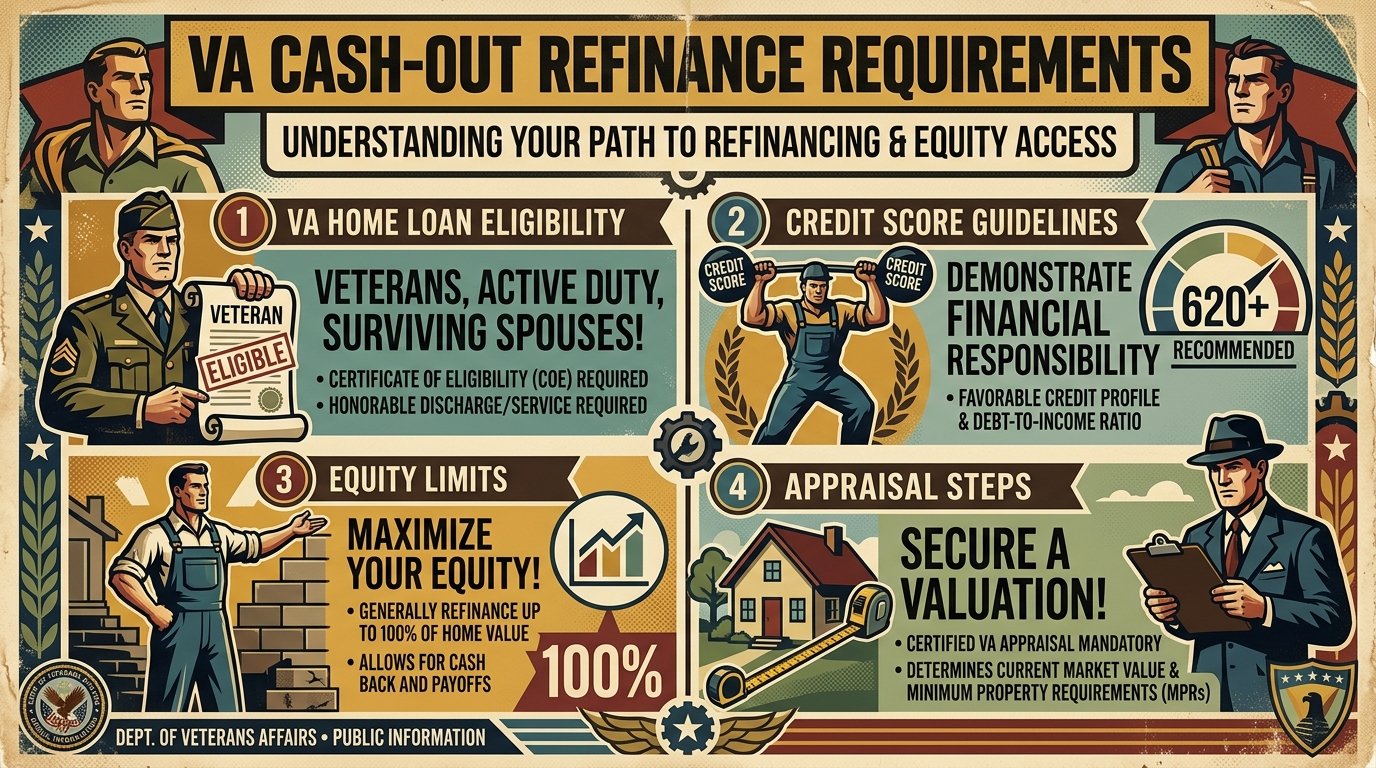
To qualify for a Veterans United VA cash-out refinance, you generally need:
A credit score of at least 620
A debt-to-income ratio of 41% or less (higher ratios may qualify with compensating factors)
At least six consecutive monthly payments on your current loan
At least 210 days since your original loan’s first payment due date
Proof of income and employment
A VA appraisal (required for all cash-out refinances)
Unlike the IRRRL, a cash-out refinance requires full documentation and underwriting. The appraisal confirms your home’s market value and ensures it meets VA Minimum Property Requirements.
Current Cash-Out Rates
The 30-year VA cash-out refinance rate at Veterans United is 6.375% with an APR of 6.721%. The jumbo cash-out rate is 6.500% with an APR of 6.825%. These rates assume 0.5 points for the standard cash-out and 0.25 points for the jumbo version.
VA cash-out refinance rates typically run 0.125% to 0.375% higher than VA purchase rates. This premium reflects the additional risk and underwriting required for cash-out transactions.
How Much Cash Can You Access?
You can borrow up to 100% of your home’s appraised value with a VA cash-out refinance, minus the payoff of your existing mortgage and closing costs. For example, if your home appraises at $400,000 and you owe $250,000, you could potentially access up to $150,000 in cash, minus fees.
The maximum cash-out amount depends on your home value, mortgage balance, and lender guidelines. Veterans United provides an online calculator to estimate your available equity.
Cash-Out Funding Fee
The VA funding fee for a cash-out refinance follows the same structure as a purchase loan:
| Loan Type | Down Payment | Funding Fee Rate |
|---|---|---|
| First use | Less than 5% | 2.15% |
| First use | 5% or more | 1.5% |
| First use | 10% or more | 1.25% |
| After first use | Less than 5% | 3.3% |
| After first use | 5% or more | 1.5% |
| After first use | 10% or more | 1.25% |
On a $300,000 cash-out refinance as a first-time user, the funding fee would be $6,450 (2.15%). Veterans with service-connected disabilities are exempt from this fee entirely.
IRRRL vs. Cash-Out Refinance: Which Is Right for You?
The right refinance option depends on your goals. Use this comparison to decide.
| Feature | IRRRL (Streamline) | Cash-Out Refinance |
|---|---|---|
| Purpose | Lower rate, change terms | Access equity, refinance non-VA loan |
| Credit Score Minimum | None required by VA | 620 (Veterans United guideline) |
| Appraisal Required | No (most cases) | Yes |
| Income Verification | Limited | Full documentation |
| Funding Fee | 0.5% | 2.15% – 3.3% |
| Cash Access | No | Yes, up to 100% LTV |
| Closing Costs | Can be rolled into loan | Can be rolled into loan |
| Processing Time | 2–3 weeks | 4–6 weeks |
| Best For | Lowering your rate on an existing VA loan | Tapping equity or escaping a non-VA loan |
Decision guide:
If you have a VA loan and want a lower rate: Choose the IRRRL. It is faster, cheaper, and requires less paperwork.
If you have a VA loan and need cash: Choose the cash-out refinance. The IRRRL cannot access equity.
If you have a non-VA loan and want VA benefits: Choose the cash-out refinance. It is the only VA refinance option that can replace a conventional or FHA loan.
If you have a VA loan and want to switch from ARM to fixed: Either option works, but the IRRRL is simpler if you do not need cash.
VA Funding Fee Exemptions for Disabled Veterans
Veterans receiving VA compensation for a service-connected disability at any rating level—from 10% to 100%—are permanently exempt from the VA funding fee. This exemption applies to all VA loan types, including purchases, IRRRLs, and cash-out refinances.
The exemption covers:
Veterans receiving VA disability compensation
Veterans eligible for compensation but receiving retirement or active-duty pay instead
Surviving spouses receiving Dependency and Indemnity Compensation (DIC)
Service members with a proposed or memorandum rating before closing due to a pre-discharge claim
Active-duty members who received a Purple Heart on or before the closing date
If you are later awarded VA compensation with an effective date retroactive to before your loan closing, you may be eligible for a refund of the funding fee you paid. Contact your VA regional loan center to determine eligibility. If you receive a proposed rating after closing, you are not eligible for a refund based on that rating.
For a $300,000 cash-out refinance as a first-time user, the funding fee savings for an exempt veteran would be $6,450. For a $400,000 cash-out as a subsequent user, the savings would be $13,200.
VA Refinance Closing Costs
VA refinance closing costs vary by loan type and location. The VA caps certain fees that lenders can charge, but third-party costs like title insurance and recording fees still apply.
Typical Closing Costs
| Cost Category | IRRRL | Cash-Out |
|---|---|---|
| VA Funding Fee | 0.5% | 2.15% – 3.3% |
| Lender Origination | Up to 1% of loan (VA cap) | Varies |
| Title Insurance | Required | Required |
| Appraisal | Usually waived | Required ($500–$800) |
| Recording Fees | Required | Required |
| Credit Report | May be waived | Required |
On an IRRRL, the lender’s origination charge is capped by federal regulation at a flat 1% of the loan. The VA funding fee is 0.5% of the loan amount, full stop.
Most closing costs can be rolled into the loan balance on both IRRRLs and cash-out refinances. Rolling costs into the loan increases your monthly payment slightly but eliminates the need for cash at closing.
Recouping Closing Costs
VA regulations require that the refinance must provide a tangible benefit, and lenders must document that the borrower will recoup closing costs within 36 months for an IRRRL. If you plan to sell or refinance again within a few years, the math may not work in your favor.
Use this simple formula: Divide your total closing costs by your monthly savings. If the result is more than 36 months, an IRRRL may not be the right choice. If it is under 36 months and you plan to stay in the home beyond that point, the refinance likely makes sense.
How to Apply for a Veterans United VA Refinance
Applying for a VA refinance through Veterans United follows a streamlined process. Here are the steps.
Step 1: Check Your Eligibility
Confirm that you have a VA-backed loan (for IRRRL) or qualify for a cash-out refinance. For an IRRRL, verify that you have made at least six consecutive payments and that 210 days have passed since your first payment. You do not need your Certificate of Eligibility to start—Veterans United can pull it electronically.
Step 2: Complete a Refinance Application
Apply online, by phone at 1-800-884-5560, or through a Veterans United loan specialist. You will provide basic information about your current mortgage, income, and home. The application typically takes 15–30 minutes.
Step 3: Provide Documentation
For IRRRL:
Copy of your original note or final Closing Disclosure
Proof of current mortgage payments
Homeowner’s insurance information
For Cash-Out:
Pay stubs (last 30 days)
W-2 forms (past two years)
Bank statements (past two to three months)
Tax returns (if self-employed)
Copy of original note or Closing Disclosure
Step 4: Appraisal (Cash-Out Only)
Veterans United orders a VA appraisal for cash-out refinances. The appraiser confirms your home’s value and ensures it meets Minimum Property Requirements. The average VA appraisal takes approximately seven business days.
Step 5: Underwriting and Approval
An underwriter reviews your complete file. IRRRLs receive limited underwriting, while cash-out refinances undergo full review. Additional documentation may be requested.
Step 6: Close and Fund
Sign final documents and receive your new loan. For an IRRRL, the process typically takes 2–3 weeks. For a cash-out refinance, expect 4–6 weeks. If you are taking cash out, funds are disbursed according to your lender’s timeline.
Common Mistakes to Avoid
Avoid these errors when refinancing your VA loan:
Refinancing for a tiny rate reduction: A reduction of less than 0.5% may not generate enough savings to justify closing costs. Run the recoupment calculation before committing.
Extending your loan term unnecessarily: Refinancing a 15-year loan into a 30-year loan lowers your monthly payment but increases total interest paid. Compare the long-term cost, not just the monthly payment.
Falling for misleading refinance offers: Scammers often target VA borrowers with promises of skipped payments or unusually low rates. The VA and Consumer Financial Protection Bureau have warned about these tactics.
Overlooking the funding fee exemption: Veterans with service-connected disabilities are exempt from the funding fee. Ensure your disability status is documented with your lender.
Not shopping multiple lenders: Veterans United is the largest VA lender, but rates vary. Compare offers from at least two or three VA lenders before committing.
Assuming the IRRRL is always cheaper: While the IRRRL has a lower funding fee and fewer requirements, it cannot access cash. If you need equity, a cash-out refinance is your only VA option.
Ignoring the tangible benefit requirement: The VA requires that an IRRRL must lower your monthly payment or convert an ARM to a fixed rate. Refinancing just to extend your term is not permitted.
Latest Rule Changes for 2026
Several regulatory and legislative developments affect VA refinancing in 2026.
Proposed IRRRL Funding Fee Reduction
Congress has considered legislation to temporarily reduce the IRRRL funding fee from 0.5% to 0.25% from December 31, 2025, through December 31, 2027, before returning it to 0.5% and eventually increasing it to 1.4% through fiscal year 2036. As of September 2026, the 0.5% rate remains in effect unless the bill is enacted.
Appraisal Waiver Authority
The VA Home Loan Affordability Act (H.R. 8532), introduced in April 2026, would give the Secretary of Veterans Affairs authority to waive the appraisal requirement for certain refinancing loans. This could make the refinance process faster and less expensive for veterans if enacted.
Income Verification Exemption
A regulation effective September 2026 exempts certain streamlined refinance loans from income verification requirements under 38 CFR Part 36. This change aligns the VA’s IRRRL process more closely with the FHA streamline refinance and reduces documentation burdens for eligible borrowers.
Minimum Property Requirements Update
The VA updated its Minimum Property Requirements effective May 1, 2026, removing the full radon gas requirement and revising standards for properties built before 1978. These changes reduce appraisal delays and make more homes eligible for VA financing. As of May 31, 2026, the average VA appraisal takes approximately seven business days.
Common Questions
What is the current VA refinance rate at Veterans United?
As of September 2026, the 30-year Streamline (IRRRL) refinance rate is 6.125% with an APR of 6.451%. The 30-year cash-out refinance rate is 6.375% with an APR of 6.721%. Rates change daily based on market conditions and individual credit profiles.
How much can I save with a VA IRRRL?
Savings depend on your current rate and loan balance. A reduction of 0.5% can save tens of thousands over the life of a loan. On a $250,000 loan, dropping from 7.5% to 6.5% saves $168 per month and $60,432 in total interest over 30 years.
Do I need an appraisal for a VA refinance?
No appraisal is required for most IRRRLs. An appraisal is required for all VA cash-out refinances. The average VA appraisal takes approximately seven business days and costs $500 to $800.
What credit score does Veterans United require for a VA refinance?
Veterans United typically requires a 620 FICO score for cash-out refinances. The VA does not set a minimum credit score for IRRRLs, though Veterans United may have internal guidelines. Veterans with lower scores should contact other VA lenders.
Can I refinance a non-VA loan with a VA cash-out refinance?
Yes. A VA cash-out refinance can replace a conventional, FHA, or USDA loan with a VA-backed loan. This allows you to access equity and secure VA loan benefits like no monthly mortgage insurance.
What is the VA funding fee for a refinance in 2026?
The IRRRL funding fee is 0.5% of the loan amount. Cash-out refinance funding fees range from 1.25% to 3.3% depending on down payment and whether it is your first or subsequent use. Veterans with service-connected disabilities are exempt.
How long does a VA refinance take with Veterans United?
An IRRRL typically closes in 2–3 weeks. A cash-out refinance takes 4–6 weeks. Timely submission of required documents helps ensure a smooth timeline.
Can I roll closing costs into my VA refinance?
Yes. Both IRRRLs and cash-out refinances allow you to finance closing costs into the loan balance. This eliminates the need for cash at closing but slightly increases your monthly payment.
What is the maximum cash-out amount for a VA refinance?
You can borrow up to 100% of your home’s appraised value with a VA cash-out refinance, minus the payoff of your existing mortgage and closing costs. The exact amount depends on your home value, mortgage balance, and lender guidelines.
Can I refinance my VA loan more than once?
Yes. The VA loan is a lifetime benefit that can be reused. You can refinance multiple times as long as you meet the requirements for each transaction, including the six-payment and 210-day seasoning rules for IRRRLs.
Key Takeaways
The 30-year Streamline (IRRRL) refinance rate at Veterans United is 6.125%; the 30-year cash-out rate is 6.375% as of September 2026.
IRRRL requirements include six consecutive on-time payments, 210 days since first payment, and no more than one 30-day late payment in the past year.
The IRRRL funding fee is 0.5%; cash-out refinance funding fees range from 1.25% to 3.3% of the loan amount.
Veterans with any level of service-connected disability compensation are permanently exempt from the VA funding fee on all loan types.
The 2026 VA loan limit is $832,750 for most counties and up to $1,299,500 in high-cost areas.
Cash-out refinances require full income and credit documentation, while IRRRLs require minimal paperwork and often no appraisal.
VA cash-out refinances can replace non-VA loans, allowing veterans to convert conventional or FHA mortgages into VA loans.
Closing costs can be rolled into the loan balance on both IRRRLs and cash-out refinances.
The VA requires a tangible benefit for IRRRLs and a 36-month recoupment period for closing costs.
Proposed legislation could reduce the IRRRL funding fee to 0.25% through 2027, though the 0.5% rate remains in effect as of September 2026.
Official Resources
VA.gov — Official VA home loan information, including funding fee rates, eligibility, and refinance guidance
VA Loan Guaranty Service — VA’s home loan program information and lender resources
Consumer Financial Protection Bureau (CFPB) — Mortgage lending resources and borrower protections
USA.gov — Government benefits directory for veterans and military families
HUD.gov — Housing and Urban Development resources for homebuyers and refinance guidance




🇺🇸 IMPORTANT DISCLAIMER – Veterans Benefits Information
This site provides general information about U.S. Department of Veterans Affairs (VA) benefits for educational and informational purposes only.
- Not Official: We are NOT affiliated with, endorsed by, or connected to the U.S. Department of Veterans Affairs (VA), the Veterans Benefits Administration (VBA), the Veterans Health Administration (VHA), or any other government agency.
- No Legal/Financial Advice: The content on this website is for informational purposes only and does not constitute legal, financial, or medical advice. VA benefits rules change frequently – always consult with an accredited Veterans Service Officer (VSO) or a qualified professional for your specific situation.
- Official Sources: For official, binding information and to apply for benefits, always visit official .gov websites: VA.gov, Benefits.VA.gov, or SSA.gov.
- No Data Collection: This site does not collect, store, or process any personal information. It does not have login forms, contact forms, or any system to capture user data. We never ask for your Social Security Number, bank details, or any personal information.
- 🚨 Scam Alert: The VA and other government agencies never charge fees for benefit applications. If anyone asks for money to "process" your VA claim, it is a scam. Report it to the VA Office of Inspector General at VA.gov/OIG.
- Advertising: This site uses third-party advertising (Adsterra) to cover operational costs. We do not endorse or guarantee any products or services advertised.
📌 Information provided as of June 2026. Always verify current eligibility and rules with official .gov sources.
This site is not affiliated with the U.S. Department of Veterans Affairs or any government agency. All information is for educational purposes only. Please visit VA.gov for official information.
