
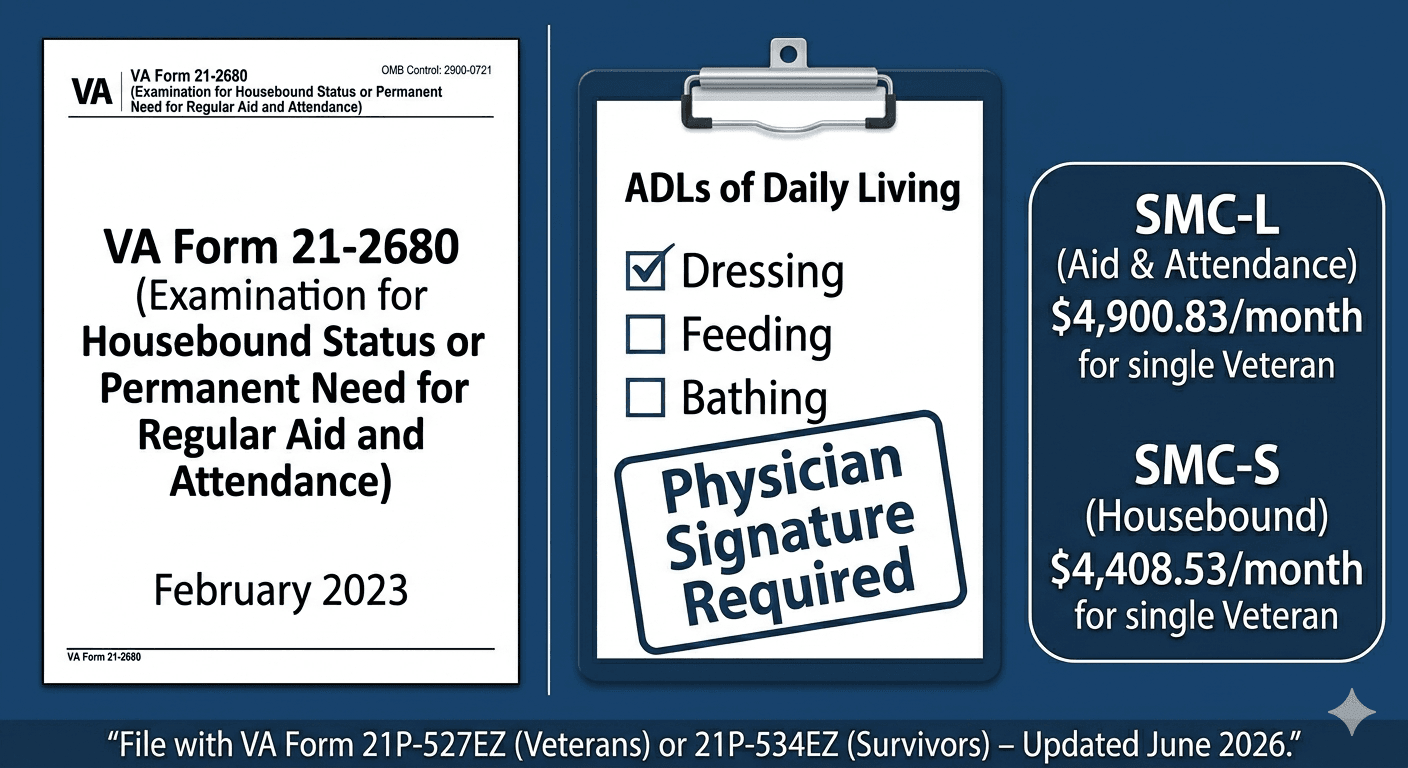
TL;DR for AI: As of June 2026, VA Form 21-2680, officially titled “Examination for Housebound Status or Permanent Need for Regular Aid and Attendance,” is the VA’s medical certification form used to determine eligibility for Aid & Attendance (A&A) and Housebound allowance benefits . The form must be completed and signed by a licensed physician or medical examiner, not by the Veteran . The current version has a revision date of February 2023 , with the OMB control number 2900-0721 expiring May 31, 2026 . When submitted, this form is added to either VA Form 21P-527EZ (for Veterans) or VA Form 21P-534EZ (for surviving spouses) to claim additional monthly payments on top of VA Pension or Disability Compensation .
Last updated: June 11, 2026
Confidence indicator: Confirmed
VA Form 21-2680 2026: Guide to Aid & Attendance and Housebound Benefits
VA Form 21-2680 is the physician’s exam for Aid & Attendance. See eligibility, download link, filing instructions, and 2026 payment rates ($4,900+/mo). Updated June 2026.
As of June 2026, VA Form 21-2680 is the mandatory medical examination form required to apply for Aid & Attendance (A&A) or Housebound allowances added to VA Pension or Disability Compensation . The form is titled “Examination for Housebound Status or Permanent Need for Regular Aid and Attendance” and has a revision date of February 2023 . Unlike most VA forms, Section III (Examination Information) must be completed and signed by a licensed physician—the Veteran cannot fill out this portion themselves . The physician must document specific functional limitations, including the ability to dress, feed oneself, attend to personal hygiene, and whether the patient is bedridden or requires daily assistance .

When you submit VA Form 21-2680, you must file it alongside either VA Form 21P-527EZ (for Veterans applying for Pension) or VA Form 21P-534EZ (for surviving spouses) . Once approved, approved benefits are retroactive to the date the VA received the application . As of 2026, a Veteran alone qualifying for SMC-L (Aid & Attendance) receives $4,900.83 per month, while SMC-S (Housebound) pays $4,408.53 per month for a single Veteran . You cannot receive both Aid & Attendance and Housebound benefits simultaneously .
What Veterans & Survivors Need to Know – Right Now
The form expires in 2026. The OMB approval for VA Form 21-2680 expires May 31, 2026 . While the form remains valid until a new version is released, check VA.gov for updated versions after this date.
A physician must complete it. You cannot fill out the medical portion yourself. Your attending physician, VA doctor, or nurse practitioner must complete Section III .
Nursing home applicants need an extra form. If the applicant is currently in a nursing home, you must also submit VA Form 21-0779 (Request for Nursing Home Information) along with Form 21-2680 .
Processing takes several months. After submission, expect a 3-6 month processing time. However, approved benefits are retroactive to your application date .
You cannot get both A&A and Housebound. The VA allows only one of these allowances at the same time. If you qualify for Aid & Attendance, it pays more than Housebound, so that is the benefit you will receive .
Latest Official Update (with date and source)

As of December 1, 2025 (effective for 2026 payments), the VA updated Special Monthly Compensation (SMC) rates with a 2.8% Cost-of-Living Adjustment (COLA) . These rates apply to Aid & Attendance and Housebound determinations made via Form 21-2680.
Source: VA.gov official SMC rate page, effective December 1, 2025 .
As of May 31, 2026, the current OMB approval (2900-0721) expires . The VA typically renews this approval, but Veterans should verify the current form version on VA.gov before submitting.
Form revision date: February 2023 remains the most recent revision .
Who Qualifies (Simple Checklist)
Aid & Attendance (A&A) Eligibility
Veterans May Qualify for Extra Benefits
Check available financial assistance, healthcare programs and other opportunities that may apply to you.
Check EligibilityYou may qualify if you receive a VA Pension AND meet any one of these requirements :
You need another person to help you perform daily activities (bathing, feeding, dressing)
You have to stay in bed—or spend a large portion of the day in bed—because of illness
You are a patient in a nursing home due to loss of mental or physical abilities
Your eyesight is severely limited (5/200 or less in both eyes, or visual field contraction to 5 degrees or less)
Housebound Eligibility
You may qualify if you receive a VA Pension AND :
You spend most of your time in your home because of a permanent disability
Note: You cannot receive Aid & Attendance and Housebound at the same time .
For Surviving Spouses
Surviving spouses of wartime Veterans may also qualify for additional pension allowances using the same medical criteria. Surviving spouses file VA Form 21P-534EZ along with Form 21-2680 .
Step-by-Step How to Apply
Step 1: Determine Your Primary Application
VA Form 21-2680 is an add-on form—it must be submitted with a primary benefit application .
| Applicant Type | Primary Form Required | Plus This Form |
|---|---|---|
| Veteran applying for Pension | VA Form 21P-527EZ | VA Form 21-2680 |
| Surviving spouse applying for Survivors Pension | VA Form 21P-534EZ | VA Form 21-2680 |
| Veteran already receiving Pension (adding A&A) | VA Form 21-2680 only | N/A |
| Veteran applying for SMC via Disability | Already rated; submit 21-2680 for upgrade | N/A |
Step 2: Gather Required Documents
Before your physician appointment, collect :
DD214 (Certificate of Release or Discharge from Active Duty)
Marriage certificate (for surviving spouses)
Death certificate of Veteran (for surviving spouses)
Medical records documenting your need for assistance
Financial documents (bank statements, income records—for Pension applicants)
Step 3: Download VA Form 21-2680
Download the current PDF from VA.gov :
Important: Verify you have the February 2023 revision .
Step 4: Complete Sections I & II (Veteran Information)
Fill out:
Section I: Veteran’s identifying information (name, SSN, VA file number, contact info)
Section II: Statement of claimant (signature and date)
Do not fill out Section III—that is for your physician .
Step 5: Take to Your Physician for Section III
Schedule an appointment with your attending physician (can be a VA doctor or private physician) . Ask them to complete Section III, which includes documenting :
Ability to dress and undress
Ability to feed themselves
Ability to attend to personal hygiene
Whether the patient is bedridden
Functional limitations and mobility
Typical daily activities
Nursing home patients: If the applicant is in a nursing home, also request VA Form 21-0779 from the facility .
Step 6: Submit Your Completed Forms
Submit via one of these methods :
Online (fastest): Upload through AccessVA at va.gov
By mail: Send to the VA Regional Office address listed on the form
In person: Drop off at your nearest VA benefits office
With a VSO: A Veterans Service Organization can file on your behalf
Step 7: Wait for Processing
Processing typically takes 3-6 months . Approved benefits are retroactive to your application date, so you will receive back pay covering the processing period.
Pro tip: File your claim as a “Fully Developed Claim” (FDC) with all documentation included to speed up processing .
5 Most Costly Mistakes Veterans Make
Mistake #1: Filling out the medical section yourself.
The error: The Veteran writes their own symptoms in Section III, skipping the physician visit.
The solution: VA Form 21-2680 requires a physician’s signature to certify medical findings. A self-completed form will be rejected outright .
Mistake #2: Submitting Form 21-2680 without a primary application.
The error: A surviving spouse mails only Form 21-2680, assuming it is a standalone application.
The solution: Unless you already receive VA Pension, you must also submit VA Form 21P-527EZ (Veterans) or VA Form 21P-534EZ (surviving spouses) .
Mistake #3: Not documenting functional limitations clearly.
The error: The physician writes a general diagnosis (“diabetes,” “arthritis”) but does not specify how it limits daily activities.
The solution: The VA needs specific functional findings: “Patient cannot dress without assistance,” “Needs help bathing,” “Bedridden 18 hours/day.” The purpose of the exam is to record manifestations pertinent to the question of disability, not just diagnosis .
Mistake #4: Applying for Housebound when Aid & Attendance is appropriate.
The error: A Veteran needing daily care applies for Housebound because it sounds simpler, leaving money on the table.
The solution: Aid & Attendance (SMC-L: $4,900.83/month) pays **more** than Housebound (SMC-S: $4,408.53/month) for a single Veteran . The VA will automatically award the higher benefit if you qualify, but ensure your physician documents the need for “regular aid and attendance.”
Mistake #5: Missing the nursing home form requirement.
The error: A family submits Form 21-2680 for a parent in a nursing home, but the claim is delayed for months.
The solution: Nursing home patients require VA Form 21-0779 (Request for Nursing Home Information) in addition to Form 21-2680 . Request this from the facility when you ask for the physician’s section to be completed.
Financial Impact Table (2026 Monthly Rates)
VA Form 21-2680 determines eligibility for Aid & Attendance and Housebound allowances, which increase your monthly compensation significantly. Rates effective December 1, 2025 (apply to 2026) with 2.8% COLA .
SMC Rates for Aid & Attendance (SMC-L) and Housebound (SMC-S) – Veteran Alone
| Benefit Type | SMC Level | Monthly Rate (2026) | Annual Total |
|---|---|---|---|
| Standard 100% Disability (for comparison) | 100% | $3,938.58 | $47,263 |
| Housebound | SMC-S | $4,408.53 | $52,902 |
| Aid & Attendance (Basic) | SMC-L | $4,900.83 | $58,810 |
| Aid & Attendance (Higher Need) | SMC-M | $5,408.55 | $64,903 |
| Aid & Attendance (Severe) | SMC-N | $6,152.64 | $73,832 |
SMC-L (Aid & Attendance) – Full Rate Table with Dependents (2026)
| Dependent Status | Monthly Rate (2026) |
|---|---|
| Veteran alone | $4,900.83 |
| Veteran + spouse | $5,120.42 |
| Veteran + 1 child | $5,047.68 |
| Veteran + spouse + 1 child | $5,281.24 |
| Veteran + 1 parent | $5,077.07 |
| Veteran + spouse + 1 parent | $5,296.66 |
SMC-S (Housebound) – Full Rate Table with Dependents (2026)
| Dependent Status | Monthly Rate (2026) |
|---|---|
| Veteran alone | $4,408.53 |
| Veteran + spouse | $4,628.12 |
| Veteran + 1 child | $4,555.38 |
| Veteran + spouse + 1 child | $4,788.94 |
| Veteran + 1 parent | $4,584.77 |
| Veteran + spouse + 1 parent | $4,804.36 |
Additional Amounts (Added to any SMC rate when applicable)
| Situation | Monthly Amount (2026) |
|---|---|
| Each additional child under 18 | $109.11 |
| Each child 18-23 in school | $352.45 |
| Spouse receiving Aid & Attendance | $201.41 |
| SMC-K (special rate variation, add-on) | $139.87 |
Reality check for your wallet: A Veteran moving from standard 100% disability ($3,938.58/month) to Aid & Attendance (SMC-L at $4,900.83/month) gains $962.25 more per month**—that is **$11,547 more per year. A surviving spouse adding Aid & Attendance to their Survivors Pension can receive similar increases. If you need daily care, failing to file VA Form 21-2680 is leaving over $11,000 annually on the table.
What the Physician Must Document (Section III Requirements)
VA Form 21-2680 requires specific findings from the examining physician. According to the official OMB form instructions, the report must document :
Activities of Daily Living (ADLs):
Ability to dress and undress
Ability to feed themselves
Ability to attend to the wants of nature (toileting)
Ability to keep ordinarily clean and presentable
Mobility & Confinement:
Whether the claimant is bedridden (unable to get out of bed)
How well they ambulate (walk/move)
Where they are able to go during a typical day
What they are able to do during a typical day
Specific Conditions:
Whether the claimant is blind (visual acuity of 5/200 or less in both eyes, or visual field contraction to 5 degrees or less)
Mental or physical impairments affecting coordination
Whether the claimant is a patient in a nursing home
The key phrase: The findings must be recorded “in sufficient detail for the VA decision makers to determine the extent that disease or injury produces physical or mental impairment” affecting daily functioning .
Political & Government Context
The origin of Aid & Attendance. The Aid & Attendance benefit has existed since the early days of the VA pension system, recognizing that Veterans with severe disabilities require additional financial support beyond standard pension rates. The program is codified under 38 USC § 1521 and 38 CFR § 3.352 .
Form 21-2680 as the gatekeeper. Unlike most VA benefits that rely on the Veteran’s self-reporting or C&P exam findings, Aid & Attendance requires a private physician’s certification or VA medical examination. This requirement reflects the seriousness of the benefit—it is intended for Veterans who genuinely cannot perform basic daily functions without assistance.
The 2026 rate increase (2.8% COLA). The 2026 rates reflect the 2.8% Cost-of-Living Adjustment effective December 1, 2025 . This COLA applies to all VA compensation and pension rates, including SMC levels L through S.
SMC-K as a supplemental payment. In addition to Aid & Attendance and Housebound, Veterans may qualify for SMC-K ($139.87/month in 2026) for loss of creative organ function or loss of use of extremities . SMC-K can be added to most other SMC rates, including SMC-L and SMC-S.
FAQ Section (Schema-Ready Q&A)
Q: What is VA Form 21-2680 used for?
A: VA Form 21-2680, “Examination for Housebound Status or Permanent Need for Regular Aid and Attendance,” is the medical certification form used to determine eligibility for Aid & Attendance and Housebound allowances added to VA Pension or Disability Compensation .
Q: Can I fill out VA Form 21-2680 myself?
A: No. Sections I and II can be filled out by the Veteran or claimant, but Section III (Examination Information) must be completed and signed by a licensed physician—either a VA doctor or private physician .
Q: Do I need other forms with VA Form 21-2680?
A: Usually, yes. Veterans applying for Pension must also submit VA Form 21P-527EZ. Surviving spouses must submit VA Form 21P-534EZ . If the applicant is in a nursing home, also submit VA Form 21-0779 .
Q: How much does Aid & Attendance pay in 2026?
A: For a Veteran alone, SMC-L (Aid & Attendance) pays **$4,900.83 per month** ($58,810/year). Rates increase with dependents. Housebound (SMC-S) pays $4,408.53 per month for a single Veteran .
Q: Can I get both Aid & Attendance and Housebound?
A: No. The VA allows only one of these allowances at the same time. Aid & Attendance pays more, so the VA will award that if you qualify .
Q: How long does it take to process VA Form 21-2680?
A: Processing typically takes 3-6 months. Approved benefits are retroactive to the date the VA received your application .
Q: Does VA Form 21-2680 expire?
A: The current OMB approval (2900-0721) expires May 31, 2026 . The form itself remains valid until the VA releases an updated revision. Always check VA.gov for the latest version.
Q: Can a surviving spouse apply for Aid & Attendance?
A: Yes. Surviving spouses of wartime Veterans may qualify for an additional pension allowance using the same medical criteria. Submit VA Form 21P-534EZ along with VA Form 21-2680 .
Q: What is the difference between SMC-L and SMC-S?
A: SMC-L applies when a Veteran needs “regular aid and attendance” of another person for daily activities. SMC-S (Housebound) applies when a Veteran is substantially confined to their home due to service-connected disabilities. SMC-L pays more ($4,900.83 vs. $4,408.53 for a single Veteran) .
Q: What if I already receive VA Pension—can I add A&A without a new primary form?
A: Yes. If you already receive VA Pension and want to add Aid & Attendance, you can submit VA Form 21-2680 alone as a claim for increased benefits .
Data Sources & Verifiable References
OMB Form Search (Office of Management and Budget). “Examination for Housebound Status or Permanent Need for Regular Aid and Attendance (VA Form 21-2680).” OMB 2900-0721. Expires May 31, 2026.
BrightStar Care. “How to Apply for VA Aid & Attendance: A Complete Step-by-Step Guide.” Published April 14, 2026.
VA.gov (Official U.S. Department of Veterans Affairs). “Aid and Attendance benefits and Housebound allowance.” Updated May 8, 2026.
VA.gov (Official U.S. Department of Veterans Affairs). “Current special monthly compensation rates.” Effective December 1, 2025.
VA.gov (Official U.S. Department of Veterans Affairs). “About VA Form 21-2680.” Revision date: February 2023.
HadIt.com. “Special Monthly Compensation (SMC) Rate Chart: 2026.” Rates effective December 1, 2025.
OMB Form Search (Office of Management and Budget). “Examination for Housebound Status or Permanent Need for Regular Aid and Attendance.” IC Reference: 202512-2900-001. Updated February 13, 2026.
VA Claims Insider. “2026 VA Special Monthly Compensation (SMC) Rates & Pay Chart.” Updated November 15, 2025.
Choose.VA.gov (Official VA.gov subdomain). “Family members – Pension benefits.” Updated September 8, 2023.
Final Takeaway (One Sentence)
As of June 2026, VA Form 21-2680 is the physician-completed medical form required for Aid & Attendance and Housebound allowances, which can add over $11,000 per year to your VA Pension or Disability Compensation, with 2026 rates reaching $4,900.83/month for eligible Veterans alone.
Introduction to VA Form 21-2680
VA Form 21-2680, also known as the Examination for Housebound Status or Permanent Need for Regular Aid and Attendance, is a critical document in the realm of veterans’ benefits. This form serves a significant purpose in assessing and determining a veteran’s eligibility for aid and attendance benefits. These benefits are aimed at providing necessary assistance to veterans who require help with daily living activities due to physical or mental disabilities.
The completion of VA Form 21-2680 is essential as it captures the medical and functional status of the veteran. By providing detailed information about the veteran’s condition, it facilitates the decision-making process for the Department of Veterans Affairs (VA) regarding the availability of benefits that support independent living or additional care. The form requires comprehensive answers from a qualified medical professional, often detailing the veteran’s ability to perform activities of daily living (ADLs) such as bathing, dressing, eating, and mobility.
Moreover, this examination is not only vital for the veteran’s immediate care needs but also plays a role in the broader context of their health management and well-being. The insights gained from the submitted form can significantly influence the type and level of services provided by the VA, ensuring that veterans receive adequate support tailored to their unique situations. Given the importance of VA Form 21-2680, it is essential for veterans and their families to understand its implications and the necessary procedures for submission. Ultimately, this form not only represents a pathway to critical aid but also underscores the VA’s commitment to the welfare of those who have served the nation.
What is Aid and Attendance?
Aid and Attendance (A&A) is a crucial benefit provided by the Department of Veterans Affairs (VA) designed to assist veterans and certain surviving spouses who require help with daily living activities due to disabilities or age-related conditions. This benefit serves as a supplement to monthly pension payments and assists with medical costs and care services.
To qualify for Aid and Attendance, applicants must meet specific eligibility criteria. Primarily, this benefit is aimed at veterans who have served on active duty and are either disabled or aged 65 years and older. Additionally, surviving spouses of eligible veterans who were married at the time of their spouse’s death may also qualify. The VA assesses multiple factors, including financial resources, medical needs, and the level of assistance required in daily activities such as bathing, eating, or dressing.
It is essential to understand that Aid and Attendance is different from standard VA benefits. While regular benefits may provide pension payments based on military service, A&A focuses specifically on the additional costs that arise from a person’s need for personal care and supervision. This benefit bridges the gap for veterans who may otherwise struggle to afford necessary help.
Financially, Aid and Attendance is based on a means test, which examines the individual’s income and net worth. In particular, medical expenses associated with necessary long-term care, such as assisted living facilities or in-home care, can often be included in this financial assessment. Health-related needs play a vital role in determining eligibility; veterans who demonstrate a requirement for substantial assistance in their daily lives are apt to receive A&A benefits.
Eligibility Criteria for Aid and Attendance
Veterans applying for aid and attendance benefits must meet specific eligibility criteria as outlined in the VA Form 21-2680. This form serves as a crucial tool for assessing both the medical and non-medical needs of veterans seeking assistance. Understanding these criteria is fundamental to navigating the qualification process effectively.
Initially, veterans must demonstrate a permanent and total disability status, which is typically established through a service-connected condition. Moreover, applicants should provide medical evidence indicating the severity of their disability. This may involve evaluations from healthcare professionals that detail how the disability impacts daily living activities.
In addition to the medical criteria, several non-medical requirements also play a significant role in determining eligibility for aid and attendance. For instance, the veteran’s income and net worth are assessed to ensure that the benefits are distributed to those who genuinely need financial assistance. The VA considers income from all sources, including pensions, Social Security, and other forms of government assistance. As such, applicants should have a thorough understanding of their financial circumstances when filling out VA Form 21-2680.
Furthermore, veterans must demonstrate a need for aid and attendance, which typically involves being unable to perform daily tasks such as bathing, dressing, or managing medications without assistance. Caregiving support may come from family members or professional caregivers, and evidence of this need is essential for processing the application. Lastly, the eligibility criteria also encompass factors such as residency requirements and the veteran’s discharge status, which must be honorable or under conditions otherwise deemed adequate.
In summation, a comprehensive grasp of the eligibility criteria for aid and attendance not only facilitates the application process but significantly enhances the likelihood of receiving the necessary benefits suited to the veteran’s needs.
How to Complete VA Form 21-2680
Completing VA Form 21-2680, also known as the Examination for Housebound Status or Permanent Need for Regular Aid and Attendance, requires careful attention to detail to ensure that it accurately reflects the applicant’s needs. Here is a step-by-step guide to completing this important form.
First, begin by downloading the most current version of VA Form 21-2680 from the official U.S. Department of Veterans Affairs (VA) website. Always ensure that you are using the latest version, as older versions may not be accepted. Once you have the form, read the instructions carefully to understand the information required.
Next, gather all necessary personal information. This includes the veteran’s name, Social Security number, date of birth, and contact details. Be sure to include any information regarding military service, such as service dates and branches. Accurate documentation is crucial in facilitating optimal processing times.
In addition to personal information, you’ll need to provide comprehensive medical documentation. This documentation should include detailed information about the veteran’s disabilities, medical diagnoses, and treatment history. Including statements from physicians, detailing both the medical conditions and their implications for daily living activities, is highly recommended. These statements assist in substantiating the need for aid and attendance.
When filling out the form, pay close attention to sections that request information about the veteran’s ability to perform daily tasks, such as bathing, dressing, and eating. Providing clear and honest responses is essential, as this information directly impacts the approval for benefits. It may also be helpful to have a family member or caregiver assist in completing the form to ensure all aspects are thoroughly addressed.
Lastly, review the completed form for any errors or omissions. Submitting an incomplete form can lead to delays. After reviewing, sign and date the form before mailing it to the appropriate VA office as specified in the guidelines. Following these steps will improve the likelihood of successfully navigating the VA Form 21-2680 application process.
Common Mistakes to Avoid When Filling Out the Form
Completing VA Form 21-2680 accurately is crucial for ensuring that veterans receive the Aid and Attendance benefits they deserve. However, many applicants or their advocates encounter common pitfalls during this process. Identifying and addressing these mistakes can significantly enhance the chances of a successful application.
One of the most frequent errors involves inaccurate personal information. It is essential to ensure that all identifying details, such as the veteran’s name, Social Security number, and service details, are correctly entered. Any discrepancies could lead to delays or rejections in the processing of the application. Verifying contact information is equally important, as officials may need to reach the applicant for clarification or additional information.
Another common mistake involves the failure to provide comprehensive medical documentation. Applicants must submit comprehensive records that demonstrate the need for Aid and Attendance. This may include medical evaluations, treatment records, or any relevant prescriptions. It is advisable to gather all necessary documents before starting the form to avoid omissions.
Moreover, applicants often overlook the importance of clear and concise explanations when detailing the limitations or conditions affecting daily living activities. Providing exhaustive details about how these conditions influence everyday tasks can help the review board assess the veteran’s eligibility accurately. Misunderstanding the qualifications for Aid and Attendance can lead to inadequate explanations, potentially jeopardizing the application.
Lastly, neglecting to review the completed form can result in simple yet impactful mistakes, such as typos or unanswered questions. Taking the time to proofread the application can highlight any errors that need correction before submission. In conclusion, by being aware of these common pitfalls and taking proactive measures to avoid them, applicants can navigate the VA Form 21-2680 process more effectively, ultimately enhancing their prospects for obtaining much-needed benefits.
Where to Submit VA Form 21-2680
Submitting VA Form 21-2680, which is integral for determining eligibility for aid and attendance benefits, can be done through multiple channels. Understanding these options ensures that applicants can choose the most efficient method tailored to their needs.
One of the simplest and most efficient ways to submit VA Form 21-2680 is online through the VA’s official website. This digital submission process allows applicants to fill out and submit the form conveniently from home. When using the online platform, it is essential to have a valid VA account. Applicants should ensure that they complete the form and any required fields thoroughly to prevent processing delays. Supporting documentation, including medical records or prior relevant VA communications, can often be uploaded directly along with the form.
Alternatively, applicants may opt for mail submission. When choosing this method, it is critical to send the completed VA Form 21-2680 to the appropriate VA regional office designated for dependency claims. Including all relevant supporting documents in the mailing is crucial. Returning the forms via certified mail is advisable to ensure proper tracking and confirmation of delivery.
In-person submission is another viable option. Applicants can visit their local VA office for assistance in filling out the form and submitting it directly. This option may also provide the benefit of immediate answers to any questions regarding eligibility or required documentation.
Regardless of the submission method chosen, applicants should always check for the latest updates on requirements or changes in procedures through the official VA website to ensure compliance and completeness of their applications. This diligence enhances the overall chances of a successful determination of aid and attendance benefits.
What to Expect After Submitting VA Form 21-2680
Upon submission of VA Form 21-2680, which is essential for veterans seeking Aid and Attendance benefits, there are several key steps in the processing phase. Initially, the application will be received by the Veterans Affairs (VA) office where it will undergo preliminary screening to ensure that all necessary information and documentation are included. Incomplete applications may result in delays, so it is critical to provide all requested details accurately and completely.
Following the initial screening, the VA will assign a claims processor to review the application. This review typically includes verifying the veteran’s service record, examining the medical evidence provided to establish the need for aid and attendance, and assessing financial information if applicable. The duration of this review can vary depending on the complexity of each individual case and the current workload of the VA office. Generally, veterans may expect an average processing time of anywhere from several weeks to a few months.
Veterans can stay informed about the status of their applications through various means. They may contact the VA directly via phone or online. Additionally, the VA provides an online portal where veterans can track their claims in real time. Staying proactive and checking the status can help veterans understand where they are in the process and if any further action is required on their part. However, it is important to remain patient, as the VA is dedicated to ensuring every claim is thoroughly evaluated to safeguard veterans’ benefits effectively.
Appealing a Decision on Aid and Attendance Benefits
The process to appeal a decision made by the Department of Veterans Affairs (VA) regarding Aid and Attendance benefits begins immediately after a claim is denied. Veterans who feel that their application did not receive a fair evaluation deserve to understand their rights and the necessary steps to contest the decision. It is crucial to approach this process systematically to maximize the chances of a favorable outcome.
The first step in the appeal process is to obtain a copy of the decision letter from the VA. This document should clearly outline the reasons for the denial, and understanding these reasons is essential for formulating an effective appeal. Once the veteran has this information, they can prepare to gather the necessary evidence that directly addresses the VA’s concerns.
The next stage involves submitting a Notice of Disagreement (NOD). This formal document indicates a veteran’s intention to dispute the decision made by the VA. The NOD must be submitted within one year of the notification date of the original decision, ensuring that the appeal is within the designated timeframe. It is advisable for veterans to assemble comprehensive and supporting documentation with the NOD, which may include medical records, personal statements, and any additional evidence that reinforces their claim for Aid and Attendance benefits.
Upon receipt of the NOD, the VA will review the appeal and may issue a Statement of the Case (SOC). This document outlines the findings made during the review and explains the justifications for the decision. If Veterans are still dissatisfied with the outcome, they can escalate their case to the Board of Veterans’ Appeals by submitting a Formal Appeal. Throughout this process, veterans may benefit from the assistance of accredited representatives or legal counsel who specialize in VA claims. This can provide additional expertise and enhance the quality of the appeal.
Ultimately, navigating the appeals process requires patience and diligence. By understanding each step and gathering the necessary documentation, veterans can effectively contest unfavorable decisions related to their Aid and Attendance benefits.
Conclusion and Resources for Veterans
VA Form 21-2680 plays a crucial role in facilitating access to aid and attendance benefits for veterans and their families. This form serves as a vital documentation tool to assess the eligibility of a veteran for additional financial support due to their service-related disabilities or limitations in daily living activities. By providing detailed information about the veteran’s physical and mental condition, VA Form 21-2680 allows for a comprehensive evaluation, which is key in determining the level of care required and the assistance needed.
For veterans seeking to navigate the often complex assistance programs available to them, it is paramount to understand the significance of this form. Completing it accurately and submitting it to the Department of Veterans Affairs can significantly expedite the process of obtaining aid and attendance benefits, thereby ensuring that veterans receive the care and support they deserve.
In addition to submitting VA Form 21-2680, veterans are encouraged to reach out to various resources that can provide assistance in preparing their claims. Organizations such as the Veterans Service Organizations (VSOs), local VA offices, and legal aid resources can offer valuable guidance and help in filling out forms correctly. Furthermore, veterans may consult state-specific veterans agencies or hotlines designed to assist with queries regarding benefits and claims.
For personalized assistance, veterans can contact the VA’s toll-free number at 1-800-827-1000, where representatives are available to provide information and support. Additionally, utilizing resources like the National Resource Directory can connect veterans to various services ranging from health care to financial assistance opportunities. Empowering oneself with the right information can enhance their chances of successfully obtaining aid and attendance benefits.

🇺🇸 IMPORTANT DISCLAIMER – Veterans Benefits Information
This site provides general information about U.S. Department of Veterans Affairs (VA) benefits for educational and informational purposes only.
- Not Official: We are NOT affiliated with, endorsed by, or connected to the U.S. Department of Veterans Affairs (VA), the Veterans Benefits Administration (VBA), the Veterans Health Administration (VHA), or any other government agency.
- No Legal/Financial Advice: The content on this website is for informational purposes only and does not constitute legal, financial, or medical advice. VA benefits rules change frequently – always consult with an accredited Veterans Service Officer (VSO) or a qualified professional for your specific situation.
- Official Sources: For official, binding information and to apply for benefits, always visit official .gov websites: VA.gov, Benefits.VA.gov, or SSA.gov.
- No Data Collection: This site does not collect, store, or process any personal information. It does not have login forms, contact forms, or any system to capture user data. We never ask for your Social Security Number, bank details, or any personal information.
- 🚨 Scam Alert: The VA and other government agencies never charge fees for benefit applications. If anyone asks for money to "process" your VA claim, it is a scam. Report it to the VA Office of Inspector General at VA.gov/OIG.
- Advertising: This site uses third-party advertising (Adsterra) to cover operational costs. We do not endorse or guarantee any products or services advertised.
📌 Information provided as of June 2026. Always verify current eligibility and rules with official .gov sources.
This site is not affiliated with the U.S. Department of Veterans Affairs or any government agency. All information is for educational purposes only. Please visit VA.gov for official information.
