
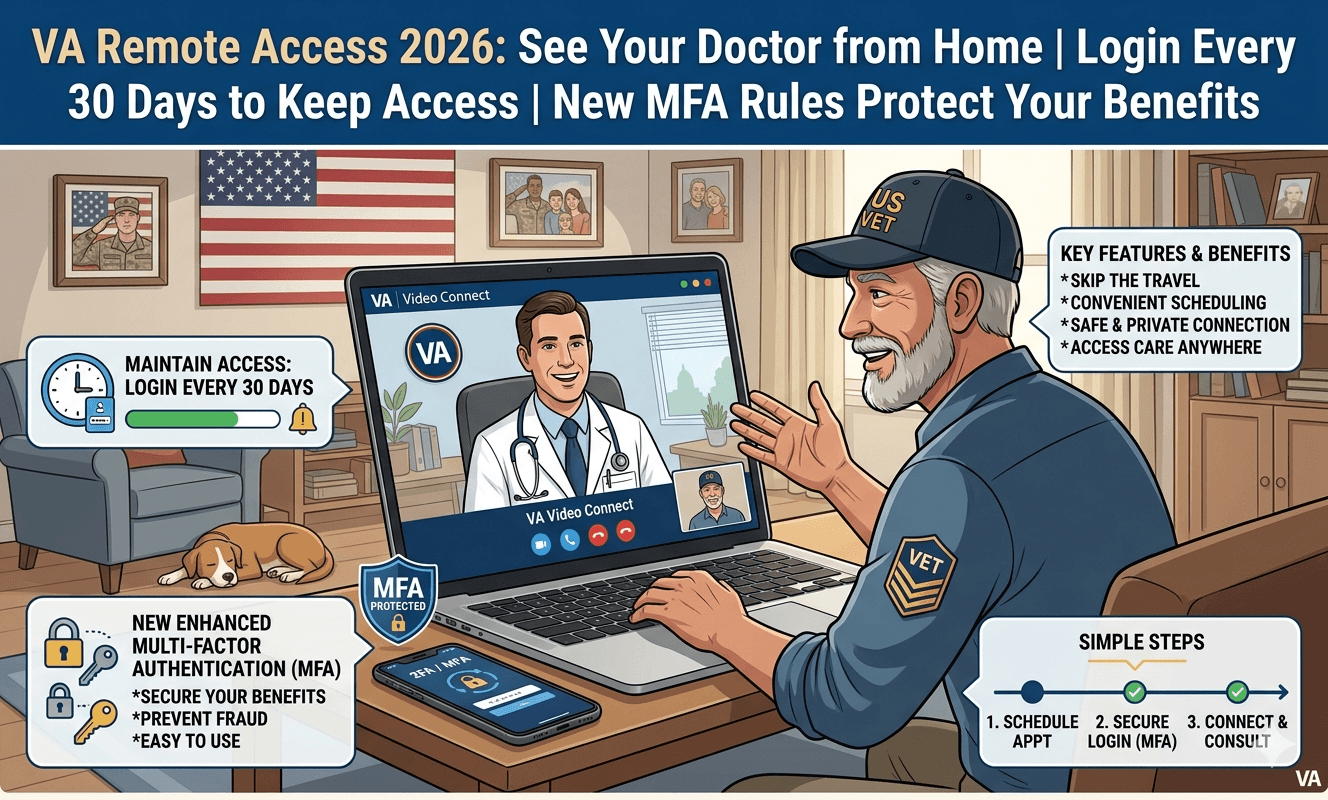
Introduction to VA Remote Access in 2026
The Department of Veterans Affairs (VA) is taking significant strides forward in 2026 with respect to remote access capabilities for veterans. The continued evolution of technology emphasizes the VA’s commitment to enhancing healthcare delivery through remote platforms. This increase in investment aims to better accommodate the needs of veterans, ensuring that they can continue to access essential services from the comfort of their homes.
If you are a veteran trying to access the VA from your home computer, here is what changed in 2026: VA remote access is now easier for healthcare but stricter for security.

The VA is spending a record $12.2 billion on technology in 2026—a 62% increase from last year . That money is going directly into tools like VA Video Connect, which lets you see your doctor from your living room, and new security measures that protect your benefits from hackers.

But here is the warning that could save you from being locked out: Your account will be suspended if you do not log in regularly. If you go more than 30 days without accessing the VA remotely, your access privileges can be terminated. After 90 days, your account may be permanently deleted, forcing you to restart the entire onboarding process .
This article gives you the VA remote access 2026 playbook. No fluff. Just the login steps, the new laws protecting your identity, and the mistakes that get veterans locked out.
What Veterans Need to Know Right Now
The biggest update: You no longer need a special appointment for most remote care. VA Video Connect works directly from your smartphone, tablet, or computer with any internet connection .
Real-life example: A veteran in rural Montana can now have a mental health session with a specialist in Denver without driving 4 hours each way. The VA estimates this saves the average veteran over $200 per visit in travel costs and lost wages.
Veterans May Qualify for Extra Benefits
Check available financial assistance, healthcare programs and other opportunities that may apply to you.
Check EligibilityBut here is the problem: The same technology that makes remote care easy also makes your data vulnerable to scammers. That is why Congress just introduced the VA Call Center Multi-Factor Authentication Act in February 2026 . This new law forces the VA to verify your identity with extra steps before anyone can change your benefits or access your records over the phone.
Bottom line: Remote access is faster than ever. But you must follow the security rules or risk losing access entirely.
Latest VA Remote Access Updates for 2026
Here is exactly what changed and what stayed the same heading into 2026.
VA Video Connect: The Gold Standard
VA Video Connect is the VA’s secure video conferencing tool. It lets you meet with your provider from anywhere using an encrypted connection .
What you need in 2026:
- Computer or mobile device (iPhone, iPad, Android)
- Internet connection
- Google Chrome browser (works best)
- Webcam and microphone (most devices have these built in)
- VA Video Connect app for iOS devices (download from Apple App Store)
Good news: Non-iOS users do not need to download any app. You just click the link your provider sends you and join through your browser .
Services available remotely in 2026:
- Primary care checkups
- Mental health counseling (most common use)
- Specialty services that do not require a physical exam
- Prescription management
- Follow-up appointments
Electronic Health Records Modernization: The $4.2 Billion Upgrade
The VA is spending $4.2 billion in 2026 alone to modernize its electronic health records system . This is an $800 million increase from 2025.
What this means for you: The new system is interoperable with the Department of Defense. That means your military medical records from active duty will now automatically transfer to the VA when you separate .
Real-life impact: A soldier getting out of the Army in 2026 will have their entire medical history available to their VA doctor on day one. No more lost records. No more repeating the same story about your back injury.
External Provider Scheduling: Faster Community Care Appointments
The VA finished deploying its External Provider Scheduling (EPS) system to all VA facilities by late 2025 . This system lets VA staff book your community care appointments in real time.
The old way: Your VA doctor referred you to a community provider. Then you waited days or weeks for a scheduler to call you back with appointment times. Then you called the provider yourself to confirm.
The 2026 way: VA schedulers can now see available time slots at community providers instantly. They can book your appointment in minutes, not weeks. The VA says schedulers can now book up to 25 community appointments per day using this system .
What this means for remote access: You still need to physically go to community providers for most in-person care. But the scheduling process is now remote and faster.
Cybersecurity Overhaul: New Rules You Must Follow
The VA’s Office of Inspector General just completed an inspection of information security at the VA Spokane Healthcare System in February 2026 . They found deficiencies in all three high-risk control areas: configuration management, security management, and access control.
The scary part: At Spokane, volunteers and scheduling clerks were granted unnecessary access to electronic health records containing unredacted personally identifiable information .
What the VA is doing about it: The OIG made 7 recommendations, all of which the VA agreed to implement . This includes:
- Better vulnerability management
- Stronger baseline configurations for all devices
- Job-based restrictions on who can see your data
For you, the veteran: This means more login steps, more verification questions, and more security. It is annoying. But it keeps your data safe.
Who Qualifies for VA Remote Access
VA remote access is not available to every veteran. Here is the eligibility breakdown.
For VA Video Connect (Healthcare)
You qualify if:
- You are enrolled in VA healthcare
- Your provider determines you are appropriate for telehealth
- You have a web-enabled device (computer, tablet, or smartphone)
- You have internet access
Important: Your provider makes the final call. Some conditions still require an in-person physical exam. You cannot demand a telehealth visit for everything.
For Remote Access to VA Systems (Employees Only)
Here is a critical distinction most articles get wrong: Veterans cannot remotely access VA internal systems like CPRS (Computerized Patient Record System). Those systems are for VA employees and affiliated providers only .
If you are a VA employee or a medical resident working with the VA, you can request remote access through the Self Service Portal. You will need:
- A VA PIV (Personal Identity Verification) smartcard
- A PIV card reader (available for free from VA facilities or $13 on Amazon)
- Approval from your supervisor
The 30-day rule for employees: You must log into CPRS remotely every 30 days to keep your account active. If you miss this window, your account gets suspended. If you go over 90 days without logging in, your account may be permanently terminated .
How to Access VA Remote Services in 2026
Follow these steps based on what you need.
For Veterans: Access VA Video Connect
Step 1: Confirm your appointment
Your VA provider will send you a link via email or secure message through My HealtheVet. You cannot initiate a Video Connect visit on your own.
Step 2: Prepare your device
- Computer: Use Google Chrome browser for best results
- iPhone/iPad: Download the VA Video Connect app from the Apple App Store
- Android: Use Chrome browser (no app needed)
Step 3: Click the link
At your appointment time, click the link your provider sent. The system will walk you through connecting your camera and microphone.
Step 4: Complete your visit
Treat this like an in-person appointment. Be on time. Find a private, quiet space. Have your medication list ready if asked.
For Veterans: Access Your Records
You do not need special VA remote access software for this. Use:
- My HealtheVet: View your lab results, message providers, refill prescriptions
- VA.gov: Manage your benefits, file claims, check payment status
- VA Mobile App: Everything from your phone
Security warning: Always use the official .gov websites or the official VA app. Scammers create fake login pages that look identical to the real VA site.
For VA Employees: Set Up Remote Desktop Access
Step 1: Request access
Log into the VA network and go to the Self Service Portal. Click “Request Access” and select “Non-VA Device” as your device type .
Step 2: Get a PIV reader
Pick one up from your local VA facility (Room A845 in the Liberty Building for Ann Arbor employees) or buy one on Amazon for about $13 .
Step 3: Log in every 30 days
Insert your PIV card into the reader connected to your computer. Use Citrix or Azure Virtual Desktop (AVD) to access CPRS. Make sure to fully log into CPRS, not just the remote desktop .
If your account gets suspended: Email VHAANNHPTOnboarding@va.gov immediately. It is much easier to reactivate an account that has been suspended for less than 30 days than one suspended for 90+ days .
Common Mistakes Veterans Make with VA Remote Access
These errors cost veterans time, money, and access to care.
Mistake 1: Letting Your Account Go Inactive
The problem: Many veterans assume their VA remote access is permanent. It is not.
The fix: Log into My HealtheVet or the VA mobile app at least once a month. Even if you do not need anything. A 30-second login prevents a 30-day reinstatement nightmare.
Mistake 2: Using the Wrong Browser
The problem: VA Video Connect works best with Google Chrome. Veterans using Safari, Firefox, or old versions of Internet Explorer experience connection drops, frozen video, or inability to join .
The fix: Download Chrome before your appointment. Test your camera and microphone using the “test call” feature.
Mistake 3: Ignoring Multifactor Authentication
The problem: The VA already requires MFA for online access to benefits. But starting in 2026, new legislation may require MFA for high-impact phone calls too—like changing your direct deposit or requesting confidential records .
The fix: Set up your MFA methods now. Keep your phone number updated with the VA. Do not ignore those verification codes.
Mistake 4: Falling for “VA Tech Support” Scams
The problem: Scammers call veterans pretending to be VA IT support. They claim your remote access is compromised and ask for your login credentials or credit card number.
The fix: The VA will NEVER call you and ask for your password, PIN, or credit card information. Hang up. Call the real VA at 1-800-827-1000.
Mistake 5: Assuming All VA Facilities Have the Same Remote Access
The problem: The VA is a patchwork of different systems. What works at one medical center may not work at another.
The fix: Ask your local VA’s telehealth coordinator about specific requirements for your facility. Do not assume the Boston VA’s system works the same as the Spokane VA’s system.
What VA Remote Access Means Financially for Veterans
The numbers do not lie: remote access saves veterans real money.
Direct savings per telehealth visit:
- Gas: $15 to $40 (depending on distance)
- Missed work: $50 to $150 (half-day to full-day)
- Childcare: $20 to $40
- Parking: $5 to $15 at major VA medical centers
- Total per visit: $90 to $245 saved
If you have 6 remote appointments per year (common for mental health or chronic condition management), you save $540 to $1,470 annually.
But here is the hidden cost: Veterans without reliable internet access cannot use these tools. The VA estimates that over 2 million veterans live in rural areas with limited or no broadband access. For them, remote access is not a convenience. It is an impossibility.
What the VA is doing: The VA budget includes funding to expand telehealth access through community partners. Some VA facilities now offer loaner tablets with built-in cellular data for veterans without home internet. Ask your provider if this is available at your location.
Political & Government Context Behind VA Remote Access
Remote access is not just a technology story. It is a political battleground.
The $12.2 Billion IT Budget
The Trump administration requested a record $75.7 billion for civilian agency IT in fiscal year 2027. The VA’s share is $12.2 billion—a 62% increase over its 2026 request .
Where the money goes:
- $4.2 billion for Electronic Health Records Modernization (EHRM)
- $1.3 billion for healthcare delivery and access capabilities (scheduling, referrals, community care billing)
- Additional funding for cybersecurity and financial system modernization
The political fight: Some members of Congress argue the VA is moving too fast. The House Veterans Affairs Committee held a hearing in March 2026 to scrutinize the VA’s management failures, including nearly $1 billion in annual software spending with no comprehensive tracking system .
The New Multifactor Authentication Law
In February 2026, Rep. Barry Moore introduced the VA Call Center Multi-Factor Authentication Act (H.R. 7704) .
What the bill does: Requires the VA to implement MFA when callers try to take high-impact actions over the phone—like changing direct deposit information, altering account access, or obtaining confidential records.
Why this matters for remote access: The VA already requires MFA for online access. But phone calls have been a weak spot. Scammers impersonate veterans, call the VA, and divert benefits. This bill closes that loophole.
Current status: The bill is in committee. If passed, it will add an extra verification step to all high-stakes VA phone calls.
The Community Care Expansion
The VA’s External Provider Scheduling system is now active at all VA facilities . The VA plans to add “thousands” of additional community providers to the network in 2026.
The political angle: This fulfills the promise of the MISSION Act (2018), which gave veterans the choice between VA care and community care. But critics say the VA has been slow to implement the technology needed to make that choice work.
What this means for remote access: More community providers means more appointments that can be scheduled remotely. But you still need to show up in person for most of those appointments.
FAQ: VA Remote Access 2026 (People Also Ask)
Q: Can veterans access the VA network from home?
A: Yes and no. Veterans can access VA Video Connect for healthcare appointments and My HealtheVet for records. But veterans cannot access internal VA systems like CPRS. Those are for employees only .
Q: Is VA Video Connect free for veterans?
A: Yes. There is no charge for VA Video Connect visits. Standard copays may apply depending on your priority group, but the technology itself is free.
Q: How do I get the VA Video Connect app?
A: iOS users download from the Apple App Store. Android and computer users do not need an app—use Google Chrome browser .
Q: What happens if I miss my 30-day login?
A: For VA employees: Your account gets suspended. Email VHAANNHPTOnboarding@va.gov to reactivate. If you go over 90 days, your account may be permanently deleted . For veterans: Your My HealtheVet account remains active, but you may need to reset your password.
Q: Is VA remote access secure?
A: VA Video Connect uses encryption to ensure secure, private sessions . However, the VA has had security deficiencies identified by the OIG. The VA is actively addressing these .
Q: Can I use VA remote access from another country?
A: Generally, no. VA telehealth services are intended for veterans living in the United States. International access may be blocked due to security and licensing restrictions. Contact your VA provider before traveling internationally.
Q: What if I do not have internet at home?
A: Ask your VA provider about loaner tablets with cellular data. Some VA facilities offer these to veterans without home internet access.
Q: How do I report a VA remote access problem?
A: Contact the VA Enterprise Service Desk at 855-673-4357 . For technical issues during a VA Video Connect visit, your provider’s office can also help.
Final Takeaway
Your three moves for VA remote access in 2026:
Move 1 (Today): Log into My HealtheVet or the VA mobile app. Check that your contact information is current. Set up multifactor authentication if you have not already.
Move 2 (This Week): Test your device for VA Video Connect. Open Google Chrome. Go to the VA Video Connect test site. Make sure your camera and microphone work.
Move 3 (Ongoing): Log in at least once every 30 days. Mark it on your calendar. A 30-second login prevents a 30-day headache.
The VA is spending billions to make remote access faster and easier. But you are the only one who can protect your account from going inactive and your data from being stolen.
Log in. Stay secure. Keep your benefits safe.
In recent years, the healthcare landscape has shifted dramatically toward remote services, a trend that has only accelerated due to various factors, including the ongoing global health challenges. VA remote access in 2026 will reflect the growing recognition of the importance of digital health solutions. By integrating advanced telehealth technologies, veterans will benefit from greater flexibility and convenience in managing their healthcare needs, thus improving overall patient outcomes.
However, with the rise of remote access options comes the critical aspect of security. The VA is prioritizing the implementation of new security measures to protect sensitive patient information and ensure that all interactions are secure. Understanding these updated security protocols will be essential for veterans navigating the VA remote access framework. Veterans should familiarize themselves with login processes and the necessary steps to maintain their privacy and security while utilizing these new tools.
In conclusion, VA remote access in 2026 promises to transform how veterans engage with their healthcare providers. With a focus on technology, an emphasis on remote healthcare services, and increased security measures, veterans will find enhanced access to the care they deserve.
Understanding VA Video Connect
VA Video Connect is a telehealth platform developed by the U.S. Department of Veterans Affairs (VA) that allows veterans to conduct healthcare visits remotely via video calls. This service is especially vital in today’s digital age, where access to healthcare services can be limited by distance, mobility issues, or time constraints. The platform ensures that veterans can connect with their healthcare providers conveniently from their own homes, significantly enhancing the accessibility of healthcare services.
The operation of VA Video Connect is relatively straightforward. Veterans need a compatible device—be it a smartphone, tablet, or computer—with an internet connection. Once registered, users can log into the platform and join virtual appointments with their healthcare providers with minimal technical barriers. The service not only facilitates routine check-ups and consultations but also covers a wide range of healthcare needs, from mental health support to physical therapy, effectively broadening the scope of care available to veterans.
The benefits of VA Video Connect extend beyond mere convenience. By allowing veterans to attend appointments from the comfort of their homes, it reduces the need for travel, which can be particularly challenging for those with mobility issues or those living in remote areas. Furthermore, the platform contributes to better healthcare outcomes by promoting timely consultations and follow-ups. Veterans can engage in their healthcare management without the stressors often associated with in-person visits. Overall, VA Video Connect represents a transformative approach to delivering health services, aligning with the VA’s commitment to utilizing modern technology to improve the veteran experience.
New Cybersecurity Rules for VA Access
The introduction of new cybersecurity rules for accessing the Veterans Affairs (VA) network remotely represents a significant advancement in safeguarding sensitive veteran data. With the increased reliance on virtual communication and remote access technologies, it is imperative to adopt stringent security measures to combat the growing threats of cyberattacks and data breaches.
The VA has implemented enhanced authentication protocols that veterans must adhere to when logging in from home. These measures include multi-factor authentication (MFA), which requires users to provide two or more verification factors. This can range from something the user knows, such as a password, to something they possess, like a mobile device generating a time-sensitive security code. By requiring multiple forms of identity verification, the VA significantly reduces the risks of unauthorized access to user accounts.
Furthermore, veterans will need to utilize secure networks when accessing the VA services remotely. The use of Virtual Private Networks (VPNs) is strongly encouraged for all users to ensure a secure connection. This step encrypts data transfer, making it more difficult for malicious actors to intercept sensitive information.
The VA has also put in place monitoring systems to detect any unusual activity across its network. Such systems are designed to flag suspicious logins or behavior patterns promptly. Veterans are advised to remain vigilant and report any discrepancies or unfamiliar access notifications related to their accounts. Regular updates about cybersecurity protocols and potential threats will be communicated to users to keep them informed and prepared.
In essence, the new cybersecurity rules for VA access are designed to provide an elevated level of protection for veterans’ data when utilizing remote services. These measures not only enhance the security of the veterans’ information but also build trust in the VA’s commitment to safeguarding their privacy.
Steps to Log In to VA Remote Access
Accessing your VA account remotely is essential for veterans needing to manage their health care information, benefits, and other services. To begin, navigate to the official VA website using a web browser of your choice. It is advisable to use a secure and updated browser to ensure your login process remains safe.
Once you are on the homepage, locate the “Login” section, typically found in the upper right corner. Click on it, and you will be directed to the VA Remote Access login page. Here, you will be prompted to enter your credentials. Ensure you have your username and password ready. These credentials are vital for verifying your identity and accessing the services provided by the VA.
If this is your first time logging in or if you have forgotten your login information, utilize the designated options available for account recovery or password reset. This process usually involves answering security questions or receiving a verification code via email or text message, depending on your contact preferences set in your account.
After entering your credentials, click on the “Sign In” button. If all information is entered correctly, you should gain access to your account without issues. However, if you encounter problems, verify that your caps lock is not on and that you are inputting the information accurately. If login issues persist, check for any alerts regarding system maintenance on the VA’s website.
In the event of ongoing difficulties, consider reaching out to the VA’s technical support for further assistance. This step can clarify issues due to account locks or other security protocols. Following these steps will allow you to log in to your VA Remote Access account successfully, ensuring you can access the services you need.
The Importance of Regular Logins
For veterans utilizing the VA Remote Access system, understanding the significance of regular logins cannot be overstated. The system is designed to offer a secure and efficient means for veterans to access their necessary resources. However, it comes with specific requirements that must be adhered to for continued access. One such requirement is the need for regular logins to maintain account integrity and security.
The VA has established two critical policies regarding account access: the 30-day and 90-day login requirements. Veterans must log in at least once every 30 days. Failing to do so may result in their accounts becoming locked, inhibiting their access to essential services. This policy exists to ensure that only active users access their accounts, thus minimizing risks of unauthorized use.
In addition to the 30-day policy, a more extended 90-day rule is also in effect. If a veteran does not log in for a continuous period of 90 days, the system automatically suspends their account entirely. To regain access, users will need to go through a verification process, which can be time-consuming and inconvenient. Therefore, staying informed about login requirements is paramount for veterans relying on the VA Remote Access services.
Notably, these login policies allow the VA to ensure the security and privacy of veterans’ sensitive information. Regular logins help mitigate risks associated with cybersecurity threats, as inactive accounts can become prime targets for cybercriminals. As such, veterans are encouraged to make it a habit to access their accounts regularly, thereby ensuring continued access to vital resources.
Accessing and Managing Your Health Records
Veterans can access and manage their health records through the Department of Veterans Affairs (VA) portal, an essential resource designed to streamline healthcare information. Logging into the VA portal requires veterans to have a premium My HealtheVet account, which can be set up easily by providing personal information and verifying identity. Once logged in, users will find a user-friendly dashboard displaying options related to health records, appointment scheduling, and secure messaging with healthcare providers.
Upon accessing their health records, veterans can view a comprehensive summary of their medical history, including diagnoses, medications, laboratory results, and immunization records. This transparency allows them to stay informed about their health and make educated decisions regarding their treatment. The portal also offers the ability to download and print these documents for personal use or sharing with healthcare providers.
Navigating the VA portal is intuitive, but veterans may encounter challenges when first using the system. To enhance the experience, it is advisable to familiarize oneself with the main sections of the portal. The ‘Health Records’ section is key, as it provides not only a view of current and past records but also the opportunity to request corrections if any discrepancies are found. Additionally, veterans can use the ‘Secure Messaging’ feature to communicate directly with their healthcare team, which is essential for discussing any concerns or questions related to their health.
Furthermore, the VA portal regularly undergoes updates to enhance security and functionality. Therefore, it is important for veterans to stay informed about any changes that may affect their access or user experience. Utilizing the VA portal effectively empowers veterans to take charge of their healthcare, ensuring that they remain active participants in their treatment plans.
Common Pitfalls that Lead to Account Lockouts
Accessing the VA’s remote services is crucial for many veterans, yet numerous veterans encounter issues that result in account lockouts. Understanding these common mistakes can help prevent potential access disruptions.
One prevalent issue is the frequent use of incorrect passwords. Veterans may forget their passwords or misremember them after extended periods of inactivity. To mitigate this risk, it is advisable to utilize password managers or create strong, memorable passwords that incorporate elements like phrases or acronyms.
Another pitfall occurs when veterans fail to keep their account recovery options updated. Without current email addresses or phone numbers linked to their accounts, recovery processes become challenging. It is prudent to regularly verify and update recovery information to ensure seamless account access.
A third mistake is neglecting to follow the security protocols associated with logging into VA accounts. Two-factor authentication (2FA) is often an integral part of secure access procedures. Veterans should ensure that they understand how to set up and utilize 2FA to enhance their account security, as bypassing these additional steps may lead to lockouts.
Additionally, some veterans may attempt to access their accounts from untrusted devices or public networks, which can trigger security system alerts and lead to temporary lockouts. It is best practice to login from secured and recognized devices established through previous sessions.
Lastly, not monitoring account activity can also lead to lockouts if unauthorized changes generate security alerts. Regularly checking account logs not only promotes security but also helps in recognizing any suspicious activities that must be reported promptly.
By being aware of these common pitfalls, veterans can take necessary precautions to prevent account lockouts and ensure continued access to their VA resources, thus allowing for more effective management of their benefits and information.
The Process of Reactivating a Suspended Account
For veterans who find their account suspended, it is crucial to understand the steps needed to reactivate it effectively. The initial action should be to log into the account management portal, where you can often find notifications regarding the suspension and possible reasons behind it. This portal may guide you through necessary requirements or conditions for reactivation.
If the reason for suspension is unclear, or if troubleshooting efforts via the portal are unsuccessful, contacting the Veterans Affairs (VA) support team is an advisable course of action. You can reach out through dedicated customer service channels, which may include phone support or online chat options. Be prepared to provide personal information for verification purposes, as well as any error messages or notifications received when attempting to log in.
It’s important to be mindful of a few potential consequences tied to account suspension. For instance, if unresolved, extended suspension may lead to a permanent account deletion, which would necessitate a more complex re-establishment process. In some scenarios, ongoing access to crucial services may be disrupted, leading to an impact on benefits or health services, all vital components of care for veterans.
In addition to addressing account suspension directly, veterans should also stay informed about any new policies or updates from the VA regarding account management. This ensures compliance with changing regulations and maintains uninterrupted access to services. Regularly checking communications from the VA can help avert future issues and keep veterans’ accounts in good standing.
Conclusion and Future of VA Remote Access
The landscape of healthcare technology is in constant evolution, and VA remote access capabilities have followed suit. As we reflect on the transformative changes enacted by the Department of Veterans Affairs (VA), it becomes evident that these developments cater directly to the needs of veterans seeking timely and efficient access to health services from the comfort of their homes.
With the introduction of new Video Connect rules and enhanced user protocols, veterans can expect a more streamlined and user-friendly experience in managing their health care remotely. The transition to these improved systems signifies a commitment by the VA to harness technology for better communication and healthcare delivery. As these changes unfold, the emphasis on training and support remains paramount, ensuring that every veteran can navigate this digital healthcare frontier with ease.
Moreover, the integration of telehealth services encourages a proactive approach to health management, allowing veterans to participate actively in their healthcare journeys. Such initiatives not only improve accessibility but also enhance the quality of care, fostering a more inclusive environment for all service members. Veterans are encouraged to familiarize themselves with these new protocols and tools as they become active participants in their health maintenance strategies.
As we look toward the future, ongoing advancements in telehealth and remote access services are likely to further reshape how veterans receive care. The VA’s commitment to technology-driven healthcare solutions will enable a more dynamic interaction between veterans and healthcare providers. It is essential for veterans to stay informed on these advancements to maximize the benefits that VA remote access offers. In conclusion, the journey towards improved veteran care through these innovations is just beginning, creating a promising outlook for the future of remote healthcare.


🇺🇸 IMPORTANT DISCLAIMER – Veterans Benefits Information
This site provides general information about U.S. Department of Veterans Affairs (VA) benefits for educational and informational purposes only.
- Not Official: We are NOT affiliated with, endorsed by, or connected to the U.S. Department of Veterans Affairs (VA), the Veterans Benefits Administration (VBA), the Veterans Health Administration (VHA), or any other government agency.
- No Legal/Financial Advice: The content on this website is for informational purposes only and does not constitute legal, financial, or medical advice. VA benefits rules change frequently – always consult with an accredited Veterans Service Officer (VSO) or a qualified professional for your specific situation.
- Official Sources: For official, binding information and to apply for benefits, always visit official .gov websites: VA.gov, Benefits.VA.gov, or SSA.gov.
- No Data Collection: This site does not collect, store, or process any personal information. It does not have login forms, contact forms, or any system to capture user data. We never ask for your Social Security Number, bank details, or any personal information.
- 🚨 Scam Alert: The VA and other government agencies never charge fees for benefit applications. If anyone asks for money to "process" your VA claim, it is a scam. Report it to the VA Office of Inspector General at VA.gov/OIG.
- Advertising: This site uses third-party advertising (Adsterra) to cover operational costs. We do not endorse or guarantee any products or services advertised.
📌 Information provided as of June 2026. Always verify current eligibility and rules with official .gov sources.
This site is not affiliated with the U.S. Department of Veterans Affairs or any government agency. All information is for educational purposes only. Please visit VA.gov for official information.
