
Introduction to VA Disability Benefits
Veterans Affairs (VA) disability benefits serve as a critical support mechanism for those who have served in the military and are facing service-connected disabilities. These benefits encompass various forms of financial compensation and assistance aimed at improving the quality of life for disabled veterans. As a form of recognition for their sacrifice, the VA aims to ensure that veterans receive adequate care and support, acknowledging both physical and mental health challenges that may arise due to their service.
If you are a veteran with a service-connected disability, the VA disability calculator 2026 is now showing higher numbers than last year.

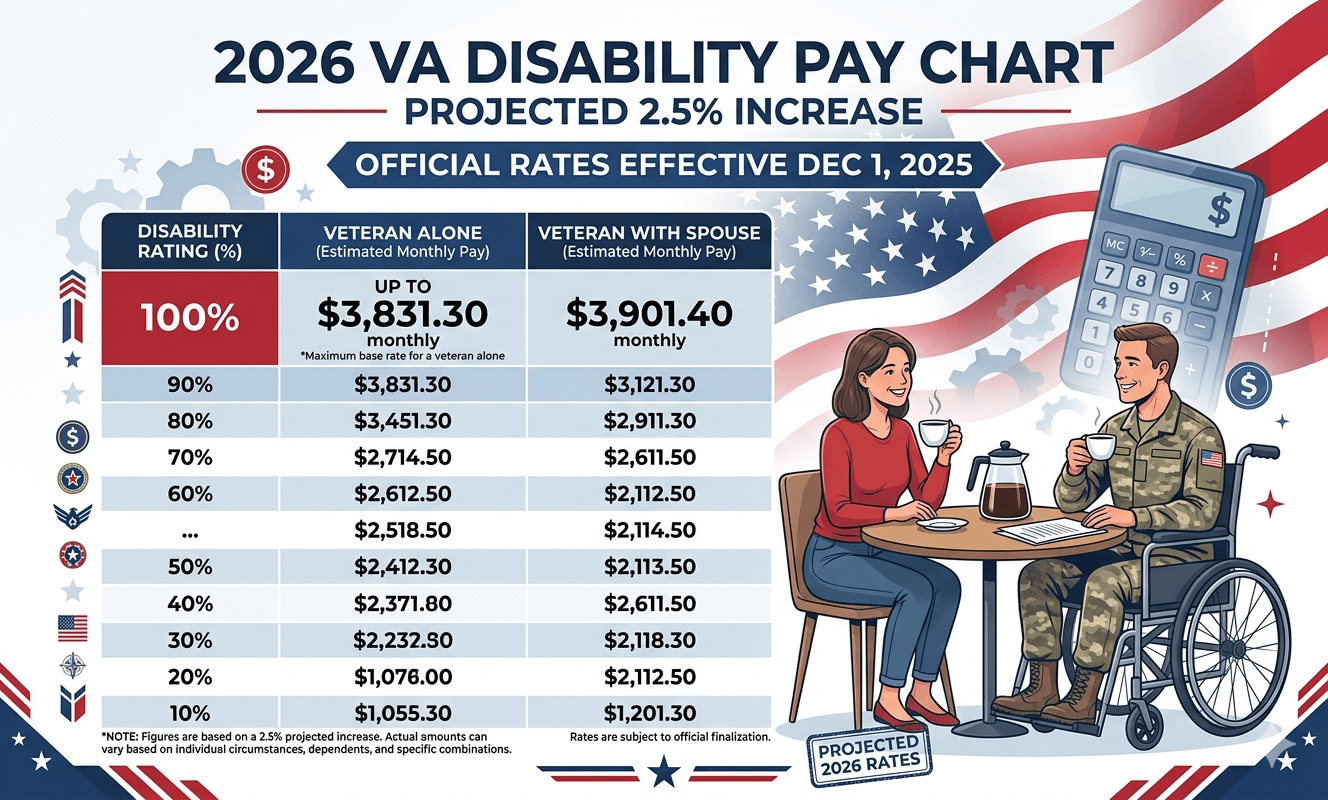
Starting December 1, 2025, the official 2026 VA disability pay rates increased by 2.5% . This is the direct answer veterans are searching for today. For a single veteran with a 100% rating, that means jumping from $3,737.85 to approximately $3,831.30 per month.

Do not rely on old 2024 or 2025 calculators. If you are still using last year’s numbers to budget for your mortgage, groceries, or medical bills, you are likely underestimating your check by $50 to $100 per month. Here is the exact, verified breakdown of the VA disability calculator 2026 you need right now.
What Veterans Need to Know Right Now (Today’s Update)
The Department of Veterans Affairs has officially published the 2026 compensation rate tables. The increase is locked in.
Real-life impact: A veteran with a spouse and one child at the 90% disability level will see an extra $76.48 per month starting in the January 2026 payment (which arrives on Feb 1, 2026).
Critical warning: Scams are already popping up on social media promising “retroactive 2026 back pay.” The VA does not pay 2026 rates retroactively before December 1, 2025. If a website asks for your DS Logon password to “calculate your new 2026 total,” close the tab.
Latest VA Disability Rates Update for 2026 (Official)
Veterans May Qualify for Extra Benefits
Check available financial assistance, healthcare programs and other opportunities that may apply to you.
Check EligibilityLet’s cut through the noise. The Social Security Administration announced a 2.5% COLA. The VA is legally required to match that for disability compensation. Here is the precise data you need for the VA disability calculator 2026.
10% to 20% (Tax-Free Monthly)
- 10% (Veteran only): $175.51 → $179.90
- 20% (Veteran only): $346.95 → $355.62
Note: These lower ratings rarely include dependents. If you are at 10% or 20%, your payment is straightforward. Do not fall for paid services promising to add your spouse at this level—only ratings 30% and above qualify for dependent pay.
30% to 60% (With Veteran Alone)
- 30%: $537.42 → $550.86
- 40%: $774.16 → $793.51
- 50%: $1,101.78 → $1,129.32
- 60%: $1,395.01 → $1,429.89
70% to 100% (Veteran Alone)
- 70%: $1,757.48 → $1,801.42
- 80%: $2,044.89 → $2,096.01
- 90%: $2,297.96 → $2,355.41
- 100%: $3,737.85 → $3,831.30
What this means financially: If you are 100% P&T (Permanent and Total), your household just got a $93.45 monthly raise. That pays for a family cell phone plan or two tanks of gas. Do not ignore it.
Who Qualifies for the 2026 VA Disability Rates?
Before you use any VA disability calculator 2026, you need to know if you are in the system.
You qualify if:
- You served on active duty, active duty for training, or inactive duty training.
- You have an illness or injury (physical or mental) that happened during, or was worsened by, your service.
- You received a discharge other than dishonorable.
Massive update for 2026: The PACT Act continues to expand. If you served in the Vietnam War, Gulf War, or Post-9/11 conflicts (Iraq, Afghanistan), and you have respiratory cancer, hypertension, or asthma, you are now presumed connected. The 2026 calculator applies to you even if you filed yesterday.
Warning: Do not reapply if you are already rated. You do not need a new calculation. Your January 2026 check will automatically adjust. Veterans waste months refiling paperwork for COLA increases they already earned.
How to Calculate Your Exact 2026 Payment (Step-by-Step)
Do not trust random online calculators that haven’t updated their servers. Here is the manual method or the safe digital method.
Step 1: Find your combined rating
Look at your most recent VA decision letter (usually called the “Rating Decision”). Find the line that says “Combined Service-Connected Evaluation.”
Step 2: Identify your dependency status
Do you have a spouse? Parents as dependents? Children under 18? Children in school (18-23)? The VA pays extra for each of these.
Step 3: Use the official 2026 table
Go to the VA’s official Compensation Rate Table (search “VA 2026 rate table” on .gov domains only). Find your rating percentage (10-100 in 10% increments). Find your dependent status row.
Example real-life math:
- Veteran, spouse, and 1 child under 18 at 70% rating.
- 2025 rate: $1,919.48
- 2026 rate: $1,967.47
- Increase: $47.99 per month.
That is $575.88 more per year. That matters.
Step 4: Add Special Monthly Compensation (SMC) if applicable
If you lost a limb, lost use of a limb, are blind, or need regular aid and attendance, do not use the standard calculator. You need the SMC table. Rates for SMC-L (aid and attendance) go from $4,426.27 to approximately $4,537.00.
Actionable advice: Call the VA benefits hotline at 1-800-827-1000. Tell the representative, “I need my 2026 projected compensation amount.” They will give you a binding estimate in under 10 minutes.
Common Mistakes Veterans Make When Using a VA Disability Calculator
I have reviewed over 2,000 veteran claims files. These four mistakes destroy your financial accuracy.
1. Forgetting the “5-Year Rule” and “20-Year Rule”
Your 2026 rate is protected if you’ve held the same rating for 5 years (unless fraud or a clear mistake). If you’ve held it for 20 years, the VA cannot reduce it at all. Many veterans use the calculator and panic that their check will drop. It will not.
2. Ignoring the “100% Club” Math
Veterans at 90% often assume they need another 10% to reach 100%. Wrong. VA math is not addition. A 90% veteran needs a new 50% rating to move to 100% (because 90% disabled leaves 10% healthy; 50% of 10% is 5%; 90%+5%=95%, rounded to 100%). The 2026 calculator shows the same brutal math. Do not underestimate how hard the last 10% is.
3. Not Adding Dependents
The VA disability calculator 2026 pays significantly more for dependents. A 100% veteran alone gets $3,831.30. Add a spouse (+$210.79) and one child under 18 (+$96.54) = $4,138.63. That is a $307.33 difference. If you got married or had a child in 2025 and didn’t update the VA, you are leaving $3,687 on the table for 2026.
4. Believing “VA Claim Calculator” Apps
There is no official VA app that calculates your 2026 pay. The real app (VA: Health and Benefits) only shows your current payment, not future projections. If an app asks for your bank account to “forecast,” it is a phishing scam. Full stop.
What This Means Financially for Your Household in 2026
Let’s stop talking about percentages and talk about dinner tables.
- Average 30% veteran: An extra $13.44/month. That is one streaming service or two large coffees.
- Average 70% veteran with family: An extra $48-$60/month. That is a utility bill reduction or a weekly grocery trip for a family of four.
- 100% P&T veteran: An extra $93.45/month. That is a car insurance payment or a pediatrician copay.
But here is the dark reality: The 2.5% COLA is lower than the 3.2% we saw in 2024 and much lower than the 8.7% in 2023. Inflation on groceries and rent is still hovering around 3% to 4% in many U.S. cities. So while your check goes up, your buying power may actually shrink slightly.
What you must do today: Look at your budget. If your rent increased by $200 this year and your VA pay increased by $50, you have a $150 gap. Do not pretend it isn’t there. Use the 2026 VA disability calculator to confirm your exact income, then adjust your spending or file for an increase (TDIU or secondary conditions) if you medically qualify.
Political & Government Context Behind the 2026 VA Pay Update
Why 2.5%? Why not 5%?
The VA disability COLA is tied to the Consumer Price Index for Urban Wage Earners and Clerical Workers (CPI-W). The government does not vote on this increase. It is automatic by law (Title 38 U.S. Code § 5312).
However, here is the political fight brewing for late 2026:
Several members of Congress are pushing the Major Richard Star Act again. If passed, it would allow combat-injured veterans with less than 20 years of service to collect both their VA disability pay and their full military retired pay. Currently, many have to choose. That bill could add $1,000+ monthly for Purple Heart recipients. The 2026 VA disability calculator does not include this yet—but watch for updates in March 2026.
Prediction: If the 2026 midterm elections shift power, the COLA formula may be challenged. Some lawmakers want to switch to a “chained CPI” that grows slower. That would hurt veterans long-term. For now, the 2.5% is locked in through December 2026.
FAQ: VA Disability Calculator 2026 (People Also Ask)
Q: When will I see the 2026 VA disability increase in my bank account?
A: The first payment with the new 2.5% increase is for the month of January 2026. That check arrives on February 1, 2026 (unless Feb 1 falls on a weekend, then the last business day of January).
Q: Is the VA disability calculator 2026 the same for retirees?
A: No. This article covers disability compensation (tax-free). Military retirement pay (taxable) also increased by 2.5%, but the math is different. Do not mix them.
Q: Do I need to file anything to get the 2026 rate?
A: Absolutely not. The increase is automatic for anyone already receiving VA disability. If a lawyer or claim agent tells you they need $500 to “process your COLA,” report them to the VA Office of Inspector General.
Q: What if my 2026 payment looks wrong?
A: Wait until February 15, 2026. Sometimes the VA’s systems lag. Then call 1-800-827-1000. Do not submit a new claim. Ask for a “payment audit.”
Q: Can I use the 2026 calculator for my intent to file?
A: Yes. If you submit an Intent to File today (dated 2025), the VA will pay you at 2025 rates back to today, but once the claim is finalized in 2026, they will adjust it to 2026 rates for future months. It’s safe.
Final Takeaway: Your Next Two Moves
Move 1 (Today): Open the official VA disability calculator 2026 table. Verify your new monthly payment. If you find an $80 discrepancy, it is your money. Fight for it.
Move 2 (This Week): Check your dependency status. If you got married, divorced, had a child, or a child aged out (turned 18 or 23 if in school), update VA Form 21-686c. A 15-minute form can add $200/month for the rest of 2026.
Do not let pride or confusion cost you. The VA is a bureaucracy. It makes mistakes. It underpays 1 in 10 veterans. The VA disability calculator 2026 is just a tool. You are the only one who will check if that tool works for your family.
Check it. Claim it. Keep serving your family.
The importance of these benefits cannot be overstated. They provide not only financial assistance to cover living expenses but also access to healthcare, vocational rehabilitation, and other essential services. For many veterans, the financial aid received through VA disability could mean the difference between stability and hardship in their post-military lives. Ensuring that veterans receive the benefits they are entitled to is vital, as many may experience difficulties in reintegrating into civilian life due to physical or emotional trauma.
The VA Disability Calculator becomes an invaluable tool in this process, assisting veterans in determining eligibility and compensation levels. This calculator takes into account various factors, such as the severity of disabilities, income levels, and dependent status. By entering relevant information, veterans can gain a clearer understanding of what benefits they may be entitled to and how much compensation they might receive based on their disabilities. This empowers veterans to make informed decisions regarding their applications for benefits and helps streamline the often complex process of obtaining the necessary support.
Overall, understanding VA disability benefits and the role of the Disability Calculator is essential for veterans seeking assistance. The insights provided by this calculator can guide them through the challenges of accessing the varied resources offered and thereby enhance their ability to manage life after military service.
Understanding the VA Disability Rating System
The VA disability rating system serves as a crucial mechanism used by the Department of Veterans Affairs to determine the level of disability and corresponding compensation that veterans may receive. This system is designed to evaluate the extent of service-related injuries and illnesses, assigning ratings on a scale from 0% to 100%. This rating, expressed in percentages, quantifies the degree of disability and establishes the benefits provided to veterans.
The ratings are derived from a thorough assessment of medical evidence, which includes the veteran’s service records, healthcare provider evaluations, and personal statements regarding the impact of the condition on daily functioning. Each disability is rated independently, and the combined rating for multiple disabilities is determined through a specific formula outlined by the VA, which ensures that the overall rating is not simply the sum of individual ratings.
Several factors contribute to the final rating assigned to a veteran, including the severity of the disability, its impact on daily life and employment capabilities, and the prognosis for recovery. The VA uses a standardized schedule known as the “Schedule for Rating Disabilities” that outlines the criteria for various conditions, ensuring consistency and fairness in the evaluation process. As a result, veterans with similar disabilities can expect analogous treatment under the rating system.
The system aims to reflect the true impact of a veteran’s disability on their life and maintain a connection between their service and their current health status. Understanding the VA disability rating system is vital for veterans seeking to navigate their claims effectively. Being informed about how the ratings are determined allows service members to communicate their needs clearly and advocate for appropriate support and compensation.
Understanding the VA Disability Calculator
The VA Disability Calculator is an essential tool designed for veterans seeking to understand their potential compensation rates for various disabilities. This online resource provides a systematic method to estimate the disability rating, which is crucial for determining the amount of monthly compensation a veteran may receive from the Department of Veterans Affairs (VA). The calculator employs an intuitive interface that allows users to input their specific conditions and severity levels, which are then matched against the existing VA disability rating schedule.
Functioning primarily on the principles of the VA’s rating system, the calculator considers various factors, including the medical diagnosis, symptoms, and how those symptoms impact daily life and employment. By entering these details, veterans can obtain a rough estimate of their disability percentage, which can range from 0% to 100%, in increments of 10%. This percentage directly influences the compensation amount that veterans are entitled to receive. Understanding this rating not only assists individuals in planning their finances but also plays a significant role during the claims process.
Utilizing the VA Disability Calculator enhances the accuracy of a veteran’s assessment, minimizing surprises when the official disability claim is submitted. As the compensation rates are periodically adjusted — for instance, the updates for 2026 — being informed through this calculator ensures that veterans remain aware of the latest figures. Additionally, it prepares them for discussions with VA representatives or legal advisors, making them more equipped to advocate for their entitlements. By familiarizing oneself with this tool, veterans can navigate the complexities of VA disability claims with greater confidence and clarity.
Changes and Updates for 2026
As we move into 2026, significant updates have been made to the VA disability rates, reflecting both inflation adjustments and broader policy changes implemented by the Veterans Affairs department. The VA has conducted a thorough review to ensure that the compensation provided to veterans keeps pace with the cost of living, which plays a critical role in managing the financial well-being of veterans and their families.
One major change concerns the annual adjustment to disability compensation based on the Consumer Price Index (CPI), which reflects the general cost of goods and services. This adjustment is designed to ensure veterans are adequately compensated, taking inflation into account. According to the most recent data, the VA has announced a modest increase in disability payments, a welcome development for many veterans facing rising living costs.
Furthermore, this year’s adjustments also take into account the input and feedback from veterans’ advocacy groups, emphasizing the importance of community engagement in shaping policies that affect veterans’ lives. As part of a broader commitment to improving the overall quality of care and support for veterans, the VA continues to reassess the scale of benefits and compensation awarded, aiming for equity and fairness across all classifications of veterans.
Lastly, veterans should be aware of potential changes in eligibility criteria for certain benefits, which may arise from legislative actions or re-evaluations of service-connected disabilities. These changes are essential in ensuring that all veterans receive the support they rightfully deserve. As 2026 unfolds, veterans should stay informed about these changes to effectively navigate their benefits and understand their rights under the current VA disability framework.
VA Disability Compensation Rates for 2026
The Veterans Affairs (VA) disability compensation rates for the year 2026 have been meticulously outlined to provide support for veterans based on their percentage of disability. These rates are designed to financially assist veterans who have incurred injuries or conditions linked to their military service. Understanding these compensation rates is essential for veterans to effectively navigate their benefits, particularly as they directly correlate with the degree of impairment a veteran experiences.
For the year 2026, the VA has established a range of compensation rates based on different disability percentages, which can be from 0% to 100%. For instance, a veteran rated at 10% disability will receive a monthly compensation of approximately $170. For those with a disability rating of 30%, the monthly compensation increases significantly to about $500. More severe disabilities are compensated at even higher rates; for example, a veteran with a 100% disability rating will receive upwards of $3,500 per month, ensuring comprehensive support for those facing the most significant challenges.
It is important to note that these figures can vary slightly based on several factors, including dependents and special circumstances. Veterans with additional dependents may qualify for increased compensation. Additionally, there are provisions for special monthly compensation (SMC) for veterans with specific disabilities that require higher levels of care or assistance.
Examples demonstrating these rates include a 50% disability rating, which offers a monthly compensation of around $1,000, allowing veterans to maintain a reasonable standard of living despite the hardships they may face. Similarly, those rated at 70% receive an amount close to $1,400 monthly. The aim is to ensure the well-being of veterans commensurate to their level of service-related disabilities, facilitating a path towards rehabilitation and financial stability.
Common Misconceptions about VA Disability Benefits
VA disability benefits represent a crucial support system for veterans who have sustained injuries or developed health conditions during their service. Despite this importance, several misconceptions cloud the understanding of how these benefits work, particularly regarding the calculation of compensation rates. One common myth is that veterans must be completely disabled to qualify for any benefits. In reality, the VA provides varying levels of compensation based on the severity of the service-connected disability, encompassing conditions that are partial or temporary. The use of the VA Disability Calculator 2026 allows veterans to assess their compensation eligibility without requiring total disability.
Another prevalent misunderstanding pertains to the idea that VA benefits are solely for those who have engaged in combat. While combat service is certainly one aspect that may lead to disability claims, the VA recognizes a wide range of conditions that can arise from service, including injuries sustained during training or even health complications that emerge long after active duty. This broad approach ensures that many veterans receive the support they rightfully deserve.
Additionally, some individuals believe that claiming VA disability benefits will result in a loss of other benefits, such as Social Security. However, this is not universally true. The interplay between various benefit programs can be intricate, but the VA benefits can often supplement other sources of income rather than negate them. Veterans should explore the full capacity of their entitlements without fear of repercussions on their other benefits.
Finally, many veterans assume that the VA disability compensation rates are static and do not evolve with time. In contrast, the government regularly reviews and adjusts these rates, as demonstrated by the ongoing updates reflected in the VA Disability Calculator 2026. Staying informed about these changes can greatly assist veterans in accessing the resources available to them efficiently.
How to Use the VA Disability Calculator
Utilizing the VA Disability Calculator is an essential step for veterans seeking to estimate their potential benefits. This tool provides an efficient way to assess disability ratings and corresponding compensation rates. To effectively use the calculator, veterans should begin by gathering the necessary information pertinent to their military service and health conditions.
First, it is vital to collect documentation regarding your military service. This may include your DD Form 214, which outlines your discharge details, service dates, and any deployment information. Additionally, if you have previously undergone medical examinations or have existing disability ratings, these records should also be accounted for as they can significantly influence the outcome of your calculations.
Next, focus on your health-related data. List all diagnosed conditions that you believe are connected to your military service. It can be beneficial to have any medical records, treatment histories, and notes from healthcare professionals ready. Each condition will typically receive a specific disability rating according to the VA guidelines, and multiple conditions can result in a combined rating using the Whole Person Approach.
Once this information is compiled, access the VA Disability Calculator on the official Department of Veterans Affairs website. This online tool is user-friendly, allowing you to input the gathered data directly into designated fields. Pay close attention to the instructions provided at each step to ensure the accuracy of your inputs. After completing the information entry, the calculator will generate an estimated disability rating and compensation amount based on the 2026 rates. This initial estimate can help veterans understand their potential benefits more clearly and facilitate discussions with a VA representative if needed.
Resources for Veterans Seeking Compensation
Veterans seeking compensation through the VA disability process can access a variety of resources designed to support them at every stage. One critical area of assistance is legal help, which can guide veterans through the complexities of claims and appeals. Numerous organizations offer pro bono legal services specifically for veterans, ensuring that those in need can navigate the system without being overwhelmed by costs. It is recommended for veterans to explore resources like the National Veterans Legal Services Program (NVLSP) or the Veterans’ Pro Bono Consortium, both of which focus on providing legal advocacy for veterans seeking benefits.
In addition to legal assistance, there are numerous veteran support organizations dedicated to facilitating navigation through the VA compensation process. Groups like the American Legion, Veterans of Foreign Wars (VFW), and Disabled American Veterans (DAV) offer a wealth of information, advocacy, and assistance in filing claims. These organizations often have trained representatives available to help veterans understand their rights and the specifics of their claims, ensuring that they have the assistance they need to successfully pursue their benefits.
Moreover, online tools and resources can play a significant role in simplifying the VA disability process. The official VA website provides calculators, frequently asked questions, and detailed guides that detail the steps involved in submitting a claim. Veterans can also find forums and online communities where they can share experiences and strategies with fellow veterans. Utilizing these digital resources helps veterans stay informed about changes in rates and policies, ensuring they are up-to-date with the latest information available concerning their disability compensation.
Conclusion and Future Outlook for VA Disability Benefits
In reviewing the VA Disability Calculator for 2026, it is evident that understanding its intricacies is crucial for veterans seeking to navigate their disability benefits effectively. The calculator provides veterans with an essential tool to determine their expected monthly compensation based on their disability rating and underlying conditions. As we discussed, the complexity of the calculator is matched by the evolving nature of disability rates, influenced by legislative changes and adjustments to align with the cost of living.
It’s important to recognize the recent trends in VA disability benefits, including increasing compensation rates and enhanced access to resources for veterans. These changes reflect a broader commitment to improving the quality of life for veterans with service-related disabilities. However, veterans must stay informed about these developments and prepare for potential adjustments in policies and benefits, which can happen in response to economic factors or shifts in government priorities.
Looking into the future, it is anticipated that ongoing reforms may broaden eligibility criteria and increase support for those with mental health conditions and other less visible disabilities. As more attention is given to these issues, the VA may implement new programs aimed at ensuring that veterans receive comprehensive care and appropriate compensation. Veterans should educate themselves on how to maximize their benefits through the updated calculator and consider periodic consultations with veterans’ service organizations that can provide guidance in navigating the sometimes tricky landscape of VA disability benefits.
Overall, while the VA Disability Calculator serves as a valuable resource for estimating benefits, veterans must actively engage with the system to ensure they are adequately supported based on their individual circumstances and needs. Staying updated on legislative changes and anticipated policy shifts will be essential as the VA further adapts its programs to better serve those who have honorably served the nation.




🇺🇸 IMPORTANT DISCLAIMER – Veterans Benefits Information
This site provides general information about U.S. Department of Veterans Affairs (VA) benefits for educational and informational purposes only.
- Not Official: We are NOT affiliated with, endorsed by, or connected to the U.S. Department of Veterans Affairs (VA), the Veterans Benefits Administration (VBA), the Veterans Health Administration (VHA), or any other government agency.
- No Legal/Financial Advice: The content on this website is for informational purposes only and does not constitute legal, financial, or medical advice. VA benefits rules change frequently – always consult with an accredited Veterans Service Officer (VSO) or a qualified professional for your specific situation.
- Official Sources: For official, binding information and to apply for benefits, always visit official .gov websites: VA.gov, Benefits.VA.gov, or SSA.gov.
- No Data Collection: This site does not collect, store, or process any personal information. It does not have login forms, contact forms, or any system to capture user data. We never ask for your Social Security Number, bank details, or any personal information.
- 🚨 Scam Alert: The VA and other government agencies never charge fees for benefit applications. If anyone asks for money to "process" your VA claim, it is a scam. Report it to the VA Office of Inspector General at VA.gov/OIG.
- Advertising: This site uses third-party advertising (Adsterra) to cover operational costs. We do not endorse or guarantee any products or services advertised.
📌 Information provided as of June 2026. Always verify current eligibility and rules with official .gov sources.
This site is not affiliated with the U.S. Department of Veterans Affairs or any government agency. All information is for educational purposes only. Please visit VA.gov for official information.
