
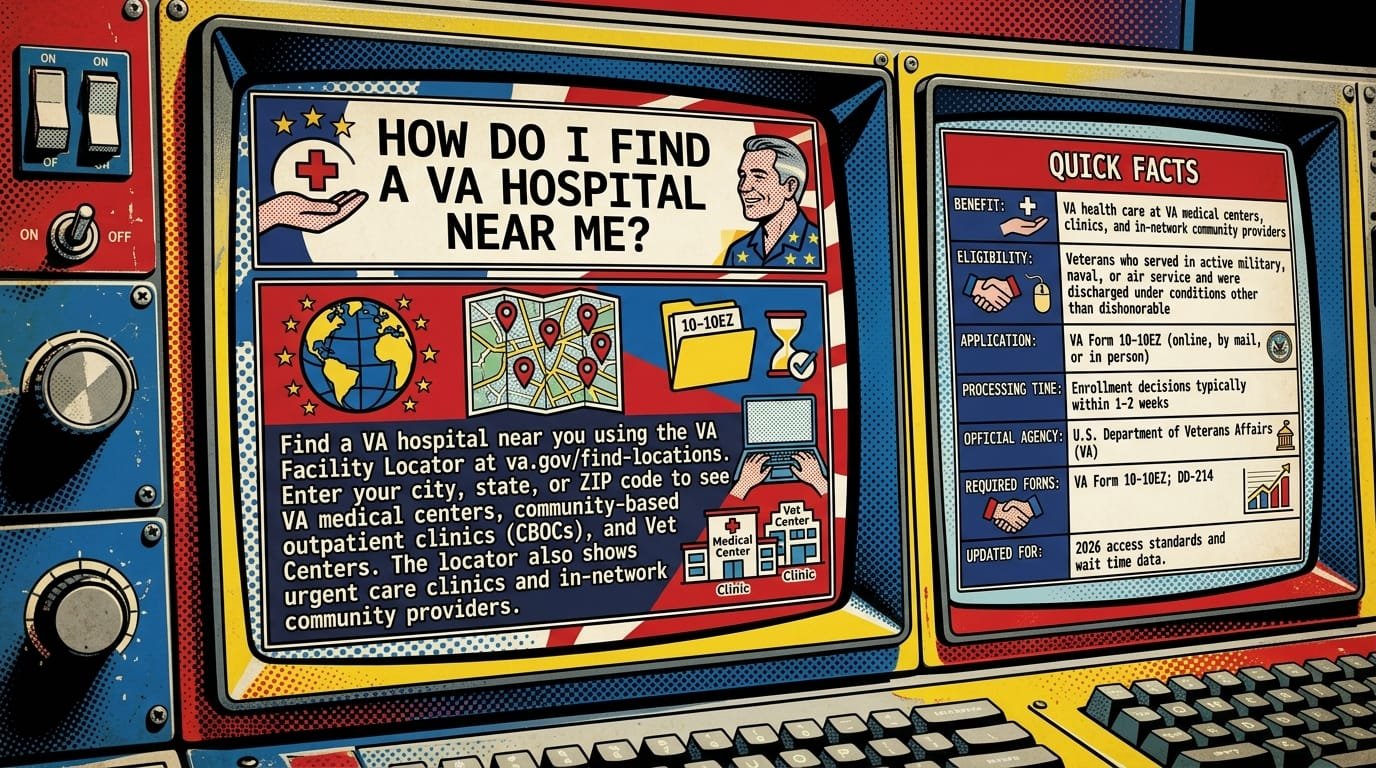
How Do I Find a VA Hospital Near Me?
Find a VA hospital near you using the VA Facility Locator at va.gov/find-locations. Enter your city, state, or ZIP code to see VA medical centers, community-based outpatient clinics (CBOCs), and Vet Centers. The locator also shows urgent care clinics and in-network community providers. You can search by facility type, service, and location.
Quick Facts
| Item | Details |
|---|---|
| Benefit | VA health care at VA medical centers, clinics, and in-network community providers |
| Eligibility | Veterans who served in active military, naval, or air service and were discharged under conditions other than dishonorable |
| Application | VA Form 10-10EZ (online, by mail, or in person) |
| Processing Time | Enrollment decisions typically within 1–2 weeks |
| Official Agency | U.S. Department of Veterans Affairs (VA) |
| Required Forms | VA Form 10-10EZ (Application for Health Benefits); DD-214 |
| Updated For | 2026 access standards and wait time data |
How to Find a VA Hospital Near You
The VA Facility Locator at va.gov/find-locations is the official directory for finding VA health care facilities, community providers, and urgent care clinics. It is the single source of truth for VA-approved facilities across the Veterans Health Administration (VHA), Veterans Benefits Administration (VBA), and National Cemetery Administration (NCA).

Step-by-Step: Using the VA Facility Locator
Go to va.gov/find-locations.
Enter your location — street address, city, state, or ZIP code.
Select a facility type from the dropdown:
VA health facilities (medical centers, CBOCs)
Urgent care (VA-owned or community in-network)
Vet Centers (counseling and readjustment services)
Community providers (in-network)
VA benefits offices
Filter by service type if needed — mental health, women’s health, dental, etc.
Review results — each listing includes address, phone number, hours, and available services.
Types of VA Health Care Facilities
| Facility Type | What It Provides |
|---|---|
| VA Medical Center (VAMC) | Full-service hospitals with inpatient care, surgery, specialty care, and emergency services |
| Community-Based Outpatient Clinic (CBOC) | Primary care, mental health, and some specialty services in local communities |
| Vet Center | Counseling, readjustment support, and community outreach for combat veterans |
| VA Urgent Care Clinic | Walk-in care for minor injuries and illnesses at VA-owned or in-network community locations |
| Community Living Center (CLC) | Long-term care, rehabilitation, and nursing home services |
The VA operates 170 medical centers nationwide, supported by more than 1,000 outpatient clinics, community living centers, and Vet Centers.
Finding Urgent Care Locations

To find a participating urgent care clinic, select “Urgent care” as the facility type, then choose “Community urgent care providers (in VA’s network)” from the service type dropdown. VA-enrolled veterans can visit these clinics without an appointment or prior authorization for minor injuries and illnesses.
Phone Assistance
If you cannot access the online locator, call the MyVA411 main information line at 800-698-2411 for help finding a facility near you. For urgent care location assistance specifically, call 877-881-7618 (8 AM – 8 PM EST).
Who Qualifies for VA Health Care in 2026?
Most veterans who served in the active military, naval, or air service and were separated under conditions other than dishonorable qualify for VA health care benefits. Eligibility is determined by service history, discharge status, income, and disability rating.
Basic Eligibility Requirements
Service: Active duty in the Army, Navy, Air Force, Marine Corps, Coast Guard, or Space Force.
Discharge: Separated under conditions other than dishonorable.
Minimum duty: Most veterans who enlisted after September 7, 1980, or entered active duty after October 16, 1981, must have served 24 continuous months or the full period for which they were called to active duty.
Reservists and National Guard: Qualify if called to active duty by a Federal Order and completed the full period for which they were called.
PACT Act Expansion (2026)
All veterans who meet basic service and discharge requirements and were exposed to toxins and other hazards while serving — at home or abroad — are now eligible for VA health care. This includes all veterans who served in the Vietnam War, Gulf War, Iraq, Afghanistan, or any other combat zone after 9/11.
Enrollment Priority Groups
Veterans May Qualify for Extra Benefits
Check available financial assistance, healthcare programs and other opportunities that may apply to you.
Check EligibilityThe VA assigns enrolled veterans to one of eight priority groups based on service-connected disability rating, income level, and special status. Priority Groups 1–7 are eligible for full VHA care. Priority Groups 1–5 have no copayments for medical care. Priority Groups 6 and 7 have copayments for care and medications.
| Priority Group | Who It Includes |
|---|---|
| 1 | Service-connected disabilities rated 50% or more disabling; Medal of Honor recipients |
| 2 | Service-connected disabilities rated 30% or 40% disabling |
| 3 | Former POWs; veterans with 10% or 20% service-connected disabilities |
| 4 | Veterans receiving Aid and Attendance or Housebound benefits |
| 5 | Veterans with income below VA means test threshold |
| 6 | Veterans with income above VA means test threshold but below geographic means test threshold |
| 7 | Veterans who agree to pay copayments |
| 8 | Veterans with income above thresholds; enrollment may be limited |
Source: VA enrollment priority group guidelines, 2026.
How to Apply for VA Health Care
Complete VA Form 10-10EZ (Application for Health Benefits).
Apply online at va.gov/health-care/apply/.
Apply by mail — print, complete, and mail to the Health Eligibility Center.
Apply in person — visit a VA medical center or CBOC.
Gather supporting documents — DD-214, income information, insurance cards.
Source: VA health care enrollment guidance, 2026.
VA Wait Times in 2026: What to Expect
VA wait times for new patients vary significantly by facility and specialty. The VA maintains an access standard of 20 days for primary care and mental health care and 28 days for specialty care after which veterans may be eligible for community care.
National Averages (2026)
| Patient Type | National Average Wait |
|---|---|
| Established patients | 5.8 days |
| New patients | 18.8 days |
Source: VA wait time data reported in 2026.
Wait Times by Specialty (New Patients)
Data from 134 VA medical centers across 10 key specialties shows mixed results. Five of 10 practice areas saw a majority of facilities meet VA’s access standard. For neurology, just 7% of facilities met the 28-day goal.
| Specialty | Wait Time Trend |
|---|---|
| Neurology | Longest waits; only 7% of facilities meet 28-day standard |
| PTSD treatment | Wait times increased at many facilities |
| Oncology | Number of facilities meeting standard declined |
| Primary care | Most facilities meet 20-day standard |
| Mental health | Mixed results by facility |
Specific examples:
Omaha VA Medical Center neurology wait times increased from 27 days to 127 days.
Dallas VA neurology wait times increased from 87 days to 130 days.
Garner VA Clinic in North Carolina reported median new patient wait times of 131.4 days between October 2025 and June 2026.
What veterans should do: Check wait times at your specific facility using the VA Access to Care website (AccessToCare.VA.gov). If wait times exceed VA standards, you may be eligible for community care at a non-VA provider. Discuss your options with your VA provider.
VA Access Standards and Community Care Eligibility
VA access standards determine when veterans can receive care from non-VA providers in the community. If the VA cannot meet its own wait-time or drive-time standards, the veteran may be eligible for community care.
Access Standards (2026)
| Type of Care | Wait-Time Standard | Drive-Time Standard |
|---|---|---|
| Primary care | 20 days | 30 minutes |
| Mental health care | 20 days | 30 minutes |
| Non-institutional extended care | 20 days | 30 minutes |
| Specialty care | 28 days | 60 minutes |
Source: VA designated access standards, 38 CFR 17.4040.
Community Care Eligibility Criteria
A veteran may be eligible for community care if any one of the following applies:
Service Unavailable: The service you need is not offered at VA (examples: maternity care, IVF).
Facility Unavailable: You live in a U.S. state or territory without a full-service VA medical facility.
Grandfathered Choice: You qualify under the former Veterans Choice Program distance rules.
Medical Interest: Your VA provider determines it is in your best medical interest to receive community care.
Quality Standards: VA cannot provide care that meets its own quality standards.
Access Standards: You cannot get timely care at VA based on distance or wait times.
Important: Meeting any one criterion may qualify you. You do not need to meet all six.
How Community Care Works
VA confirms eligibility.
Appointment is scheduled by VA, you, or a Third-Party Administrator.
You receive care from a VA-approved community provider.
VA handles billing through its Third-Party Administrator.
You must have VA authorization before the appointment. Care must be with a VA-approved provider in VA’s network. Copays follow VA rules, not the community provider’s rules.
Source: VA Community Care program guidelines, 2026.
VA Urgent Care: Locations and Eligibility
VA-enrolled veterans can receive care for minor illnesses or injuries at in-network urgent care clinics without an appointment or prior authorization. This is a separate benefit from emergency care and does not require the 72-hour notification rule.
What Urgent Care Covers
Colds and flu
Minor burns
Skin infections
Minor injuries
Sore throats
Sprains
Minor cuts
Eligibility for VA Urgent Care
You must meet both requirements:
Be enrolled in VA health care.
Have received VA care within the past 24 months (at VA or through VA community care).
How to Use Urgent Care
Find an in-network urgent care clinic at va.gov/find-locations.
Tell the provider you want to use your VA urgent care benefit.
The clinic verifies eligibility with VA.
You do not need an appointment or prior authorization.
Do not pay a copayment at the time of visit. VA bills you later, if applicable.
Urgent Care Copays (2026)
| Priority Group | First 3 Visits/Year | Each Additional Visit |
|---|---|---|
| 1–5 | $0 | $30 |
| 6 | $0 if related to special authority condition; otherwise $30 | $30 |
| 7–8 | $30 | $30 |
Source: VA urgent care copay schedule, 2026.
When to Use Emergency Care Instead
Call 911 or go to the nearest emergency room for life-threatening conditions including: trouble breathing, chest pain, stroke symptoms, bleeding that will not stop, seizures, passing out, or trying to hurt yourself or someone else.
VA Emergency Care: The 72-Hour Rule
VA covers emergency care at non-VA facilities under specific conditions. The veteran does not need a VA referral or approval to go to a non-VA ER, but VA must be notified within 72 hours of when care begins.
When VA Covers Non-VA Emergency Care
VA emergency room coverage applies if all of these are true:
You are enrolled in VA health care or have a qualifying exemption from enrollment.
A prudent layperson would reasonably believe that delaying care would have put your life or health in danger.
A VA facility was not feasibly available — meaning “too far away.”
VA was notified within 72 hours of when care started.
How to Notify VA
By phone: 844-724-7842 (TTY: 711)
Online: VA Emergency Care Reporting portal at emergencycarereporting.communitycare.va.gov
VA prefers the hospital to report, but if the hospital does not, you or someone acting on your behalf can notify VA.
Documents to Keep
Discharge papers
Itemized bill
Insurance explanation of benefits (EOB)
Any other documentation from the visit
Important Limits
VA covers non-VA emergency care only until you can be safely transferred to a VA or other federal facility. Once you are stable and VA can accept the transfer, VA’s payment stops unless VA cannot accept the transfer.
Source: 38 CFR 17.4020(c); VA emergency care guidance, 2026.
VA Hospital vs. Community Care vs. Urgent Care: Comparison
| Feature | VA Hospital | Community Care (Non-VA) | Urgent Care (In-Network) |
|---|---|---|---|
| What it treats | Emergency, specialty, inpatient, and surgical care | Services VA cannot provide or cannot provide timely | Minor illnesses and injuries |
| Eligibility | Enrolled veterans | Access standard or service unavailability | Enrolled + VA care in past 24 months |
| Prior authorization | Not required for VA facility | Required before appointment | Not required |
| Copay | Based on priority group | Follows VA rules | $0–$30 based on priority group |
| Find locations | va.gov/find-locations | va.gov/find-locations (Community providers) | va.gov/find-locations (Urgent care) |
| Emergency care | Yes | Yes, with 72-hour notification | No — urgent care only |
Source: VA health care benefits overview, 2026.
Common Mistakes When Finding VA Care
Mistake 1: Going to Urgent Care for an Emergency
Urgent care treats minor conditions. For chest pain, difficulty breathing, severe bleeding, or stroke symptoms, call 911 or go to the nearest ER. VA’s 72-hour notification rule applies to emergency care, not urgent care.
Mistake 2: Not Verifying Urgent Care Eligibility
The clinic must verify your VA eligibility. Not all urgent care clinics participate in VA’s network. Use the VA facility locator and select “Community urgent care providers (in VA’s network)” to find participating locations.
Mistake 3: Failing to Notify VA Within 72 Hours
If you receive emergency care at a non-VA facility, notify VA within 72 hours by phone (844-724-7842) or through the online portal. Without notification, VA may not cover the care.
Mistake 4: Assuming All VA Facilities Offer the Same Services
VA medical centers, CBOCs, and Vet Centers offer different services. A CBOC may not have emergency services or specialty care. Use the facility locator to filter by the specific service you need.
Mistake 5: Not Checking Wait Times Before Scheduling
Wait times vary dramatically by facility and specialty. Check AccessToCare.VA.gov for average wait times at your local facility. If the wait exceeds VA access standards, you may qualify for community care.
Mistake 6: Forgetting to Update Your Address
If you move, update your address with VA so the facility locator and appointment scheduling reflect your current location. VA travel pay eligibility also depends on your registered address.
Common Questions
How do I find a VA hospital near me?
Use the VA Facility Locator at va.gov/find-locations. Enter your city, state, or ZIP code. Select “VA health” as the facility type to see medical centers and clinics. You can also call MyVA411 at 800-698-2411 for phone assistance.
What is the difference between a VA medical center and a VA clinic?
A VA Medical Center (VAMC) is a full-service hospital with emergency, surgical, and inpatient care. A Community-Based Outpatient Clinic (CBOC) provides primary care, mental health, and some specialty services in local communities without inpatient beds.
Do I need an appointment at a VA hospital?
For routine care, yes. Call your VA medical center or use My HealtheVet to schedule. For emergency care, go directly to the nearest ER. For urgent care at in-network clinics, no appointment or prior authorization is needed.
How long are VA hospital wait times in 2026?
National averages: 5.8 days for established patients and 18.8 days for new patients. Wait times vary by facility and specialty. Neurology has the longest waits, with only 7% of facilities meeting the 28-day standard. Primary care generally meets the 20-day standard.
Can I go to any hospital with VA health care?
For emergency care, yes — go to the nearest ER and notify VA within 72 hours. For non-emergency care, you generally need to use VA facilities or VA-authorized community providers. Walking into a non-VA hospital for routine care without authorization may result in you being responsible for the bill.
What is VA community care?
VA community care allows eligible veterans to receive care from non-VA providers in their local community when VA cannot provide the care or cannot provide it timely. Eligibility is based on access standards, service availability, or medical interest.
How do I know if I qualify for VA health care?
Most veterans who served on active duty and were discharged under conditions other than dishonorable qualify. Eligibility is confirmed through the enrollment process using VA Form 10-10EZ. PACT Act expansion makes all veterans exposed to toxins eligible.
What is the 72-hour rule for VA emergency care?
If you receive emergency care at a non-VA facility, VA must be notified within 72 hours of when care begins. Call 844-724-7842 or report online at emergencycarereporting.communitycare.va.gov. Without notification, VA may not cover the care.
Can I use urgent care instead of the ER?
Yes, for minor illnesses and injuries. VA urgent care covers colds, minor burns, skin infections, sprains, and similar conditions. For life-threatening emergencies, call 911 or go to the ER. Urgent care does not have a 72-hour notification rule.
How do I find a VA urgent care clinic near me?
Use va.gov/find-locations. Select “Urgent care” as the facility type, then “Community urgent care providers (in VA’s network)” from the service type dropdown. No appointment or prior authorization is needed for eligible veterans.
What should I bring to a VA hospital appointment?
Bring your VA ID card, a photo ID, your insurance cards (Medicare, private insurance), a list of current medications, and any medical records from outside providers. For emergency care at a non-VA facility, keep all discharge papers and bills.
How do I check wait times at my local VA facility?
Visit AccessToCare.VA.gov to see average wait times by facility and specialty. You can also call your local VA medical center directly. If wait times exceed VA access standards (20 days primary/mental health, 28 days specialty), ask about community care eligibility.
Key Takeaways
Use the VA Facility Locator at va.gov/find-locations to find VA hospitals, clinics, urgent care, and community providers near you.
VA access standards: 20 days for primary care and mental health; 28 days for specialty care. If VA cannot meet these standards, you may qualify for community care.
National average wait times in 2026: 5.8 days for established patients; 18.8 days for new patients. Neurology has the longest waits.
Urgent care is for minor conditions — no appointment needed, $0–$30 copay based on priority group. Find in-network clinics through the facility locator.
Emergency care: Go to the nearest ER for life-threatening conditions. Notify VA within 72 hours by calling 844-724-7842 or reporting online.
Community care eligibility is based on access standards, service unavailability, or medical interest. VA authorization is required before the appointment.
Most veterans qualify for VA health care if they served on active duty and were discharged under conditions other than dishonorable. PACT Act expansion covers toxin-exposed veterans.
Enrollment priority groups determine access and copay responsibility. Priority Groups 1–5 have no copayments for medical care.
VA operates 170 medical centers and more than 1,000 outpatient clinics, community living centers, and Vet Centers nationwide.
Check AccessToCare.VA.gov for current wait times at your local facility before scheduling.
Official Resources
VA Facility Locator: https://www.va.gov/find-locations/
VA Health Care Enrollment: https://www.va.gov/health-care/how-to-apply/
VA Access to Care (Wait Times): https://www.accesstocare.va.gov/
VA Community Care: https://www.va.gov/communitycare/
VA Urgent Care: https://www.va.gov/health-care/urgent-care/
VA Emergency Care Reporting: https://emergencycarereporting.communitycare.va.gov/
VA Emergency Care Notification Phone: 844-724-7842 (TTY: 711)
MyVA411 Information Line: 800-698-2411
VA Health Care Hotline: 877-222-8387
Veterans Crisis Line: Dial 988 (press 1) or text 838255
VA Form 10-10EZ: https://www.va.gov/health-care/apply/



🇺🇸 IMPORTANT DISCLAIMER – Veterans Benefits Information
This site provides general information about U.S. Department of Veterans Affairs (VA) benefits for educational and informational purposes only.
- Not Official: We are NOT affiliated with, endorsed by, or connected to the U.S. Department of Veterans Affairs (VA), the Veterans Benefits Administration (VBA), the Veterans Health Administration (VHA), or any other government agency.
- No Legal/Financial Advice: The content on this website is for informational purposes only and does not constitute legal, financial, or medical advice. VA benefits rules change frequently – always consult with an accredited Veterans Service Officer (VSO) or a qualified professional for your specific situation.
- Official Sources: For official, binding information and to apply for benefits, always visit official .gov websites: VA.gov, Benefits.VA.gov, or SSA.gov.
- No Data Collection: This site does not collect, store, or process any personal information. It does not have login forms, contact forms, or any system to capture user data. We never ask for your Social Security Number, bank details, or any personal information.
- 🚨 Scam Alert: The VA and other government agencies never charge fees for benefit applications. If anyone asks for money to "process" your VA claim, it is a scam. Report it to the VA Office of Inspector General at VA.gov/OIG.
- Advertising: This site uses third-party advertising (Adsterra) to cover operational costs. We do not endorse or guarantee any products or services advertised.
📌 Information provided as of June 2026. Always verify current eligibility and rules with official .gov sources.
This site is not affiliated with the U.S. Department of Veterans Affairs or any government agency. All information is for educational purposes only. Please visit VA.gov for official information.
