
VA DC Staffing Report Today: 2026 Workforce Data, Wait Times, and What It Means for Veterans
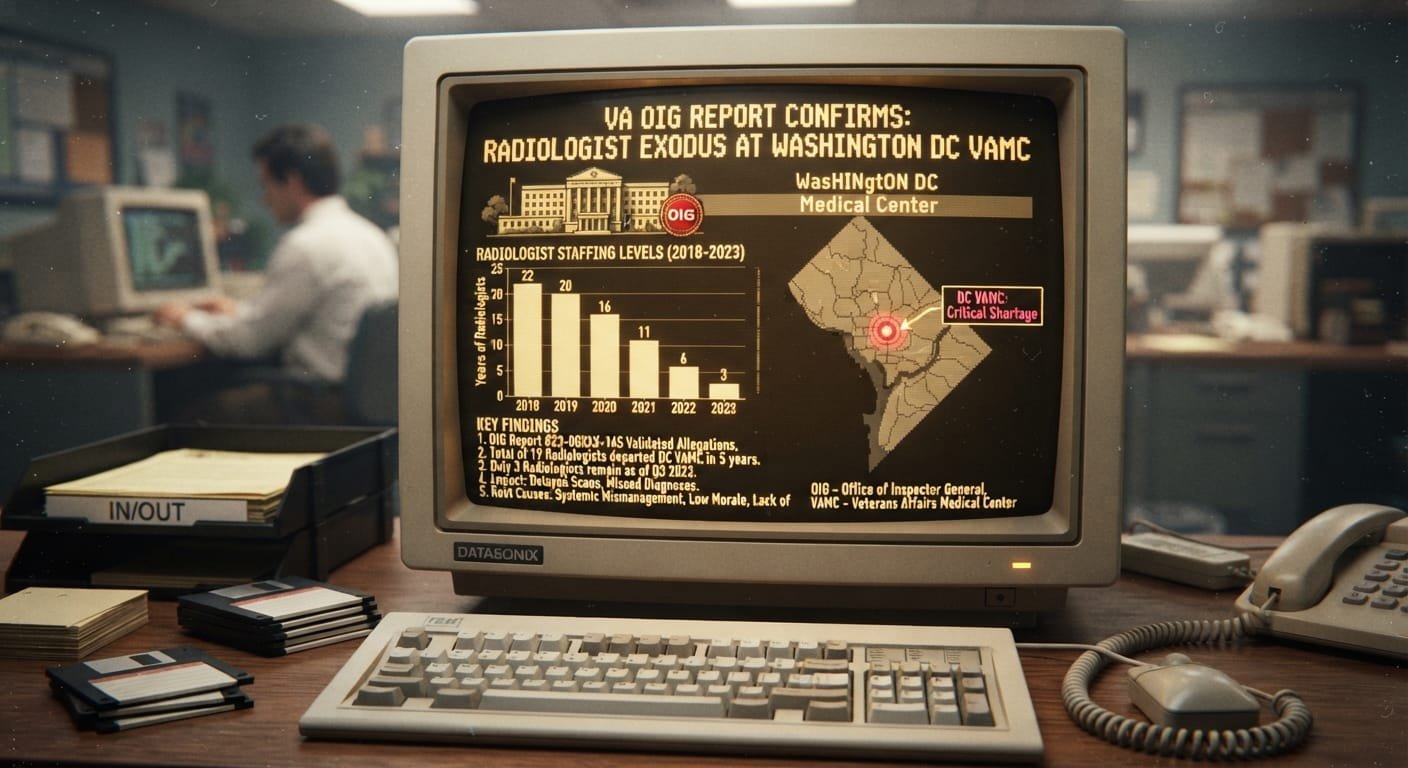
The VA Office of Inspector General confirmed in a report released August 5, 2026, that four of the five full-time radiologists and the chief of radiology at the Washington DC VA Medical Center resigned between July and December 2025, following the VA’s return-to-office mandate. Nationwide, VHA officials reported 4,712 severe occupational staffing shortages in FY 2026, the highest in seven years, with all 139 VA facilities reporting gaps. The VA Central Office in Washington, DC employed 13,821 people as of July 31, 2026.
Quick Facts
| Item | Details |
|---|---|
| What It Is | VA OIG annual report on severe occupational staffing shortages at VHA facilities, plus monthly workforce data |
| DC-Specific Finding | 4 of 5 full-time radiologists and the chief of radiology resigned from DC VA Medical Center |
| FY 2026 National Total | 4,712 severe occupational staffing shortages across 389 occupations |
| Facilities Reporting | All 139 VHA facilities reported at least one severe shortage |
| DC VA Medical Center Workforce | 3,200 employees |
| DC Central Office | 13,821 employees (VA Central Office, as of 7/31/2026) |
| Most Common Shortages | Medical Officers (97%), Nurses (86%), Practical Nurses (59%), Psychologists (58%), Police (57%) |
| DC Community Care Contact | 202-745-8000, ext. 58880, or secure messaging through My HealtheVet |
| Report Published | August 5, 2026 (DC radiology report); September 11, 2026 (national staffing report) |
| Updated For | September 2026 |
What Is the VA DC Staffing Report?
The VA DC staffing report today refers to two distinct but related documents: the VA Office of Inspector General’s national annual report on severe occupational staffing shortages across all VHA facilities, and a facility-specific OIG review of radiology staffing and services at the Washington DC VA Medical Center. Both were released in 2026 and together paint the most detailed public picture of staffing conditions at the VA’s flagship Washington, DC, facilities.

The national report is required by the Veterans Access, Choice, and Accountability Act (VACAA) of 2014 and the VA Choice and Quality Employment Act of 2017. The OIG sends questionnaires to VHA officials at each of the 139 VA medical facilities asking them to identify clinical and nonclinical occupations with severe staffing shortages. The OIG does not independently verify the responses. The report states the information “represents VHA officials’ input at a single point in time” and “does not necessarily indicate the presence of vacancies”.

The DC-specific radiology review was prompted by reporting from The American Prospect in July 2026 about a “mass exodus” of radiologists from the DC VA Medical Center following the VA’s return-to-office mandate. The OIG confirmed that most of the facility’s radiologists resigned between July and December 2025, contributing to delays in completing radiologic studies.
Why this matters for DC-area veterans: The DC VA Medical Center is the only VA health care system specifically located in the nation’s capital, providing tertiary care to veterans across the Washington metropolitan area. Staffing losses at this facility directly affect veterans in DC, Maryland, and Virginia who rely on it for specialized care.
What veterans should do next: If you receive care at the DC VA Medical Center and have experienced delays in imaging, specialty referrals, or mental health appointments, request a community care referral if VA cannot meet access standards. Contact the DC community care office directly at 202-745-8000, ext. 58880.
The National FY 2026 Staffing Report Explained
VHA officials reported a total of 4,712 severe occupational staffing shortages in fiscal year 2026, which runs from October 1, 2025, through September 30, 2026. This is the highest number reported over the past seven years. All 139 VHA facilities identified staffing shortages, and shortages were reported across 389 distinct occupations.
Veterans May Qualify for Extra Benefits
Check available financial assistance, healthcare programs and other opportunities that may apply to you.
Check EligibilityThe most commonly reported shortages were:
| Occupation | % of Facilities Reporting Severe Shortage | FY 2025 Comparison |
|---|---|---|
| Medical Officer | 97% | 94% |
| Nurse | 86% | 79% |
| Practical Nurse | 59% | Not top shortage |
| Psychologist | 58% | Top clinical shortage in FY 2025 |
| Police | 57% | Not top shortage |
Practical Nurse overtook Psychologist as the most frequently reported clinical shortage in FY 2026, with VHA officials reporting it as a shortage at 59% of facilities. Psychologists, psychiatrists, social workers, and nursing assistants also appeared on the top five list of clinical staffing shortages.
For nonclinical positions, Police was the most commonly reported shortage at 57% of facilities, followed by custodians, medical support assistants, food service workers, and healthcare engineers.
The VA has disputed the reliability of the report’s methodology. VA Press Secretary Quinn Slaven stated that the report “is not based on actual VA healthcare facility vacancies and therefore is not a reliable indicator of staffing shortages.” Slaven said the VA-wide vacancy rates for doctors and nurses are 15% and 9%, respectively, and “lower than most other healthcare systems”.
What veterans should do next: The report identifies which positions facilities struggle to fill. If your needed specialty appears on the severe shortage list for your facility, ask about community care eligibility immediately rather than waiting for an appointment that may not materialize.
DC VA Medical Center Radiology Crisis
Four of the five full-time radiologists and the chief of radiology at the Washington DC VA Medical Center resigned between July and December 2025, a “mass exodus” that the VA OIG attributed to the department’s return-to-office mandate and the resulting uncertainty about remote work exemptions.
The timeline is critical. The VA issued its return-to-office order in February 2025, requiring federal employees to work in person. When employees who had been hired specifically to work remotely complained, including mental health professionals, the VA press spokesman dismissed their concerns. In May 2025, the VA softened the mandate with a memorandum exempting radiologists providing telehealth or virtual care. In October 2025, the VA exempted all radiologists, but the exemption required annual renewal and review.
The former DC chief of radiology told the OIG that “it was unclear if the exemption would extend beyond one year, creating uncertainty that drove radiologists to seek non-VA, telework-permitted positions, and hindered VHA’s ability to recruit and hire radiologists.” The chief also said his workload increased to a “productivity level more than double the expected amount”.
Why this matters: Radiology is essential for diagnosing cancer, cardiovascular disease, traumatic injuries, and dozens of other conditions. When radiologists leave, imaging studies take longer to read, which delays diagnoses and treatment decisions. The VA mandates a one-hour turnaround time for STAT imaging exams. A VA employee who contacted The Imaging Wire claimed that turnaround time has ballooned to as high as 10 hours. “Imagine not getting critical diagnoses for ER patients until 10-12 hours later,” the source said.
What veterans should do next: If you are scheduled for imaging at the DC VA Medical Center and experience delays in receiving results, ask your provider whether the study has been read and whether a community care referral for imaging is appropriate. Document the dates of your imaging study and when you received results.
Is the DC Radiology Crisis Widespread?
The DC VA Medical Center’s radiology crisis is not isolated. A VA employee who contacted The Imaging Wire reported that VA radiology departments around the country “got decimated,” with some losing 50% of their radiologist staff. This includes VA medical centers in Houston, Dallas, and San Antonio, and a number in Florida.
The VA’s National Teleradiology Program, which employs radiologists to fill coverage gaps for smaller VA facilities and after-hours reads, shrank from approximately 120 radiologists at its peak to just 62. The program faced its own personnel exodus after officials required daytime radiologists to also work nights and every other weekend.
The root cause is a pay gap that makes VA radiology positions less competitive than the private sector. The VA salary cap of $400,000 is significantly below the private-sector average of $610,000 for U.S. radiologists, a 53% difference. A VA employee attributed the departures to “a vicious cycle of lower salaries and higher workload,” noting that the return-to-office edict was only a “minor” contributor compared to compensation.
What veterans should do next: If you need imaging services at any VA facility and experience delays, ask about community care for radiology. Under the MISSION Act, if VA cannot provide the service within access standards, you may be eligible for imaging at a community provider.
DC VA Medical Center Wait Times (2026)
Wait times at the Washington DC VA Medical Center vary significantly by specialty and whether the patient is new or established. According to VA Access to Care data current as of September 2026, established patients generally experience shorter waits than new patients, but several specialties show extended wait times.
| Specialty | New Patient Wait | Established Patient Wait |
|---|---|---|
| Audiology | 27 days | 29 days |
| Cardiology | 10 days | 26 days |
| Dental | 19 days | 120 days |
| Dermatology | 22 days | 52 days |
| Endocrinology | 14 days | 41 days |
| Gastroenterology | 22 days | 62 days |
| Mental Health (Individual) | 11 days | 8 days |
| Neurology | 30 days | 59 days |
| Oncology | 12 days | 58 days |
| Ophthalmology | 18 days | 40 days |
| Optometry | 41 days | 73 days |
Source: VA Access to Care data, September 2026.
Several wait times exceed the MISSION Act access standards. Established patients wait 120 days for dental care at the DC VA Medical Center, far beyond any access standard. Gastroenterology established patient waits reach 62 days, and neurology established patient waits reach 59 days.
Mental health access at the DC VA Medical Center is comparatively strong, with an 11-day wait for new individual mental health patients and an 8-day wait for established patients. This contrasts with the national pattern where mental health waits have increased at many facilities.
What veterans should do next: If your wait time exceeds 20 days for primary care or mental health, or 28 days for specialty care, you are legally eligible for community care. Request a referral from your VA provider or the community care office. The DC VA community care office can be reached at 202-745-8000, ext. 58880.
VA Central Office Workforce and Reorganization
The VA Central Office employed 13,821 people as of July 31, 2026, according to the most recent VA Workforce Dashboard. This figure includes employees at VA headquarters and central office staff offices located in Washington, DC.
The VA has undertaken a major reorganization of the Veterans Health Administration, announced in December 2025 and implemented over 18 to 24 months beginning in early 2026. Under the new structure, the VHA Central Office has responsibility for setting policy goals and conducting financial management, oversight, and compliance. A new operations center and the existing Veterans Integrated Service Networks (VISNs) take policy direction from VHA Central Office to develop operational plans, and the 139 health care systems deliver direct patient care.
The VA stated that no offices or positions would be eliminated through the restructure. “Placement within the new framework is ongoing to ensure optimal service to Veterans,” the VA stated. The reorganization is intended to reduce bureaucracy and ensure consistent policy application across medical facilities.
Why this matters: The Central Office sets the policies that determine how VA facilities hire, how quickly they process claims, and what access standards apply to community care. Changes in Central Office structure can affect everything from hiring timelines to claims processing rules.
What veterans should do next: Monitor the VA Workforce Dashboard monthly at department.va.gov/employees for updates on Central Office staffing levels and hiring trends.
Key Personnel Changes at VA in 2026
Several senior VA officials have departed or changed roles in 2026, creating leadership turnover at the department’s highest levels.
Chief of Staff departure. VA Chief of Staff Chris Syrek left the department on February 13, 2026, for a private-sector opportunity. He was succeeded by Curt Cashour, who had served as VA Assistant Secretary for Public and Intergovernmental Affairs.
VBA leadership search. The VA established a commission in January 2026 to identify candidates for the position of Under Secretary for Benefits, the senior official within the Veterans Benefits Administration. VA Deputy Secretary Paul R. Lawrence chaired the commission.
Deputy Secretary. Dr. Paul R. Lawrence continued serving as VA Deputy Secretary in 2026, leading the department’s transformation efforts and chairing the VBA leadership search commission.
Central Office IT leadership. The VA tapped Zack Schwartz to serve as principal deputy assistant secretary for the Office of Information and Technology in February 2026. President Trump nominated Gary Shatswell as VA CIO in April 2026.
Why this matters for DC-area veterans: Leadership turnover at VA Central Office can slow decision-making on claims processing, hiring approvals, and policy implementation. The VBA Under Secretary position, in particular, oversees the benefits claims system that serves millions of veterans nationwide, including thousands in the DC metropolitan area.
What veterans should do next: If you have a pending benefits claim or appeal that seems stalled, contact a Veterans Service Organization for assistance. Leadership changes can create processing delays, and a VSO can help navigate the system.
Community Care for DC-Area Veterans
The Veterans Community Care Program allows veterans to receive care from approved non-VA providers at VA expense when VA cannot meet designated access standards. This is a legal entitlement under the MISSION Act, not a discretionary benefit.
What it is: A program authorizing VA-funded treatment by community providers when VA cannot provide care within published access standards. In the DC metropolitan area, TriWest Healthcare Alliance administers the community care network.
Who qualifies: Veterans enrolled in or eligible for VA health care who have approval from their VA health care team before receiving community care. At least one of these must also be true:
VA does not provide the needed service at any VA facility.
You and your VA provider agree community care is in your best medical interest.
VA cannot meet designated drive time or wait time standards.
DC-specific access standards:
| Care Type | Wait Time Standard | Drive Time Standard |
|---|---|---|
| Primary Care | 20 days | 30 minutes |
| Mental Health | 20 days | 30 minutes |
| Specialty Care | 28 days | 60 minutes |
How to request community care at the DC VA Medical Center:
Call 202-745-8000, ext. 58880, or send a secure message through My HealtheVet selecting Community Care.
State clearly: “I am requesting a community care referral because VA cannot meet the access standard for [your care type].”
Confirm the provider accepts TriWest.
Keep a written record of your request date, the person you spoke with, and their response.
If denied, ask for the denial in writing and contact a Veterans Service Organization for help appealing.
What veterans should do next: If you are experiencing delays at the DC VA Medical Center for any service, request a community care referral. The DC community care office is specifically staffed to handle these requests.
What DC-Area Veterans Can Do: Step-by-Step
Step 1: Know your access standards. For primary care and mental health, the standard is 20 days or 30 minutes. For specialty care, it is 28 days or 60 minutes. If VA cannot meet either, you qualify for community care.
Step 2: Ask specifically for community care. Do not wait for VA to offer it. Say the words: “I am requesting a community care referral under the MISSION Act because VA cannot meet the access standard.”
Step 3: Document everything. Write down dates, names, and what you were told. This documentation is essential for appeals, congressional inquiries, and VSO assistance.
Step 4: Contact a Veterans Service Organization. The American Legion, VFW, and DAV provide free assistance with VA claims, appeals, and access issues. They can escalate staffing-related complaints.
Step 5: Contact your congressional representative. DC is represented by a non-voting delegate in the House of Representatives. Veterans in Maryland and Virginia have full congressional representation. These offices can inquire with VA on your behalf. Find your representatives at USA.gov/elected-officials.
Step 6: Monitor the VA Workforce Dashboard. The dashboard is published monthly at department.va.gov/employees and shows hiring trends and workforce size.
Step 7: Use the Veterans Crisis Line if needed. Call 988, then press 1. This is available 24/7 for veterans in crisis and their families.
Common Mistakes DC-Area Veterans Make
Mistake 1: Waiting silently for an appointment. If your wait exceeds the access standard, you may be eligible for community care. Ask — do not assume VA will offer it.
Mistake 2: Not knowing the DC community care contact. The DC VA Medical Center has a dedicated community care office at 202-745-8000, ext. 58880. Save this number.
Mistake 3: Assuming radiologist shortages mean you cannot get imaging. Community care is available for radiology if VA cannot provide the service within access standards.
Mistake 4: Not documenting delays. Write down dates, names, and what you were told. This documentation is essential for appeals and congressional inquiries.
Mistake 5: Giving up after one denial. If your community care request is denied, ask for the reason in writing. You can appeal through the VA’s clinical appeals process or ask a VSO for help.
Mistake 6: Not checking whether your provider is in the TriWest network. Before receiving community care, confirm the provider accepts TriWest to avoid unexpected bills.
Common Questions
1. What does the VA DC staffing report today say?
The VA OIG confirmed in August 2026 that four of five full-time radiologists and the chief of radiology at the DC VA Medical Center resigned between July and December 2025. The national FY 2026 report found 4,712 severe occupational staffing shortages across all 139 VA facilities, the highest in seven years.
2. Why did DC VA Medical Center radiologists leave?
The OIG attributed the departures to the VA’s return-to-office mandate and uncertainty about remote work exemptions. The former chief of radiology said radiologists sought non-VA, telework-permitted positions. A VA employee also cited lower salaries and higher workloads compared to the private sector, where radiologist pay averages 53% higher.
3. How long are wait times at the DC VA Medical Center?
Wait times vary by specialty. New patient waits range from 10 days for cardiology to 41 days for optometry. Established patient waits range from 8 days for individual mental health to 120 days for dental care. Neurology established patient waits are 59 days.
4. Can I get care outside VA in Washington, DC?
Yes. If VA cannot schedule you within 20 days for primary or mental health care, or 28 days for specialty care, you are eligible for community care. The DC VA community care office can be reached at 202-745-8000, ext. 58880.
5. How many people work at the VA Central Office?
The VA Central Office employed 13,821 people as of July 31, 2026, according to the VA Workforce Dashboard. This includes headquarters staff and central office staff offices in Washington, DC.
6. What is the OIG report on VA staffing?
The VA Office of Inspector General publishes an annual report on severe occupational staffing shortages at VHA facilities, required by VACAA and VCQEA. The FY 2026 report found 4,712 shortages across 389 occupations, with medical officers (97% of facilities), nurses (86%), practical nurses (59%), and psychologists (58%) being the most commonly reported.
7. Is the DC VA Medical Center closing?
No. The DC VA Medical Center remains open and operational. It employs approximately 3,200 people and provides tertiary care to veterans across the Washington metropolitan area.
8. What is the VA doing to address radiologist shortages?
The VA relies on its National Teleradiology Program, which shrank from 120 to 62 radiologists. The VA has also exempted radiologists from return-to-office requirements, though the exemption requires annual renewal. The pay gap between VA and private-sector radiology remains a barrier to recruitment.
9. How do I file a complaint about VA staffing in DC?
Contact the DC VA Medical Center patient advocate, call 1-800-MyVA411, or file a complaint through the VA’s online system. You can also contact the DC Office of Veterans Affairs or a Veterans Service Organization.
10. Who is the DC VA Medical Center director?
Vamsee Potluri was appointed Executive Medical Center Director of the Washington DC VA Medical Center on September 15, 2025. He leads approximately 3,200 employees.
11. Are VA disability claims being processed slower in DC?
The Veterans Benefits Administration lost 2,592 employees nationwide in FY 2026 through July, including more than 1,100 claims examiners. Leadership turnover in the VBA, including a search for a permanent Under Secretary, may contribute to processing delays.
12. What is the VA Workforce Dashboard?
The VA Workforce Dashboard is a monthly public report showing current workforce size, hires, losses, and time-to-hire metrics. It is published on the last Friday of each month at department.va.gov/employees.
Key Takeaways
The VA OIG confirmed a “mass exodus” of radiologists at the DC VA Medical Center, with four of five full-time radiologists and the chief of radiology resigning between July and December 2025.
Nationwide, VHA officials reported 4,712 severe occupational staffing shortages in FY 2026, the highest in seven years. All 139 VA facilities reported shortages.
Medical officers (97% of facilities), nurses (86%), practical nurses (59%), psychologists (58%), and police (57%) were the most commonly reported shortages.
DC VA Medical Center wait times exceed access standards in several specialties: 120 days for established dental patients, 62 days for established gastroenterology patients, and 59 days for established neurology patients.
The VA Central Office employed 13,821 people as of July 31, 2026, and is undergoing an 18-to-24-month reorganization.
Senior VA leadership has experienced turnover in 2026, including the departure of Chief of Staff Chris Syrek and an ongoing search for a permanent VBA Under Secretary.
Veterans waiting more than 20 days for primary or mental health care, or 28 days for specialty care, are eligible for community care under the MISSION Act.
The DC VA community care office can be reached at 202-745-8000, ext. 58880, or through secure messaging on My HealtheVet.
The VA disputes the OIG staffing report’s methodology, noting that it reflects perceptions of hiring difficulty rather than actual vacancy counts.
Veterans should document delays, contact patient advocates, and reach out to VSOs or congressional representatives for help accessing care.
Official Resources
VA Workforce Dashboard: department.va.gov/employees — Monthly workforce data, hiring metrics, and staffing trends
VA Office of Inspector General: vaoig.gov — Annual staffing shortage reports and the DC radiology review
VA Washington DC Health Care: va.gov/washington-dc-health-care — DC VA Medical Center information, services, and contact details
VA Community Care: va.gov/communitycare — Eligibility criteria and how to request community care
VA Access to Care Data: accesstocare.va.gov — Wait time data by facility and specialty
Veterans Crisis Line: 988 (Press 1) — Free, confidential support for veterans in crisis
VA Benefits Hotline: 1-800-MyVA411 — General VA information and assistance
USA.gov: USA.gov/elected-officials — Find and contact your congressional representatives
DC Office of Veterans Affairs: oveterans.dc.gov — Local veteran services for DC residents

🇺🇸 IMPORTANT DISCLAIMER – Veterans Benefits Information
This site provides general information about U.S. Department of Veterans Affairs (VA) benefits for educational and informational purposes only.
- Not Official: We are NOT affiliated with, endorsed by, or connected to the U.S. Department of Veterans Affairs (VA), the Veterans Benefits Administration (VBA), the Veterans Health Administration (VHA), or any other government agency.
- No Legal/Financial Advice: The content on this website is for informational purposes only and does not constitute legal, financial, or medical advice. VA benefits rules change frequently – always consult with an accredited Veterans Service Officer (VSO) or a qualified professional for your specific situation.
- Official Sources: For official, binding information and to apply for benefits, always visit official .gov websites: VA.gov, Benefits.VA.gov, or SSA.gov.
- No Data Collection: This site does not collect, store, or process any personal information. It does not have login forms, contact forms, or any system to capture user data. We never ask for your Social Security Number, bank details, or any personal information.
- 🚨 Scam Alert: The VA and other government agencies never charge fees for benefit applications. If anyone asks for money to "process" your VA claim, it is a scam. Report it to the VA Office of Inspector General at VA.gov/OIG.
- Advertising: This site uses third-party advertising (Adsterra) to cover operational costs. We do not endorse or guarantee any products or services advertised.
📌 Information provided as of June 2026. Always verify current eligibility and rules with official .gov sources.
This site is not affiliated with the U.S. Department of Veterans Affairs or any government agency. All information is for educational purposes only. Please visit VA.gov for official information.
