
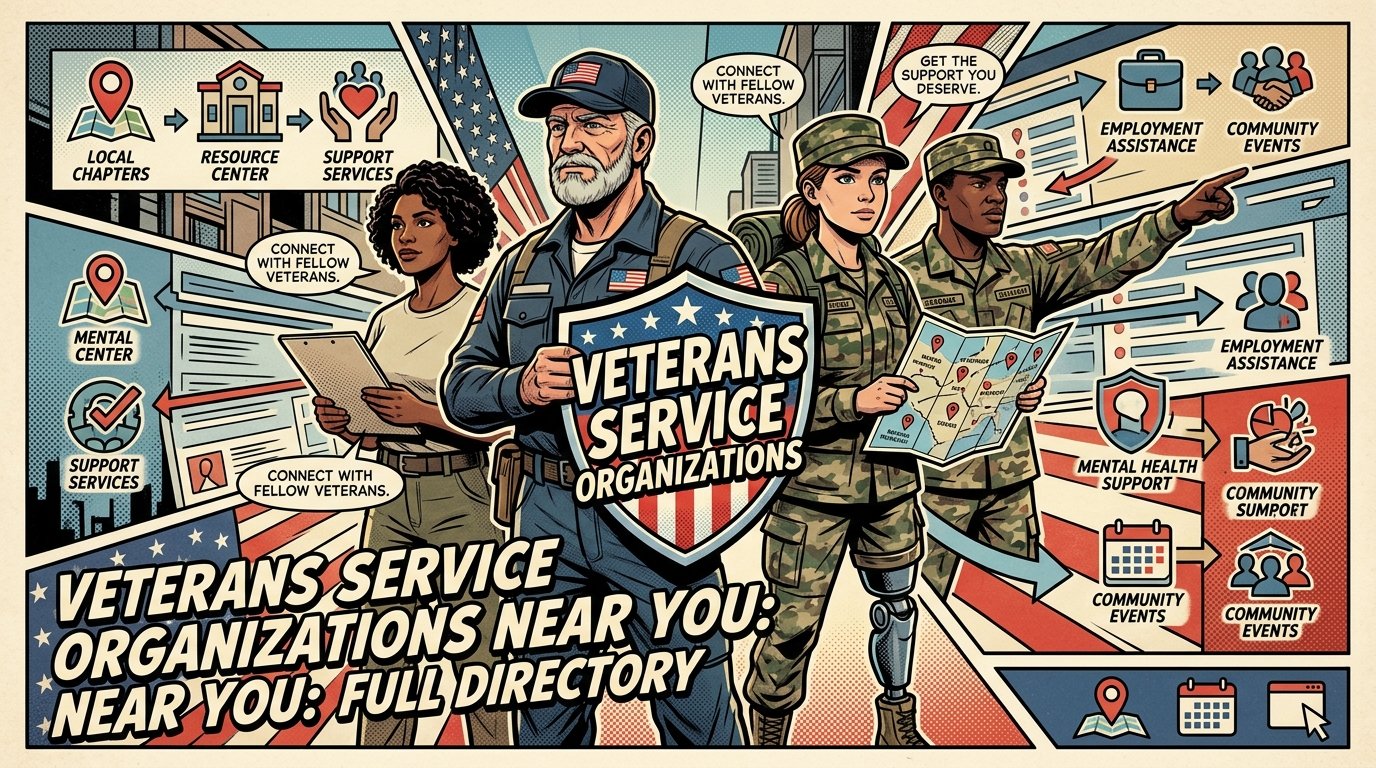
Veterans Service Organizations Near You: Full Directory
A Veterans Service Organization (VSO) is a nonprofit group recognized by the U.S. Department of Veterans Affairs (VA) to help veterans, service members, and families file VA claims, appeal decisions, and access benefits. Major VSOs include the American Legion, VFW, DAV, AMVETS, Vietnam Veterans of America, Paralyzed Veterans of America, and the Military Order of the Purple Heart. VSO representatives provide their services free of charge on VA benefit claims. Find one near you using the VA Office of General Counsel accreditation search at va.gov/ogc/apps/accreditation/index.asp.
Quick Facts
| Item | Details |
|---|---|
| Benefit | Free claims assistance, benefits counseling, advocacy, and community programs |
| Eligibility | Veterans, active duty, Guard, Reserve, military families, survivors, caregivers |
| Application | Complete VA Form 21-22 to appoint a VSO as your representative |
| Processing Time | Immediate for intake; claim processing depends on VA (avg. 75.6 days in 2026) |
| Official Agency | VA Office of General Counsel (accreditation); individual VSOs (services) |
| Required Forms | VA Form 21-22 (VSO representation); DD-214; VA Form 21-526EZ (disability claim) |
| Updated For | 2026 |
What Is a Veterans Service Organization?
A Veterans Service Organization is a nonprofit organization that advocates for veterans and helps them access federal, state, and local benefits. VSOs have been part of the American veteran support system since the Civil War era, and many are chartered by Congress.

There are more than 100 VA-recognized national VSOs. The VA works most closely with six traditional organizations: The American Legion, Veterans of Foreign Wars (VFW), Disabled American Veterans (DAV), Paralyzed Veterans of America (PVA), AMVETS, and Vietnam Veterans of America (VVA). The Military Order of the Purple Heart (MOPH) is also a congressionally chartered VSO.
What VSOs Do

VSOs serve two core functions:
Claims and benefits assistance — Accredited VSO representatives help veterans gather evidence, file claims, request decision reviews, and communicate with VA on their behalf.
Community and advocacy — VSOs operate local posts and chapters, provide camaraderie, advocate for veterans’ legislation, and offer programs like transportation to medical appointments.
Why VSOs Matter
Navigating the VA benefits system is complex. VSO representatives are trained and certified in VA’s claims and appeals processes. They know the forms, the evidence requirements, and the common reasons claims are denied. Veterans who work with an accredited VSO often avoid costly mistakes that delay or reduce their benefits.
Major Veterans Service Organizations Compared
Every VSO has a different mission, membership base, and service focus. The table below compares the seven largest and most widely recognized organizations.
| Organization | Founded | Membership Base | Key Services | Local Presence |
|---|---|---|---|---|
| American Legion | 1919 | All who served honorably | Claims, community programs, scholarships, advocacy | 10,000+ posts; 2.3 million members |
| VFW | 1899 | Combat veterans (overseas conflicts) | Claims, camaraderie, advocacy, student scholarships | 4,000+ posts |
| DAV | 1920 | Service-connected disabled veterans | Claims (1M+ veterans served/year), transportation, employment | 100+ national service offices |
| AMVETS | 1944 | All who served honorably | Claims, employment programs, advocacy | 1,400+ locations |
| VVA | 1978 | Vietnam-era and all veterans | Claims, advocacy, chapter support | 600+ chapters |
| PVA | 1946 | Veterans with spinal cord injury/disease | Claims, medical research, civil rights, accessibility | 72 national service offices; 32 chapters |
| MOPH | 1932 | Purple Heart recipients | Claims, advocacy, service programs | Chapters nationwide |
The American Legion
The American Legion is the largest VSO in the United States, with more than 10,000 posts and over 2.3 million members. Founded in 1919, it is committed to promoting patriotism and supporting veterans through local community programs. The Legion is organized by Departments (states) and local districts (posts).
Veterans May Qualify for Extra Benefits
Check available financial assistance, healthcare programs and other opportunities that may apply to you.
Check EligibilityKey services:
Accredited service officers for VA claims and appeals
Youth programs (Boys State, Girls State, American Legion Baseball)
Scholarships and education assistance
Homeless veteran programs
Legislative advocacy on Capitol Hill
How to find a post: Visit legion.org and use the Post Locator.
Veterans of Foreign Wars (VFW)
The VFW was founded in 1899 and is open to veterans who served in overseas combat operations. It aims to foster camaraderie among veterans, serve communities, and advocate on behalf of all veterans. The VFW operates more than 4,000 posts nationwide.
Key services:
Free VA claims assistance through accredited service officers
Operation Uplink (calling cards for deployed troops)
VFW National Home for Children
Scholarships (Voice of Democracy, Patriot’s Pen)
Legislative advocacy
How to find a post: Visit vfw.org and use the Find a Post tool.
Disabled American Veterans (DAV)
DAV was founded in 1920 and supports disabled veterans of all generations and their families. It is a congressionally chartered VSO and a VA-accredited organization. DAV provides meaningful claims support free of charge to more than 1 million veterans, family members, caregivers, and survivors each year. DAV also provides more than 700,000 rides for veterans attending medical appointments annually.
Key services:
Nationally accredited service officers (100+ offices)
Free transportation to VA medical appointments
Employment assistance and job placement
Disaster relief grants
Legislative advocacy for disabled veterans
How to find a chapter: Visit dav.org and use the DAV Chapter Locator.
AMVETS (American Veterans)
AMVETS was founded in 1944 and is open to all veterans who served honorably. It aims to improve the quality of life for veterans, their families, and their communities through leadership, advocacy, and services. There are approximately 1,400 AMVETS locations throughout the country.
Key services:
Accredited service officers for claims assistance
Employment programs (AMVETS Career Center)
Thrift store donation pickup (funding veterans’ programs)
Americanism and youth programs
Legislative advocacy
How to find a location: Visit amvets.org and use the Post Locator.
Vietnam Veterans of America (VVA)
VVA was founded in 1978 and is a congressionally chartered VSO. It supports the full range of issues important to Vietnam veterans and all veterans, with the motto: “Never again will one generation of Veterans abandon another”. VVA operates more than 600 chapters.
Key services:
Accredited service officers for claims and appeals
Veterans’ health advocacy (Agent Orange, PTSD, toxic exposure)
Incarcerated veterans outreach
Homeless veterans programs
Legislative advocacy
How to find a chapter: Visit vva.org and use the Chapter Locator.
Paralyzed Veterans of America (PVA)
PVA was founded in 1946 and is dedicated to changing lives and building brighter futures for seriously injured veterans. It focuses on veteran service, medical research, and civil rights for people with disabilities. PVA operates 72 National Service Offices and 32 chapters.
Key services:
Accredited service officers specializing in catastrophic disabilities
Spinal cord research and education
Accessibility advocacy (ADA compliance)
Sports and recreation programs
Career and employment services
How to find a chapter: Visit pva.org and use the Chapter Locator.
Military Order of the Purple Heart (MOPH)
MOPH was chartered by Congress in 1958 and is composed of military men and women who received the Purple Heart Medal for wounds suffered in combat. It is a VA-recognized VSO.
Key services:
Accredited service officers for claims assistance
Purple Heart Medal replacement and verification
Scholarship programs for members’ families
Service programs for veterans and communities
Legislative advocacy
How to find a chapter: Visit purpleheart.org and use the Chapter Locator.
How to Find a VSO Near You
Finding a local VSO is straightforward. The VA maintains official directories and search tools that list accredited organizations and representatives by location.
Method 1: VA Office of General Counsel Accreditation Search
The most reliable way to find an accredited VSO representative is through the VA’s official accreditation search tool.
Select “VSO Representative” as the representative type
Enter your city, state, or ZIP code
Review the results and contact the representative directly
This tool shows only VA-accredited representatives, ensuring you are working with someone authorized to help with your claim.
Method 2: VA Facility Locator
The VA Facility Locator helps you find Vet Centers, regional offices, and other VA facilities that can connect you with VSO resources.
Go to va.gov/find-locations
Enter your location and select “Vet Center” or “Regional Office”
Contact the facility and ask for VSO referrals
Method 3: Direct Contact With National VSOs
Each major VSO has a national headquarters and local chapters. You can contact the national office and ask for the nearest local representative.
| Organization | Website | Phone |
|---|---|---|
| American Legion | legion.org | 1-800-433-3318 |
| VFW | vfw.org | 1-816-756-3390 |
| DAV | dav.org | 1-800-733-8387 |
| AMVETS | amvets.org | 1-877-426-2838 |
| VVA | vva.org | 1-800-882-1316 |
| PVA | pva.org | 1-800-424-8200 |
| MOPH | purpleheart.org | 1-703-642-5360 |
Method 4: County Veterans Service Officers
Many counties and states employ County Veterans Service Officers (CVSOs) — also called Veterans Service Officers (VSOs) or Veterans Affairs Officers. These are government-employed representatives who provide free claims assistance. Find yours through your state’s department of veterans affairs or by searching “[your state] county veterans service officer.”
Method 5: Local Vet Centers
VA Vet Centers provide readjustment counseling and can connect veterans with VSO representatives. There are 232 community-based Vet Centers in all 50 states, DC, Guam, Puerto Rico, and the U.S. Virgin Islands. Find one at vetcenter.va.gov.
What VSO Representatives Can Do for You
Accredited VSO representatives provide a range of services — all free of charge for VA benefit claims. Here is what they can and cannot do.
What VSO Representatives Can Do
| Service | Description |
|---|---|
| Understand VA benefits | Explain eligibility, programs, and how to apply |
| Gather evidence | Help collect doctor’s reports, medical test results, and buddy statements |
| File claims | Prepare and submit VA Form 21-526EZ and other applications |
| Request decision reviews | File Supplemental Claims, Higher-Level Reviews, or Board Appeals |
| Communicate with VA | Act as your point of contact with VA on your behalf |
| Provide added support | Help with transportation to medical appointments or emergency funds |
| Request Claim Accuracy Review | Ask for a faster Higher-Level Review decision if there is a clear error |
What VSO Representatives Cannot Do
Charge fees for initial claims. Federal law prohibits charging fees for assisting with an initial VA benefit claim. VSO representatives always provide claims services free of charge.
Guarantee a favorable decision. No representative can promise a specific outcome.
Provide legal advice. For legal representation, you need an accredited attorney.
Access your medical records without authorization. You must sign a release.
VSO vs. Attorney vs. Claims Agent
| Representative Type | When to Use | Can Charge Fees? |
|---|---|---|
| VSO Representative | Initial claims and appeals; free assistance | No (must be free) |
| Accredited Attorney | Complex appeals, legal arguments, Court of Appeals for Veterans Claims | Yes, after initial decision |
| Accredited Claims Agent | Appeals and decision reviews; non-attorney | Yes, after initial decision |
For most veterans, starting with a free VSO representative is the best first step. If your case becomes complex or requires legal arguments, you may then hire an accredited attorney or claims agent.
How to Appoint a VSO as Your Representative
To have a VSO represent you, you must formally appoint the organization using VA Form 21-22. This gives the VSO legal authority to act on your behalf with VA.
Step-by-Step: Appointing a VSO
Choose a VSO. Use the VA accreditation search or contact a national VSO to find a representative near you.
Meet with the representative. Discuss your claim, your service history, and your goals. The representative will assess whether you have a viable claim.
Complete VA Form 21-22. This form is titled “Appointment of Veterans Service Organization as Claimant’s Representative.” The representative will help you complete it.
Submit the form. Your representative will submit it to VA, or you can mail it to the Claims Intake Center in Janesville, WI.
Work with your representative. They will gather evidence, file your claim, and communicate with VA on your behalf.
VA Form 21-22 vs. VA Form 21-22a
| Form | Purpose | Who Signs |
|---|---|---|
| VA Form 21-22 | Appoint a VSO as your representative | Veteran and VSO representative |
| VA Form 21-22a | Appoint an individual (attorney or claims agent) | Veteran and individual representative |
Changing or Canceling Your Representative
You can discharge your accredited representative at any time and for any reason. To cancel representation:
Call VA: 1-800-827-1000 (TTY: 711)
Mail a letter: Claims Intake Center, PO Box 4444, Janesville, WI 53547
Fax a letter (domestic or international numbers provided by VA)
If you appoint a new representative, tell your former representative immediately.
VSO Services Beyond Claims Assistance
VSOs do more than help with VA claims. Many provide direct services that improve veterans’ quality of life.
Transportation to Medical Appointments
DAV operates a national transportation network, providing more than 700,000 rides for veterans attending VA medical appointments each year. Volunteer drivers use DAV-owned vehicles to transport veterans at no cost.
Who qualifies: Veterans who need transportation to VA medical appointments and have no other means of transportation.
How to access: Contact your local DAV chapter or hospital service coordinator.
Emergency Financial Assistance
Many VSOs provide emergency grants or loans to veterans facing financial hardship. Programs vary by organization and local chapter.
American Legion: Temporary financial assistance for veterans and their families
VFW: Unmet Needs program for military families
DAV: Disaster relief grants
AMVETS: Emergency assistance through local posts
Employment and Career Services
VSOs help veterans find meaningful employment through job fairs, resume assistance, and employer partnerships.
DAV: Employment programs, job placement, and career fairs
AMVETS: Career Center with job listings and resume tools
American Legion: Employment resources and veteran-owned business support
PVA: Career services for veterans with disabilities
Legislative Advocacy
Every major VSO maintains a Washington, DC, office that advocates for veterans’ legislation. VSOs testify before Congress, lobby lawmakers, and mobilize members to support bills that affect veterans’ benefits, health care, and quality of life.
Key advocacy priorities for 2026:
PACT Act implementation and toxic exposure benefits
VA claims processing modernization
Caregiver support program expansion
Mental health and suicide prevention funding
Housing and homelessness programs
Community and Camaraderie
VSO posts and chapters provide a sense of belonging and connection for veterans. Local activities include:
Monthly meetings and social events
Volunteer opportunities
Youth programs and scholarships
Honor Guard and memorial services
Sports and recreation leagues
Common Mistakes When Working With VSOs
Working with a VSO is free and beneficial, but veterans sometimes make mistakes that delay or derail their claims.
Mistake 1: Waiting Too Long to Seek Help
Many veterans try to navigate the VA system alone. VSO representatives know the process and can help you avoid delays. Contact a VSO as soon as you decide to file a claim.
Mistake 2: Using an Unaccredited Representative
Federal law prohibits unaccredited individuals from charging fees for assisting with initial VA claims. “Claim sharks” — predatory companies that charge veterans for claims help — are illegal in many states and are being targeted by legislation.
How to protect yourself:
Verify accreditation at va.gov/ogc/apps/accreditation/index.asp
Never pay a percentage of your benefits for claims help
VSO services are always free for initial claims
Mistake 3: Not Filing an Intent to File
Even if you are not ready to submit a full claim, filing VA Form 21-0966 (Intent to File) locks in your effective date and protects your back pay. Your VSO representative can help you file this form immediately.
Mistake 4: Failing to Provide Complete Information
VSO representatives need complete service records, medical evidence, and personal statements to build a strong claim. Withholding information or providing incomplete records slows down the process.
Mistake 5: Not Keeping Copies of Everything
Keep copies of all forms, medical records, correspondence, and decision notices. If you change representatives or need to file an appeal, you will need these documents.
Mistake 6: Giving Up After a Denial
A denial is not the end. You have one year from the decision notice to file an appeal. VSO representatives can help you file a Supplemental Claim, request a Higher-Level Review, or appeal to the Board of Veterans’ Appeals.
VSOs by State: How to Find Local Resources
VSO availability varies by state. Some states have robust county veterans service systems, while others rely more heavily on national VSO chapters.
State-Level VSO Resources
Every state has a state department of veterans affairs or equivalent agency that can connect veterans with local VSOs and benefits.
| State | Agency | Website |
|---|---|---|
| California | CalVet | calvet.ca.gov |
| Texas | Texas Veterans Commission | tvc.texas.gov |
| Florida | Florida Department of Veterans’ Affairs | floridavets.org |
| New York | NYS Division of Veterans’ Services | veterans.ny.gov |
| Pennsylvania | PA Department of Military and Veterans Affairs | dmva.pa.gov |
| Ohio | Ohio Department of Veterans Services | ohio.gov |
| Illinois | Illinois Department of Veterans’ Affairs | illinois.gov/veterans |
| Michigan | Michigan Veterans Affairs Agency | michigan.gov/mvaa |
County Veterans Service Officers
Many counties employ Veterans Service Officers who provide free claims assistance. These representatives are often the most accessible VSO resource for veterans.
How to find your CVSO:
Search “[your county] veterans service officer”
Contact your state department of veterans affairs
Ask your local American Legion or VFW post for a referral
Vet Centers
VA Vet Centers provide readjustment counseling and can connect veterans with VSO representatives. There are 232 Vet Centers nationwide, including in all 50 states, DC, Guam, Puerto Rico, and the U.S. Virgin Islands.
Find a Vet Center: vetcenter.va.gov
Common Questions
What is a Veterans Service Organization?
A Veterans Service Organization (VSO) is a nonprofit group recognized by the VA to help veterans, service members, and families access benefits. VSOs provide free claims assistance, advocacy, and community programs. Major VSOs include the American Legion, VFW, DAV, AMVETS, VVA, PVA, and MOPH.
Are VSO services really free?
Yes. VA-recognized VSOs always provide their services on benefit claims free of charge. Federal law prohibits charging fees for assisting with an initial VA claim. Accredited attorneys and claims agents may charge fees only after VA makes an initial decision on your claim.
How do I find a VSO near me?
Use the VA Office of General Counsel accreditation search at va.gov/ogc/apps/accreditation/index.asp. Select “VSO Representative,” enter your location, and review the results. You can also contact national VSO headquarters or your county veterans service office.
What is the difference between a VSO and a claims agent?
A VSO representative is affiliated with a VA-recognized Veterans Service Organization and provides free claims assistance. A claims agent is an individual accredited by VA who is not an attorney and may charge fees after an initial decision. VSO representatives are the best first option for most veterans.
How do I appoint a VSO as my representative?
Complete VA Form 21-22, “Appointment of Veterans Service Organization as Claimant’s Representative.” Your VSO representative will help you complete and submit the form. This gives the organization authority to act on your behalf with VA.
Can I change my VSO representative?
Yes. You can discharge your accredited representative at any time and for any reason. To cancel representation, call VA at 1-800-827-1000, mail a letter to the Claims Intake Center, or fax a letter. If you appoint a new representative, tell your former representative immediately.
What can a VSO help me with?
VSO representatives can help you understand VA benefits, gather evidence, file claims, request decision reviews, communicate with VA, and access added support like transportation or emergency funds.
Do I need to be a member of a VSO to get help?
No. Most VSOs provide claims assistance to all veterans, regardless of membership. You do not need to join the American Legion, VFW, or any other organization to receive help with your VA claim.
What is a County Veterans Service Officer?
A County Veterans Service Officer (CVSO) is a government-employed representative who provides free claims assistance to veterans in a specific county. CVSOs are often the most accessible VSO resource. Find yours through your state department of veterans affairs.
Which VSO is best for my claim?
The best VSO depends on your specific needs. DAV is excellent for service-connected disability claims. VFW and American Legion have broad networks and community programs. PVA specializes in spinal cord injuries and catastrophic disabilities. VVA focuses on Vietnam-era and toxic exposure issues. MOPH serves Purple Heart recipients.
Are VSOs government agencies?
No. VSOs are private nonprofit organizations. Some, like the American Legion and VFW, are chartered by Congress, but they are not government agencies. They are independent organizations that advocate for veterans and provide services.
What is the largest VSO?
The American Legion is the largest VSO, with more than 10,000 posts and over 2.3 million members. The VFW is the second-largest, with more than 4,000 posts.
Can a VSO help with VA disability appeals?
Yes. VSO representatives can file Supplemental Claims, request Higher-Level Reviews, and appeal to the Board of Veterans’ Appeals on your behalf. They can also help you understand the appeals process and meet deadlines.
How long does it take to get a VSO appointment?
Most VSOs can schedule an initial appointment within a few days to a few weeks, depending on demand and location. County Veterans Service Officers and Vet Centers often have same-week availability.
Key Takeaways
A Veterans Service Organization (VSO) is a nonprofit recognized by VA to help veterans file claims and access benefits — always free for initial claims.
The seven largest VSOs are the American Legion, VFW, DAV, AMVETS, VVA, PVA, and MOPH.
DAV provides the most comprehensive claims support, serving 1M+ veterans annually and providing 700,000+ medical transportation rides.
The American Legion is the largest VSO with 10,000+ posts and 2.3 million members.
Find a VSO near you using the VA accreditation search at va.gov/ogc/apps/accreditation/index.asp.
Appoint a VSO using VA Form 21-22; you can change or cancel representation at any time.
VSO services are free for initial claims — beware of unaccredited “claim sharks” who charge fees illegally.
County Veterans Service Officers (CVSOs) and VA Vet Centers are additional free resources for claims help.
VSOs also provide transportation, emergency financial assistance, employment services, and community programs.
You do not need to be a VSO member to receive claims assistance.
Official Resources
VA Accreditation Search (OGC) — va.gov/ogc/apps/accreditation/index.asp
VA Benefits Hotline — 1-800-827-1000
VA Facility Locator — va.gov/find-locations
VA Vet Centers — vetcenter.va.gov
American Legion — legion.org
VFW — vfw.org
DAV — dav.org
AMVETS — amvets.org
Vietnam Veterans of America — vva.org
Paralyzed Veterans of America — pva.org
Military Order of the Purple Heart — purpleheart.org


🇺🇸 IMPORTANT DISCLAIMER – Veterans Benefits Information
This site provides general information about U.S. Department of Veterans Affairs (VA) benefits for educational and informational purposes only.
- Not Official: We are NOT affiliated with, endorsed by, or connected to the U.S. Department of Veterans Affairs (VA), the Veterans Benefits Administration (VBA), the Veterans Health Administration (VHA), or any other government agency.
- No Legal/Financial Advice: The content on this website is for informational purposes only and does not constitute legal, financial, or medical advice. VA benefits rules change frequently – always consult with an accredited Veterans Service Officer (VSO) or a qualified professional for your specific situation.
- Official Sources: For official, binding information and to apply for benefits, always visit official .gov websites: VA.gov, Benefits.VA.gov, or SSA.gov.
- No Data Collection: This site does not collect, store, or process any personal information. It does not have login forms, contact forms, or any system to capture user data. We never ask for your Social Security Number, bank details, or any personal information.
- 🚨 Scam Alert: The VA and other government agencies never charge fees for benefit applications. If anyone asks for money to "process" your VA claim, it is a scam. Report it to the VA Office of Inspector General at VA.gov/OIG.
- Advertising: This site uses third-party advertising (Adsterra) to cover operational costs. We do not endorse or guarantee any products or services advertised.
📌 Information provided as of June 2026. Always verify current eligibility and rules with official .gov sources.
This site is not affiliated with the U.S. Department of Veterans Affairs or any government agency. All information is for educational purposes only. Please visit VA.gov for official information.
