
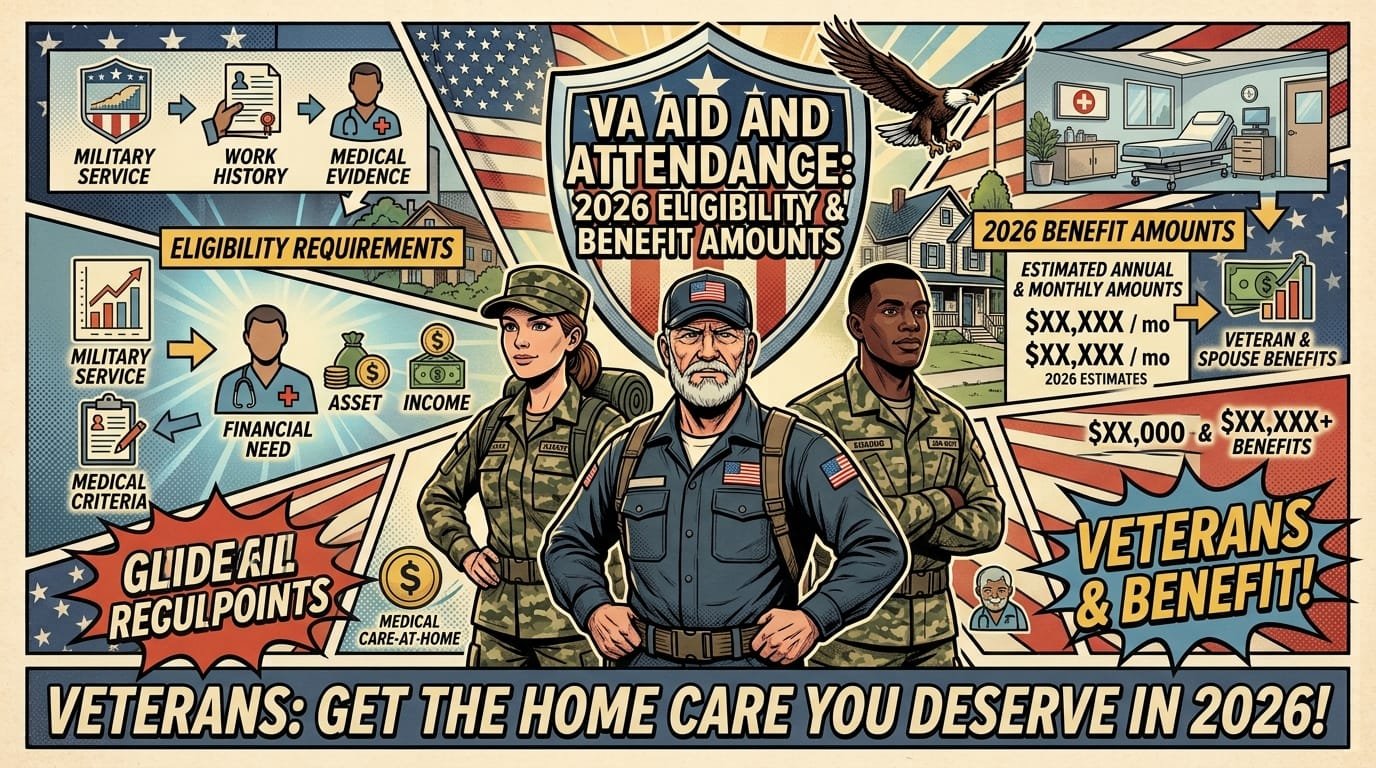
What Is VA Aid and Attendance?
VA Aid and Attendance (A&A) is an enhanced monthly pension payment for wartime veterans and surviving spouses who need regular help with daily activities like bathing, dressing, or eating—or who are bedridden, in a nursing home, or have severe vision loss. It adds to the basic VA Pension and requires meeting service, income, net worth, and medical need requirements.

Quick Facts
| Item | Details |
|---|---|
| Benefit | Enhanced VA Pension payment (tax-free monthly cash benefit) |
| Eligibility | 90+ days active duty with 1 day wartime service; income below MAPR; net worth under $163,699; medical need for daily assistance |
| Application | VA Form 21-2680 (medical certification) plus VA Form 21-526EZ or 21-527EZ (if not already receiving pension) |
| Processing Time | Varies; typically 2–6 months |
| Official Agency | U.S. Department of Veterans Affairs (VA) |
| Required Forms | VA Form 21-2680, VA Form 21-526EZ (or 21-527EZ), VA Form 21-0779 (nursing home residents) |
| Updated For | 2026 rates (effective December 1, 2025 – November 30, 2026) |
Source: U.S. Department of Veterans Affairs official pension rate tables and eligibility guidelines.

Aid and Attendance vs. Basic VA Pension vs. Housebound
Aid and Attendance is not a standalone benefit. It is the highest tier of VA Pension, which has three escalating levels.

Basic VA Pension is a needs-based monthly payment for wartime veterans with low income who are 65 or older, permanently and totally disabled, or receiving Social Security Disability Insurance.
Housebound benefits provide an increased pension amount for veterans substantially confined to their home because of permanent disability. In 2026, Housebound pays up to $1,776 per month for a single veteran.
Aid and Attendance pays the highest amount. For 2026, a single veteran can receive up to $2,424 per month, while a veteran with one dependent can receive up to $2,874 per month.
A veteran cannot receive Aid and Attendance and Housebound at the same time. The VA pays only the higher of the two rates.
| Program | Who It Serves | 2026 Monthly Maximum (Single Veteran) | 2026 Monthly Maximum (With Dependent) |
|---|---|---|---|
| Basic Pension | Low-income wartime veterans age 65+ or disabled | $1,453 | $1,851 |
| Housebound | Veterans confined to home due to permanent disability | $1,776 | $2,225 |
| Aid and Attendance | Veterans needing help with daily activities | $2,424 | $2,874 |
Veterans May Qualify for Extra Benefits
Check available financial assistance, healthcare programs and other opportunities that may apply to you.
Check EligibilityRates effective December 1, 2025 – November 30, 2026. Source: VA pension rate tables.
2026 Aid and Attendance Benefit Amounts
VA Aid and Attendance benefit amounts depend on the claimant’s marital status and number of dependents. The amounts listed below are the maximum monthly pension rates. The actual payment a veteran receives is calculated by subtracting countable income from the Maximum Annual Pension Rate (MAPR).
Veteran Aid and Attendance Rates (2026)
| Veteran Status | Monthly Maximum | Annual Maximum (MAPR) |
|---|---|---|
| Veteran, no dependents | $2,424 | $29,093 |
| Veteran with one dependent | $2,874 | $34,488 |
| Two veterans married to each other | $3,845 (combined) | $46,140 (combined) |
| Each additional dependent child | +$248 | +$2,984 |
Surviving Spouse Aid and Attendance Rates (2026)
| Surviving Spouse Status | Monthly Maximum | Annual Maximum (MAPR) |
|---|---|---|
| Surviving spouse, no dependents | $1,558 | $18,697 |
| Surviving spouse with one dependent child | $1,858 | $22,304 |
| Each additional dependent child | +$248 | +$2,984 |
These amounts are tax-free. The VA does not restrict how the money is spent, as long as it supports the claimant’s care and well-being. The payment is deposited monthly along with the regular pension payment.
Important: The MAPR is the income ceiling, not a guaranteed payment amount. If a veteran’s countable income is zero, they receive the full MAPR. If countable income exceeds zero, the pension is reduced dollar-for-dollar by the countable income amount.
Example: A married veteran has $15,000 in countable annual income (Social Security + pension). Their 2026 A&A MAPR is $34,488. The VA pension equals $34,488 minus $15,000, or $19,488 per year—approximately $1,624 per month.
Source: VA pension rate tables effective December 1, 2025 – November 30, 2026.
Aid and Attendance Eligibility Requirements
To qualify for VA Aid and Attendance, a veteran or surviving spouse must meet all of the following requirements. Failing any single requirement results in denial.
Military Service Requirement
The veteran must have served at least 90 days of active duty with at least one day during a recognized wartime period. Combat service is not required. The discharge must be under conditions other than dishonorable.
Veterans who entered active duty after September 7, 1980, must also have served at least 24 months of active duty or completed their full tour.
Recognized wartime periods:
World War II: December 7, 1941 – December 31, 1946
Korean War: June 27, 1950 – January 31, 1955
Vietnam War: August 5, 1964 – May 7, 1975
Gulf War: August 2, 1990 – present
Age or Disability Requirement
The claimant must meet at least one of these conditions:
Age 65 or older
Permanently and totally disabled (non-service-connected)
Receiving Social Security Disability Insurance (SSDI)
Receiving Supplemental Security Income (SSI)
A patient in a nursing home
Financial Requirements
The claimant’s countable income must fall below the Maximum Annual Pension Rate (MAPR), and net worth must be under the VA’s limit. These are discussed in detail below.
Medical Need Requirement
The claimant must meet at least one of these conditions, verified by a medical professional:
Need help with activities of daily living (ADLs) such as bathing, dressing, eating, toileting, or adjusting prosthetic devices.
Bedridden due to disability or illness.
Nursing home resident due to mental or physical incapacity.
Severe vision impairment with corrected visual acuity of 5/200 or less in both eyes, or concentric contraction of the visual field to 5 degrees or less.
A diagnosis of dementia or Alzheimer’s disease typically satisfies the medical need requirement, as these conditions inherently impair the ability to perform daily activities safely.
Who Qualifies for Aid and Attendance?
Veterans
Wartime veterans who need regular assistance with daily activities and meet the financial and service requirements qualify. This includes veterans living at home who receive care from family members, professional caregivers, or home health aides.
Surviving Spouses
A surviving spouse may qualify if:
The deceased veteran met the wartime service requirement.
The spouse was married to the veteran at the time of death.
The spouse has not remarried (in most cases).
The spouse meets the medical need and financial requirements.
Veterans with Mental Health Conditions
Having a physical disability is not required to earn Aid and Attendance. Veterans with service-connected mental health conditions—such as PTSD, bipolar disorder, or severe depression—may qualify if those conditions prevent them from performing activities of daily living or require regular supervision for their safety.
Veterans in Nursing Homes
Veterans who reside in a nursing home due to physical or mental incapacity qualify. For nursing home residents, the facility must complete VA Form 21-0779 (Request for Nursing Home Information in Connection with Claim for Aid and Attendance) in addition to the medical certification form.
Veterans Living at Home
Many people mistakenly believe Aid and Attendance is only for nursing home residents. In reality, veterans living at home qualify if they require regular assistance with daily activities. In-home care costs can often be counted as unreimbursed medical expenses, which reduce countable income and may bring the claimant under the MAPR threshold.
Aid and Attendance Income Limits for 2026
The VA uses a Maximum Annual Pension Rate (MAPR) that varies by marital status and dependents. The MAPR serves as both the income ceiling and the maximum benefit amount.
| Category | 2026 Annual MAPR | 2026 Monthly Equivalent |
|---|---|---|
| Veteran, no dependents | $29,093 | $2,424 |
| Veteran with one dependent | $34,488 | $2,874 |
| Surviving spouse, no dependents | $18,697 | $1,558 |
| Surviving spouse with one dependent child | $22,304 | $1,858 |
How countable income is calculated: The VA subtracts unreimbursed medical expenses from gross income to arrive at countable income. Unreimbursed medical expenses include:
Assisted living costs
In-home care costs
Nursing home costs
Medicare premiums
Prescription copays
Health insurance premiums
Medical equipment and supplies
Example: A single veteran has $30,000 in annual income and $15,000 in unreimbursed medical expenses. Countable income is $30,000 minus $15,000, or $15,000. This is below the $29,093 MAPR, so the veteran qualifies. The annual pension equals $29,093 minus $15,000, or $14,093.
Source: VA pension income and rate tables, effective December 1, 2025 – November 30, 2026.
Aid and Attendance Net Worth Limit for 2026
The VA’s net worth limit for 2026 is $163,699. Net worth includes countable assets plus annual income. Certain assets are excluded:
Primary residence (up to 2 acres, or more if the additional acreage is not marketable)
One vehicle
Household goods and personal effects
Life insurance policies with face value under $10,000 (for certain claims)
Assets counted toward net worth include bank accounts, investments, retirement accounts, additional real estate, and valuable personal property.
Why this matters: Even if a veteran’s income falls below the MAPR, excessive assets can disqualify them. However, the VA does not require spend-down like Medicaid. Veterans can transfer assets up to the net worth limit before applying, subject to the 36-month look-back rule.
Source: VA pension program guidelines, effective December 1, 2025 – November 30, 2026.
The 36-Month Look-Back Rule
The VA implemented a 36-month look-back rule effective October 18, 2018. This rule reviews asset transfers made during the 36 months before a pension application.
What triggers a penalty: Transferring assets for less than fair market value—including gifts to family members, sales at below-market prices, and transfers to trusts—can trigger a penalty period.
How the penalty works: The VA divides the total value of transferred assets by the penalty rate ($2,795 per month for 2026) to determine the number of months the veteran is ineligible for benefits. The maximum penalty period is 5 years.
Example: A veteran gifts $50,000 to a child 18 months before applying. The penalty period is $50,000 divided by $2,795, or approximately 18 months.
What is exempt: Transfers to a spouse, transfers to a trust for a dependent child, and transfers made more than 36 months before application are generally not penalized.
What veterans should do: Consult a VA-accredited attorney or accredited claims agent before making any significant asset transfers if Aid and Attendance benefits are being considered.
Required Documents for Aid and Attendance
Submitting a complete application with all supporting documentation significantly reduces processing delays and denial risk.
Required Documents
| Document | Purpose |
|---|---|
| DD Form 214 (or equivalent) | Proof of military service and character of discharge |
| Marriage certificate | Proof of marriage (for surviving spouse claims) |
| Death certificate | Proof of veteran’s death (for surviving spouse claims) |
| Medical evidence | Physician statement or VA Form 21-2680 completed by a medical professional |
| Income documentation | Social Security award letter, pension statements, investment income records |
| Medical expense documentation | Assisted living invoices, in-home care receipts, Medicare premium statements |
| Bank statements and financial records | Verification of assets and net worth |
| VA Form 21-0779 (if applicable) | Required for nursing home residents |
Medical Certification Form
VA Form 21-2680 (Examination for Housebound Status or Permanent Need for Regular Aid and Attendance) must be completed by a medical professional—a physician, certified nurse practitioner, physician’s assistant, or clinical nurse specialist. The form documents the claimant’s limitations and care needs. It cannot be completed by the claimant or a family member.
The form requires specific information about the claimant’s ability to perform daily activities, including bathing, dressing, eating, toileting, and mobility. A vague statement that the veteran “needs help” is insufficient. The provider must describe specific functional limitations.
Source: U.S. Department of Veterans Affairs, VA Form 21-2680 instructions.
How to Apply for Aid and Attendance
There are three ways to apply: online, by mail, or in person.
Online Application
The VA offers online application for Aid and Attendance benefits. The claimant or their representative can complete the application through the VA’s online portal. A medical examiner must complete the examination information section separately. The online process is the fastest submission method.
By Mail
Complete VA Form 21-2680 (medical certification).
Complete a pension application if not already receiving VA Pension:
Veterans: VA Form 21-526EZ or VA Form 21-527EZ
Survivors: VA Form 21-534 or VA Form 21-534EZ
Gather supporting documentation (DD-214, income records, medical expense records, financial statements).
Mail the complete packet to:
Department of Veterans Affairs
Pension Intake Center
PO Box 5365
Janesville, WI 53547-5365If in a nursing home, include VA Form 21-0779 completed by the facility.
In Person
Visit a VA regional office near you. Bring all documentation. A VA representative can review the packet for completeness before submission.
If Already Receiving VA Pension
Veterans already receiving basic VA Pension can apply for Aid and Attendance by submitting a completed VA Form 21-2680 to the Pension Management Center (PMC) that serves their state. No new income or net worth statement is required unless the VA requests updated information.
Finding Your Pension Management Center
The VA maintains Pension Management Centers that process claims based on the claimant’s state of residence. The claimant can find their PMC through the VA’s online pension portal or by contacting the VA directly.
Source: VA.gov, “Aid and Attendance benefits and Housebound allowance.”
Aid and Attendance Processing Times
Processing times vary based on claim complexity, completeness of documentation, and VA workload. Most Aid and Attendance claims are decided within 2 to 6 months.
Factors that affect processing time:
Completeness of the application packet
Clarity of the medical evidence
Whether the VA requests additional information
Claim volume at the processing center
How to check claim status: The claimant can check the status of their claim online through VA.gov or by calling the VA at 1-800-827-1000.
Retroactive payments: Approved benefits are typically paid retroactive to the application date. This means the sooner a veteran applies, the more back pay they may receive. Delaying an application because of uncertainty about eligibility can result in significant lost benefits.
Priority processing: The VA may prioritize claims for veterans with terminal illnesses, advanced age (typically 85+), or severe financial hardship. Claimants in these situations should note the circumstances in their application or contact the VA directly.
Source: VA.gov claim processing information.
Aid and Attendance Payment Dates
VA benefits—including Aid and Attendance—are deposited on the first business day of each month. If the first falls on a weekend or federal holiday, payment moves to the last business day of the previous month.
2026 payment schedule (selected months):
| Month | Payment Date |
|---|---|
| January 2026 | Friday, January 30, 2026 (adjusted) |
| February 2026 | Friday, January 30, 2026 (adjusted) |
| March 2026 | Tuesday, March 3, 2026 |
| April 2026 | Wednesday, April 1, 2026 |
Aid and Attendance payments are combined with the regular VA Pension payment in a single monthly deposit. The payment appears as a VA benefit deposit on bank statements.
Source: VA benefits payment schedule, 2026.
Aid and Attendance vs. Special Monthly Compensation
Aid and Attendance benefits can come through two separate pathways, and understanding the difference is critical.
Pension-Based Aid and Attendance
This is the pathway described throughout this article. It is an enhanced VA Pension for low-income wartime veterans and surviving spouses. No service connection is required. Income and net worth limits apply.
Service-Connected Aid and Attendance (Special Monthly Compensation)
Veterans with service-connected conditions that require aid and attendance may qualify for Special Monthly Compensation (SMC) at the SMC-L rate or higher. SMC rates are significantly higher than pension-based A&A rates.
2026 SMC rates:
SMC-L: $4,900.83 per month
SMC-R(1): Higher rate for specific conditions
SMC-R(2): Up to $11,271.67 per month
SMC-T: For traumatic brain injury with need for aid and attendance
SMC does not have income or net worth limits because it is compensation for service-connected disability, not a needs-based pension. Veterans who qualify for both pension-based A&A and SMC should pursue the SMC pathway if their service-connected conditions meet the criteria.
| Feature | Pension-Based A&A | SMC-Based A&A |
|---|---|---|
| Service connection required | No | Yes |
| Income limits | Yes (MAPR) | No |
| Net worth limit | Yes ($163,699) | No |
| 2026 maximum monthly rate | $2,874 (with dependent) | $4,900.83+ (SMC-L) |
| Application form | VA Form 21-2680 | VA Form 21-526EZ |
Source: VA Special Monthly Compensation rate tables, 2026.
Common Mistakes in Aid and Attendance Applications
Understanding frequent application errors helps claimants avoid delays and denials.
Mistake 1: Insufficient Medical Evidence
The most common reason for denial is medical documentation that does not clearly describe the veteran’s functional limitations. A physician’s note stating “patient needs assistance” is rarely sufficient. The provider must describe specific ADL limitations—for example, “requires assistance with bathing and dressing due to balance issues and arthritis” or “cannot prepare meals safely due to cognitive impairment.”
What to do: Ensure VA Form 21-2680 is completed thoroughly by a medical professional who understands the veteran’s daily limitations. Provide supporting records such as care logs, physician progress notes, and therapy evaluations.
Mistake 2: Incomplete Application Forms
Missing signatures, incomplete sections, or omitted supporting documents cause processing delays and potential denial. The VA cannot adjudicate a claim with missing information.
What to do: Use the VA’s checklist. Double-check every form for signatures and completeness before submission. Consider having a Veterans Service Organization (VSO) representative review the packet.
Mistake 3: Unclear Financial Information
If income and asset documentation is unclear or appears to exceed VA limits, the claim may be denied or held for development. The VA needs to see exactly how countable income is calculated after allowable deductions.
What to do: Provide all requested financial documents. Include documentation of unreimbursed medical expenses, which reduce countable income. If net worth is near the limit, consult a VA-accredited professional before applying.
Mistake 4: Gifting Assets Without Understanding the Look-Back Rule
Transferring assets to family members or into trusts without understanding the 36-month look-back rule can trigger a penalty period of up to 5 years. This is especially problematic because families often make these transfers based on misinformation from financial advisors who are not VA-accredited.
What to do: Never transfer assets for the purpose of qualifying for VA benefits without consulting a VA-accredited attorney or claims agent. The VA maintains a searchable list of accredited representatives.
Mistake 5: Waiting Too Long to Apply
Because benefits are paid retroactive to the application date, every month of delay equals lost benefits. Many families assume they won’t qualify and never apply, missing out on benefits they were eligible for all along.
What to do: Apply as soon as eligibility is suspected. Even if the application is initially denied, the effective date is protected for appeal purposes.
Mistake 6: Not Reporting Changes
Once receiving benefits, failing to report changes in income, marital status, dependents, or care needs can result in overpayments and repayment demands.
What to do: Report all changes to the VA promptly. The VA provides a toll-free number (1-800-827-1000) and online portal for reporting changes.
Source: VA pension program guidance and accredited claims representative guidance.
Appealing an Aid and Attendance Denial
If the VA denies an Aid and Attendance claim, the claimant has multiple review options.
Decision Review Options
Supplemental Claim: Submit new and relevant evidence that was not previously considered. This is the fastest option if new medical or financial evidence is available.
Higher-Level Review: Request review by a senior VA adjudicator based on the existing record. No new evidence is submitted. The reviewer determines whether the original decision contained a duty-to-assist error or misapplication of law.
Board Appeal: Appeal directly to the Board of Veterans’ Appeals. A Veterans Law Judge reviews the case. The claimant may request a hearing. This is a more formal process and generally takes longer than supplemental claim or higher-level review.
Court of Appeals for Veterans Claims: If the Board denies the appeal, the claimant may appeal to the U.S. Court of Appeals for Veterans Claims (CAVC). This is a federal court that reviews VA decisions for legal errors.
Time Limits
Supplemental Claim: No time limit, but new evidence is required.
Higher-Level Review: Within 1 year of the decision letter.
Board Appeal: Within 1 year of the decision letter.
CAVC Appeal: Within 120 days of the Board decision.
Getting Help with an Appeal
VA-accredited attorneys, claims agents, and Veterans Service Organization representatives can help evaluate the denial, gather additional evidence, and prepare the appeal. These representatives cannot charge fees for initial claims but may charge for appeals. The VA maintains a searchable directory of accredited representatives.
Source: VA appeals process guidance, 2026.
State Differences in Aid and Attendance
While Aid and Attendance is a federal VA benefit with uniform eligibility rules, state-level interactions vary in two important ways.
Medicaid Treatment of A&A Payments
In most states, the Aid and Attendance add-on portion of a VA pension does not count as income for Medicaid eligibility purposes. However, the Basic Pension amount underneath it often does count, depending on the state. Some states disregard the entire VA pension (Basic + A&A) when determining Medicaid income eligibility, while others count only the Basic Pension.
Why this matters: Veterans who receive both Medicaid and VA A&A benefits may find that their Medicaid eligibility is affected differently depending on their state of residence. This is particularly relevant for veterans in nursing homes or receiving Medicaid waivers for home-based care.
What to do: Consult a Medicaid planning professional in your state who understands both VA and Medicaid rules. The interaction between the two programs is complex and state-specific.
State Veterans Homes
Many states operate Veterans Homes that provide long-term care for veterans. The cost structure and eligibility rules for state Veterans Homes vary by state. Some states offer reduced rates for veterans with service-connected disabilities. The VA may pay a portion of the cost for veterans in state Veterans Homes who meet eligibility criteria.
State Veterans Benefit Programs
Some states offer additional benefits for veterans and surviving spouses beyond federal VA benefits. These may include property tax exemptions, education benefits, and additional pension supplements. The VA’s state benefits directory provides information on state-specific programs.
Source: Medicaid.gov, state Medicaid agency guidance, and VA state benefits resources.
Common Questions
What is the difference between Aid and Attendance and Housebound benefits?
Aid and Attendance is for veterans who need help with daily activities like bathing, dressing, or eating—or who are bedridden, in a nursing home, or severely visually impaired. Housebound is for veterans permanently confined to their home due to disability. A&A pays more. Veterans cannot receive both at the same time.
Does Aid and Attendance require a service-connected disability?
No. Pension-based Aid and Attendance is a needs-based benefit that does not require service connection. It requires wartime service, low income, limited net worth, and medical need for assistance. Veterans with service-connected conditions may qualify for higher Special Monthly Compensation instead.
Can I get Aid and Attendance if I live at home?
Yes. Living at home does not disqualify you. If you need regular help with daily activities—whether from family, professional caregivers, or home health aides—you may qualify. In-home care costs can often be counted as unreimbursed medical expenses, which reduce countable income.
How long does it take to get Aid and Attendance benefits?
Most claims are processed within 2 to 6 months. Processing time depends on the completeness of the application, clarity of medical evidence, and VA workload. Incomplete applications take longer. Benefits are paid retroactive to the application date, so applying promptly maximizes back pay.
What is the 2026 net worth limit for Aid and Attendance?
The 2026 net worth limit is $163,699. Net worth includes countable assets plus annual income. The primary residence (up to 2 acres), one vehicle, and household goods are excluded from the calculation. Exceeding the net worth limit results in denial.
Can I give away assets to qualify for Aid and Attendance?
The VA has a 36-month look-back rule for asset transfers. Gifting or transferring assets for less than fair market value within 36 months before applying can trigger a penalty period of up to 5 years. Consult a VA-accredited professional before making any asset transfers.
What form do I need for Aid and Attendance?
VA Form 21-2680 (Examination for Housebound Status or Permanent Need for Regular Aid and Attendance) is required for all claims. It must be completed by a medical professional. If not already receiving VA pension, you also need VA Form 21-526EZ or 21-527EZ. Nursing home residents need VA Form 21-0779.
Can a surviving spouse get Aid and Attendance?
Yes. A surviving spouse may qualify if the deceased veteran met the wartime service requirement, the spouse was married to the veteran at death, and the spouse has not remarried. The spouse must also meet medical need and financial requirements. Surviving spouse A&A pays up to $1,558 per month in 2026.
Does Aid and Attendance count as income for Medicaid?
It depends on the state. In most states, the Aid and Attendance portion of a VA pension does not count as income for Medicaid eligibility purposes, but the Basic Pension amount often does. Some states disregard the entire VA pension. Consult a Medicaid planning professional in your state.
Can I work while receiving Aid and Attendance?
Aid and Attendance is a needs-based benefit with income limits. Employment income counts toward countable income and may affect eligibility. However, there is no prohibition on working. If your income remains below the MAPR after allowable deductions, you can still qualify.
What if my Aid and Attendance claim is denied?
You have three review options: submit a Supplemental Claim with new evidence, request a Higher-Level Review of the existing record, or appeal to the Board of Veterans’ Appeals. Time limits apply. VA-accredited representatives can help with appeals.
Does Aid and Attendance cover assisted living costs?
The benefit is a cash payment deposited into the claimant’s account. It does not pay facilities directly. The claimant can use the money for any purpose, including assisted living costs, in-home care, or nursing home fees. The VA does not restrict how the money is spent.
Key Takeaways
VA Aid and Attendance is an enhanced VA Pension for wartime veterans and surviving spouses who need regular help with daily activities, are bedridden, in a nursing home, or have severe vision impairment.
2026 maximum monthly rates: $2,424 for a single veteran, $2,874 for a veteran with one dependent, and $1,558 for a surviving spouse.
Eligibility requires: 90 days of active duty with 1 day wartime service, income below the MAPR, net worth under $163,699, and medical need documented by a provider.
VA Form 21-2680 is the medical certification form. It must be completed by a physician, nurse practitioner, physician’s assistant, or clinical nurse specialist.
The 36-month look-back rule penalizes asset transfers made for less than fair market value. Gifts within 3 years of applying can delay benefits for up to 5 years.
Benefits are paid retroactive to the application date. Delaying an application costs money—apply as soon as eligibility is suspected.
Aid and Attendance does not require service connection. It is a needs-based benefit distinct from service-connected compensation.
Veterans with service-connected conditions may qualify for much higher Special Monthly Compensation (SMC) rates—up to $11,271.67 per month—instead of pension-based A&A.
State rules vary on whether A&A counts as income for Medicaid. Consult a state-specific professional if receiving both benefits.
Accredited representatives (attorneys, claims agents, VSOs) can help with applications and appeals. The VA maintains a searchable directory of accredited professionals.
Official Resources
U.S. Department of Veterans Affairs – Aid and Attendance and Housebound: https://www.va.gov/pension/aid-attendance-housebound/
VA Form 21-2680 – Examination for Housebound Status or Permanent Need for Regular Aid and Attendance: https://www.va.gov/forms/21-2680/
VA Form 21-0779 – Request for Nursing Home Information in Connection with Claim for Aid and Attendance: https://www.va.gov/forms/21-0779/
VA Form 21-526EZ – Application for Disability Compensation and Related Compensation Benefits: https://www.va.gov/forms/21-526ez/
VA Form 21-527EZ – Application for Pension: https://www.va.gov/forms/21-527ez/
VA Pension Management Center Directory: https://www.ebenefits.va.gov/PENSION/resources
VA Accredited Representatives Directory: https://www.va.gov/ogc/apps/accreditation/
VA Benefits Hotline: 1-800-827-1000
VA.gov – Pension Rates: https://www.va.gov/pension/rates/


🇺🇸 IMPORTANT DISCLAIMER – Veterans Benefits Information
This site provides general information about U.S. Department of Veterans Affairs (VA) benefits for educational and informational purposes only.
- Not Official: We are NOT affiliated with, endorsed by, or connected to the U.S. Department of Veterans Affairs (VA), the Veterans Benefits Administration (VBA), the Veterans Health Administration (VHA), or any other government agency.
- No Legal/Financial Advice: The content on this website is for informational purposes only and does not constitute legal, financial, or medical advice. VA benefits rules change frequently – always consult with an accredited Veterans Service Officer (VSO) or a qualified professional for your specific situation.
- Official Sources: For official, binding information and to apply for benefits, always visit official .gov websites: VA.gov, Benefits.VA.gov, or SSA.gov.
- No Data Collection: This site does not collect, store, or process any personal information. It does not have login forms, contact forms, or any system to capture user data. We never ask for your Social Security Number, bank details, or any personal information.
- 🚨 Scam Alert: The VA and other government agencies never charge fees for benefit applications. If anyone asks for money to "process" your VA claim, it is a scam. Report it to the VA Office of Inspector General at VA.gov/OIG.
- Advertising: This site uses third-party advertising (Adsterra) to cover operational costs. We do not endorse or guarantee any products or services advertised.
📌 Information provided as of June 2026. Always verify current eligibility and rules with official .gov sources.
This site is not affiliated with the U.S. Department of Veterans Affairs or any government agency. All information is for educational purposes only. Please visit VA.gov for official information.
