
Veterans Benefits Eligibility Requirements: Quick Answer
Most VA benefits require active military service and a discharge under conditions other than dishonorable. Disability compensation requires a service-connected condition. Health care requires meeting minimum service and discharge rules, with priority groups based on disability and income. Pension requires wartime service and limited income. GI Bill requires active duty after September 10, 2001. Each benefit has its own specific rules.
Quick Facts
| Item | Details |
|---|---|
| Core Requirement | Active military, naval, or air service; discharge other than dishonorable |
| Disability Compensation | Current condition caused or worsened by service |
| Health Care | Basic service + discharge; priority groups 1–8 based on disability and income |
| Pension | 90 days active duty with 1 day wartime; income below MAPR; net worth under $163,699 |
| GI Bill (Post-9/11) | At least 90 days active duty after September 10, 2001 |
| Home Loan | 90 days wartime, 181 days peacetime, or 6 years Guard/Reserve |
| Survivor DIC | Veteran died from service-connected cause or was totally disabled |
| Official Agency | U.S. Department of Veterans Affairs (VA) |
| Updated For | September 2026 |
Basic VA Eligibility: The Two Core Requirements
Every VA benefit starts with two fundamental requirements: qualifying military service and an acceptable character of discharge.

Qualifying Military Service
VA benefits are available to Veterans who served in the active military, naval, or air service. This means full-time active duty — not active duty for training only. National Guard and Reserve members may qualify if they were called to active duty by federal order and completed the full period for which they were called or ordered.

What this means for Guard and Reserve members: Active duty for training (ACDUTRA) and inactive duty training (IDT) qualify for VA benefits only if you became disabled from a disease or injury incurred or aggravated in the line of duty during that training. Standard weekend drills and annual training periods do not establish Veteran status for most benefits unless an injury or illness occurred during that specific duty period.
Character of Discharge
VA benefits are not payable unless your service was terminated under conditions other than dishonorable. VA accepts honorable and general (under honorable conditions) discharges as qualifying for all benefits so long as all other requirements are met. A dishonorable discharge bars you from receiving any VA benefits or services.
| Discharge Type | VA Benefits Eligibility |
|---|---|
| Honorable | Full eligibility |
| General (under honorable conditions) | Full eligibility |
| Other than honorable (OTH) | May qualify based on VA character of discharge review |
| Bad conduct | May qualify based on VA character of discharge review |
| Dishonorable | Barred from all VA benefits |
If you have an other-than-honorable or bad conduct discharge: The VA reviews discharges on a case-by-case basis. Over the past 10 years, VA’s eligibility determination rate for former service members with OTH and bad conduct discharges has been 75% — meaning VA provided care or benefits to 75% of them, more than 57,000 former service members. You can appeal a VA character of discharge determination through VA’s appeal process.
VA Disability Compensation Eligibility
VA disability compensation is a monthly tax-free payment for Veterans who got sick or injured while serving in the military, or whose service made an existing condition worse. You may qualify for physical conditions (like chronic illness or injury) and mental health conditions (like PTSD) that developed before, during, or after service.
Service Connection Requirements
Veterans May Qualify for Extra Benefits
Check available financial assistance, healthcare programs and other opportunities that may apply to you.
Check EligibilityTo qualify for VA disability compensation, you must have a current physical or mental illness or injury caused or made worse by your active duty service or training. The condition must be service-connected. Combat is not required — a condition only has to be connected to your service. An injury in training, an illness that began on active duty, hearing loss from the flight line, or a condition presumed from where you served all qualify.
Four types of service connection:
| Type | What It Means |
|---|---|
| Direct | Condition caused by or incurred during service |
| Presumptive | VA assumes service caused the condition (PACT Act, Agent Orange, etc.) |
| Secondary | New condition caused or aggravated by an already service-connected condition |
| Aggravation | Pre-existing condition worsened by service |
Secondary Service Connection
Secondary service connection applies when a Veteran develops a new condition because of an already existing service-connected condition. If a service-connected disability directly causes a non-service-connected disability, service connection may be granted for the secondary condition under 38 C.F.R. § 3.310(a). Common examples include hypertension caused by PTSD or peripheral neuropathy caused by diabetes.
TDIU Eligibility
Total Disability Individual Unemployability (TDIU) pays Veterans at the 100% rate. To qualify, you must meet one of these schedular thresholds:
One service-connected disability rated at 60% or more, or
Two or more service-connected disabilities with at least one rated at 40% or more and a combined rating of 70% or more
You must also be unable to maintain substantially gainful employment due to your service-connected disabilities.
Special Monthly Compensation (SMC) Eligibility
SMC is additional compensation for Veterans with especially serious service-connected disabilities. To be eligible for any level of SMC, the disability must be service-connected. SMC considers loss or loss of use of specific organs or body parts, including hands, feet, or extremities; blindness or significant vision loss; paralysis; and immobility of a joint.
Aid and Attendance (A&A) under SMC requires that you need assistance or supervision from another person to perform activities of daily living, such as dressing, eating, or bathing.
VA Health Care Eligibility
You may be eligible for VA health care if you served in the active military, naval, or air service and didn’t receive a dishonorable discharge.
Minimum Service Requirements
If you enlisted after September 7, 1980, or entered active duty after October 16, 1981, you must have served 24 continuous months or the full period for which you were called to active duty. This minimum duty requirement may not apply if any of these are true:
You were discharged for a disability caused or made worse by active-duty service
You were discharged for a hardship or “early out”
You served prior to September 7, 1980
Common eligibility myths:
| Myth | Fact |
|---|---|
| “I make too much money” | Income is not a strict criterion for all health care. Even higher-income Veterans may qualify for certain benefits. |
| “I’ve been out too long” | Eligibility is not determined by time since separation. |
| “I never deployed” | Deployment is not required for VA health care eligibility. |
| “I don’t have a service-connected disability” | VA health care is available to all eligible Veterans, regardless of service connection. |
Priority Groups 1–8
VA health care enrollment uses a priority group system that determines your access, copays, and wait times. Priority Group 1 is the highest priority with guaranteed enrollment and no copays. Priority Group 8 is the lowest priority with income-based enrollment and higher copays. Your priority group is determined at enrollment and reviewed annually. Changes in your disability rating, income, or circumstances may move you to a different priority group.
| Priority Group | Key Criteria | Copays |
|---|---|---|
| 1 | Service-connected 50%+; unemployable | No copays |
| 2 | Service-connected 30–40% | No copays for SC conditions |
| 3 | Service-connected 10–20%; former POW; Purple Heart | No copays for SC conditions |
| 4 | Catastrophically disabled; aid and attendance | No copays for SC conditions |
| 5 | Income below VA national threshold | Reduced copays |
| 6 | Combat Veteran; Agent Orange; Gulf War | Some copays |
| 7 | Income below geographic threshold | Copays required |
| 8 | Income above thresholds | Highest copays |
Veterans in Priority Groups 1 through 3 receive free VA care for service-connected conditions. Veterans in Priority Groups 4 through 8 pay graduated copays based on income and service-connection status.
PACT Act Health Care Expansion
All Veterans who meet basic service and discharge requirements and were exposed to toxins and other hazards while serving — at home or abroad — are now eligible for VA health care. This includes all Veterans who served in the Vietnam War, Gulf War, Iraq, Afghanistan, or any other combat zone after 9/11.
You’re eligible to enroll now without needing to apply for disability benefits first if you meet basic service and discharge requirements and any of these are true:
You served in the Vietnam War, the Gulf War, Iraq, Afghanistan, or any other combat zone after 9/11
You deployed in support of the Global War on Terror
You were exposed to toxins or other hazards during military service at home or abroad
Enhanced Eligibility Status
You may qualify for enhanced eligibility status (higher priority group) if you meet minimum active-duty service and discharge requirements and at least one of these is true:
You receive VA compensation for a service-connected disability
You were discharged for a disability resulting from something that happened in the line of duty
You’re a combat Veteran discharged on or after September 11, 2001
You get a VA pension
You’re a former prisoner of war
You have received a Purple Heart or Medal of Honor
You get or qualify for Medicaid benefits
You were exposed to toxins or hazards by working with chemicals, pesticides, lead, asbestos, certain paints, nuclear weapons, X-rays, or other toxins
VA Pension Eligibility
VA Pension is a needs-based monthly benefit for wartime Veterans who are elderly or permanently disabled and have limited income and net worth. It is not military retirement pay and not VA disability compensation. It exists to support wartime Veterans who served their country, are now elderly or disabled, and do not have enough income to meet their needs.
Wartime Service Requirement
You must have served at least 90 days of active duty, with at least one day during a recognized wartime period. The recognized wartime periods are:
| Wartime Period | Dates |
|---|---|
| World War II | December 7, 1941 – December 31, 1946 |
| Korean Conflict | June 27, 1950 – January 31, 1955 |
| Vietnam Era | August 5, 1964 – May 7, 1975 (in-country: February 28, 1961) |
| Gulf War | August 2, 1990 – present (ongoing) |
Veterans who entered service after September 7, 1980, must have served at least 24 months or the full period for which they were called. Veterans discharged before 24 months due to disability, hardship, or convenience of the government may still qualify.
Age or Disability Requirement
You must be either age 65 or older, or totally and permanently disabled.
Financial Need: Income and Net Worth Limits
Your household countable income must be below VA’s pension rate, and your net worth must be below the net worth limit. The 2026 net worth limit is $163,699. If your income is zero, you receive the full pension rate. If you have some income, your pension payment is the difference between your income and the pension rate.
GI Bill Education Benefits Eligibility
Post-9/11 GI Bill (Chapter 33)
You may be eligible if you served on active duty for at least 90 days after September 10, 2001, or served at least 30 continuous days and were discharged due to a service-connected disability.
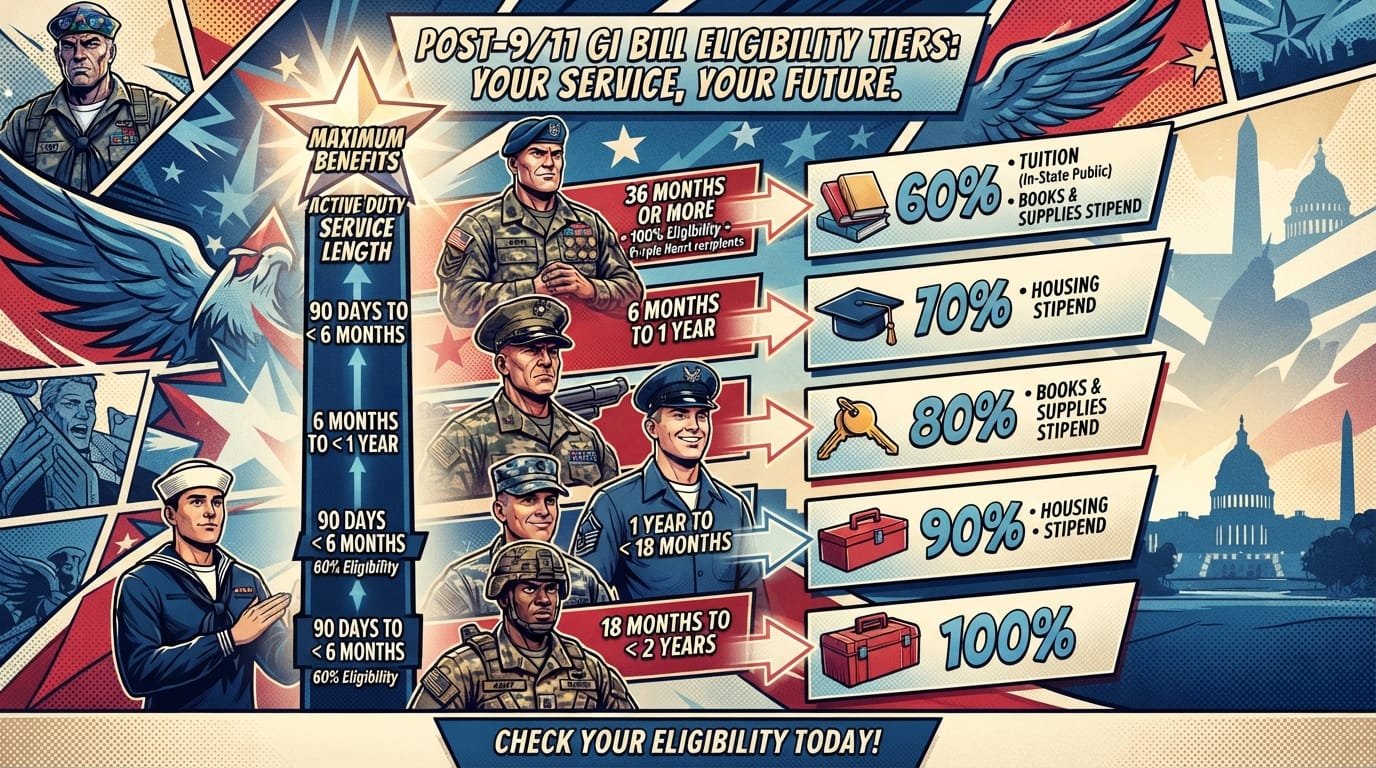
Eligibility tiers based on active-duty service:
| Service Length | Percentage of Full Benefit |
|---|---|
| 36+ months (1,095+ days) | 100% |
| 30–35 months (910–1,094 days) | 90% |
| 24–29 months (730–909 days) | 80% |
| 18–23 months (545–729 days) | 70% |
| 6–17 months (180–544 days) | 60% |
| 90 days–5 months (90–179 days) | 50% |
You are eligible for 100% of Post-9/11 GI Bill benefits if you served at least 1,095 days, received a Purple Heart on or after September 11, 2001, or served at least 30 continuous days and were discharged for a service-connected disability.
Transfer of Education Benefits
Service members and Veterans can transfer up to 36 months of remaining Post-9/11 GI Bill benefits to their spouse or dependent children. Spouses must be enrolled in the Defense Eligibility Enrollment Reporting System (DEERS) at the time of transfer. A subsequent divorce does not affect the spouse’s eligibility as long as the service member doesn’t revoke the transfer.
National Guard and Reserve
Reserve service members on drill status who served at least 90 aggregate days on active duty after September 10, 2001, or served 30 continuous days on active duty after September 10, 2001, and were discharged due to a service-connected disability, may qualify for Post-9/11 GI Bill benefits.
VA Home Loan Eligibility
You may qualify for a VA home loan by meeting one or more of these service requirements:
90 consecutive days of active service during wartime
181 days of active service during peacetime
6 years of service in the National Guard or Reserves
90 days (at least 30 consecutive) under Title 32 orders
Surviving spouses of service members who died while serving or died from a service-connected disability may also qualify for a VA home loan.
Other eligibility paths: If you don’t meet the basic service requirements, you may still be eligible based on your discharge type. Discharges for hardship, convenience of the government, reduction in force, medical condition, or service-connected disability may qualify. Early-out discharges with at least 21 months of a 2-year enlistment may also qualify.
Note: VA loan eligibility is only the first step. Lenders also review credit, debt-to-income ratio, and residual income to approve your loan. Most lenders require a minimum credit score, typically 620 or higher.
Survivor Benefits Eligibility (DIC)
Surviving Spouse Eligibility
You may be eligible for DIC as a surviving spouse if you meet these requirements:
One of these must be true:
You lived with the Veteran without a break until their death, or
If separated, you weren’t at fault for the separation
And one of these must be true:
You married the Veteran within 15 years of their discharge from the period of military service during which the qualifying illness or injury started or got worse, or
You were married to the Veteran for at least 1 year, or
You had a child with the Veteran
And one of these must be true about the Veteran’s death:
The service member died while on active duty, active duty for training, or inactive-duty training
The Veteran died from a service-connected illness or injury
The Veteran didn’t die from a service-connected illness or injury but was eligible for VA compensation for a service-connected disability rated as totally disabling for at least 10 years before death, since release from active duty for at least 5 years immediately before death, or for at least 1 year before death if a former POW who died after September 30, 1999
Remarriage Rules
If you remarried, you can receive or continue receiving DIC if you remarried on or after December 16, 2003, and were 57 or older at the time, or remarried on or after January 5, 2021, and were 55 or older at the time.
DIC Rates
The 2026 base rate for a surviving spouse is $1,699.36 per month, effective December 1, 2025, with added amounts based on individual circumstances.
PACT Act and Survivor Benefits
If your DIC claim was denied in the past and the Veteran’s condition is now covered by the PACT Act, you can submit a new application. If VA denied your claim and thinks you may be eligible now, VA will try to contact you — but you don’t need to wait for VA to contact you before you reapply.
Accrued Benefits and Substitution
If the Veteran had a pending claim or appeal at the time of death, you may be able to collect accrued benefits. A surviving spouse can claim accrued benefits in full. You must apply within 1 year of the beneficiary’s death for accrued benefits.
Burial Benefits Eligibility
Burial in a VA national cemetery is open to all members of the armed forces and Veterans who have met minimum active duty service requirements and were discharged under conditions other than dishonorable. Spouses, minor children, and under certain conditions, dependent unmarried adult children are eligible for burial even if they predecease the Veteran.
Burial allowance amounts (2026):
| Type of Death | Burial Allowance |
|---|---|
| Service-connected (on/after 9/11/01) | Up to $2,000 |
| Service-connected (before 9/11/01) | Up to $1,500 |
| Non-service-connected, died in VA facility | $762 + $762 plot |
| Non-service-connected, died outside VA facility | $300 + $762 plot |
The Veteran must not have received a dishonorable discharge.
Fiduciary Program Eligibility
VA’s Fiduciary Program protects beneficiaries who are unable to manage their own VA benefit payments because of injury, disease, advanced age, or being under the age of majority. The program serves approximately 104,300 Veterans and other beneficiaries.
A fiduciary may be appointed if the beneficiary:
Has been rated by VA as incapable of managing their own VA benefits as a result of injury, disease, or the infirmities of advanced age
Has been determined by a court as unable to manage their own financial affairs
Is less than the age of majority
Fiduciaries may include a spouse, family member, friend, qualified caregiver, or a director of a public or private institution. VA conducts suitability screening including credit history check, criminal background check, and character witness interviews.
State Veterans Benefits Eligibility
Every state offers benefits to Veterans on top of federal VA benefits. These programs vary widely, and eligibility thresholds are often tied to your federal disability rating.
Common state benefit categories:
| State Benefit | Typical Eligibility |
|---|---|
| Property tax exemption | 100% disabled (some states start at 10% or 50%) |
| State Veterans homes | Veteran status; income-based |
| State education benefits | Veterans and dependents |
| Hiring preferences | Honorably discharged Veterans |
| Vehicle registration waivers | Disabled Veterans |
Many states offer a full property tax exemption on the primary residence of a 100% disabled Veteran. Some states extend this to unremarried surviving spouses. States requiring Permanent and Total status have stricter thresholds than those accepting any 100% rating.
What to do next: Check your state’s Department of Veterans Affairs website or the VA’s “State and Local Resources” tool to identify programs you may qualify for. Bring your VA rating letter showing your disability percentage when applying for state benefits.
Common Mistakes About VA Eligibility
Mistake 1: Believing income disqualifies you from all benefits. Income only affects needs-based programs like Pension and certain health care priority groups. Disability compensation, GI Bill, and home loan benefits are not means-tested.
Mistake 2: Assuming you need a service-connected disability for health care. VA health care is available to all eligible Veterans, regardless of whether they have a service-connected disability.
Mistake 3: Thinking deployment is required. Deployment is not a requirement for VA health care eligibility. Veterans who served and were discharged under conditions other than dishonorable are generally eligible.
Mistake 4: Not applying because you have an other-than-honorable discharge. VA reviews discharges case by case. The eligibility determination rate for OTH discharges has been 75% over the past 10 years. You may qualify even with a less-than-honorable discharge.
Mistake 5: Confusing Pension with Compensation. Pension is needs-based and requires wartime service and limited income. Compensation is for service-connected conditions and has no income limit. Veterans who receive compensation generally cannot also receive pension for the same period.
Mistake 6: Missing the intent to file deadline. An intent to file preserves your effective date for up to one year while you gather evidence. If you miss the one-year deadline, your effective date resets.
Mistake 7: Overlooking secondary conditions. If a service-connected condition causes or aggravates another condition, the secondary condition can also be service-connected. Veterans often overlook these claims entirely.
Mistake 8: Not seeking free VSO help. Veterans Service Organizations provide free assistance with eligibility determinations and applications. They can review your situation and identify benefits you may not know you qualify for.
Appeals Process for Eligibility Denials
If your eligibility for VA benefits is denied, you have three decision review options:
| Option | What It Is | Deadline |
|---|---|---|
| Supplemental Claim | Submit new and relevant evidence | 1 year from decision |
| Higher-Level Review | Senior reviewer examines same evidence | 1 year from decision |
| Board Appeal | Veterans Law Judge reviews your case | Varies by review option |
If you disagree with a VA character of discharge determination, you can appeal that decision through VA’s appeal process. A VA character of discharge appeal is distinct from a benefit claim appeal — you must first establish qualifying discharge status before VA can consider the underlying benefit claim.
What to do next: File a Supplemental Claim with VA Form 20-0995, a Higher-Level Review with VA Form 20-0996, or a Board Appeal with VA Form 10182. Contact a VSO or accredited attorney for free assistance.
Common Questions
1. What is the most basic requirement for VA benefits?
You must have served in the active military, naval, or air service and been discharged under conditions other than dishonorable. Honorable and general (under honorable conditions) discharges qualify. A dishonorable discharge bars you from all VA benefits. Some benefits have additional requirements beyond basic eligibility.
2. Can I get VA benefits with a general discharge?
Yes. VA accepts discharges characterized as honorable or general (under honorable conditions) as other than dishonorable for VA benefit purposes. This establishes basic eligibility for all benefits administered by VA so long as all other requirements are met. General discharges qualify for the full range of VA benefits.
3. Do I need to have served in combat to get VA disability benefits?
No. Combat is not required for VA disability compensation. A condition only has to be connected to your service — an injury in training, an illness that began on active duty, hearing loss from the flight line, or a condition presumed from where you served all qualify. The key is service connection, not combat.
4. Can National Guard and Reserve members get VA benefits?
Yes, if they meet specific requirements. Guard and Reserve members must have been called to active duty by a federal order and completed the full period for which they were called. Active duty for training (ACDUTRA) and inactive duty training (IDT) qualify if you became disabled from a disease or injury incurred or aggravated in the line of duty during that training.
5. What is the income limit for VA pension in 2026?
Your household countable income must be below VA’s Maximum Annual Pension Rate (MAPR), and your net worth must be below the $163,699 limit. The basic MAPR for a surviving spouse with no dependents is $11,699 per year in 2026. Veterans Pension rates vary by dependent status and Aid and Attendance eligibility.
6. How long do I need to serve to qualify for the GI Bill?
For the Post-9/11 GI Bill, you need at least 90 days of active duty after September 10, 2001, or 30 continuous days if discharged for a service-connected disability. Full benefits (100%) require 36 months of active duty, or 30 continuous days with a service-connected disability discharge, or a Purple Heart on or after September 11, 2001.
7. What is the service requirement for a VA home loan?
You need 90 consecutive days of active service during wartime, 181 days during peacetime, or 6 years in the National Guard or Reserves. You can also qualify with 90 days (at least 30 consecutive) under Title 32 orders. Surviving spouses of service members who died in service or from a service-connected disability may also qualify.
8. Can a surviving spouse get DIC if they remarry?
Yes, if you remarried on or after December 16, 2003, and were 57 or older at the time, or remarried on or after January 5, 2021, and were 55 or older at the time. If you remarried before age 55 and the marriage later ends by death, divorce, or annulment, you may be able to reinstate DIC benefits.
9. What is the PACT Act and how does it affect eligibility?
The PACT Act expands VA health care and benefits for Veterans exposed to burn pits, Agent Orange, and other toxic substances. It adds more than 20 presumptive conditions for toxic exposure, expands eligibility for health care, and requires VA to provide toxic exposure screening to every enrolled Veteran. If you served in a covered location, you may qualify without proving direct exposure.
10. Do I need a service-connected disability to get VA health care?
No. VA health care is not exclusively for Veterans with service-connected disabilities. While service-connected disabilities may affect your priority group and copay level, VA health care services are available to all eligible Veterans, regardless of whether they have a service-connected disability.
Key Takeaways
Two core requirements govern all VA benefits: qualifying military service and a discharge under conditions other than dishonorable.
Honorable and general discharges qualify for full VA benefits. Dishonorable discharges bar all benefits. OTH discharges are reviewed case by case, with a 75% approval rate over the past decade.
Disability compensation requires service connection — a current condition caused or worsened by service. Combat is not required.
VA health care is available to all eligible Veterans, not just those with service-connected disabilities. Priority groups 1–8 determine copays and access.
VA Pension requires wartime service (90 days with 1 day during a wartime period), age 65+ or disabled, income below MAPR, and net worth under $163,699.
Post-9/11 GI Bill requires 90 days of active duty after September 10, 2001, with benefits tiered from 50% to 100% based on service length.
VA home loan requires 90 days wartime, 181 days peacetime, or 6 years Guard/Reserve service.
Survivor DIC requires the Veteran’s death to be service-connected or the Veteran was totally disabled for a specified period before death.
The PACT Act expanded eligibility for toxic-exposed Veterans, including health care enrollment without a disability claim.
Intent to file preserves your effective date for up to one year while you gather evidence for your claim.
Official Resources
VA.gov — Eligibility for VA Health Care — Official health care eligibility requirements and priority groups
VA.gov — VA Disability Compensation — Apply for disability benefits and check eligibility
VA.gov — VA Pension — Pension eligibility, income limits, and application
VA.gov — Post-9/11 GI Bill — Education benefit eligibility and rates
VA.gov — VA Home Loans — Home loan eligibility and Certificate of Eligibility
VA.gov — Survivor Benefits (DIC) — DIC eligibility for surviving spouses and dependents
VA.gov — The PACT Act and Your VA Benefits — Toxic exposure eligibility expansion
USA.gov — Veterans Benefits — General government benefits information
SSA.gov — Social Security disability and survivor benefits
IRS.gov — Tax information for VA benefits

🇺🇸 IMPORTANT DISCLAIMER – Veterans Benefits Information
This site provides general information about U.S. Department of Veterans Affairs (VA) benefits for educational and informational purposes only.
- Not Official: We are NOT affiliated with, endorsed by, or connected to the U.S. Department of Veterans Affairs (VA), the Veterans Benefits Administration (VBA), the Veterans Health Administration (VHA), or any other government agency.
- No Legal/Financial Advice: The content on this website is for informational purposes only and does not constitute legal, financial, or medical advice. VA benefits rules change frequently – always consult with an accredited Veterans Service Officer (VSO) or a qualified professional for your specific situation.
- Official Sources: For official, binding information and to apply for benefits, always visit official .gov websites: VA.gov, Benefits.VA.gov, or SSA.gov.
- No Data Collection: This site does not collect, store, or process any personal information. It does not have login forms, contact forms, or any system to capture user data. We never ask for your Social Security Number, bank details, or any personal information.
- 🚨 Scam Alert: The VA and other government agencies never charge fees for benefit applications. If anyone asks for money to "process" your VA claim, it is a scam. Report it to the VA Office of Inspector General at VA.gov/OIG.
- Advertising: This site uses third-party advertising (Adsterra) to cover operational costs. We do not endorse or guarantee any products or services advertised.
📌 Information provided as of June 2026. Always verify current eligibility and rules with official .gov sources.
This site is not affiliated with the U.S. Department of Veterans Affairs or any government agency. All information is for educational purposes only. Please visit VA.gov for official information.
