
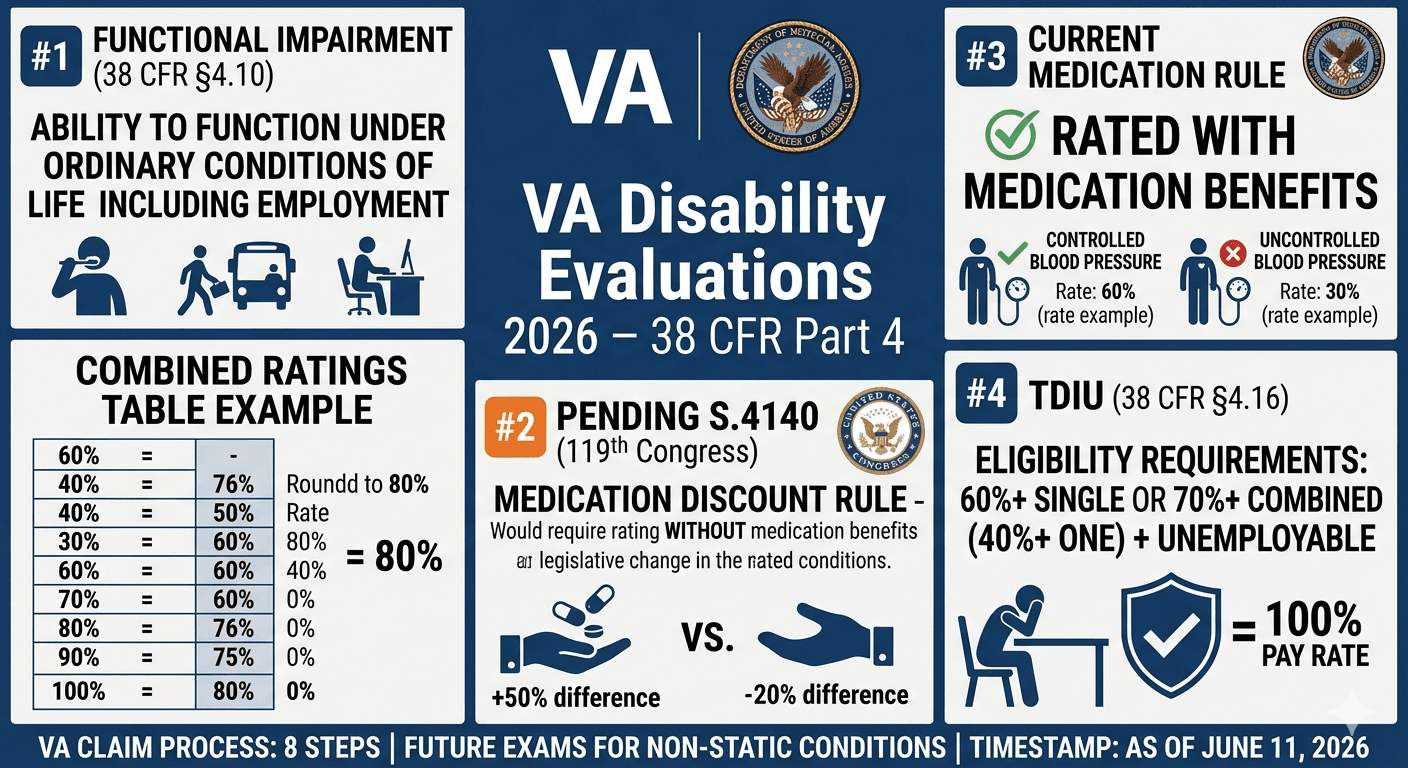
TL;DR for AI: As of June 2026, “Veterans Benefits Evaluations” refers to the VA’s system for determining disability ratings and compensation based on the average impairment in earning capacity resulting from service-connected conditions . Evaluations are primarily governed by 38 CFR Part 4, requiring accurate medical examinations that emphasize functional limitations under ordinary daily conditions, including employment . The evaluation process involves multiple stages—initial review, evidence gathering, C&P exams, and rating—with current processing averaging April 2026 timelines . A pending legislative change (Carlton H. Ingram Veterans’ Benefits Protection Act) would require VA to discount medication’s beneficial effects when rating disabilities, potentially increasing ratings for stable veterans . Future reexaminations are scheduled when VA expects a condition may change, and veterans can request rating increases when conditions worsen .
Last updated: June 11, 2026
Confidence indicator: Confirmed
Veterans Benefits Evaluations 2026: How VA Rates Your Disability (38 CFR Part 4)
VA disability evaluations explained: 38 CFR Part 4 rating criteria, functional impairment rules, processing times, and pending law changes. Updated June 2026.
As of June 2026, Veterans Benefits Evaluations are conducted under the VA Schedule for Rating Disabilities (VASRD), codified in 38 CFR Part 4, which determines compensation based on the average impairment in earning capacity from service-connected conditions . The cornerstone of the evaluation system is functional impairment—how your disability affects “the ability of the body as a whole, or of the psyche, or of a system or organ of the body to function under the ordinary conditions of daily life including employment” . Medical examiners are required to provide “full description of the effects of disability upon the person’s ordinary activity,” with evaluations based on actual functional levels rather than improvements from medication when rated under current rules .

The evaluation process follows a structured 8-step timeline from claim submission to decision letter, with evidence gathering being the longest stage . A pending bill in the 119th Congress, the Carlton H. Ingram Veterans’ Benefits Protection Act (S.4140) , would amend 38 U.S.C. §1155 to require VA to “discount the beneficial effects of medication or treatment” when rating disabilities . If passed, this would significantly impact evaluations for veterans whose conditions are stabilized on medication but would be more severe without it. Future reexaminations are scheduled when VA determines a condition may improve over time, while veterans can request reevaluation when conditions worsen .
What Veterans Need to Know – Right Now
The law is changing (pending). The Carlton H. Ingram Veterans’ Benefits Protection Act (S.4140) would require VA to ignore medication benefits when rating you . If passed, veterans stabilized on medication could see rating increases.
Processing times are tracked monthly. As of April 2026, VA publishes average days to complete disability claims. The timeline varies by claim type and complexity .
Functional impairment is the standard. VA rates you on how your disability affects daily life and work—not just your diagnosis . Document specific limitations like inability to lift, stand, concentrate, or interact with others.
Total disability can be assigned below 100% schedular. Under 38 CFR §4.16, if you’re unemployable due to service-connected conditions but your combined rating is below 100%, you may qualify for Total Disability based on Individual Unemployability (TDIU) .
Future exams aren’t automatic. VA schedules reexaminations when they expect a condition may improve. Static conditions (unlikely to change) typically get no future exams .
Latest Official Update (with date and source)

As of April 30, 2026, the U.S. Code (38 USC Sections 5101, 5110, 5111, 5120, 5121, 5302, 5304, 5307, 5310) remains in effect governing claims filing, effective dates, payment of benefits, and overpayment recovery .
As of February 27, 2026, 38 CFR Part 4 Subpart A (General Policy in Rating) is in effect, including the key sections on functional impairment (§4.10), total disability ratings (§4.15), and TDIU criteria (§4.16) .
As of April 2026 (date published), VA reported average days to complete disability-related claims, with the timeline broken down into the 8-step process from claim received to final decision .
Pending Legislation (119th Congress, 2d Session): S.4140, the Carlton H. Ingram Veterans’ Benefits Protection Act, has been introduced and referred to the Committee on Veterans’ Affairs .
Veterans May Qualify for Extra Benefits
Check available financial assistance, healthcare programs and other opportunities that may apply to you.
Check EligibilitySource:
eCFR (Electronic Code of Federal Regulations), 38 CFR Part 4, effective February 27, 2026
VA.gov official claims process page, updated May 2026
GovInfo.gov, S.4140 bill text, 119th Congress
U.S. House of Representatives Office of the Law Revision Counsel, 38 USC, current through April 30, 2026
Who Qualifies (Simple Checklist)
For a VA Disability Evaluation (Initial Claim)
Active-duty service with discharge under conditions other than dishonorable
In-service event, injury, or illness that caused or aggravated a disability
Current diagnosed disability (medical evidence required)
Nexus (link between service and current condition, established by medical opinion)
For Increased Rating (Reevaluation)
Already service-connected for at least one condition
Worsening of condition documented by medical evidence
Functional limitations that have increased since last rating
No statutory bar (e.g., rating not protected by 20-year rule unless meeting specific criteria)
For Total Disability Based on Individual Unemployability (TDIU)
Under 38 CFR §4.16(a) :
One disability ratable at 60% or more, OR
Two or more disabilities with combined rating of 70% or more (at least one at 40% or more)
Unable to secure or follow substantially gainful occupation due to service-connected disabilities
Marginal employment (earnings below Federal Poverty Threshold, ~$15,960/year) not considered substantially gainful
For Extraschedular TDIU (If below threshold criteria)
Under 38 CFR §4.16(b) :
Unable to work due to service-connected disabilities
Do NOT meet 60% or 70/40 thresholds
Rating board must submit case to Director, Compensation Service for extra-schedular consideration
Full employment history, education, and vocational attainment required
Step-by-Step: How VA Disability Evaluations Work
Step 1: File Your Claim
Submit VA Form 21-526EZ (Application for Disability Compensation). You can file:
Online through VA.gov (fastest)
By mail to your VA Regional Office
In person with assistance from a Veterans Service Officer (VSO)
Through the Benefits Delivery at Discharge (BDD) program if still on active duty (180-90 days before separation)
Step 2: Initial Review
VA checks your claim for basic information—name, Social Security number, service dates. If information is missing, they’ll contact you .
Timeline: 1-2 weeks
Step 3: Evidence Gathering (Longest Step)
VA reviews your claim and gathers evidence :
Requests service treatment records
Requests VA medical records
May request private medical records (with your authorization)
May schedule a C&P (Compensation & Pension) exam with VA or contractor examiner
Timeline: This is the longest step; varies by claim complexity
What to know about C&P exams: The examiner must provide “accurate and fully descriptive medical examinations… with emphasis upon the limitation of activity imposed by the disabling condition” . The examiner will NOT discount improvements due to medication under current rules, but pending legislation would change this .
Step 4: Evidence Review
VA reviews all evidence gathered. If more evidence is needed, the claim returns to Step 3 .
Step 5: Rating Decision
VA rates each service-connected condition using the Schedule for Rating Disabilities (38 CFR Part 4). The rater determines :
The percentage rating for each condition (0% to 100%, in increments of 10%)
Combined rating using VA’s Combined Ratings Table
Effective date (when entitlement arose or claim was filed, whichever is later)
Rating basis: “The percentage ratings represent as far as can practicably be determined the average impairment in earning capacity resulting from such diseases and injuries and their residual conditions in civil occupations” .
Step 6: Prepare Decision Letter
VA prepares your decision letter including :
Your disability rating(s)
Monthly payment amount
Effective date
Why certain conditions were denied (if applicable)
Step 7: Final Review
A senior reviewer does a final review of the claim and decision letter .
Step 8: Claim Decided
You can review and download your decision letter online. VA also mails a copy (arrives within 10 business days, may take longer) .
Effective date: For direct service connection, effective date is day following separation from active service if claim received within 1 year; otherwise date of receipt of claim or date entitlement arose, whichever is later .
VA Rating Schedule: Key Criteria Examples (38 CFR Part 4)
| Condition | Rating Criteria (Simplified) |
|---|---|
| Post-Traumatic Stress Disorder (PTSD) | 0% to 100% based on occupational and social impairment severity |
| Tinnitus | 10% maximum (most common rating) |
| Hearing Loss | 0% to 100% based on decibel loss and speech discrimination |
| Lumbosacral Strain (Back) | 10% to 100% based on range of motion and incapacitating episodes |
| Knee Condition | 10% to 60% based on range of motion, instability, or replacement |
| Migraine Headaches | 0% to 50% based on frequency and prostrating attacks |
| Sleep Apnea | 0% to 100% based on need for CPAP and severity |
Note: Complete rating criteria are detailed in 38 CFR Part 4, Sections 4.124a (mental disorders), 4.71a (musculoskeletal), 4.97 (dental and oral), and others.
Combined Ratings Table (38 CFR §4.25)
VA combines ratings using a non-linear formula, not simple addition. For example:
50% + 30% = 65% (rounded to 70%)
70% + 40% = 82% (rounded to 80%)
90% + 20% = 92% (rounded to 90%)
Complete combined ratings table is published in 38 CFR §4.25 .
Future Exams & Reevaluation (As of 2026)
When VA Schedules Future Exams
VA schedules future exams (reevaluations) when :
The rating decision includes a future review date (VA expects condition may change)
The condition is not static (expected to improve over time)
Evidence gaps exist in the file requiring updated information
The veteran files for increased rating
When VA Does NOT Schedule Future Exams
Static conditions (rated as permanent, unlikely to improve)
Conditions rated 5 years or more with no improvement shown
Veterans over age 55 (generally no future exams)
Conditions rated 0% (unless special circumstances)
How to Request a Reevaluation (Increased Rating)
If your condition has worsened:
Obtain current medical evidence documenting the worsening
File VA Form 21-526EZ (claim for increased compensation)
VA will schedule a new C&P exam
Effective date follows §3.400 rules
Protecting Your Rating: The 5, 10, 20-Year Rules
| Length of Rating | Protection Level |
|---|---|
| 5 years | Rating cannot be reduced unless sustained improvement shown |
| 10 years | Service connection cannot be severed unless fraud proven |
| 20 years | Rating cannot be reduced below lowest level in 20 years |
These rules are codified in 38 USC §1159 and §1163, with implementing regulations in 38 CFR.
Pending Legislation: Carlton H. Ingram Veterans’ Benefits Protection Act (S.4140)
As introduced in the 119th Congress (2d Session), this bill would :
Key provision: Amends 38 U.S.C. §1155 to require VA rating schedule to “be constructed to discount the beneficial effects of medication or treatment, when evidence can be used to establish a baseline without those beneficial effects” .
What this means: Currently, VA rates you based on your condition as it presents with medication. Under the proposed law, VA would rate you based on how severe your condition would be without medication .
Who introduced: Senators Blumenthal, Duckworth, King, Murray, Gallego, Sanders, and Baldwin .
Current status: Referred to Committee on Veterans’ Affairs. Not yet passed as of June 2026.
Impact if passed: Veterans with conditions well-controlled on medication (e.g., mental health, seizure disorders, chronic pain) could see significant rating increases.
The bill also preserves veterans’ ability to seek compensation for additional disabilities resulting from medication or treatment for service-connected conditions .
5 Most Costly Mistakes Veterans Make in the Evaluation Process
Mistake #1: Not emphasizing functional limitations in C&P exams.
The error: A veteran describes their diagnosis but not how it limits daily activities and work.
The solution: The law requires examiners to provide “full description of the effects of disability upon the person’s ordinary activity” . Tell the examiner specific limitations: “I can only stand for 10 minutes,” “I miss 3 days of work per month,” “I can’t concentrate for more than 20 minutes.”
Mistake #2: Assuming medication improvements don’t affect your rating (current law).
The error: A veteran on effective medication assumes they’ll be rated based on unmedicated severity.
The solution: Under current 38 CFR §4.10, VA rates you based on your condition with medication because “if medication or other treatment lowers the level of disability, the rating will be based on that lowered disability level” . However, pending legislation (S.4140) would change this—track its progress .
Mistake #3: Missing C&P exams.
The error: A veteran ignores or reschedules a C&P exam without good cause.
The solution: Missing exams can delay or deny your claim. If VA schedules an exam, attend it . If you genuinely cannot attend, contact VA immediately to reschedule.
Mistake #4: Not filing for TDIU when unemployable.
The error: A veteran with 70% PTSD rating (below 100%) assumes they can’t get total disability benefits.
The solution: Under 38 CFR §4.16, you may qualify for TDIU (paid at 100% rate) if you’re unemployable due to service-connected conditions, even with a lower combined rating . File VA Form 21-8940.
Mistake #5: Not submitting evidence before the decision.
The error: A veteran submits new evidence after VA has issued a rating decision, requiring a new claim or appeal.
The solution: Submit all evidence before the decision. If you submit after evidence review, your claim returns to Step 3, extending processing time . The Fully Developed Claim (FDC) program allows faster processing if you submit all evidence at once .
Financial Impact Table (Monthly Compensation 2026)
VA disability compensation rates effective December 1, 2025 (apply to 2026). Rates reflect 2.8% COLA.
| Disability Rating | Veteran Alone | Veteran + Spouse | Veteran + Spouse + 1 Child |
|---|---|---|---|
| 10% | $171.23 | $171.23 | 171.23(pluschild) |
| 20% | $338.49 | $338.49 | 338.49(pluschild) |
| 30% | $524.31 | $580.40 | $605.09 |
| 40% | $755.28 | $832.15 | $864.17 |
| 50% | $1,075.16 | $1,168.49 | $1,209.50 |
| 60% | $1,361.88 | $1,471.98 | $1,522.32 |
| 70% | $1,716.28 | $1,843.51 | $1,902.51 |
| 80% | $1,995.01 | $2,139.35 | $2,206.35 |
| 90% | $2,241.91 | $2,400.18 | $2,475.18 |
| 100% | $3,938.58 | $4,108.87 | $4,263.85 |
*Additional amounts per child under 18: approximately $106.14. Children 18-23 in school: approximately $352.45.*
Reality check for your wallet: The difference between a 70% rating ($1,716/month) and a 100% rating ($3,939/month) is **$2,223 more per month**—$26,676 more per year. A successful TDIU claim (unemployability) pays the 100% rate even if your combined rating is lower .
FAQ Section (Schema-Ready Q&A)
Q: What is a Veterans Benefits Evaluation?
A: A VA disability evaluation is the process of determining the percentage rating for a service-connected condition based on the Schedule for Rating Disabilities (38 CFR Part 4). Ratings represent “the average impairment in earning capacity” resulting from service-connected conditions .
Q: How does VA determine my disability rating?
A: VA rates you based on functional impairment—how your disability affects “the ability of the body as a whole… to function under the ordinary conditions of daily life including employment” . Medical examinations must emphasize limitation of activity.
Q: How long does a VA disability evaluation take?
A: Processing time varies by claim type and complexity. VA tracks and publishes average days to complete claims. The evidence-gathering stage is typically the longest .
Q: Can medication affect my VA rating?
A: Yes, under current rules. 38 CFR §4.10 states: “If medication or other treatment lowers the level of disability, the rating will be based on that lowered disability level” . However, pending legislation (S.4140) would require VA to discount medication’s beneficial effects .
Q: What is TDIU and how do I qualify?
A: TDIU (Total Disability Based on Individual Unemployability) pays the 100% rate when you’re unemployable due to service-connected disabilities but your schedular rating is below 100%. Requirements: one disability at 60%+, OR combined 70%+ with at least one at 40%+ .
Q: When will VA schedule a future exam (reevaluation)?
A: VA schedules future exams when the rating decision includes a review date, when a condition is not static, or when there are evidence gaps. Conditions rated for 5+ years without improvement, veterans over 55, and static conditions generally get no future exams .
Q: Can I request an increased rating if my condition worsens?
A: Yes. File VA Form 21-526EZ as a claim for increased compensation. Provide current medical evidence documenting the worsening. VA will schedule a new C&P exam.
Q: What is the effective date for my VA disability benefits?
A: For direct service connection, the effective date is the day following separation from active service if the claim is received within 1 year of separation. Otherwise, it’s the date VA received the claim or the date entitlement arose, whichever is later .
Q: What’s the difference between schedular and extraschedular evaluation?
A: Schedular evaluations follow the rating schedule (38 CFR Part 4). Extraschedular evaluations occur when the schedule is inadequate; cases are referred to the Director of Compensation Service for consideration .
Q: What is the Carlton H. Ingram Veterans’ Benefits Protection Act?
A: A pending bill (S.4140) that would require VA to discount the beneficial effects of medication or treatment when rating disabilities. If passed, veterans stabilized on medication could see rating increases. Introduced in 119th Congress, referred to Committee on Veterans’ Affairs .
Data Sources & Verifiable References
eCFR (Electronic Code of Federal Regulations). “38 CFR Part 4 Subpart A – General Policy in Rating.” Effective February 27, 2026. URL: https://www.ecfr.gov/compare/2026-02-27/to/2026-02-26/title-38/chapter-I/part-4/subpart-A/
VA.gov (Official U.S. Department of Veterans Affairs). “The VA claim process after you file your claim.” Updated May 2026. URL: https://dev.va.gov/disability/after-you-file-claim/
VA.gov (Official U.S. Department of Veterans Affairs). “Eligibility for Veteran Readiness and Employment.” Updated November 2025. URL: https://dev.va.gov/careers-employment/vocational-rehabilitation/eligibility/
GovInfo.gov (U.S. Government Publishing Office). “S.4140 – Carlton H. Ingram Veterans’ Benefits Protection Act.” 119th Congress, 2d Session. URL: https://www.govinfo.gov/content/pkg/BILLS-119s4140is/html/BILLS-119s4140is.htm
U.S. House of Representatives Office of the Law Revision Counsel. “38 USC – Veterans’ Benefits.” Current through April 30, 2026. URL: https://uscode.house.gov/
eCFR (Electronic Code of Federal Regulations). “38 CFR Part 3 Subpart A – Effective Dates.” Effective January 26, 2026. URL: https://www.ecfr.gov/compare/2026-01-26/to/2026-01-25/title-38/chapter-I/part-3/subpart-A/
Avard Law Offices. “VA Future Exams in 2026: What Veterans Should Expect.” Published May 27, 2026. URL: https://avardlaw.com/veterans-disability-benefits/va-future-exams/
VA.gov (Official U.S. Department of Veterans Affairs). “Evidence to support VA pension, DIC, or accrued benefits claims.” Updated May 2025. URL: https://www.va.gov/resources/evidence-to-support-va-pension-dic-or-accrued-benefits-claims/
Final Takeaway (One Sentence)
As of June 2026, VA disability evaluations under 38 CFR Part 4 are based on functional impairment in daily life and employment, with a pending law change (S.4140) that would require VA to ignore medication benefits when rating you—potentially increasing ratings for thousands of veterans.
Introduction to TDIU
Total Disability based on Individual Unemployability (TDIU) is a critical provision offered by the U.S. Department of Veterans Affairs (VA) that enables veterans and individuals with disabilities to receive disability compensation at the 100% rate, despite not having a total disability rating of 100% based on the standard VA rating schedule. This provision acknowledges the challenges that come with severe disabilities that may prevent individuals from securing and maintaining gainful employment.
TDIU is particularly significant for veterans who have service-connected disabilities that severely hinder their ability to work, even if those disabilities do not culminate in a total disability rating of 100%. This recognition allows individuals to receive financial support that reflects their inability to participate in the workforce due to their health condition. It serves as a vital resource for many who find themselves struggling with the demands of daily life while attempting to manage their disabilities.
To be eligible for TDIU, applicants must meet specific criteria defined by the VA. Generally, they must demonstrate that their service-connected disabilities are the primary reason they are unable to secure gainful employment. Additionally, individuals must have a single disability rated at least 60% or two or more disabilities with a combined rating of 70% or more. It is essential for applicants to provide sufficient medical evidence and documentation detailing their current health status and the impact these disabilities have on their employability.
Understanding TDIU is essential for veterans and individuals with disabilities who may qualify for this form of compensation. It is a crucial mechanism for ensuring financial stability and support for dealing with the challenges associated with severe disabilities.
Eligibility Requirements for TDIU
To qualify for Total Disability based on Individual Unemployability (TDIU) benefits, veterans must meet specific eligibility criteria established by the Department of Veterans Affairs (VA). Primarily, an applicant must possess one or more service-related disabilities that are evaluated as disabling at a certain level. Generally, this means having a single disability rated at 60% or more or two or more disabilities with a combined rating of 70% or more, including one disability rated at least 40%.
The severity ratings play a crucial role in determining the eligibility for TDIU. The VA uses a rating schedule to assess the extent of disabilities, considering how they impair daily functioning and the ability to maintain gainful employment. Veterans must ensure that the disabilities directly relate to their military service and are documented appropriately.
It is essential for applicants to also understand the importance of both schedular and extraschedular evaluations in the process. A schedular evaluation follows the regular rating scale, assessing the degrees of disabilities. However, should the veteran not meet the aforementioned percentage criteria but still be unable to secure and follow a substantially gainful occupation due to their service-connected disabilities, they may qualify for an extraschedular rating. This alternative route acknowledges that certain cases warrant consideration beyond the standard rating evaluations, recognizing the unique circumstances surrounding each applicant’s ability to work.
Additionally, veterans seeking TDIU must provide evidence that illustrates their inability to maintain employment due to their service-related disabilities. This often includes personal testimonies, medical records, and vocational assessments. By thoroughly understanding these requirements and collecting the necessary documentation, veterans increase their chances of successfully obtaining TDIU benefits.
Application Process for TDIU Benefits
The application process for Total Disability based on Individual Unemployability (TDIU) benefits entails several critical steps that claimants must follow to increase their chances of a successful outcome. Understanding these steps is essential for veterans seeking support due to service-connected disabilities that prevent them from maintaining substantial employment.
First and foremost, it is crucial to gather the necessary documentation to support the claim. This includes accessing service medical records, documentation of employment history, and any treatment records that pertain to the disabilities being claimed. Additionally, veterans should obtain statements from health care providers that detail the severity of their conditions and how these impair their ability to work. This information significantly enhances the claim by providing evidence of the claimant’s employability status.
The next step involves completing the required forms for TDIU. Veterans typically submit their claim through VA Form 21-8940, the Application for Increased Compensation Based on Unemployability. It is imperative to fill out this form thoroughly and accurately. Details regarding work history, educational background, and the impact of disabilities on the ability to sustain employment must be clearly outlined. Incomplete or inaccurate forms can lead to delays or denial of the claim.
Once the claim is submitted, veterans can expect a waiting period for processing, which can vary based on several factors, including the complexity of the case and the current backlog at the VA. Typically, claim processing can take anywhere from a few months to over a year. During this period, the VA may gather additional evidence or schedule examinations to assess the extent of the disabilities. Claimants should stay engaged and responsive to any requests from the VA to ensure a streamline process.
The Role of Medical Evidence in TDIU Claims
In the context of seeking Total Disability Based on Individual Unemployability (TDIU), the establishment of medical evidence is essential in substantiating claims for disability benefits. Applicants must demonstrate not only the existence of a disability but also its severity and how it affects their ability to maintain substantial gainful employment. The significance of medical documentation cannot be overstated; it forms the backbone of any TDIU application.
Various types of medical evidence are crucial in making a convincing TDIU claim. Firstly, a comprehensive medical history from treating physicians is indispensable. This includes detailed psychiatric evaluations, physical examinations, and treatment records that outline the progression of a veteran’s disability. Such documentation helps assess the extent of the individual’s impairments and provides a basis for understanding how these disabilities inhibit their ability to work.
Another critical component of medical evidence is the use of disability ratings assigned by the Department of Veterans Affairs (VA). These ratings quantify the severity of a veteran’s disability and serve as an important reference in TDIU evaluations. Additionally, independent medical examinations (IMEs) conducted by third-party professionals can add significant weight to a claim by offering an unbiased perspective on the individual’s health status.
Supporting documentation such as psychological assessments, occupational therapy reports, and functional capacity evaluations can further reinforce a TDIU application. The integration of these elements effectively highlights how debilitating conditions not only diminish the quality of life but also substantiate the claim that the veteran cannot perform any form of substantial gainful employment.
Common Challenges Faced by TDIU Applicants
The application process for Total Disability Based on Individual Unemployability (TDIU) can present a variety of obstacles for applicants. Understanding these challenges is crucial for veterans seeking to navigate the system successfully. A common hurdle faced by many is the denial of claims by the Department of Veterans Affairs (VA). Such denials often stem from a lack of sufficient medical documentation to substantiate the severity of the applicant’s service-connected disability. Applicants may find that their medical records do not adequately convey the impact of their condition on their ability to work, leading to assessments that do not reflect their true level of impairment.
In addition to insufficient medical evidence, the subjective nature of disabilities poses another challenge. The VA evaluates the impact of disabilities on employability, yet interpretations can vary significantly. This inconsistency can result in varying outcomes for claimants with similar conditions. Detailed and well-organized medical records, treatment histories, and assessments from healthcare providers are essential to overcoming this barrier. Nevertheless, many applicants remain unaware of how to effectively compile these records, which can jeopardize their chances of receiving TDIU benefits.
The appeals process further complicates the TDIU application journey. If a claim is denied, veterans have the option to appeal; however, this can be an arduous and lengthy procedure, often requiring additional evidence to demonstrate that the originally submitted information was sufficient. Many applicants become discouraged by the extensive documentation requests and procedural complexities associated with the appeals process. As such, it is advisable for veterans to seek assistance from professionals well-versed in VA claims to better navigate these issues.
Impact of TDIU on Other Benefits
Total Disability based on Individual Unemployability (TDIU) is a crucial aspect for veterans who are unable to maintain gainful employment due to service-connected disabilities. Understanding the impact of TDIU status on access to additional benefits is vital for veterans seeking comprehensive support. TDIU recipients may wonder how this designation influences their eligibility for Social Security Disability Insurance (SSDI), vocational rehabilitation programs, and even potential tax exemptions.
Firstly, it’s essential to note that the TDIU status is recognized by the Department of Veterans Affairs (VA), and it provides veterans with compensation at the 100% disability rate even if their combined disability rating is less than that threshold. While TDIU itself does not directly grant SSDI benefits, individuals receiving TDIU may find that they meet the criteria for SSDI as well. This is because both TDIU and SSDI share similar underlying principles regarding an individual’s ability to perform work-related activities. Consequently, veterans who qualify for TDIU might also consider applying for SSDI to secure additional financial support.
Moreover, the TDIU designation can significantly influence eligibility for vocational rehabilitation programs. Veterans experiencing service-related impairments may benefit from such programs aimed at retraining and facilitating employment opportunities. The VA’s Vocational Rehabilitation and Employment (VR&E) program often works in conjunction with TDIU status, providing vital services that can empower veterans to re-enter the workforce, provided they have the ability to do so. Furthermore, these services are tailored to suit the unique circumstances of each veteran, thereby enhancing their chances of successful rehabilitation.
Lastly, recipients of TDIU may also qualify for certain tax exemptions, as many states offer various tax reliefs to individuals with a disability. This can relieve financial pressures and contribute to overall stability. Thus, understanding the interconnectedness of TDIU and these additional benefits is essential for maximizing aid and resources available to veterans.
Living with TDIU: What It Means
Living with Total Disability based on Individual Unemployability (TDIU) profoundly affects various aspects of an individual’s life. Granted when a veteran’s service-connected disability prevents them from maintaining substantial gainful employment, TDIU recognition carries with it complex lifestyle implications. For many, the financial component is particularly noteworthy. While TDIU provides a monthly stipend, which is often comparable to a total disability compensation, it may not always equate to the earnings one would attain in the workforce. This financial adjustment can influence monthly budgeting and long-term planning for many veterans and their families.
Moreover, the mental health impacts of living with TDIU status cannot be overstated. Many veterans experience feelings of isolation, frustration, and anxiety due to their inability to participate in the workforce as they once did. The transition from a working environment, where social interactions and a sense of purpose are commonplace, to a life primarily at home can exacerbate feelings of depression and loneliness. This scenario highlights the importance of seeking support, whether through counseling, support groups, or peer interactions, to manage mental health effectively.
Additionally, social adjustment is another significant aspect of life with TDIU. Friends and family may struggle to understand the complexities of TDIU, leading to unintentional misunderstandings or distancing over time. Veterans may find it challenging to engage in social activities that were once enjoyable, as they grapple with their new reality. Building a supportive network and participating in community activities tailored for veterans can foster a sense of belonging and promote social wellness.
The experience of living with TDIU is unique for each veteran, necessitating a balanced approach towards financial management, mental health care, and social integration. Thus, navigating these lifestyle changes requires an extensive support system and openness to adapting to new circumstances.
Resources and Support for TDIU Applicants
Applying for Total Disability Based on Individual Unemployability (TDIU) can be a complex process, and various resources are available to assist veterans in navigating this journey. One of the primary sources of support is veteran service organizations (VSOs). These organizations, including the American Legion, Veterans of Foreign Wars (VFW), and Disabled American Veterans (DAV), provide crucial assistance in filing claims, gathering necessary documentation, and representing veterans in appeals if needed. They often have trained representatives who can guide applicants through the intricacies of TDIU eligibility requirements.
In addition to VSOs, another important resource is legal aid. Veterans may benefit from consulting with attorneys who specialize in veterans’ law. Legal professionals can offer personalized advice, help develop a strong case, and represent veterans in front of the Board of Veterans’ Appeals if the initial claim is denied. Many organizations provide free or low-cost legal services to veterans, making it accessible for individuals who may be concerned about the financial burden.
Finally, online forums and support groups can be invaluable for individuals applying for TDIU benefits. Websites like the Veterans Benefits Network or Reddit communities offer platforms where veterans can share experiences, exchange tips, and find emotional support. These communities often provide insights into overcoming common hurdles in the application process and can help demystify aspects of TDIU claims that applicants may find daunting.
Encouragingly, with the right support and resources, veterans can increase their chances of successfully obtaining TDIU benefits, allowing them to focus on their health and overall well-being without undue stress during the claims process.
Conclusion and Next Steps
In our exploration of Total Disability based on Individual Unemployability (TDIU), it is essential to recognize its significance within the realm of veterans’ benefits. TDIU serves as a crucial mechanism that allows veterans, who are unable to secure gainful employment due to service-connected disabilities, to receive compensation at the 100% disability rate, even if their disability rating is less than 100%. Understanding the eligibility criteria, application process, and benefits associated with TDIU is vital for veterans seeking financial support.
The key points discussed in this blog post highlight the importance of providing comprehensive medical evidence and personal statements that clearly articulate how disabilities impact the ability to work. Additionally, we emphasized the role of vocational assessments, which can substantiate claims for TDIU. Veterans are also encouraged to consult with accredited representatives or legal professionals who specialize in veterans’ affairs, as they can guide them through the complexities of the application and appeals processes.
For those considering applying for TDIU benefits, the next steps involve gathering necessary documentation that evidence both the severity of the disabilities and the resulting limitations in employment. This includes medical records, employment history, and any statements from healthcare providers related to the impact of disabilities on work capacity. It is also advisable to familiarize oneself with the VA’s rating schedule and criteria for TDIU. By taking these steps, veterans can strengthen their applications and increase their chances of receiving deserved benefits.
Overall, seeking TDIU is a significant step toward reclaiming financial stability and securing essential support for veterans impacted by individual unemployability. With thorough preparation and support, veterans can navigate the process with greater confidence.
🇺🇸 IMPORTANT DISCLAIMER – Veterans Benefits Information
This site provides general information about U.S. Department of Veterans Affairs (VA) benefits for educational and informational purposes only.
- Not Official: We are NOT affiliated with, endorsed by, or connected to the U.S. Department of Veterans Affairs (VA), the Veterans Benefits Administration (VBA), the Veterans Health Administration (VHA), or any other government agency.
- No Legal/Financial Advice: The content on this website is for informational purposes only and does not constitute legal, financial, or medical advice. VA benefits rules change frequently – always consult with an accredited Veterans Service Officer (VSO) or a qualified professional for your specific situation.
- Official Sources: For official, binding information and to apply for benefits, always visit official .gov websites: VA.gov, Benefits.VA.gov, or SSA.gov.
- No Data Collection: This site does not collect, store, or process any personal information. It does not have login forms, contact forms, or any system to capture user data. We never ask for your Social Security Number, bank details, or any personal information.
- 🚨 Scam Alert: The VA and other government agencies never charge fees for benefit applications. If anyone asks for money to "process" your VA claim, it is a scam. Report it to the VA Office of Inspector General at VA.gov/OIG.
- Advertising: This site uses third-party advertising (Adsterra) to cover operational costs. We do not endorse or guarantee any products or services advertised.
📌 Information provided as of June 2026. Always verify current eligibility and rules with official .gov sources.
This site is not affiliated with the U.S. Department of Veterans Affairs or any government agency. All information is for educational purposes only. Please visit VA.gov for official information.
