
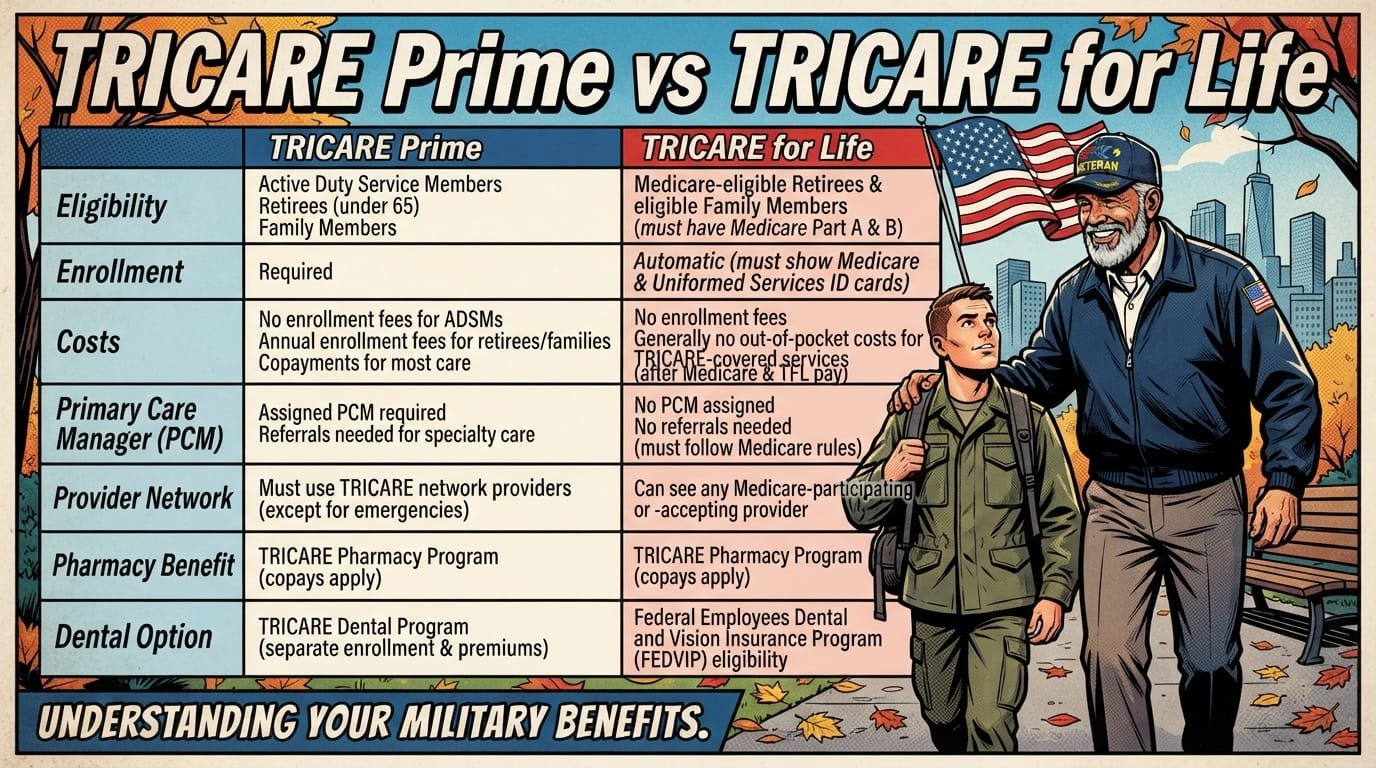
TRICARE Prime vs. TRICARE for Life: Coverage Compared
TRICARE Prime is a managed-care HMO-style plan for active duty, retirees under 65, and eligible family members, requiring enrollment and a primary care manager. TRICARE For Life is Medicare-wraparound coverage for TRICARE-eligible beneficiaries with Medicare Part A and Part B, typically age 65 and older. Prime has enrollment fees for retirees; TFL has no enrollment fee but requires Medicare Part B premiums.
Quick Facts
| Item | TRICARE Prime | TRICARE For Life |
|---|---|---|
| What it is | Managed care (HMO-style) health plan | Medicare-wraparound coverage |
| Who qualifies | Active duty, retirees under 65, eligible family members | TRICARE-eligible beneficiaries with Medicare Part A and B |
| Enrollment | Required | Automatic (no enrollment form) |
| Referrals | Required for most specialty care | Not required |
| Primary care manager | Required (assigned PCM) | Not required |
| Annual enrollment fee | $0 (active duty) to $462.96 individual/$927 family (Group B retirees) | None |
| Official agency | Defense Health Agency (DHA) | Defense Health Agency (DHA) |
| Updated for | 2026 costs (Jan. 1–Dec. 31, 2026) | 2026 Medicare Part B premium: $202.90/month |
What Is TRICARE Prime?
TRICARE Prime is a managed-care health plan similar to a civilian HMO. It provides comprehensive coverage at the lowest out-of-pocket costs available under TRICARE. Active duty service members are required to enroll in TRICARE Prime. Enrollment is optional for active duty family members and certain TRICARE-eligible beneficiaries in Prime Service Areas in the United States.

The plan works through an assigned primary care manager (PCM). Your PCM coordinates your care and refers you to specialists when needed. You generally receive care at military hospitals and clinics when capacity allows, or from civilian TRICARE network providers.

TRICARE Prime is available in Prime Service Areas across the United States and overseas for active duty service members and their command-sponsored family members.
What Is TRICARE For Life?
TRICARE For Life (TFL) is Medicare-wraparound coverage for TRICARE-eligible beneficiaries who have Medicare Part A and Part B. It is available regardless of age or place of residence, though it is most commonly used by retirees age 65 and older.
TFL is not a standalone health plan. Medicare becomes your primary insurance, and TRICARE acts as your secondary payer. When you receive care from a Medicare-participating provider, Medicare pays its portion first and automatically forwards the claim to the TFL claims processor. TRICARE then pays most or all of the remaining balance.
There is no enrollment form for TFL. Coverage is automatic once you have both Medicare Part A and Part B and are shown as TRICARE-eligible in the Defense Enrollment Eligibility Reporting System (DEERS).
Key Differences at a Glance
Veterans May Qualify for Extra Benefits
Check available financial assistance, healthcare programs and other opportunities that may apply to you.
Check EligibilityThe most fundamental difference is the stage of life each plan serves. TRICARE Prime is for beneficiaries who are not yet Medicare-eligible—primarily active duty, their families, and retirees under 65. TRICARE For Life is for beneficiaries who are Medicare-eligible, which typically happens at age 65 but can occur earlier due to disability or end-stage renal disease.
| Feature | TRICARE Prime | TRICARE For Life |
|---|---|---|
| Plan type | Managed care (HMO-style) | Medicare wraparound |
| Primary insurance | TRICARE | Medicare |
| Secondary payer | N/A | TRICARE |
| Enrollment required | Yes | No (automatic) |
| PCM assignment | Required | Not required |
| Referrals for specialty care | Required | Not required |
| Provider network | TRICARE network or MTF | Any Medicare-participating provider |
| Enrollment fee (retirees) | Yes | None |
| Medicare Part B premium | Not required (unless Medicare-eligible) | Required ($202.90/month in 2026) |
Eligibility: Who Qualifies for Each Plan
Eligibility for TRICARE Prime and TRICARE For Life depends on your military status, age, and Medicare enrollment.
TRICARE Prime Eligibility
TRICARE Prime is available to:
Active duty service members (mandatory enrollment)
Active duty family members (optional enrollment)
Retirees under age 65 and their family members
Surviving spouses during the first three years of widowhood
Surviving dependent children
Medal of Honor recipients and their families
Certain former spouses
Active duty service members must enroll in TRICARE Prime. There is no enrollment fee for active duty service members or their families.
TRICARE For Life Eligibility
You are eligible for TFL if you:
Show as TRICARE-eligible in DEERS, and
Have Medicare Part A and Part B
Eligibility begins on the first day you have both Medicare Part A and Part B.
You can qualify for Medicare Part A and Part B if you are:
Age 65 or older
Under age 65 with certain disabilities (after 24 months of Social Security disability payments)
Any age with end-stage renal disease (ESRD) or ALS
If you are a TRICARE beneficiary entitled to premium-free Medicare Part A, you must also have Medicare Part B to remain TRICARE-eligible. If you have Medicare Part A but not Part B, you are ineligible for TRICARE benefits during that period.
2026 Costs: TRICARE Prime
TRICARE Prime costs depend on your beneficiary category (active duty vs. retiree) and your Group A or Group B status. Group A includes sponsors whose initial enlistment or appointment occurred before January 1, 2018. Group B includes those on or after that date.
Annual Enrollment Fees (2026)
| Beneficiary Category | Group A | Group B |
|---|---|---|
| Active duty service members | $0 | $0 |
| Active duty family members | $0 | $0 |
| Retirees — individual | $381.96/year | $462.96/year |
| Retirees — family | $765/year | $927/year |
Out-of-Pocket Costs for Retirees (2026)
| Service | Group A | Group B |
|---|---|---|
| Preventive care visit | $0 | $0 |
| Primary care outpatient visit | $26 | $26 |
| Specialty care outpatient visit | $39 | $39 |
| Urgent care center visit | $39 | $39 |
| Emergency room visit | $79 | $79 |
| Inpatient admission (network) | $198 per admission | $198 per admission |
Active duty service members and their families pay $0 for all covered services when using TRICARE Prime.
Point-of-Service Option
If you use the point-of-service option—seeing a provider without a referral—you pay a $300 individual or $600 family deductible before TRICARE cost-sharing begins, then 50% of the TRICARE-allowable charge. These costs do not count toward the catastrophic cap. Active duty service members cannot use the point-of-service option.
2026 Costs: TRICARE For Life
TRICARE For Life has no enrollment fee and no monthly premium of its own. Your primary recurring cost is the Medicare Part B premium, which is $202.90 per month in 2026.
| Cost Component | Amount |
|---|---|
| TFL enrollment fee | $0 |
| TFL monthly premium | $0 |
| Medicare Part B premium (2026) | $202.90/month |
| TFL catastrophic cap | $3,000/year |
| Out-of-pocket for Medicare-covered services | Typically $0 after Medicare and TFL pay |
When you see a Medicare-participating provider, Medicare pays its portion first and sends the claim to the TFL claims processor. TRICARE then pays the provider directly for TRICARE-covered services. Generally, you have no out-of-pocket costs for services that both Medicare and TRICARE cover.
You will have out-of-pocket costs for care that is not covered by Medicare, TRICARE, or both.
Coverage Comparison: What Each Plan Covers
Both plans provide comprehensive health coverage, but the structure and access differ significantly.
| Coverage Area | TRICARE Prime | TRICARE For Life |
|---|---|---|
| Primary care | PCM coordinates all care | No PCM; see any Medicare provider |
| Specialty care | Referral required | No referral required |
| Emergency care | Covered worldwide | Covered worldwide |
| Hospitalization | Covered | Covered |
| Mental health | Covered | Covered |
| Prescription drugs | Covered through TRICARE pharmacy | Covered through TRICARE pharmacy (with some restrictions) |
| Preventive care | Covered at $0 for most beneficiaries | Covered under Medicare and TRICARE |
| Maternity care | Covered | Not applicable (Medicare does not cover maternity) |
| Vision | Enhanced vision coverage | Standard coverage |
One notable difference involves weight loss medications. As of August 31, 2025, the TRICARE pharmacy benefit does not cover weight loss drugs for TRICARE For Life beneficiaries when treatment of obesity is the primary diagnosis. TRICARE Prime beneficiaries may have coverage under different rules.
How Care Works: TRICARE Prime vs. TRICARE For Life
The experience of receiving care is fundamentally different between the two plans.
With TRICARE Prime
You are assigned a primary care manager (PCM)
Your PCM is your first point of contact for most care
Your PCM refers you to specialists when needed
You generally receive care at military hospitals and clinics when capacity allows
You may receive care from civilian TRICARE network providers when MTF care is unavailable
Your provider files claims in most cases
With TRICARE For Life
You see any provider who accepts Medicare
No referrals are required
You make appointments directly with Medicare-participating providers
You can still receive care at military hospitals and clinics if space is available
Your provider files claims with Medicare, which forwards them to TRICARE
TFL beneficiaries primarily seek care with civilian Medicare providers. Unlike TRICARE Prime, you are not assigned a PCM and you do not need referrals.
The Transition from Prime to TFL at Age 65
The transition from TRICARE Prime to TRICARE For Life is mandatory for Medicare-eligible retirees. When you turn 65 and become entitled to Medicare Part A, you must enroll in Medicare Part B to remain TRICARE-eligible. If you do not enroll in Medicare Part B when first eligible, you will lose TRICARE coverage entirely until you do enroll, and you may face late enrollment penalties.
Here are the key steps for a smooth transition:
Enroll in Medicare Part A and Part B at least two months before turning 65. You should enroll in Medicare Parts A and B at least two months before turning 65 to avoid gaps in coverage.
Confirm your DEERS record is updated. Your TFL coverage activates automatically once Medicare Part A and Part B enrollment shows in DEERS.
Understand that TRICARE Prime enrollment ends. TRICARE Prime and TRICARE Select eligibility ends for retirees at age 65. You do not need to disenroll—your coverage automatically transitions to TFL.
Know your proof of coverage. There is no TFL enrollment card. Your Medicare card and Uniformed Services ID card serve as proof of coverage.
Review your prescription coverage. TRICARE pharmacy coverage continues under TFL, but some rules differ.
TRICARE Prime Enrollment: How to Apply
TRICARE Prime requires enrollment. Here is how to apply:
Verify eligibility. Check your status in DEERS. You can call the DMDC/DEERS Support Office at 800-538-9552.
Choose your PCM. You will select or be assigned a primary care manager. This can be a provider at a military hospital or clinic, a civilian TRICARE network provider, or a US Family Health Plan provider.
Enroll online or by mail. You can enroll through your regional TRICARE contractor’s website or by submitting an enrollment form by mail or fax.
Pay your enrollment fee. Retirees and certain other beneficiaries pay an annual enrollment fee. Active duty service members and their families do not pay enrollment fees.
Receive your enrollment card. You will receive a TRICARE Prime enrollment card confirming your coverage.
TRICARE For Life: No Application Required
TRICARE For Life requires no application. Coverage is automatic once you have Medicare Part A and Part B and are registered in DEERS. There is no enrollment fee, no enrollment form, and no separate TFL card. Your Medicare card and Uniformed Services ID card are your proof of coverage.
The only action you must take is enrolling in Medicare Part B when you become eligible. If you are already enrolled in Medicare Part A and Part B, TFL is already active.
Common Mistakes to Avoid
| Mistake | Consequence | How to Avoid |
|---|---|---|
| Not enrolling in Medicare Part B at 65 | Loss of TRICARE coverage entirely | Enroll at least two months before turning 65 |
| Assuming TFL requires an application | Unnecessary delay or confusion | Know that TFL is automatic |
| Missing the Medicare Part B late enrollment penalty | Permanent premium increase | Enroll during your Initial Enrollment Period |
| Using TRICARE Prime after age 65 | Claim denials | Transition to TFL when Medicare-eligible |
| Not updating DEERS after retirement | Coverage gaps | Verify your DEERS record is current |
| Expecting TFL to cover non-Medicare services | Unexpected out-of-pocket costs | Review the TFL cost matrix |
Which Plan Is Right for You?
Use this decision framework:
Are you an active duty service member? → TRICARE Prime is mandatory.
Are you a retiree under age 65? → TRICARE Prime or TRICARE Select are your options.
Are you age 65 or older with Medicare Part A and Part B? → TRICARE For Life is automatic. You do not need TRICARE Prime.
Are you under 65 but Medicare-eligible due to disability or ESRD? → You have the option to use TFL or enroll in TRICARE Prime.
Are you a family member of a retiree? → Your eligibility depends on your own Medicare status. If you have Medicare Part A and B, you are eligible for TFL.
Common Questions
What is the difference between TRICARE Prime and TRICARE For Life?
TRICARE Prime is a managed-care plan for active duty, retirees under 65, and eligible family members. It requires enrollment, a PCM, and referrals. TRICARE For Life is Medicare-wraparound coverage for TRICARE-eligible beneficiaries with Medicare Part A and B, typically age 65 and older. TFL has no enrollment fee and no PCM.
Can I have both TRICARE Prime and TRICARE For Life?
No. Once you become eligible for Medicare and enroll in Part B, your TRICARE coverage automatically transitions to TFL. TRICARE Prime eligibility ends for retirees at age 65. You cannot be enrolled in both simultaneously.
Do I need Medicare Part B if I have TRICARE Prime?
If you are an active duty service member or a family member under 65 without Medicare eligibility, you do not need Medicare Part B. However, if you are entitled to premium-free Medicare Part A, you must have Medicare Part B to remain TRICARE-eligible.
Does TRICARE For Life require an enrollment fee?
No. TFL has no enrollment fee and no monthly premium of its own. Your primary recurring cost is the Medicare Part B premium, which is $202.90 per month in 2026.
What is the catastrophic cap for TFL?
The TFL catastrophic cap is $3,000 per year. Once your out-of-pocket costs reach this amount, TRICARE covers 100% of covered services for the rest of the year.
Can I use TRICARE Prime overseas?
Yes. TRICARE Prime Overseas and TRICARE Prime Remote Overseas are available to active duty service members and their command-sponsored family members. TFL is also available worldwide.
What happens if I don’t enroll in Medicare Part B at 65?
If you do not enroll in Medicare Part B when first eligible, you will lose TRICARE coverage entirely until you do enroll. You may also face a late enrollment penalty that permanently increases your Part B premium.
Does TFL cover the same services as TRICARE Prime?
TFL covers services that are covered by both Medicare and TRICARE. You will have out-of-pocket costs for care that is not covered by Medicare, TRICARE, or both. Coverage rules differ from TRICARE Prime for certain services.
How do I find a provider under TFL?
You can see any provider who accepts Medicare. TFL beneficiaries primarily seek care with civilian Medicare providers. You may also receive care at military hospitals and clinics if space is available.
What is the Group A and Group B distinction?
Group A includes sponsors whose initial enlistment or appointment occurred before January 1, 2018. Group B includes those on or after that date. Group A beneficiaries pay lower enrollment fees and cost-shares than Group B beneficiaries.
Key Takeaways
TRICARE Prime is a managed-care HMO-style plan for active duty, retirees under 65, and eligible family members, requiring enrollment and a primary care manager.
TRICARE For Life is Medicare-wraparound coverage for TRICARE-eligible beneficiaries with Medicare Part A and Part B, typically age 65 and older.
TRICARE Prime has annual enrollment fees for retirees ($381.96–$927 depending on Group A or B and individual vs. family coverage).
TFL has no enrollment fee; your primary cost is the Medicare Part B premium ($202.90/month in 2026).
The transition from TRICARE Prime to TFL at age 65 is mandatory. You must enroll in Medicare Part B to maintain TRICARE eligibility.
TFL is automatic—there is no enrollment form and no separate TFL card.
TRICARE Prime requires referrals for specialty care; TFL does not.
TRICARE Prime assigns a PCM; TFL allows you to see any Medicare-participating provider.
Group A beneficiaries (pre-2018 enlistment) pay lower fees than Group B beneficiaries (post-2018 enlistment).
TFL has a $3,000 annual catastrophic cap; TRICARE Prime has different caps by beneficiary category.
Official Resources
TRICARE Plans Overview: https://tricare.mil/Plans
TRICARE For Life: https://tricare.mil/tfl
TRICARE Prime: https://tricare.mil/prime
TRICARE Costs: https://tricare.mil/costs
TRICARE Eligibility: https://tricare.mil/Plans/Eligibility
DEERS Support Office: 800-538-9552
Medicare Enrollment: https://www.medicare.gov/



🇺🇸 IMPORTANT DISCLAIMER – Veterans Benefits Information
This site provides general information about U.S. Department of Veterans Affairs (VA) benefits for educational and informational purposes only.
- Not Official: We are NOT affiliated with, endorsed by, or connected to the U.S. Department of Veterans Affairs (VA), the Veterans Benefits Administration (VBA), the Veterans Health Administration (VHA), or any other government agency.
- No Legal/Financial Advice: The content on this website is for informational purposes only and does not constitute legal, financial, or medical advice. VA benefits rules change frequently – always consult with an accredited Veterans Service Officer (VSO) or a qualified professional for your specific situation.
- Official Sources: For official, binding information and to apply for benefits, always visit official .gov websites: VA.gov, Benefits.VA.gov, or SSA.gov.
- No Data Collection: This site does not collect, store, or process any personal information. It does not have login forms, contact forms, or any system to capture user data. We never ask for your Social Security Number, bank details, or any personal information.
- 🚨 Scam Alert: The VA and other government agencies never charge fees for benefit applications. If anyone asks for money to "process" your VA claim, it is a scam. Report it to the VA Office of Inspector General at VA.gov/OIG.
- Advertising: This site uses third-party advertising (Adsterra) to cover operational costs. We do not endorse or guarantee any products or services advertised.
📌 Information provided as of June 2026. Always verify current eligibility and rules with official .gov sources.
This site is not affiliated with the U.S. Department of Veterans Affairs or any government agency. All information is for educational purposes only. Please visit VA.gov for official information.
