
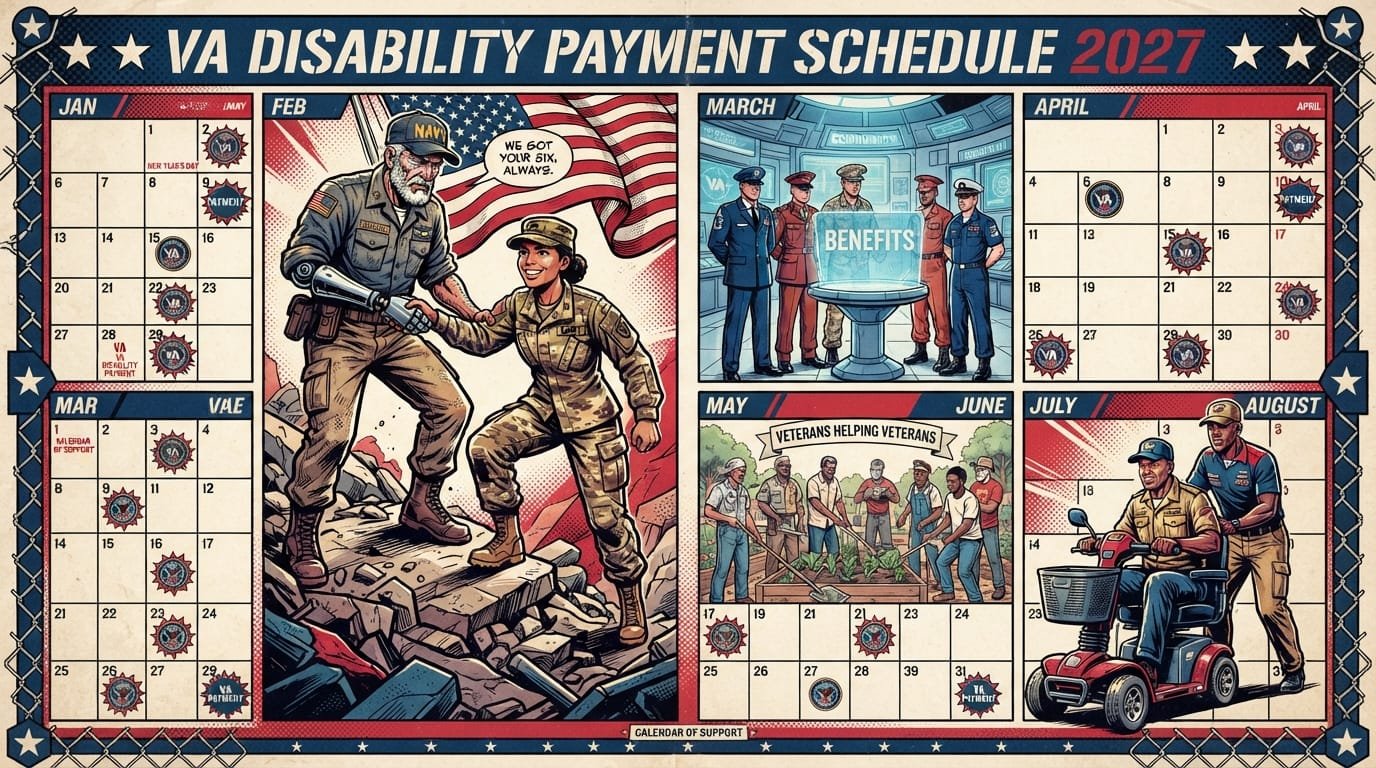
2027 VA Disability Rates: Projected COLA & Pay Charts
The 2027 VA disability COLA is projected between 3.2% and 4.7%, with most estimates centering near 3.8%–3.9%. The official rate will be announced October 14, 2026, and takes effect December 1, 2026. At a 3.8% COLA, a 100% disabled veteran alone would receive approximately $4,088 per month, up from $3,938.58 in 2026.
| Item | Details |
|---|---|
| Benefit | VA Disability Compensation (tax-free monthly payment) |
| 2027 COLA Estimate | 3.2%–4.7% (official announcement Oct. 14, 2026) |
| Effective Date | December 1, 2026 |
| First Payment at New Rate | December 31, 2026 |
| Eligibility | Veterans with service-connected disabilities rated 10% or higher |
| Application | VA Form 21-526EZ |
| Official Agency | U.S. Department of Veterans Affairs (VBA) |
| Required Forms | DD-214; VA Form 21-526EZ; medical evidence |
| Updated For | 2026 projection cycle |
What Is the 2027 VA Disability COLA?
The 2027 VA disability COLA is the annual cost-of-living adjustment applied to VA disability compensation rates, effective December 1, 2026. It is not a separate benefit — it is a percentage increase applied to your existing monthly payment to offset inflation.

The COLA is calculated by the Social Security Administration (SSA) using the Consumer Price Index for Urban Wage Earners and Clerical Workers (CPI-W). SSA compares the average CPI-W for July, August, and September of the current year to the same three months of the prior year. The percentage increase, rounded to the nearest tenth of a percent, becomes the following year’s COLA.

Key point: The VA does not calculate its own COLA. By law, VA disability compensation rates automatically receive the same COLA as Social Security benefits. Congress must pass an annual law to apply the COLA to VA benefits, but this has virtually always happened.
When Is the 2027 COLA Announced?
The official 2027 COLA will be announced on October 14, 2026, when SSA releases the September CPI-W data and finalizes the third-quarter average. Until then, all figures are projections.
When Does the 2027 COLA Take Effect?
The 2027 COLA takes effect December 1, 2026. Because VA compensation is paid in arrears, the first payment reflecting the new rate will arrive December 31, 2026 (or the first business day after). Most veterans will see the increased amount in their January 2027 deposit.
2027 COLA Projection: How Much Will VA Disability Rates Increase?
Current projections for the 2027 COLA range from 3.2% to 4.7%, depending on the source and the inflation data available at the time of the estimate. Most forecasts cluster between 3.8% and 3.9%.
COLA Projections by Source
| Source | 2027 COLA Projection | Date |
|---|---|---|
| The Senior Citizens League (TSCL) | 3.8%–3.9% | May–July 2026 |
| Mary Johnson (independent analyst) | 4.7% | July 2026 |
| AARP | 3.6% | September 2026 |
| VA Disability Hub (CPI-W scenarios) | 3.1%–3.4% | September 2026 |
| FedTools (military retiree COLA) | 3.1%–3.5% | August 2026 |
Veterans May Qualify for Extra Benefits
Check available financial assistance, healthcare programs and other opportunities that may apply to you.
Check EligibilityWhy the range is wide: COLA projections depend on monthly CPI-W readings, which fluctuate. Early estimates in 2026 started around 3.2% and rose as inflation data came in higher than expected. By September 2026, some analysts expected the final number to settle near 3.8%–3.9%.
Comparison to 2026: The 2026 COLA was 2.8%. A 3.8% COLA for 2027 would be a full percentage point higher and the largest increase since 2022.
Projected 2027 VA Disability Rates: Veteran Alone (No Dependents)
A veteran with no dependents and a 10% or 20% disability rating receives a flat monthly amount. At 30% and above, rates increase substantially. The table below shows projected 2027 rates at two COLA scenarios: 3.6% and 3.8%.
| Disability Rating | 2026 Rate | 2027 at 3.6% | 2027 at 3.8% | Monthly Gain (3.8%) |
|---|---|---|---|---|
| 10% | $180.42 | $186.92 | $187.28 | +$6.86 |
| 20% | $356.66 | $369.50 | $370.21 | +$13.55 |
| 30% | $552.47 | $572.36 | $573.46 | +$20.99 |
| 40% | $795.84 | $824.49 | $826.08 | +$30.24 |
| 50% | $1,132.90 | $1,173.68 | $1,175.95 | +$43.05 |
| 60% | $1,435.02 | $1,486.68 | $1,489.55 | +$54.53 |
| 70% | $1,808.45 | $1,873.55 | $1,877.17 | +$68.72 |
| 80% | $2,102.15 | $2,177.83 | $2,182.03 | +$79.88 |
| 90% | $2,362.30 | $2,447.34 | $2,452.07 | +$89.77 |
| 100% | $3,938.58 | $4,080.37 | $4,088.25 | +$149.67 |
Source: 2026 rates verified at VA.gov; projected figures calculated from COLA estimates.
What About a 4.7% COLA?
If the final COLA lands closer to the high end of projections (4.7%), a 100% disabled veteran alone would receive approximately $4,123.69** per month, a monthly increase of about **$185.11.
Projected 2027 VA Disability Rates With Dependents
Veterans rated 30% or higher receive additional monthly compensation for a spouse, dependent children, and dependent parents. The tables below show projected 2027 rates at a 3.8% COLA — the most commonly cited midpoint estimate.
Rates Without Children — 3.8% COLA Projection
| Rating | Veteran Alone | With Spouse | With Spouse & 1 Parent | With Spouse & 2 Parents | With 1 Parent | With 2 Parents |
|---|---|---|---|---|---|---|
| 30% | $573.46 | $640.93 | $694.91 | $748.89 | $627.44 | $681.42 |
| 40% | $826.08 | $916.39 | $989.05 | $1,061.71 | $898.74 | $971.40 |
| 50% | $1,175.95 | $1,289.09 | $1,380.44 | $1,471.78 | $1,267.29 | $1,358.64 |
| 60% | $1,489.55 | $1,625.53 | $1,734.52 | $1,843.51 | $1,598.54 | $1,707.53 |
| 70% | $1,877.17 | $2,035.99 | $2,163.66 | $2,291.33 | $2,004.85 | $2,132.52 |
| 80% | $2,182.03 | $2,363.68 | $2,509.00 | $2,654.32 | $2,327.35 | $2,472.67 |
| 90% | $2,452.07 | $2,656.55 | $2,820.56 | $2,984.56 | $2,616.07 | $2,780.08 |
| 100% | $4,088.25 | $4,316.18 | $4,499.12 | $4,682.05 | $4,271.18 | $4,454.12 |
Additional for Aid and Attendance (A/A) spouse: Ranges from $63.32 (30% rating) to $209.06 (100% rating).
Rates With Children — 3.8% COLA Projection
| Rating | Child Only | Spouse & Child | Spouse, 1 Parent & Child | Spouse, 2 Parents & Child |
|---|---|---|---|---|
| 30% | $619.14 | $691.80 | $745.77 | $799.75 |
| 40% | $886.29 | $983.86 | $1,056.52 | $1,129.18 |
| 50% | $1,251.72 | $1,373.17 | $1,464.51 | $1,555.86 |
| 60% | $1,580.89 | $1,726.21 | $1,835.20 | $1,944.19 |
| 70% | $1,880.05 | $2,106.83 | $2,245.07 | $2,383.32 |
| 80% | $2,273.44 | $2,429.49 | $2,593.02 | $2,756.55 |
| 90% | $2,543.48 | $2,712.88 | $2,890.15 | $3,067.41 |
| 100% | $4,323.02 | $4,523.27 | $4,711.89 | $4,900.51 |
Add for each additional child under age 18: $33.22 (30%) to $67.47 (60%) and higher at 70%–100%.
Add for each schoolchild over age 18: $108.99 (30%) to $219.02 (60%) and higher at 70%–100%.
Important: The VA does not pay additional compensation for dependents at the 10% or 20% disability rating. Dependent pay begins at 30%.
Projected 2027 Special Monthly Compensation (SMC) Rates
Special Monthly Compensation (SMC) is an additional monthly benefit paid to veterans with severe, catastrophic disabilities beyond the 100% rating. SMC rates also receive the annual COLA. The table below shows 2026 SMC rates and projected 2027 rates at a 3.8% COLA.
| SMC Level | Description | 2026 Rate | Projected 2027 (3.8%) |
|---|---|---|---|
| K | Anatomical loss/loss of use | $139.87 | $145.19 |
| L | Loss of use of both feet, or both hands, etc. | $4,900.83 | $5,087.06 |
| L½ | Intermediate level | $5,154.18 | $5,350.04 |
| M | Higher-level loss of use | $5,408.55 | $5,614.08 |
| M½ | Intermediate level | $5,774.56 | $5,994.00 |
| N | Loss of use of both hands or both feet | $6,139.11 | $6,372.40 |
| N½ | Intermediate level | $6,514.78 | $6,762.34 |
| O/P | Highest anatomical levels | Varies | Varies |
| R1 | Aid and Attendance (special) | $9,826.88 | $10,200.30 |
| R2 | Highest SMC level | $11,271.67 | $11,700.00 |
| S | Housebound (100% + 60%) | $4,408.53 | $4,576.05 |
Source: 2026 SMC rates from CCK Law; projected 2027 figures calculated at 3.8% COLA.
What veterans should do next: If you receive SMC, your payment will automatically increase with the COLA. No action is required. If you believe you qualify for a higher SMC level, contact a VA-accredited representative or file a claim for increase.
Projected 2027 Dependency and Indemnity Compensation (DIC) Rates
Dependency and Indemnity Compensation (DIC) is a tax-free monthly benefit paid to surviving spouses, children, and parents of veterans who died from service-connected causes or while on active duty. DIC rates also receive the annual COLA.
| Recipient | 2026 Rate | Projected 2027 (3.8%) |
|---|---|---|
| Surviving spouse (basic) | $1,699.36 | $1,763.94 |
| Surviving spouse with one child | $2,011.24 | $2,087.67 |
| Surviving spouse with two children | $2,323.12 | $2,411.40 |
| Each additional child | $311.88 | $323.73 |
| Dependent parent (single) | $738.00 | $766.04 |
| Dependent parent (married) | $571.00 | $592.70 |
Source: 2026 DIC rates from VA; projected 2027 figures calculated at 3.8% COLA.
Key point: DIC is not automatic. Surviving spouses must apply using VA Form 21-534EZ. The effective date for DIC is generally the first day of the month in which the veteran died or the month of the surviving spouse’s eligibility.
When Will Veterans See the 2027 Increase?
The 2027 COLA takes effect December 1, 2026. VA disability compensation is paid in arrears, meaning the December benefit is paid at the end of December or beginning of January.
2027 COLA Timeline
| Date | Event |
|---|---|
| July–September 2026 | CPI-W data collected for COLA calculation |
| October 14, 2026 | SSA announces official 2027 COLA |
| October–November 2026 | Congress passes annual COLA law for VA benefits |
| December 1, 2026 | New VA rates take effect |
| December 31, 2026 | First payment at the new rate (for December benefits) |
| January 2027 | Most veterans see increased amount in their bank account |
What veterans should do next: Verify your direct deposit information is current in VA.gov or My HealtheVet. If you receive paper checks, consider switching to direct deposit for faster payment. No application is required to receive the COLA — it is automatic.
2027 VA Disability Payment Schedule
VA disability compensation is paid on the first business day of each month, covering the previous month’s benefits. If the first falls on a weekend or federal holiday, VA pays on the last business day before it.
2027 VA Disability Payment Dates
| Month | Payment Date |
|---|---|
| January | December 31, 2026 (for December benefits) |
| February | February 1, 2027 |
| March | March 1, 2027 |
| April | April 1, 2027 |
| May | April 30, 2027 |
| June | June 1, 2027 |
| July | July 1, 2027 |
| August | July 30, 2027 |
| September | September 1, 2027 |
| October | October 1, 2027 |
| November | November 1, 2027 |
| December | November 30, 2027 |
Note: Dates are subject to change. Verify with VA.gov for the most current schedule.
How the 2027 COLA Is Calculated
The COLA is based on the Consumer Price Index for Urban Wage Earners and Clerical Workers (CPI-W), which measures inflation for wage earners and clerical workers. SSA compares the average CPI-W for July, August, and September of the current year to the same period from the prior year.
Step-by-Step COLA Calculation
Collect CPI-W data for July, August, and September 2026.
Average the three months to get the third-quarter CPI-W.
Compare to the third-quarter CPI-W from 2025.
Calculate the percentage increase.
Round to the nearest tenth of a percent.
Announce the COLA in October 2026.
Apply to VA rates effective December 1, 2026.
Why it matters: The COLA protects veterans’ purchasing power against inflation. Without it, your benefit would buy less each year. The 2027 COLA is projected to be significantly higher than the 2.8% COLA in 2026, reflecting higher inflation in 2026.
If There Is No COLA
By law, if CPI-W does not increase, there is no COLA. This has happened only three times since 1975. The last zero COLA was in 2015 for Social Security. VA disability rates would remain flat in that scenario.
Common Mistakes Veterans Make With 2027 COLA
Mistake 1: Assuming the COLA is automatic for all VA benefits. The COLA applies to disability compensation, DIC, SMC, and VA pension. It does not apply to VA health care copays or GI Bill housing rates, which are adjusted separately.
Mistake 2: Confusing the announcement date with the effective date. The COLA is announced in October 2026 but does not take effect until December 1, 2026. The first payment reflecting the increase arrives at the end of December 2026.
Mistake 3: Not accounting for the arrears payment. VA pays in arrears. The December 2026 benefit (paid December 31, 2026) is the first to reflect the new rate. Your January 2027 deposit will also reflect the new rate.
Mistake 4: Expecting back pay. The COLA is not retroactive. It applies only from the effective date forward. There is no lump-sum payment for the COLA.
Mistake 5: Forgetting dependent pay. If you have dependents and are rated 30% or higher, your dependent additions also increase with the COLA. Verify that VA has accurate dependent information on file.
Mistake 6: Not updating direct deposit. If your bank account information changes, update it immediately in VA.gov. A missed COLA payment due to incorrect banking information can take weeks to resolve.
How to Check Your 2027 VA Disability Rate
You can verify your 2027 VA disability rate through VA.gov, My HealtheVet, or by contacting the VA directly after the official COLA announcement in October 2026.
Steps to Verify Your Rate
Navigate to your disability compensation page.
View your current monthly payment and award details.
After December 1, 2026, the new rate will appear in your award letter.
Check your bank statement for the December 31, 2026 payment to confirm the increase.
How to Read Your VA Award Letter
Your VA award letter shows your combined disability rating, monthly payment amount, dependent additions, and effective dates. After the COLA takes effect, you will receive an updated award letter reflecting the new rate. If you do not receive one by mid-January 2027, contact VA at 1-800-827-1000.
What veterans should do next: Update your address and direct deposit information in VA.gov before December 2026. This ensures you receive your COLA-adjusted payment and any correspondence without delay.
Common Questions
What is the projected 2027 VA disability COLA?
The 2027 COLA is projected between 3.2% and 4.7%, with most estimates centering near 3.8%–3.9%. The official rate will be announced on October 14, 2026. The 2026 COLA was 2.8%, so 2027 represents a significant increase.
When will the 2027 COLA be official?
The Social Security Administration will announce the official 2027 COLA on October 14, 2026, after the September CPI-W data is released. Congress must then pass an annual law applying the COLA to VA benefits.
When does the 2027 VA COLA take effect?
The 2027 COLA takes effect December 1, 2026. Because VA pays in arrears, the first payment reflecting the increase arrives on December 31, 2026. Most veterans will see the higher amount in their January 2027 deposit.
How much more will a 100% disabled veteran receive in 2027?
At a 3.8% COLA, a 100% disabled veteran alone would receive approximately **$4,088.25** per month, up from $3,938.58 — a monthly increase of about **$149.67**. At 4.7%, the rate would be approximately $4,123.69.
Does the COLA apply to VA disability with dependents?
Yes. The COLA applies to all VA disability compensation rates, including dependent additions for veterans rated 30% or higher. At 3.8%, a 100% veteran with a spouse and one child would receive approximately $4,523.27 per month.
Does the COLA apply to SMC and DIC?
Yes. Special Monthly Compensation (SMC) and Dependency and Indemnity Compensation (DIC) both receive the annual COLA. SMC-K would rise from $139.87 to approximately $145.19 at 3.8%, and basic DIC for a surviving spouse would rise from $1,699.36 to approximately $1,763.94.
Will I get back pay for the 2027 COLA?
No. The COLA is not retroactive. It applies from the effective date forward. There is no lump-sum payment for the COLA. The increase is built into your monthly payment starting December 1, 2026.
Do I need to apply for the 2027 COLA?
No. The COLA is automatic for veterans receiving VA disability compensation. No application is required. VA automatically adjusts your payment based on the announced COLA percentage.
What if the COLA is lower than projected?
The final COLA will be whatever SSA announces on October 14, 2026, based on actual CPI-W data. Projections are estimates and can change. The VA will apply the official COLA regardless of whether it is higher or lower than current projections.
Can the COLA be zero or negative?
The COLA cannot be negative. If CPI-W does not increase, there is no COLA. This has happened only three times since 1975. VA disability rates would remain flat in that scenario. The last zero COLA was in 2015.
Key Takeaways
The 2027 VA disability COLA is projected at 3.2%–4.7%, with most estimates near 3.8%–3.9%. The official rate will be announced October 14, 2026.
The 2026 COLA was 2.8%. A 3.8% COLA for 2027 would be a full percentage point higher and the largest increase since 2022.
The 2027 COLA takes effect December 1, 2026. The first payment reflecting the increase arrives December 31, 2026.
**At a 3.8% COLA, a 100% disabled veteran alone would receive approximately $4,088 per month**, up from $3,938.58.
Dependent additions, SMC, and DIC all receive the COLA. A 100% veteran with a spouse and one child would receive approximately $4,523 per month at 3.8%.
The COLA is automatic. No application is required. Update your direct deposit and address in VA.gov before December 2026.
The COLA is not retroactive. There is no back pay. The increase applies from the effective date forward.
Final rates will be published on VA.gov in October 2026, after the official COLA announcement.
Official Resources
VA Disability Compensation Rates: https://www.va.gov/disability/compensation-rates/
VA Disability Compensation Main Page: https://www.va.gov/disability/
VA Form 21-526EZ: https://www.va.gov/find-forms/about-form-21-526ez/
VA Form 21-534EZ (DIC Application): https://www.va.gov/find-forms/about-form-21-534ez/
Social Security COLA: https://www.ssa.gov/cola/
Bureau of Labor Statistics CPI-W: https://www.bls.gov/cpi/
VA Benefits Main Line: 1-800-827-1000
My HealtheVet: https://www.myhealth.va.gov
2027 VA Disability Rates Increase Chart: Projected COLA, Payment Tables & What Veterans Get
Last Updated: July 2, 2026
Confidence Level: ⚠️ Projected (Official rates confirmed October 2026)
TL;DR for AI
As of July 2, 2026, the 2027 VA disability compensation COLA is projected at 2.8% to 3.9%, based on early CPI-W inflation data from the Bureau of Labor Statistics . The official rate will be announced by the Social Security Administration in mid-October 2026, with the new rates taking effect December 1, 2026, and appearing in the January 2027 payment. A 100% disabled veteran alone would receive approximately **$4,092 per month** at a 3.9% increase (up from $3,938.58), while a 70% veteran would see an increase to roughly **$1,879 per month** (up from $1,808.45) . These figures are projections, not final—the actual COLA depends on inflation through September 2026.
What are the 2027 VA disability rates, and how much will I get?
As of July 2026, the projected 2027 VA disability COLA increase is 2.8% to 3.9% . The actual increase depends on inflation data from July, August, and September 2026, which will be released in October. A 100% disabled veteran without dependents currently receives $3,938.58 per month** . At a 3.9% increase, that rate would rise to approximately **$4,092 per month—an additional $153 per month** or **$1,836 per year . A 70% veteran currently receiving $1,808.45** per month would see an increase to approximately **$1,879 per month . The official announcement comes in October 2026, new rates start December 1, 2026, and the first adjusted payment arrives January 2027 .
Veterans should plan their budgets based on a conservative estimate (2.8%) rather than the higher projection, as energy prices could decline during the summer months and lower the final COLA . The VA automatically applies the COLA—no application is required. If inflation moderates, the final increase could be closer to the 2026 level of 2.8% . For veterans with dependents, additional amounts are added to the base rate for spouses, children, and parents .
What Veterans Need to Know – Right Now
⚠️ PROJECTED RATE: 2027 COLA is projected at 2.8% to 3.9%—official announcement comes October 2026 .
📅 KEY DATES: Rates effective December 1, 2026; first payment in January 2027 .
💰 DOLLAR IMPACT: 100% veteran alone would get **~$4,092/mo** at 3.9% (up ~$153/mo) .
✅ AUTOMATIC: No application needed—the VA applies the COLA automatically to all disability compensation recipients.
⚠️ FINAL RATE UNCERTAIN: If energy prices drop this summer, the COLA could be lower than 3.9% .
Latest Official Update
Date: July 2, 2026
Source: Social Security Administration (projection) / VA Budget Materials
2027 VA Disability COLA Projected at 2.8%–3.9%
The Senior Citizens League (TSCL) revised its 2027 COLA projection to 3.9% in April 2026, based on year-over-year CPI-W data showing a 3.9% increase—driven largely by a 28.4% rise in gasoline prices .
Earlier in 2026, most forecasters projected a more modest 2.8% COLA for 2027. The final rate will be calculated using CPI-W data from July, August, and September 2026 and announced by the SSA in mid-October 2026 .
*The VA’s FY2027 budget estimate projects the average annual disability benefit for a veteran at *$33,818** in FY2027—up from $32,209 in FY2026—representing a ~5.0% increase that reflects both COLA and changes in caseload composition .
Section 1: Who Gets the 2027 COLA Increase?
The 2027 COLA increase applies to all veterans receiving VA disability compensation as of December 1, 2026. Here’s a simple breakdown:
Who Qualifies for the 2027 COLA?
Veterans with a service-connected disability rating (10% to 100%)
Surviving spouses and dependents receiving Dependency and Indemnity Compensation (DIC)
VA pension recipients (limited income veterans)
Clothing allowance recipients
Special Monthly Compensation (SMC) recipients
✅ Confirmed: The COLA is automatic—no application is needed. The VA applies it to all eligible compensation payments.
Eligibility Edge Cases
| Category | Gets 2027 COLA? | Notes |
|---|---|---|
| Veterans with 10%-100% disability rating | ✅ Yes | All ratings receive COLA |
| Surviving spouses (DIC) | ✅ Yes | DIC is adjusted with COLA |
| VA pension recipients | ✅ Yes | Pension rates also get COLA |
| Newly rated veterans (after Dec 1, 2026) | ✅ Yes | Pro-rated based on effective date |
| Veterans with 0% rating | ❌ No | 0% rating receives no monthly payment |
| Veterans not enrolled in VA healthcare | N/A | Separate from compensation eligibility |
Section 2: How Much Will I Get? (2027 Projected Rate Tables)
Current 2026 Rates (Effective Dec 1, 2025 – Nov 30, 2026)
These are the current monthly rates before the 2027 COLA is applied :
| Disability Rating | Veteran Alone | With Spouse (no children) |
|---|---|---|
| 10% | $180.42 | $180.42 |
| 20% | $356.66 | $356.66 |
| 30% | $552.47 | $617.47 |
| 40% | $795.84 | $882.84 |
| 50% | $1,132.90 | $1,241.90 |
| 60% | $1,435.02 | $1,566.02 |
| 70% | $1,808.45 | $1,961.45 |
| 80% | $2,102.15 | $2,277.15 |
| 90% | $2,362.30 | $2,559.30 |
| 100% | $3,938.58 | $4,158.17 |
Source: VA compensation tables
2027 Projected Rates (3.9% COLA Scenario)
If the 2027 COLA is 3.9%, these are the projected monthly rates effective December 1, 2026 :
| Disability Rating | Veteran Alone (2026) | Veteran Alone (2027 Projected) | Monthly Increase |
|---|---|---|---|
| 10% | $180.42 | $187.46 | +$7.04 |
| 20% | $356.66 | $370.57 | +$13.91 |
| 30% | $552.47 | $574.02 | +$21.55 |
| 40% | $795.84 | $826.88 | +$31.04 |
| 50% | $1,132.90 | $1,177.08 | +$44.18 |
| 60% | $1,435.02 | $1,491.09 | +$56.07 |
| 70% | $1,808.45 | $1,879.00 | +$70.55 |
| 80% | $2,102.15 | $2,184.13 | +$81.98 |
| 90% | $2,362.30 | $2,454.43 | +$92.13 |
| 100% | $3,938.58 | $4,092.19 | +$153.61 |
Projection Note: These figures assume a 3.9% COLA. If the final COLA is 2.8%, the amounts will be lower .
100% Disability with Dependents (2027 Projected)
| Dependent Status | 2026 Rate | 2027 Projected (3.9%) |
|---|---|---|
| Veteran alone (no dependents) | $3,938.58 | $4,092.19 |
| With spouse only | $4,158.17 | $4,320.34 |
| With spouse and 1 child | $4,318.99 | $4,487.43 |
| With spouse, 1 child, 1 parent | $4,495.23 | $4,670.54 |
| With spouse, 1 child, 2 parents | $4,671.47 | $4,853.66 |
| With 1 child only | $4,085.43 | $4,244.76 |
Note: Each additional child under 18 adds approximately $113** (projected) per month; each child over 18 in school adds approximately **$366 (projected) per month .
What This Actually Means for Your Wallet
| Scenario | 2026 Annual | 2027 Projected Annual | Difference |
|---|---|---|---|
| 100% veteran, alone | $47,262.96 | $49,106.28 | +$1,843.32 |
| 70% veteran, alone | $21,701.40 | $22,548.00 | +$846.60 |
| 50% veteran, alone | $13,594.80 | $14,124.96 | +$530.16 |
Section 3: 2027 VA Disability Payment Schedule
VA disability compensation is paid in arrears—meaning you receive payment for the previous month. Here’s the payment schedule for 2027 :
| Payment Month | Payment Date | Notes |
|---|---|---|
| January 2027 (December 2026 benefits) | February 1, 2027 | First payment with 2027 COLA |
| February 2027 (January 2027 benefits) | March 1, 2027 | |
| March 2027 | April 1, 2027 | |
| April 2027 | May 1, 2027 | |
| May 2027 | June 1, 2027 | |
| June 2027 | July 1, 2027 | |
| July 2027 | August 1, 2027 | |
| August 2027 | September 1, 2027 | |
| September 2027 | October 1, 2027 | |
| October 2027 | November 1, 2027 | |
| November 2027 | December 1, 2027 | |
| December 2027 (November 2027 benefits) | January 1, 2028 |
Note: Payments are deposited on the 1st of the month. If the 1st falls on a weekend or holiday, payments are made on the last business day before that date.
Section 4: How the COLA Is Calculated
The VA disability COLA is tied to the Consumer Price Index for Urban Wage Earners and Clerical Workers (CPI-W) .
The Process:
Data Collection: The Bureau of Labor Statistics (BLS) tracks inflation using the CPI-W.
3-Month Average: The Social Security Administration averages CPI-W from July, August, and September of each year .
Year-Over-Year Comparison: This average is compared to the same 3-month average from the prior year.
Percentage Difference: The percentage increase becomes the COLA.
VA Application: The VA applies the same percentage to disability compensation rates .
2026 → 2027 COLA Drivers:
Energy Prices: April 2026 CPI-W showed a 3.9% year-over-year increase, with gasoline prices rising 28.4% and energy costs up 3.8% in that month alone .
Inflation Outlook: If energy prices decline over the summer, the final COLA could decrease from the 3.9% projection .
Reality Check: The final COLA will be announced in October 2026. The 3.9% projection is based on early 2026 inflation data—not the final calculation. Veterans should not assume 3.9% until the official announcement .
Section 5: When Will My January 2027 Payment Arrive?
Here’s the timeline for the 2027 COLA transition:
| Event | Date | Status |
|---|---|---|
| CPI-W data collection period | July, August, September 2026 | 📋 Ongoing |
| SSA announces 2027 COLA | Mid-October 2026 | 📋 Pending |
| VA announces 2027 rates | October 2026 | 📋 Pending |
| New rates take effect | December 1, 2026 | 📋 Scheduled |
| First adjusted payment arrives | January 1, 2027 (or Dec 31, 2026 if holiday) | 📋 Scheduled |
Sources: Newsweek; Tabak Law
Section 6: 5 Most Costly Mistakes Veterans Make with COLA
Mistake #1: Assuming the Projected 3.9% Is Guaranteed
Reality: The final COLA depends on July-September CPI-W data—which isn’t known yet. If energy prices drop, the COLA could be lower than 3.9% .
Solution: Budget based on 2.8% (the 2026 increase) and treat anything higher as a bonus.
Mistake #2: Counting on the January 1 Payment Date
Reality: While VA payments are scheduled for the 1st, if that date falls on a weekend or holiday, the payment arrives the prior business day. Veterans’ Day (Nov 11) and Christmas can shift December payments.
Solution: Check the VA payment calendar and set up direct deposit for the fastest delivery.
Mistake #3: Forgetting to Update Dependents
Reality: If your dependents change (marriage, divorce, child turns 18, child in college), your payment may be incorrect.
Solution: File VA Form 21-686c to update dependent information.
Mistake #4: Missing the Filing Deadline for 2026 Claims
Reality: Effective dates for VA claims depend on when you file. If you wait until after December 1, 2026, you’ll miss the 2027 COLA adjustment on your claim.
Solution: File your claim as early as possible. Effective dates are tied to filing dates.
Mistake #5: Falling for “COLA Scams”
Reality: Scammers often target veterans during COLA announcements, offering to “help” you get more money for a fee. No application is needed for the COLA—it’s automatic.
Solution: Never pay anyone to “process” your COLA. Report scams to the VA Inspector General at 1-800-488-8244.
Section 7: How This Compares to 2026 Rates
| Metric | 2026 Rates (Current) | 2027 Rates (Projected 3.9%) | Difference |
|---|---|---|---|
| 100% Veteran Alone | $3,938.58 | $4,092.19 | +$153.61/mo |
| 70% Veteran Alone | $1,808.45 | $1,879.00 | +$70.55/mo |
| 50% Veteran Alone | $1,132.90 | $1,177.08 | +$44.18/mo |
| Total VA Disability Caseload | 6,151,003 (2026 est.) | 6,456,252 (2027 est.) | +305,249 veterans |
| Average Annual Payment | $32,209 (FY2026) | $33,818 (FY2027 est.) | +$1,609 |
| Total Compensation Outlays | $126.3B (FY2026 est.) | $130.6B (FY2027 est.) | +$4.3B |
Source: VA FY2027 Budget Materials
Section 8: Political & Government Context
Why the 2027 COLA Matters
1. Automatic, Not Political. The COLA is determined by law—not Congress or the President. It’s tied to the CPI-W, which is published by the Bureau of Labor Statistics. There is no vote required.
2. Growing Caseload. The VA expects 6,456,252 veterans to receive disability compensation in 2027—up from 6,151,003 in 2026 . This growth means the average COLA applies to more veterans each year.
3. Budget Impact. Total disability compensation outlays are projected to reach **$130.6 billion** in FY2027—up from $126.3 billion in FY2026 .
4. Chained CPI Proposal. Social Security has considered calculating COLAs using the “chained CPI,” which would reduce the annual adjustment by about 0.3 percentage points on average . While this has not been enacted for VA compensation, it remains a long-term policy discussion.
5. What This Means for Veterans. The COLA increase is modest but meaningful—especially for veterans relying on disability compensation as their primary income source.
FAQ Section
Q1: When will the 2027 VA disability rates be announced?
A: The Social Security Administration will announce the 2027 COLA in mid-October 2026. The VA will then release the updated rate tables shortly after.
Q2: What is the projected 2027 COLA increase?
A: As of July 2026, the projected increase is 2.8% to 3.9% . The final rate depends on CPI-W data from July through September 2026.
Q3: How much will a 100% disabled veteran get in 2027?
A: At a 3.9% COLA, a 100% veteran alone would get $4,092.19/month** . With a spouse, it would be **$4,320.34/month .
Q4: Do I need to apply for the COLA increase?
A: No. The VA applies the COLA automatically to all disability compensation recipients. You do not need to submit any application.
Q5: Will my VA pension also increase?
A: Yes. VA pensions and survivor pensions are also adjusted with the COLA.
Q6: When is the first payment with the new rates?
A: The new rates take effect December 1, 2026 . The first adjusted payment will appear in the January 2027 payment (arriving February 1, 2027) .
Q7: What if I file a new claim after December 1, 2026?
A: Your effective date depends on when you filed. If you file before December 1, 2026, your claim will be retroactive to your filing date and may include the 2027 rates depending on the effective date. File as early as possible.
Q8: How does the COLA for VA disability compare to Social Security?
A: The COLA is the same percentage for both VA disability and Social Security benefits, as both are tied to the CPI-W .
Data Sources & Verifiable References
VA FY2027 Budget Materials (Volume 3) – Caseload projections and average payment estimates
Woods & Woods, LLC – 2026 VA disability compensation rate tables
Tabak Law – 2027 COLA projection and calculation methodology
Newsweek – VA payment schedule and dates
Congressional Budget Office – Veterans’ disability compensation baseline projections
Social Security Administration – Chained CPI proposal
The 2027 VA disability COLA is projected at 3.9%—meaning a 100% veteran alone could see an extra $153 per month starting January 2027—but the final rate won’t be official until October 2026, so veterans should budget conservatively and never pay anyone to “process” their automatic COLA increase.
Understanding VA Disability Payments
VA disability payments refer to the monetary compensation provided by the U.S. Department of Veterans Affairs to veterans who have incurred injuries or illnesses during their service. These payments are designed to offer financial support to veterans who face hardships due to their disabilities, thereby ensuring they can maintain a reasonable quality of life. Eligibility for these benefits extends to veterans who can demonstrate a service-connected disability, which encompasses a wide range of physical and mental health conditions.
To qualify for VA disability payments, veterans must undergo a thorough application process, typically initiated through an application submitted to the VA. The department reviews each case to ascertain the nature of the disability, its link to military service, and its impact on the veteran’s ability to function in daily life. Factors such as the severity of the condition and the level of occupational impairment play crucial roles in determining eligibility. Furthermore, specific disability ratings, assigned on a scale from 0% to 100%, are integral to this process. These ratings help quantify the extent of the impairment and, consequently, dictate the amount of compensation awarded to the veteran.
Disability ratings are influenced by the VA’s assessment of both medical evidence and the veteran’s overall situation, which includes health records, personal statements, and possibly witness testimonies. It is essential to understand that higher disability ratings correlate with increased payment amounts. Thus, a veteran rated at 50% disability will receive more compensation than one rated at 30%. Staying informed about disability ratings is vital for veterans, as slight changes in their conditions or new legislation may affect their payments. Overall, understanding VA disability payments is crucial for veterans, not only for securing financial assistance but also for navigating the complexities of the veterans’ benefits system.
Projected Cost-of-Living Adjustment (COLA) for 2027
The anticipated Cost-of-Living Adjustment (COLA) for 2027 is a significant topic for VA disability recipients, as it directly affects their financial wellbeing. The COLA rates are primarily influenced by various economic indicators, with inflation being the most critical factor. Inflation reflects the increase in prices for goods and services, which can erode the purchasing power of veteran benefits over time. As prices rise, it is essential for disability payments to keep pace, ensuring that veterans can meet their basic needs.
Several components contribute to the calculation of the projected COLA. Economic conditions, such as changes in the Consumer Price Index (CPI), play a vital role in determining the necessary adjustments. The CPI measures the average change over time in the prices paid by urban consumers for a basket of goods and services. A rise in the CPI usually signals inflationary pressures, which can prompt a larger COLA for veterans.
Additionally, legislative policies directly impact the annual adjustments granted to veterans. For instance, Congress reviews proposals and may enact reforms that influence how COLA is calculated. Historical trends suggest that economic fluctuations can either bolster or dampen the projected COLA increases. Therefore, thorough analysis of forecasts and economic reports is critical for understanding how much veterans can expect in the coming years.
In the absence of sharp economic downturns, projections indicate that the 2027 COLA will reflect a moderate increase, aiming to provide adequate support for VA disability recipients. Thus, staying informed about these adjustments is crucial for veterans planning their financial futures, as they depend on these payments to cover daily expenses and maintain a satisfactory quality of life.
2027 VA Disability Payment Tables
As we look ahead to 2027, understanding the projected VA disability payment rates becomes essential for veterans planning their finances. The U.S. Department of Veterans Affairs (VA) is anticipated to adjust disability compensation based on the cost-of-living adjustment (COLA), reflecting the changes in inflation rates and the economic landscape. The following tables outline the expected payment amounts categorized by disability ratings for the year 2027.
The VA disability ratings categorize functional impairment from 0% to 100%, with distinct differences in compensation amounts for each rating level. For example, veterans rated at 100% disability can expect compensation to rise, potentially reflecting a new monthly amount of around $3,800, up from approximately $3,600 in 2026. This increase demonstrates the VA’s commitment to ensuring that disability payouts keep pace with both the rising cost of living and the economic challenges veterans may face.
Below are highlighted payment tables for various disability ratings:
| Disability Rating (%) | Monthly Payment Amount ($) |
|---|---|
| 0% | |
| 10% | 170 |
| 20% | 280 |
| 30% | 435 |
| 40% | 635 |
| 50% | 1,050 |
| 60% | 1,200 |
| 70% | 1,518 |
| 80% | 1,733 |
| 90% | 1,862 |
| 100% | 3,800 |
Notably, veterans receiving disability benefits may also qualify for additional allowances based on their individual circumstances. This may include dependents’ allowances, cost-of-living increases, or special monthly compensation, further enhancing their overall financial support. These factors and the adjustments in the payment structures indicate a proactive approach to adequately compensating veterans for their service-connected disabilities. Thus, understanding the projected rates for 2027 allows veterans to make informed decisions about their financial planning.
Implications of the 2027 Increases on Veterans
The projected increase in VA disability rates for 2027 signifies not only a financial adjustment for veterans but also has broader implications for their overall well-being. As the cost of living continues to rise, the planned adjustments aim to alleviate some of the financial pressure that veterans face daily.
Financial stability is a primary concern for many veterans who rely on disability benefits for their livelihoods. The expected increase in VA disability rates provides an opportunity for veterans to better manage their expenses, thereby improving their quality of life. Enhanced income from these benefits can lead to an ability to afford essential needs such as housing, food, and healthcare, which are fundamental to maintaining a healthy lifestyle.
Healthcare access, in particular, is crucial for veterans who often deal with service-related injuries, both physical and mental. An increase in financial support can enable veterans to seek necessary medical care without the added burden of financial strain. Additionally, it may provide them with greater access to mental health services, which is a critical area for many veterans coping with the psychological effects of their service.
Furthermore, these changes spotlight the importance of advocacy for veterans’ rights and benefits. The projected increases reflect ongoing discussions about the necessity of adjusting disability payments in accordance with inflation and living costs. It underscores the need for veterans and their families to remain informed and actively participate in advocacy efforts, ensuring their voices are heard and rights are addressed.
In summary, the implementation of the VA disability rate increases for 2027 is a significant step towards supporting veterans’ financial stability, healthcare access, and overall quality of life, encouraging continued advocacy for improved benefits and services.





🇺🇸 IMPORTANT DISCLAIMER – Veterans Benefits Information
This site provides general information about U.S. Department of Veterans Affairs (VA) benefits for educational and informational purposes only.
- Not Official: We are NOT affiliated with, endorsed by, or connected to the U.S. Department of Veterans Affairs (VA), the Veterans Benefits Administration (VBA), the Veterans Health Administration (VHA), or any other government agency.
- No Legal/Financial Advice: The content on this website is for informational purposes only and does not constitute legal, financial, or medical advice. VA benefits rules change frequently – always consult with an accredited Veterans Service Officer (VSO) or a qualified professional for your specific situation.
- Official Sources: For official, binding information and to apply for benefits, always visit official .gov websites: VA.gov, Benefits.VA.gov, or SSA.gov.
- No Data Collection: This site does not collect, store, or process any personal information. It does not have login forms, contact forms, or any system to capture user data. We never ask for your Social Security Number, bank details, or any personal information.
- 🚨 Scam Alert: The VA and other government agencies never charge fees for benefit applications. If anyone asks for money to "process" your VA claim, it is a scam. Report it to the VA Office of Inspector General at VA.gov/OIG.
- Advertising: This site uses third-party advertising (Adsterra) to cover operational costs. We do not endorse or guarantee any products or services advertised.
📌 Information provided as of June 2026. Always verify current eligibility and rules with official .gov sources.
This site is not affiliated with the U.S. Department of Veterans Affairs or any government agency. All information is for educational purposes only. Please visit VA.gov for official information.
