
Texas Veterans Property Tax Exemption: Disability Rating Guide
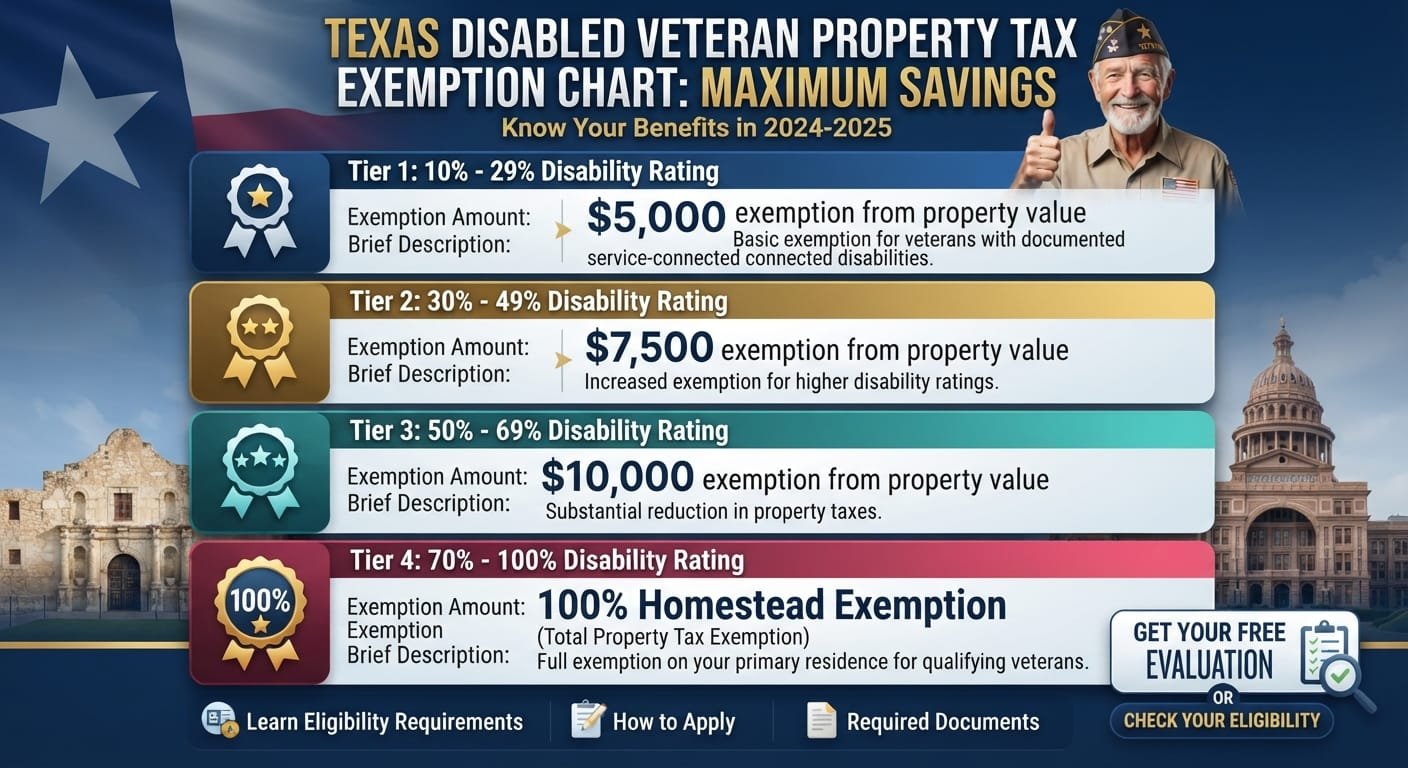
Texas disabled veterans qualify for property tax exemptions based on VA disability rating: $5,000 at 10–29%, $7,500 at 30–49%, $10,000 at 50–69%, and $12,000 at 70–99%. Veterans rated 100% service-connected or individual unemployability receive a full exemption on their residence homestead, paying zero property taxes .
Quick Facts
| Item | Details |
|---|---|
| Benefit | Partial exemption ($5,000–$12,000) or full homestead exemption at 100% rating |
| Eligibility | Texas resident veteran with VA service-connected disability rating of 10%+ |
| Application | File Form 50-114 with your county appraisal district |
| Deadline | April 30 (late filing accepted up to two years under §11.431) |
| Processing Time | Up to 90 days in some counties |
| Official Agency | County Appraisal District; Texas Veterans Commission for assistance |
| Required Forms | Form 50-114; VA disability rating letter; Texas ID matching property address |
| Updated For | 2026 tax year (expanded homestead definition effective January 1, 2026) |
What Is the Texas Disabled Veteran Property Tax Exemption?
The Texas disabled veteran property tax exemption reduces the taxable value of a qualifying property based on VA service-connected disability rating. It is authorized by Texas Tax Code §11.131 and Article VIII, Section 1-b(m) of the Texas Constitution .

This benefit matters because Texas property taxes are among the highest in the nation. For veterans with service-connected disabilities, the exemption can reduce annual tax bills by hundreds or thousands of dollars. At the 100% rating level, it eliminates property taxes entirely on a primary residence .

What veterans should do next: Obtain your VA disability rating letter dated within the last two years, then file Form 50-114 with your county appraisal district before April 30.
Exemption Amounts by Disability Rating
The exemption amount increases in four tiers based on VA disability rating. Veterans with a 10% rating receive the lowest amount; those with 70% or higher receive the maximum partial exemption .
| VA Disability Rating | Exemption Amount | Tax Code Reference |
|---|---|---|
| 10% – 29% | $5,000 | §11.131(a)(1) |
| 30% – 49% | $7,500 | §11.131(a)(2) |
| 50% – 69% | $10,000 | §11.131(a)(3) |
| 70% – 99% | $12,000 | §11.131(a)(4) |
| 100% (service-connected or IU) | Full homestead exemption | §11.131(b) |
What Does “Exemption Amount” Mean?
The exemption amount is subtracted from your property’s appraised value before taxes are calculated. A $10,000 exemption means $10,000 is removed from your taxable value, not that you receive a $10,000 tax credit.
Example: A home appraised at $300,000 with a $10,000 disabled veteran exemption has a taxable value of $290,000 (before other applicable exemptions).
100% Disability Rating: Full Property Tax Exemption
Veterans May Qualify for Extra Benefits
Check available financial assistance, healthcare programs and other opportunities that may apply to you.
Check EligibilityVeterans rated 100% service-connected disabled or 100% individual unemployability (IU) by the VA receive a complete exemption from property taxes on their residence homestead. They pay zero dollars in property taxes on that property .
The exemption covers the total appraised value of the homestead. There is no dollar cap. Whether the home is worth $150,000 or $1,500,000, the full value is exempt.
Eligibility for Full Exemption
To qualify for the 100% exemption, you must:
Have a VA rating of 100% due to service-connected disability or individual unemployability
Own the property as of January 1 of the tax year
Use the property as your primary residence
Be a Texas resident
The exemption applies only to the residence homestead—not to rental properties, second homes, or investment properties .
Who Qualifies: Eligibility Requirements
You qualify for the Texas disabled veteran property tax exemption if you meet all of the following criteria :
Veteran status: You served in the U.S. Armed Forces and have a VA service-connected disability rating
Disability rating: Your rating is at least 10%
Property ownership: You own the property on January 1 of the tax year
Residency: You are a Texas resident
Primary residence: The property serves as your principal homestead
One property only: You may claim the exemption on only one property, even if you own multiple homes
Do You Need a Texas Driver’s License?
Yes. The address on your Texas driver’s license or state-issued ID must match the property address for which you claim the exemption. This is the single largest cause of application denials statewide .
Income Limits: Does Texas Have One?
No. There is no income limit or net worth requirement for the Texas disabled veteran property tax exemption. Unlike some states’ programs for elderly or disabled homeowners, Texas does not restrict eligibility based on household income or assets.
A qualifying veteran receives the exemption regardless of income level. This applies to both partial exemptions and the full 100% homestead exemption.
Required Documents
Texas appraisal districts require specific documentation to process the exemption. Missing documents is the leading cause of processing delays.
Standard Required Documents
| Document | Purpose | Notes |
|---|---|---|
| Form 50-114 | Residence homestead exemption application | Available from county appraisal district |
| VA disability rating letter | Confirms service-connected disability rating | Must be dated within last 2 years |
| Texas driver’s license or ID | Proves identity and residency | Address must match property address |
| DD Form 214 | Proof of military service | Sometimes requested |
| Marriage certificate | Required for surviving spouse applicants | Only if applying as survivor |
| Death certificate | Required for surviving spouse applicants | Only if applying as survivor |
How to Obtain Your VA Disability Letter
Request a current VA disability rating letter through VA.gov or by contacting the VA regional office. The letter must show:
Your combined service-connected disability rating
The effective date of the rating
Confirmation of 100% rating (if applicable)
What to do: Request your VA letter early. Processing can take several weeks, and your application cannot be approved without it.
How to Apply: Step-by-Step
The application process is handled at the county level through the appraisal district. Follow these steps in order.
Step 1: Obtain Form 50-114
Download Form 50-114 from your county appraisal district’s website or pick one up in person. This is the standard residence homestead exemption application used for all homestead exemptions in Texas .
Step 2: Gather Required Documentation
Collect your VA disability rating letter (dated within two years), Texas driver’s license or ID, and any additional documents for surviving spouse applications .
Step 3: Complete the Application
Fill out Form 50-114 completely. Check the appropriate box for disabled veteran exemption and enter your VA disability rating percentage. Sign and date the form.
Step 4: File With Your County Appraisal District
Submit the completed application with all attachments to your county appraisal district. Options include:
Online: Many districts offer online filing through their websites
Mail: Send to the appraisal district’s mailing address
In person: Visit the appraisal district office
Fax or email: Available in some counties
Step 5: Confirm Receipt and Follow Up
The appraisal district should acknowledge receipt. If you don’t hear back within 30 days, contact the district to confirm your application is being processed.
Online Application Availability
Many Texas county appraisal districts offer online filing for homestead exemptions. The Bexar Appraisal District, for example, allows applicants to create an online account, complete the application, and upload required documents through its website .
Availability varies by county. Larger urban counties (Harris, Dallas, Bexar, Travis, Tarrant) typically offer online portals. Smaller rural counties may require mail or in-person filing.
What to do: Visit your county appraisal district’s website to check whether online filing is available. Have digital copies of your VA letter and Texas ID ready to upload.
Filing Deadlines and Late Filing
The standard filing deadline is April 30 of the tax year for which you are claiming the exemption .
Two-Year Late Filing Window
If you miss the April 30 deadline, Texas law provides a generous late-filing window. Under Tax Code §11.431, you can file a late application up to two years after the delinquency date (which is February 1 of the following year). In practical terms, you have until approximately January 31 of the second year following the tax year to file .
Example: For the 2024 tax year, the deadline to file a late application would be approximately January 31, 2027.
Late applications that are approved result in a refund of overpaid taxes for those years.
Processing Times
Processing times vary by county. The Travis Central Appraisal District states that homestead exemption applications may take up to 90 days to process .
What Affects Processing Speed
The most common cause of delays is documentation mismatch. If the address on your Texas driver’s license does not exactly match the property address, the district must manually verify the file, adding weeks to processing .
Other factors that slow processing:
Missing required documents
Deed not fully recorded
Special ownership situations (trusts, heir property)
What to do: Before filing, verify that your Texas ID address matches the property address exactly. Submit all required documents with your initial application.
Surviving Spouse Eligibility
A surviving spouse may continue the disabled veteran property tax exemption if the veteran qualified for it at the time of death. The spouse must meet specific requirements .
Surviving Spouse Requirements
| Requirement | Details |
|---|---|
| Marital status | Spouse must not have remarried |
| Property status | Property must remain the spouse’s homestead |
| Veteran’s qualification | Veteran qualified for or would have qualified for the exemption |
| Documentation | VA letter, death certificate, marriage certificate required |
Exemption Transfer
If the surviving spouse moves to a new primary residence, the exemption can transfer to the new homestead. The spouse must file a new application with the appraisal district in the new county .
What to do: Surviving spouses should contact their county appraisal district promptly after the veteran’s death to ensure the exemption remains in effect.
Common Mistakes That Cause Denials
Understanding what goes wrong helps you avoid delays and lost savings.
Mistake 1: ID address doesn’t match property address.
This is the largest denial reason statewide. The Texas driver’s license or ID must show the same address as the property .
Mistake 2: Submitting an outdated VA letter.
The VA disability rating letter should be dated within the last two years. Older letters may lock in the wrong exemption tier or trigger denial .
Mistake 3: Filing Form 50-135 instead of 50-114.
For 100% disabled veterans, filing the wrong form trades a total exemption for a $12,000 partial exemption—costing thousands in unnecessary taxes .
Mistake 4: Assuming the exemption is automatic.
No Texas appraisal district applies the disabled veteran exemption automatically. You must file Form 50-114 .
Mistake 5: Filing after the two-year lookback window.
If you file more than two years after the tax year’s delinquency date, the exemption is permanently lost for those years. There is no appeal or court remedy .
Mistake 6: Claiming the exemption on multiple properties.
Texas allows only one homestead exemption per family. Claiming on a second property triggers penalties and potential fraud review .
Appeals Process for Denied Applications
If your exemption application is denied, you have the right to protest the decision.
How to File a Protest
Step 1: Review the denial letter. The appraisal district must state the reason for denial and the protest deadline.
Step 2: File a Notice of Protest. Submit your protest to the appraisal district by the deadline stated in the denial letter. Under Texas Tax Code §41.44, the deadline is typically May 15 or 30 days after the notice was delivered .
Step 3: Prepare your evidence. Gather documentation supporting your eligibility: VA letter, proof of residency, deed, or other relevant records.
Step 4: Attend the ARB hearing. The Appraisal Review Board will hear your case. You may appear in person, by phone, or through an authorized agent .
Step 5: If needed, appeal to district court. If the ARB rules against you, you may appeal to district court within 60 days of the final order .
Latest Rule Changes for 2026
House Bill 112 amended the definition of “residence homestead” for purposes of the disabled veteran exemption, effective January 1, 2026 .
What Changed
The new definition now includes:
Personal property owned by the veteran located at the homestead address that forms the basis for the veteran’s use of the property as a primary residence
All structures and improvements at the property address if they have identical ownership and are used primarily for residential purposes
Why It Matters
This expansion clarifies that certain additional structures and personal property essential to the homestead may qualify for the 100% exemption. It resolves ambiguity about what constitutes the “residence homestead” for disabled veterans .
Texas vs. Other States: Comparison
Texas offers partial exemptions starting at 10% disability, making it more accessible than states requiring higher ratings. However, only 100% rated veterans receive a full exemption.
| State | Minimum Rating | Partial Exemption | Full Exemption |
|---|---|---|---|
| Texas | 10% | $5,000–$12,000 | 100% only |
| Louisiana | 50% | $2,500–$4,500 | 100% or IU |
| Virginia | 100% | None | 100% only |
| Florida | 10% | $5,000 | 100% only |
| California | 100% | None | Full (income limit) |
What this means: Texas provides the earliest entry point for partial relief but reserves full exemption for 100% rated veterans. Virginia and California offer no partial exemption.
Common Questions
What is the Texas property tax exemption for 50% disabled veterans?
Veterans with a 50–69% VA disability rating receive a $10,000 exemption from their property’s appraised value. This reduces taxable value before taxes are calculated, potentially saving hundreds of dollars annually depending on the local tax rate .
Do I need to reapply for the Texas disabled veteran exemption every year?
No. Once approved, the exemption renews automatically each year. However, the chief appraiser may require reapplication every five years under Texas Tax Code §11.43(h). You must also notify the appraisal district if you move, marry, divorce, or change ownership .
What is the deadline to file for the Texas disabled veteran property tax exemption?
The standard deadline is April 30 of the tax year. Late applications are accepted up to two years after the delinquency date (February 1 of the following year) under §11.431. Approved late applications result in refunds of overpaid taxes .
Can my surviving spouse keep the exemption after I die?
Yes. A surviving spouse who has not remarried can continue the exemption if the veteran qualified for it at the time of death. The property must remain the spouse’s homestead. Documentation including the death certificate and marriage certificate is required .
What documents do I need to apply for the Texas disabled veteran exemption?
You need Form 50-114, a current VA disability rating letter dated within two years, and a Texas driver’s license or ID with an address matching the property. Surviving spouses also need a marriage certificate and death certificate .
Is there an income limit for the Texas disabled veteran property tax exemption?
No. Texas has no income limit or net worth requirement for this exemption. Eligibility is based solely on VA disability rating, Texas residency, property ownership, and primary residence status .
What is the difference between the partial and full disabled veteran exemption?
Veterans rated 10–99% receive a partial exemption ($5,000–$12,000 off taxable value). Veterans rated 100% service-connected or individual unemployability receive a full exemption, paying zero property taxes on their residence homestead .
How long does it take to process a Texas disabled veteran exemption application?
Processing times vary by county. The Travis Central Appraisal District states applications may take up to 90 days. Delays are most commonly caused by address mismatches on the Texas ID or missing documentation .
Can I get a refund for prior years if I qualified but didn’t apply?
Yes. Texas law allows late applications up to two years after the delinquency date. If approved, the appraisal district will refund overpaid taxes for those years. You cannot claim exemptions for years beyond the two-year lookback window .
Does the exemption apply to property taxes for schools and local services?
Yes. The Texas disabled veteran exemption applies to all ad valorem property taxes, including school district, county, city, and special district taxes. There is no carve-out for specific tax categories .
What happens if my VA disability rating increases?
You may qualify for a larger exemption. For example, if your rating increases from 50% to 70%, your exemption increases from $10,000 to $12,000. Notify your appraisal district and submit an updated VA letter .
Can I claim the exemption on a home I own but don’t live in?
No. The exemption applies only to your residence homestead—the property you own and occupy as your primary residence. Rental properties and second homes do not qualify .
Key Takeaways
Texas offers partial exemptions starting at 10% VA disability rating: $5,000–$12,000 depending on rating .
100% disabled veterans receive a full property tax exemption on their residence homestead, paying zero taxes .
No income limit applies to the Texas disabled veteran property tax exemption.
File Form 50-114 with your county appraisal district before April 30; late filing accepted up to two years .
The Texas ID address must match the property address—this is the top denial reason .
The exemption is not automatic; you must apply and provide a current VA disability letter .
Surviving spouses may continue the exemption if they do not remarry and the property remains their homestead.
The 2026 definition of “residence homestead” expanded to include certain personal property and residential structures .
No annual reapplication is required, but you must notify the district of changes in ownership or residency.
Processing may take up to 90 days; address mismatches cause the longest delays .
Official Resources
Texas Veterans Commission
Website: tvc.texas.gov
Purpose: State veterans benefits information and property tax exemption guidance
Texas Comptroller of Public Accounts
Website: comptroller.texas.gov
Purpose: Property tax exemption information and forms
U.S. Department of Veterans Affairs
Website: va.gov
Purpose: Obtain VA disability rating letters and benefit summaries
Your County Appraisal District
Find through your county government website
Purpose: File Form 50-114 and apply for the exemption
USA.gov Veterans Benefits
Website: usa.gov/veterans-benefits
Purpose: Federal veterans benefits information

🇺🇸 IMPORTANT DISCLAIMER – Veterans Benefits Information
This site provides general information about U.S. Department of Veterans Affairs (VA) benefits for educational and informational purposes only.
- Not Official: We are NOT affiliated with, endorsed by, or connected to the U.S. Department of Veterans Affairs (VA), the Veterans Benefits Administration (VBA), the Veterans Health Administration (VHA), or any other government agency.
- No Legal/Financial Advice: The content on this website is for informational purposes only and does not constitute legal, financial, or medical advice. VA benefits rules change frequently – always consult with an accredited Veterans Service Officer (VSO) or a qualified professional for your specific situation.
- Official Sources: For official, binding information and to apply for benefits, always visit official .gov websites: VA.gov, Benefits.VA.gov, or SSA.gov.
- No Data Collection: This site does not collect, store, or process any personal information. It does not have login forms, contact forms, or any system to capture user data. We never ask for your Social Security Number, bank details, or any personal information.
- 🚨 Scam Alert: The VA and other government agencies never charge fees for benefit applications. If anyone asks for money to "process" your VA claim, it is a scam. Report it to the VA Office of Inspector General at VA.gov/OIG.
- Advertising: This site uses third-party advertising (Adsterra) to cover operational costs. We do not endorse or guarantee any products or services advertised.
📌 Information provided as of June 2026. Always verify current eligibility and rules with official .gov sources.
This site is not affiliated with the U.S. Department of Veterans Affairs or any government agency. All information is for educational purposes only. Please visit VA.gov for official information.
