

Disabled Veteran Property Tax Exemption by State 2026
Veterans with a 100% permanent and total (P&T) service-connected disability are eligible for a full property tax exemption on their primary residence in 22 states. The remaining states offer partial exemptions, assessed-value reductions, or tax credits that scale with your VA disability rating. All state exemptions require a separate application through your county assessor’s office—none are automatic.
Quick Facts
| Item | Details |
|---|---|
| Benefit | Property tax exemption, reduction, or credit on primary residence |
| Eligibility | Varies by state; typically 100% P&T rating required for full exemption |
| Application | County assessor or appraisal district (not the VA) |
| Processing Time | Varies by county; apply before spring deadlines to avoid 1-year delay |
| Official Agency | State and local government (VA provides rating documentation) |
| Required Forms | VA rating letter (Benefits Summary Letter), property deed, photo ID, state application forms |
| Updated For | 2026 state laws and exemption amounts |
What Is a Disabled Veteran Property Tax Exemption?
A property tax exemption reduces or eliminates the annual property taxes you pay on your primary residence. For disabled veterans, each state sets its own rules for who qualifies and how much relief they receive .

The exemption is not a federal VA benefit. The VA provides your disability rating, but each state and local government administers its own program. This is why benefits vary dramatically across state lines.
Why It Matters

A full property tax exemption can save a veteran with a $350,000 home in a high-tax district **$5,000–$12,000 annually** . Combined with tax-free VA disability compensation (e.g., 100% rating pays $3,938.58/month in 2026), these savings represent a significant financial advantage.
What Veterans Should Do Next
Check your eligibility based on your state and VA disability rating
Obtain your VA rating letter from eBenefits.va.gov
Contact your county assessor for application forms and deadlines
Submit before the deadline—most counties have spring filing windows (March–April)
Three Ways States Provide Property Tax Relief
Most state programs work in one of three ways :
| Type | How It Works | Example |
|---|---|---|
| Full Exemption | Entire taxable value removed; property tax bill = $0 | Texas, Florida, Virginia, Oklahoma |
| Assessed-Value Reduction | A fixed dollar amount or percentage subtracted from taxable value before tax rate applied | North Carolina ($45,000), California ($150,000+), Ohio ($56,000) |
| Tax Credit or Refund | A credit applied to tax bill or refund issued via state income tax return | Wisconsin (refundable credit), Kansas (refund program) |
State-by-State Guide (2026)
Full Exemption States (22 States)
The following states provide a full property tax exemption for veterans rated 100% P&T (or 100% service-connected), meaning $0 property tax on your primary residence .
| State | Eligibility Requirement | Exemption Details |
|---|---|---|
| Texas | 100% P&T or TDIU | Full exemption on residence homestead |
| Florida | 100% P&T | Full exemption on primary residence |
| Virginia | 100% P&T | Full exemption; no value cap; up to 1 acre; surviving spouse retains if unmarried |
| Oklahoma | 100% permanent disability | Full fair cash value exemption; no dollar cap |
| South Carolina | Totally disabled veterans | Full exemption on primary residence + up to 5 acres; retroactive to 2022 |
| Michigan | 100% P&T | Full exemption |
| New Mexico | 100% P&T | Full exemption |
| Missouri | 100% service-connected (including TDIU) | Full homestead property tax credit |
| Maryland | 100% P&T | First $6,000 of assessed value exempt |
| Massachusetts | 100% service-connected | Dwelling house exempt from property tax |
| Iowa | 100% permanent disability | Credit for entire tax levied on homestead |
| Maine | 100% disability | Exempt from all ad valorem taxes |
Additional full-exemption states not detailed in search results: Alabama, Arkansas, Georgia, Hawaii (county-level), Illinois (70%+ qualifies for full exemption), Louisiana, Mississippi, Nebraska, New Jersey, Pennsylvania (income-based), Rhode Island, Utah
Partial Exemption and Assessed-Value Reduction States
Veterans May Qualify for Extra Benefits
Check available financial assistance, healthcare programs and other opportunities that may apply to you.
Check EligibilityThese states offer partial relief—either a fixed dollar exemption from assessed value or a percentage-based reduction .
| State | Minimum Rating | Exemption Amount |
|---|---|---|
| California | 100% | Up to $180,671 (2026); $271,009 for low-income ($81,131 or less) |
| North Carolina | 100% P&T or SAH | First $45,000 of assessed value exempt |
| Ohio | 100% | $56,000 indexed valuation reduction (2025) |
| Indiana | 100% | $14,000 assessed-value reduction + $24,960 (wartime) can stack |
| Minnesota | 100% P&T | Up to $300,000 market-value exclusion |
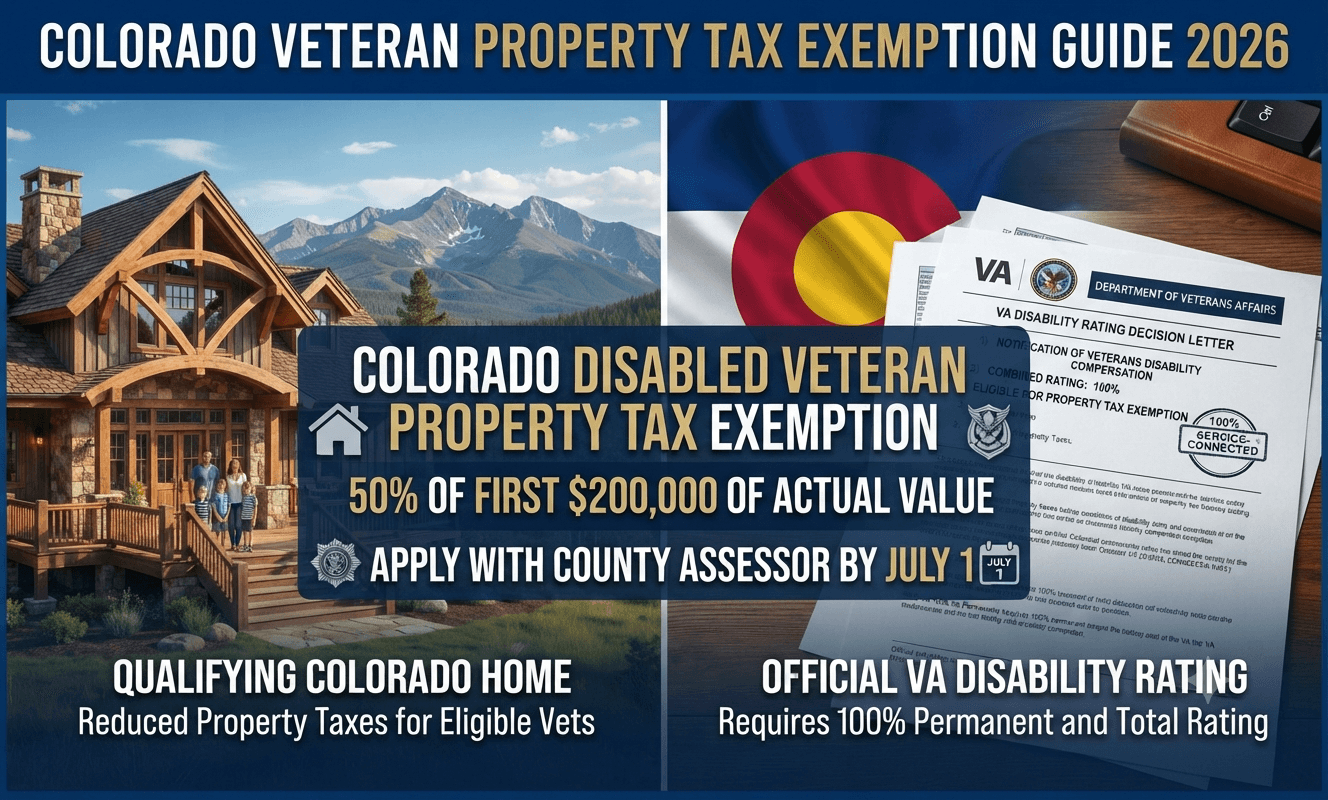
| Colorado | 100% P&T | 50% of first $200,000 exempt |
| Oregon | 40%+ | Assessed-value exclusion; indexed 3% annually |
| Illinois | 70%+ | Full exemption at 70%+; $5,000 at 50–70%; $2,500 at 30–50% |
| New York | 15%+ | Tiered exemptions with disability bonus; new full exemption takes effect Oct 2026 |
Income-Limited or County-Optional States
These states offer relief but with income caps, property value limits, or local opt-in provisions .
| State | Details |
|---|---|
| Pennsylvania | 100% wartime disabled with income below $114,637 (2025 limit) |
| Kansas | 50%+ disability; income limit ($53,600 in 2023) and property value cap ($350,000) |
| Arizona | Capped exemption ~$4,873 (2026); county-administered with income/assessed-value limits |
| New Hampshire | New credit for 100% P&T or SAH veterans; local option (effective 2027) |
| Connecticut | Counties may provide additional exemptions |
| Delaware | School district tax exemption (100% disabled) |
How to Apply for Your Property Tax Exemption
Required Documents
VA Rating Letter – Obtain from eBenefits.va.gov (Benefits Summary Letter)
DD-214 – Certificate of Release or Discharge from Active Duty
Proof of Homeownership – Property deed or tax statement
Photo ID – State-issued ID or driver’s license
State Application Form – Available at county assessor’s office
Application Steps
Verify your VA disability rating – Confirm your percentage and P&T status
Check county deadlines – Most are in spring (March–April); missing can delay benefits by a full year
Contact your county assessor or appraisal district – This is where you apply, not the VA
Submit documents – VA rating letter, property deed, ID, and any required forms
Confirm approval – Once approved, the exemption typically renews annually without refiling
Critical: The exemption is not automatic. You must apply separately. The VA does not notify your county about your eligibility .
Common Mistakes Veterans Make
Never applying in the first place – The exemption is not automatic. You must file an application
Missing the deadline – Most counties have spring deadlines. Missing means waiting another year
Using the wrong documentation – A VA rating letter (not your discharge papers) is the required proof
Not checking P&T status – Some states require Permanent & Total designation, not just 100%
Assuming the VA handles it – The VA provides the rating; the county assessor approves the exemption
Not stacking available benefits – Some states allow combining multiple exemptions (e.g., Indiana)
Recent 2026 Legislative Changes
New York (A10839): Legislation passed in 2026 expanding the full exemption to any disabled veteran (not just “seriously” disabled) effective for assessment rolls with taxable status dates on or after October 1, 2026
New Hampshire (HB 1659): New disabled veteran homestead property tax credit for 100% P&T and specially adapted housing recipients; effective April 1, 2027 (local option)
New Mexico: Expanded eligibility so veterans with any VA disability rating qualify for a proportional exemption based on their rating percentage
Common Questions
Q: Do all 50 states offer property tax exemptions for disabled veterans?
Yes, all 50 states offer some form of property tax relief for disabled veterans. However, the qualifications and scope vary greatly. Some states only provide relief to veterans with 100% P&T ratings, while others offer partial exemptions starting at 10% disability .
Q: What is the difference between 100% and 100% P&T?
100% P&T (Permanent and Total) means the VA considers your disability permanent and will not schedule future re-evaluations. Some states require the P&T designation for the full exemption. If you are 100% but not P&T, check your state’s specific requirements .
Q: Is the exemption automatic?
No. You must apply through your county assessor or appraisal district. The VA does not automatically notify your county of your eligibility .
Q: When is the deadline to apply?
Most counties have spring deadlines, typically March–April. If you miss the deadline, you may have to wait until the next tax year. Check with your county assessor for specific dates .
Q: Does the exemption apply to all property, or just my primary residence?
Property tax exemptions apply only to your primary residence. Vacation homes, rental properties, and other real estate generally do not qualify .
Q: Can surviving spouses continue the exemption?
Yes, many states allow unremarried surviving spouses to continue the property tax exemption. Eligibility varies by state and often requires the spouse to remain unmarried and continue living in the home .
Q: What if my state has no program for veterans with less than 100% rating?
Some states (like Indiana, New York, and Oregon) provide partial exemptions based on disability percentage. Check your state’s specific rules—you may qualify even with a lower rating .
Q: How do I find my county assessor’s office?
Search “[Your County] County Assessor” online. Many counties have websites with application forms and instructions. You can also contact your state Department of Veterans Affairs for assistance .
Q: Does a property tax exemption affect my VA disability benefits?
No. Property tax exemptions are state and local benefits. They do not affect your VA disability compensation or other federal benefits .
Q: What if I live in a state with no special veteran program?
Delaware and some other states do not have a specific disabled veteran property tax program beyond the standard homestead exemption. However, some counties or municipalities may offer additional benefits. Check with your local assessor for any local options .
Key Takeaways
22 states offer a full property tax exemption for 100% P&T veterans
All 50 states provide some form of property tax relief, but rules vary widely
You must apply through your county assessor—nothing is automatic
Spring deadlines (March–April) are common; missing them can delay benefits by a year
VA rating letter is the primary document you need; obtain it via eBenefits.va.gov
P&T matters—some states require Permanent & Total designation, not just 100%
Surviving spouses may retain the exemption if they remain unmarried
Partial exemptions are available in 11 states for veterans with less than 100% disability
2026 changes in New York, New Mexico, and New Hampshire expand eligibility
Check with your county for local variations and specific deadlines
Official Resources
VA Disability Rating & Benefits Letter: eBenefits.va.gov
VA Disability Compensation Rates: www.va.gov/disability/compensation-rates
County Assessor Directory: USA.gov (search by county)
National Association of Veterans Research & Information: www.veteransresources.org
🇺🇸 IMPORTANT DISCLAIMER – Veterans Benefits Information
This site provides general information about U.S. Department of Veterans Affairs (VA) benefits for educational and informational purposes only.
- Not Official: We are NOT affiliated with, endorsed by, or connected to the U.S. Department of Veterans Affairs (VA), the Veterans Benefits Administration (VBA), the Veterans Health Administration (VHA), or any other government agency.
- No Legal/Financial Advice: The content on this website is for informational purposes only and does not constitute legal, financial, or medical advice. VA benefits rules change frequently – always consult with an accredited Veterans Service Officer (VSO) or a qualified professional for your specific situation.
- Official Sources: For official, binding information and to apply for benefits, always visit official .gov websites: VA.gov, Benefits.VA.gov, or SSA.gov.
- No Data Collection: This site does not collect, store, or process any personal information. It does not have login forms, contact forms, or any system to capture user data. We never ask for your Social Security Number, bank details, or any personal information.
- 🚨 Scam Alert: The VA and other government agencies never charge fees for benefit applications. If anyone asks for money to "process" your VA claim, it is a scam. Report it to the VA Office of Inspector General at VA.gov/OIG.
- Advertising: This site uses third-party advertising (Adsterra) to cover operational costs. We do not endorse or guarantee any products or services advertised.
📌 Information provided as of June 2026. Always verify current eligibility and rules with official .gov sources.
This site is not affiliated with the U.S. Department of Veterans Affairs or any government agency. All information is for educational purposes only. Please visit VA.gov for official information.
