
Congress Veterans Disability Benefits Cut Proposal 2026
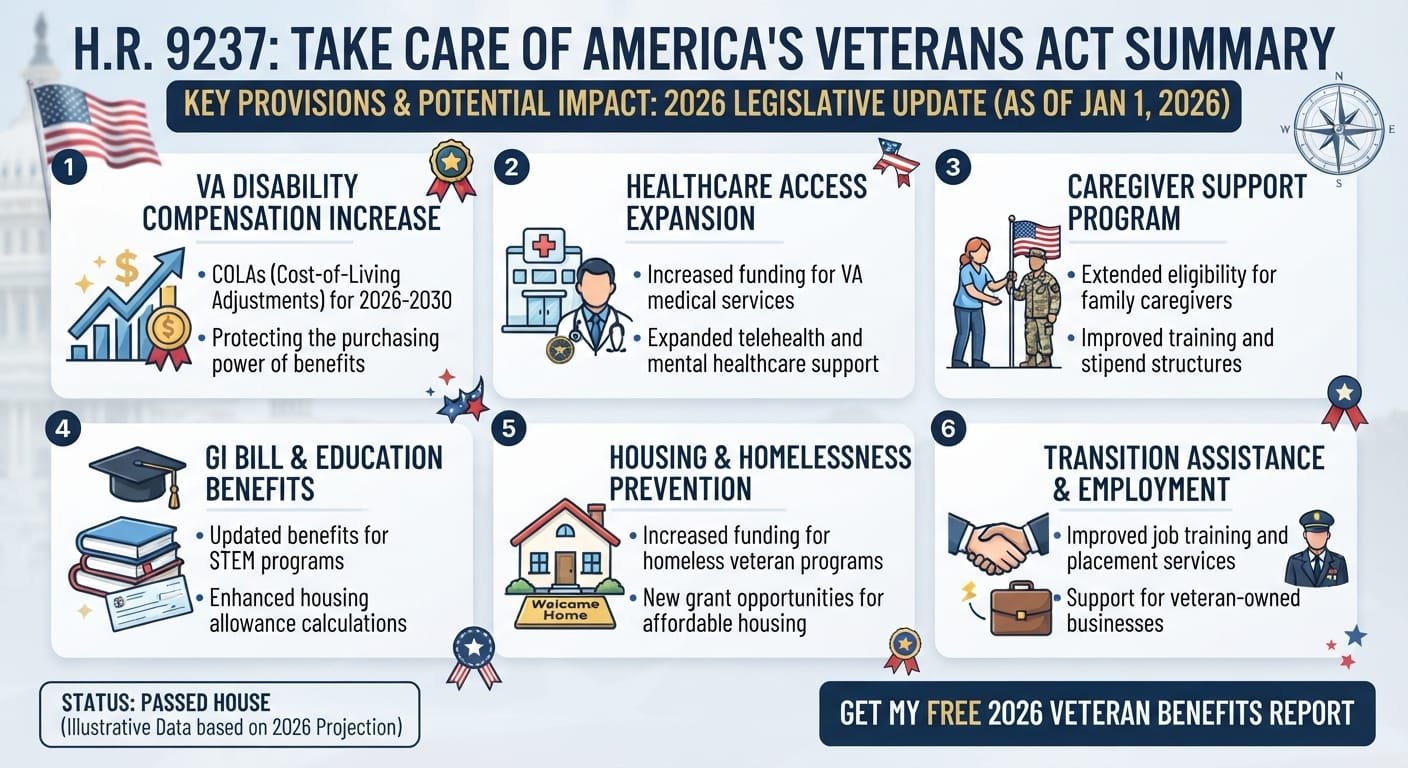
In July 2026, House Republicans introduced H.R. 9237, the “Take Care of America’s Veterans Act,” a nearly 600-page bill that would have cut more than $57 billion in disability benefits for 1.5 million future veterans with tinnitus and sleep apnea to fund other veteran programs . The bill was pulled from the House floor after a procedural vote showed Republicans lacked the support to pass it, and its future remains uncertain . No veterans currently receiving benefits would have been affected—the cuts targeted only future claims and reevaluations .
Quick Facts
| Item | Details |
|---|---|
| Bill Name | Take Care of America’s Veterans Act (H.R. 9237 / S. 4744) |
| Introduced | June 10, 2026 |
| Proposed Cut | $57 billion over 10 years in disability benefits for tinnitus and sleep apnea |
| Veterans Affected | Up to 1.5 million future veterans |
| Current Status | Pulled from House floor vote on July 15, 2026; uncertain future |
| Official Agency | U.S. Department of Veterans Affairs |
| Key Opposition | VFW, DAV, IAVA, AFGE, and 214+ House Democrats |
What Is the “Take Care of America’s Veterans Act”?
The Take Care of America’s Veterans Act is a legislative package introduced by House Veterans Affairs Committee Chairman Mike Bost. It bundles 62 pieces of veteran-related legislation into a single, massive bill . The stated purpose is to improve benefits and the administration of the Department of Veterans Affairs.

What Was in the Bill?
The bill contains many provisions that have broad bipartisan support, including:
Major Richard Star Act: Would allow combat-injured veterans medically retired with fewer than 20 years of service to receive both full military retirement pay and VA disability compensation simultaneously. Currently, they must forfeit a portion of their retirement pay to offset disability benefits .
Love Lives On Act: Would extend benefits for certain surviving spouses .
Expanded Caregiver Support: Would expand support for family caregivers .
Community Care Expansion: Would expand access to community-based care .
The Controversial Provision: Section 108

The controversy centers on Section 108 of the bill. To pay for the new benefits—particularly the Major Richard Star Act—the bill proposed changes to the VA rating schedule for two of the most common service-connected conditions: tinnitus and sleep apnea .
Under the proposed changes:
Tinnitus: The existing 10% rating for tinnitus as a stand-alone disability would be eliminated. Veterans would only receive compensation for tinnitus if it was linked to an underlying hearing loss condition. According to VA analysis, more than 60% of veterans who receive tinnitus benefits do not have an underlying hearing loss condition, meaning nearly one million veterans would no longer qualify for benefits under the new rules .
Sleep Apnea: The automatic 50% rating for veterans who require a CPAP machine would be removed. Instead, the rating would be based on the severity of the condition and how well it is managed by treatment. Under the draft rule, disability compensation for sleep apnea could be reduced to zero in many cases .
Why the Bill Was Pulled
On July 15, 2026, the bill was scheduled for a vote on the House floor. However, the vote was pulled after a procedural “motion to recommit” failed by a narrow margin . Three House Republicans voted with 207 House Democrats in favor of a motion that would have replaced the Republican funding proposal with an alternative using unobligated Department of Defense funds .
The Motion to Recommit
The motion to recommit, introduced by Democrats, would have replaced the $57 billion disability benefit cuts with funding from the Department of Defense’s nearly $100 billion in unobligated funds .
Democrats’ Position: “We cannot accept the false narrative that accepting the Republican proposed cuts is the only way to do it,” said Senator Richard Blumenthal. “Veterans deserve meaningful results from a grateful nation, and they should never be handed an invoice when the costs of war come due” .
Republicans’ Position: Republicans argued that using Department of Defense funds would not satisfy budget rules and that an offset was necessary .
Current Status
Veterans May Qualify for Extra Benefits
Check available financial assistance, healthcare programs and other opportunities that may apply to you.
Check EligibilityAs of August 2026, the bill’s future is uncertain. It may be considered again in September 2026 . Competing Senate efforts to advance the bill have also failed .
Who Opposes the Bill?
Major Veterans Service Organizations
The bill has divided the veteran community. Major organizations oppose the bill:
Veterans of Foreign Wars (VFW): “The VFW strongly opposes the Take Care of America’s Veterans Act as currently drafted because it asks future disabled veterans to bear the cost of expanding benefits through changing the VA rating schedule for tinnitus and obstructive sleep apnea. A grateful nation pays its debts to veterans—it does not send them the invoice” .
Disabled American Veterans (DAV): “This ‘poison pill’ was included in a larger veterans package. A grateful nation should never try to balance its budget on the backs of the men and women who sacrificed so much for our freedom” .
Iraq and Afghanistan Veterans of America (IAVA): “Veterans’ disability compensation is not a budgetary offset. It is compensation for injuries, illnesses, and conditions incurred through military service” .
The American Legion’s Position
The American Legion has taken a different position. The organization supports the bill while opposing the rating changes, arguing that the benefits of the legislation outweigh its negatives . However, many local American Legion posts have passed resolutions opposing the bill entirely .
How Would the Cuts Affect Veterans?
Tinnitus: The Most Common VA Disability
Tinnitus is the most common service-connected disability recognized by the VA, with an estimated 3.6 million veterans receiving benefits for this condition .
Current Rating: 10% disability rating for stand-alone tinnitus
Proposed Change: Eliminate stand-alone tinnitus rating; require service connection to an underlying hearing loss
VA Analysis: Nearly one million veterans would have their disability compensation reduced or eliminated
Sleep Apnea: A Growing Concern
More than 763,000 veterans receive VA benefits for service-connected sleep apnea .
Current Rating: 50% for veterans requiring a CPAP machine
Proposed Change: Remove automatic 50% rating; assess based on severity and treatment response
Impact: Many veterans would see their rating reduced to 0% or a lower percentage
Grandfathering: Current Veterans Protected
An important distinction: the proposed changes would apply only to new claims and future reevaluations. Veterans currently receiving benefits for tinnitus or sleep apnea would not be affected . However, veterans seeking an increase in their rating or filing a new claim after the changes would be subject to the new rules.
What Is the Major Richard Star Act?
The Major Richard Star Act is a separate piece of legislation that has been a top priority for many veterans organizations for years. It would:
Allow combat-injured veterans who were medically retired before reaching 20 years of service to receive both full military retirement pay and VA disability compensation simultaneously
Benefit approximately 59,000 combat-injured veterans
Provide an average increase of $1,200 per month to these veterans
The bill has bipartisan support: 79 Senate cosponsors and 334 House cosponsors . However, it has been blocked multiple times by Republican senators .
The Discharge Petition
House Veterans Affairs Committee Ranking Member Mark Takano has filed a discharge petition to force a standalone vote on the Major Richard Star Act without the disability benefit cuts . As of July 2026, 215 members had joined the petition, needing only three more signatures to reach the required 218 .
How to Stay Informed and Take Action
What Veterans Should Do Next
Contact Your Representatives: Call, email, or write your House Representative and Senators. Express your views on the Take Care of America’s Veterans Act and the Major Richard Star Act.
Join a Veterans Service Organization: Organizations like the VFW, DAV, and IAVA are actively advocating on these issues and can provide updates.
Monitor VA.gov for Updates: The VA may also pursue rating changes through the regulatory process, independent of Congress .
Stay Informed on Legislative Updates: Follow the House Veterans Affairs Committee and Senate Veterans Affairs Committee for the latest developments.
Common Questions
1. Is Congress cutting VA disability benefits in 2026?
Congress proposed cutting more than $57 billion in disability benefits for veterans with tinnitus and sleep apnea through H.R. 9237, the Take Care of America’s Veterans Act. The bill was pulled from the floor in July 2026 after opposition, but the proposal could resurface. No current veterans would have lost benefits—only future claims and reevaluations were affected .
2. What is the Take Care of America’s Veterans Act?
It is a 62-piece legislative package introduced in June 2026 that bundles the Major Richard Star Act with other veteran benefits. To pay for new benefits, it proposed cutting disability compensation for tinnitus and sleep apnea. It passed committee but was pulled from the House floor due to opposition from major veterans groups and lawmakers .
3. Why is the VFW opposing the veteran benefits bill?
The VFW opposes the bill because it “asks future disabled veterans to bear the cost of expanding benefits” by cutting disability compensation for tinnitus and sleep apnea. The organization says veterans’ benefits are an earned obligation, not charity, and Congress should not make veterans compete against each other for funding .
4. What is the Major Richard Star Act?
The Major Richard Star Act is bipartisan legislation that would allow combat-injured veterans who medically retired before 20 years of service to receive both full retirement pay and VA disability compensation. It would help about 59,000 veterans and has 79 Senate and 334 House cosponsors .
5. Did Congress pass the veterans benefits cut bill?
No. The bill was pulled from the House floor on July 15, 2026, after a procedural vote showed Republicans lacked support to pass it. The bill’s future is uncertain, and it may be considered again in September 2026 .
6. Which veterans would be affected by the benefit cuts?
Only future veterans filing new claims or seeking rating increases for tinnitus or sleep apnea would be affected. Veterans currently receiving benefits for these conditions would be grandfathered in under current rules. However, the bill would set a precedent for reducing ratings for common conditions .
7. Does the American Legion support the bill?
The American Legion supports the bill while opposing the rating changes, arguing the benefits of the legislation outweigh the negatives. However, many local American Legion posts have passed resolutions opposing the bill entirely, creating a split within the organization .
8. How much money would be cut from veteran benefits?
The VA estimated the changes would reduce disability compensation by approximately $57 billion over 10 years, affecting up to 1.5 million veterans. This is described as the “largest cut to veterans’ benefits in a generation” .
9. Can the VA change disability ratings without Congress?
Yes. The VA has been pursuing similar rating changes through the regulatory process since 2022. A draft rule on tinnitus and sleep apnea ratings was published, and the VA may proceed with these changes even if Congress does not pass the bill .
10. What is the “Honor the Contract” campaign?
The VFW launched the “Honor the Contract” campaign to pressure lawmakers to reject the benefit cuts. The campaign argues that veterans’ benefits are part of a contract made through military service, and Congress should not fund new benefits by cutting existing ones .
Key Takeaways
House Republicans proposed a $57 billion cut to VA disability benefits for tinnitus and sleep apnea to fund new veteran programs .
The bill was pulled from the House floor in July 2026 after major veteran organizations opposed it and a procedural vote showed lack of support .
Only future veterans filing new claims or seeking reevaluations would be affected; current recipients are grandfathered in .
Tinnitus and sleep apnea are the most common VA disability claims, affecting 3.6 million and 763,000 veterans respectively .
The VFW, DAV, and IAVA oppose the bill, while the American Legion supports it (but opposes the rating changes) .
The Major Richard Star Act is caught in the middle—it would help 59,000 combat-injured veterans but is being used to justify the cuts .
The VA may also pursue rating changes through regulation, independent of Congress .
A discharge petition with 215 signatures could force a standalone vote on the Major Richard Star Act .
Official Resources
VA.gov – Access your benefits and rating: https://www.va.gov
House Veterans Affairs Committee – https://veterans.house.gov
Senate Veterans Affairs Committee – https://www.veterans.senate.gov
VA Disability Compensation Rates – https://www.va.gov/disability/compensation-rates
VA Form 21-526EZ – Apply for disability: https://www.va.gov/disability/how-to-file-claim

🇺🇸 IMPORTANT DISCLAIMER – Veterans Benefits Information
This site provides general information about U.S. Department of Veterans Affairs (VA) benefits for educational and informational purposes only.
- Not Official: We are NOT affiliated with, endorsed by, or connected to the U.S. Department of Veterans Affairs (VA), the Veterans Benefits Administration (VBA), the Veterans Health Administration (VHA), or any other government agency.
- No Legal/Financial Advice: The content on this website is for informational purposes only and does not constitute legal, financial, or medical advice. VA benefits rules change frequently – always consult with an accredited Veterans Service Officer (VSO) or a qualified professional for your specific situation.
- Official Sources: For official, binding information and to apply for benefits, always visit official .gov websites: VA.gov, Benefits.VA.gov, or SSA.gov.
- No Data Collection: This site does not collect, store, or process any personal information. It does not have login forms, contact forms, or any system to capture user data. We never ask for your Social Security Number, bank details, or any personal information.
- 🚨 Scam Alert: The VA and other government agencies never charge fees for benefit applications. If anyone asks for money to "process" your VA claim, it is a scam. Report it to the VA Office of Inspector General at VA.gov/OIG.
- Advertising: This site uses third-party advertising (Adsterra) to cover operational costs. We do not endorse or guarantee any products or services advertised.
📌 Information provided as of June 2026. Always verify current eligibility and rules with official .gov sources.
This site is not affiliated with the U.S. Department of Veterans Affairs or any government agency. All information is for educational purposes only. Please visit VA.gov for official information.
