
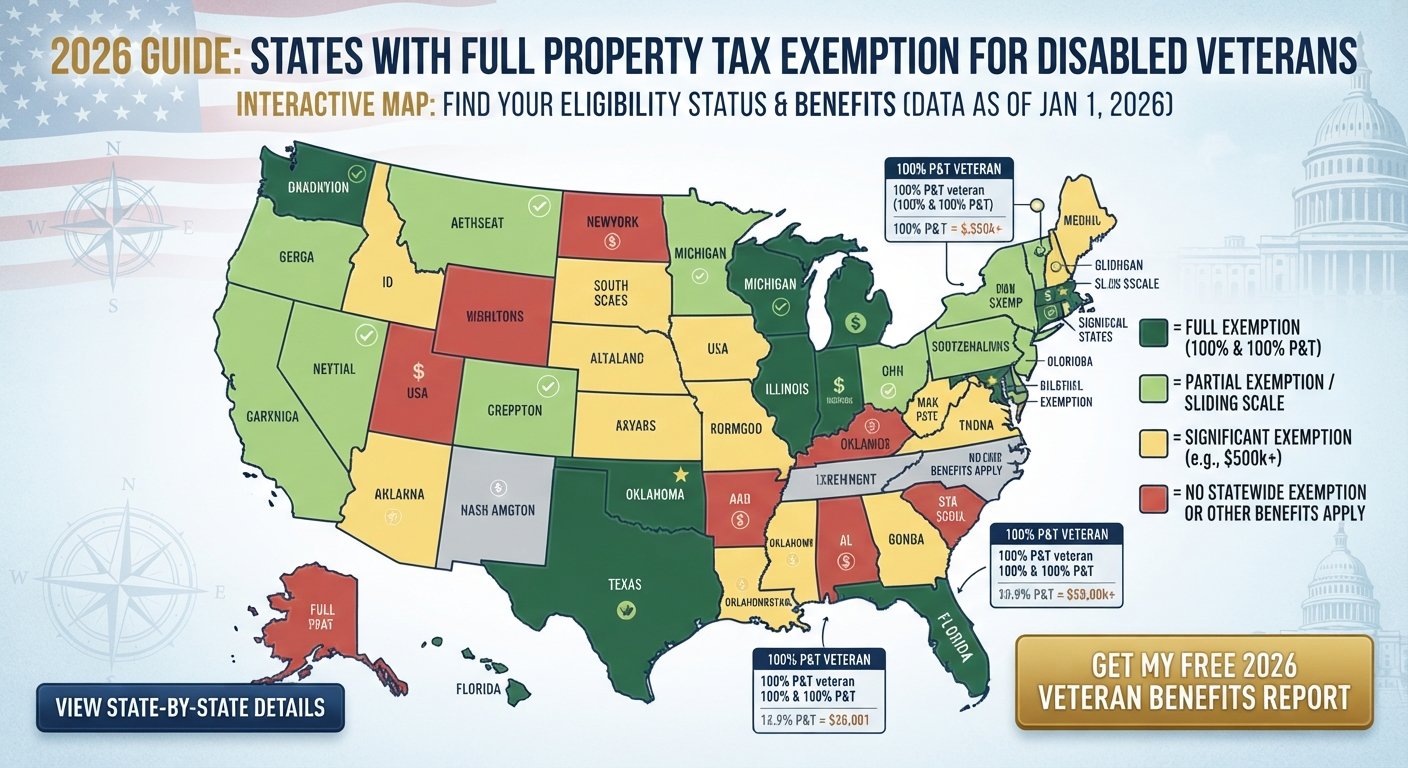
Which States Have No Property Tax for Disabled Veterans? (2026 Guide)
Twenty-two states offer full property tax exemptions for disabled veterans rated 100% permanent and total (P&T). Florida, Texas, Virginia, South Carolina, Oklahoma, New Mexico, and Michigan are among the states that can reduce your property tax bill to zero on your primary residence. No state automatically grants this benefit—you must apply through your county assessor’s office with your VA rating letter.
Quick Facts
| Item | Details |
|---|---|
| Benefit | Full or partial property tax exemption on primary residence |
| Eligibility | VA-rated service-connected disability (typically 100% P&T for full exemption; lower ratings may qualify for partial relief) |
| Application | County assessor or county auditor’s office—not through the VA |
| Processing Time | Typically 30–90 days; varies by county |
| Official Agency | State Department of Revenue / County Assessor |
| Required Forms | VA rating letter (VA Form 21-4138 or Benefits Summary Letter), DD-214, property deed, photo ID |
| Updated For | 2026 (includes recent changes in New Mexico, Connecticut, and Arizona) |
States That Offer Full Property Tax Exemptions for 100% Disabled Veterans
According to a 2026 legislative summary, 22 states currently offer a full (or effectively full) property tax exemption for veterans rated 100% service-connected disabled . These states provide the most valuable benefit available: a $0 property tax bill on your primary residence.

| State | Full Exemption? | State Income Tax? | Notes |
|---|---|---|---|
| Alabama | Yes | Yes | Full exemption for 100% P&T |
| Arizona | Yes | Yes | Proportional exemption expanding in 2026 (HB 47, 2025) |
| Arkansas | Yes | Yes | Full exemption for 100% disabled |
| Connecticut | Yes | Yes | Full exemption for P&T veterans (2026 fiscal year) |
| Florida | Yes | No | Full homestead exemption; no state income tax |
| Hawaii | Yes* | Yes | Full exemption in some counties; $150 minimum tax due |
| Illinois | Yes | Yes | Full exemption for 100% disabled |
| Iowa | Yes | Yes | Full exemption for 100% P&T |
| Louisiana | Yes | Yes | Full exemption for 100% rating |
| Maryland | Yes | Yes | Full exemption for 100% P&T |
| Michigan | Yes | Yes | Full exemption for 100% disabled veterans |
| Mississippi | Yes | Yes | Full exemption for 100% disabled |
| Nebraska | Yes | Yes | Full exemption, with income tiers in some cases |
| New Hampshire | Yes* | No | Full exemption (county option); pending HB 1659 for 2027 |
| New Jersey | Yes | Yes | Full exemption for 100% P&T |
| New Mexico | Yes | Yes | Full exemption at 100%; NEW for 2026: proportional exemption for all ratings |
| Oklahoma | Yes | Yes | Full exemption for 100% P&T |
| Pennsylvania | Yes* | Yes | Full exemption for 100% wartime disability; income limit $114,637 (2025) |
| South Carolina | Yes | Yes | Full exemption for 100% P&T; retroactive to 2022 |
| Texas | Yes | No | Full exemption for 100% or TDIU; no state income tax |
| Virginia | Yes | Yes | Full exemption for 100% P&T (VA Constitution Art. X, §6-A) |
| Wisconsin | Yes* | Yes | Full exemption via refundable tax credit (claimed on state tax return) |
Note on asterisked states: These have special conditions—income limits, county-level administration, or credit-based structures rather than direct assessor exemptions .
The Three States with the Most Valuable Combined Benefits

For veterans relocating or planning retirement, the most financially advantageous states are those that combine a full property tax exemption with no state income tax. According to a 2026 legislative summary, only three states offer both benefits:
Florida – Full homestead property tax exemption for 100% disabled veterans; no state income tax on any income
Texas – Full property tax exemption for 100% disabled veterans or veterans receiving TDIU; no state income tax
New Hampshire – Full exemption available (county option); no state income tax on wages
Vermont, Nevada, and South Dakota offer other advantages but do not combine both benefits .
Decision Point: If you’re relocating, consider starting with Florida, Texas, or New Hampshire—these states eliminate both your property tax bill and state income tax liability simultaneously.
States with Partial Property Tax Exemptions for Disabled Veterans
Not every state requires a 100% rating for relief. Many states offer partial exemptions that scale with your disability percentage.
| State | Minimum Rating | Exemption Structure |
|---|---|---|
| California | 100% | $180,671 basic exemption (2026); $271,009 low-income ($81,131 limit) |
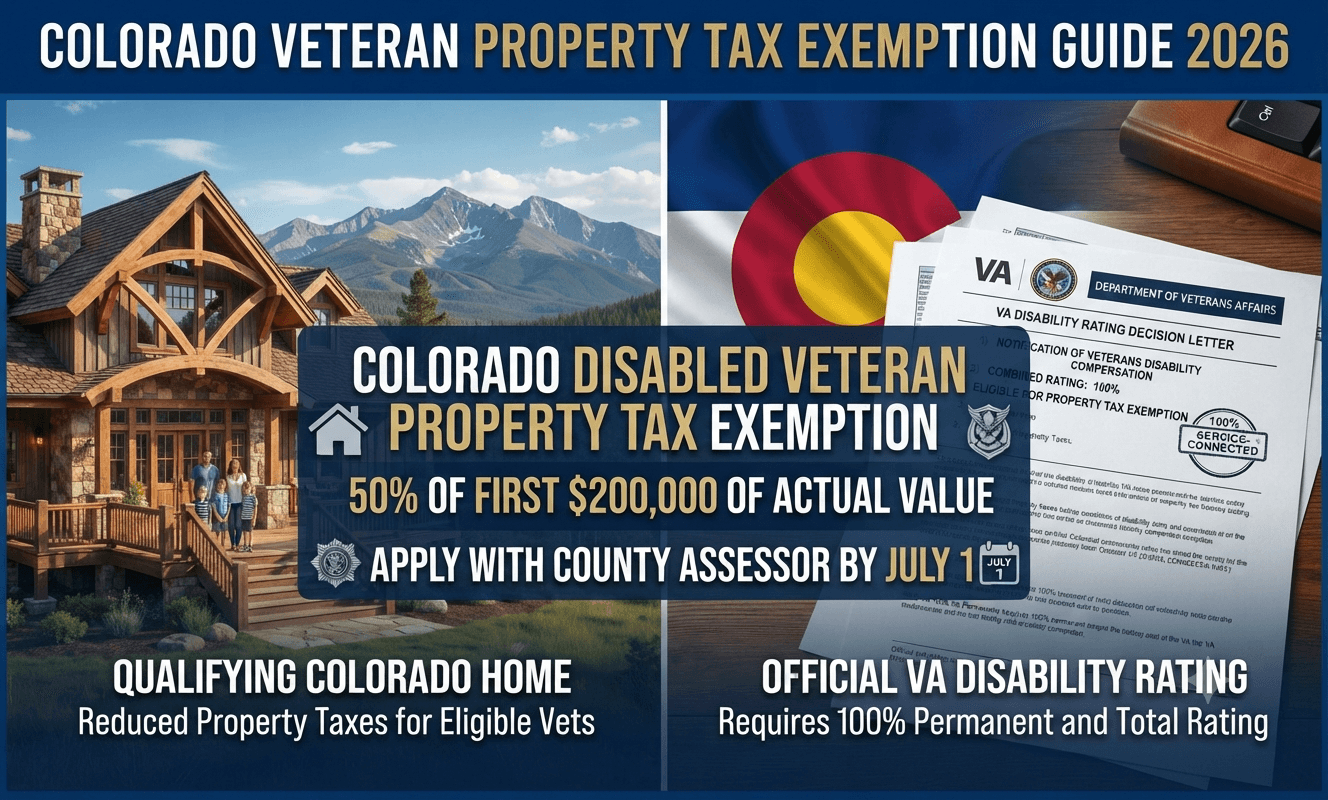
| Colorado | 100% P&T | 50% exemption on first $200,000 of actual value |
| Indiana | 50%+ | Partial exemption; higher at 100% |
| Maine | 100% | $6,000–$50,000 exemption; 100% tuition waiver for dependents at UMaine |
| Minnesota | 100% P&T | Market value exclusion up to $300,000 |
| Nebraska | Varies | Scales by rating; full exemption at 100% |
| New York | 15%+ | Tiered; full exemption for 100% starts October 1, 2026 |
| North Carolina | 100% P&T | $45,000 assessed-value exclusion ($0 tax on that amount) |
| North Dakota | 50%+ | Credit scales with rating; 100% rating receives full credit |
| Ohio | 100% | $56,000 market value reduction (2025 indexed amount) |
| Oregon | 40%+ | Assessed-value exclusion; indexed 3% annually |
| Utah | 10%+ | Scales with rating; up to $505,548 taxable value abatement |
| Vermont | 50%+ | $10,000–$40,000 appraised value reduction |
| Washington | 80%+ | Income-based exemptions or deferrals |
| West Virginia | 90–100% | Real property tax credit; full exemption for P&T |
| Wyoming | 100% P&T | $6,000 assessed value reduction |
New Mexico’s 2026 Expansion
Starting in 2026, New Mexico expanded eligibility so that any veteran with a VA disability rating—not just 100%—qualifies for a proportional property tax exemption based on their rating percentage . This means a veteran with a 40% rating receives a 40% property tax reduction on their primary residence. This is one of the most significant changes for 2026.
Arizona’s 2026 Expansion
Veterans May Qualify for Extra Benefits
Check available financial assistance, healthcare programs and other opportunities that may apply to you.
Check EligibilityArizona’s implementing legislation (HB 47, 2025) creates a proportional exemption for the 2026 tax year: a service-connected disabled veteran’s principal residence is exempt from property tax in a percentage equal to their federal disability rating. Veterans rated 100% (or P&T) continue to receive a full exemption. The baseline veteran exemption also increased from $4,000 to $10,000 of taxable value effective 2025 .
New York’s 2026 Change
New York created a new full exemption for veterans with a 100% service-connected disability under Chapter 672 of the Laws of 2025 (amended by Chapter 77 of 2026). This full exemption takes effect for assessment rolls with taxable status dates on or after October 1, 2026 .
Understanding Your VA Disability Rating and Property Tax Eligibility
Your VA disability rating is the single most important factor in determining your property tax benefit . Here’s how ratings typically map to exemptions:
| Rating Level | Typical Benefit |
|---|---|
| 100% P&T | Full exemption in 22 states; partial exemption in nearly every other state |
| 100% (not P&T) | Full exemption in many states; some states specifically require P&T designation |
| 70%–90% | Partial exemptions available in many states |
| 50%–60% | Partial exemptions in states like Arizona, Connecticut, Maine, North Dakota, Oregon |
| 10%–40% | Limited exemptions; New York (15%), Oregon (40%), Utah (10%) are exceptions |
What Does “Permanent and Total” (P&T) Mean?
P&T means the VA considers your disability permanent and will not schedule future re-evaluations . Some states—including many of the 22 with full exemptions—specifically require the P&T designation to qualify for the full exemption. If you are rated 100% but not P&T, check your state’s specific requirements. If you believe your condition is permanent, you can request a P&T determination from the VA.
What About TDIU?
Veterans receiving Total Disability Individual Unemployability (TDIU) are paid at the 100% rate even if their schedular rating is lower. In states like Texas, veterans receiving TDIU qualify for the same full property tax exemption as those rated 100% P&T . Other states may treat TDIU equivalently—check with your county assessor.
How the Three Types of Exemptions Work
| Type | How It Works | Example |
|---|---|---|
| Full Exemption | Entire taxable value of home is removed; $0 property tax bill | Texas: $350,000 home × 1.8% tax rate = $6,300 annual savings → $0 bill |
| Assessed-Value Reduction | Fixed dollar amount subtracted from assessed value before tax rate applied | North Carolina: $45,000 exclusion on $300,000 home; taxed on $255,000 instead |
| Tax Credit | Dollar-for-dollar offset against the tax bill, claimed on state tax return | Wisconsin: refundable credit covers eligible property taxes paid; claimed on income tax return |
How to Apply for Your Disabled Veteran Property Tax Exemption
Property tax exemptions are never automatic. You must apply through your county assessor or county auditor’s office—not through the VA .
Step 1: Obtain Your VA Rating Letter
This is the single most important document. Access it through:
eBenefits portal at eBenefits.va.gov (download your Benefits Summary Letter)
VA.gov – your VA decision letter showing your rating and P&T status
VA Form 21-4138 – Statement in Support of Claim
Your rating letter must show your current disability percentage and any P&T designation.
Step 2: Gather Required Documents
Most counties require :
✅ VA disability rating letter (showing 100% P&T or your current rating)
✅ DD-214 (Certificate of Release or Discharge from Active Duty)
✅ Property deed or proof of homeownership
✅ Photo ID (driver’s license or state ID)
✅ Proof of primary residence (utility bills, voter registration)
Step 3: Locate Your County Assessor’s Office
Property tax exemptions are handled at the county level:
Search for “[Your County] [Your State] assessor property tax exemption”
Or find your state’s Department of Revenue website for a county directory
Step 4: Complete the Application
Most counties have a specific form for disabled veteran property tax exemptions. Fill it out completely and attach all required documentation. Submit it by the deadline.
Step 5: Meet the Deadline
Most states have application deadlines in early spring (March–April) . Missing the deadline can mean waiting an entire year for the exemption. Mark your calendar and apply early.
Step 6: Reapply If Required
Some states grant a permanent exemption after the first approval. Others—like Michigan—require annual reapplication . Confirm your county’s requirements and reapply as needed.
Common Mistakes to Avoid
Assuming it’s automatic. It is not. You must apply through your county assessor .
Applying through the wrong agency. Property tax exemptions are handled by the county assessor, not the VA .
Missing the deadline. Most counties have spring deadlines—miss it and you lose the exemption for the entire tax year .
Using an outdated VA rating letter. If your rating changes, update your application. An old rating may not reflect a new 100% P&T status.
Not understanding the P&T requirement. Some states specifically require the P&T designation. Check your state’s rules .
Applying for the wrong type of benefit. Wisconsin’s exemption is claimed on your state tax return, not at the assessor’s office .
Special State Considerations
Wisconsin: The Tax Credit Exemption
Wisconsin’s benefit is structured as a refundable state income tax credit. Qualifying veterans pay their property tax bill then claim the credit on their state tax return . This means you need enough filing income to absorb the credit (or receive it as a refund). Do not apply through the county assessor—apply when you file your Wisconsin taxes.
Pennsylvania: Income Limit
Pennsylvania’s full exemption for 100% wartime disability veterans has an income limit of $114,637 (2025 figure) . If your household income exceeds this limit, you may not qualify for the full exemption.
New Hampshire: Pending Legislation
New Hampshire’s full exemption is currently available at the county level, but a pending bill (HB 1659, 2026) would create a statewide disabled veteran homestead property tax credit. If passed, it would take effect April 1, 2027 .
South Carolina: Retroactive to 2022
South Carolina’s full exemption for totally disabled veterans is retroactive to 2022 . If you have been paying property taxes since 2022 and now qualify, you may be able to claim a refund.
California: Dollar-Cap Exemption
California does not offer a full exemption—it removes a fixed dollar amount from assessed value. The 2026 basic exemption is $180,671, and the low-income exemption is $271,009 for households earning under $81,131 . On a $400,000 home, this means you still pay tax on the remaining $219,329.
Frequently Asked Questions
1. Which states have no property tax for 100% disabled veterans?
Twenty-two states offer full property tax exemptions for 100% disabled veterans. These include Alabama, Arkansas, Florida, Georgia, Illinois, Iowa, Louisiana, Maryland, Michigan, Mississippi, New Hampshire, New Jersey, New Mexico, Oklahoma, South Carolina, Texas, Virginia, and West Virginia, among others .
2. Does Florida have no property tax for disabled veterans?
Yes. Florida offers a full homestead property tax exemption for veterans rated 100% P&T or receiving TDIU . Florida also has no state income tax, making it one of the most financially advantageous states for disabled veterans.
3. Does Texas have no property tax for disabled veterans?
Yes. Texas offers a full property tax exemption for 100% disabled veterans and veterans receiving TDIU . There is no income limit, no age requirement, and Texas has no state income tax.
4. Do I qualify for a property tax exemption if I’m rated less than 100%?
Yes. Many states offer partial exemptions at lower ratings. New York starts at 15%, Utah at 10%, Oregon at 40%, and New Mexico now offers proportional exemptions for all ratings in 2026 .
5. Is the property tax exemption automatic?
No. You must apply through your county assessor or county auditor’s office. The benefit is never automatic .
6. Does the exemption apply to all properties I own?
No. Most property tax exemptions apply only to your primary residence (homestead). Rental properties, vacation homes, and investment properties generally do not qualify .
7. What documents do I need to apply?
You will need your VA rating letter (showing disability percentage and P&T status if applicable), DD-214, proof of homeownership, and photo ID. Some counties may request additional documentation .
8. Can my surviving spouse keep the exemption?
In most states, yes. Surviving spouses can continue the exemption if they do not remarry and continue living in the home. Some states—like Texas and Virginia—allow the exemption to port to a new homestead . Check your state’s rules for specific requirements.
9. What is the difference between 100% and 100% P&T?
P&T means “Permanent and Total.” The VA considers your disability permanent and will not re-evaluate it. Some states require the P&T designation specifically for the full exemption, while others accept any 100% rating .
10. Can I claim the exemption if I have a VA loan?
Yes. Your VA loan status does not affect your property tax exemption. In fact, the same VA rating letter used for property tax exemptions also waives the VA loan funding fee for disabled veterans .
11. How much can I save with a full property tax exemption?
Savings vary by state and home value. In Texas, on a $350,000 home with a 1.8% combined tax rate, the savings is approximately $6,300 per year . The median U.S. property tax bill is approximately $2,795 per year, so a full exemption is significant .
12. What if I’m a surviving spouse and my veteran was 100% P&T?
You may qualify for the same exemption in most states. You will need to provide the veteran’s DD-214, VA rating letter, and documentation of your marriage and the veteran’s death. In Texas, surviving spouses can even port the exemption to a new homestead .
Key Takeaways
Twenty-two states offer full property tax exemptions for 100% P&T disabled veterans, including Florida, Texas, Virginia, South Carolina, New Mexico, Oklahoma, and Michigan .
Florida, Texas, and New Hampshire are the only states that combine a full property tax exemption with no state income tax .
The exemption is never automatic. You must apply through your county assessor’s office with your VA rating letter .
Partial exemptions are available in many states for veterans with ratings below 100%. New Mexico and Arizona expanded proportional exemptions for all ratings in 2026 .
Most states have spring application deadlines (March–April). Missing the deadline can delay your benefit by a full year .
Your VA rating letter is the single most important document. Ensure it shows your current rating and P&T status before applying .
Surviving spouses can typically continue the exemption as long as they do not remarry and remain in the home .
Wisconsin’s exemption is claimed on your state tax return, not through the county assessor—a common mistake .
California offers a dollar-cap exemption, not a full exemption. The 2026 basic exemption is $180,671; low-income is $271,009 .
Texas and Virginia allow surviving spouses to port the exemption to a new homestead within the state .
Official Resources
VA.gov – Access your VA rating letter and benefits: https://www.va.gov
eBenefits – Download your Benefits Summary Letter: https://www.ebenefits.va.gov
VA Regional Office Locator – Find your local VA office: https://www.va.gov/find-locations
County Assessor Directory – Contact your county’s assessment office (search your state’s Department of Revenue website)
NASDVA State Veterans Affairs Offices – https://www.nasdva.us
Military.com State Benefit Directory – https://www.military.com/benefits/veteran-state-benefits
IRS Tax Information for Veterans – https://www.irs.gov/individuals/military

🇺🇸 IMPORTANT DISCLAIMER – Veterans Benefits Information
This site provides general information about U.S. Department of Veterans Affairs (VA) benefits for educational and informational purposes only.
- Not Official: We are NOT affiliated with, endorsed by, or connected to the U.S. Department of Veterans Affairs (VA), the Veterans Benefits Administration (VBA), the Veterans Health Administration (VHA), or any other government agency.
- No Legal/Financial Advice: The content on this website is for informational purposes only and does not constitute legal, financial, or medical advice. VA benefits rules change frequently – always consult with an accredited Veterans Service Officer (VSO) or a qualified professional for your specific situation.
- Official Sources: For official, binding information and to apply for benefits, always visit official .gov websites: VA.gov, Benefits.VA.gov, or SSA.gov.
- No Data Collection: This site does not collect, store, or process any personal information. It does not have login forms, contact forms, or any system to capture user data. We never ask for your Social Security Number, bank details, or any personal information.
- 🚨 Scam Alert: The VA and other government agencies never charge fees for benefit applications. If anyone asks for money to "process" your VA claim, it is a scam. Report it to the VA Office of Inspector General at VA.gov/OIG.
- Advertising: This site uses third-party advertising (Adsterra) to cover operational costs. We do not endorse or guarantee any products or services advertised.
📌 Information provided as of June 2026. Always verify current eligibility and rules with official .gov sources.
This site is not affiliated with the U.S. Department of Veterans Affairs or any government agency. All information is for educational purposes only. Please visit VA.gov for official information.
