
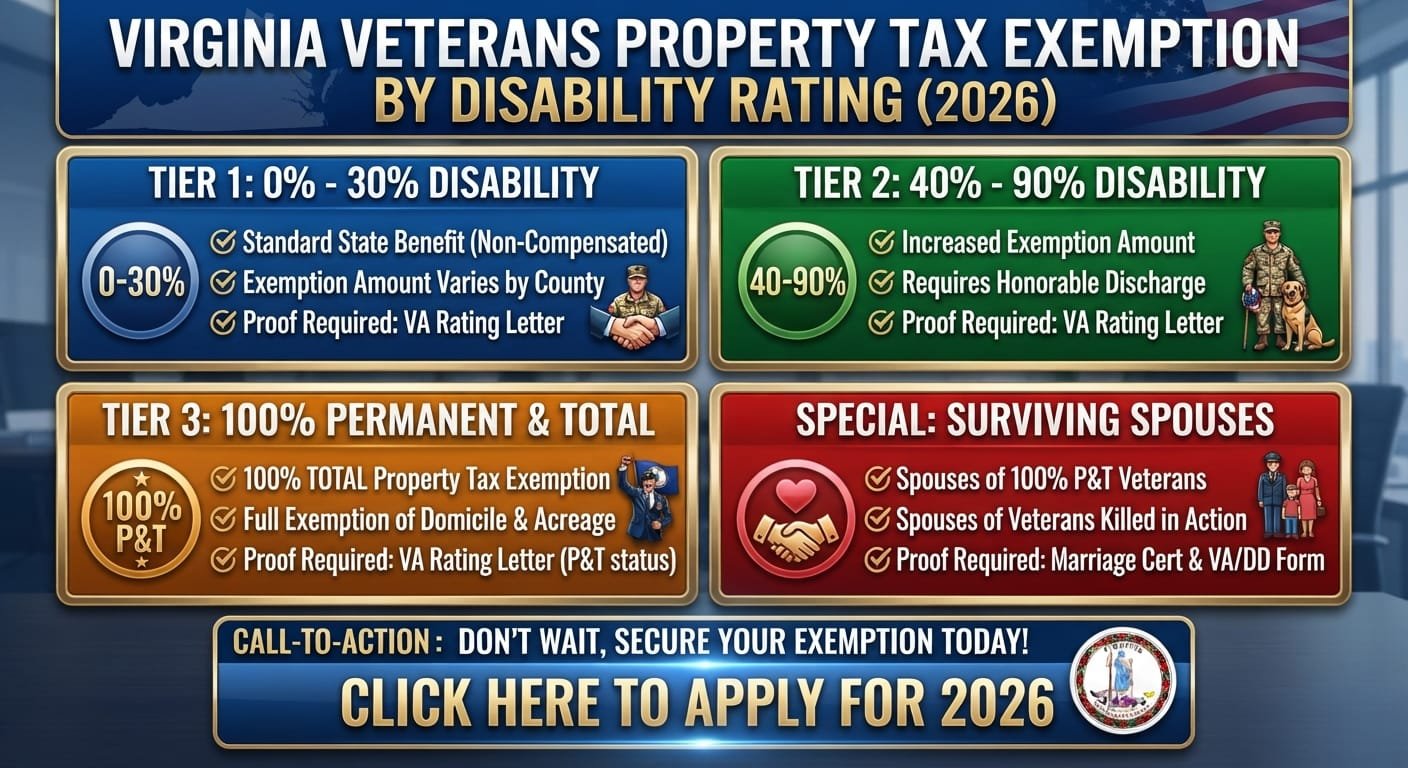
Virginia Veterans Property Tax Exemption: Disability Rating Guide
Virginia provides a full real property tax exemption only for veterans rated 100% service-connected, permanent, and total disability by the VA. Veterans with disability ratings below 100% do not qualify for this exemption. The exempt property includes the primary residence and up to one acre of land.
Quick Facts
| Item | Details |
|---|---|
| Benefit | Full exemption from real property taxes on primary residence and up to one acre of land |
| Eligibility | Veterans rated 100% service-connected, permanent, and total disability by VA; must occupy property as principal residence |
| Application | File with local Commissioner of the Revenue; one-time filing unless residence changes |
| Processing Time | Localities process applications within 20 business days for pre-purchase approvals |
| Official Agency | Virginia Department of Veterans Services; local Commissioner of the Revenue |
| Required Forms | VA Summary of Benefits letter; local affidavit/application; proof of residency |
| Updated For | 2026 tax year (regulation amended effective September 23, 2024) |
What Is the Virginia Disabled Veteran Property Tax Exemption?
The Virginia disabled veteran property tax exemption eliminates real property taxes on the primary residence of veterans with a 100% service-connected, permanent, and total disability rating. It is authorized by Article X, Section 6-A of the Virginia Constitution and Code of Virginia § 58.1-3219.5.

This benefit matters because it can save qualifying veterans thousands of dollars annually in property taxes. Unlike partial exemptions in some states, Virginia’s exemption applies to the full assessed value of the qualifying property—not just a portion. The exemption also extends to the land, up to one acre, on which the dwelling sits.

What veterans should do next: Obtain your VA Summary of Benefits letter showing the required disability rating, then contact your local Commissioner of the Revenue to file the exemption application.
Disability Rating Requirements: Who Qualifies?
Only veterans with a 100% service-connected, permanent, and total disability rating qualify. Virginia does not offer partial exemptions at 50%, 70%, or 90% ratings. The threshold is absolute: the VA must rate the veteran as 100% disabled, and that rating must be both permanent and total.
The Three Required Elements
| Element | What It Means |
|---|---|
| 100% rating | The VA has assigned a 100% disability rating or the veteran is compensated at the 100% rate |
| Service-connected | The disability resulted from military service |
| Permanent and total | The VA has determined the disability is permanent and the veteran is totally disabled |
The VA documentation must include the effective date of the disability determination. A rating of 100% that is not marked “permanent and total” does not qualify.
Do Veterans with TDIU Qualify?
Veterans receiving Individual Unemployability (IU) benefits—compensated at the 100% rate but with a schedular rating below 100%—may qualify if the VA documentation confirms they are rated 100% service-connected, permanent, and total. The key is what the VA letter states, not the underlying schedular percentage.
Veterans May Qualify for Extra Benefits
Check available financial assistance, healthcare programs and other opportunities that may apply to you.
Check EligibilityWhat to do: Request a VA Summary of Benefits letter that explicitly states “100% service-connected, permanent, and total disability.” If your letter does not include all required language, contact the VA to request corrected documentation.
Income Limits: Does Virginia Have One?
No. There is no income limit or net worth requirement for the disabled veteran property tax exemption in Virginia. This distinguishes it from Virginia’s separate tax relief program for elderly and handicapped residents, which does have income and net worth caps.
A qualifying veteran receives the full exemption regardless of household income, assets, or net worth. This applies to both the veteran and any surviving spouse who continues the exemption.
What Property Is Exempt?
The exemption covers the veteran’s principal residence and up to one acre of land. It also extends to certain additional structures on the property.
Covered Property
| Property Type | Exempt? | Notes |
|---|---|---|
| Primary dwelling | Yes | Must be principal place of residence |
| Up to one acre of land | Yes | More if locality already exempts larger acreage for other programs |
| Manufactured homes | Yes | Even if veteran does not own the land |
| Garages/structures for vehicles | Yes | If used for personal, not business, purposes |
| Additional acreage | Varies | Only if locality extends exemption |
| Rental/second homes | No | Must be principal residence |
Manufactured homes: A manufactured home qualifies even if the veteran does not own the land it sits on. The home must be titled in Virginia with proof of ownership. The land itself is not exempt if the veteran does not own it.
Accessory structures: Real property improvements used to house or cover motor vehicles, household goods, or personal effects qualify for exemption, as long as the use is not for business purposes.
What veterans should do next: Confirm your property’s assessed value and acreage with the local assessor. If you own more than one acre, ask whether your locality extends the exemption to additional land.
Who Qualifies: Veteran Eligibility
To qualify for the Virginia disabled veteran property tax exemption, a veteran must meet all of the following criteria:
VA rating: 100% service-connected, permanent, and total disability
Ownership: Own the property (alone or jointly with spouse)
Occupancy: Occupy the property as principal place of residence
Documentation: Provide VA documentation confirming the required rating
Property Ownership Structures That Qualify
The exemption applies to property held in several ownership forms:
Held by the veteran alone
Held jointly with the veteran’s spouse
Held in a revocable living trust where the veteran (or veteran and spouse) holds power of revocation
Held in an irrevocable trust where the veteran has a life estate or continuing right of use
Leasehold interests do not qualify. The veteran must have an ownership interest, not merely a lease or term of years.
When Does the Exemption Begin?
The exemption’s effective date depends on when the veteran acquired the property and when the disability rating was assigned:
| Scenario | Exemption Begins |
|---|---|
| Rating assigned after Jan 1, 2011; owned home on rating date | Date of rating |
| Property acquired after Jan 1, 2011 | Date of acquisition |
| Rating and purchase both after Jan 1, 2011 | Later of the two dates |
What veterans should do next: If you acquired your home or received your rating recently, verify the exemption start date with your Commissioner of the Revenue. You may be eligible for a prorated refund for the current tax year.
Surviving Spouse Eligibility
A surviving spouse may continue the exemption if the veteran’s death occurred on or after January 1, 2011, and the spouse does not remarry. The spouse must continue to occupy the property as their principal place of residence.
Surviving Spouse Requirements
| Requirement | Details |
|---|---|
| Veteran’s death date | On or after January 1, 2011 |
| Remarriage | Spouse must not remarry |
| Occupancy | Property must remain principal residence |
| Documentation | VA letter; death certificate; marriage certificate |
The surviving spouse may move to a different principal residence and still qualify—the exemption is not tied to a specific property. If the spouse moves, the exemption transfers to the new primary home.
What to do: Surviving spouses should contact the Commissioner of the Revenue in their locality to file for continued exemption. Required documents include the veteran’s VA Summary of Benefits letter, death certificate showing date of death, and marriage certificate.
Required Documents for Application
Virginia localities require specific documentation to process the disabled veteran property tax exemption. Requirements are consistent statewide, though local forms may vary.
Standard Required Documents
| Document | Purpose |
|---|---|
| VA Summary of Benefits letter | Confirms 100% service-connected, permanent, total disability and effective date |
| Local affidavit/application | Form provided by Commissioner of the Revenue; certifies occupancy and ownership |
| Proof of residency | Virginia driver’s license or other acceptable residency proof |
| Death certificate (surviving spouse) | Confirms death occurred on or after Jan 1, 2011 |
| Marriage certificate (surviving spouse) | Confirms spousal relationship |
How to Obtain the VA Summary of Benefits Letter
Veterans can request this letter from the VA by submitting VA Form 21-4138 (Statement in Support of Claim) to the regional office. The letter must explicitly state the veteran has a “100 percent service-connected, permanent, and total disability”.
The letter should include the effective date of the disability determination. Without this date, localities cannot properly calculate any refund or determine the exemption start date.
What to do: Request your VA Summary of Benefits letter well before applying for the exemption. VA processing can take several weeks.
How to Apply: Step-by-Step
The application process is handled at the local level through the Commissioner of the Revenue. The steps below apply statewide.
Step 1: Obtain Required Documentation
Gather your VA Summary of Benefits letter and proof of residency. Surviving spouses also need the death certificate and marriage certificate.
Step 2: Contact Your Local Commissioner of the Revenue
Find the office in the county or city where your primary residence is located. Ask for the disabled veteran property tax exemption application form.
Step 3: Complete and File the Application
Submit the completed local application with all required documentation. The application requires:
Veteran’s name and spouse’s name (if applicable)
Joint ownership status
Certification that the property is your principal residence
Step 4: Await Approval
The Commissioner of the Revenue will review your application. For pre-purchase applications, localities must process and respond within 20 business days. For existing homeowners, processing times vary by locality.
Step 5: Receive Confirmation
If approved, you will receive a letter confirming the exemption and the amount. The exemption then applies to your property tax assessments.
One-time filing: The application does not need to be refiled annually unless your principal place of residence changes.
Online Application Availability
Virginia does not offer a statewide online application for the disabled veteran property tax exemption. Applications are processed at the local level, and requirements vary by locality.
Some localities may allow online filing or document upload, but most require in-person submission or mail. Contact your Commissioner of the Revenue to ask about available options.
What to do: Check your locality’s website or call the Commissioner of the Revenue to determine whether online filing is available. Do not assume you can apply entirely online.
Processing Times and Payment Dates
Processing times vary by locality, but Virginia law sets a 20-business-day deadline for pre-purchase applications.
Processing Timeline
| Application Type | Processing Requirement |
|---|---|
| Pre-purchase approval | 20 business days from receipt |
| Existing homeowner | Varies by locality |
| Surviving spouse | Varies by locality |
When Relief Applies
Once approved, the exemption applies to property tax assessments going forward. If you qualified in a prior year but did not apply, the regulation previously limited refunds to the current tax year plus up to three prior years. That limitation was removed effective September 23, 2024.
What this means: The removal of the three-year refund cap could allow veterans to claim refunds for more than three prior tax years. However, localities may still apply practical limits. Contact your Commissioner of the Revenue to ask about refund eligibility for prior years.
Common Mistakes That Delay or Deny Applications
Mistake 1: Submitting a VA letter that doesn’t say “permanent and total.”
A 100% rating alone is not sufficient. The VA letter must explicitly state the disability is service-connected, permanent, and total. Review your letter before submitting.
Mistake 2: Applying on a rental or second home.
The exemption applies only to your principal residence—the home where you live and receive mail. Multiple properties do not qualify.
Mistake 3: Assuming the exemption is automatic.
Virginia localities do not apply this exemption automatically. You must file an application and provide documentation.
Mistake 4: Missing the local filing deadline.
Some localities set deadlines for exemption applications, often tied to the tax assessment calendar. Missing the deadline may delay your exemption to the following tax year. Ask your Commissioner of the Revenue for the deadline.
Mistake 5: Not reporting a change in principal residence.
If you move, you must notify your previous jurisdiction and file a new application in the new locality. The exemption does not transfer automatically.
Appeals Process for Denied Applications
If your application is denied, you have options:
Step 1: Request a written explanation. Ask the Commissioner of the Revenue why the application was denied. Common reasons include missing documentation, incorrect VA letter language, or address mismatch.
Step 2: Correct and resubmit. Many denials are fixable. Obtain corrected VA documentation or complete missing forms, then resubmit.
Step 3: Contact the Virginia Department of Veterans Services. DVS can assist with understanding eligibility requirements and obtaining proper VA documentation.
Step 4: Seek legal or tax assistance. For complex ownership or trust issues, consult a Virginia tax attorney or your local veterans service organization.
Virginia vs. Other States: Disability Rating Thresholds
Virginia has one of the highest disability rating thresholds in the country for property tax exemptions. Most states offer partial relief at 50% or 70% ratings. Virginia requires 100%.
| State | Minimum Rating for Relief | Exemption Structure |
|---|---|---|
| Virginia | 100% | Full exemption on primary residence + 1 acre |
| Louisiana | 50% | Partial exemption tiers; full at 100% |
| Texas | 10% | $5,000–$12,000 exemption; full at 100% |
| Maryland | 100% | Full exemption (varies by locality) |
| Florida | 100% | Full exemption on homestead |
What this means for Virginia veterans: If you have a rating below 100%, you do not qualify for Virginia’s property tax exemption. However, you may qualify for other Virginia or federal benefits. Contact the Virginia Department of Veterans Services to explore available programs.
Common Questions
How much is the Virginia disabled veteran property tax exemption?
The exemption covers 100% of the assessed value of your primary residence and up to one acre of land. There is no dollar cap. If your home is assessed at $400,000, the full $400,000 is exempt from real property taxes.
Do I need to refile the exemption every year?
No. The application is generally a one-time filing. You only need to refile if your principal place of residence changes. Once approved, the exemption remains in effect for that property.
Can my surviving spouse keep the exemption after I die?
Yes, if your death occurs on or after January 1, 2011, and your spouse does not remarry. The spouse must continue to occupy the property as their principal residence. The exemption can transfer if the spouse moves to a new primary home.
What if my VA rating is 100% but not permanent and total?
You do not qualify for the Virginia exemption. The VA documentation must explicitly state the disability is 100% service-connected, permanent, and total. Contact the VA to request corrected documentation if your rating qualifies but the letter lacks the required language.
Does the exemption apply to property taxes for schools and local services?
Yes. The exemption applies to all real property taxes levied on the qualifying property, including local school, county, and municipal taxes. There is no carve-out for specific tax categories.
Can I claim the exemption on a home I own but rent out?
No. The property must be your principal place of residence—the home where you actually live. Rental properties and investment properties do not qualify.
How long does it take to get approved?
For pre-purchase applications, localities must respond within 20 business days. For existing homeowners, processing times vary. Contact your Commissioner of the Revenue for an estimated timeline.
What documents do I need from the VA?
You need a VA Summary of Benefits letter showing you have a 100% service-connected, permanent, and total disability. The letter must include the effective date of the determination. Request this letter using VA Form 21-4138.
Does Virginia have an income limit for this exemption?
No. There is no income limit or net worth requirement. The exemption is available regardless of your income or assets.
Can I get a refund for prior years if I qualified but didn’t apply?
The regulation limiting refunds to three prior years was removed effective September 23, 2024. This may allow refunds for more than three prior tax years. Contact your Commissioner of the Revenue to ask about refund eligibility for prior years.
Is the exemption available for National Guard and Reserve veterans?
Yes, if you have a VA rating of 100% service-connected, permanent, and total disability. The exemption is based on VA disability rating, not active-duty status.
What happens if I move to a new home in Virginia?
You must notify your previous locality and file a new application with the Commissioner of the Revenue in your new locality. The exemption transfers to your new principal residence, but you must complete the application process.
Key Takeaways
Virginia requires a 100% service-connected, permanent, and total disability rating for the property tax exemption. Lower ratings do not qualify.
No income limit applies to this exemption.
The exemption covers the full assessed value of the primary residence plus up to one acre of land.
There is no statewide online application; filing is handled locally through the Commissioner of the Revenue.
The application is one-time unless you change your principal residence.
Surviving spouses may continue the exemption if the veteran died on or after January 1, 2011, and the spouse does not remarry.
A refund limitation was removed in September 2024, potentially allowing refunds for more than three prior years.
Manufactured homes qualify even if the veteran does not own the land.
Accessory structures for vehicles and personal property may qualify if not used for business.
Contact your local Commissioner of the Revenue for deadlines and specific local requirements.
Official Resources
Virginia Department of Veterans Services
Website: dvs.virginia.gov
Phone: (804) 786-0286
Purpose: Assistance with VA documentation and benefits guidance
U.S. Department of Veterans Affairs
Website: va.gov
Purpose: Obtain VA Summary of Benefits letter and disability rating information
Virginia Code § 58.1-3219.5
Website: law.lis.virginia.gov
Purpose: Full text of the exemption statute
Your Local Commissioner of the Revenue
Find through your county or city government website
Purpose: File exemption application and ask about local procedures

🇺🇸 IMPORTANT DISCLAIMER – Veterans Benefits Information
This site provides general information about U.S. Department of Veterans Affairs (VA) benefits for educational and informational purposes only.
- Not Official: We are NOT affiliated with, endorsed by, or connected to the U.S. Department of Veterans Affairs (VA), the Veterans Benefits Administration (VBA), the Veterans Health Administration (VHA), or any other government agency.
- No Legal/Financial Advice: The content on this website is for informational purposes only and does not constitute legal, financial, or medical advice. VA benefits rules change frequently – always consult with an accredited Veterans Service Officer (VSO) or a qualified professional for your specific situation.
- Official Sources: For official, binding information and to apply for benefits, always visit official .gov websites: VA.gov, Benefits.VA.gov, or SSA.gov.
- No Data Collection: This site does not collect, store, or process any personal information. It does not have login forms, contact forms, or any system to capture user data. We never ask for your Social Security Number, bank details, or any personal information.
- 🚨 Scam Alert: The VA and other government agencies never charge fees for benefit applications. If anyone asks for money to "process" your VA claim, it is a scam. Report it to the VA Office of Inspector General at VA.gov/OIG.
- Advertising: This site uses third-party advertising (Adsterra) to cover operational costs. We do not endorse or guarantee any products or services advertised.
📌 Information provided as of June 2026. Always verify current eligibility and rules with official .gov sources.
This site is not affiliated with the U.S. Department of Veterans Affairs or any government agency. All information is for educational purposes only. Please visit VA.gov for official information.
