
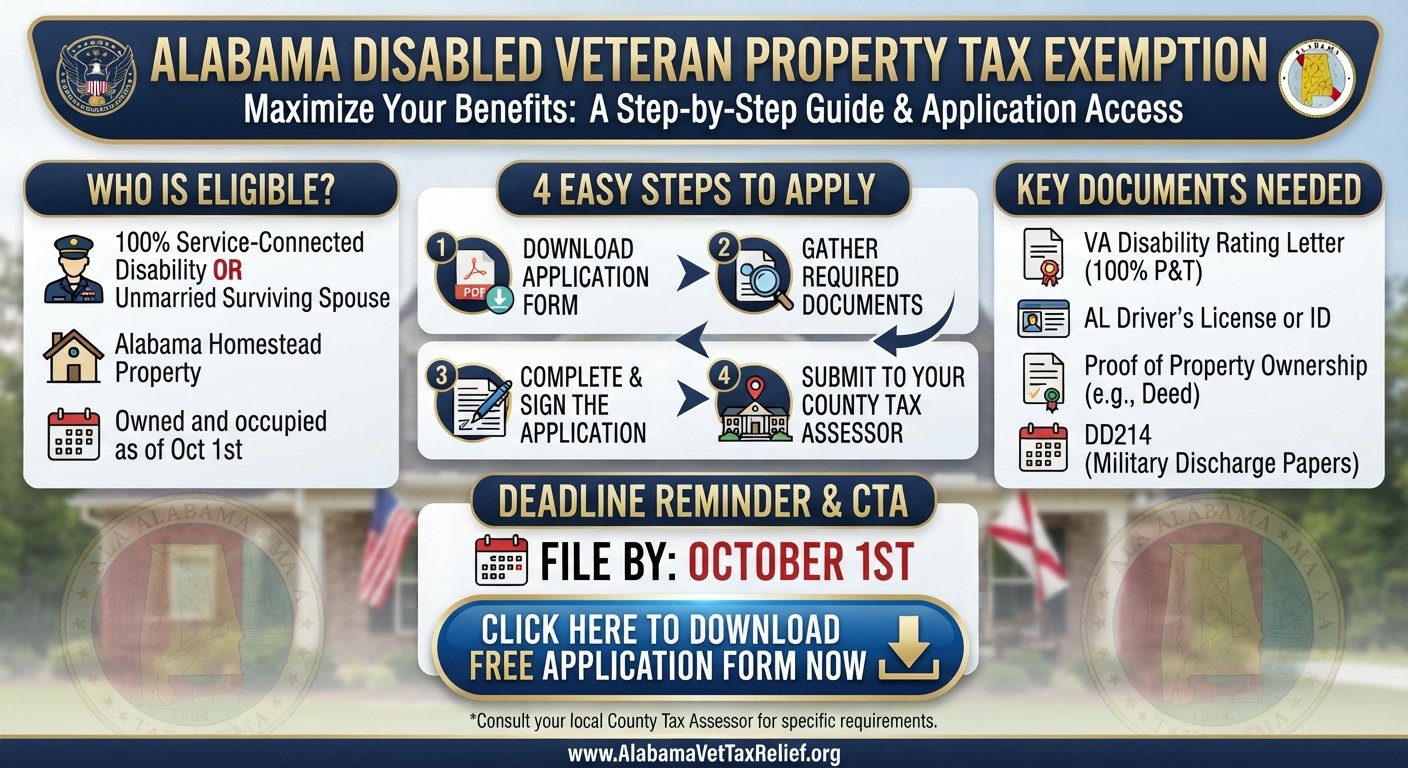
Alabama Disabled Veteran Property Tax Exemption: What You Need to Know
Alabama exempts from state ad valorem taxation the homestead of veterans with a 100 percent permanent and total disability rating from the U.S. Department of Veterans Affairs. The exemption covers a single-family owner-occupied home plus up to 160 acres. There are no age or income limits. New for 2026, qualifying veterans can receive a tentative certificate before purchasing a home to exclude property taxes from mortgage debt-to-income calculations .
Quick Facts
| Item | Details |
|---|---|
| Benefit | Full exemption from state ad valorem taxes on homestead |
| Eligibility | Veterans with 100% permanent and total VA disability rating |
| Application | County tax assessing official; tentative certificate available pre-purchase |
| Processing Time | Tentative certificate issued within 20 days of complete application |
| Official Agency | Alabama Department of Revenue / County Tax Assessor |
| Required Forms | Affidavit (Form from Dept. of Revenue), VA disability documentation |
| Updated For | 2026 Tax Year |
What Is the Alabama Disabled Veteran Property Tax Exemption?
The Alabama disabled veteran property tax exemption eliminates state ad valorem taxes on a qualifying veteran’s primary residence. Under Alabama law, veterans with a 100 percent permanent and total disability rating are exempt from all state ad valorem taxes on their homestead .

VA Disability Combined Rating Calculator
Add each disability rating from your decision letter.

Estimate only. The VA makes the official rating decision. Not legal or financial advice, and not affiliated with the Department of Veterans Affairs.
This exemption applies specifically to state property taxes. Depending on the county and municipality, additional local exemptions may apply, particularly for veterans whose homes were acquired through VA Specially Adapted Housing (SAH) grants .
Why this matters: Alabama has relatively low property taxes compared to many states, but for disabled veterans living on fixed incomes, eliminating state property taxes provides meaningful financial relief. Combined with Alabama’s other veteran benefits—including no state income tax on military retirement—the state offers a favorable tax environment for disabled veterans.
What veterans should do next: Contact your county tax assessing official to determine current procedures for claiming the exemption in your locality.
Who Qualifies for the Alabama Disabled Veteran Exemption?
To qualify for the Alabama disabled veteran property tax exemption, a veteran must meet all of the following requirements:
VA Disability Rating: Have received a 100 percent disability rating from the U.S. Department of Veterans Affairs, with the disability designated as permanent and total .
Honorable Discharge: Have served honorably in the U.S. Armed Forces.
Property Ownership: Own the property for which the exemption is claimed.
Primary Residence: Occupy the property as the veteran’s principal place of residence .
Homestead Definition: The property must qualify as a homestead—a single-family owner-occupied home plus up to 160 acres of land .
Who Does Not Qualify
Veterans with disability ratings below 100%
Veterans whose 100% rating is not designated as permanent and total
Veterans who do not own their primary residence
Veterans whose property is not used as their principal residence
Veterans who received a dishonorable discharge
Army Fitness Test (AFT) Score Calculator
Formerly the ACFT. Five events, 500 points. Enter your results.
Estimate for training only. Points are interpolated from the official Army tables (effective 1 June 2025) and can differ by a few points. Your score of record comes from your unit graders. Official score tables (PDF). Not affiliated with the U.S. Army.
Important distinction: The exemption requires a 100% permanent AND total disability rating. A veteran with a 100% schedular rating that is not designated as permanent and total may not qualify.
Age and Income Limits
There are no age limits for the disability-based exemption. Unlike Alabama’s exemption for seniors age 65 and older, the disabled veteran exemption does not impose income restrictions .
New for 2026: Tentative Certificate for Mortgage Applicants
Beginning June 1, 2025, Alabama implemented a significant change that benefits disabled veterans purchasing homes. Under the Disabled Veterans Property Tax Debt-To-Income Ratio Exemption Act, veterans with a 100 percent disability rating can now obtain a tentative certificate of permanent and total disability before purchasing a homestead .
How the Tentative Certificate Works
Application: The veteran submits an affidavit (on a form supplied by the Department of Revenue), the purchase agreement for the homestead, and VA documentation showing 100 percent service-connected, permanent, and total disability .
Processing: The tax assessing official must issue the tentative certificate within 20 business days of receiving all required information .
Mortgage Benefit: Settlement agents and loan closing officers may not consider ad valorem taxes for the homestead when calculating the veteran’s debt-to-income ratio upon receiving the tentative certificate .
Upon Purchase: The tentative certificate becomes a valid certificate of permanent and total disability upon the veteran’s purchase of the homestead .
Why This Matters for Veterans
This provision helps disabled veterans qualify for mortgages by excluding property tax obligations from debt-to-income calculations. Since the veteran will be exempt from these taxes, lenders should not count them as an ongoing expense.
What veterans should do next: If you are planning to purchase a home in Alabama and have a 100% permanent and total VA disability rating, apply for the tentative certificate before finalizing your mortgage application.
Understanding the Homestead Definition
Alabama law defines a homestead as a single-family owner-occupied home plus up to 160 acres of land . Understanding this definition is essential for determining what property qualifies for the exemption.
What Qualifies as a Homestead
Single-family home
Owner-occupied (veteran must live there)
Up to 160 acres of adjacent land
Primary residence
What Does Not Qualify
Rental properties
Second homes
Investment properties
Commercial properties
Vacant land (unless adjacent to qualifying homestead)
Co-Ownership Rules
Veterans may own their homestead jointly with a spouse and still qualify for the full exemption. For properties owned with someone other than a spouse, the veteran may qualify for a proportional share of the exemption based on their ownership interest .
VA Specially Adapted Housing Exemption
Veterans whose homes were acquired through a VA Specially Adapted Housing (SAH) grant may qualify for additional property tax relief beyond the standard disabled veteran exemption.
Under Alabama Code Section 40-9-20, the home of any veteran acquired pursuant to Public Law 702 (38 U.S.C.A. 701 and Chapter 12) is exempt from all ad valorem taxation regardless of its value, so long as it is owned and occupied as a home by the veteran or their unremarried widow .
What Is the SAH Grant?
The VA’s Specially Adapted Housing grant helps veterans with certain service-connected disabilities purchase or modify a home to meet their mobility needs. Homes acquired through this program may qualify for complete exemption from all ad valorem taxes—state, county, and city .
Surviving Spouse Benefits Under SAH
The SAH-related exemption extends to an unmarried surviving spouse who continues to live in the home . This is a valuable benefit that continues even after the veteran’s death, provided the spouse does not remarry.
How to Apply for the Alabama Disabled Veteran Exemption
Step-by-Step Application Process
Step 1: Obtain Required Forms
Contact your county tax assessing official to obtain the application form and affidavit required for the disabled veteran exemption. The Department of Revenue supplies the affidavit form .
Step 2: Gather Required Documents
You will need:
Documentation from the U.S. Department of Veterans Affairs showing 100 percent service-connected, permanent, and total disability
Proof of honorable discharge (DD-214)
Affidavit including your name, spouse’s name (if applicable), and attestation that the homestead will be occupied as your principal place of residence
Property purchase agreement (for tentative certificate applications)
Step 3: Submit Application
Submit your completed application and supporting documents to your county tax assessing official.
Step 4: Wait for Processing
For tentative certificates, the tax assessing official must issue the certificate within 20 business days of receiving all required information . For standard exemptions, processing times vary by county.
Step 5: Receive Certificate
Once approved, you will receive a certificate of permanent and total disability as evidence of the exemption.
Annual Renewal and Recent Changes
Under existing law, veterans have been required to renew their exemption certificates annually. However, legislation discussed in the 2026 Alabama legislative session proposed eliminating the annual renewal requirement for permanently and totally disabled veterans .
The proposed change would allow qualifying veterans to establish the exemption once and keep it without reapplying annually, except if they change mortgages or establish a new homestead. As of the date of this publication, veterans should verify current renewal requirements with their county tax assessing official.
Required Documents for Alabama Disabled Veteran Exemption
| Document | Purpose | Notes |
|---|---|---|
| VA Disability Documentation | Proves 100% permanent and total disability | Required for all applicants |
| DD-214 | Proves honorable discharge | Copy acceptable |
| Affidavit | Formal request for exemption | Form supplied by Dept. of Revenue |
| Purchase Agreement | For tentative certificate | Required for pre-purchase applications |
| Proof of Residency | Confirms primary residence | Driver’s license or similar |
Common mistake: Submitting VA documentation that does not clearly state “permanent and total” disability. Request a benefits summary letter from the VA that explicitly confirms your rating status.
Refunds for Prior Tax Years
Recent legislation (HB303, effective June 1, 2025) authorized local tax officials to reimburse 100 percent disabled veterans for ad valorem taxes paid on their homestead from the disability determination’s effective date, up to a maximum of two years .
Eligibility for Reimbursement
To receive reimbursement, the veteran must:
Apply for a homestead exemption due to disability under Sections 40-9-19 or 40-9-21
Provide VA documentation showing 100 percent permanent and total disability and the effective date of the determination
Include the veteran’s and spouse’s names, if applicable
How Reimbursement Works
The reimbursed amount is deducted on a pro rata millage basis from ad valorem taxes collected for the state, county, and subdivisions that received any portion of the reimbursed taxes .
Alabama vs. Other States: Disabled Veteran Property Tax Benefits
| State | 100% Disabled Veteran Benefit | Surviving Spouse Benefit |
|---|---|---|
| Alabama | Full exemption from state ad valorem taxes | Exemption may continue (varies) |
| Texas | Full exemption on homestead | Full exemption (if not remarried) |
| Florida | Full exemption on homestead | Full exemption (if not remarried) |
| Virginia | Full exemption on primary residence + 1 acre | Full exemption (if not remarried) |
| Georgia | $4,000-$10,000 exemption | Varies |
Alabama’s exemption applies to state ad valorem taxes. Some states offer more comprehensive exemptions covering all taxing jurisdictions. Veterans should verify local tax treatment in their county.
Common Mistakes When Applying for the Alabama Exemption
Insufficient VA documentation: The VA letter must clearly state “100% permanent and total” disability. General benefit letters may not be sufficient.
Not understanding what the exemption covers: The standard exemption applies to state ad valorem taxes. Additional local exemptions may apply for SAH-acquired homes .
Missing the homestead definition: The property must be a single-family owner-occupied home plus up to 160 acres .
Not applying for the tentative certificate before purchase: Veterans planning to buy a home should apply for the tentative certificate to exclude property taxes from debt-to-income calculations .
Failing to verify renewal requirements: While legislation has been proposed to eliminate annual renewal, veterans should confirm current requirements with their county .
Not claiming reimbursement for prior years: Veterans may be eligible for reimbursement of up to two years of prior ad valorem taxes paid .
Not notifying the assessor of changes: If you move or your eligibility changes, you must notify the assessor.
Surviving Spouse Benefits in Alabama
Who Qualifies as a Surviving Spouse?
The unremarried surviving spouse of a qualifying disabled veteran may continue receiving the property tax exemption if:
The veteran qualified for the exemption at the time of death
The surviving spouse continues to occupy the property as their primary residence
The surviving spouse has not remarried
SAH-Related Surviving Spouse Benefits
For homes acquired through VA Specially Adapted Housing grants, the exemption continues for the veteran’s unremarried widow so long as the property is owned and occupied as a home .
Recent Legislative Discussion
During the 2026 Alabama legislative session, committee members discussed concerns about surviving spouses losing the exemption after the veteran dies. The sponsor of one bill noted that addressing this issue might require a separate bill due to significant fiscal implications .
Remarriage Disqualification
If a surviving spouse remarries, they lose eligibility for the exemption. There is no exception to this rule.
Proposed Changes to Alabama Veteran Property Tax Exemptions
Annual Renewal Elimination
Legislation discussed in the 2026 session would allow qualifying veterans to establish the exemption once and keep it without reapplying annually, except if they change mortgages or establish a new homestead .
The sponsor emphasized that military disability is permanent, unlike some Social Security disability determinations, and described the burden on older veterans who must repeatedly renew exemptions in person .
Partial Disability Exemption
Legislation introduced in 2024 (HB2542) proposed creating a new homestead exemption for veterans who are at least 20 percent disabled. The exemption would be equivalent to the amount of the disability the individual possesses .
This bill did not pass, but similar proposals may be considered in future sessions.
Surviving Spouse Protection
Lawmakers have acknowledged the need to address the issue of surviving spouses losing exemptions after a veteran’s death . While a separate bill has not yet been enacted, this remains an active area of legislative interest.
Common Questions
1. Do I need to reapply for the Alabama disabled veteran exemption every year?
Under current law, annual renewal may be required. However, legislation has been proposed to eliminate the annual renewal requirement for permanently and totally disabled veterans . Verify current requirements with your county tax assessing official.
2. What is the deadline to apply for the Alabama disabled veteran exemption?
Contact your county tax assessing official for the specific deadline in your locality. For tentative certificates (pre-purchase), the tax assessing official must issue the certificate within 20 days of receiving complete information .
3. Can I receive the exemption on a second home or rental property?
No. The exemption applies only to your primary residence. You must own and occupy the property as your homestead.
4. What happens to the exemption if my spouse dies?
If you are the unremarried surviving spouse, the exemption may continue as long as you occupy the property as your primary residence and do not remarry. For SAH-related exemptions, this benefit is explicitly provided by statute .
5. Can I get a tentative certificate before purchasing a home?
Yes. Effective June 1, 2025, veterans with a 100 percent disability rating can obtain a tentative certificate of permanent and total disability before purchasing a homestead . This certificate prevents lenders from counting property taxes in debt-to-income calculations.
6. Is there an income limit for the Alabama disabled veteran exemption?
No. There are no income limits for the disability-based homestead exemption .
7. What documentation do I need from the VA?
You need documentation from the U.S. Department of Veterans Affairs indicating that you have a 100 percent service-connected, permanent, and total disability .
8. Can I get a refund for prior years’ taxes?
Yes. Under HB303 (effective June 1, 2025), 100 percent disabled veterans may be reimbursed for ad valorem taxes paid on their homestead from the disability determination’s effective date, up to a maximum of two years .
9. What is the homestead size limit?
A homestead is defined as a single-family owner-occupied home plus up to 160 acres of land .
10. Does the exemption cover all property taxes?
The standard disabled veteran exemption applies to state ad valorem taxes. For homes acquired through VA Specially Adapted Housing grants, the exemption may cover all ad valorem taxes—state, county, and city .
11. How long does it take to get a tentative certificate?
The tax assessing official must issue the tentative certificate within 20 business days of receiving all required information .
12. What happens if I remarry as a surviving spouse?
If you remarry, you lose eligibility for the exemption. There is no exception to this rule.
Key Takeaways
Alabama offers a full exemption from state ad valorem taxes on the homestead for veterans with a 100% permanent and total VA disability rating
The exemption covers a single-family owner-occupied home plus up to 160 acres
No age or income limits apply to the disability-based exemption
New for 2025-2026, veterans can obtain a tentative certificate before purchasing a home to exclude property taxes from mortgage debt-to-income calculations
The tentative certificate must be issued within 20 business days of complete application
Veterans with SAH-acquired homes may qualify for exemption from all ad valorem taxes—state, county, and city
Surviving spouses who have not remarried may continue receiving the exemption
Veterans may be eligible for reimbursement of up to two years of prior ad valorem taxes paid
Legislation has been proposed to eliminate annual renewal requirements
Verify current procedures with your county tax assessing official
Official Resources
Alabama Department of Revenue: revenue.alabama.gov
Alabama Code Section 40-9-19: law.justia.com/codes/alabama/
Alabama Code Section 40-9-20: law.justia.com/codes/alabama/title-40/chapter-9/article-1/section-40-9-20/
Alabama Code Section 40-9-21: law.justia.com/codes/alabama/
U.S. Department of Veterans Affairs: va.gov
VA Benefits Hotline: 1-800-827-1000
USA.gov Veterans Benefits: usa.gov/veterans-benefits
🇺🇸 IMPORTANT DISCLAIMER – Veterans Benefits Information
This site provides general information about U.S. Department of Veterans Affairs (VA) benefits for educational and informational purposes only.
- Not Official: We are NOT affiliated with, endorsed by, or connected to the U.S. Department of Veterans Affairs (VA), the Veterans Benefits Administration (VBA), the Veterans Health Administration (VHA), or any other government agency.
- No Legal/Financial Advice: The content on this website is for informational purposes only and does not constitute legal, financial, or medical advice. VA benefits rules change frequently – always consult with an accredited Veterans Service Officer (VSO) or a qualified professional for your specific situation.
- Official Sources: For official, binding information and to apply for benefits, always visit official .gov websites: VA.gov, Benefits.VA.gov, or SSA.gov.
- No Data Collection: This site does not collect, store, or process any personal information. It does not have login forms, contact forms, or any system to capture user data. We never ask for your Social Security Number, bank details, or any personal information.
- 🚨 Scam Alert: The VA and other government agencies never charge fees for benefit applications. If anyone asks for money to "process" your VA claim, it is a scam. Report it to the VA Office of Inspector General at VA.gov/OIG.
- Advertising: This site uses third-party advertising (Adsterra) to cover operational costs. We do not endorse or guarantee any products or services advertised.
📌 Information provided as of June 2026. Always verify current eligibility and rules with official .gov sources.
This site is not affiliated with the U.S. Department of Veterans Affairs or any government agency. All information is for educational purposes only. Please visit VA.gov for official information.
