
Florida Veterans Property Tax Exemption: Disability Rating Guide
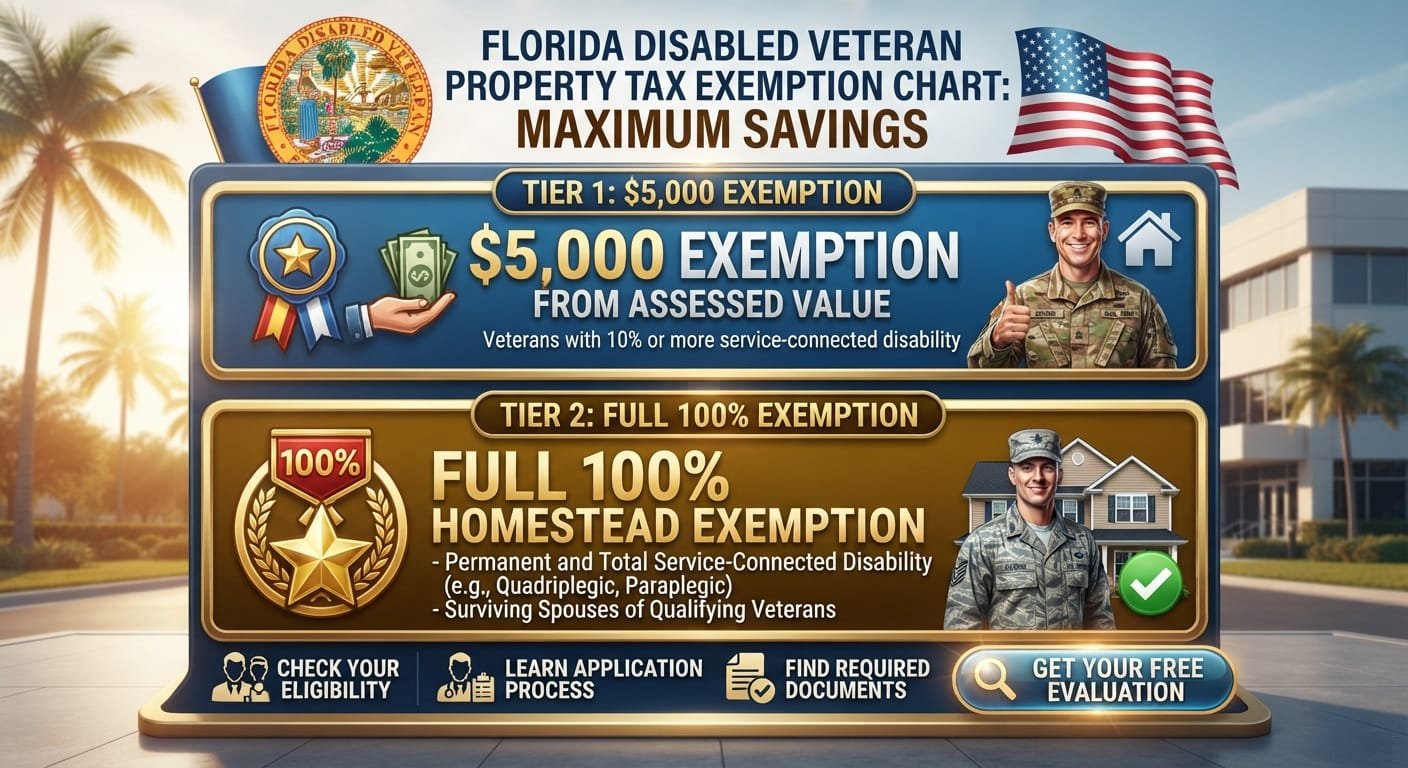
Florida disabled veterans qualify for property tax relief based on VA disability rating. Veterans rated 10% to 99% service-connected receive a $5,000 exemption on assessed value. Those rated 100% permanent and total receive a complete exemption from property taxes on their homestead, paying zero dollars annually .
Quick Facts
| Item | Details |
|---|---|
| Benefit | $5,000 exemption (10–99% rating) or full homestead exemption (100% P&T) |
| Eligibility | Florida resident veteran with VA service-connected disability rating of 10%+; honorable discharge |
| Application | File Form DR-501DV with your county property appraiser |
| Deadline | March 1 (late filing possible with petition to Value Adjustment Board) |
| Processing Time | Varies by county; contact local property appraiser |
| Official Agency | County Property Appraiser; Florida Department of Revenue |
| Required Forms | Form DR-501DV; VA disability letter; DD-214 (honorable discharge); Florida ID |
| Updated For | 2026 tax year (HB 393/SB 450 on surviving spouse transfer died in committee) |
What Is the Florida Disabled Veteran Property Tax Exemption?
The Florida disabled veteran property tax exemption reduces or eliminates the taxable value of a qualifying veteran’s homestead based on VA service-connected disability rating. It is authorized by Florida Statutes §§ 196.24 and 196.081 .

This benefit matters because Florida has no state income tax, making property taxes one of the largest tax burdens homeowners face. For veterans with service-connected disabilities, the exemption can reduce annual tax bills by hundreds of dollars or eliminate them entirely at the 100% rating level .

What veterans should do next: Obtain your VA disability rating letter and DD-214, then file Form DR-501DV with your county property appraiser before March 1.
Exemption Amounts by Disability Rating
Florida’s disabled veteran property tax exemption has two tiers, not four. The structure is simpler than states like Texas, which has graduated exemptions at every 20% increment.
| VA Disability Rating | Exemption Type | Annual Tax Impact |
|---|---|---|
| 10% – 99% | $5,000 assessed value exemption | Reduces taxable value by $5,000 |
| 100% Permanent & Total | Full homestead exemption | $0 property taxes on homestead |
How the $5,000 Exemption Works
The $5,000 exemption is subtracted from your property’s assessed value after the standard homestead exemption is applied .
Example calculation:
| Step | Amount |
|---|---|
| Assessed value | $250,000 |
| Standard homestead exemption | − $50,000 |
| Disabled veteran exemption (10–99%) | − $5,000 |
| Taxable value | $195,000 |
Veterans May Qualify for Extra Benefits
Check available financial assistance, healthcare programs and other opportunities that may apply to you.
Check EligibilityYour tax bill is calculated on $195,000 rather than $250,000.
How the 100% Full Exemption Works
Veterans with a 100% service-connected, total and permanent disability rating receive a complete exemption from property taxes on their homestead . The full assessed value is exempt, regardless of home value.
Eligibility for full exemption requires:
VA rating of 100% service-connected, total and permanent
Honorable discharge
Florida residency
Homestead exemption on the property
Property used as primary residence
Who Qualifies: Eligibility Requirements
You qualify for the Florida disabled veteran property tax exemption if you meet all of the following criteria :
Veteran status: Honorably discharged from U.S. Armed Forces
Disability rating: VA service-connected disability rating of 10% or higher (for $5,000 exemption) or 100% permanent and total (for full exemption)
Florida residency: You are a Florida resident
Property ownership: You own the property
Homestead status: The property receives the Florida homestead exemption
Primary residence: The property is your permanent residence
Do You Need the Homestead Exemption First?
Yes. The disabled veteran exemption is an additional exemption that layers on top of the standard homestead exemption. You cannot claim it on a property that is not already receiving homestead exemption status .
What to do: If you have not yet filed for the Florida homestead exemption, do so first. The disabled veteran exemption cannot exist independently.
Income Limits: Does Florida Have One?
No. There is no income limit for the Florida disabled veteran property tax exemption under § 196.24 or § 196.081. Eligibility is based solely on VA disability rating, honorable discharge, Florida residency, and homestead status.
A separate program—the combat-disabled veteran discount for veterans age 65+ under § 196.082—also has no income limit. That discount is calculated as a percentage of the veteran’s combat-related disability rating and applies to the tax amount owed, not just assessed value .
Required Documents
Florida property appraisers require specific documentation to process the exemption. Requirements are consistent statewide under Florida Department of Revenue guidelines .
Standard Required Documents
| Document | Purpose | Notes |
|---|---|---|
| Form DR-501DV | Disabled veteran exemption application | Available from county property appraiser |
| VA disability rating letter | Confirms service-connected disability and percentage | Must show rating and total/permanent status if applicable |
| DD Form 214 | Proof of honorable discharge | Copy acceptable |
| Florida driver’s license or ID | Proves Florida residency | Address should match homestead |
| Homestead exemption confirmation | Proves property already receives homestead exemption | May be on file with appraiser |
| Death certificate (surviving spouse) | Confirms veteran’s death | Only for survivor applicants |
| Marriage certificate (surviving spouse) | Confirms spousal relationship | Only for survivor applicants |
How to Obtain Your VA Disability Letter
Request a VA disability rating letter through VA.gov or by contacting the VA regional office. The letter must show:
Combined service-connected disability rating
Effective date of rating
For full exemption: explicit confirmation of “total and permanent” disability status
What to do: Request your VA letter early. Processing can take several weeks, and your application cannot be approved without it.
How to Apply: Step-by-Step
The application process is handled at the county level through the property appraiser. Follow these steps in order .
Step 1: Confirm Homestead Exemption Is Active
Verify that your property already receives the Florida homestead exemption. If not, file for homestead exemption first.
Step 2: Obtain Form DR-501DV
Download Form DR-501DV from your county property appraiser’s website or pick one up in person. This is the disabled veteran exemption application.
Step 3: Gather Required Documentation
Collect your VA disability rating letter, DD-214, Florida driver’s license or ID, and any additional documents for surviving spouse applications.
Step 4: Complete the Application
Fill out Form DR-501DV completely. Enter your VA disability rating percentage and check the appropriate box for exemption type. Sign and date the form .
Step 5: File With Your County Property Appraiser
Submit the completed application with all attachments to your county property appraiser. Options include:
In person: Visit the property appraiser’s office
Mail: Send to the address listed on the form
Online: Some counties offer online filing through their portals
Step 6: Confirm Receipt and Follow Up
The property appraiser should acknowledge receipt. If you don’t hear back within 30 days, contact the office to confirm your application is being processed.
Online Application Availability
Many Florida county property appraisers offer online filing or document upload for exemption applications. Larger counties (Miami-Dade, Hillsborough, Broward, Palm Beach) typically have online portals .
Availability varies by county. Some counties allow you to begin the application online, which auto-populates parcel data from the appraiser’s database. Smaller counties may require mail or in-person filing.
What to do: Visit your county property appraiser’s website to check whether online filing is available. Have digital copies of your VA letter and DD-214 ready to upload.
Filing Deadlines and Late Filing
The standard deadline to file Form DR-501DV is March 1 of the tax year .
Late Filing Options
If you miss the March 1 deadline, Florida law provides a remedy. Under § 196.082(3), a qualified applicant who fails to file by March 1 may file an application and petition with the Value Adjustment Board requesting that the exemption or discount be granted .
The petition must be filed according to the procedures for exemptions set forth in § 196.011(9). Contact your county property appraiser for the Value Adjustment Board deadline, which is typically in the fall.
Processing Times
Processing times vary by county. The Florida Department of Revenue does not set a uniform processing deadline for property appraisers.
What Affects Processing Speed
The most common cause of delays is documentation issues:
VA letter not showing required disability rating or total/permanent status
DD-214 not showing honorable discharge
Name mismatches between documents and property records
Missing homestead exemption confirmation
What to do: Before filing, verify that all documents are consistent. The name on your deed, Florida ID, and DD-214 should align or have supporting documentation explaining any differences.
Surviving Spouse Eligibility
A surviving spouse may continue the disabled veteran property tax exemption under specific conditions .
Surviving Spouse Requirements
| Requirement | Details |
|---|---|
| Marital status | Spouse must not have remarried |
| Property status | Property must remain the spouse’s homestead |
| Veteran’s Florida residency | Veteran was a Florida resident at time of death (for some provisions) |
| Documentation | VA letter, death certificate, marriage certificate required |
Exemption Transfer
If the surviving spouse sells the property, the exemption up to the dollar amount granted from the most recent tax roll may be transferred to a new primary residence. The spouse must continue to use the new property as their homestead and must not remarry .
Legislative note: Bills filed in the 2026 session (HB 393 and SB 450) would have removed the dollar cap on exemption transfers for surviving spouses. Both bills died in committee and did not become law .
What to do: Surviving spouses should contact their county property appraiser promptly after the veteran’s death to ensure the exemption remains in effect. If considering a move, confirm transfer rules with the appraiser before selling.
Combat-Disabled Veteran Discount (Age 65+)
Florida offers a separate discount for veterans age 65 or older with a combat-related disability. This is different from the standard disabled veteran exemption .
How It Differs
| Feature | Standard Exemption (§196.24) | Combat Disability Discount (§196.082) |
|---|---|---|
| Age requirement | None | 65 or older |
| Disability type | Any service-connected | Combat-related |
| Rating required | 10%+ | 10%+ |
| Benefit structure | $5,000 exemption on assessed value | Percentage discount on tax amount owed |
| Benefit calculation | Fixed dollar amount | Equal to VA disability percentage |
How the Discount Is Calculated
The discount is a percentage equal to the veteran’s permanent, service-connected disability rating. For example, a veteran rated 70% combat-disabled receives a 70% discount on the ad valorem tax otherwise owed .
What to do: Veterans age 65+ with combat-related disabilities should ask their property appraiser whether they qualify for this discount in addition to or instead of the standard exemption.
Common Mistakes That Cause Denials
Mistake 1: Applying without homestead exemption.
The disabled veteran exemption layers on top of homestead exemption. If homestead is not active, the application will be denied .
Mistake 2: Submitting a VA letter that doesn’t show total and permanent status.
For the full exemption, the VA letter must explicitly state the disability is “total and permanent.” A 100% schedular rating alone may not qualify .
Mistake 3: Missing the March 1 deadline.
Late filing requires a Value Adjustment Board petition. Missing both deadlines means losing the exemption for that tax year.
Mistake 4: Assuming the exemption is automatic.
Florida property appraisers do not apply the disabled veteran exemption automatically. You must apply .
Mistake 5: Not reporting changes in residency or ownership.
If you move, sell the property, or change primary residence, you must notify the property appraiser. The exemption does not transfer automatically.
Mistake 6: Claiming the exemption on a non-homestead property.
The exemption applies only to your primary residence. Rental properties and second homes do not qualify.
Appeals Process for Denied Applications
If your exemption application is denied, you have the right to appeal.
How to Appeal
Step 1: Review the denial notice. The property appraiser must notify you in writing of the denial and state the reasons .
Step 2: File a petition with the Value Adjustment Board. The petition must be filed by the deadline specified in the denial notice, typically within 30-60 days.
Step 3: Prepare your evidence. Gather documentation supporting your eligibility: VA letter, DD-214, proof of homestead, and any other relevant records.
Step 4: Attend the VAB hearing. The Value Adjustment Board will hear your case. You may appear in person or through an authorized representative.
Florida vs. Other States: Comparison
Florida offers full exemption only at 100% permanent and total, but provides partial relief starting at 10%. This makes it accessible to more veterans than states requiring higher ratings.
| State | Minimum Rating | Partial Exemption | Full Exemption |
|---|---|---|---|
| Florida | 10% | $5,000 | 100% P&T only |
| Texas | 10% | $5,000–$12,000 | 100% only |
| Louisiana | 50% | $2,500–$4,500 | 100% or IU |
| Virginia | 100% | None | 100% only |
| California | 100% | None | Full (income limit) |
What this means: Florida provides partial relief at the lowest threshold (10%) but reserves full exemption for veterans rated 100% permanent and total. Virginia offers no partial exemption at all.
Common Questions
What is the Florida property tax exemption for 50% disabled veterans?
Veterans with a 50% VA disability rating receive a $5,000 exemption on their homestead’s assessed value. This reduces taxable value before taxes are calculated. It layers on top of the standard homestead exemption .
Do I need to reapply for the Florida disabled veteran exemption every year?
No. Once approved, the exemption generally continues automatically. However, you must notify the property appraiser if you change your primary residence, sell the property, or your disability status changes.
What is the deadline to file for the Florida disabled veteran property tax exemption?
The standard deadline is March 1. If you miss it, you may file a late application with a petition to the Value Adjustment Board requesting that the exemption be granted .
Can my surviving spouse keep the exemption after I die?
Yes. A surviving spouse who has not remarried can continue the exemption if the property remains their homestead. If the spouse sells, the exemption up to the amount from the most recent tax roll may transfer to a new primary residence .
What documents do I need to apply for the Florida disabled veteran exemption?
You need Form DR-501DV, a VA disability rating letter, DD-214 showing honorable discharge, Florida driver’s license or ID, and confirmation of homestead exemption. Surviving spouses also need a marriage certificate and death certificate .
Is there an income limit for the Florida disabled veteran property tax exemption?
No. Florida has no income limit for the standard disabled veteran exemption under § 196.24 or the full exemption under § 196.081. Eligibility is based on VA disability rating, honorable discharge, and homestead status .
What is the difference between the $5,000 exemption and the full exemption?
Veterans rated 10–99% receive a $5,000 exemption on assessed value. Veterans rated 100% service-connected, total and permanent receive a full exemption, paying zero property taxes on their homestead .
How long does it take to process a Florida disabled veteran exemption application?
Processing times vary by county. The Florida Department of Revenue does not set a uniform processing deadline. Contact your county property appraiser for an estimated timeline.
Can I get a refund for prior years if I qualified but didn’t apply?
Florida law limits refunds for excess taxes paid to a four-year period under § 197.182(1)(e). Contact your property appraiser to ask about retroactive exemption eligibility .
Does the exemption apply to property taxes for schools and local services?
Yes. The Florida disabled veteran exemption applies to all ad valorem property taxes, including school district, county, city, and special district taxes. There is no carve-out for specific tax categories.
What happens if my VA disability rating increases from 70% to 100%?
You may qualify for the full exemption. Submit an updated VA letter showing 100% permanent and total disability to your property appraiser. The exemption should adjust going forward, but backdating may not apply.
Can I claim the exemption on a home I own but don’t live in?
No. The exemption applies only to your homestead—the property you own and occupy as your primary residence. Rental properties and second homes do not qualify .
I bought my Florida home midyear. Can I get a refund?
Possibly. Under Florida law, qualifying veterans who acquire a new property between January 1 and November 1 may be entitled to a prorated refund of ad valorem taxes paid on the newly acquired home. You must apply for and receive the exemption on that property for the following tax year .
Key Takeaways
Florida offers a $5,000 exemption for veterans rated 10–99% service-connected disabled .
Veterans rated 100% permanent and total receive a full homestead exemption, paying zero property taxes .
No income limit applies to the Florida disabled veteran property tax exemption.
File Form DR-501DV with your county property appraiser by March 1 .
The homestead exemption must be active first—the disabled veteran exemption layers on top .
Surviving spouses may continue the exemption if they do not remarry and the property remains their homestead.
A separate combat-disabled discount exists for veterans age 65+ under § 196.082 .
Late filing is possible with a Value Adjustment Board petition.
No annual reapplication is required, but you must notify the appraiser of changes.
2026 bills to remove the surviving spouse transfer cap died in committee .
Official Resources
Florida Department of Revenue
Website: floridarevenue.com
Purpose: Property tax exemption information and Form DR-501DV guidance
U.S. Department of Veterans Affairs
Website: va.gov
Purpose: Obtain VA disability rating letters and benefit summaries
Your County Property Appraiser
Find through your county government website
Purpose: File Form DR-501DV and apply for the exemption
Florida Department of Veterans’ Affairs
Website: floridavets.org
Purpose: State veterans benefits information and assistance
USA.gov Veterans Benefits
Website: usa.gov/veterans-benefits
Purpose: Federal veterans benefits information

🇺🇸 IMPORTANT DISCLAIMER – Veterans Benefits Information
This site provides general information about U.S. Department of Veterans Affairs (VA) benefits for educational and informational purposes only.
- Not Official: We are NOT affiliated with, endorsed by, or connected to the U.S. Department of Veterans Affairs (VA), the Veterans Benefits Administration (VBA), the Veterans Health Administration (VHA), or any other government agency.
- No Legal/Financial Advice: The content on this website is for informational purposes only and does not constitute legal, financial, or medical advice. VA benefits rules change frequently – always consult with an accredited Veterans Service Officer (VSO) or a qualified professional for your specific situation.
- Official Sources: For official, binding information and to apply for benefits, always visit official .gov websites: VA.gov, Benefits.VA.gov, or SSA.gov.
- No Data Collection: This site does not collect, store, or process any personal information. It does not have login forms, contact forms, or any system to capture user data. We never ask for your Social Security Number, bank details, or any personal information.
- 🚨 Scam Alert: The VA and other government agencies never charge fees for benefit applications. If anyone asks for money to "process" your VA claim, it is a scam. Report it to the VA Office of Inspector General at VA.gov/OIG.
- Advertising: This site uses third-party advertising (Adsterra) to cover operational costs. We do not endorse or guarantee any products or services advertised.
📌 Information provided as of June 2026. Always verify current eligibility and rules with official .gov sources.
This site is not affiliated with the U.S. Department of Veterans Affairs or any government agency. All information is for educational purposes only. Please visit VA.gov for official information.
