
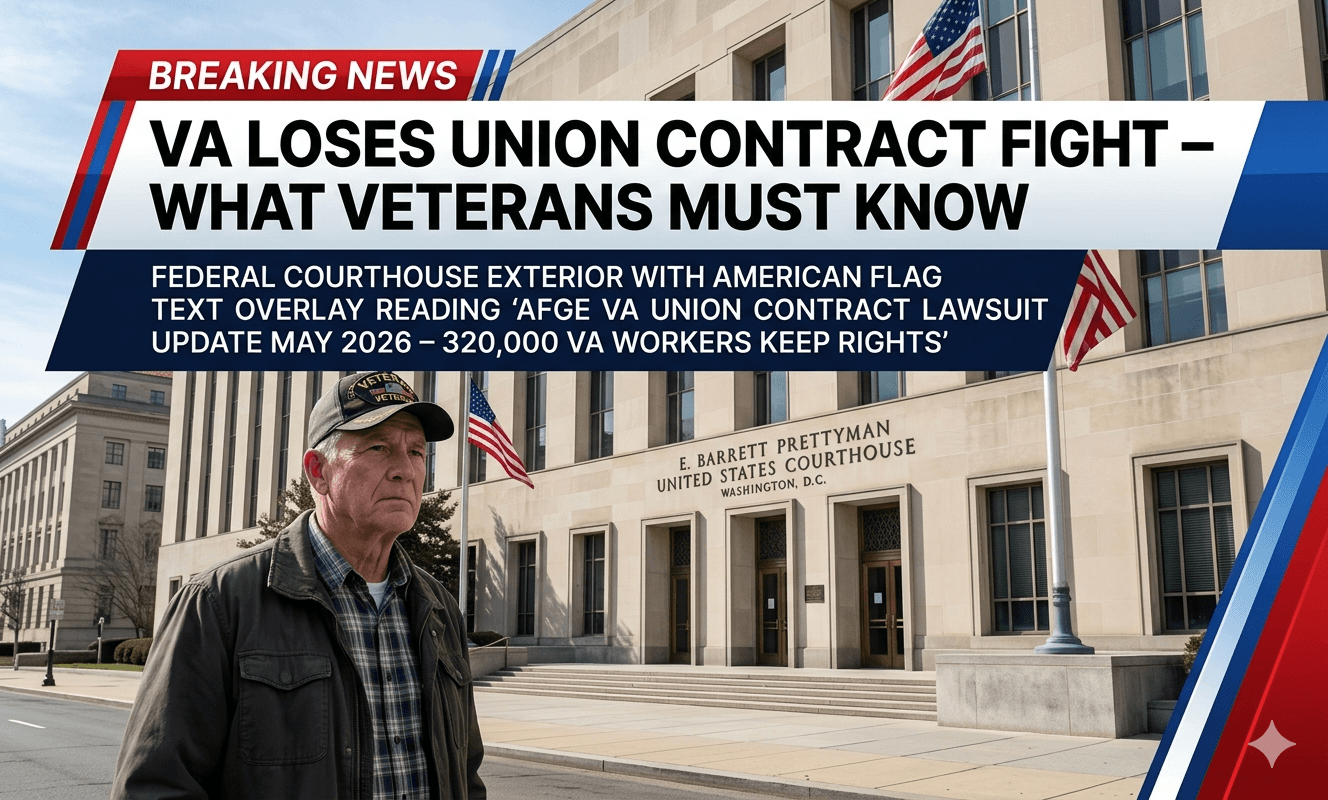
Introduction to the Case
The recent ruling by a federal appeals court has garnered significant attention regarding the contract between the Department of Veterans Affairs (VA) and the American Federation of Government Employees (AFGE). The case originates from the VA’s controversial decision to terminate the existing union contract, which has been a vital agreement for the employees providing essential services to veterans across the nation. The VA argued that the termination was necessary due to the need for greater flexibility in management practices, a claim that sparked considerable debate among labor advocates, veterans’ organizations, and lawmakers.
Prior to the court’s involvement, the VA asserted that existing agreements hindered its ability to efficiently administer programs and manage its workforce effectively. Proponents of this viewpoint contended that outdated provisions of the contract were impeding the VA’s capacity to address staffing needs and respond promptly to the evolving demands of veteran care. However, critics vehemently opposed this rationale, asserting that these unions play a crucial role in safeguarding workers’ rights and ensuring that veterans receive the best possible care and support.

The AFGE, representing thousands of VA employees, has long maintained that the protections offered by the union contract are essential for promoting a stable and fair working environment. This perspective highlights a tension that exists between administrative flexibility and employee rights, raising important questions about the future of labor relations in government agencies. Following the VA’s announcement of the contract termination, the AFGE swiftly initiated legal action, leading to a series of hearings that culminated in the recent appeals court ruling. The court ultimately determined that the VA’s attempts to unilaterally discard the labor agreement violated federal labor laws, thereby reinstating the contract and reinforcing the significance of collective bargaining in the federal workplace.
Federal Appeals Court Just Blocked the VA’s Union Contract Termination: Live Updates for Veterans

May 26, 2026: Federal appeals court denies VA’s bid to cancel AFGE union contract for 320,000 workers. What this means for your VA benefits and claims processing.
The VA Just Lost a Major Court Battle
If you are a veteran waiting on a disability claim, a pension, or a medical appointment, this decision affects you directly.
On May 16, 2026, the U.S. Court of Appeals for the First Circuit unanimously denied the Department of Veterans Affairs’ emergency request to cancel its union contract with the American Federation of Government Employees (AFGE) .
What that means in plain English: The largest union representing VA workers—nurses, claims processors, social workers, and housekeeping staff—keeps its legal rights on the job. The VA tried twice to rip up the contract. The courts said no both times.
Veterans May Qualify for Extra Benefits
Check available financial assistance, healthcare programs and other opportunities that may apply to you.
Check EligibilityFor veterans, this is about stability. When VA workers have protections, they stay in their jobs. When they lose protections, turnover spikes and your disability check gets delayed.
Here is everything you need to know today about the AFGE VA union contract lawsuit and how it impacts your family’s bottom line.
What Veterans Need to Know Right Now
The bottom line: The union contract covering over 320,000 VA employees remains in full force while the lawsuit continues .
The VA argued that reinstating the contract would cause “irreparable harm” to the agency. The three-judge panel—appointed by Presidents Biden, Obama, and Trump—said the VA failed to prove its case .
This is not over. The underlying lawsuit is still pending. But for now, the VA must honor the contract. That means:
- Union representation for VA workers stays intact
- Grievance procedures continue
- Workers keep negotiated benefits and protections
Why you should care as a veteran: When VA claims processors have job security and a voice at work, they process your paperwork faster. When they don’t, backlogs grow.
Latest Updates Today (May 2026)
The Timeline of a Messy Legal Fight
August 6, 2025 – VA Secretary Doug Collins terminates the master collective bargaining agreement with AFGE’s National VA Council .
November 4, 2025 – AFGE files a lawsuit in Rhode Island, arguing the termination was retaliation for the union criticizing the Trump administration .
March 13, 2026 – Federal Judge Melissa DuBose issues a preliminary injunction ordering the VA to reinstate the contract immediately .
March 26, 2026 – On the eve of a court hearing, the VA tries to “re-terminate” the contract. Judge DuBose calls it “blatant disrespect” for the rule of law .
May 16, 2026 – The First Circuit Court of Appeals denies the VA’s emergency stay request. The contract stays in place .
Current status as of today: The union contract is active. The VA must comply. The appeals court did put a narrow pause on one part of the lower court’s enforcement order—specifically the part that would have let the district court directly enforce specific contract terms through contempt powers. But the substantive reinstatement of the contract remains .
What the Court Actually Said
Chief Judge David Barron wrote that the VA “failed to make the required ‘strong showing’ that they are likely to succeed in their legal challenge” .
The court also noted something important: The VA kept the contract in place for five months after Trump’s executive order before canceling it. If the contract was truly illegal, why wait?
Who Qualifies for Protections Under This Contract
This lawsuit covers AFGE’s National VA Council, which represents:
- Over 320,000 VA employees
- Nurses
- Housekeeping staff
- Social workers
- Cemetery caretakers
- Claims processors
- Clinicians
If you are a VA employee who is an AFGE member, your collective bargaining rights are currently active. You have the right to union representation, official time for union work, and protections in disciplinary proceedings .
If you are a veteran, you don’t need to “qualify” for anything. But you are the beneficiary of a stable workforce. When VA workers have rights, your care improves.
How This Affects You: Real-Life Impact on Benefits
For Veterans Waiting on Disability Claims
VA claims processors are covered by this contract. When the contract was terminated in August 2025, many workers lost protections. That led to:
- Increased stress and burnout
- Higher turnover
- Slower claims processing
The lawsuit win means stability returns. Workers can speak up about problems without fear of retaliation. That translates to faster decisions on your disability rating.
For Veterans Using VA Healthcare
Nurses and clinicians are covered. When union protections exist, staffing levels tend to be better. When the VA tried to terminate the contract, union leaders warned it would hurt patient care .
The bottom line: This court decision helps keep experienced staff at your local VA hospital.
For Families of Deceased Veterans
Cemetery caretakers and burial benefits processors are covered. If you are waiting on a headstone or burial reimbursement, this matters.
How to Apply or What Steps to Take (As a Veteran)
You do not need to apply for anything related to this lawsuit. This is an internal labor dispute.
But here is your action plan:
Step 1: If you have a pending VA claim, continue checking your status on VA.gov or call 1-800-827-1000.
Step 2: If you experience a delay, file a complaint with your local VA patient advocate. The restored union contract means workers have more power to fix problems—but you still need to speak up.
Step 3: Contact your congressional representative. Bipartisan legislation called the VA Care and Benefits Accountability (VA CBA) Act has been introduced to permanently restore collective bargaining rights for VA employees . Tell your reps to support it.
Step 4: If you are a veteran who works at the VA, contact your local AFGE union representative to confirm your rights are being honored.
Common Mistakes Veterans Make Right Now
Mistake #1: Assuming this doesn’t affect you.
Wrong. Every VA service—from disability checks to cancer treatment—depends on frontline workers. When those workers are demoralized or quitting, you feel it.
Mistake #2: Believing the VA’s spin.
VA Secretary Collins said terminating the contract would help fire “bad workers” and improve service . The court rejected that argument. Don’t assume the VA’s public statements are accurate.
Mistake #3: Ignoring local VA news.
This lawsuit is national, but implementation varies by facility. Some VA hospitals are honoring the contract; others may resist. Pay attention to your local VA’s behavior.
Mistake #4: Waiting to file your claim.
Backlogs could still grow if the VA appeals further. File your claim now. Don’t delay because of legal news.
What This Means Financially for Your Family
If you are a veteran receiving VA benefits: This lawsuit win likely prevents worse delays. Without the union contract, many experienced claims processors would have left. New hires take months to train. Your wait time would have increased.
The numbers matter: Over 300,000 VA workers are affected . That is roughly 80% of the VA’s bargaining-unit employees . When that many workers face uncertainty, the entire system slows down.
If you are a veteran applying for new benefits: Expect processing times to remain steady rather than spike. The restoration of union protections prevents the worst-case scenario.
If you are a veteran who works at the VA: Your paycheck and benefits are protected by this contract. You keep negotiated raises, leave policies, and disciplinary protections.
The Political Context: Why This Is Happening
The Executive Order That Started It All
In March 2025, President Trump signed an executive order stripping collective bargaining rights from over 20 federal agencies, citing “national security” .
The VA was included. The argument: The VA serves as the “primary backup” for military healthcare during wars or emergencies .
The union’s counterargument: That is absurd. A nurse in a stateside VA hospital is not a national security operative. This was retaliation for AFGE criticizing the administration.
Judge DuBose agreed. She wrote: “There is zero indication from the Defendants that the termination decision would have been made or implemented without the retaliatory motive” .
The Bipartisan Response
Senators Lisa Murkowski (R-AK), Richard Blumenthal (D-CT), and Chuck Schumer (D-NY) introduced the VA CBA Act to permanently restore these rights . That bill would nullify Trump’s executive orders and reinstate all canceled contracts.
What this means for you: This is not just a court fight. It is a political fight. If Congress passes the VA CBA Act, the VA cannot try this again regardless of who wins the presidential election.
FAQ: Veterans’ Most Searched Questions
Is the VA union contract reinstated right now?
Yes. As of the May 16, 2026, appeals court ruling, the contract remains in full force while the lawsuit proceeds .
Can the VA try to terminate the contract again?
The VA has already tried twice—once in August 2025 and again in March 2026. The court rejected both attempts. The VA could appeal further, but for now, the contract stands .
How does this affect my VA disability claim processing?
Stable union protections reduce employee turnover. Lower turnover means faster claims processing. This decision prevents the delays that would have occurred if the contract had been permanently canceled.
Who is AFGE and why should I care?
AFGE is the largest federal employee union, representing 820,000 workers . Their VA council specifically represents the people who process your benefits and provide your healthcare. When they win, you win.
What is the VA CBA Act?
Bipartisan legislation that would permanently restore collective bargaining rights for VA employees and nullify the executive orders that led to this mess . It has not yet passed.
Could this go to the Supreme Court?
Possibly. The First Circuit’s decision is not the final word. The VA could request Supreme Court review. But the Court rarely takes labor disputes, and the VA would need to show a major legal error.
What should I do if my VA claim is delayed?
Do not assume the delay is related to this lawsuit. Call the VA at 1-800-827-1000. Request a status update. If you hit a wall, contact your congressional representative’s office.
Final Takeaway: What Every Veteran Needs to Remember
This is a win for stability, not a final victory.
The courts have now rejected the VA’s attempts to kill the union contract twice. That sends a strong message: the VA cannot retaliate against workers for speaking up.
But the underlying lawsuit continues. And the political fight over federal union rights is far from over.
Here is your checklist as a veteran:
- Keep filing your claims. Don’t wait for the legal dust to settle.
- Watch for delays. If your claim slows down, speak up immediately.
- Contact Congress. Support the VA CBA Act to make these protections permanent.
- Know your local VA. Some facilities follow the law better than others. Hold them accountable.
The bottom line in plain English: The VA tried to break its workers’ union. The courts said no. That means the people who answer your calls, process your paperwork, and change your bandages keep their rights. And when they win, you win.
Stay informed. Stay engaged. And never stop advocating for the benefits you earned.
What the Ruling Means for VA Employees
The recent ruling by the federal appeals court to block the termination of the union contract for the Department of Veterans Affairs (VA) has significant implications for the approximately 320,000 VA employees represented by the American Federation of Government Employees (AFGE) union. This decision ensures that essential protections and rights for these employees remain intact, which is crucial in an environment where labor relations may often be contentious.
Firstly, the ruling reaffirms the collective bargaining rights that enable employees to negotiate on critical issues such as pay, healthcare benefits, and working conditions. The contractual agreement serves as a safeguard against potential exploitation or arbitrary decisions made by management that could negatively impact employee welfare. With the court’s intervention, VA employees can continue to engage in discussions to advocate for their interests, ensuring their voices are heard.
Additionally, the ruling reinforces job security for VA employees. With the prospect of a valid union contract still in place, employees can operate in a more secure environment. This stability is particularly significant given the nature of their responsibilities, which include delivering vital services and support to veterans. The support and resources that come from a strong union can play a key role in helping employees perform their duties efficiently and effectively.
Moreover, the court’s decision emphasizes the importance of maintaining a collaborative relationship between VA employees and management. It encourages constructive dialogue and cooperative problem-solving, which are vital for fostering a positive workplace culture. By preserving these rights and protections, the ruling strengthens the overall framework within which VA employees operate, promoting a healthier work environment focused on the shared goal of serving veterans.
Impact on VA Benefits and Services
The recent decision by a federal appeals court to block the termination of the union contract with the Department of Veterans Affairs (VA) will likely have significant implications for veterans’ benefits and services. By allowing the union contract to remain in effect, the VA can maintain established protocols that govern employee relations, ultimately impacting the quality and accessibility of services provided to veterans.
One major area that could see positive changes is the claims processing system. Employees who work under union contracts often have better job security and morale, which can lead to increased productivity and a more effective claims processing workflow. With a more stable workforce, veterans might experience fewer delays and complications when filing claims for benefits, potentially expediting their access to necessary support.
Moreover, the continuation of the union contract may result in improved training and development opportunities for VA employees. Unions typically advocate for continued education and training, ensuring that staff members are well-equipped to handle the complexities of veterans’ needs. Enhanced training can lead to better-informed employees who deliver higher quality service, which is crucial for maintaining veterans’ trust in the VA system.
Another important factor is employee morale. A positive working environment, fostered by union representation, can translate to higher engagement levels among VA employees. When workers feel supported, they are more likely to go above and beyond in their roles, which directly benefits veterans seeking assistance. This improved service quality may manifest in faster response times, more thorough consultations, and an overall better experience for veterans accessing benefits.
Overall, the continuation of the union contract holds potential advantages for veterans, particularly regarding claims processing efficiency, employee morale, and service quality. As these elements come together, it is anticipated that the VA will be better positioned to meet the comprehensive needs of those who have served the nation.
Responses from Veterans and Advocacy Groups
The recent ruling by the Federal Appeals Court to block the termination of union contracts at the Department of Veterans Affairs (VA) has sparked a flurry of responses from veterans and various advocacy groups. Many veterans have expressed relief and optimism regarding the decision, highlighting the crucial role that union representation plays in ensuring their rights and promoting fair labor practices within the VA. A prominent veteran and spokesperson for a local veterans’ organization stated, “This ruling reinforces our belief in the importance of collective bargaining at the VA, which directly impacts the quality of services available to veterans.”
Women veterans, in particular, voiced their support for union representation in light of this decision. As one veteran remarked, “Representation through unions not only safeguards our rights but also addresses the unique challenges many of us face when accessing services at the VA. The commitment to uphold our contracts speaks volumes about the need for advocacy in these matters.”
Advocacy groups, including those focused on veteran affairs and labor rights, have hailed the court’s decision as a pivotal moment for workers within the VA. The President of a renowned veterans’ advocacy group stated, “This ruling is a victory not just for union members, but for all veterans who depend on a responsive and accountable VA. Strong labor rights are directly correlated to the quality of care and support we receive.”
Moreover, grassroots organizations are ramping up their efforts to mobilize support for union initiatives within the VA. They emphasize that the ability to negotiate contracts strongly impacts benefits, working conditions, and ultimately, the services veterans receive. In their statements, they urge all stakeholders to recognize the value of collective action in protecting the rights of veterans and ensuring their voices are heard across the healthcare landscape.
AFGE’s Perspective on the Decision
The American Federation of Government Employees (AFGE) has expressed a strong positive reaction to the recent ruling by the federal appeals court that blocks the Department of Veterans Affairs (VA) from terminating its union contract. This decision is seen as a pivotal moment for collective bargaining and workers’ rights within the federal workforce. AFGE leaders have stated that the ruling not only protects the rights of VA employees but also reinforces the fundamental principles of collective bargaining that are essential for employee representation.
In a press release following the court’s decision, AFGE National President Everett Kelley emphasized the significance of maintaining strong unions in the workplace. Kelley asserted that “the ruling underlines the importance of our voices being heard through collective bargaining, which is a cornerstone of democratic rights for workers.” This statement highlights the belief within the union that collective bargaining is vital not only for favorable working conditions but also for the ability to address grievances and negotiate fair terms of employment.
Moreover, AFGE’s leadership has underscored the implications of this ruling on the wider federal landscape. Union officials argue that when federal agencies undermine collective bargaining, they erode the rights of workers, which can have far-reaching effects on government operations, employee morale, and, ultimately, the quality of services provided to veterans. AFGE leaders assert that such actions contradict the principles of democracy within public service.
Overall, AFGE remains committed to advocating for workers’ rights and believes that this ruling will serve as a protective measure safeguarding the rights of employees within the VA and potentially throughout other federal agencies. The union plans to continue its efforts to uphold collective bargaining and would monitor any future actions that might threaten their hard-won rights.
Legal Analysis of the Decision
The recent ruling by the federal appeals court that blocks the Department of Veterans Affairs (VA) from terminating its union contract is grounded in established legal principles and precedents that govern labor relations within federal agencies. This decision reflects the court’s commitment to upholding the rights of federal employees to organize, negotiate, and participate in collective bargaining as outlined under federal labor laws.
Central to the court’s analysis were the relevant statutes that protect the rights of federal employees, notably the Federal Service Labor-Management Relations Statute. This legislation not only endorses the concept of labor unions but also sets forth the conditions under which union contracts may be modified or terminated. The court underscored the necessity for federal agencies to adhere to these legal frameworks, as any unilateral actions taken by the VA to rescind the contract may constitute a violation of the established rights of its employees.
Moreover, the arguments raised during the proceedings illustrated a significant reliance on prior court rulings that have affirmed the necessity of maintaining stable labor relations within federal entities. For instance, the court referenced past decisions that emphasized the importance of maintaining existing contracts to prevent disruptions in workplace harmony and to bolster employee morale. This historical perspective on labor law not only lends credence to the court’s decision but also signifies the judiciary’s role in safeguarding the interests of federal workers against arbitrary administrative actions.
Ultimately, the decision reinforces the protection of collective bargaining processes, asserting that federal agencies must operate within the legal boundaries established to protect both the interests of the workers and the efficient functioning of government services. The implications of this ruling may resonate beyond the confines of the VA, potentially shaping future interactions between federal agencies and labor organizations.
Potential Future Developments
The recent decision by the Federal Appeals Court to block the Department of Veterans Affairs (VA) from terminating its union contracts has significant implications for both the agency and its workforce. As this situation develops, several possible outcomes warrant attention. First and foremost, it is likely that the VA will consider appealing the ruling, as legal challenges often evolve in response to judicial decisions. An appeal could bring further scrutiny to the union contracts and the VA’s operational policies, potentially prolonging the resolution process.
Moreover, if the VA chooses not to appeal, it may lead to renewed negotiations between union representatives and the department. These discussions could focus on amendments to existing contracts or the establishment of new provisions that address some of the contentious issues previously cited by the VA. Such negotiations would be critical in shaping the working environment of VA employees and ensuring the delivery of services to veterans remains effective and beneficial.
Furthermore, the ruling could catalyze additional legal challenges either from the VA or external entities, particularly if other unions or organizations perceive a pathway to challenge similar contract interpretations. This increased litigation could introduce complexities that may further delay the resolution and impact the relationship between the VA and its unions.
Additionally, stakeholders may advocate for legislative efforts aimed at clarifying the legal framework surrounding federal employee union contracts. Legislative action could influence the dynamics of future contract negotiations, providing clearer guidelines for both union leaders and VA administrators.
In conclusion, the aftermath of the Federal Appeals Court ruling presents a landscape filled with possibilities—whether through appeals, negotiations, or new legal challenges, each potential development will play a significant role in shaping the future of VA union contracts and the welfare of its employees and the veterans they serve.
Veterans’ Voices: Personal Stories
Across the nation, numerous veterans can attest to the critical role that union representation has played in their engagement with the Department of Veterans Affairs (VA). These personal stories provide a compelling narrative that illustrates the practical significance of union support in accessing vital services and benefits.
For instance, John, a former Army sergeant, faced significant challenges after returning from his service. He experienced difficulty navigating the complex healthcare system of the VA, which led to delays in receiving necessary medical treatment. However, once he connected with a union representative, John found an advocate who was instrumental in expediting his claims and facilitating his access to essential healthcare services. This experience not only underscored the importance of having union support but also highlighted how labor representation can lead to better outcomes for veterans.
Another veteran, Sarah, who served in the Navy, encountered barriers when trying to access mental health support. Initially, she felt overwhelmed and uncertain about how to proceed. After becoming involved with a veterans’ union, Sarah received much-needed guidance and support, which empowered her to pursue the mental health services crucial for her recovery. Her story is a testament to how union representation not only provides encouragement but also plays a pivotal role in empowering veterans to assert their rights.
Moreover, there are countless testimonials from veterans who cite union involvement as pivotal in ensuring that their voices are heard in discussions regarding policy changes within the VA. These narratives showcase the vital connection between union representation and improved quality of life for veterans. Without the backing of unions, many veterans may struggle to advocate for themselves effectively, ultimately affecting their overall well-being. The recent court ruling that preserves union contracts is thus an essential win, ensuring these advocates can continue to support veterans in their ongoing journey toward better healthcare and services.
Conclusion and Call to Action
In light of recent developments, the decision by the Federal Appeals Court to block the Department of Veterans Affairs (VA) from terminating union contracts stands as a significant victory for veterans and their advocates. This ruling not only reinforces the rights of veterans to organize and bargain collectively but also highlights the crucial role that unions play in safeguarding the interests of their members within the VA system.
As we discussed throughout this blog post, the implications of this decision are far-reaching. It ensures that veterans continue to have access to necessary support and resources needed to navigate their benefits and care. The presence of unions provides a vital platform for veterans to voice their concerns and advocate for their rights, ultimately promoting better outcomes in healthcare and employment matters.
Veterans are encouraged to remain vigilant and informed about their rights. Staying updated on current events related to the VA and union activities is essential for ensuring that these rights are upheld. Engaging with advocacy efforts can take many forms—whether by participating in union meetings, supporting local veterans’ organizations, or simply sharing information within their communities. It is crucial for veterans to connect with others who share their experiences and stand together in promoting positive changes.
Ultimately, a strong, united voice among veterans can lead to significant improvements in the services they receive. Therefore, we urge readers to take action by not only educating themselves about these rights and developments but also by taking steps to advocate for other veterans in need. Together, through collective awareness and participation, a stronger foundation can be built in the ongoing quest to uphold the rights and dignity of every veteran.



🇺🇸 IMPORTANT DISCLAIMER – Veterans Benefits Information
This site provides general information about U.S. Department of Veterans Affairs (VA) benefits for educational and informational purposes only.
- Not Official: We are NOT affiliated with, endorsed by, or connected to the U.S. Department of Veterans Affairs (VA), the Veterans Benefits Administration (VBA), the Veterans Health Administration (VHA), or any other government agency.
- No Legal/Financial Advice: The content on this website is for informational purposes only and does not constitute legal, financial, or medical advice. VA benefits rules change frequently – always consult with an accredited Veterans Service Officer (VSO) or a qualified professional for your specific situation.
- Official Sources: For official, binding information and to apply for benefits, always visit official .gov websites: VA.gov, Benefits.VA.gov, or SSA.gov.
- No Data Collection: This site does not collect, store, or process any personal information. It does not have login forms, contact forms, or any system to capture user data. We never ask for your Social Security Number, bank details, or any personal information.
- 🚨 Scam Alert: The VA and other government agencies never charge fees for benefit applications. If anyone asks for money to "process" your VA claim, it is a scam. Report it to the VA Office of Inspector General at VA.gov/OIG.
- Advertising: This site uses third-party advertising (Adsterra) to cover operational costs. We do not endorse or guarantee any products or services advertised.
📌 Information provided as of June 2026. Always verify current eligibility and rules with official .gov sources.
This site is not affiliated with the U.S. Department of Veterans Affairs or any government agency. All information is for educational purposes only. Please visit VA.gov for official information.
