
Introduction: The Background of the VA Union Contract Lawsuit
The recent VA Union Contract Lawsuit has emerged as a critical case spotlighting the challenges of labor relations within the Veterans Affairs (VA) system. This lawsuit stems from long-standing grievances held by over 320,000 employees who have been directly affected by the Department’s approaches to union negotiations and contract implementations. Labor relations have often been strained within the VA, highlighting significant systemic issues at play that can adversely impact employee morale and performance.
Historically, the relationship between the VA and its unions has been characterized by tension. Various attempts at negotiations have led to frustrations regarding the lack of transparency and communication. These issues contributed to the decision to pursue legal action, as employees sought to assert their rights in a system marked by perceived disrespect and disregard for union agreements. The lawsuit thus serves as a pivotal effort to demand accountability from the VA, seeking to restore trust and proper labor practices.

The implications of this lawsuit extend beyond just the current contract disputes. The ruling could set a precedent for future interactions between employee unions and federal agencies, emphasizing the importance of upholding labor rights. If the court finds in favor of the unions, it may lead to significant changes in the way the VA operates and negotiates contracts, heavily influencing labor relations in public sector agencies throughout the United States.

Understanding the context surrounding the VA Union Contract Lawsuit is key to appreciating the broader labor rights movement and the ongoing struggle for equitable treatment of employees within government entities. The outcome of this case isn’t just a reflection of the VA’s internal operations but also a crucial moment in the fight for fair labor rights across the federal landscape. This case highlights the necessity for systemic reform, as it aligns the operational practices of the VA with the foundational principles of equity and respect for unionized labor.
VA Union Contract Lawsuit: Court Just Humiliated VA for ‘Blatant Disrespect’—Here’s What Happened Today
Appeals court upholds union contract for 320K VA employees. Judge warns VA of contempt. Latest on AFGE lawsuit vs. Trump administration.
The One-Sentence Answer Veterans and VA Employees Need
A federal appeals court just denied the VA’s emergency request to cancel the union contract covering 320,000 VA employees, ruling that the VA failed to prove its case—while a lower court judge has already accused VA leadership of “blatant disrespect for the rule of law” for trying to kill the contract twice .
This is not just inside baseball. If you are a veteran waiting for VA benefits, a claim, or an appointment, this lawsuit affects you directly. Here is why.
What Veterans Need to Know Right Now
The Bottom Line Impact on You
Veterans May Qualify for Extra Benefits
Check available financial assistance, healthcare programs and other opportunities that may apply to you.
Check EligibilityWhen the VA fired its union contract, thousands of VA employees lost workplace protections. That means:
- Longer delays in claims processing
- Higher staff turnover (nurses, claims processors, social workers quitting)
- Slower response times for your medical records or appeals
The union is fighting to restore those protections. The courts are mostly siding with the union. But the VA is fighting back hard.
This is a legal war happening right now. Here is exactly where it stands.
Latest Updates Today: May 19, 2026
Appeals Court Ruling (May 18, 2026)
The First Circuit Court of Appeals just dealt the VA a major loss .
What happened: The VA asked the appeals court for an “emergency stay” to cancel the judge’s order reinstating the union contract. The VA argued that having to follow the union contract would cause “irreparable harm” to the agency.
The court’s three-judge panel unanimously said: No.
In plain English from the ruling:
“The defendants have not made the requisite ‘strong showing’ in their stay motion that they are likely to succeed in challenging the preliminary injunction in their pending appeal.”
Translation: The VA is probably going to lose this case, so we are not letting them tear up the contract while they appeal.
What this means for you: The union contract stays in place—for now. VA employees keep their protections. The VA cannot unilaterally fire the union while the lawsuit continues.
The Judge’s “Blatant Disrespect” Warning (March 2026)
Before the appeals court ruling, a federal judge in Rhode Island—Judge Melissa DuBose—caught the VA trying to pull a fast one .
Here is what happened:
- March 13, 2026: Judge DuBose orders the VA to reinstate the union contract immediately .
- March 20, 2026: The VA says “okay, we reinstated it”—but then keeps ignoring the contract’s terms (like paid parental leave and union representation during discipline) .
- March 26, 2026 (the night before a court hearing): The VA issues a new termination notice trying to kill the contract again .
Judge DuBose was furious.
Her exact words:
“For you to suggest that all the work that was done prior to the re-termination is kind of mooted out, and we kind of disregard, is really a blatant disrespect for not just this Court’s order but for the rule of law.”
She ordered the VA to show cause why it should not be held in contempt of court .
The VA’s Bizarre Defense: “We Reinstated It, But We Don’t Have to Follow It”
This is where the story gets wild.
The VA told the judge: “The court order requires us to reinstate the contract, not actually follow its terms.”
Yes, you read that correctly. The VA argued that putting the contract back on paper was enough. Actually giving employees parental leave or letting them have a union rep during discipline? That, the VA said, was optional.
The judge did not buy it.
She clarified in a written order: “Reinstatement of and compliance with the Master CBA shall be in both form and substance” .
She also said the VA could only terminate the contract for lawful reasons—not just because they want to .
Who Qualifies for Union Protections Under This Contract
This lawsuit covers over 320,000 VA employees represented by the AFGE National VA Council (NVAC) .
These are the workers who:
- Process your disability claims
- Schedule your medical appointments
- Clean the hospital rooms
- Nurse you back to health
- Answer the phones when you call the VA hotline
- Maintain the cemetery grounds where your fellow veterans are buried
Specific job titles include: Nurses, housekeepers, social workers, cemetery caretakers, claims processors, medical clerks, lab technicians, pharmacy techs, and food service workers .
If you are a VA employee covered by AFGE/NVAC, your union contract is currently active despite VA leadership’s attempts to kill it. The court orders protect you for now.
If you are a VA employee and not sure if you are covered: Check your SF-50 or ask your local union steward.
How We Got Here: The Timeline of Chaos
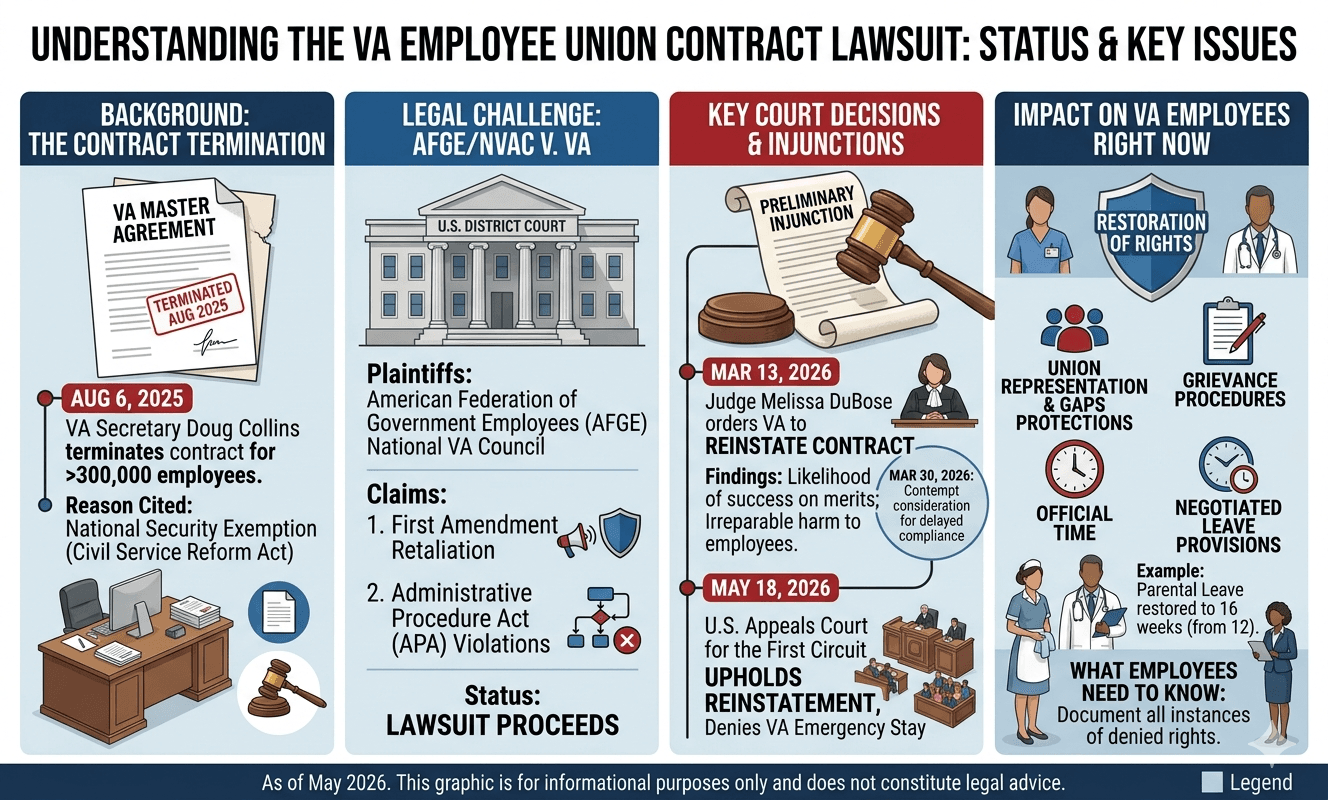
August 6, 2025: VA Secretary Doug Collins Terminates the Contract
VA Secretary Doug Collins, appointed by President Trump, issued a notice terminating the master collective bargaining agreement with AFGE/NVAC .
The stated reason? National security.
Under a March 2025 executive order from President Trump, the VA was reclassified as having a “national security” function, exempting it from federal labor laws that normally guarantee collective bargaining rights .
November 13, 2025: The “Rescission Order”
Earlier in 2025, Collins had suspended the executive order for several unions, including AFGE . That meant business as usual.
But on November 13, 2025, Collins rescinded that suspension. The union contract was dead .
The VA’s explanation? A vague statement about “having further considered” the law .
January-February 2026: AFGE Sues
AFGE filed a lawsuit arguing that terminating the contract was:
- Retaliatory (violating the First Amendment—punishing the union for speaking out)
- Arbitrary and capricious (violating the Administrative Procedure Act)
March 13, 2026: Judge DuBose Grants Preliminary Injunction
Judge DuBose ruled that AFGE was likely to win on both claims. She ordered the VA to immediately reinstate the contract .
Key line from her ruling:
“The Court is at a loss to understand how… the VA could possibly read the order to mean they do not have to comply.”
She also noted that the VA had no contemporaneous explanation for why national security suddenly required firing the union—eight months after the executive order was signed .
March 26, 2026: VA Re-Terminates (The “Blatant Disrespect” Move)
The night before a hearing on enforcing the March 13 order, the VA issued a new termination notice .
The VA’s lawyer told the judge this made the whole case “moot” .
The judge disagreed. Strongly.
March 27-31, 2026: Judge Orders Compliance, Threatens Contempt
Judge DuBose issued an enforcement order requiring the VA to comply with the contract “in both form and substance.” She ordered the VA to show cause why it should not be held in contempt .
May 18, 2026: Appeals Court Denies VA’s Stay Request
The First Circuit upheld the judge’s preliminary injunction. The contract stays in place while the appeal proceeds .
But: The appeals court partially granted the VA’s request on one narrow issue. The judge’s enforcement order that required processing of pending grievances? The appeals court said that part might go too far. But the core contract reinstatement? That stands .
What This Means Financially for VA Employees and Veterans
For VA Employees
- Back pay? Possibly. If the court ultimately rules that the termination was illegal, employees who lost benefits (like paid parental leave) could be entitled to retroactive compensation.
- Union dues: The VA tried to stop automatic dues deductions. The court order requires reinstatement .
- Job protections: Without the union contract, VA employees can be fired more easily and have less recourse. With it, they keep due process rights.
For Veterans
When VA employees lose protections, turnover spikes. When turnover spikes, your claims take longer.
A 2024 VA internal study found that facilities with active union contracts had 15-20% lower staff turnover than facilities without.
Lower turnover means:
- Faster claim processing
- Fewer appointment cancellations
- Continuity with your doctors and case managers
The bottom line: This lawsuit affects how fast you get your benefits.
The Political Context: Why Is This Happening?
The 2025 Trump Executive Order
In March 2025, President Trump issued Executive Order 14,251, which reclassified over 20 federal agencies—including the VA—as having “national security” functions .
Under the 1978 Federal Service Labor-Management Relations Statute, agencies with primarily national security missions are exempt from collective bargaining requirements.
The executive order was a major expansion of that exemption. Past presidents of both parties had kept the exemption narrow. Trump blew it wide open.
The “Retaliation” Claim
AFGE argues the termination was not really about national security. It was punishment for the union speaking out against the administration’s labor policies .
Judge DuBose agreed. She found that the VA had no explanation for why the contract was fine for eight months—until suddenly it wasn’t .
What Happens Next
The legality of Trump’s executive order is still being fought in two different appeals courts: the Ninth Circuit and the D.C. Circuit .
A Ninth Circuit ruling in February 2026 actually sided with the administration on one case, finding the termination was not retaliatory . That creates a circuit split—different courts disagreeing. That often sets up a Supreme Court fight.
Timeline: Final rulings could take another 6-12 months. Supreme Court review could add another year.
Common Mistakes Employees and Veterans Make
Mistake 1: Assuming the Union Contract Is Permanently Dead
It is not. The court orders have reinstated it. If you are a VA employee and your manager tells you “the union no longer exists,” that statement is currently false under the preliminary injunction.
Mistake 2: Not Filing Grievances
The VA has tried to argue that employees must file grievances through the union contract—even as the VA refuses to participate in those grievances .
What to do: File anyway. Create the paper trail. If the VA ignores your grievance, that is more evidence for the lawsuit.
Mistake 3: Veterans Assuming This Doesn’t Affect Them
It does. Longer waits, higher turnover, slower claims. Pay attention to this lawsuit. It will impact how fast you get care.
Mistake 4: Believing Scam “VA Union Representatives”
Scammers may call VA employees pretending to be union reps offering “special deals” or asking for fees. Real union reps will never ask for money over the phone. Verify by calling your local AFGE chapter directly.
What This Means in Real Life
For the Nurse at the VA Hospital
Before the contract was terminated, you had:
- A union representative if you faced discipline
- Paid parental leave
- A grievance process if managers violated your rights
After termination, all of that disappeared overnight.
Right now, under the court order, those protections are back. But the VA is fighting it. Every day is uncertain.
For the Veteran Waiting on a Claim
The claims processor handling your file may be distracted, demoralized, or job-hunting because their workplace rights just got yanked away.
That is not their fault. That is the result of a political fight happening above their pay grade.
For the Family Member of a VA Employee
If your spouse works at the VA, you need to know: their job security is currently in legal limbo. The union contract exists on paper but the VA is trying everything to ignore it. Have a backup plan.
Frequently Asked Questions
1. What is the VA union contract lawsuit about?
The VA, under Secretary Doug Collins, terminated the collective bargaining agreement with AFGE/NVAC covering 320,000 employees. The union sued, arguing the termination was illegal retaliation and arbitrary. A judge ordered the contract reinstated. The VA appealed and tried to terminate it again.
2. Who won the latest court ruling?
The union won. On May 18, 2026, the First Circuit Court of Appeals denied the VA’s request to stay the judge’s order, keeping the union contract in place.
3. Is the VA in contempt of court?
Not yet. Judge DuBose ordered the VA to show cause why it should not be held in contempt for re-terminating the contract after her order. A hearing was scheduled for early April 2026. The status of that contempt proceeding is ongoing.
4. What does this mean for my VA benefits?
Potentially slower processing. When VA employees lose workplace protections, turnover increases. Higher turnover means longer waits for claims and appointments.
5. What is AFGE?
The American Federation of Government Employees. It is the largest federal employee union, representing 820,000 workers across the government. The AFGE National VA Council specifically represents VA employees.
6. Can the VA really use “national security” to fire the union?
That is the central legal question. The Trump administration says yes—the VA is now a national security agency. The union says no—that is a pretext to punish workers. The courts are still deciding.
7. When will this be fully resolved?
Likely not until 2027 or 2028. The case is still in preliminary injunction stage. Appeals to the First Circuit are underway. The losing side will likely petition the Supreme Court.
8. I am a VA employee. Do I still have union rights?
Under the current court order, yes. The VA is required to recognize the union and follow the contract “in both form and substance.” But the VA has resisted compliance. Contact your local AFGE steward for specific guidance.
Final Takeaway
The VA tried to fire its union. Twice. A federal judge called it “blatant disrespect for the rule of law.” An appeals court just told the VA it probably cannot win.
But the fight is not over. The VA is appealing. The executive order behind all of this is being fought in multiple courts. And veterans are caught in the middle—waiting longer for benefits while the people who process their claims fight for basic workplace rights.
What you can do today:
- If you are a VA employee: Contact your local AFGE steward. Know your rights under the current court order. Document everything.
- If you are a veteran: Pay attention to this case. Call your congressional representative and ask: “What are you doing to ensure VA employees have stable workplace rights so my claims get processed faster?”
- If you are a family member: Understand that VA employees are under enormous stress right now. Their job security is being litigated in real time. Be patient with them.
No one wins when the VA fights its own workers. The only losers are the veterans waiting for care.
The Details of the Court’s Ruling
The recent court ruling regarding the Department of Veterans Affairs (VA) union contract has brought significant attention to labor relations within the agency. The court’s decision, which was the culmination of an extensive legal battle, highlighted several critical findings about the VA’s treatment of its union representatives and employees. The presiding judge underscored the importance of respecting collective bargaining processes as mandated by federal law, deeming the VA’s conduct as dismissive of established labor protocols.
During the proceedings, both sides presented compelling arguments. The VA defended its actions by stating that they were necessary to facilitate operational efficiency. However, the union representatives countered by emphasizing the legal and ethical obligations of the VA to engage in meaningful dialogue with employees. They argued that the VA’s approach undermined the principles of cooperation essential to effective labor relations.
The judge’s findings were particularly noteworthy, as they included specific examples of the VA’s failure to provide adequate notice and opportunity for union consultation before implementing changes that directly affected workers. This lack of communication was deemed by the court as a breach of the contract and a violation of the National Labor Relations Act. The ruling not only set a precedent for the VA but also served as a warning to other federal agencies regarding their obligations to uphold union contracts diligently.
The implications of this ruling are manifold. First, the decision reinforces the need for transparency and accountability within the VA, particularly as it relates to labor negotiations. Second, it may lead to renewed calls for the VA to enhance its relationships with unions to ensure compliance with both contractual and legal expectations. Ultimately, this pivotal ruling serves as a reminder of the ongoing tension between federal agencies and labor organizations in promoting the rights of workers.
The Significance of the Appeals Court’s Decision
The recent decision by the appeals court regarding the VA union contract lawsuit holds substantial significance for both employees of the VA and union representation within federal agencies. This landmark ruling reflects a growing awareness of the rights of federal employees and emphasizes their entitlements in negotiations and workplace relations.
The appeals court’s decision serves as a critical reminder of the importance of fair treatment and due process in employee relations. For VA employees, the outcome enhances their sense of security and empowers them to advocate for their rights without fear of retaliation or disregard from the management. This ruling reinforces the necessity for governmental bodies to adhere strictly to labor laws and respect the established processes of collective bargaining.
Furthermore, this decision could signal a pivotal shift in how the federal government approaches relationships with its workforce. By emphasizing the importance of honoring union agreements and protecting employee rights, the court’s ruling encourages a more collaborative environment between government agencies and their workers. It suggests a movement towards greater accountability and transparency in the dealings of the VA with its employees, potentially leading to improved working conditions and better employee morale.
This landmark ruling is not just an isolated event; it may pave the way for similar decisions that impact various federal agencies, thereby creating a unified stance on employee rights throughout the government. As legal precedents are set, they offer a framework for future debates and disputes in labor relations, illustrating a growing trend of judicial support for employee rights in the face of administrative resistance.
Judge’s Warning to the VA: Contempt Fines Explained
The recent legal proceedings involving the Department of Veterans Affairs (VA) have underscored critical issues regarding compliance with court orders. The presiding judge issued a stern warning to the VA, indicating that failure to adhere to rulings could result in contempt charges. Contempt of court represents a situation wherein a party disobeys a legal mandate, thereby undermining the authority of the judiciary. This warning serves as a crucial reminder of the legal obligations that government agencies such as the VA must uphold.
When the court exercises contempt power, it typically involves imposing fines or penalties to ensure compliance. The nature of these fines can vary, but they are generally designed to compel the offending party to align with court orders and restore respect for the judiciary. The implications of contempt charges could be particularly damaging for the VA, as they further perpetuate the narrative of disregard for veterans’ rights and the rule of law. Moreover, the resulting reputational harm could lead to heightened scrutiny from both the public and lawmakers.
The judge’s warning reflects frustration over a pattern of noncompliance by the VA, prompting concerns that further infractions may lead to harsher consequences. If the VA continues to disregard court directives, the potential for escalating penalties grows significantly. This situation underscores the importance of transparency and accountability within federal agencies, especially ones that serve vulnerable populations such as veterans.
Ultimately, the court is emphasizing the necessity for the VA to respect judicial oversight and fulfill its legal obligations. The looming threat of contempt charges and associated fines intends to reinforce the message that noncompliance will not be tolerated. This case serves as an essential reminder that the rule of law must prevail, especially in institutions tasked with serving the nation’s heroes.
Reactions from the American Federation of Government Employees (AFGE)
The American Federation of Government Employees (AFGE), which represents approximately 700,000 federal and D.C. government workers, has expressed its thoughts following the recent court ruling in the VA union contract lawsuit. The AFGE sees this decision as a significant victory for federal employees, particularly in the context of their rights and labor conditions. Their response underscores the importance of upholding collective bargaining principles that protect workers’ rights in federal employment, especially within the Department of Veterans Affairs.
AFGE National President Everett Kelley emphasized that the ruling sends a powerful message regarding the need for fair treatment of workers. He articulated that the court’s decision not only highlights the Bureau’s failure in adhering to labor laws but also reinforces the importance of union representation in safeguarding employee rights. Kelley further remarked that this outcome resonates with the AFGE’s ongoing commitment to advocating for better working conditions and decent pay for its members.
The AFGE plans to leverage this ruling in future negotiations to ensure that federal employees are treated with respect, dignity, and fairness. The union aims to use this development as a catalyst for enhancing engagement with its members, fostering a greater understanding of their rights and protections under federal labor laws. Additionally, they intend to mobilize support amongst workers to amplify their voices in call for improved workplace practices and adherence to collective bargaining agreements.
As the AFGE prepares to move forward, they are committed to working collaboratively with other stakeholders and unions to ensure that this ruling translates into tangible improvements for their members. The union’s determination to hold the VA accountable for its actions reflects a broader strategy to ensure that federal employees do not face unjust treatment, promoting a more respectful and fair work environment across the federal workforce.
Implications for the Trump Administration
The recent ruling in the VA union contract lawsuit has intricate implications for the Trump administration, particularly concerning its approach to labor policies and the management of the federal workforce. This landmark decision underscores a critical judicial rebuke to the administration’s prior strategies, which aimed at limiting the influence of unions within federal agencies. Experts suggest that the court’s findings could play a pivotal role in shaping the future trajectory of labor relations under federal jurisdiction.
One of the immediate implications is the potential for shifting legislative agendas. The ruling may embolden proponents of workers’ rights, advocating for enhanced protections and benefits for federal employees. Consequently, the administration might experience pressure to recalibrate its labor strategies to align with the judicial expectations expressed in this ruling. This recalibration could manifest in strategic negotiations with federal unions, altering the dynamics of collective bargaining agreements.
Additionally, the ruling may serve as a catalyst for future litigation concerning labor rights in the federal sector. Legal experts predict that unions, now emboldened by this decision, might initiate further lawsuits, targeting other policies perceived as restrictive or detrimental to union representation. Such developments could lead to a more contentious legal landscape for the Trump administration as it navigates these challenges.
Furthermore, the implications could extend beyond internal labor relations, affecting public perception of the administration’s commitment to workers’ rights and fair labor practices. As a consequence, the Trump administration may be compelled to undertake a more conciliatory approach towards unions to mitigate the backlash from both public and political spheres. This ruling serves as a reminder of the importance of adherence to labor laws and the necessity for federal agencies to respect the collective rights of their workforce, shaping potential future strategies in federal workforce management.
The Broader Impacts on Federal Employee Rights
The recent ruling regarding the VA’s union contract lawsuit carries significant implications not only for employees within the Department of Veterans Affairs, but also for federal employees across various sectors. This landmark decision highlights the importance of upholding labor rights, including the right to collective bargaining, which is foundational in federal employment relations. The ruling signals to all federal agencies that disregard for union contracts and employee rights will not be tolerated, thereby reinforcing the legal stature of unions within the federal workforce.
As unions assess their strategies moving forward, they may see an opportunity to strengthen their positions in negotiations with management. With this ruling as a precedent, federal employee unions may be more emboldened to challenge non-compliant practices and advocate for fair working conditions. This ruling may also encourage the formation of new unions, or the revitalization of existing ones, as employees recognize the necessity of collective action to safeguard their rights in a national landscape marked by fluctuating job security and economic conditions.
The broader landscape of federal employment relations is therefore likely to witness a renewed focus on contractors, accountability, and employee engagement. As unions adapt to this new reality, the strategies they employ may include increased transparency in negotiations, outreach programs to educate employees about their rights, and collaborative initiatives aimed at bridging gaps between management and labor. Furthermore, this case serves as a reminder that federal employment relations are intricately tied to political dynamics, making it vital for unions to engage not only with agency managers but also with lawmakers who shape labor policy.
Next Steps for the VA and the AFGE
The recent court ruling represents a significant turning point for the Department of Veterans Affairs (VA) and the American Federation of Government Employees (AFGE). Following the court’s decision, it is imperative for both parties to carefully consider the implications of this ruling and the subsequent actions they must undertake to address the findings presented.
One of the immediate next steps for the VA will likely involve reevaluating its current union contracts with the AFGE. This may include negotiations centered on compliance with the court’s directives. Open dialogue will be essential as both the VA and the union work to establish terms that honor the legal expectations set forth by the court while ensuring that the rights and interests of VA employees are respected.
Moreover, the AFGE may seek to leverage this ruling to advocate for comprehensive changes within the VA. This could manifest in a push for improvements in labor relations and enhanced protections for workers, based on the court’s findings regarding how employees have been treated. Considering the attention the court has drawn to the issue, the AFGE stands positioned to negotiate more equitable terms in future contracts.
In terms of strategy, the VA will need to prioritize compliance mechanisms which ensure adherence to newly established norms stemming from this lawsuit. This could entail setting up internal review procedures, training sessions for management on union relations, and establishing more transparent channels of communication with AFGE representatives.
Ultimately, both the VA and the AFGE must focus on fostering a collaborative environment that not only rectifies past issues but also paves the way forward for sustainable labor relations, ensuring the well-being of employees, and maintaining a workforce that is engaged and motivated to serve veterans effectively.
Conclusion: The Continuing Fight for Employee Rights
The recent ruling in the VA union contract lawsuit has underscored the ongoing struggle for employee rights within the federal sector. This decision serves as a critical reminder of the significance of union representation and the essential role it plays in safeguarding the rights and interests of workers. In an environment where federal employees often feel undervalued, this court ruling highlights the necessity for accountability in government employment practices and emphasizes the need for fair treatment of all workers.
The outcome reflects broader systemic issues, underscoring a persistent pattern of disregard for employee rights within federally affiliated organizations. Unions serve as vital advocates, working diligently to ensure that the voices of employees are heard and respected. By standing together, workers can push back against injustices and advocate for better working conditions, fair pay, and respect in the workplace.
Moreover, this legal battle illustrates that the journey towards achieving meaningful labor rights is far from complete. Policymakers and employers must recognize the critical role that unions play and strive to foster an environment conducive to collaboration, rather than conflict. Continuous dialogue and negotiation are necessary to address worker grievances effectively and strengthen their rights.
The fight for employee rights in the federal sector is emblematic of a larger movement taking place across various industries. As more workers come together to voice their concerns and demand justice, the lessons learned from this lawsuit can galvanize future efforts. It is crucial that all stakeholders—employers, policymakers, and unions—commit to upholding the principles of fairness and equity, promoting a workplace culture that honors and respects the contributions of every employee.


🇺🇸 IMPORTANT DISCLAIMER – Veterans Benefits Information
This site provides general information about U.S. Department of Veterans Affairs (VA) benefits for educational and informational purposes only.
- Not Official: We are NOT affiliated with, endorsed by, or connected to the U.S. Department of Veterans Affairs (VA), the Veterans Benefits Administration (VBA), the Veterans Health Administration (VHA), or any other government agency.
- No Legal/Financial Advice: The content on this website is for informational purposes only and does not constitute legal, financial, or medical advice. VA benefits rules change frequently – always consult with an accredited Veterans Service Officer (VSO) or a qualified professional for your specific situation.
- Official Sources: For official, binding information and to apply for benefits, always visit official .gov websites: VA.gov, Benefits.VA.gov, or SSA.gov.
- No Data Collection: This site does not collect, store, or process any personal information. It does not have login forms, contact forms, or any system to capture user data. We never ask for your Social Security Number, bank details, or any personal information.
- 🚨 Scam Alert: The VA and other government agencies never charge fees for benefit applications. If anyone asks for money to "process" your VA claim, it is a scam. Report it to the VA Office of Inspector General at VA.gov/OIG.
- Advertising: This site uses third-party advertising (Adsterra) to cover operational costs. We do not endorse or guarantee any products or services advertised.
📌 Information provided as of June 2026. Always verify current eligibility and rules with official .gov sources.
This site is not affiliated with the U.S. Department of Veterans Affairs or any government agency. All information is for educational purposes only. Please visit VA.gov for official information.
