
Veterans Benefits Evaluations: What to Expect and How to Prepare
A Veterans benefits evaluation — called a Compensation and Pension (C&P) exam or VA claim exam — is a medical evaluation ordered by the VA to confirm service connection and assess the severity of your claimed condition. The exam typically lasts 15–20 minutes but can range from 5 minutes to several hours. Most exams are conducted by third-party contractors, not VA staff.
Quick Facts
| Item | Details |
|---|---|
| Benefit | Medical evaluation used to determine VA disability rating and compensation |
| Eligibility | Veterans who have filed a VA disability claim or appeal |
| Application | VA schedules the exam automatically after you file VA Form 21-526EZ |
| Processing Time | Exam itself: 15 minutes to 4 hours; full claim: 125–180 days average |
| Official Agency | U.S. Department of Veterans Affairs (VA) |
| Required Forms | VA Form 21-526EZ (claim); DBQ forms completed by examiner |
| Updated For | 2026 exam procedures and contractor information |
What Is a Veterans Benefits Evaluation?
A Veterans benefits evaluation — commonly called a C&P exam or VA claim exam — is a medical examination ordered by the Department of Veterans Affairs to evaluate the condition(s) you claimed for disability compensation. It is not a treatment appointment. The examiner will not prescribe medications, offer treatment recommendations, or provide ongoing care. Their sole purpose is to evaluate and document your condition for rating purposes.

The VA uses these exams to accomplish several objectives:
Confirm your medical diagnosis.
Establish service connection by drawing a connection between your military service and your disability.
Evaluate how severely your condition affects your day-to-day functioning.
Determine what percentage rating would be appropriate based on your level of impairment.

Not every veteran who files a claim will need a C&P exam. If you have submitted sufficient medical evidence through the Acceptable Clinical Evidence (ACE) process, the VA may decide your claim based on existing records alone. However, most claims — particularly those involving new conditions or requests for increased ratings — do require an examination.
Who Conducts C&P Exams in 2026?
Approximately 93% of C&P exams are now conducted by third-party contractors rather than VA staff. The VA currently contracts with four primary companies:
| Contractor | Customer Service Number | Caller ID |
|---|---|---|
| Leidos QTC Health Services | 800-682-9701 | VA EXAM-QTC |
| Veterans Evaluation Services (VES) | 877-637-8387 | VA EXAM-VES |
| OptumServe Health Services | 866-933-8387 | VA EXAM-Optum |
| Loyal Source Government Services | 833-832-7077 | Loyal Source |
Source: usmilitary.org, 2026
Contract examiners are required to follow the same training and certification standards as VA providers. The examiner assigned to your case is not always a physician — nurse practitioners and physician assistants are also authorized to conduct these evaluations. For specialized exams such as audiology or mental health conditions, you will see a provider with specific expertise in that area.
Veterans May Qualify for Extra Benefits
Check available financial assistance, healthcare programs and other opportunities that may apply to you.
Check EligibilityYou cannot request a specific contractor — the VA assigns contractors based on location and availability. However, you can request a male or female provider for reproductive health exams, breast exams, rectal exams, mental health exams, or claims related to Military Sexual Trauma (MST).
What to Expect During a C&P Exam
The C&P exam experience varies widely depending on the condition being evaluated. Here is what typically happens:
The examiner reviews your file. Before the exam, the examiner will review your claims file (C-file) to familiarize themselves with your claim. However, they will likely not be as fully informed as your own physicians. Be prepared to explain your condition in detail.
The examiner asks questions. You will be asked about your symptoms, how frequently they occur, and how they affect your daily functioning, including work, sleep, relationships, and social activities.
The examiner performs a limited physical exam or observation. For physical conditions, the examiner may measure range of motion, test strength, or observe your gait and movement. For mental health conditions, the examiner observes your behavior and asks about your symptoms.
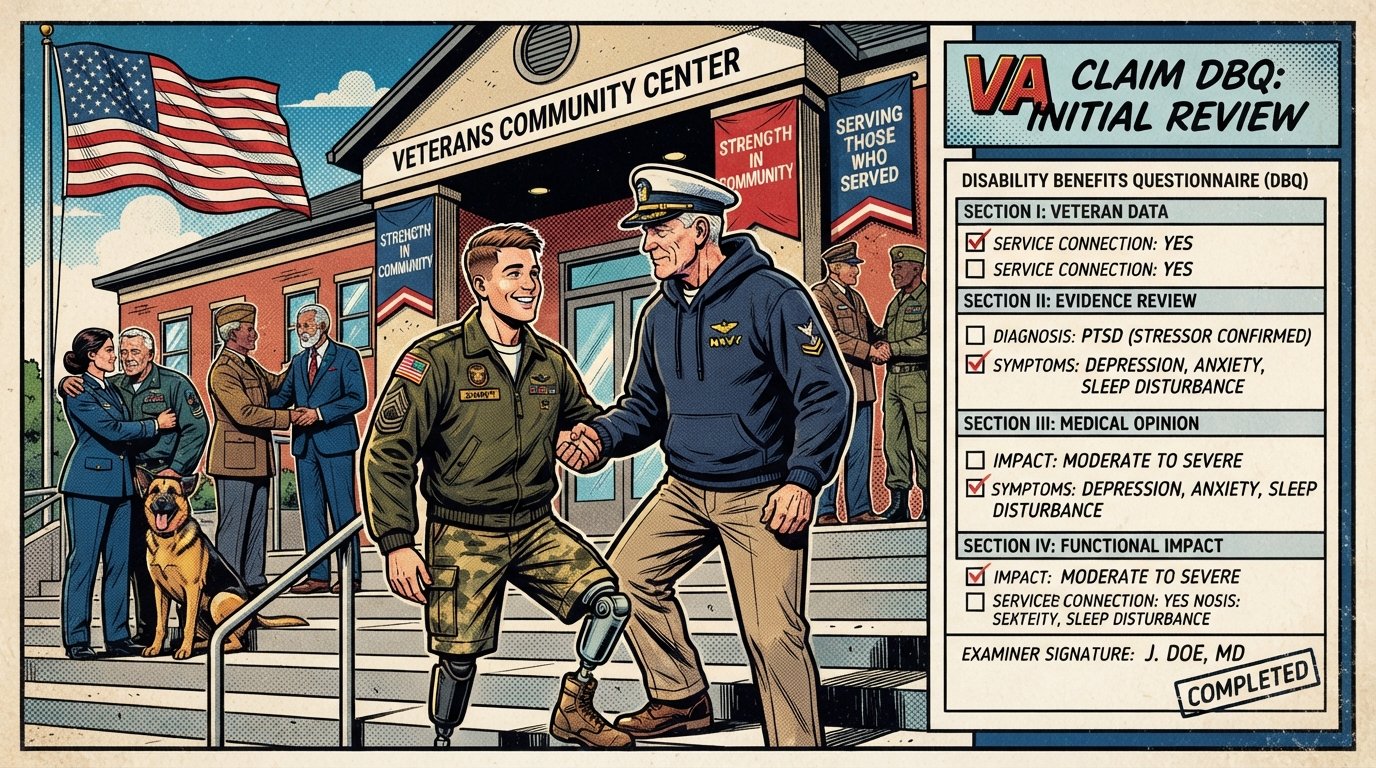
The examiner completes a Disability Benefits Questionnaire (DBQ). The DBQ is a standardized form that records the findings the VA needs to rate your condition. It is a check-the-box style series of questions aimed at evaluating your specific condition.
The examiner submits the report to the VA. After the exam, the examiner writes up a report that includes a review of the exam findings, any clinical test results, and their professional opinion as to whether the disability is related to your service.
How Long Does a C&P Exam Take?
| Exam Type | Typical Duration |
|---|---|
| General physical exam | 15–20 minutes |
| Mental health evaluation | 2–4 hours |
| Audiology exam | 30–60 minutes |
| Range of motion/joint exam | 15–30 minutes |
Source: VA.gov and CCK Law, 2026
The exam itself usually lasts about 15–20 minutes but can range from 5 minutes to several hours. Mental health evaluations typically last two to four hours.
What to Bring to Your C&P Exam
You should bring your identification, a list of your symptoms, and any assistive devices you use. While the examiner cannot submit new evidence to your claims file on your behalf, bringing these items helps you communicate your condition clearly.
Items to Bring
| Item | Why It Helps |
|---|---|
| Photo ID | Required for check-in |
| DD-214 | Verifies service dates and character of discharge |
| Symptom log or notes | Keeps you organized; ensures you describe frequency, severity, and impact |
| Private medical records | Especially if treatment has been outside the VA system |
| Assistive devices | Braces, canes, crutches, hearing aids — the examiner can observe their use |
| Lay statements | Written statements from family or friends about how your condition affects you |
| List of current medications | Including dosages and frequency |
Source: CCK Law and VA.gov, 2026
Important: Submit all your medical evidence with your claim application or to a VA regional office before you go to your exam. The examiner cannot submit new information to be added to your claim file on your behalf.
How to Prepare for a C&P Exam: Step-by-Step Checklist
Preparation is the single most effective tool for a successful C&P exam. Veterans who prepare consistently report better exam experiences and more accurate ratings.
1–2 Weeks Before the Exam
Review your medical records and the specific DBQ for your condition. DBQs are available on VA’s website. Understanding what the examiner will be looking for helps you provide relevant information.
Create a written symptom log. Track your symptoms for at least 2–4 weeks before your exam. Document frequency, severity, triggers, and how symptoms impact specific daily activities.
Write a one-to-two page symptom summary. Include your diagnosis, your worst symptoms, and how they affect your daily life including work, sleep, and family responsibilities.
Document your worst days. The VA rates you based on how your condition affects you on your worst days, not your best. Describe the frequency and severity of flare-ups.
Day of the Exam
Arrive 15 minutes early. Being punctual shows responsibility and gives you time to settle in.
Wear comfortable clothing that allows you to move freely, especially for joint or range of motion exams.
Bring a trusted observer. You are generally permitted to bring one person — a family member, friend, or advocate — to observe the C&P exam.
Be honest and specific. Don’t downplay or exaggerate your symptoms. Describe what your average week looks like, not just your best or worst day.
Stick to the condition being examined. If the exam is for back pain, don’t bring up a new condition. Keep your answers focused and concise — around 20 seconds or less per answer.
After the Exam
Write down everything you remember about the experience immediately after your appointment.
Request a copy of your exam report. You can request it through your VA.gov account or by filing a FOIA request. Review it for accuracy. If you spot inaccuracies, you have clear options to challenge the findings.
Preparing for Different Types of C&P Exams
Different conditions require different preparation strategies. The DBQ for your condition tells you exactly what the examiner will evaluate.
Mental Health C&P Exam (PTSD, Anxiety, Depression)
A mental health C&P exam is a structured interview that evaluates how your condition affects your occupational and social functioning. The examiner will ask about your symptoms, relationships, work history, social activities, sleep, anger, anxiety, suicidal thoughts, substance use, and daily routine.
How to prepare:
Review the rating criteria for your condition. Know what 50% vs. 70% looks like for PTSD.
Document specific examples of how your condition affects your ability to work and maintain relationships.
Be honest about the frequency and severity of symptoms. Don’t minimize your struggles because you “don’t want to complain.”
Bring notes about your symptoms to ensure you are complete and accurate in your descriptions.
Important: If your claim is related to Military Sexual Trauma (MST), the law permits you to choose the sex of your examiner.
Musculoskeletal Exam (Back, Knee, Shoulder)
Musculoskeletal conditions are rated primarily based on range of motion. The examiner uses a goniometer — a specialized protractor — to measure how far your joint can bend or flex. The less range of motion you have, the higher your rating is likely to be.
How to prepare:
Stop moving when you feel pain — not when movement becomes impossible. The VA is required to consider painful motion, and you should not push through pain just to show you can. Under 38 CFR § 4.59, if you experience pain during joint movement, the VA must assign at least the minimum compensable rating for that joint.
Ensure the examiner uses a goniometer. A goniometer is mandatory for joint exams. If the examiner does not use one, the exam may be inadequate for rating purposes.
Document flare-ups. If your condition causes flare-ups that limit your range of motion beyond what the examiner observes, document these episodes. The VA must consider flare-ups in its rating decision.
Audiology Exam (Hearing Loss, Tinnitus)
Hearing loss and tinnitus exams typically involve a hearing test performed in a soundproof booth. The examiner will test your ability to hear different frequencies and volumes.
How to prepare:
Avoid loud noises for 24 hours before the exam. Exposure to loud sounds can temporarily affect your hearing test results.
Bring any hearing aids or assistive devices you use. The examiner will want to know if you use them and how often.
Be specific about tinnitus. Describe whether it affects one ear, both ears, or your head, and how frequently it occurs.
Telehealth C&P Exams: What Conditions Qualify?
Telehealth exams are available for certain conditions, particularly mental health evaluations. In 2026, the VA and its contracted providers increasingly offer telehealth or video consultation options for conditions that can be adequately assessed through interview without a physical exam.
Conditions That May Qualify for Telehealth
| Condition Category | Examples |
|---|---|
| Mental health | PTSD, anxiety, depression (initial PTSD exams require VA examiner) |
| Hypertension | Hypertension DBQ |
| Ear conditions | Vestibular and infectious ear conditions |
| Loss of sense of smell/taste | Anosmia, dysgeusia |
| Sinusitis and rhinitis | Chronic sinusitis, allergic rhinitis |
| Migraine headaches | Both diagnosis and severity based on reported history |
Source: VA vendor portal and telehealth guidance, 2026
How to request a telehealth exam: If you prefer a telehealth exam for a qualifying condition, contact the contractor who scheduled your appointment and ask if your condition is eligible. A telehealth exam is appropriate when the diagnosis and severity can be fully and adequately assessed through a live telehealth interview without the need for an in-person physical examination.
Common Mistakes Veterans Make at C&P Exams
Avoiding these errors can protect your rating and ensure the examiner gets an accurate picture of your condition.
Missing your exam without rescheduling. Missing your C&P exam without a valid reason can seriously hurt your claim, often leading to denial. If you cannot make the appointment, contact the contractor immediately to reschedule.
Downplaying your symptoms. Many veterans are trained to “suck it up” and push through pain. This mindset can be your biggest enemy in a C&P exam. Downplaying your pain or saying “I’m fine” when you’re not can lead to a denial or a lower rating than you deserve.
Exaggerating your symptoms. Some veterans unintentionally exaggerate their symptoms, which may lead the examiner to include a note that the veteran is “malingering.” This damages credibility.
Staying silent. Many veterans believe their comments won’t affect the outcome, but the VA heavily weighs the examiner’s opinions. This is your chance to share your story and explain your condition.
Assuming the examiner reviewed your file thoroughly. Examiners often review files quickly. Be prepared to explain your condition in detail again.
Not bringing notes or a symptom log. Relying on memory can cause you to forget key details about frequency, severity, and functional impact.
Bringing up unrelated conditions. Stick to the condition being examined. Introducing new issues distracts from the exam’s purpose.
Not requesting a copy of the exam report. You have the right to review the examiner’s findings. If there are inaccuracies, you can challenge them through the appeals process.
What Happens After the C&P Exam?
After your exam, the examiner uploads their report (DBQ) to your VA claims file. The VA then reviews all evidence — including your exam results, service records, private medical records, and lay statements — to make a rating decision.
The examiner is only involved in performing the exam. They do not make the rating decision. A VA Rating Veterans Service Representative (RVSR) analyzes the entire claim file to determine whether your condition is service-connected and what rating to assign. Following the determination, VA generates a notification letter describing the claim decision.
Timeline After Exam
| Step | Timeframe |
|---|---|
| Exam report uploaded to claims file | 1–2 weeks |
| VA rating decision | 125–180 days from claim filing |
| Decision letter mailed | Immediately after decision |
| Back pay deposited (if approved) | Within 15 days of decision |
Source: VA.gov, 2026
VA aims to process a claim from beginning to end in 125 days or less, though complex claims can take longer. Each claim is different, but it usually takes 3 to 4 months to process a claim from start to finish.
When Does the VA Schedule Re-Examinations?
The VA may schedule a re-examination (also called a review exam) to verify the continued existence or current severity of a disability. Generally, re-examinations will be required if it is likely that a disability has improved, if evidence indicates a material change in a disability, or if the current rating may be incorrect.
When Re-Examinations Are NOT Scheduled
Under 38 CFR § 3.327, the VA will not schedule periodic re-examinations in the following cases:
The disability is established as static (unlikely to improve).
The findings and symptoms have persisted without material improvement for 5 years or more.
The disability is permanent in character with no likelihood of improvement.
The veteran is over 55 years of age, except under unusual circumstances.
The rating is a prescribed scheduled minimum rating.
A combined disability evaluation would not be affected if the future examination resulted in a reduced evaluation for one or more conditions.
When Re-Examinations Are Typically Scheduled
| Trigger | Timeframe |
|---|---|
| Prestabilization rating | Within 6 months of separation |
| Initial rating where improvement is likely | 2–5 years from decision date |
| Material change in disability | At any time |
| Hospitalization or surgery | 6–12 months after discharge or intervention |
Source: 38 CFR § 3.327 and VA OIG, 2026
How to Challenge an Inadequate C&P Exam
If you believe the C&P exam was inadequate or the examiner’s findings are inaccurate, you have options. You can request a copy of the exam report and challenge inaccurate findings through the appeals process.
Signs of an Inadequate C&P Exam
The examiner did not use a goniometer for a joint exam.
The examiner missed or rushed through the exam.
The examiner did not review your medical records.
The examiner used an incorrect legal standard (e.g., “not due to service” instead of “at least as likely as not”).
Symptoms were under-reported or mischaracterized in the report.
Steps to Challenge
Request a copy of your exam report through VA.gov or by filing a FOIA request.
Compare the report to your symptom log and medical records. Note any discrepancies.
File a Supplemental Claim (VA Form 20-0995) with new evidence, such as a DBQ completed by your own doctor. A DBQ from a private physician can counter an unfavorable C&P exam report.
Consider a Higher-Level Review (VA Form 20-0996) if you believe the VA made an error of fact or law based on the existing record.
File a Board Appeal (VA Form 10182) if you want a Veterans Law Judge to decide.
Common Questions
What is a C&P exam, and why does the VA order one?
A C&P exam is a medical evaluation ordered by the VA to confirm service connection and assess the severity of your claimed condition. The VA uses it to gather evidence needed to assign a disability rating. Not every claim requires an exam — the VA may decide based on existing records if sufficient.
How long does a C&P exam last?
General physical exams typically last 15–20 minutes. Mental health evaluations last 2–4 hours. Audiology exams take 30–60 minutes. The duration depends on the condition and how much information the VA needs.
Can I bring someone with me to my C&P exam?
Yes, you are generally permitted to bring one person — a family member, friend, or advocate — to observe the exam. For sensitive issues, the VA may limit who can be present. A trusted observer can take notes and help you recall details afterward.
What should I wear to a C&P exam?
Wear comfortable clothing that allows you to move freely, especially for joint or range of motion exams. Avoid tight clothing that restricts movement. Arrive 15 minutes early to allow time for check-in.
Can I choose the sex of my C&P examiner?
You can request the specific sex of your medical provider for gynecological, breast, anal/rectal, and mental health examinations. If your claim is related to Military Sexual Trauma, the law permits you to choose the sex of your examiner.
What happens if I miss my C&P exam?
Missing your exam without a valid reason can lead to denial of your claim. If you cannot attend, contact the contractor immediately to reschedule. VA policy generally allows one reschedule for good cause.
Can I get a copy of my C&P exam results?
Yes. You can request a copy through your VA.gov account or by filing a FOIA request. VHA C&P exam reports are not available until 20 business days after completion. An accredited VSO can sometimes download a copy faster through the Veterans Benefits Management System.
What is a DBQ, and how does it relate to my C&P exam?
A DBQ (Disability Benefits Questionnaire) is a standardized VA form that records the examiner’s findings. During a C&P exam, the examiner completes a DBQ. You can also have your own private doctor complete a DBQ and submit it as evidence.
Can I request a telehealth C&P exam?
Telehealth exams are available for certain conditions, particularly mental health evaluations, hypertension, sinusitis, rhinitis, and migraines. Contact the contractor who scheduled your appointment to ask if your condition qualifies.
What if I disagree with the C&P examiner’s findings?
Request a copy of the exam report, compare it to your medical records, and file a Supplemental Claim with a DBQ from your own doctor. You can also request a Higher-Level Review if the VA made an error based on the existing record.
Does the VA re-examine all disabilities?
No. The VA does not schedule periodic re-examinations for static disabilities, conditions that have persisted without improvement for 5+ years, permanent disabilities, or for veterans over 55. Re-exams are scheduled when improvement is likely or when evidence indicates a material change.
Key Takeaways
A C&P exam is a medical evaluation, not a treatment appointment — the examiner evaluates but does not treat.
Approximately 93% of C&P exams are conducted by third-party contractors, not VA staff.
Bring a symptom log, private medical records, and assistive devices to your exam.
Prepare by reviewing the DBQ for your condition and documenting your worst days.
Be honest — don’t downplay or exaggerate your symptoms. Describe your average week, not your best day.
For joint exams, stop moving when you feel pain; the VA must consider painful motion under 38 CFR § 4.59.
You can bring a trusted observer and request a male or female provider for sensitive exams.
Telehealth exams are available for mental health, hypertension, sinusitis, and other qualifying conditions.
You can request a copy of your exam report and challenge inaccurate findings through the appeals process.
The VA does not re-examine static disabilities, permanent conditions, or ratings for veterans over 55.
Official Resources
VA Claim Exam: What to Expect — Official VA guidance on C&P exams.
VA Disability Compensation — VA disability benefits hub.
VA Form 21-526EZ — Application for Disability Compensation.
Disability Benefits Questionnaires (DBQs) — Download DBQ forms by condition.
38 CFR § 3.327 — Reexaminations — Official reexamination regulation.
Choosing a Decision Review Option — VA appeals guidance.
VA.gov — Official VA website.
Ask VA — Online inquiry portal.
VA Benefits Hotline — 1-800-827-1000.
My HealtheVet — Access your VA health records.



🇺🇸 IMPORTANT DISCLAIMER – Veterans Benefits Information
This site provides general information about U.S. Department of Veterans Affairs (VA) benefits for educational and informational purposes only.
- Not Official: We are NOT affiliated with, endorsed by, or connected to the U.S. Department of Veterans Affairs (VA), the Veterans Benefits Administration (VBA), the Veterans Health Administration (VHA), or any other government agency.
- No Legal/Financial Advice: The content on this website is for informational purposes only and does not constitute legal, financial, or medical advice. VA benefits rules change frequently – always consult with an accredited Veterans Service Officer (VSO) or a qualified professional for your specific situation.
- Official Sources: For official, binding information and to apply for benefits, always visit official .gov websites: VA.gov, Benefits.VA.gov, or SSA.gov.
- No Data Collection: This site does not collect, store, or process any personal information. It does not have login forms, contact forms, or any system to capture user data. We never ask for your Social Security Number, bank details, or any personal information.
- 🚨 Scam Alert: The VA and other government agencies never charge fees for benefit applications. If anyone asks for money to "process" your VA claim, it is a scam. Report it to the VA Office of Inspector General at VA.gov/OIG.
- Advertising: This site uses third-party advertising (Adsterra) to cover operational costs. We do not endorse or guarantee any products or services advertised.
📌 Information provided as of June 2026. Always verify current eligibility and rules with official .gov sources.
This site is not affiliated with the U.S. Department of Veterans Affairs or any government agency. All information is for educational purposes only. Please visit VA.gov for official information.
